- Base Value(2025): 158.4 Bn
- Estimated Value(2026): 168.5 Bn
- Forecast Value (2036): 313.4 Bn
- CAGR (2026 - 2036): 6.4%
Fortified Foods Market Forecast and Outlook By Fact.MR
In 2025, the fortified foods market was valued at USD 158.4 billion. Based on Fact MR analysis, demand for fortified foods is estimated to grow to USD 168.5 billion in 2026 and USD 313.4 billion by 2036. FMR projects a CAGR of 6.4% during the forecast period.
The absolute dollar growth from 2026 to 2036 is USD 144.9 billion. Expansion reflects steady development in nutrient enriched food categories rather than a structural shift in the broader food industry. Fortified foods are widely incorporated across dairy products, breakfast cereals, beverages, and packaged snacks to enhance vitamin and mineral content. Food manufacturers continue introducing formulations enriched with micronutrients such as vitamin D, iron, calcium, and folic acid to address nutritional deficiencies and support balanced diets. Growth pace remains moderated by regulatory approval requirements for nutrient fortification, cost pressures linked to ingredient sourcing, and labeling compliance across different food safety frameworks.
China leads with a projected CAGR of 8.4%, supported by expanding packaged food consumption and rising demand for nutrient enriched staple products. Germany follows with a CAGR of 8.0%, reflecting steady adoption of fortified cereals, dairy products, and functional beverages. The United States shows a CAGR of 7.4%, supported by widespread availability of vitamin enriched foods across large retail networks. Japan records a CAGR of 6.5%, driven by continued demand for fortified beverages and functional food products. India shows the slowest growth at 6.2%, reflecting gradual expansion of fortified packaged foods through organized retail channels. Mature food markets generate a significant share of replacement demand as product reformulation and regulatory standards shape nutrient fortification practices.
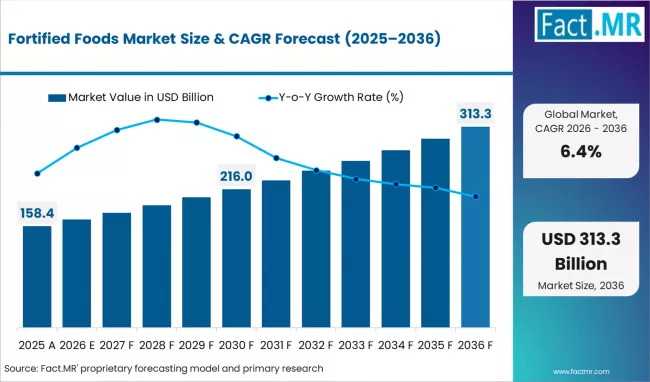
Fortified Foods Market Market Value Analysis | Source: Fact.MR
Fortified Foods Market
| Metric | Details |
|---|---|
| Industry Size (2026E) | USD 168.5 billion |
| Industry Value (2036F) | USD 313.4 billion |
| CAGR (2026 to 2036) | 6.4% |
Source: Fact.MR analysis. Updated Mar 17, 2026
Fortified Foods Market Definition
The Fortified Foods Market includes food products that have been enhanced with added vitamins, minerals, or other nutrients to improve their nutritional content. Fortification is carried out during food processing to address dietary nutrient gaps and support balanced nutrition. Common fortified foods include cereals, dairy products, beverages, bakery products, and infant nutrition items. Nutrients such as iron, calcium, vitamin D, iodine, and folic acid are frequently added. These products are consumed by general populations and specific groups seeking improved nutritional intake. The primary function of fortified foods is to provide essential nutrients through widely consumed everyday food products.
Market Inclusions
This report covers global and regional market sizes for fortified foods with forecast analysis for the study period. The market is segmented by product category including fortified cereals, dairy products, beverages, bakery items, and infant foods. Application segments include general nutrition, maternal and child nutrition, and functional food consumption. End users include food manufacturers, nutrition product companies, and institutional food supply programs. The report also evaluates pricing structures, production patterns, and selected trade flow analysis across major food manufacturing regions.
Market Exclusions
The report excludes dietary supplements sold in capsule, tablet, or powder form since they belong to the nutraceutical supplement category. Pharmaceutical vitamin products and medical nutrition formulations are also outside the defined scope. Fresh foods that naturally contain nutrients without added fortification are not included. The analysis does not cover agricultural nutrient enrichment practices used during crop cultivation, as the study focuses strictly on processed foods with added nutrients during manufacturing.
Research Methodology
- Primary Research: Interviews were conducted with food manufacturers, nutrition product developers, ingredient suppliers, and food distribution specialists.
- Desk Research: Public information was collected from food industry publications, government nutrition reports, company disclosures, and trade statistics.
- Market-Sizing and Forecasting: A hybrid model combining bottom up production analysis with top down consumption assessment across food manufacturing sectors was applied.
- Data Validation and Update Cycle: Findings were cross verified through multiple food industry sources and expert inputs, with periodic updates conducted as new production and trade data becomes available.
Summary of the Fortified Foods Market
- Market Definition
- The market comprises food products enriched with added vitamins, minerals, or other nutrients during manufacturing to improve nutritional value. Fortified foods include cereals, dairy products, beverages, bakery items, and staple foods such as flour, rice, milk, and edible oils. These products are consumed widely to address micronutrient deficiencies and support balanced dietary intake.
- Demand Drivers
- Government nutrition programs promoting fortification of staple foods such as flour, salt, milk, and edible oils.
- Rising consumer awareness regarding balanced nutrition and demand for foods enriched with essential vitamins and minerals.
- Expansion of packaged food categories incorporating micronutrients such as vitamin D, iron, calcium, and folic acid.
- Increasing availability of fortified food products through organized retail networks and large scale food distribution systems.
- Key Segments Analyzed
- Micronutrients: Vitamins account for about 45% share due to widespread fortification of cereals, dairy products, beverages, and staple foods.
- Application: Basic food represents roughly 35% share supported by fortification of staple items such as flour, rice, milk, salt, and edible oils.
- Raw Materials: Wheat flour, rice, milk, sugar, and edible oils serve as common carriers for micronutrient fortification.
- Geography: China records the fastest expansion supported by rising demand for nutrient enriched packaged foods and staple food fortification initiatives.
- Analyst Opinion at Fact MR
- Shambhu Nath Jha, Principal Consultant, Fact MR, opines, "In this updated edition of the Fortified Foods Market report, industry participants will observe that food fortification continues to serve as an effective method for addressing micronutrient deficiencies across populations. Manufacturers incorporate vitamins and minerals into widely consumed foods to improve nutritional intake through everyday diets. Companies with strong formulation expertise and distribution networks across staple food categories will maintain stable positions in the fortified food supply chain."
- Strategic Implications or Executive Takeaways
- Expand development of fortified staple foods including flour, rice, milk, and edible oils to support public nutrition programs.
- Strengthen research capabilities related to micronutrient stabilization and integration within processed food products.
- Maintain compliance with food safety regulations and nutrient labeling standards governing fortification practices.
- Develop fortified food formulations targeting specific nutrition needs across different population groups.
- Methodology
- Primary interviews conducted with food manufacturers, nutrition product developers, ingredient suppliers, and food distribution specialists.
- Desk research based on food industry publications, government nutrition reports, company disclosures, and international trade statistics.
- Market sizing developed through a hybrid approach combining bottom up production analysis and top down consumption assessment across food manufacturing sectors.
- Findings validated through multiple industry sources and expert consultations following Fact MR internal modeling standards.
Segmental Analysis
Fortified Foods Market Analysis by Micronutrients
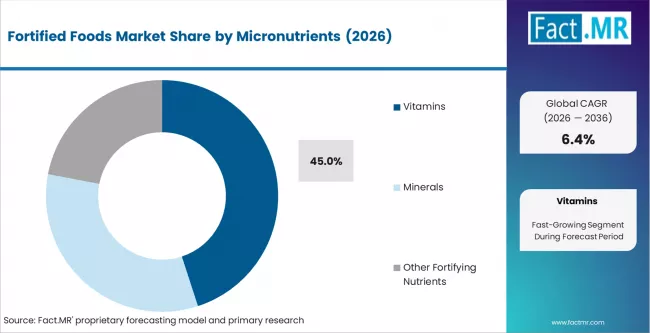
Fortified Foods Market Analysis By Micronutrients | Source: Fact.MR
- Market Overview: Vitamins are projected to account for around 45% share of the fortified foods market by 2026. Food manufacturers widely incorporate vitamins into processed food products to address micronutrient deficiencies and improve nutritional value. Vitamins such as vitamin A, vitamin D, vitamin B complex, and vitamin C are commonly added to cereals, dairy products, beverages, and staple food items. Governments and public health organizations in several countries encourage vitamin fortification programs to improve population nutrition levels. The consistent use of vitamin fortification in packaged foods and staple products continues to support the dominance of this micronutrient segment.
- Demand Drivers:
- Public Nutrition Programs: Governments support vitamin fortification initiatives in staple foods such as flour, milk, and edible oils to address nutritional deficiencies.
- Packaged Food Fortification: Food manufacturers incorporate vitamins into breakfast cereals, dairy products, and beverages to enhance nutritional profiles.
- Consumer Health Awareness: Increased awareness regarding balanced nutrition encourages the consumption of vitamin fortified food products.
Fortified Foods Market Analysis by Application
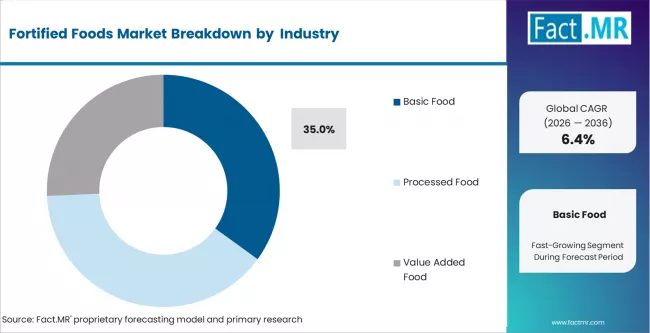
Fortified Foods Market Analysis By Application | Source: Fact.MR
- Market Overview: Basic food applications are expected to represent approximately 35% share of the fortified foods market in 2026. Basic foods include staple products such as wheat flour, rice, milk, edible oils, and salt that are fortified with essential micronutrients. These staple food items are widely consumed across different population groups, making them suitable vehicles for micronutrient fortification programs. Food processors and government agencies often implement fortification strategies within staple food supply chains to ensure broad nutritional coverage across populations.
- Demand Drivers:
- Staple Food Fortification Programs: Governments and food producers fortify widely consumed staple foods to improve micronutrient intake among populations.
- Large Consumption Base: Basic food products such as flour, rice, and milk reach a large consumer base, supporting their role in fortified food distribution.
- Food Processing Integration: Fortification technologies are integrated into existing food processing systems, allowing efficient addition of micronutrients during manufacturing.
Key Dynamics
Fortified Foods Market Drivers, Restraints, and Opportunities
FMR analysts observe that the fortified foods market developed as governments and food manufacturers addressed nutrient deficiencies through large-scale food enrichment programs. Early fortification initiatives focused on adding iodine to salt and vitamins to staple foods such as flour and milk to reduce public health deficiencies. The current market valuation reflects the integration of vitamin and mineral fortification across packaged foods including breakfast cereals, dairy products, beverages, and infant nutrition products. Demand persists because fortified foods provide a practical method for delivering essential micronutrients through widely consumed food products.
A structural shift is occurring as traditional fortification of staple foods expands toward functional food products formulated with targeted nutrient profiles. Conventional fortified staples such as flour and cooking oil remain widely distributed through public health programs where affordability and mass consumption remain key priorities. Food manufacturers increasingly introduce fortified beverages, dairy alternatives, and snack products containing vitamins, minerals, and trace nutrients aimed at specific nutritional requirements. These specialized fortified food products carry higher formulation and ingredient costs due to nutrient stabilization processes and regulatory labeling compliance. Even with stable consumption of basic fortified staples, the pricing premium associated with functional fortified foods contributes to gradual market value expansion.
- Public Health Fortification: Governments maintain large-scale food fortification initiatives that address micronutrient deficiencies through widely consumed staple foods.
- Food Fortification Standards: Regulatory frameworks such as the Codex Alimentarius Guidelines on Food Fortification with Micronutrients and national food labeling regulations govern nutrient addition and product claims.
- Asia Nutrition Programs: India, Indonesia, and several Southeast Asian countries operate national food fortification programs targeting deficiencies in iron, iodine, and vitamin A through staple food distribution systems.
Regional Analysis
The market analysis covers key global regions, including North America, Europe, East Asia, and South Asia. It is segmented geographically, with specific market dynamics for each region. The full report provides a detailed market attractiveness analysis.
.webp "Top Country Growth Comparison Fortified Foods Market Cagr (2026 2036)")
Top Country Growth Comparison Fortified Foods Market Cagr (2026 2036) | Source: Fact.MR
| Country | CAGR (2026-2036) |
|---|---|
| USA | 7.4% |
| Germany | 8.0% |
| China | 8.4% |
| Japan | 6.5% |
| India | 6.2% |
Source: Fact.MR analysis. Updated Mar 17, 2026
Source: Fact MR (FMR) analysis, based on proprietary forecasting model and primary research
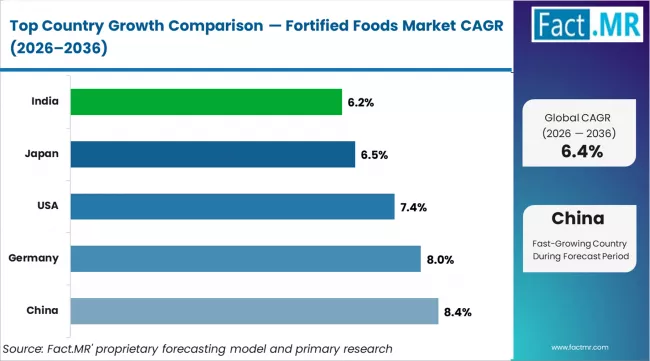
Fortified Foods Market Cagr Analysis By Country | Source: Fact.MR
North America
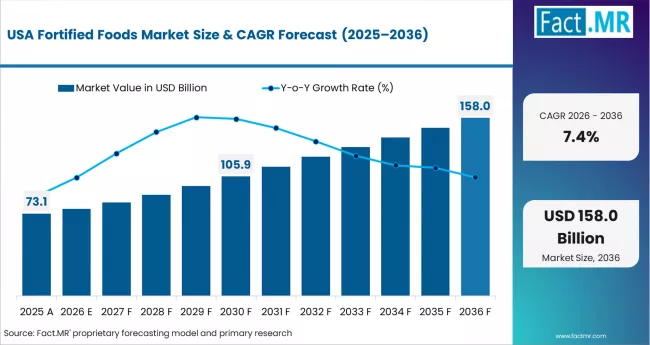
Fortified Foods Market Country Value Analysis | Source: Fact.MR
The USA represents a major market supported by demand for functional foods, nutrition awareness, and food fortification programs. Key companies include General Mills, Inc., Nestlé S.A., and Kellogg Company.
- USA: Demand for fortified foods in the U.S. is projected to rise at 7.4% CAGR through 2036. Growth is supported by national nutrition initiatives promoted by the United States Department of Agriculture (04-2025) and expansion of fortified cereal product lines by General Mills, Inc. (08-2025).
Europe
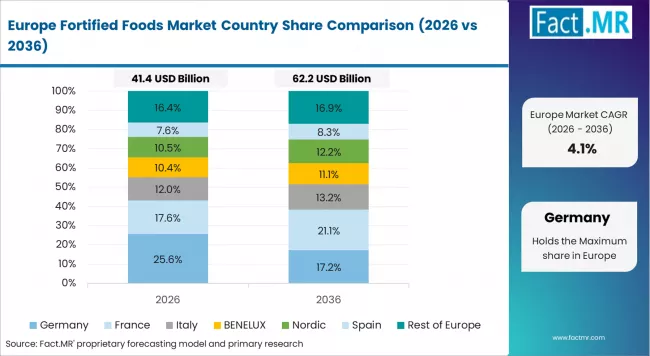
Fortified Foods Market Europe Country Market Share Analysis, 2026 & 2036 | Source: Fact.MR
Germany represents a key market supported by functional food demand, dietary supplement consumption, and innovation in fortified food products.
- Germany: Demand for fortified foods in Germany is projected to rise at 8.0% CAGR through 2036. Growth is supported by nutrition improvement initiatives promoted by the Federal Ministry of Food and Agriculture (03-2025) and product innovation programs by Nestlé S.A. (07-2025).
East Asia
China and Japan represent important markets supported by nutrition awareness programs, packaged food demand, and functional ingredient adoption.
- China: Demand for fortified foods in China is projected to rise at 8.4% CAGR through 2036. Growth is supported by national nutrition improvement programs promoted by the National Health Commission (03-2025) and expansion of fortified dairy product lines by Nestlé S.A. (08-2025).
- Japan: Demand for fortified foods in Japan is projected to rise at 6.5% CAGR through 2036. Growth is supported by health nutrition initiatives promoted by the Ministry of Health, Labour and Welfare (04-2025) and fortified food product development by Kellogg Company (07-2025).
South Asia
India represents a growing market supported by food fortification initiatives, public nutrition programs, and packaged food consumption.
- India: Demand for fortified foods in India is projected to rise at 6.2% CAGR through 2036. Growth is supported by national food fortification programs promoted by the Food Safety and Standards Authority of India (05-2025) and expansion of fortified food product distribution by Nestlé S.A. (09-2025).
Fact MR's analysis of the fortified foods market in North America, Europe, East Asia, and South Asia consists of country-wise assessments that include the USA, Germany, China, Japan, and India. Readers can find detailed trends, regulatory updates, and company-specific investments shaping market growth in these countries.
Competitive Landscape
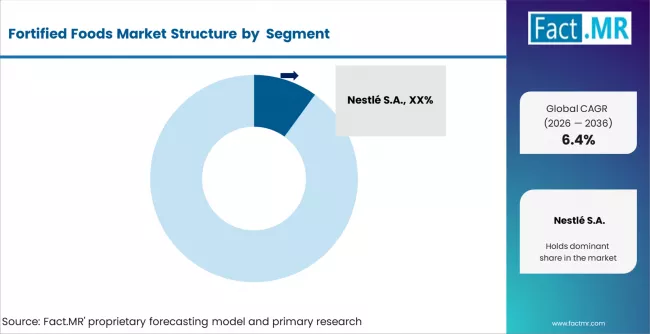
Fortified Foods Market Analysis By Company | Source: Fact.MR
Competitive Structure and Buyer Dynamics in the Fortified Foods Market
The competitive structure of the Fortified Foods Market is moderately concentrated, with several multinational food and nutrition companies holding significant influence across global supply chains. Major participants including Nestlé S.A., Danone S.A., Unilever PLC, Abbott Laboratories, Kellanova, General Mills, Inc., and PepsiCo, Inc. maintain strong positions through established consumer brands and extensive distribution networks. These companies offer fortified dairy products, cereals, beverages, and nutritional foods designed to address dietary deficiencies and health requirements. Additional participants such as Royal FrieslandCampina N.V., Mead Johnson Nutrition, and Archer Daniels Midland Company contribute through specialized nutrition products and ingredient supply for fortified formulations. Competition in the market is primarily shaped by product formulation quality, nutritional efficacy, regulatory compliance, and brand credibility among consumers.
Several companies maintain structural advantages through vertically integrated supply chains and strong research capabilities in nutritional science. Firms such as Nestlé S.A., Danone S.A., and Abbott Laboratories benefit from extensive research facilities and clinical nutrition expertise that support product development. Archer Daniels Midland Company provides fortified ingredient systems and nutrient premixes used by food manufacturers across multiple product categories. Large retail chains and food distributors often maintain diverse supplier portfolios to reduce dependence on a single brand or manufacturer. Procurement teams evaluate suppliers based on product consistency, regulatory approval, and supply reliability. This purchasing structure moderates supplier pricing leverage within the market. Companies with established consumer brands, strong distribution infrastructure, and advanced nutrition research capabilities retain moderate negotiating influence in global fortified food supply agreements.
Key Players of the Fortified Foods Market
- Nestlé S.A.
- Danone S.A.
- Unilever PLC
- Abbott Laboratories
- Kellanova
- General Mills, Inc.
- Mead Johnson Nutrition
- Royal FrieslandCampina N.V.
- Archer Daniels Midland Company
- PepsiCo, Inc.
Report Scope
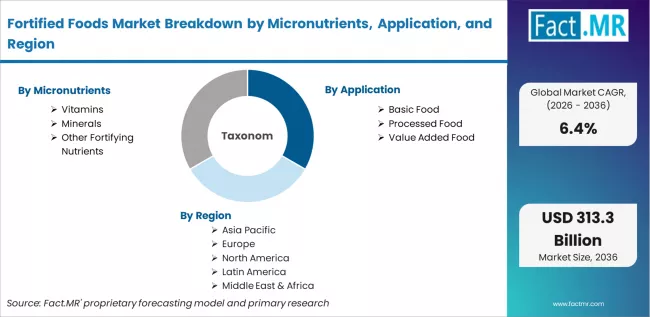
Fortified Foods Market Breakdown By Micronutrients, Application, And Region | Source: Fact.MR
| Metric | Value |
|---|---|
| Quantitative Units | USD 168.5 billion (2026) to USD 313.4 billion (2036), at a CAGR of 6.4% |
| Market Definition | The fortified foods market includes production and distribution of food products enriched with vitamins, minerals, and other micronutrients to improve nutritional value and address dietary deficiencies across populations. |
| Raw Material | Flours (Rice Flour, Wheat Flour, Corn Flour), Rice, Salt, Milk, Oil, Sugar |
| Micronutrients | Vitamins (Vitamin A, Vitamin B, Vitamin C, Vitamin D, Other Vitamins), Minerals (Calcium, Iron, Zinc, Iodine, Other Minerals), Other Fortifying Nutrients |
| Application Coverage | Basic Food, Processed Food, Value Added Food, Condiments, Juice |
| Technology | Drying (Oven Drying, Drum Drying, Spray Drying), Extrusion, Coating & Encapsulation, Others |
| Sales Channel | Modern Trade, Online Sales, Neighborhood Stores, Other Retail Format |
| Key Companies Profiled | Nestlé S.A., Danone S.A., Unilever PLC, Abbott Laboratories, Kellanova, General Mills, Inc., Mead Johnson Nutrition, Royal FrieslandCampina N.V., Archer Daniels Midland Company, PepsiCo, Inc. |
| Forecast Period | 2026 to 2036 |
| Approach | Hybrid top-down and bottom-up market modeling validated through interviews with food manufacturers and ingredient suppliers, supported by production benchmarking, nutrition program adoption analysis, and trade data evaluation. |
Source: Fact.MR analysis. Updated Mar 17, 2026
Bibliographies
- [1] United States Department of Agriculture. (2025). National nutrition initiatives.
- [2] National Health Commission, China. (2025). National nutrition improvement programs.
- [3] Food Safety and Standards Authority of India. (2025). National food fortification programs.
- [4] Federal Ministry of Food and Agriculture, Germany. (2025). Nutrition improvement initiatives.
- [5] Ministry of Health, Labour and Welfare, Japan. (2025). Health nutrition initiatives.
- [6] General Mills, Inc. (2025). Fortified cereal product expansion.
- [7] Nestlé S.A. (2025). Product innovation programs.
- [8] Kellogg Company. (2025). Fortified food product development.
- [9] Codex Alimentarius Commission. (2023). Guidelines on food fortification with micronutrients.
This Report Addresses
- Market size estimation and revenue forecasts for the Fortified Foods Market from 2026 to 2036, supported by packaged food production benchmarks and micronutrient ingredient consumption indicators.
- Growth opportunity mapping across vitamin fortified and mineral fortified food products integrated into staple foods and processed food formulations.
- Segment and regional revenue forecasts covering basic foods, processed foods, value added foods, condiments, and fortified juice products across major food manufacturing regions.
- Competition strategy assessment including food formulation capability, nutrient premix integration, and fortified product distribution benchmarking among global food manufacturers and ingredient suppliers.
- Regulatory and nutrition compliance analysis covering frameworks such as Codex Alimentarius guidelines on food fortification and national food labeling regulations governing micronutrient addition in processed foods.
- Market report delivery in PDF, Excel, PPT, and interactive dashboard formats designed for food ingredient procurement planning, nutrition program assessment, and fortified food product development strategy.
- Supply chain vulnerability assessments identifying micronutrient ingredient sourcing dependencies, premix manufacturing concentration, and regional food processing infrastructure risks affecting fortified food production.
Segmentation
Fortified Foods Market Key Segments
-
Raw Material :
- Flours
- Rice Flour
- Wheat Flour
- Corn Flour
- Rice
- Salt
- Milk
- Oil
- Sugar
- Flours
-
Micronutrients :
- Vitamins
- Vitamin A
- Vitamin B
- Vitamin C
- Vitamin D
- Other Vitamins
- Minerals
- Calcium
- Iron
- Zinc
- Iodine
- Other Minerals
- Other Fortifying Nutrients
- Vitamins
-
Application :
- Basic Food
- Processed Food
- Value Added Food
- Condiments
- Juice
-
Technology :
- Drying
- Oven Drying
- Drum Drying
- Spray Drying
- Extrusion
- Coating and Encapsulation
- Others
- Drying
-
Sales Channel :
- Modern Trade
- Online Sales
- Neighborhood Stores
- Other Retail Format
-
Region :
- North America
- USA
- Canada
- Mexico
- Europe
- Germany
- UK
- France
- Italy
- Spain
- Nordic Countries
- BENELUX
- Rest of Europe
- Asia Pacific
- China
- Japan
- South Korea
- India
- Australia
- Rest of Asia Pacific
- Latin America
- Brazil
- Argentina
- Rest of Latin America
- Middle East and Africa
- Kingdom of Saudi Arabia
- United Arab Emirates
- South Africa
- Rest of Middle East and Africa
- Other Regions
- Oceania
- Central Asia
- Other Markets
- North America
Frequently Asked Questions
How large is the demand for Fortified Foods in the global market in 2026?
What will be the market size of Fortified Foods in the global market by 2036?
What is the expected demand growth for Fortified Foods in the global market between 2026 and 2036?
Which Micronutrient Segment is poised to lead global demand by 2026?
Which Company is Identified as a Leading Participant in the Fortified Foods Market?
What is Driving Fortified Foods Demand in the United States?
What is the United States Growth Outlook in this Report?
Why is China an Important Market for Fortified Foods?
What is the China Growth Outlook in this Report?
What Factors Support Fortified Foods Demand in India?
What is the India Growth Outlook in this Report?
Why is Germany Considered an Important Market for Fortified Foods?
What is the Germany Growth Outlook in this Report?
Why is Japan an Important Market for Fortified Foods?
What is the Japan Growth Outlook in this Report?
What are Fortified Foods and What are They Mainly Used For?
What does Fortified Foods Market Mean in this Report?
What is Included in the Scope of this Fortified Foods Market Report?
What is Excluded from the Scope of this Report?
What does Market Forecast Mean on this Page?
How is the Fortified Foods Market Forecast Developed in this Report?
Who worked on this report


Preview the report firsthand - request a free sample
Free SampleGet the brochure for pricing and purchase details
Download PDF