- Market Value (2025): USD 454.9 Mn
- Estimated Value (2026): USD 540.0 Mn
- Forecast Value (2036): USD 2998.5 Mn
- CAGR (2026-2036): 18.7%
What is the Sugar Kelp Coatings Market forecast to be worth by 2036?
USD 540.0 million in 2026 to USD 2998.5 million by 2036 at an 18.7% CAGR.
- The sugar kelp coatings market was valued at USD 454.9 million in 2025.
- Demand is projected to increase from USD 540.0 million in 2026 to USD 2998.5 million by 2036.
- The market is forecast to record 18.7% CAGR from 2026 to 2036, supported by converters qualifying seaweed barriers for fiber formats.
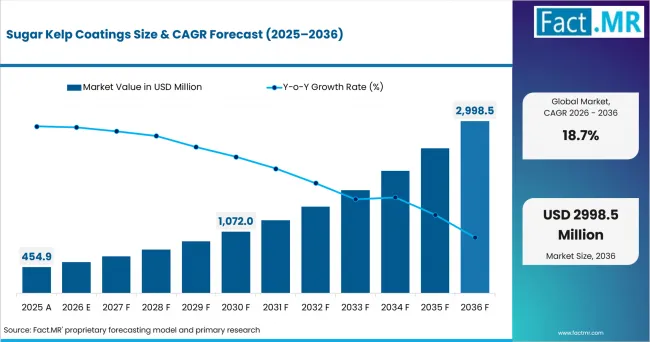
Sugar Kelp Coatings Value Analysis | Source: Fact.MR
What are the defining numbers behind Sugar Kelp Coatings Market growth?
USD 2458.5 million absolute opportunity by 2036, led by alginate-rich polymers, paper / board substrates and Japan.
- Demand Drivers in the Market
- Packaging converters need coating chemistries that keep paper formats usable in food contact. The European Commission said in August 2026 that all EU packaging must be recyclable by 2030.
- Foodservice pack suppliers need grease resistance in board formats. FDA said in January 2025 that 35 food contact notifications for PFAS-containing grease-proofing substances used on paper and paperboard were no longer effective because those uses had been abandoned.
- Brand packaging teams need cost signals that justify fiber-pack trials. PackUK set the 2025 to 2026 fee for fibre-based composites at GBP 461 per tonne.
- Key Segments Analyzed
- By Kelp Polymer: Alginate-rich is expected to hold 37.0% share in 2026, driven by film-forming behavior and water-based processing fit.
- By Barrier Function: Oxygen barrier is projected to account for 29.0% share in 2026, supported by the need to protect food quality in paper packs.
- By Substrate: Paper / board is anticipated to capture 39.0% share in 2026, owing to converter trials that keep the pack format familiar.
- By Application Method: Aqueous roll coat is estimated to represent 31.0% share in 2026, shaped by its fit with existing coating and drying lines.
- Analyst Opinion at Fact.MR
- Shambhu Nath Jha, Principal Consultant at Fact.MR, states, “Sugar kelp coatings are drawing attention because the test has moved from material origin to line performance. Packaging teams are expected to judge oxygen barrier, grease holdout, drying behavior and food-contact files before price enters the discussion. Suppliers that combine polymer control with converter testing and clear documentation have the cleaner route into fiber packaging.”
- Strategic Implications
- Packaging converters should test sugar kelp coatings on the target paper grade and measure oxygen transmission before commercial sampling.
- Food brands should connect material claims with end-of-life checks so pack changes pass retailer and regulator review.
- Seaweed processors should document alginate consistency by harvest source because repeatable polymer behavior decides coating results.
- Foodservice pack suppliers should align trials with sandwich, wrap and chilled-meal formats before wider fiber-pack use.
Japan is expected to record 18.8% CAGR through 2036 on food-processing needs and seaweed familiarity. The UK is projected to post 18.4% CAGR as EPR fees push fiber-pack redesign. The USA is anticipated to advance at 18.1% CAGR due to foodservice packaging demand. France is estimated to hold 17.7% CAGR owing to food-manufacturing scale. Germany is forecast to record 16.1% CAGR through recycling rules.
How does the Sugar Kelp Coatings Market break down by segment?
Alginate-rich leads at 37.0%; paper / board leads at 39.0%.
Which Kelp Polymer dominates?
Alginate-rich holds 37.0% share in 2026.
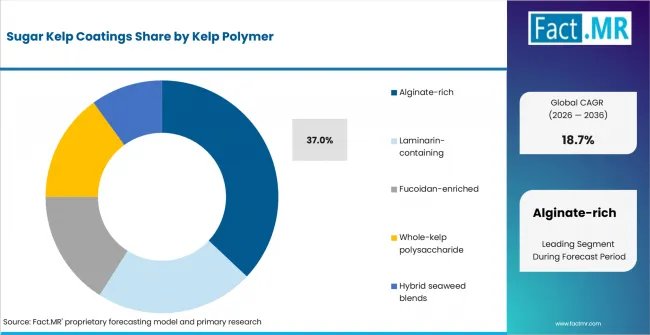
Sugar Kelp Coatings Analysis By Kelp Polymer | Source: Fact.MR
Alginate-rich coatings are expected to hold 37.0% share in 2026, driven by film formation and controlled viscosity in water-based systems. Laminarin-containing systems serve packaging teams that want added functional value from the kelp fraction. Whole-kelp blends remain useful when formulators need broader seaweed solids. Algaia said in March 2025 that its industrial transformation program for brown-seaweed biorefining included a new extraction facility and a new production line.
What leads the Barrier Function segment?
Oxygen barrier leads with 29.0% share in 2026.
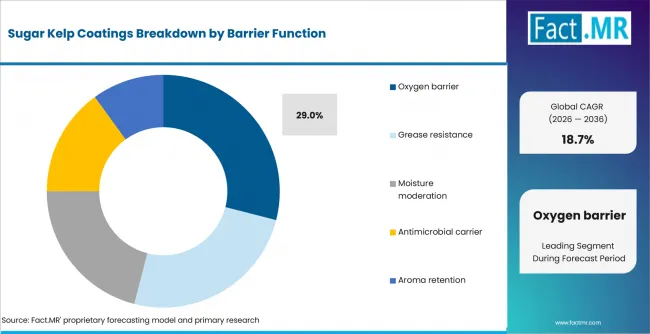
Sugar Kelp Coatings Analysis By Barrier Function | Source: Fact.MR
Oxygen barrier is projected to account for 29.0% share in 2026, supported by packaged foods that lose quality when paper allows gas transfer. Grease resistance fits food-to-go formats where sauces and oils weaken plain board. Moisture moderation serves produce and chilled packs that need shelf-life support. The EU Packaging and Packaging Waste Regulation began applying in August 2026, with the requirement that all packaging be recyclable applying from 2030.
How does Substrate shape demand?
Paper / board accounts for 39.0% share in 2026.
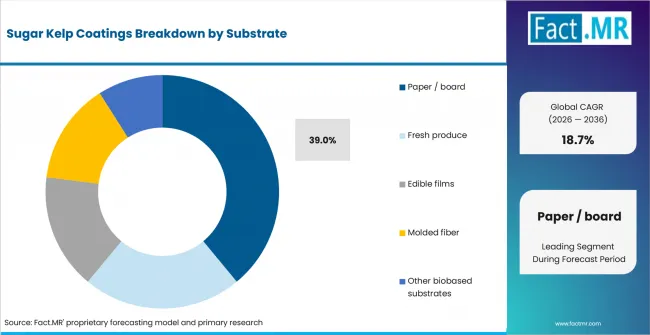
Sugar Kelp Coatings Analysis By Substrate | Source: Fact.MR
Paper / board is anticipated to capture 39.0% share in 2026 because it gives converters a route to replace plastic liners. Fresh produce substrates need moisture control while preserving product visibility. Edible films and molded fiber extend sugar kelp chemistry beyond flat board. FDA FCN No. 2512 for Kelp Industries Ltd, covering agar palmitate as a coating for paper and paperboard, became effective on August 26, 2026.
What supports Aqueous roll coat within Application Method?
Aqueous roll coat holds 31.0% share in 2026.
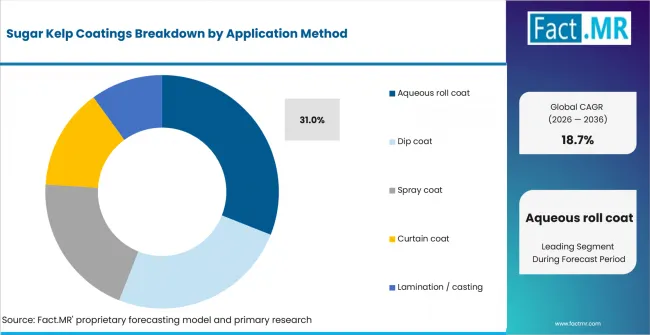
Sugar Kelp Coatings Analysis By Application Method | Source: Fact.MR
Aqueous roll coat is estimated to represent 31.0% share in 2026, owing to its fit with existing paper-coating lines. Dip coat suits produce and smaller formats where coverage counts more than speed. Spray coat supports shaped packs. PackUK’s June 2025 EPR base-fee table provides UK packaging producers with material-specific cost benchmarks that can inform decisions around packaging structures and coating routes.
What is accelerating Sugar Kelp Coatings Market adoption, and what is holding it back?
Plastic-free fiber packaging drives it; feedstock variability restrains it.
Drivers Impact Analysis
| DRIVER | (~) % IMPACT ON CAGR | GEOGRAPHIC RELEVANCE | IMPACT TIMELINE |
|---|---|---|---|
| Fiber-packaging plastic replacement trials | +1.8% | Global | Medium term (2-4 years) |
| Foodservice grease and moisture barrier needs | +1.4% | USA, UK, Japan | Short term (<= 2 years) |
| Food-contact approval pathways | +1.1% | USA, Europe | Medium term (2-4 years) |
| Seaweed polymer formulation progress | +0.9% | Europe, Japan | Long term (>= 4 years) |
Opportunity Impact Analysis
| OPPORTUNITY | (~) % IMPACT ON CAGR | GEOGRAPHIC RELEVANCE | IMPACT TIMELINE |
|---|---|---|---|
| Recovery-compatible paperboard coatings | +1.2% | Global | Medium term (2-4 years) |
| Fresh-produce and edible-film uses | +0.9% | Europe, Japan | Long term (>= 4 years) |
| Seaweed-coated visible food packs | +0.7% | UK, Europe | Short term (<= 2 years) |
Restraints Impact Analysis
| RESTRAINT | (~) % IMPACT ON CAGR | GEOGRAPHIC RELEVANCE | IMPACT TIMELINE |
|---|---|---|---|
| Feedstock variability | -0.8% | Global | Short term (<= 2 years) |
| Coating-line drying limits | -0.6% | Europe, North America | Medium term (2-4 years) |
| Food-contact documentation burden | -0.5% | USA, Europe, Japan | Medium term (2-4 years) |
Which countries are scaling Sugar Kelp Coatings Market through 2036?
- The country comparison spans 2.7 percentage points and forms three practical growth bands across the forecast period.
- Japan remains 0.4 percentage point above the United Kingdom through food-processing demand and familiarity with seaweed-derived inputs.
- The United Kingdom remains 0.3 percentage point above the United States as EPR fees and active fiber-pack redesign support seaweed-coating trials.
- The United States remains 0.4 percentage point above France through foodservice packaging demand and pressure to replace conventional grease-proofing chemistries.
- France remains 1.6 percentage points above Germany through food-manufacturing scale and brown-seaweed processing capability in Brittany.
- Germany closes the displayed range through recycling targets and converter attention to paper-pack qualification.
Comparable CAGRs can create different entry conditions due to food-contact approvals, seaweed-processing capacity, waste-fee exposure and converter readiness. Full report coverage includes North America, Latin America, Western Europe, Eastern Europe, East Asia, South Asia & Pacific, Middle East & Africa.
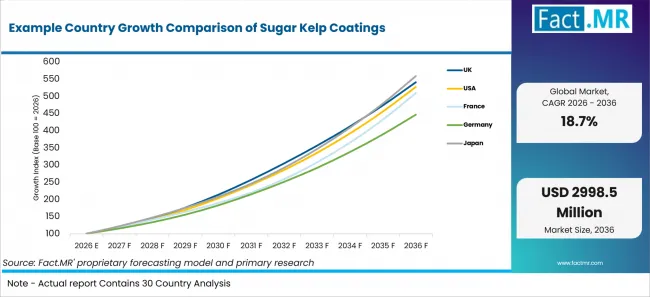
Example Country Growth Comparison Of Sugar Kelp Coatings | Source: Fact.MR
| Country | CAGR |
|---|---|
| Japan | 18.8% |
| United Kingdom | 18.4% |
| United States | 18.1% |
| France | 17.7% |
| Germany | 16.1% |
How does Japan perform?
18.8% CAGR through 2036, driven by food-processing packaging replacement and seaweed familiarity.
Japan’s food-packaging converters are expected to test sugar kelp coatings where seaweed chemistry is already familiar to food brands. USDA FAS reported in April 2025 that Japan’s food-processing sector produced USD 174 billion in 2024. The base supports oxygen and moisture protection trials across paper, board and prepared-food packaging.
What supports the United Kingdom outlook?
18.4% CAGR through 2036, led by EPR fees and fiber-pack redesign.
The UK outlook is shaped by food manufacturing scale and active seaweed-coating developers. ONS reported in July 2026 that food manufacturing represented 22.9% of UK manufacturers’ product sales in 2025. Local coating trials give converters visible examples of seaweed-derived barriers moving into fiber packaging.
What underpins USA growth?
18.1% CAGR through 2036, backed by foodservice packaging demand and PFAS replacement pressure.
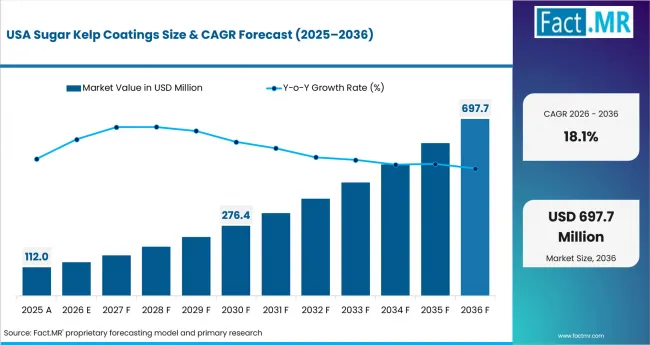
Sugar Kelp Coatings Country Value Analysis | Source: Fact.MR
USA demand is expected to build around prepared-food packaging and paperboard grease-proofing replacement. USDA ERS reported in June 2026 that food away from home accounted for 56.3% of U.S. food expenditures in 2025. The shift supports trial work for boxes, wraps and chilled foodservice packs.
How is France scaling demand?
17.7% CAGR through 2036, shaped by food-manufacturing scale and Brittany seaweed extraction.
France benefits from a large food-manufacturing base and brown-seaweed processing capacity in Brittany. Insee reported in July 2026 that French food-products manufacturing output reached EUR 177,560 million in 2024. The regional base supports formulation trials for European paper and food packaging.
What supports Germany adoption?
16.1% CAGR through 2036, driven by recycling targets and paper-pack qualification.
Germany’s converters are expected to evaluate sugar kelp coatings through sorting and fiber recovery. Umweltbundesamt reported in January 2026 that around 5.5 million tonnes of packaging waste collected by Germany’s dual systems were recovered in 2024. Documented recycling performance is expected to guide paper and board coating trials.
Who leads the Sugar Kelp Coatings Market?
SeaSol Technologies and Atlantic Sea Solutions (Atlas) are direct participants through seaweed-derived coating offerings. Their positioning is relevant where packaging converters require renewable barrier layers for paper and board while evaluating oxygen, grease and moisture performance alongside compatibility with existing coating processes.
Oceanium strengthens the competitive landscape through its work with sugar kelp and related seaweed materials. Its relevance lies in connecting kelp-derived feedstocks with packaging applications where formulators need consistent polymer functionality and a credible seaweed-based material route.
Algaia participates through brown-seaweed alginate materials, providing upstream polymer capability for coating formulators. This supports water-based coating development where film formation, viscosity control and repeatable raw-material quality influence converter trials and commercial qualification.
Which companies are the key providers?
Key companies include Oceanium; SeaSol Technologies; Atlantic Sea Solutions (Atlas); and Algaia.
- Oceanium
- SeaSol Technologies
- Atlantic Sea Solutions (Atlas)
- Algaia
Bibliography
- Central Agency Packaging Register, & German Environment Agency. (2026, January 27). Facts against myths: Packaging waste recycling in Germany is working.
- Department for Environment, Food & Rural Affairs. (2025, June 30). Extended Producer Responsibility for Packaging: 2025 base fees. GOV.UK.
- Directorate-General for Communication. (2026, August 12). New packaging rules for less waste and easier recycling. European Commission.
- Food and Agriculture Organization of the United Nations. (2026, June 16). Asia drives global aquatic production to record high, powered by aquaculture expansion.
- Aoki, S. (2025, April 1). Food processing ingredients annual (GAIN Report No. JA2025-0014). U.S. Department of Agriculture, Foreign Agricultural Service.
- Institut national de la statistique et des études économiques. (2026, July 21). Indicateurs macroéconomiques de l’industrie agroalimentaire: Données annuelles de 2010 à 2024.
- Kelpi. (2026, June 29). Kelpi partners with Amcor to scale next-generation seaweed-derived barrier coatings for fiber packaging.
- Notpla. (2026, May 8). The future of food-to-go packaging? A plastic-free window box built for real foodservice.
- Office for National Statistics. (2026, July 24). UK manufacturers’ sales by product: 2025.
- U.S. Food and Drug Administration. (2025, January 3). FDA determines authorization for 35 food contact notifications related to PFAS are no longer effective.
- Zeballos, E., & Sinclair, W. (2026, June 11). Total U.S. food spending reached $2.51 trillion in 2025. U.S. Department of Agriculture, Economic Research Service.
- Algaia. (2025, March 24). Algaia takes a new step in its industrial ambition.
This Report Answers
- The report explains where sugar kelp coatings are used across kelp polymer and barrier-function categories.
- Segment analysis identifies alginate-rich polymers and paper / board substrates as the main 2026 share leaders.
- Country analysis examines Japan, the United Kingdom, the United States, France and Germany.
- Competitive analysis reviews Oceanium, SeaSol Technologies, Atlantic Sea Solutions (Atlas), and Algaia.
- Application analysis assesses how oxygen barrier, grease resistance and moisture moderation influence coating selection.
- The forecast draws on interviews, provider checks, official packaging data and first-party company developments.
What does the Sugar Kelp Coatings Market cover?
The Sugar Kelp Coatings Market covers seaweed-derived coating materials applied to paper, board, produce surfaces, edible films and molded fiber. These coatings improve oxygen barrier, grease resistance, moisture moderation, antimicrobial carrying and aroma retention in food and packaging applications.
The assessment differs from broader seaweed ingredients because it focuses on coating use. Food texturizers, cosmetic extracts, fertilizers and feed ingredients are outside the boundary when they lack a barrier or application-method role in packaging.
What is included in the scope?
The scope includes alginate-rich, laminarin-containing, fucoidan-enriched, whole-kelp polysaccharide and hybrid seaweed blends used as coating systems. It covers oxygen barrier, grease resistance and moisture moderation across paper / board, fresh produce, edible films and molded fiber.
Adjacent coverage on bio barrier coatings, bio-based barrier resins, biobased PHA coatings, compostable cartonboard coatings and waterborne heat-seal coatings provides context for nearby barrier materials.
What is excluded from the scope?
General hydrocolloid ingredients, uncoated paperboard, petroleum-based barrier films and ordinary plastic laminates are outside the scope. Seaweed extracts for food texture, cosmetics, agriculture or animal feed are excluded unless sold as coating materials for packaging or produce protection.
How Was the Analysis Built?
The analysis draws on desk research, company portfolio review and industry interviews.
- Primary Research: Primary research includes discussions with packaging converters, coating formulators, seaweed processors, foodservice pack suppliers and brand packaging teams. These conversations examine coating trials, food-contact review, barrier targets and acceptance hurdles.
- Desk Research: Desk research covers government packaging data, food-manufacturing statistics, regulatory publications, company announcements, product pages and portfolio materials. Key externally sourced statistics and company developments used in the analysis are reflected in the bibliography.
- Market Sizing and Forecasting: Market estimates combine packaging-substrate use, barrier-function needs, country growth, company participation and coating-line readiness. Market values, shares and CAGRs remain unchanged throughout the forecast.
- Data Validation and Update Cycle: Findings are validated against public statistics, first-party company activity, provider portfolio mapping and technical interviews. Regular updates review coating approvals, partnerships, packaging rules and commercial launches.
What is the report’s scope and coverage?
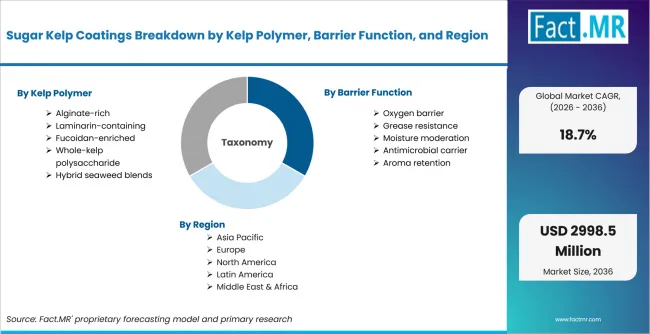
Sugar Kelp Coatings Breakdown By Kelp Polymer, Barrier Function, And Region | Source: Fact.MR
| Attribute | Details |
|---|---|
| Quantitative Units | USD million |
| Market Definition | Seaweed-derived coating materials based on sugar kelp polymers used to improve barrier performance in food and fiber packaging. |
| Kelp Polymer | Alginate-rich; Laminarin-containing; Fucoidan-enriched; Whole-kelp polysaccharide; Hybrid seaweed blends |
| Barrier Function | Oxygen barrier; Grease resistance; Moisture moderation; Antimicrobial carrier; Aroma retention |
| Substrate | Paper / board; Fresh produce; Edible films; Molded fiber; Other biobased substrates |
| Application Method | Aqueous roll coat; Dip coat; Spray coat; Curtain coat; Lamination / casting |
| Regions Covered | North America; Latin America; Western Europe; Eastern Europe; East Asia; South Asia & Pacific; Middle East & Africa |
| Countries Covered | Japan; United Kingdom; United States; France; Germany |
| Direct and Adjacent Companies Profiled | Oceanium; SeaSol Technologies; Atlantic Sea Solutions (Atlas); Algaia |
| Forecast Period | 2026 to 2036 |
| Approach | Hybrid top-down and bottom-up approach using packaging demand, coating trials, country indicators and provider review. |
How is the market segmented?
-
By Kelp Polymer
- Alginate-rich
- Laminarin-containing
- Fucoidan-enriched
- Whole-kelp polysaccharide
- Hybrid seaweed blends
-
By Barrier Function
- Oxygen barrier
- Grease resistance
- Moisture moderation
- Antimicrobial carrier
- Aroma retention
-
By Substrate
- Paper / board
- Fresh produce
- Edible films
- Molded fiber
- Other biobased substrates
-
By Application Method
- Aqueous roll coat
- Dip coat
- Spray coat
- Curtain coat
- Lamination / casting
-
By Region
- North America
- Latin America
- Western Europe
- Eastern Europe
- East Asia
- South Asia & Pacific
- Middle East & Africa