- Market Value (2025): USD 0.5 Bn
- Estimated Value (2026): USD 0.6 Bn
- Forecast Value (2036): USD 1.7 Bn
- CAGR (2026-2036): 10.8%
What is the Compostable Cartonboard Coatings Market forecast to be worth by 2036?
USD 0.6 billion in 2026 to USD 1.7 billion by 2036, recording a 10.8% CAGR.
- The compostable cartonboard coatings market crossed a valuation of USD 0.5 billion in 2025 as board mills expanded plastic-replacement trials.
- Market value is expected to increase from USD 0.6 billion in 2026 to USD 1.7 billion by 2036.
- The market is forecast to record a 10.8% CAGR from 2026 to 2036 as converters qualify certified barriers on established lines.
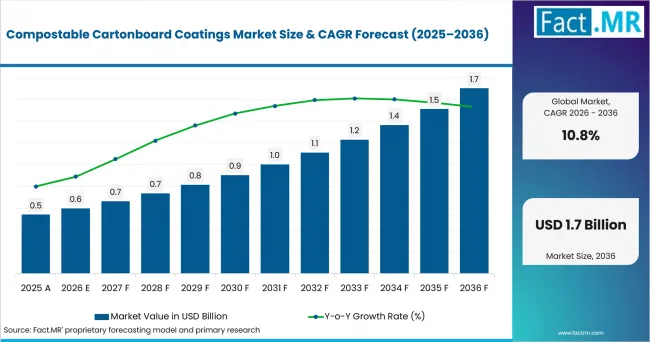
Compostable Cartonboard Coatings Market Value Analysis | Source: Fact.MR
What are the defining numbers behind Compostable Cartonboard Coatings Market growth?
USD 1.1 billion absolute opportunity by 2036, led by PLA - PHA and industrially compostable systems alongside foodservice applications.
- Demand Drivers in the Market
- Board mills need plastic-replacement coatings that preserve carton stiffness and production speed across recurring commercial programs.
- Foodservice packaging producers require grease protection that survives hot contents and repeated handling across takeaway formats.
- Brand owners need finished-package certification with disposal wording matched to destination markets and processor routes.
- Converters need familiar coating methods that avoid major capital changes and prevent extended production qualification stoppages.
- Key Segments Analyzed
- By Chemistry: PLA - PHA is expected to hold 34.0% share in 2026, supported by established processing routes and recognized compostability pathways.
- By Certification: Industrially compostable is projected to account for 66.0% share in 2026, owing to controlled testing and clearer processor criteria.
- By Barrier Property: Grease and oil resistance is anticipated to capture 38.0% share in 2026, due to immediate staining and leakage risks.
- By End Use: Foodservice is estimated to represent 40.0% share in 2026, attributable to high turnover and frequent contact with food residue.
- By Substrate: Folding boxboard is forecast to garner 38.0% share in 2026, driven by established printed-carton workflows and converter capacity.
- Analyst Opinion at Fact.MR
- Shambhu Nath Jha, Principal Consultant at Fact.MR states: “Commercial adoption depends on proving each coated structure under actual converting conditions before customer approval. Demand is expected to favor formulators connecting barrier chemistry with certification and local processor acceptance. Commercial value rests on documented line performance and an accepted end-of-life route for each package.”
- Strategic Implications
- Coating formulators should test barrier performance on intended board grades under realistic heat and grease exposure.
- Board mills need to compare coat weight and drying demand before approving chemistry through commercial production trials.
- Converters must secure finished-package certification and written processor acceptance before presenting commercial compostability claims to customers.
- Brand owners should retain a verified fiber-recovery route wherever organics processors reject certified compostable cartonboard packaging.
Retail food packaging needs line-compatible grease protection and heat sealing that survives commercial converting conditions reliably. In April 2026, Michelman announced the launch of Nuvita® Life 4002 and Nuvita® Life 4605, two bio-based, plastic-free barrier coatings developed for fiber-based retail food packaging applications.
India is expected to record a 13.4% CAGR, supported by certified substitution programs. China is projected to post 12.4% CAGR, driven by fiber packaging. United Kingdom is anticipated to advance at 11.1% CAGR, owing to collection reform. Germany is estimated to record 10.5% CAGR, reinforced by fiber recovery. Brazil is forecast to post 10.4% CAGR, influenced by biodegradable packaging.
How does the Compostable Cartonboard Coatings Market break down by segment?
PLA - PHA is projected to account for 34.0% share, industrially compostable is estimated to garner 66.0% share.
Which chemistry category dominates?
PLA - PHA is projected to account for 34.0% share in 2026
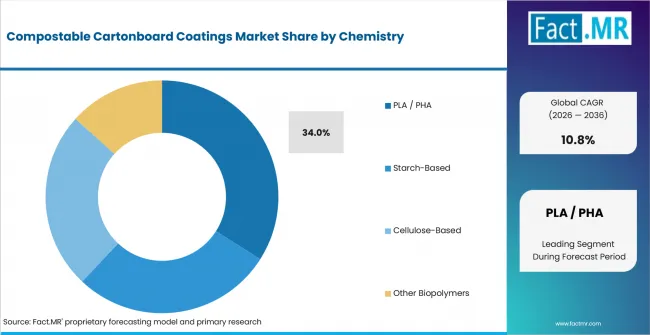
Compostable Cartonboard Coatings Market Analysis By Chemistry | Source: Fact.MR
Based on chemistry, PLA - PHA is projected to account for 34.0% share in 2026 due to familiar sealing routes and lower reformulation effort. PLA - PHA uses familiar extrusion and dispersion equipment across commercial compostable laminate packaging programs at scale. BASF followed this operating fit in April 2026 by expanding ecovio grades for paper barrier coatings.
Which certification category dominates?
Industrially compostable is estimated to garner 66.0% share in 2026
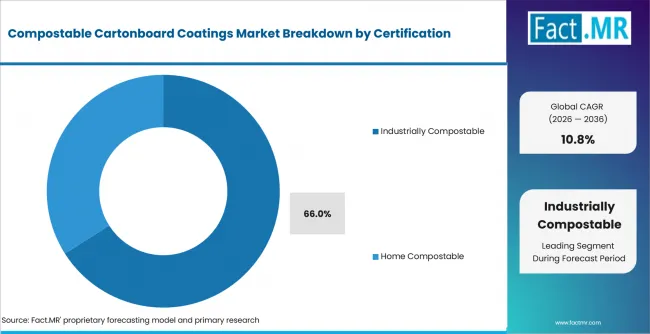
Compostable Cartonboard Coatings Market Analysis By Certification | Source: Fact.MR
In 2026, industrially compostable is expected to lead certification with 66.0% share because controlled facilities provide reproducible disintegration conditions. Commercial orders require processor acceptance that matches each certified package with an available local treatment route. Metpack and BASF addressed that requirement in May 2025 through home-compostable coated paperboard with food-contact approval.
How does barrier property shape demand?
Grease and oil resistance is forecast to capture 38.0% share in 2026
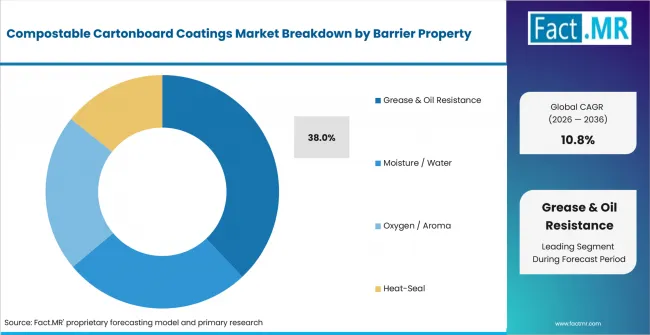
Compostable Cartonboard Coatings Market Analysis By Barrier Property | Source: Fact.MR
By barrier property, grease and oil resistance is forecast to represent 38.0% share in 2026 driven by visible leakage and staining failures. Grease protection prevents staining and stiffness loss across takeaway cartons using waterproof paper coatings under hot conditions. UPM and Paramelt addressed this need in March 2026 through a low-coat-weight concept for established lines.
What supports foodservice within end use?
Foodservice is estimated to represent 40.0% share in 2026
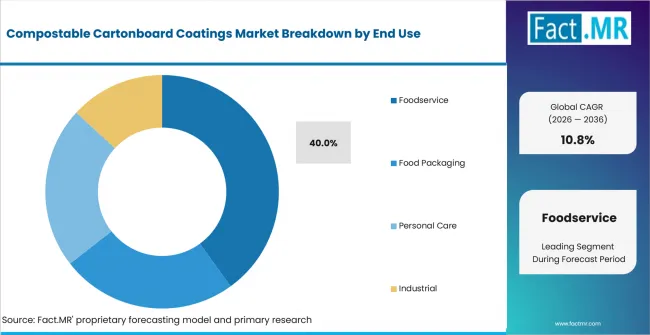
Compostable Cartonboard Coatings Market Analysis By End Use | Source: Fact.MR
Foodservice is projected to hold 40.0% share in 2026 owing to recurring takeaway use and frequent contact with food residue. Foodservice cartons reveal leakage during short service cycles, unlike food packaging barriers designed for longer storage and filling conditions.
hich substrate category dominates?
Folding boxboard is anticipated to hold 38.0% share in 2026
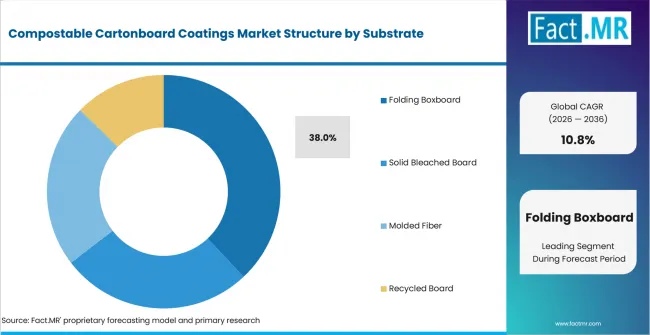
Compostable Cartonboard Coatings Market Analysis By Substrate | Source: Fact.MR
The substrate category is forecast to be led by folding boxboard at 38.0% share in 2026 due to established printing and scoring workflows. Folding boxboard combines stiffness with established carton equipment for paper coating materials across high-volume conversion. Kemira and Bluepha extended this route in June 2025 through an APAC partnership for PHA mineral oil barrier coatings.
What is accelerating Compostable Cartonboard Coatings Market adoption, and what is holding it back?
Packaging regulation drives it, collection mismatch restrains it.
Drivers Impact Analysis
| DRIVER | (~) % IMPACT ON CAGR | GEOGRAPHIC RELEVANCE | IMPACT TIMELINE |
|---|---|---|---|
| Packaging regulation and PFAS replacement | +0.9% | Europe and global markets | Short term (<= 2 years) |
| Foodservice barrier performance | +0.7% | Global with Asia focus | Medium term (2-4 years) |
| Established equipment compatibility | +0.6% | North America, Europe, Asia | Medium term (2-4 years) |
| Industrial compostability certification | +0.5% | Europe and North America | Medium term (2-4 years) |
| Brand specification changes | +0.4% | Global brand accounts | Long term (>= 4 years) |
Source: Fact.MR analysis. Updated Aug 1, 2026
- Packaging regulation: European rules connect material composition with recyclability controls, requiring barrier trials before August 2026 compliance.
- Foodservice performance: Hot contents expose leakage during handling, so demand is projected to favor coatings tested at service temperatures.
- Installed equipment compatibility: Familiar application methods reduce capital exposure and are anticipated to shorten qualification across established board grades.
- Certification clarity: Repeatable disintegration testing supports package comparison, although commercial programs require written acceptance from local processors.
Opportunity Impact Analysis
| OPPORTUNITY | (~) % IMPACT ON CAGR | GEOGRAPHIC RELEVANCE | IMPACT TIMELINE |
|---|---|---|---|
| Dual-pathway structures | +0.5% | Europe and North America | Medium term (2-4 years) |
| PLA and PHA barrier packages | +0.4% | Asia Pacific and Europe | Medium term (2-4 years) |
| Closed-loop foodservice programs | +0.3% | North America and Europe | Short term (<= 2 years) |
| Regional application laboratories | +0.3% | India, China and Brazil | Long term (>= 4 years) |
Source: Fact.MR analysis. Updated Aug 1, 2026
- Dual-pathway structures: Repulpable compostable coatings reduce municipal rollout risk, so opportunity is projected to widen across two-route packages.
- Biopolymer coating packages: Modular PLA and PHA systems create openings for providers meeting commercial coat-weight and sealing targets.
- Closed-loop foodservice programs: Contracted collection aligns package use with processor acceptance, supporting coating demand across controlled foodservice venues.
Restraints Impact Analysis
| RESTRAINT | (~) % IMPACT ON CAGR | GEOGRAPHIC RELEVANCE | IMPACT TIMELINE |
|---|---|---|---|
| Collection acceptance mismatch | -0.6% | Global municipal systems | Short term (<= 2 years) |
| Applied coating cost | -0.5% | Price-sensitive converters | Medium term (2-4 years) |
| Production scale-up risk | -0.4% | Global converters | Medium term (2-4 years) |
| Disposal-claim fragmentation | -0.3% | Europe, North America, Asia | Long term (>= 4 years) |
Source: Fact.MR analysis. Updated Aug 1, 2026
- Collection mismatch: Certified packages enter different municipal routes, so adoption is expected to remain selective without written processor acceptance.
- Applied material cost: Higher coat weights raise material and drying expenses, causing converters to delay programs exceeding compliance value.
- Production-line risk: High-speed coating exposes failures missed during laboratory testing, so purchasing remains cautious before commercial validation.
Which countries are scaling Compostable Cartonboard Coatings Market fastest?
India 13.4%, United Kingdom 11.1%, Germany 10.5%, Brazil 10.4%.
Regional analysis covers North America, Europe, Asia Pacific, Latin America, and Middle East and Africa.
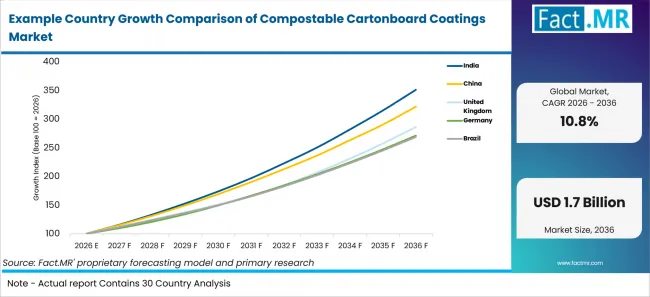
Example Country Growth Comparison Of Compostable Cartonboard Coatings Market | Source: Fact.MR
| COUNTRY | CAGR |
|---|---|
| United Kingdom | 11.1% |
| Germany | 10.5% |
| Brazil | 10.4% |
Source: Fact.MR analysis. Updated Aug 1, 2026
What supports the United Kingdom outlook?
11.1% CAGR, owing to collection reform in the country.
Companies in the United Kingdom prioritize recyclable fiber performance under collection systems separating paper from organics treatment across local authorities. England’s March 2026 reforms require separate paper and card collection across household waste systems nationwide. Demand is anticipated to post an 11.1% CAGR by 2036, although contaminated formats need an accepted treatment route.
What is driving Germany’s growth through 2036?
10.5% CAGR, reinforced by fiber recovery.
German board mills favor recyclable fiber structures with precise disposal instructions before considering compostability claims. The August 2025 minimum standard strengthens recyclability assessment across packaging designed for established fiber recovery routes. Demand is estimated to record a 10.5% CAGR during the assessment period, although narrow organics acceptance requires documented treatment routes.
How is Brazil developing Compostable Cartonboard Coatings demand?
10.4% CAGR, supported by local packaging conversion.
Brazil based companies need local regulatory files and consistent board performance before switching commercial barrier chemistry. Anvisa’s September 2024 framework defines registration and notification alongside manufacturing communication routes for foods and packaging. Demand is forecast to rise at a 10.4% CAGR, although limited organics infrastructure constrains commercial disposal claims.
Who leads the Compostable Cartonboard Coatings Market?
Solenis and Michelman provide coatings, while Archroma and BASF add cartonboard barrier chemistry.
Competition remains moderately fragmented because formulators and board producers control different qualification steps across finished structures. Specialized applications permit commercial entry, but food-contact records and local service create meaningful scale barriers.
Solenis and Michelman compete through water-based coatings, while Archroma and BASF add barrier chemistry for fiber applications. Xampla scales biodegradable packaging programs through converter partnerships while Kemira and Stora Enso support coating and board integration.
Which companies are the key providers?
Some of the key players profiled include Solenis, Michelman, Archroma, BASF, Kemira, Stora Enso, and Xampla.
- Solenis
- Michelman
- Archroma
- BASF
- Kemira
- Stora Enso
- Xampla.
Bibliography
- European Parliament and Council of the European Union. (2025, January 22). Regulation (EU) 2025-40 of the European Parliament and of the Council of 19 December 2024 on packaging and packaging waste, amending Regulation (EU) 2019-1020 and Directive (EU) 2019-904, and repealing Directive 94-62-EC (Text with EEA relevance).
- Ministry of Environment, Forest and Climate Change. (2024, March 14). G.S.R. 201(E) [14-03-2024] - Plastic Waste Management (Amendment) Rules, 2024.
- State Council of the People's Republic of China. (2025, April 18). China unveils new regulations on express delivery sector.
- Department for Environment, Food & Rural Affairs. (2026, March 31). Simpler household recycling rules come into force across England.
- Umweltbundesamt. (2025, August 29). Recyclingfähigkeit von Verpackungen: Mindeststandard 2025.
- Agência Nacional de Vigilância Sanitária. (2024, September 2). Quais as formas de regularização de alimentos e embalagens no Sistema Nacional de Vigilância Sanitária (SNVS).
- Michelman. (2026, April 30). Michelman Introduces Nuvita® Life 4002 & Nuvita® Life 4605: Bio-Based Barrier Coatings for Paper Packaging Applications.
- BASF. (2026, April 29). New ecovio® portfolio for flexible packaging: multiple barrier options combined with organic or paper recycling.
- BASF. (2025, May 6). Metpack and BASF cooperate to demonstrate certified home-compostable, coated paper for food packaging.
- UPM. (2026, March 24). UPM and Paramelt introduce bio-based food packaging concept.
- Xampla. (2026, March 12). Just Eat Takeaway expands plastic-free Morro Coating range across Europe.
- Kemira. (2025, June 25). Kemira and Bluepha Announce Exclusive Partnership to Commercialize Fully Biobased Barrier Coatings in APAC.
This Report Addresses
- Report coverage tracks Chemistry choices and Certification design requirements in Compostable Cartonboard Coatings.
- The segment review evaluates Barrier Property applications alongside End Use demand patterns.
- The country outlook examines India, China, United Kingdom, Germany, and Brazil in comparable commercial settings.
- Provider comparison reviews manufacturing readiness and customer qualification expectations in Compostable Cartonboard Coatings.
- Substrate demand signals inform the practical route to market.
- Published data and primary checks support the Compostable Cartonboard Coatings forecast assumptions.
What does the Compostable Cartonboard Coatings Market cover?
PLA - PHA and other biopolymers used as functional cartonboard barriers.
The market covers compostable coatings that provide grease, moisture, oxygen, aroma, or heat-seal functions across cartonboard packaging.
Applied coating chemistry separates this category from uncoated board and finished packages lacking a separately valued barrier function.
What is included in the scope?
Compostable cartonboard coatings for foodservice, food packaging, personal care, and industrial applications.
The scope covers four biopolymer chemistry groups across applications where coating supplies a separately purchased functional barrier.
What is excluded from the scope?
Uncoated paperboard, finished packaging, and non-compostable laminates remain excluded.
The scope excludes uncoated paperboard, complete converted packages, and materials without a measured barrier function.
How Was the Analysis Built?
The analysis draws on 120+ sources, 35+ company portfolios, 25+ countries, and more than 20 industry interviews.
- Primary Research: Primary research includes discussions with manufacturers, service providers, technology developers, distributors, end users, procurement teams, and subject-matter experts. These conversations examine purchasing priorities, product adoption, operational challenges, approval requirements, competitive positioning, and the factors that influence wider market acceptance.
- Desk Research: Desk research covers government statistics, regulatory publications, company filings, trade data, technical studies, industry associations, standards, public policy, and other authoritative sources. Every source used in the analysis is documented in the bibliography.
- Market Sizing and Forecasting: Market estimates combine historical performance, demand indicators, pricing and volume trends, segment shares, company participation, country-level growth, adoption patterns, investment activity, and barriers to market expansion.
- Data Validation and Update Cycle: Findings are validated by comparing primary interviews with public data, company activity, regulatory changes, trade patterns, and industry developments. Regular updates review new product launches, capacity changes, partnerships, approvals, procurement trends, and shifts in commercial adoption.
Segmentation
What is the report’s scope and coverage?
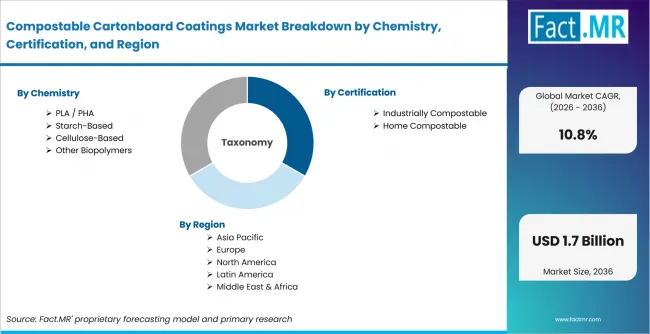
Compostable Cartonboard Coatings Market Breakdown By Chemistry, Certification, And Region | Source: Fact.MR
| Coverage field | Report scope |
|---|---|
| Quantitative Units | USD Billion |
| Market Definition | Compostable coatings that provide grease, moisture, oxygen, aroma, or heat-seal performance on cartonboard |
| Chemistry | PLA - PHA, Starch-Based, Cellulose-Based, Other Biopolymers |
| Certification | Industrially Compostable, Home Compostable |
| Barrier Property | Grease & Oil Resistance, Moisture - Water, Oxygen - Aroma, Heat-Seal |
| End Use | Foodservice, Food Packaging, Personal Care, Industrial |
| Substrate | Folding Boxboard, Solid Bleached Board, Molded Fiber, Recycled Board |
| Regions Covered | North America, Europe, Asia Pacific, Latin America, Middle East and Africa |
| Countries Covered | United Kingdom, Germany, Brazil |
| Key Companies Profiled | Solenis, Michelman, Archroma, BASF, Kemira, Stora Enso, Xampla |
| Forecast Period | 2026 to 2036 |
| Approach | Hybrid modelling uses attachment rates, demand, application mix, and qualification timing |
Source: Fact.MR analysis. Updated Aug 1, 2026
How is the market segmented?
-
By Chemistry:
- PLA - PHA
- Starch-Based
- Cellulose-Based
- Other Biopolymers
-
By Certification:
- Industrially Compostable
- Home Compostable
-
By Barrier Property:
- Grease & Oil Resistance
- Moisture - Water
- Oxygen - Aroma
- Heat-Seal
-
By End Use:
- Foodservice
- Food Packaging
- Personal Care
- Industrial
-
By Substrate:
- Folding Boxboard
- Solid Bleached Board
- Molded Fiber
- Recycled Board
-
By Region:
- North America
- United States
- Canada
- Europe
- Germany
- United Kingdom
- France
- Italy
- Spain
- Asia Pacific
- India
- China
- Japan
- South Korea
- Australia
- Latin America
- Brazil
- Mexico
- Argentina
- Chile
- Middle East & Africa
- United Arab Emirates
- Saudi Arabia
- South Africa
- Türkiye
- North America
Frequently Asked Questions
What share is PLA - PHA expected to capture within chemistry?
How is industrially compostable positioned across certification demand?
Which barrier property is projected to account for the primary share?
What supports foodservice within the end-use split?
How much share is folding boxboard estimated to garner?
Which factor creates the main adoption pressure?
What continues to restrain recurring commercial orders?
Why do converters carry commercial weight in this market?
Who worked on this report


Preview the report firsthand - request a free sample
Free SampleGet the brochure for pricing and purchase details
Download PDF