- Market Value (2025): USD 649.7 Mn
- Estimated Value (2026): USD 690.0 Mn
- Forecast Value (2036): USD 1260.0 Mn
- CAGR (2026-2036): 6.2%
What is the Waterborne Heat-Seal Coatings Market forecast to be worth by 2036?
USD 690.0 million in 2026 to USD 1,260.0 million by 2036 at 6.2% CAGR.
- The Waterborne Heat-Seal Coatings Market crossed a valuation of USD 649.7 million in 2025 as converters increased qualification work across paper and flexible packaging structures.
- Demand is projected to increase from USD 690.0 million in 2026 to USD 1,260.0 million by 2036 across the forecast period.
- The market is forecast to record 6.2% CAGR from 2026 to 2036 as waterborne systems gain use across sealable packaging structures.
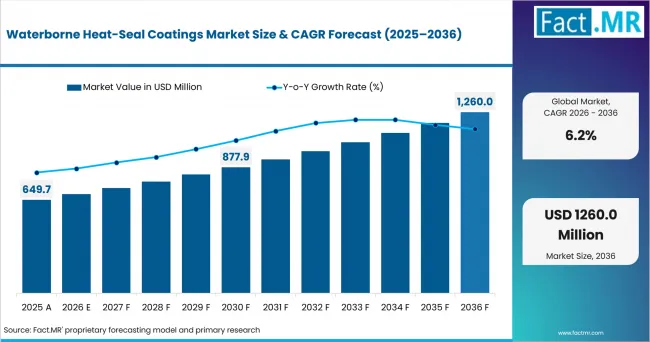
Waterborne Heat Seal Coatings Market Market Value Analysis | Source: Fact.MR
What are the defining numbers behind Waterborne Heat-Seal Coatings Market growth?
USD 570.0 million in absolute opportunity is projected through 2036.
- Demand Drivers in the Market
- Paper packaging makers need coatings that seal with heat without adding a separate plastic film.
- Food packaging companies need seals that work at lower temperatures. This helps protect heat-sensitive products and keeps filling or wrapping lines running smoothly.
- Lidding makers need seals that stay closed during handling but still open without too much force.
- Companies also need clear food-contact and recycling records before approving a coating for regular plant use.
- Key Segments Analyzed
- By Substrate: Paper is expected to hold 30% share in 2026 supported by qualification of sealable fiber structures across food and consumer packaging.
- By Chemistry: Acrylic is projected to account for 31% share in 2026 owing to the use of aqueous dispersions in coating application and heat-seal performance.
- By Seal Performance: Low-Temperature Seal is anticipated to capture 28% share in 2026 due to the need to limit heat exposure during package formation.
- By Application: Lidding is estimated to represent 31% share in 2026 attributable to use across tray and cup structures that require controlled seal performance.
- By End Use: Food is forecast to account for 44% share in 2026 driven by package integrity requirements and food-contact review during coating approval.
- Analyst Opinion at Fact.MR
- Shambhu Nath Jha, Senior Analyst at Fact.MR, states, “Water-based heat-seal coatings must perform well beyond the lab. The seal should stay strong after drying and storage. The coating must also run well on current production lines. Technical teams need to support plant trials and fix any process problems before regular use begins.”
- Strategic Implications
- Companies should record the temperature needed to start sealing and the strength of the hot seal at the coating amount used by the packaging plant. These results should be ready before commercial approval.
- Packaging plants should compare drying energy and the risk of coated surfaces sticking together before replacing solvent-based products with water-based coatings.
- Food packaging companies should check food-contact safety and seal strength after storage before using one coating across several package types.
Germany is anticipated to advance at 7.1% owing to structured technical review. Brazil is estimated to grow at 6.5%, while the United States is forecast to record a 5.9% CAGR.
How does the Waterborne Heat-Seal Coatings Market break down by segment?
Paper leads Substrate with 30% share and Acrylic leads Chemistry with 31% share in 2026.
What leads the Substrate segment?
Paper holds 30% share in 2026.
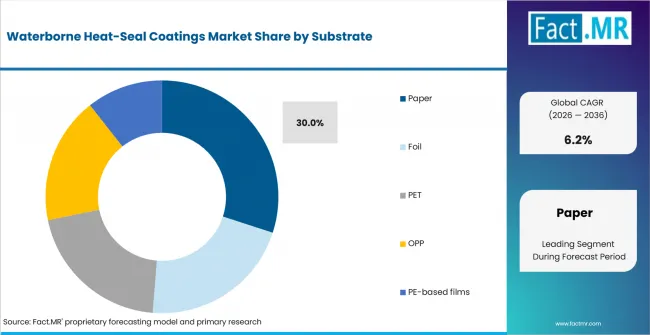
Waterborne Heat Seal Coatings Market Analysis By Substrate | Source: Fact.MR
Paper moves ahead because the coating can give a fiber-based pack its own sealing layer. This helps reduce the need for an extra plastic film in some cups, trays, wraps, and other paper formats. Foil remains useful where barrier protection is the first concern, especially in lidding and blister packs. PET and OPP fit clear packs and faster production lines. PE-based films continue where factories already use polyolefin packaging equipment. ACTEGA and Michelman offer water-based heat-seal coatings for paper and flexible packaging.
How does Chemistry shape demand?
Acrylic accounts for 31% share in 2026.
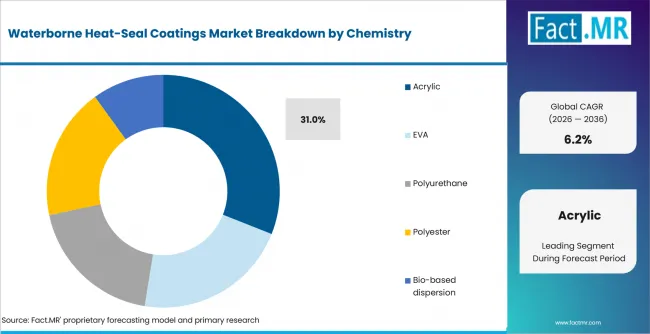
Waterborne Heat Seal Coatings Market Analysis By Chemistry | Source: Fact.MR
Acrylic gives coating formulators a practical balance of water-based application, drying, adhesion, and seal strength. It works especially well on paper and board, which supports its leading position. EVA is chosen when the seal needs more flexibility. Polyurethane and Polyester serve packs that face tougher heat or adhesion needs. Bio-based dispersions remain part of the comparison where renewable content is part of the product brief.
Where is Seal Performance demand strongest?
Low-temperature seal holds 28% share in 2026.
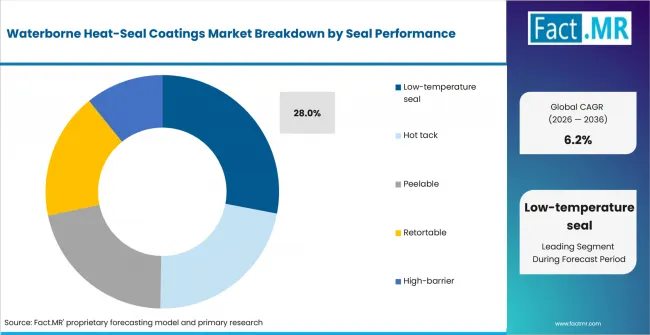
Waterborne Heat Seal Coatings Market Analysis By Seal Performance | Source: Fact.MR
Lower sealing heat can protect thin films, coated paper, and heat-sensitive products during packing. It can also reduce the time needed to form each seal. Hot tack serves packs that must stay closed before the seal cools. Peelable grades are made for easier opening. Retortable coatings face tougher checks because the seal must survive heat treatment. High-barrier grades must protect the pack without losing sealing strength. Michelman offers coatings designed to begin sealing at lower temperatures.
What supports Application adoption?
Lidding leads with 31% share in 2026.
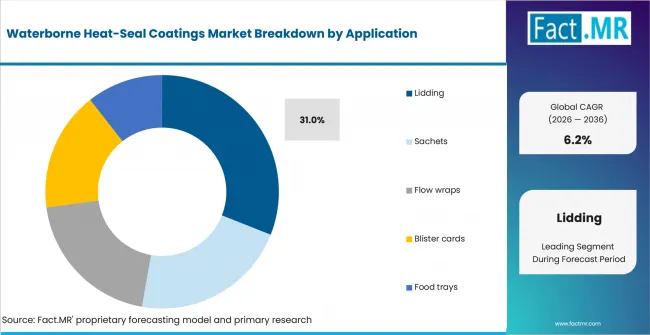
Waterborne Heat Seal Coatings Market Analysis By Application | Source: Fact.MR
Trays and cups need a top layer that closes firmly but still opens in a controlled way. This keeps Lidding at the front of the Application segment. Sachets and Flow Wraps depend more on speed because weak seals can quickly create leaks on fast lines. Blister Cards need steady adhesion within a narrow sealing range. Food Trays place extra weight on storage strength and clean opening. Henkel supplies functional coatings for lidding and flow-pack structures made from PE, PP, and PET films.
Which End Use Segment dominates?
Food holds 44% share in 2026.
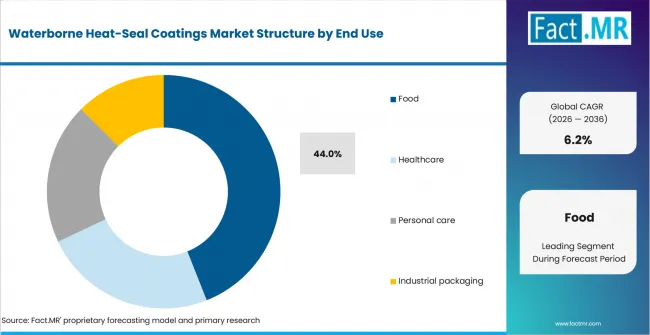
Waterborne Heat Seal Coatings Market Analysis By End Use | Source: Fact.MR
Food packaging faces the widest set of approval checks. The seal must protect the product during filling, transport, storage, and opening. Food-contact review adds another step before regular use. Healthcare follows through blister packs that need clean processing and reliable closure. Personal Care uses similar coatings in sachets and lidded formats. Industrial Packaging applies them where coated paper or film must close securely without a separate sealant layer. ACTEGA and Michelman both offer food-contact options for commercial packaging.
What is accelerating Waterborne Heat-Seal Coatings Market adoption and what is holding it back?
Low-temperature seal performance is projected to support adoption; qualification cost and drying control are expected to restrain conversion from existing systems.
Drivers Impact Analysis
| DRIVER | (~) % IMPACT ON CAGR | GEOGRAPHIC RELEVANCE | IMPACT TIMELINE |
|---|---|---|---|
| Low-temperature sealing on Paper | +0.8% | China and export suppliers | Medium term (2-4 years) |
| Waterborne conversion from solvent systems | +0.6% | Europe and North America | Short term (<= 2 years) |
| Food packaging qualification programs | +0.5% | Asia Pacific | Medium term (2-4 years) |
| Local application support near converters | +0.4% | Global | Long term (>= 4 years) |
Source: Fact.MR analysis. Updated Jul 16, 2026
- Low-temperature sealing on Paper: Paper packaging needs a strong seal without too much heat. Lower sealing temperatures help protect the package and the product inside. They also help plants keep the same line speed and package shape.
- Waterborne conversion from solvent systems: Packaging plants are testing water-based coatings to reduce solvent use. The new coating still needs to dry well and bond properly. It must also give steady seal strength on current equipment.
- Food packaging qualification programs: Food packaging coatings must pass seal tests and food-contact checks before regular orders begin. Repeat use starts after the coating gives the same result across plant trials and the required records are complete.
- Local application support near converters: Seal results can change with coating amount and drying temperature. Line speed and the type of paper or film also affect performance. Nearby technical teams help plants adjust these settings and finish trials more quickly.
Opportunity Impact Analysis
| OPPORTUNITY | (~) % IMPACT ON CAGR | GEOGRAPHIC RELEVANCE | IMPACT TIMELINE |
|---|---|---|---|
| Grades tuned for Food packaging | +0.5% | Global | Medium term (2-4 years) |
| Application labs for Acrylic | +0.4% | Asia Pacific and Europe | Short term (<= 2 years) |
| PPWR-ready technical documentation | +0.4% | Europe and United Kingdom | Medium term (2-4 years) |
| Lidding and paper-tray plant trials | +0.3% | India and Brazil | Long term (>= 4 years) |
Source: Fact.MR analysis. Updated Jul 16, 2026
- Grades made for Food packaging: Food packaging needs coatings that seal at lower temperatures and meet food-contact rules. The seal must also stay strong during storage. Products with clear records and steady performance are expected to gain wider use.
- Application labs for Acrylic: Acrylic coatings can behave differently on Paper and film. Surface type, coating amount, and sealing temperature all affect the result. Lab teams check bonding, drying, and sealing before plant trials begin.
- PPWR-ready technical documentation: European packaging companies need clear details on material content and recycling before Regulation (EU) 2025/40 takes effect. Coating makers can support this work with organized records that show whether the final pack meets design and recycling rules.
- Lidding and paper-tray plant trials: Lids and paper trays need the right coating amount, drying level, and sealing temperature. Plant trials help manufacturers set these conditions before raising output and placing repeat orders.
Restraints Impact Analysis
| RESTRAINTS | (~) % IMPACT ON CAGR | GEOGRAPHIC RELEVANCE | IMPACT TIMELINE |
|---|---|---|---|
| Qualification cost | -0.4% | Global processors | Medium term (2-4 years) |
| Substrate fit limits in Acrylic | -0.3% | Global | Short term (<= 2 years) |
| Food-contact documentation burden | -0.3% | Europe and North America | Medium term (2-4 years) |
| Scale-up and drying risk | -0.2% | High-volume plants | Long term (>= 4 years) |
Source: Fact.MR analysis. Updated Jul 16, 2026
- Qualification cost: Packaging companies must test seal strength, surface sticking, and storage results before replacing an approved coating. This work takes time and adds cost. The new product must match current performance without creating sealing or handling problems.
- Substrate fit limits in Acrylic: Acrylic coatings can behave differently on Paper, Foil, and film. A product that seals well on Paper may show weaker bonding or a smaller sealing range on another material.
- Food-contact documentation burden: Coating companies need clear records for material content, migration, and food-contact rules. The work increases when one coating is used with different materials, foods, temperatures, or regional requirements.
- Scale-up and drying risk: Lab settings may not give the same result on a full production line. Changes in coating amount, line speed, drying heat, or water removal can affect bonding and seal strength.
Which countries are scaling Waterborne Heat-Seal Coatings Market fastest?
Germany 7.1%, Brazil 6.5%, United States 5.9%.
.webp "Top Country Growth Comparison Waterborne Heat Seal Coatings Market Cagr (2026 2036)")
Top Country Growth Comparison Waterborne Heat Seal Coatings Market Cagr (2026 2036) | Source: Fact.MR
Regional analysis covers North America, Europe, Asia Pacific, Latin America, and the Middle East & Africa.
| COUNTRY | CAGR |
|---|---|
| Germany | 7.1% |
| Brazil | 6.5% |
| United States | 5.9% |
Source: Fact.MR analysis. Updated Jul 16, 2026
What supports the Germany outlook?
7.1% CAGR, linked to European packaging rules and product checks.
New European packaging rules are pushing German companies to review coating materials and package records. Regulation (EU) 2025/40 entered into force in February 2025 and generally applies from August 2026. Henkel also provides coating guidance for fiber-based and flexible packaging. These changes are expected to support a 7.1% CAGR through 2036.
What underpins Brazil’s growth?
6.5% CAGR, driven by paper, plastics, and chemical production.
Brazil has active paper and chemical industries that support local coating trials for Food packaging and film. IBGE reported in September 2025 that pulp and paper output rose by 3.8% in July 2025. Chemical production increased by 1.9%. Nearby technical help is expected to support a 6.5% CAGR through 2036.
How is the United States developing demand?
5.9% CAGR, led by paper packaging and recycling needs.
Water-based coatings are being tested more often in the United States as companies review Paper and film packaging. In July 2026, the U.S. Census Bureau reported paperboard container shipments of USD 38.682 billion from January to May 2026. This was 3.8% higher than a year earlier. Demand is estimated to grow at a 5.9% CAGR through 2036 as more plants test these coatings on existing lines.
Who leads the Waterborne Heat-Seal Coatings Market?
ACTEGA and Henkel lead direct heat-seal coating coverage, while Mitsui Chemicals strengthen water-based systems for paper, foil, and plastic films.
ACTEGA markets ACTEseal systems in water-based and solvent-based forms for Food and pharmaceutical packaging that requires reliable heat sealing. Henkel offers functional coatings for OPP, PE, and BOPET films used in Lidding and Flow wraps.
Mitsui Chemicals positions CHEMIPEARL as a water-based polyolefin dispersion for Paper, Foil, and resin films. Michelman introduced water-based barrier and functional coatings for flexible and rigid packaging at Pack Expo 2024.
What is the report’s scope and coverage?
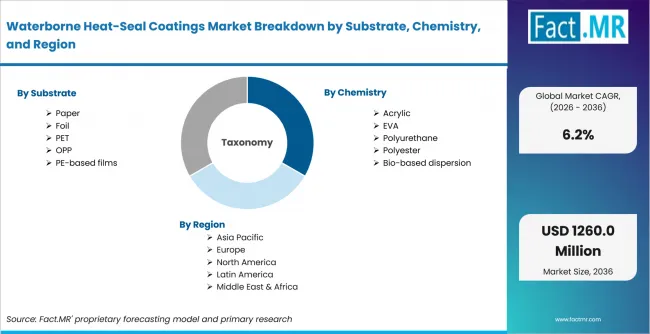
Waterborne Heat Seal Coatings Market Breakdown By Substrate, Chemistry, And Region | Source: Fact.MR
| Attribute | Details |
|---|---|
| Quantitative Units | USD Million in 2026 to USD Million by 2036 at CAGR |
| Market Definition | Water-based heat-seal coatings used on paper, foil, films, and laminates for flexible and semi-rigid packaging. |
| Substrate | Paper; Foil; PET; OPP; PE-based films |
| Chemistry | Acrylic; EVA; Polyurethane; Polyester; Bio-based dispersion |
| Seal Performance | Low-temperature seal; Hot tack; Peelable; Retortable; High-barrier |
| Application | Lidding; Sachets; Flow wraps; Blister cards; Food trays |
| End Use | Food; Healthcare; Personal care; Industrial packaging |
| Regions Covered | North America; Europe; Asia Pacific; Central and South America; Middle East and Africa |
| Countries Covered | Germany; Brazil; United States |
| Key Companies Profiled | ACTEGA; Henkel; Mitsui Chemicals; Michelman |
| Forecast Period | 2026 to 2036 |
| Approach | Hybrid top-down and bottom-up approach using Heat Seal Coatings / Flexible Packaging Coatings; segment shares; country growth; mapping; and technical validation |
Source: Fact.MR analysis. Updated Jul 16, 2026
How is the market segmented?
-
By Substrate
- Paper
- Foil
- PET
- OPP
- PE-based films
-
By Chemistry
- Acrylic
- EVA
- Polyurethane
- Polyester
- Bio-based dispersion
-
By Seal Performance
- Low-temperature seal
- Hot tack
- Peelable
- Retortable
- High-barrier
-
By Application
- Lidding
- Sachets
- Flow wraps
- Blister cards
- Food trays
-
By End Use
- Food
- Healthcare
- Personal care
- Industrial packaging
-
By Region
- North America
- United States
- Canada
- Europe
- Germany
- United Kingdom
- France
- Italy
- Spain
- Asia Pacific
- China
- India
- Japan
- South Korea
- Australia
- Central & South America
- Brazil
- Argentina
- Mexico
- Chile
- Middle East & Africa
- UAE
- Saudi Arabia
- South Africa
- North America
Which companies are the key providers?
ACTEGA and Henkel are key providers. Mitsui Chemicals are also profiled. Michelman complete the company set.
- ACTEGA
- Henkel
- Mitsui Chemicals
- Michelman
Bibliography
- Michelman. (15 October 2024). Michelman Debuts Water-based Barrier Coatings and PE Alternatives at Pack Expo 2024 to Help Converters and Brands Reach Sustainability Goals. Michelman.
- U.S. Census Bureau. (2 July 2026). Manufacturers’ Shipments, Inventories, and Orders: May 2026 Full Report. U.S. Census Bureau.
This Report Addresses
- The report provides strategic intelligence on Waterborne Heat-Seal Coatings across Substrate and Chemistry choices that shape packaging qualification programs.
- Segment analysis covers Paper and Acrylic as the share leaders within the 2026 market structure.
- Regional outlook evaluates US, Germany, France, UK and 30+ countries.
- Competitive analysis profiles ACTEGA, Henkel and Mitsui Chemicals, followed by Michelman as additional active coating providers.
- Seal assessment covers Low-temperature seal, Hot tack and Peelable options alongside Retortable and High-barrier performance requirements.
- Use-case assessment covers Lidding and Sachets alongside Flow wraps, Blister cards and Food trays.
What does the Waterborne Heat-Seal Coatings Market cover?
Water-based heat-seal coatings used on Paper and Foil as well as PET or OPP and PE-based films across named packaging applications.
The Waterborne Heat-Seal Coatings Market covers coatings sold to create a sealable surface after controlled heat and pressure are applied.
Commercial value includes coating revenue and the technical support needed for application or drying and final seal qualification.
What is included in the scope?
Water-based heat-seal coating revenue across the defined Substrate and Chemistry segments within flexible or semi-rigid packaging production.
The scope includes Acrylic and EVA as well as Polyurethane or Polyester and Bio-based dispersion grades sold for heat-seal function. Coverage spans Low-temperature seal and Hot tack plus Peelable or Retortable and High-barrier performance categories. Applications include Lidding and Sachets alongside Flow wraps or Blister cards within the defined market boundary. Food trays complete the Application scope where coated surfaces must seal during filled package handling. End Use coverage includes Food and Healthcare Plus Personal care and Industrial packaging where the purchased function is heat sealing.
What is excluded from the scope?
Solvent-only coatings and extrusion sealant films remain outside the market unless revenue is reported within a waterborne heat-seal product line.
The scope excludes pressure-sensitive label adhesives and cold-seal coatings because their activation mechanism differs from the named heat-seal function. Coating equipment and base packaging substrates remain outside the revenue boundary unless bundled product revenue cannot be separated.
How was the analysis built?
120+ sources, 40+ company portfolios, 25+ countries, 20+ interviews.
- Primary Research: Primary research includes discussions with manufacturers, service providers, technology developers, distributors, end users, procurement teams, and subject-matter experts. These conversations examine purchasing priorities, product adoption, operational challenges, approval requirements, competitive positioning, and the factors that influence wider market acceptance.
- Desk Research: Desk research covers government statistics, regulatory publications, company filings, trade data, technical studies, industry associations, standards, public policy, and other authoritative sources. Every source used in the analysis is documented in the bibliography.
- Market Sizing and Forecasting: Market estimates combine historical performance, demand indicators, pricing and volume trends, segment shares, company participation, country-level growth, adoption patterns, investment activity, and barriers to market expansion.
- Data Validation and Update Cycle: Findings are validated by comparing primary interviews with public data, company activity, regulatory changes, trade patterns, and industry developments. Regular updates review new product launches, capacity changes, partnerships, approvals, procurement trends, and shifts in commercial adoption.
Frequently Asked Questions
Which Substrate leads the Waterborne Heat-Seal Coatings Market?
Which Chemistry leads the Waterborne Heat-Seal Coatings Market?
Which Seal Performance leads the Waterborne Heat-Seal Coatings Market?
Which Application leads the Waterborne Heat-Seal Coatings Market?
Which End Use leads the Waterborne Heat-Seal Coatings Market?
How does Germany perform in the Waterborne Heat-Seal Coatings Market?
How does the United States perform in the Waterborne Heat-Seal Coatings Market?
What is the primary driver in the Waterborne Heat-Seal Coatings Market?
Why is Paper important in the Waterborne Heat-Seal Coatings Market?
Who worked on this report


Preview the report firsthand - request a free sample
Free SampleGet the brochure for pricing and purchase details
Download PDF