- Market Value (2025): USD 1.02 Bn
- Estimated Value (2026): USD 1.15 Bn
- Forecast Value (2036): USD 3.96 Bn
- CAGR (2026-2036): 13.2%
What is the Super Capacitors Battery Energy Storage System Market forecast to be worth by 2036?
USD 1.15 billion in 2026 to USD 3.96 billion by 2036 at a 13.2% CAGR.
- Worth USD 1.02 billion in 2025, the super capacitors battery energy storage system market already serves vehicle power systems, wind turbine pitch controls, industrial backup units and grid support cabinets.
- Revenue will grow from USD 1.15 billion in 2026 to USD 3.96 billion by 2036 as automakers fit capacitor modules to electrified platforms and utilities buy fast-response units for frequency and voltage support.
- A 13.2% CAGR reflects a technology moving from component sales into packaged storage systems, where each module carries balancing electronics, thermal control and power conversion that lift the value per installation.
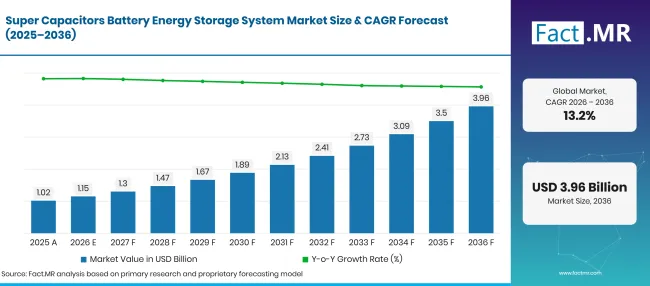
Super Capacitors Battery Energy Storage System Market Forecast Global | Source: Fact.MR
| Year | Basis | Market Value (USD billion) |
|---|---|---|
| 2025 | Actual | 1.02 |
| 2026 | Estimate | 1.15 |
| 2036 | Forecast | 3.96 |
| CAGR 2026 to 2036 | Forecast period | 13.2% |
Source: Fact.MR analysis. Updated Nov 5, 2026
What are the defining numbers behind Super Capacitors Battery Energy Storage System Market growth?
New value of USD 2.8 billion will be created between 2026 and 2036, led by double-layer cells, vehicle applications and utility grid support.
- Demand Drivers in the Market
- Electric vehicles are pulling high-power storage into mass production. Electric car sales exceeded 17 million globally in 2024, a sales share above 20%, according to the International Energy Agency [1]. Each of these platforms needs a way to capture braking energy and cover sudden acceleration loads, a job that capacitor modules handle without shortening battery life.
- Solar and wind growth is raising the need for storage that reacts faster than any spinning reserve. The International Renewable Energy Agency reported a record 585 GW of renewable power capacity added in 2024, with solar accounting for more than three-quarters of the expansion [2].
- AI data centers are opening a fresh demand channel. Graphics processor clusters draw power in steep, repeated spikes, and operators want buffers that respond in microseconds and survive constant cycling.
- Industrial automation keeps adding equipment with short, heavy power bursts. Port cranes, automated guided vehicles, presses and robotic lines all draw peak current for seconds at a time. Capacitor-based buffers cut peak demand charges and protect sensitive electronics from voltage sags.
- Key Segments Analyzed
- By Product Type: Electric Double-Layer Capacitors will hold 58.3% share in 2026 because their carbon electrodes and proven cell formats give buyers long cycle life at a known cost.
- By Application: Automotive will account for 31.4% of 2026 demand, as hybrid buses, trucks and passenger cars use capacitor modules for braking energy recovery and start-stop support.
- By End-User: Utilities will capture 29.7% in 2026, since grid operators need instant response to frequency and voltage deviations caused by renewable generation.
- Analyst Opinion at Fact.MR
- Shambhu Nath Jha, Principal Consultant at Fact.MR, states, “Supercapacitor storage has shed its image as a component curiosity and is now specified wherever power peaks are short, sharp and frequent. Vehicle platforms and grid support cabinets will carry most of the growth, while AI data centers will give suppliers a new high-value outlet within the next three years. Companies that can ship complete modules with balancing, thermal control and certified safety ratings will win the contracts that cell-only suppliers miss.”
- Strategic Implications
- Manufacturers should invest in higher-voltage cells and lower internal resistance, since buyers in data centers and grid support now compare suppliers on peak current ratings and safety certification.
- Automotive suppliers should design battery and capacitor packs together, letting capacitors take braking and acceleration peaks so battery cells last longer in buses and commercial fleets.
- Utilities and grid service providers should test capacitor units for frequency response and voltage support alongside battery projects, where fast reaction earns grid service revenue.
- Investors should favor suppliers with module integration skills and secured long-term orders, because packaged systems carry higher margins than bare cells.
Japan heads the five-country comparison at 16.6%, as its new national strategy treats power density as a target in its own right and its capacitor makers hold deep materials expertise. The United States follows closely at 16.2%, where the pace of battery storage installation and AI data center construction creates matching need for fast power buffers. Germany, at 15.3%, trails by about a point, with a long queue of grid storage connection offers and a strong industrial automation base. A wider gap of 3.6 points separates Brazil at 11.7%, where dedicated storage auctions are still at an early stage. The United Kingdom, at 9.9%, closes the range, since its flexibility programmes favor long-duration assets over short, high-power storage.
How does the Super Capacitors Battery Energy Storage System Market break down by segment?
Electric Double-Layer Capacitors will lead Product Type at 58.3%; Automotive will head Application at 31.4%; Utilities will hold End-User at 29.7% in 2026.
Which Product Type leads?
Electric Double-Layer Capacitors hold 58.3% of 2026 sales.
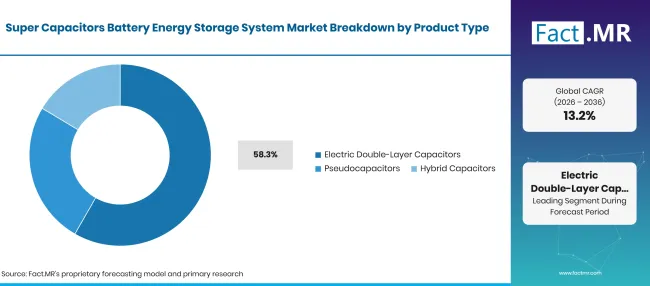
Super Capacitors Battery Energy Storage System Market Breakdown Product Type | Source: Fact.MR
| Product Type | Share (2026) |
| Electric Double-Layer Capacitors (Leading segment) | 58.3% |
| Other segments combined | 41.7%* |
| Total | 100.0% |
Source: Fact.MR analysis. Updated Nov 5, 2026
Engineers choose double-layer cells when they need the most cycles per dollar. Charge is stored on the surface of porous carbon, so no chemical reaction wears the electrode, and cells routinely last for hundreds of thousands of cycles. Electrode quality depends on high-surface-area carbons tracked in activated carbon supply. Public funding is also reaching containerized formats: India’s Technology Development Board sanctioned support in October 2025 for a mobile high-power containerized supercapacitor storage system built for pulse power, grid stabilization and defence use [3]. Pseudocapacitors use metal oxides or conductive polymers to add fast surface reactions, which raises energy density but narrows cycle life. Hybrid capacitors pair a battery-type electrode with a capacitor electrode and are gaining interest in sectors that want more runtime per module, a trend linked to graphene battery designs.
What supports Automotive within Application?
Automotive takes 31.4% of 2026 revenue.
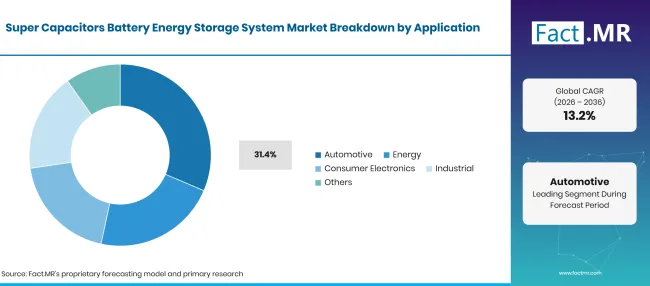
Super Capacitors Battery Energy Storage System Market Breakdown Application | Source: Fact.MR
| Application | Share (2026) |
| Automotive (Leading segment) | 31.4% |
| Other segments combined | 68.6%* |
| Total | 100.0% |
Source: Fact.MR analysis. Updated Nov 5, 2026
Vehicles brake and accelerate thousands of times a day in city service, and each cycle produces a burst of energy that batteries absorb poorly. Capacitor modules catch that burst and return it on the next acceleration, which cuts fuel use in hybrids and reduces stress on traction batteries. City fleets covered in electric bus demand are a natural fit. YUNASKO reported in February 2025 that it continues to take part in the EU-funded HEDAsupercap project, which targets efficient hybrid storage systems for urban transport [4]. Energy applications include wind turbine pitch control and solar smoothing. Consumer electronics use small coin and prismatic cells for memory backup. Industrial users rely on capacitors for cranes, automated guided vehicles and uninterruptible power units.
How does End-User shape demand?
Utilities account for 29.7% of 2026 value.
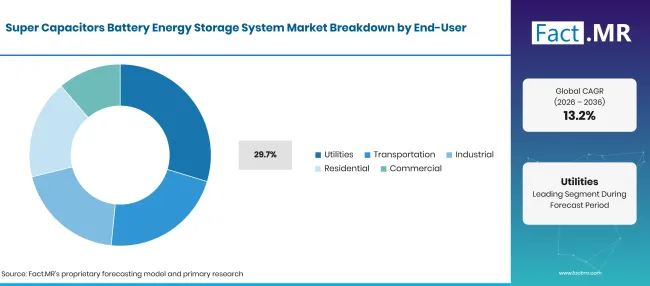
Super Capacitors Battery Energy Storage System Market Breakdown End User | Source: Fact.MR
| End-User | Share (2026) |
| Utilities (Leading segment) | 29.7% |
| Other segments combined | 70.3%* |
| Total | 100.0% |
Source: Fact.MR analysis. Updated Nov 5, 2026
Grid operators face second-by-second swings as more solar and wind plants connect, and they need storage that can inject or absorb power almost instantly. Capacitor units handle frequency regulation, voltage support and fault ride-through, and they do so for decades without capacity fade. Many utility projects now combine them with cells from the lithium-ion battery supply base, splitting fast and slow duties between the two. Transportation end-users include bus operators, rail networks and port authorities. Industrial plants buy capacitor buffers to cut peak demand charges. Residential and commercial users remain small buyers today, mostly through backup units and building power quality equipment.
What is accelerating Super Capacitors Battery Energy Storage System Market adoption, and what is holding it back?
Fast charging, high power density, long service life and rising renewable output are drawing buyers toward capacitor-based storage. Lower energy density than batteries limits these systems to short-duration duties, and high material and integration costs still slow purchases in price-sensitive sectors.
Drivers Impact Analysis
| DRIVER | (~) % IMPACT ON CAGR | GEOGRAPHIC RELEVANCE | IMPACT TIMELINE |
|---|---|---|---|
| Electric and hybrid vehicles using supercapacitors to capture braking energy and ease battery loads | +4.4% | East Asia, Europe, North America | Medium term (2-4 years) |
| Solar and wind operators requiring quick-response storage to keep voltage and frequency steady | +3.7% | Europe, North America, East Asia | Medium term (2-4 years) |
| Industries requiring instant power response and equipment capable of withstanding constant cycling | +2.8% | Global | Short term (<=2 years) |
| Factories, cranes and heavy machinery drawing power in short, heavy bursts | +2.0% | Global | Short term (<=2 years) |
Source: Fact.MR analysis. Updated Nov 5, 2026
Opportunity Impact Analysis
| OPPORTUNITY | (~) % IMPACT ON CAGR | GEOGRAPHIC RELEVANCE | IMPACT TIMELINE |
|---|---|---|---|
| Hybrid systems pairing batteries with supercapacitors for longer runtime and faster response | +1.4% | Global | Medium term (2-4 years) |
| Modular high-voltage units scalable for utility and industrial sites | +1.0% | Europe, North America, East Asia | Medium term (2-4 years) |
| Supercapacitor packs for electric buses and commercial vehicles with frequent stop-start cycles | +0.8% | East Asia, Europe, Latin America | Medium term (2-4 years) |
| Domestic supercapacitor manufacturing and ready-to-deploy containerized storage units | +0.4% | South Asia, East Asia | Long term (>=4 years) |
Source: Fact.MR analysis. Updated Nov 5, 2026
Restraints Impact Analysis
| RESTRAINT | (~) % IMPACT ON CAGR | GEOGRAPHIC RELEVANCE | IMPACT TIMELINE |
|---|---|---|---|
| Lower energy density than conventional batteries | -1.2% | Global | Short term (<=2 years) |
| High costs of advanced materials and system integration | -1.0% | Global | Medium term (2-4 years) |
| Limited suitability for applications requiring steady power over long periods | -0.7% | Global | Medium term (2-4 years) |
| Thermal management, cell balancing and integration challenges that slow deployment | -0.5% | Global | Long term (>=4 years) |
Source: Fact.MR analysis. Updated Nov 5, 2026
Which countries are scaling the Super Capacitors Battery Energy Storage System Market through 2036?
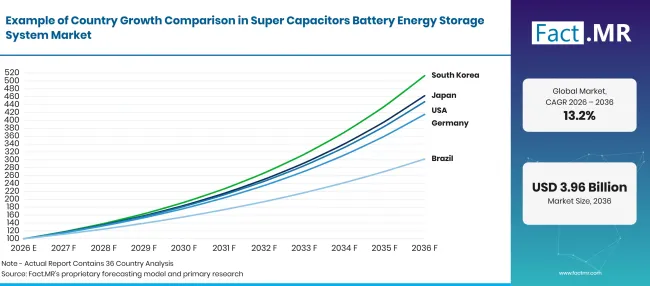
Super Capacitors Battery Energy Storage System Market Growth Index | Source: Fact.MR
| Country | CAGR (2026 to 2036) |
|---|---|
| Japan | 16.6% |
| United States | 16.2% |
| Germany | 15.3% |
| Brazil | 11.7% |
| United Kingdom | 9.9% |
Source: Fact.MR analysis. Updated Nov 5, 2026
What supports adoption in Japan?
16.6% CAGR, driven by a national strategy that now targets power output alongside storage capacity.
Japan’s capacitor makers, automotive electronics suppliers and carbon material producers give the country a deep base for supercapacitor cells. In June 2026, the Ministry of Economy, Trade and Industry revised its battery plan into the Battery and Power Industry Strategy, widening the focus from energy density to power density and setting a domestic manufacturing target of 150 GWh per year from 2030 [5].
How is the United States developing demand?
16.2% CAGR, backed by fast battery storage build-out and AI data center construction.
Utilities are adding storage at speed to handle renewable variability and peak loads. The U.S. Energy Information Administration reported 43.6 GW of operating utility-scale battery storage at the end of 2025, with another 8.3 GW added in the first half of 2026, bringing the total to nearly 52 GW [6]. That growing fleet widens the market for capacitor units that manage power quality and near-instant grid response.
What is supporting Germany’s adoption?
15.3% CAGR, helped by a long queue of grid storage projects and strong factory automation.
Germany’s shift to renewable electricity keeps raising the number of storage projects seeking a grid connection. SMARD reported that network operators issued battery storage connection offers covering 54.2 GW of power and 142.4 GWh of energy in 2025 [7]. Capacitor modules can work alongside these batteries by handling the short spikes that wear cells most. The country’s machine builders and automation suppliers also buy capacitor buffers for presses, robots and intralogistics vehicles.
How is Brazil scaling demand?
11.7% CAGR, reflecting the first steps toward a structured storage procurement system.
Brazil is preparing its first auction dedicated to energy storage capacity. The Energy Research Office reported in August 2026 that 6,091 projects registered for the 2026 Power Capacity Reserve Auction for Energy Storage, representing 296,807 MW of proposed capacity [8]. Battery projects will take most awards, yet the scale of interest signals a grid that is starting to value fast response.
How does the United Kingdom perform?
9.9% CAGR, as storage policy currently channels most support toward long-duration assets.
Great Britain uses a cap-and-floor revenue scheme to reduce investment risk for long-duration storage. In June 2026, Ofgem provisionally selected 16 projects under the scheme, covering pumped storage hydro, compressed air, lithium-ion batteries and vanadium redox flow batteries, and noted that the country already runs 2.8 GW of long-duration storage at four pumped hydro sites [9]. Supercapacitors fall outside that programme, so their growth relies on rail, industry and grid power quality contracts.
Who leads the Super Capacitors Battery Energy Storage System Market?
Competition splits into three groups. Specialist system builders such as Skeleton Technologies and LS Materials compete on module power, safety certification and the ability to deliver complete racks for data centers, grids and fusion research. Skeleton reported in June 2026 that its supercapacitor set a record peak current under UL certification, and in October 2026 it announced a strategic investment led by Siemens to expand manufacturing in the United States [10] [11]. LS Materials announced its first ultracapacitor supply to a U.S. fusion power project in April 2026 [12].
Established capacitor makers, including Nippon Chemi-Con, KYOCERA AVX and VINATech, rely on high-volume cell production, automotive grades and long customer relationships. A third group, CAP-XX and YUNASKO, focuses on thin prismatic cells, lithium-ion capacitors and hybrid designs for compact or transport uses. Through 2036, suppliers that pair cell quality with integration engineering will win the larger system orders.
What is the report’s scope and coverage?
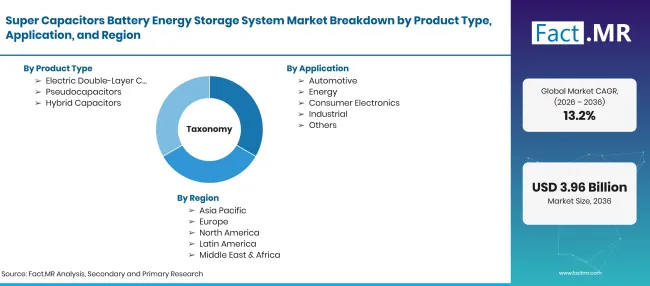
Super Capacitors Battery Energy Storage System Market Taxonomy | Source: Fact.MR
| Attribute | Details |
|---|---|
| Quantitative Units | USD billion in 2026 to USD billion by 2036 at CAGR |
| Market Definition | Energy storage systems that use supercapacitor cells and modules to store and release electrical energy through electrostatic double-layer or pseudocapacitive mechanisms for rapid power delivery, buffering and voltage stabilization. |
| Product Type | Electric Double-Layer Capacitors; Pseudocapacitors; Hybrid Capacitors |
| Application | Automotive; Energy; Consumer Electronics; Industrial; Others |
| End-User | Utilities; Transportation; Industrial; Residential; Commercial |
| Regions Covered | North America; Latin America; Western Europe; Eastern Europe; East Asia; South Asia & Pacific; Middle East & Africa |
| Countries Covered | Japan; United States; Germany; Brazil; United Kingdom |
| Companies Profiled | Skeleton Technologies; LS Materials; Nippon Chemi-Con; KYOCERA AVX; VINATech; CAP-XX; YUNASKO |
| Forecast Period | 2026 to 2036 |
| Approach | Hybrid top-down and bottom-up model built from capacitor cell output, module and system installations, application demand, end-user adoption and country growth rates. |
Source: Fact.MR analysis. Updated Nov 5, 2026
Bibliography
- [1] International Energy Agency. (2025, May 14). Global EV Outlook 2025: Executive summary.
- [2] International Renewable Energy Agency. (2025, March 26). Record-Breaking Annual Growth in Renewable Power Capacity.
- [3] Technology Development Board, Department of Science and Technology, Government of India. (2025, October 31). TDB-DST sanctions Support for Indigenous Supercapacitor Energy Storage System by M/s Westech Power Management Pvt. Ltd, Pune, Maharashtra.
- [4] YUNASKO. (2025, February 10). YUNASKO continues to participate in Horizon Europe projects.
- [5] Ministry of Economy, Trade and Industry, Japan. (2026, June 2). "Battery Industry Strategy" Revised as the "Battery and Power Industry Strategy".
- [6] U.S. Energy Information Administration. (2026, August 7). Battery storage capacity averaged 70% growth over the last three years.
- [7] SMARD, Bundesnetzagentur. (2026, August 20). Status of battery storage applications in 2025/2026.
- [8] Empresa de Pesquisa Energética. (2026, August 5). 2026 Power Capacity Reserve Auction for Energy Storage: EPE registers record number of projects.
- [9] Office of Gas and Electricity Markets. (2026, June 26). Ofgem boosts long duration storage to secure more homegrown energy for customers.
- [10] Skeleton Technologies. (2026, June 25). Skeleton Technologies Supercapacitor Sets Record for Highest Peak Current Certified by UL at 3,500 Amperes.
- [11] Skeleton Technologies. (2026, October 14). Skeleton Technologies secures strategic investment led by Siemens to expand US manufacturing.
- [12] LS Materials. (2026, April 23). LS Materials, first supply to U.S. fusion project
This Report Answers
- How large will supercapacitor energy storage revenue be in 2026, and what value will it reach by 2036?
- Why do electric double-layer capacitors hold the lead over pseudocapacitors and hybrid capacitors?
- Which application and end-user groups lead, and what technical needs explain their 2026 positions?
- How do Japan, the United States, Germany, Brazil and the United Kingdom differ in storage policy and grid investment?
- Where do specialist system builders compete with established capacitor makers?
- What role do energy density, material cost and cell balancing play in limiting wider use?
What does the Super Capacitors Battery Energy Storage System Market cover?
This market tracks storage systems that rely on supercapacitor cells to capture, hold and release electrical energy within seconds or less. Electric double-layer capacitors, pseudocapacitors and hybrid capacitors form the three technology groups, and revenue is counted at the cell, module and packaged system level. Readers comparing broader storage options can refer to energy storage systems.
Value covers automotive, energy, consumer electronics, industrial and other applications across utilities, transportation, industrial, residential and commercial buyers. Revenue is valued at manufacturer selling prices, with modules and integrated systems counted once at their final assembled value to avoid double counting of cells. Component-level trends are covered in the supercapacitor cells study.
What is included in the scope?
Standalone supercapacitor storage systems, capacitor cells, integrated modules, high-voltage assemblies and containerized units built for rapid-response storage.
Hybrid battery and supercapacitor configurations in which the capacitor bank forms an identifiable part of the system.Cell balancing circuits, voltage monitoring, thermal management and power conversion interfaces sold as part of a supercapacitor solution.Systems used for regenerative braking, industrial power buffering, renewable smoothing, data center load support and short-duration grid services.
What is excluded from the scope?
Battery-only storage installations using lithium-ion, lead-acid or flow chemistries with no separate capacitor component.
Ordinary capacitors used only for filtering, coupling or power-factor correction.Fuel cells, pumped hydro, compressed air and flywheel storage systems.Carbon powders, electrolytes and other raw materials traded on their own, along with generation, transmission and distribution equipment.
How Was the Analysis Built?
The analysis draws on 120+ sources, 35+ company portfolios, 25+ countries, and more than 20 industry interviews.
- Primary Research: Primary research includes discussions with manufacturers, service providers, technology developers, distributors, end users, and subject-matter experts. These conversations examine purchasing priorities, product adoption, operational challenges, approval requirements, competitive positioning, and the factors that influence wider market acceptance.
- Desk Research: Desk research covers government statistics, regulatory publications, company filings, trade data, technical studies, industry associations, standards, public policy, and other authoritative sources. Every source used in the analysis is documented in the bibliography.
- Market Sizing and Forecasting: Market estimates combine historical performance, demand indicators, pricing and volume trends, segment shares, company participation, country-level growth, adoption patterns, investment activity, and barriers to market expansion.
- Data Validation and Update Cycle: Findings are validated by comparing primary interviews with public data, company activity, regulatory changes, trade patterns, and industry developments. Regular updates review new product launches, capacity changes, partnerships, approvals, and shifts in commercial adoption.
Segmentation
Which companies are the key providers?
Key companies in the Super Capacitors Battery Energy Storage System Market include Skeleton Technologies, LS Materials, Nippon Chemi-Con, KYOCERA AVX, VINATech, CAP-XX and YUNASKO.
- Skeleton Technologies
- LS Materials
- Nippon Chemi-Con
- KYOCERA AVX
- VINATech
- CAP-XX
- YUNASKO
How is the market segmented?
-
By Product Type
- Electric Double-Layer Capacitors
- Pseudocapacitors
- Hybrid Capacitors
-
By Application
- Automotive
- Energy
- Consumer Electronics
- Industrial
- Others
-
By End-User
- Utilities
- Transportation
- Industrial
- Residential
- Commercial
-
By Region
- North America
- Latin America
- Western Europe
- Eastern Europe
- East Asia
- South Asia & Pacific
- Middle East & Africa
Frequently Asked Questions
How large is the super capacitors battery energy storage system market in 2026?
What growth rate will the super capacitors battery energy storage system market record?
Which product type leads?
Which application leads?
Which end-user leads?
Which country will grow quickest?
Who are the main companies?
What holds the market back?
Who worked on this report


Preview the report firsthand - request a free sample
Free SampleGet the brochure for pricing and purchase details
Download PDF