- Estimated Value(2026): 1.9 Bn
- Forecast Value (2036): 3.3 Bn
- CAGR (2026 - 2036): 5.7%
What is the suppositories market forecast to be worth by 2036?
- The suppositories market surpassed a valuation of USD 1.8 billion in 2025.
- Demand is set to rise from USD 1.9 billion in 2026 to USD 3.3 billion by 2036.
- The market is forecast to grow at 5.7% CAGR from 2026 to 2036 as non-oral dosage needs increase across hospitals and retail pharmacies.
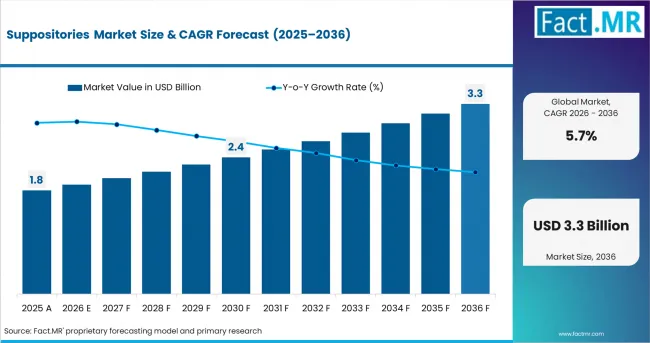
Suppositories Market Value Analysis | Source: Fact.MR
| Metric | Details |
|---|---|
| Industry Size 2026 | USD 1.9 billion |
| Industry Value 2036 | USD 3.3 billion |
| CAGR 2026 to 2036 | 5.7% |
Source: Fact.MR analysis. Updated Jun 4, 2026
Summary of Suppositories Market
- Demand Drivers in the Market
- Non-oral Delivery Need: Hospitals need suppositories for patients who cannot swallow tablets or capsules.
- Bowel Care Use: Care providers use rectal suppositories for constipation and hemorrhoid care.
- Pharmacy Access: Retail pharmacies support OTC access for constipation relief and self-care use.
- Key Segments Analyzed
- By Product Type: Rectal suppositories are expected to hold 68.0% share in 2026 because bowel care and non-oral medication needs support repeat use.
- By Base Type: Lipophilic bases are likely to account for 59.0% share in 2026 as many rectal suppositories need melt-based release after insertion.
- By Form: Semi-solid forms are projected to hold 74.0% share in 2026 since most products need stable shape and controlled softening.
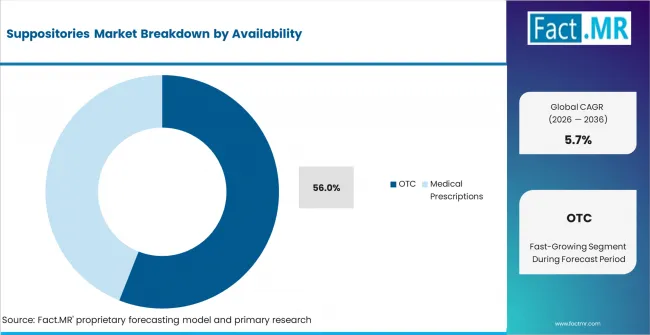
- By Availability: Over-the-counter products are anticipated to capture 56.0% share in 2026 as constipation relief products are widely sold through retail pharmacies.
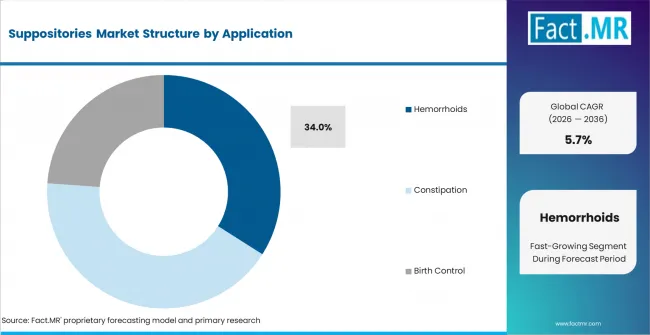
- By Application: Hemorrhoids are expected to hold 34.0% share in 2026 because anorectal symptoms often need local treatment support.
- By Geography: The United States is expected to register 5.1% CAGR through 2036 as retail laxative use and hospital care support demand.
- Analyst Opinion at Fact.MR
- Shambhu Nath Jha, Principal Consultant at Fact.MR, states, “Suppositories are useful when oral medication is difficult or unsuitable. Demand is tied to care delivery instead of convenience alone. Suppliers that support stable manufacturing and patient use will gain better access across pharmacies and hospitals.”
- Strategic Implications
- Formulation Stability: Manufacturers need base systems that keep the product shape stable during storage.
- Pharmacy Access: OTC suppliers should provide clear labeling and safe use instructions for constipation products.
- Hospital Use: Drug makers must align suppository products with care needs for patients who cannot take oral medication.
Suppositories demand is moving beyond basic bowel care. Clinicians need this dosage form for patients who cannnot swallow tablets or capsules. Care providers use rectal products for constipation care and palliative treatment. Pharmaceutical firms also need stable dosage forms that support local treatment and wider drug absorption. DailyMed lists updated bisacodyl suppository labels for constipation relief in 2025. [1]
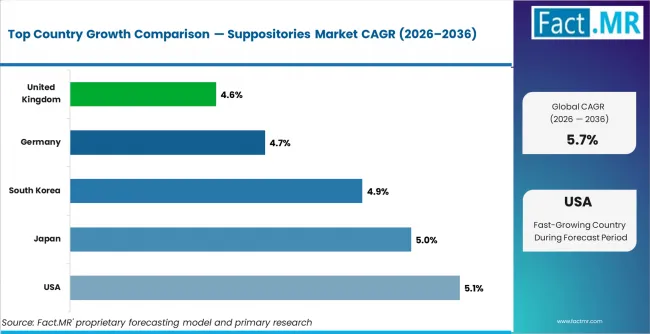
The United States is expected to register 5.1% CAGR through 2036 as hospital care and retail laxative use support demand. Japan is projected to record 5.0% CAGR as aging care needs increase the use of non-oral dosage forms. South Korea is likely to post 4.9% CAGR by 2036 as hospital pharmacies and retail channels improve patient access. Germany is forecast to advance at 4.7% CAGR because Europe’s pharmaceutical base supports manufacturing and clinical use. The United Kingdom is poised to record 4.6% CAGR as constipation care and palliative medication support steady use.
How does the suppositories market break down by segment?
Suppositories Market Analysis by Product Type
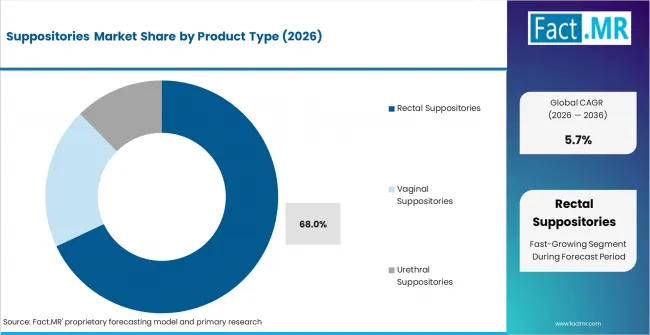
Suppositories Market Analysis By Product Type | Source: Fact.MR
Rectal suppositories are expected to hold 68.0% share in 2026 because constipation and non-oral administration needs are common in care settings. Vaginal suppositories support gynecological applications such as dryness and birth control. DailyMed’s 2026 glycerin suppository label lists use for occasional constipation relief. [2]
- Rectal Delivery: Rectal suppositories support bowel care and medication use for patients who cannot take oral products.
- Vaginal Use: Vaginal suppositories support local treatment in gynecological care.
- Specialist Route: Urethral suppositories serve limited clinical use and need clear patient guidance.
Suppositories Market Analysis by Base Type
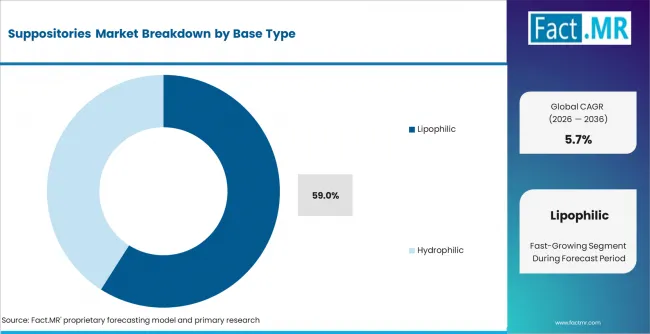
Suppositories Market Analysis By Base Type | Source: Fact.MR
Lipophilic bases lead because many suppository products need to soften or melt after insertion. The base type is likely to account for 59.0% share in 2026 as many rectal products use melt-based release for local action. LGM Pharma invested in U.S. manufacturing capabilities for liquids, suspensions, semi-solids, and suppositories in 2025. [3]
- Lipophilic Release: Lipophilic bases support melt-based release after use and suit many rectal products.
- Hydrophilic Dissolution: Hydrophilic bases support water-soluble release needs and selected formulation profiles.
- Storage Control: Base choice affects melting risk and shelf stability during transport and pharmacy storage.
Suppositories Market Analysis by Form
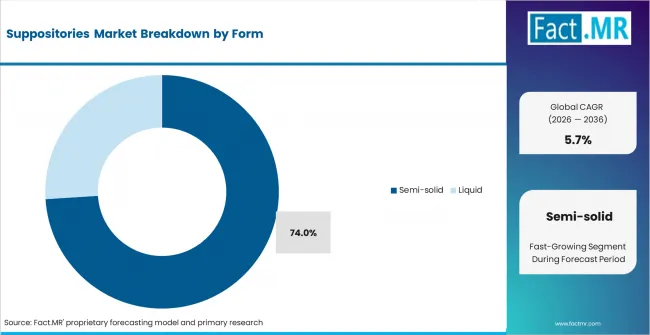
Suppositories Market Analysis By Form | Source: Fact.MR
Semi-solid forms lead because suppositories need to keep shape before use and soften after placement. Liquid formats serve limited specialty use because handling and packaging needs differ. Semi-solid products are projected to hold 74.0% share in 2026 because most rectal and vaginal products must be packed and dispensed in stable unit form. Formulation teams must control base hardness and drug uniformity. Bayer’s 2025 Annual Report confirms its broad pharmaceutical and consumer health activity across regulated product portfolios. [4] Form choice affects manufacturing quality because each unit must deliver consistent active ingredient performance.
- Shape Control: Semi-solid forms help manufacturers keep unit shape stable during packaging and storage.
- Dose Uniformity: Controlled mixing supports even active ingredient distribution in each suppository.
- Handling Ease: Stable forms help pharmacies and caregivers administer products with fewer handling issues.
Suppositories Market Analysis by Availability
Suppositories Market Analysis By Availability | Source: Fact.MR
OTC products support common use because constipation relief and bowel care products are often purchased through retail pharmacies. Medical prescriptions serve specialist treatments such as seizures or controlled drug delivery. Over-the-counter products are anticipated to capture 56.0% share in 2026 because short-term constipation relief products have regular retail pharmacy access.
- Retail Access: OTC suppositories help patients manage occasional constipation through pharmacies.
- Clinical Oversight: Prescription products support specialist use that requires physician direction.
- Label Discipline: Clear instructions help patients and caregivers use suppositories safely.
Suppositories Market Analysis by Application
Suppositories Market Analysis By Application | Source: Fact.MR
Hemorrhoids hold a major application position because anorectal symptoms often need local delivery and quick relief. Constipation creates repeat demand through rectal laxative products. Hemorrhoids are expected to hold 34.0% share in 2026 because local treatment can reduce discomfort without oral dosing. Seizure and erectile dysfunction applications serve more specific clinical needs. Application choice depends on route suitability and patient condition.
- Hemorrhoid Care: Local suppository delivery supports anorectal symptom treatment and patient comfort.
- Constipation Relief: Rectal laxative products help bowel movement when oral options are unsuitable.
- Specialty Therapy: Vaginal and urethral applications serve targeted treatment needs with narrower patient groups.
What is accelerating suppositories adoption, and what is holding it back?
Non-oral drug delivery is the main driver for suppositories demand. Hospitals need dosage forms for patients who cannot swallow medicines. Caregivers rely on rectal products for bowel care and palliative support. Retail pharmacies support OTC constipation relief products.
Manufacturing and storage can limit wider adoption. Suppositories need careful base selection and controlled temperature handling. Some products may soften during storage or transport. Patients may avoid suppositories because of discomfort or low familiarity. Manufacturers need clearer patient instructions and packaging that protects product shape.
Opportunities in the Suppositories Market
- Geriatric Care: Suppliers can support hospitals and caregivers with products for patients who cannot take oral medicines.
- OTC Constipation: Retail brands can expand clear-label suppository products for short-term bowel care use.
- CDMO Manufacturing: Contract manufacturers can support pharmaceutical firms that need specialized dosage form production.
Which countries are scaling suppositories demand fastest?
Based on regional analysis, the suppositories market is segmented into North America, Latin America, Europe, East Asia, South Asia and ASEAN, Oceania, and Middle East and Africa.
| Country | CAGR 2026 to 2036 |
|---|---|
| United States | 5.1% |
| Japan | 5.0% |
| South Korea | 4.9% |
| Germany | 4.7% |
| United Kingdom | 4.6% |
Source: Fact.MR analysis. Updated Jun 4, 2026
Suppositories Market Cagr Analysis By Country | Source: Fact.MR
North America Suppositories Market Analysis
North America demand is led by the United States. Hospital systems and OTC laxative use support the region. Manufacturers need stable dosage forms and clear labeling for prescription and OTC channels.
- United States: The United States is expected to register 5.1% CAGR from 2026 to 2036 as retail pharmacies and hospital care support suppository use. OTC constipation products help patients access rectal laxative without a prescription. Hospitals use non-oral dosage forms for patients with swallowing difficulty or palliative care needs.
East Asia Suppositories Market Analysis
East Asia demand comes from aging care needs and hospital-based drug delivery. Japan and South Korea support regional demand through advanced care systems and pharmacy access. Patient education is important because suppository use can be sensitive.
- Japan: Older patient care and non-oral medication needs support Japan’s 5.0% CAGR by 2036. Hospitals and long-term care providers need dosage forms for patients with swallowing difficulty. Rectal products can support bowel care and selected medication delivery. Local pharmaceutical quality standards will shape supplier acceptance. Retail pharmacies can support OTC constipation products with clear instructions.
- South Korea: South Korea is likely to post 4.9% CAGR through 2036 as hospital pharmacies and retail channels support patient access. Suppositories serve patients who need local delivery or cannot take oral products. Constipation care supports repeat use across pharmacies and care settings. Gynecological applications create selective demand for vaginal suppositories. Manufacturers need clear product labels because patient acceptance depends on safe use guidance.
Europe Suppositories Market Analysis
Europe demand is supported by pharmaceutical manufacturing and established pharmacy channels. Germany and the United Kingdom support demand through hospital use and retail access. Manufacturers must manage storage quality and drug labeling rules.
- Germany: Germany pharmaceutical base and aging care needs support suppository demand. The country is forecast to advance at 4.7% CAGR by 2036 as hospitals use non-oral dosage forms for selected patients. Retail pharmacies support OTC laxative access for short-term constipation relief. German manufacturers and CDMOs can support quality-controlled dosage form production. Storage stability matters because suppository bases can soften under poor conditions.
- United Kingdom: Constipation care and palliative medication support steady use in the United Kingdom. The country is poised to record 4.6% CAGR over the forecast period as NHS care pathways create demand for non-oral options in selected patients. Retail pharmacies support OTC bowel care products and pharmacist advice. Vaginal and rectal products serve local treatment needs in specialist applications. Manufacturers need clear dosage guidance and patient-friendly packaging.
Who leads the suppositories market landscape?
Suppositories Market Analysis By Company | Source: Fact.MR
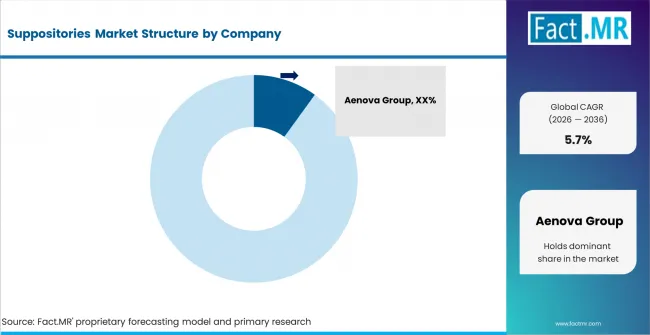
The suppositories market is supported by companies that understand specialist dosage forms and patient use. Aenova Group can serve pharmaceutical brands through contract manufacturing. LGM Pharma supports projects that need product development and supply help. Pfizer Inc. and Novartis AG bring established pharmaceutical experience and pharmacy reach.
Growth through 2036 will depend on stable formulation quality. Suppositories need the right base and steady dose release. Packaging also matters because products must stay stable during storage and handling. Pharmaceutical firms will prefer partners that can manage these needs without supply issues.
Which companies are the key players?
- Aenova Group
- LGM Pharma
- Pfizer Inc.
- Bayer AG
- Novartis AG
Bibliography
- [1] DailyMed. (2025, October 24). Bisacodyl suppository drug label information. National Library of Medicine.
- [2] DailyMed. (2026, May 5). Glycerin suppositories drug label information. National Library of Medicine.
- [3] LGM Pharma. (2025, March 12). LGM Pharma invests $6M in U.S. drug manufacturing capabilities for liquids, suspensions, semi-solids, and suppositories. LGM Pharma.
- [4] Bayer AG. (2026). Annual Report 2025. Bayer AG.
This Report Addresses
- Strategic intelligence on suppositories demand across hospitals, pharmacies, and home care.
- Forecast mapping from USD 1.9 billion in 2026 to USD 3.3 billion by 2036.
- Segment analysis by product type, base type, form, availability, and application.
- Regional outlook covering the United States, Japan, South Korea, Germany, and the United Kingdom.
- Competitive analysis of Aenova Group, LGM Pharma, Pfizer Inc., Bayer AG, Novartis AG.
- Product assessment covering rectal suppositories, vaginal suppositories, lipophilic bases, and OTC products.
- Primary interviews, supplier checks, and official source review support validation.
What does the suppositories market cover?
The suppositories market covers solid or semi-solid dosage forms inserted into the rectum or urethra to deliver active ingredients. The market includes drug products used for constipation and erectile dysfunction. The market is defined by non-oral route delivery and cavity-based drug administration.
Suppositories Market Inclusions
The scope includes rectal and urethral suppositories. Hydrophilic and lipophilic base types are covered. Semi-solid and liquid forms are included when the dosage form is intended for insertion. Prescription and OTC products are covered across retail pharmacies and online channels.
Suppositories Market Exclusions
The scope excludes oral tablets and gels sold without suppository delivery. Enemas are outside scope because they use a different administration format. General laxatives are excluded unless sold as suppository products. Vaginal creams are excluded unless formed and sold as vaginal suppositories.
Suppositories Market Research Methodology
- Primary Research
- Primary research includes interviews with hospital pharmacists and pharmaceutical formulation heads. Retail pharmacy distributors were reviewed separately.
- Desk Research
- Desk research reviews official drug labels and pharmaceutical company filings. Clinical guidance and product documentation support application validation.
- Market-Sizing and Forecasting
- Forecasting uses product type demand and application use. Base type and availability patterns support the forecast approach.
- Data Validation and Update Cycle
- Forecasts are validated through supplier checks and pharmacy channel interviews. Regional assumptions are reviewed against aging care needs and pharmaceutical access patterns.
Segmentation
What is the report’s scope and coverage?
| Attribute | Details |
|---|---|
| Quantitative Units | USD 1.9 billion in 2026 to USD 3.3 billion by 2036 at 5.7% CAGR |
| Market Definition | Non-oral dosage forms inserted into the rectum, vagina, or urethra for drug delivery |
| Product Type | Rectal Suppositories, Vaginal Suppositories, Urethral Suppositories |
| Base Type | Hydrophilic, Lipophilic |
| Form | Semi-solid, Liquid |
| Availability | Medical Prescriptions, Over-the-Counter |
| Application | Constipation, Hemorrhoids, Seizures, Vaginal Dryness, Birth Control, Erectile Dysfunction |
| Regions Covered | North America, Latin America, Europe, East Asia, South Asia and ASEAN, Oceania, Middle East and Africa |
| Countries Covered | United States, Japan, South Korea, Germany, United Kingdom |
| Key Companies Profiled | Aenova Group, LGM Pharma, Pfizer Inc., Bayer AG, Novartis AG |
| Forecast Period | 2026 to 2036 |
| Approach | Hybrid top-down and bottom-up approach using product type demand, base type, form, availability, application, and regional validation |
Source: Fact.MR analysis. Updated Jun 4, 2026
How is the market segmented?
-
By Product Type:
- Rectal Suppositories
- Vaginal Suppositories
- Urethral Suppositories
-
By Base Type:
- Hydrophilic
- Lipophilic
-
By Form:
- Semi-solid
- Liquid
-
By Availability:
- Medical Prescriptions
- Over-the-Counter
-
By Application:
- Constipation
- Hemorrhoids
- Seizures
- Vaginal Dryness
- Birth Control
- Erectile Dysfunction
-
Region:
- North America
- United States
- Canada
- Mexico
- Europe
- Germany
- United Kingdom
- France
- Italy
- Spain
- Asia Pacific
- China
- Japan
- South Korea
- Taiwan
- Singapore
- Latin America
- Brazil
- Argentina
- Middle East & Africa
- GCC Countries
- South Africa
- Israel
- North America
Frequently Asked Questions
What is the Suppositories Market size in 2026?
What will the Suppositories Market be worth by 2036?
What CAGR is projected for the Suppositories Market?
Which product type leads the Suppositories Market?
Rectal suppositories lead with 68.0% share in 2026 because bowel care and non-oral delivery needs support use.
How does Japan perform in the Suppositories Market?
What is the main driver in the Suppositories Market?
What is the main restraint in the Suppositories Market?
Why are rectal suppositories important in this market?
Why are OTC suppositories important in this market?
Who worked on this report


Preview the report firsthand - request a free sample
Free SampleGet the brochure for pricing and purchase details
Download PDF