- Base Value(2025): 15.7 Bn
- Estimated Value(2026): 16.4 Bn
- Forecast Value (2036): 25.1 Bn
- CAGR (2026 - 2036): 4.3%
Sweet and Savory Spread Market Forecast By Fact.MR
In 2025, the sweet and savory spread market was valued at USD 15.7 billion. Based on Fact MR analysis, demand for sweet and savory spreads is estimated to grow to USD 16.4 billion in 2026 and USD 25.1 billion by 2036. FMR projects a CAGR of 4.3% during the forecast period.
The absolute dollar growth from 2026 to 2036 is USD 8.7 billion. This growth is driven by increasing consumer demand for convenience foods, rising popularity of on-the-go meals, and the adoption of spreads as functional and flavored food options. Product innovations, such as reduced-sugar, organic, and protein-enriched spreads, are further supporting market expansion. However, price sensitivity, raw material cost fluctuations, and competition from alternative products may constrain growth in some regions.
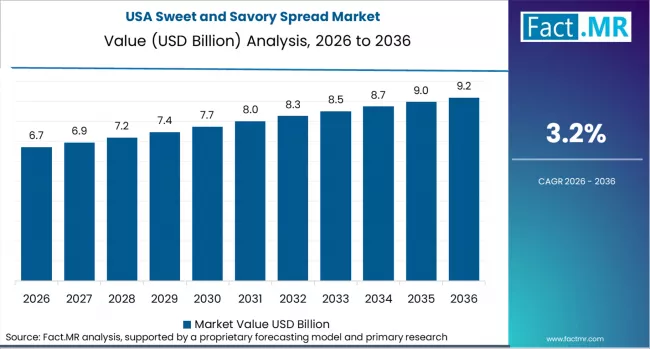
India leads with a CAGR of 5.8%, driven by growing consumption of convenience foods and expanding retail distribution channels. Brazil follows with 4.6%, supported by rising demand for flavored and functional spreads. Australia grows at 4.1%, reflecting adoption of premium and health-focused products. Germany shows a CAGR of 3.7%, driven by steady demand in retail and foodservice sectors. The UK grows at 3.5%, fueled by consistent consumer demand for household spreads. The USA grows at 3.2%, reflecting moderate adoption and replacement demand in mature markets.
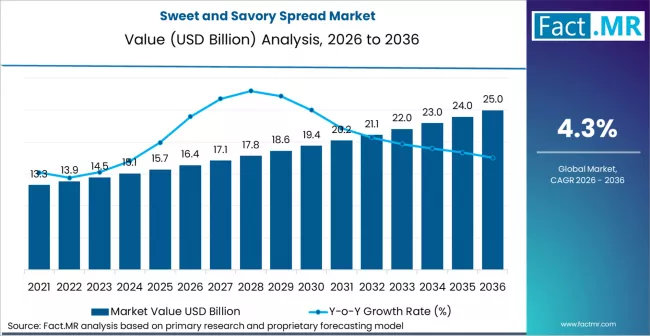
Sweet And Savory Spread Market Market Value Analysis | Source: Fact.MR
Sweet and Savory Spread Market
| Metric | Value |
|---|---|
| Estimated Value in (2026E) | USD 16.4 billion |
| Forecast Value in (2036F) | USD 25.1 billion |
| Forecast CAGR (2026 to 2036) | 4.3% |
Sweet and Savory Spread Market Definition
The Sweet and Savory Spread Market involves the production and sale of ready‑to‑use food spreads with sweet (e.g., fruit, chocolate) or savory (e.g., cheese, vegetable, umami) flavour profiles used on bread, crackers, and in culinary applications.
Market Inclusions
This report covers global and regional market sizes for sweet and savory spreads over a defined forecast period, including product types (jams, jellies, nut butters, cheese spreads, vegetable pâtés), application channels (retail, foodservice), and distribution segments (supermarkets/hypermarkets, convenience stores, online).
Market Exclusions
The scope excludes condiment products not marketed as spreadable (such as sauces, dressings), whole fruit or raw food ingredients, and individual consumer packaged foods where spread content is incidental and not separately quantified.
Research Methodology
- Primary Research: Interviews were conducted with food manufacturers, product developers, and retail buyers.
- Desk Research: Data was sourced from industry reports, food publications, and trade association statistics.
- Market‑Sizing and Forecasting; A hybrid model combining top‑down consumer food consumption forecasts with bottom‑up shipment and revenue data was used.
- Data Validation and Update Cycle: Findings were validated through expert review and aligned with recent production, adoption, and trade figures.
Summary of the Sweet and Savory Spread Market
- Market Definition
- The Sweet and Savory Spread Market involves global production, trade, and sale of ready-to-use spreads with sweet (e.g., fruit, chocolate) or savory (e.g., butter, cheese, nut) profiles. These products are used in households, foodservice (HoReCa), and retail applications for bread, snacks, baking, and culinary purposes.
- Demand Drivers
- Rising consumer preference for convenience foods and on-the-go meals.
- Increasing adoption of functional and flavored spreads, including protein-enriched, reduced-sugar, and organic variants.
- Growth in the foodservice and hospitality (HoReCa) sectors.
- Expansion of retail and e-commerce distribution channels.
- Product innovations enhancing taste, versatility, and health appeal.
- Key Segments Analyzed
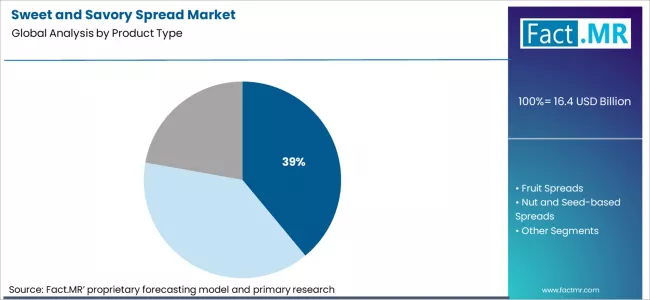
- Product Type: Butter/Cheese (39% share in 2026), Fruit Spreads, Jam, Nut and Seed-based Spreads, Chocolate Spread, Yeast-based Spread.
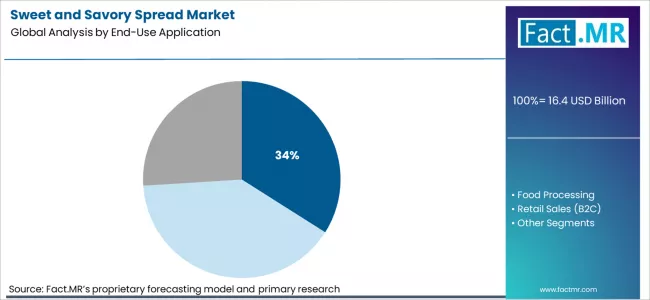
- End-Use Application: Foodservice (HoReCa) (34% share in 2026), Food Processing, Retail Sales (B2C).
- Distribution Channel: Supermarkets, Hypermarkets, Convenience Stores, Online Retail, Specialty Stores.
- Geography: North America, South Asia, Western Europe, Oceania, Latin America; India leads with a CAGR of 5.8%, followed by Brazil (4.6%), Australia (4.1%), Germany (3.7%), UK (3.5%), and USA (3.2%).
- Analyst Opinion at Fact MR
- Shambhu Nath Jha, Principal Consultant, Fact MR, observes, “The sweet and savory spreads market is shaped by convenience, flavor diversity, and premium positioning. Butter and cheese spreads dominate due to versatility in culinary applications, while HoReCa adoption drives bulk demand. Manufacturers investing in functional, artisanal, and health-oriented spreads, supported by strong retail and foodservice distribution, are well-positioned to capture incremental growth. Consumer preference for taste, quality, and convenience defines the competitive landscape through 2036.”
- Strategic Implications/Executive Takeaways
- Expand butter, cheese, and nut-based spreads with premium and functional formulations.
- Target foodservice channels with bulk and standardized products for consistency.
- Focus on high-growth regions such as India, Brazil, and Australia with rising convenience food adoption.
- Introduce health-oriented and artisanal spreads to meet evolving consumer preferences.
- Leverage retail and online distribution to enhance market visibility and reach.
- Methodology
- Primary Research: Interviews with food manufacturers, product developers, and retail buyers.
- Desk Research: Data sourced from industry reports, trade publications, and market associations.
- Market Sizing & Forecasting: Hybrid top-down and bottom-up modeling combining consumption forecasts and shipment/revenue data.
- Data Validation: Expert review and alignment with recent production, adoption, and trade figures; updated via proprietary Fact MR forecasting models.
Segmental Analysis
Sweet and Savory Spread Market Analysis by Product Type
Sweet And Savory Spread Market Analysis By Product Type | Source: Fact.MR
Market Overview: Butter and cheese spreads are expected to capture 39% of the market share by 2026. These spreads are widely used due to their versatility, taste, and convenience, making them popular in both household consumption and foodservice applications. Butter and cheese spreads provide flavor enhancement, easy application, and functional benefits in cooking and baking.
Demand Drivers:
- Versatility in Culinary Applications: Butter and cheese spreads are used in sandwiches, baked goods, and as toppings, supporting their high demand across foodservice and retail sectors.
- Consumer Preference for Convenience: Ready-to-use spreads offer time-saving solutions for both households and professional kitchens.
- Rising Adoption in Foodservice: Hotels, restaurants, and cafes rely on butter and cheese spreads for consistent quality and taste in menu offerings.
Sweet and Savory Spread Market Analysis by End-Use Application
Sweet And Savory Spread Market Analysis By End Use Application | Source: Fact.MR
Market Overview: Foodservice (HoReCa) applications are projected to hold 34% of the market share by 2026. Spreads are extensively used in hotels, restaurants, and cafes to prepare menu items, offer toppings, and enhance flavor, making the foodservice sector a key driver for market growth.
Demand Drivers:
- High Usage in Hospitality and Catering: Hotels, restaurants, and cafes use spreads in sandwiches, bakery items, and breakfast offerings, increasing demand for bulk and quality products.
- Consistency and Quality Requirements: Foodservice operators prefer standardized spreads that maintain consistent taste and texture across multiple servings.
- Growing Hospitality Industry: Expansion of the global HoReCa sector, driven by tourism and urbanization, fuels demand for sweet and savory spreads in professional kitchens.
Sweet and Savory Spread Market Drivers, Restraints, and Opportunities
FMR analysts observe that the sweet and savory spread market is a mature, consumer‑preference segment shaped by established snacking and convenience food habits across demographics. Historically, basic jams and peanut butter dominated pantry staples; as taste diversity and snacking occasions expanded, structural demand emerged for a broader range of sweet (fruit, honey, chocolate) and savory (umami, cheese, seed) spreads that enhance flavor profiles and meal versatility. The 2026 valuation reflects this enduring demand, supported by product innovation and retail penetration rather than rapid category disruptions.
While traditional classics retain large volume share, premium and differentiated spreads with exotic ingredients, functional benefits (protein, low sugar), and artisanal positioning are gaining share. These higher‑value offerings often command elevated prices, contributing to net market value growth even as overall unit volumes grow in line with food consumption trends. The market exists because spreads are adaptable across meals and snacks, and evolving consumer tastes continually reshape product portfolios.
- Taste & Convenience Demand: Consumers adopt diverse sweet and savory spreads to replace basic options and enhance breakfast, snacks, and sandwiches with bold flavors.
- Health & Label Trends: Demand for protein‑fortified, low‑sugar, and clean‑label spreads pushes reformulation and premium positioning.
- Regional Culinary Dynamics: In North America and Europe, strong snacking culture drives premium spread uptake, while Asia‑Pacific sees rapid growth with expanding retail and flavor exploration.
Regional Analysis
The market analysis covers key global regions, including North America, South Asia, Western Europe, Oceania, and Latin America. It is segmented geographically, with specific market dynamics for each region. The full report provides a detailed market attractiveness analysis.
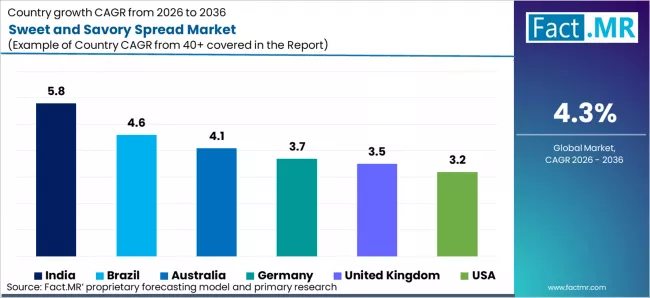
Sweet And Savory Spread Market Cagr Analysis By Country | Source: Fact.MR
| Country | CAGR (2026-2036) |
|---|---|
| USA | 3.2% |
| United Kingdom | 3.5% |
| India | 5.8% |
| Germany | 3.7% |
| Australia | 4.1% |
| Brazil | 4.6% |
Source: Fact MR (FMR) analysis, based on proprietary forecasting model and primary research
North America
Sweet And Savory Spread Market Country Value Analysis | Source: Fact.MR
The USA is a major market, driven by demand in bakery, dairy, and breakfast products, and rising preference for convenient spreads. Key players include Kellogg Company, General Mills, and Unilever.
- USA: Demand for sweet and savory spreads in the U.S. is projected to rise at 3.2% CAGR through 2036. Growth is supported by expansion of retail distribution channels (06-2025) and Kellogg Company’s regional production increase (09-2025).
South Asia
India is a significant market, supported by growing consumer awareness, urban retail expansion, and rising demand in packaged foods.
- India: Demand for sweet and savory spreads in India is projected to rise at 5.8% CAGR through 2036. Growth is influenced by government food processing initiatives (05-2025) and General Mills’ regional product line expansions (09-2025).
Western Europe
Germany and the United Kingdom are key markets, driven by packaged food consumption, bakery usage, and retail penetration.
- Germany: Demand for sweet and savory spreads in Germany is projected to rise at 3.7% CAGR through 2036. Growth is supported by retail chain expansions (04-2025) and Unilever’s regional production investments (08-2025).
- United Kingdom: Demand for sweet and savory spreads in the UK is projected to rise at 3.5% CAGR through 2036. Growth is supported by supermarket chain expansions (03-2025) and Unilever’s distribution network development (07-2025).
Oceania
Australia is a key market, supported by bakery and dairy product consumption and premium spreads adoption.
- Australia: Demand for sweet and savory spreads in Australia is projected to rise at 4.1% CAGR through 2036. Growth is influenced by retail expansion programs (05-2025) and Kellogg Company’s regional production capacity increase (09-2025).
Latin America
Brazil is a leading market, driven by bakery, dairy, and breakfast product usage in urban and semi-urban regions.
- Brazil: Demand for sweet and savory spreads in Brazil is projected to rise at 4.6% CAGR through 2036. Growth is supported by government food processing programs (04-2025) and Nestlé’s regional production expansions (08-2025).
Fact MR's analysis of the sweet and savory spread market in North America, South Asia, Western Europe, Oceania, and Latin America consists of country-wise assessments that include the USA, India, the United Kingdom, Germany, Australia, and Brazil. Readers can find detailed trends, regulatory updates, and company-specific investments shaping market growth in these countries.
What is the Competitive Structure and Buyer Behavior in the Sweet and Savory Spread Market?
Sweet And Savory Spread Market Analysis By Company | Source: Fact.MR
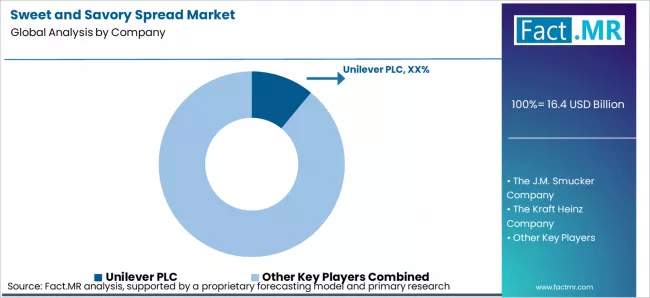
The sweet and savory spread market is moderately concentrated, with major multinational food companies such as Unilever PLC, The J.M. Smucker Company, The Kraft Heinz Company, Conagra Brands, Inc., Premier Foods plc, Ferrero International S.A., and Nestlé S.A. holding significant share alongside regional and specialty producers including Wellness Foods Ltd., Nature Food Chocolatier, and National Grape Cooperative Association, Inc. The primary competitive variables are product taste and texture quality, ingredient differentiation (such as natural or premium formulations), brand recognition, and distribution breadth across retail and foodservice channels. Firms with extensive manufacturing scale, broad product portfolios, and strong relationships with retailers and distributors hold structural advantages because they can ensure consistent supply, maintain competitive pricing, support promotional activities, and secure high‑visibility shelf placement.
Large grocery chains, mass merchandisers, and e‑commerce platforms exert notable buyer leverage by qualifying multiple suppliers, negotiating pricing and promotional support, and standardizing assortment guidelines to meet category performance targets. To manage supplier dependency, these buyers often maintain diverse supply sources and emphasize quality and delivery reliability in contract terms, which limits individual suppliers’ pricing power. As a result, competition centers on delivering taste appeal, brand strength, product consistency, and responsive service rather than on price alone.
Key Players of the Sweet and Savory Spread Market
- Unilever PLC
- The J.M. Smucker Company
- The Kraft Heinz Company
- Conagra Brands, Inc.
- Premier Foods plc
- Ferrero International S.A.
- Wellness Foods Ltd.
- Nestlé S.A.
- Nature Food Chocolatier
- National Grape Cooperative Association, Inc.
Report Scope
| Metric | Value |
|---|---|
| Quantitative Units | USD 16.4 billion (2026) to USD 25.1 billion (2036), at a CAGR of 4.3% |
| Market Definition | The sweet and savory spread market includes global production, trade, and sales of butter, cheese, jams, fruit, nut, seed, chocolate, and yeast-based spreads for food processing, foodservice, and retail applications. |
| Product Type | Butter/Cheese, Fruit Spreads, Jam, Nut and Seed-based Spreads, Chocolate Spread, Yeast-based Spread |
| End-Use Application | Food Processing, Foodservice (HoReCa), Retail Sales (B2C) |
| Distribution Channel | Supermarkets, Hypermarkets, Convenience Stores, Online Retail, Specialty Stores |
| Key Companies Profiled | Unilever PLC, The J.M. Smucker Company, The Kraft Heinz Company, Conagra Brands, Inc., Premier Foods plc, Ferrero International S.A., Wellness Foods Ltd., Nestlé S.A., Nature Food Chocolatier, National Grape Cooperative Association, Inc. |
| Forecast Period | 2026 to 2036 |
| Approach | Hybrid top-down and bottom-up modeling validated through interviews with spread manufacturers and distributors, supported by trade data benchmarking and plant-level capacity verification |
Bibliographies
- The Guardian. (2025, September 27). Britain’s butter sales rise as flavored spreads gain popularity. The Guardian.
- Food & Wine. (2025). Tillamook cream cheese wins international cheese and dairy awards. Food & Wine.
This report addresses
- Market intelligence enabling evaluation of global sweet and savory spreads by product type (butter/cheese, fruit spreads, jam, nut and seed-based spreads, chocolate spread, yeast-based spread), end-use application (food processing, foodservice/HoReCa, retail sales/B2C), and distribution channels (supermarkets, hypermarkets, convenience stores, online retail, specialty stores).
- Market volume (revenue) estimates and 10-year forecasts from 2026 to 2036, validated using consumer demand trends, retail expansion, and foodservice adoption patterns.
- Growth opportunity mapping across product types, end-use applications, and distribution channels, with major markets including India, Brazil, Australia, Germany, the UK, and the USA.
- Segment and regional revenue forecasts for butter/cheese spreads, jams, nut-based spreads, and chocolate spreads, including usage in household, retail, and foodservice applications.
- Competitive strategy analysis highlighting product taste, texture, ingredient differentiation, brand recognition, and distribution breadth, with major players including Unilever PLC, The J.M. Smucker Company, The Kraft Heinz Company, Conagra Brands, Inc., Premier Foods plc, Ferrero International S.A., Wellness Foods Ltd., Nestlé S.A., Nature Food Chocolatier, and National Grape Cooperative Association, Inc.
- Adoption dynamics emphasizing household, retail, and foodservice implementation of spreads for culinary, snacking, and convenience food applications, supporting flavor enhancement, meal versatility, and premium product positioning.
- Report delivery in PDF, Excel, PowerPoint, and interactive dashboard formats suitable for executive, operational, and strategic planning.
Sweet and Savory Spread Market Key Segments
-
Product Type
- Butter/Cheese
- Fruit Spreads
- Jam
- Nut and Seed-based Spreads
- Chocolate Spread
- Yeast-based Spread
-
End-Use Application
- Food Processing
- Foodservice (HoReCa)
- Retail Sales (B2C)
-
Distribution Channel
- Supermarkets
- Hypermarkets
- Convenience Stores
- Online Retail
- Specialty Stores
-
Region
- North America
- USA
- Canada
- Mexico
- Europe
- Germany
- UK
- France
- Italy
- Spain
- Nordic Countries
- BENELUX
- Rest of Europe
- Asia Pacific
- China
- Japan
- South Korea
- India
- Australia
- Rest of Asia Pacific
- Latin America
- Brazil
- Argentina
- Rest of Latin America
- Middle East and Africa
- Kingdom of Saudi Arabia
- United Arab Emirates
- South Africa
- Rest of Middle East and Africa
- Other Regions
- Oceania
- Central Asia
- Other Markets
- North America