- Market Value (2025): USD 8.2 Bn
- Estimated Value (2026): USD 8.76 Bn
- Forecast Value (2036): USD 16.9 Bn
- CAGR (2026-2036): 6.8%
What is the Swine Diseases Treatment Market forecast to be worth by 2036?
USD 8.8 billion in 2026 to USD 16.9 billion by 2036 at a 6.8% CAGR.
- Worth USD 8.2 billion in 2025, the swine diseases treatment market draws most of its value from vaccines, antibiotics and supportive therapies used to protect breeding and growing herds.
- Revenue will expand from USD 8.76 billion in 2026 to USD 16.9 billion by 2036, as larger commercial farms formalize herd health programs and outbreak response plans.
- A 6.8% CAGR reflects steady spending on prevention, since producers now treat disease losses as a controllable cost line in pork production.
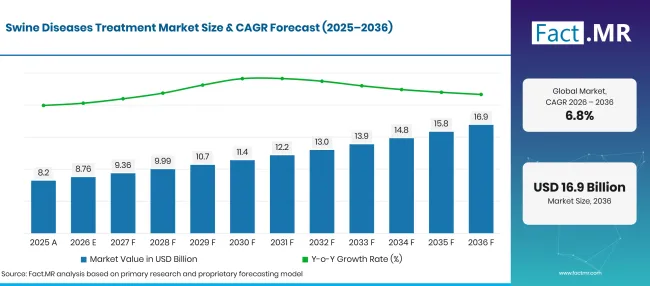
Swine Diseases Treatment Market Forecast Global | Source: Fact.MR
| Year | Basis | Market Value (USD billion) |
|---|---|---|
| 2025 | Actual | 8.2 |
| 2026 | Estimate | 8.76 |
| 2036 | Forecast | 16.9 |
| CAGR 2026 to 2036 | Forecast period | 6.8% |
Source: Fact.MR analysis. Updated Nov 9, 2026
What are the defining numbers behind Swine Diseases Treatment Market growth?
The 2026 to 2036 period adds USD 8.2 billion in new value, concentrated in vaccines and injectable programs.
- Demand Drivers in the Market
- Preventable disease remains a heavy drag on livestock output. The World Organisation for Animal Health (WOAH) states that more than 20% of global animal production is lost to preventable disease every year [1]. Pig producers feel this through piglet mortality, poor feed conversion and lost reproductive cycles.
- PRRS keeps vaccine and veterinary budgets under pressure in major producing countries. USDA’s Economic Research Service reported unusually high PRRSV case counts in the second quarter of 2025 and noted that modified-live vaccines offer only partial protection [2]. That gap keeps herd veterinarians looking for stronger prevention tools.
- African swine fever still shapes biosecurity spending even where it has not arrived. WOAH’s September 2026 situation report recorded 235 new outbreaks, with 13,889 domestic pigs lost on affected farms [3]. Producers in free countries respond with stricter entry controls, testing and herd monitoring.
- Antibiotic stewardship is pushing farms toward prevention. WOAH’s ninth annual report on antimicrobial agents for animals shows a 5% global decrease in use between 2020 and 2022, based on 85 consistently reporting participants [4]. Less routine medication raises the value of vaccines, diagnostics and precise treatment protocols.
- Concentrated production systems need consistent health routines. Larger units move thousands of pigs through each stage, so one infection can spread quickly across a site. Scheduled vaccination and early intervention help protect throughput and margins.
- Key Segments Analyzed
- By Treatment Type: Vaccines will hold 38.5% share in 2026, since farms prefer to stop infections before they reach sows and nursery pigs.
- By Disease Type: Porcine Reproductive and Respiratory Syndrome (PRRS) will account for 44.2% of 2026 revenue, as the virus damages sow fertility and causes respiratory disease in growing pigs.
- By Route of Administration: Injectable will capture 52.1% of 2026 value as most swine vaccines and many antibiotics are given by intramuscular dose.
- By End-User: Clinics will command 58.4% in 2026, given that producers rely on veterinary practices for diagnosis, vaccine planning and prescriptions.
- Analyst Opinion at Fact.MR
- Shambhu Nath Jha, Principal Consultant at Fact.MR, states, “Swine health budgets will keep shifting toward prevention, because a PRRS break or a PED outbreak costs far more than the vaccine program that could have limited it. Producers will favor products that cover several pathogens in one dose and fit easily into existing schedules. Suppliers that pair vaccines with diagnostic support and clear stewardship guidance will earn a stronger place in herd health plans.”
- Strategic Implications
- Vaccine developers should focus on broader PRRS and PCV2 coverage and ready-to-use formats, since each extra handling step costs labor on large farms.
- Pharmaceutical suppliers should build their antibiotic lines around clear labels, short withdrawal periods and prescriber guidance, as stewardship rules tighten in Europe and North America.
- Veterinary practices should expand farm-level testing and routine herd assessments, which give producers earlier warning and make treatment choices more precise.
- Investors should track herd consolidation and biosecurity rules in major pork exporters, where structured health programs lift spending per animal.
Germany leads the country set at 7.8%, where a large but consolidating herd places more animals under each farm’s veterinary plan. Brazil follows at 7.1%, with export growth tying herd health to market access. The United States, at 6.5%, combines a large inventory with recurring PRRS pressure. A gap of 0.7 points then separates it from the United Kingdom at 5.8%, where welfare and biosecurity standards guide spending. Japan closes the set at 5.1%, reflecting a stable herd with fewer but larger farms.
How does the Swine Diseases Treatment Market break down by segment?
Vaccines will lead Treatment Type at 38.5%; PRRS will head Disease Type at 44.2%; Injectable will hold Route of Administration at 52.1%; Clinics will lead End-User at 58.4% in 2026.
Which Treatment Type leads?
Vaccines hold 38.5% of 2026 sales.
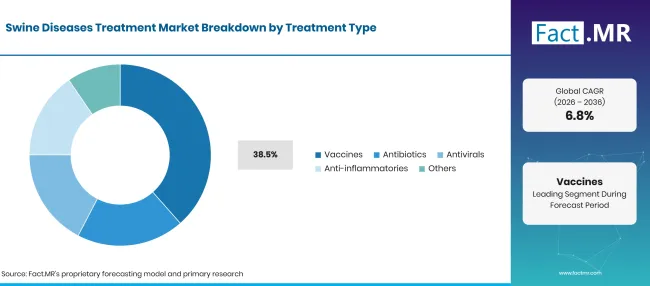
Swine Diseases Treatment Market Breakdown Treatment Type | Source: Fact.MR
| Treatment Type | Share (2026) |
|---|---|
| Vaccines (Leading segment) | 38.5% |
| Other segments combined | 61.5%* |
| Total | 100.0% |
Source: Fact.MR analysis. Updated Nov 9, 2026
Prevention costs less than a disease break in a sow herd, so producers build their health plans around immunization against PRRS, porcine circovirus and Mycoplasma hyopneumoniae. Ready-to-use products keep winning space on farms. Merck Animal Health made Circumvent CL commercially available in December 2025, a single-bottle vaccine against PCV types 2a and 2d and Lawsonia intracellularis that needs no mixing [5]. Antibiotics remain necessary for susceptible bacterial infections and secondary complications, and the wider animal antibiotics and antimicrobials category shows how stewardship is reshaping prescribing. The U.S. Food and Drug Administration published its 2024 summary of antimicrobials sold for food-producing animals in November 2025 [6]. Older molecules such as chlortetracycline for livestock face closer review, while antivirals and anti-inflammatories serve narrower clinical needs.
What supports PRRS within Disease Type?
PRRS takes 44.2% of 2026 revenue.
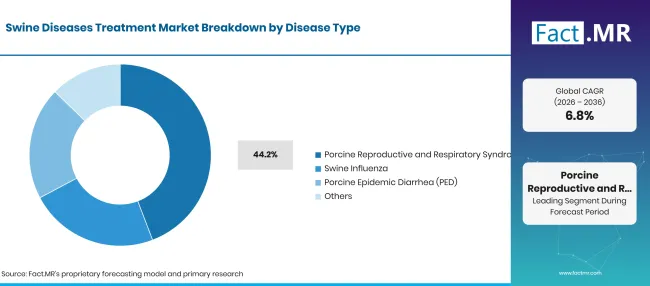
Swine Diseases Treatment Market Breakdown Disease Type | Source: Fact.MR
| Disease Type | Share (2026) |
|---|---|
| Porcine Reproductive and Respiratory Syndrome (PRRS) (Leading segment) | 44.2% |
| Other segments combined | 55.8%* |
| Total | 100.0% |
Source: Fact.MR analysis. Updated Nov 9, 2026
Few swine infections hit both the farrowing room and the finishing barn the way PRRS does. The virus causes abortions and weak litters in sows and respiratory disease in growing pigs. USDA’s Economic Research Service notes that there is no effective treatment for PRRS once pigs are infected [2]. That leaves vaccination, herd closure and secondary infection control as the main tools. Swine influenza adds seasonal respiratory pressure, and PED remains a threat to young piglets in intensive units. Porcine circovirus, enzootic pneumonia and ileitis also generate steady demand within the other disease categories. Feed-based nutrition support, including feed micronutrients, often runs alongside these programs but falls outside treatment revenue.
What leads the Route of Administration segment?
Injectable accounts for 52.1% of 2026 value.
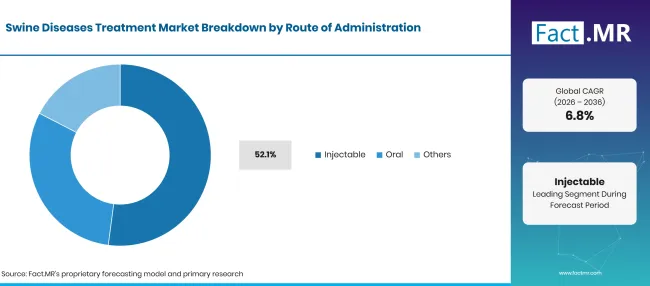
Swine Diseases Treatment Market Breakdown Route Of Administration | Source: Fact.MR
| Route of Administration | Share (2026) |
|---|---|
| Injectable (Leading segment) | 52.1% |
| Other segments combined | 47.9%* |
| Total | 100.0% |
Source: Fact.MR analysis. Updated Nov 9, 2026
Intramuscular and subcutaneous dosing gives veterinarians control over exactly how much product each pig receives. Most commercial swine vaccines are licensed for injection, and many long-acting antibiotics follow the same route. Single-dose products reduce handling and stress during weaning and transfer. Oral treatments delivered through feed or drinking water suit group medication when many pigs need the same therapy. Producers often blend these through a feed premix under veterinary direction. Topical and other routes serve specific clinical uses, and the choice depends on the medicine, the disease and the age group.
How does End-User shape demand?
Clinics represent 58.4% of 2026 spending.
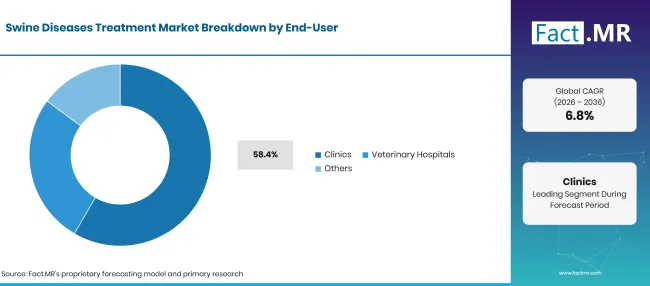
Swine Diseases Treatment Market Breakdown End User | Source: Fact.MR
| End-User | Share (2026) |
|---|---|
| Clinics (Leading segment) | 58.4% |
| Other segments combined | 41.6%* |
| Total | 100.0% |
Source: Fact.MR analysis. Updated Nov 9, 2026
Producers turn to veterinary practices for diagnosis, vaccine scheduling and prescriptions, which places clinics at the point where most product decisions are made. Regular farm visits let veterinarians track recurring infections and adjust protocols between batches. Clinic equipment, from veterinary examination tables to diagnostic tools, supports this advisory role. Veterinary hospitals handle complex cases that need specialist diagnostics or surgery. Commercial farms with in-house veterinary staff, research institutions and other animal health organizations add further demand through direct purchasing of swine health products.
What is accelerating Swine Diseases Treatment Market adoption, and what is holding it back?
Recurring PRRS pressure, ASF risk and the growth of large commercial herds are pulling spending toward vaccines and structured herd health plans. Stewardship rules are moving budgets from routine antibiotics toward prevention. High program costs on smaller farms, uneven veterinary access in emerging producers and slow product registration across countries hold back faster uptake.
Drivers Impact Analysis
| DRIVER | (~) % IMPACT ON CAGR | GEOGRAPHIC RELEVANCE | IMPACT TIMELINE |
|---|---|---|---|
| Persistent PRRS, PED and swine influenza pressure on commercial herds | +1.6% | Global | Short term (<=2 years) |
| Growth of large commercial pig farms with formal herd health programs | +1.3% | Latin America, East Asia, North America | Medium term (2-4 years) |
| Shift from routine antibiotics toward preventive vaccination | +1.0% | Western Europe, North America | Medium term (2-4 years) |
| Improved diagnostics and multivalent vaccine technology | +0.7% | Western Europe, North America, East Asia | Long term (>=4 years) |
Source: Fact.MR analysis. Updated Nov 9, 2026
Opportunity Impact Analysis
| OPPORTUNITY | (~) % IMPACT ON CAGR | GEOGRAPHIC RELEVANCE | IMPACT TIMELINE |
|---|---|---|---|
| Combination and ready-to-use swine vaccines | +0.8% | Global | Medium term (2-4 years) |
| Wider veterinary access in emerging pig-producing countries | +0.6% | Latin America, South Asia & Pacific | Long term (>=4 years) |
| Farm-level diagnostics and pathogen surveillance services | +0.5% | Western Europe, North America, East Asia | Medium term (2-4 years) |
| Herd-specific autogenous vaccines for variable strains | +0.3% | North America, Western Europe | Short term (<=2 years) |
Source: Fact.MR analysis. Updated Nov 9, 2026
Restraints Impact Analysis
| RESTRAINT | (~) % IMPACT ON CAGR | GEOGRAPHIC RELEVANCE | IMPACT TIMELINE |
|---|---|---|---|
| High cost of vaccination and veterinary programs for smaller farms | -0.7% | Global | Short term (<=2 years) |
| Antimicrobial resistance and restrictions on antibiotic use | -0.5% | Western Europe, North America | Medium term (2-4 years) |
| Limited vaccine efficacy against fast-changing PRRS strains | -0.4% | Global | Medium term (2-4 years) |
| Differing product registration rules across countries | -0.2% | Global | Long term (>=4 years) |
Source: Fact.MR analysis. Updated Nov 9, 2026
Which countries are scaling the Swine Diseases Treatment Market through 2036?
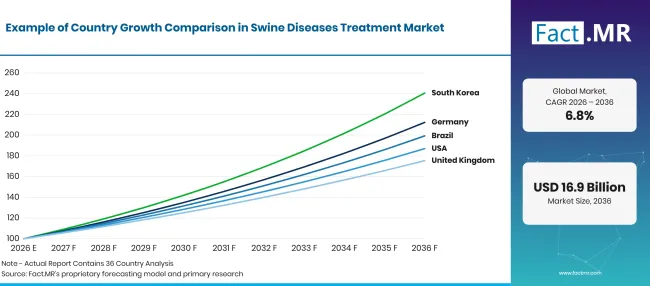
Swine Diseases Treatment Market Growth Index | Source: Fact.MR
| Country | CAGR (2026 to 2036) |
|---|---|
| Germany | 7.8% |
| Brazil | 7.1% |
| United States | 6.5% |
| United Kingdom | 5.8% |
| Japan | 5.1% |
Source: Fact.MR analysis. Updated Nov 9, 2026
What supports swine diseases treatment adoption in Germany?
7.8% CAGR, supported by herd consolidation and close veterinary oversight of larger farms.
Germany’s pig sector is shrinking in farm numbers but not in herd scale, which concentrates disease risk and veterinary spending. Destatis counted 21.5 million pigs on 15,220 farms in November 2025, an average of more than 1,400 animals per holding [7]. Larger units run formal vaccination calendars and regular diagnostic checks and keep biosecurity budgets steady.
How is Brazil developing demand?
7.1% CAGR, as export growth ties herd health to market access.
Brazil’s pork exporters must meet strict health standards in buyer markets, so disease prevention carries a direct commercial value. The Goiás state agriculture secretariat reported that national pork exports from January to November 2025 reached 1.3 million tonnes and USD 3.2 billion, a record in both volume and value [8]. Export-focused producers treat respiratory and enteric disease control as part of meeting those buyer standards.
What is supporting United States adoption?
6.5% CAGR, backed by a large inventory and recurring PRRS pressure.
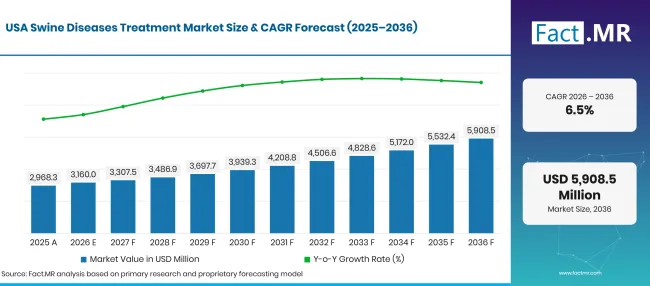
Swine Diseases Treatment Market Forecast Usa | Source: Fact.MR
American producers run some of the world’s biggest sow farms, and PRRS remains their most costly recurring disease. USDA’s National Agricultural Statistics Service counted 75.5 million hogs and pigs on December 1, 2025, including 5.95 million kept for breeding [9]. Herd veterinarians combine commercial vaccines, autogenous products and strict pig flow to contain outbreaks across multi-site systems.
How is the United Kingdom developing demand?
5.8% CAGR, reflecting welfare standards and farm biosecurity rules.
British pig farms operate under detailed welfare and medicine-use standards, which push producers toward vaccination and veterinary health plans. Defra’s 2025 agriculture statistics put the pig population at 4.7 million head, up 0.5% on 2024, while the female breeding herd fell to 316,000 [10]. A smaller sow base makes each litter more valuable and keeps attention on reproductive disease control.
What supports Japan’s adoption?
5.1% CAGR, owing to a stable herd on fewer, larger farms.
Japan’s pig industry is consolidating steadily, which shifts disease management toward bigger operations with in-house health routines. The Ministry of Agriculture, Forestry and Fisheries counted 8.756 million pigs on 2,880 farms as of February 1, 2026, with farm numbers down 8.0% from the 2024 survey [11]. Fewer holdings with more pigs each place disease prevention under tighter veterinary management.
Who leads the Swine Diseases Treatment Market?
Two kinds of supplier shape this market. Broad animal health groups such as Boehringer Ingelheim, Zoetis, Elanco and Merck Animal Health carry full swine portfolios that span PRRS, circovirus, respiratory and enteric disease.
Boehringer Ingelheim describes its long record in PRRS vaccines, research partnerships with European and Chinese institutes, and work toward an African swine fever vaccine [12]. Merck Animal Health widened its ready-to-use range in December 2025 with Circumvent CL [5]. Elanco pairs Prevacent PRRS with respiratory antibiotics such as Pradalex. Specialists form the second group: Ceva Santé Animale and HIPRA focus on swine vaccines and disease education, and Ceva backed the first Swine Influenza Symposium in September 2026 [13]. Virbac supplies livestock medicines, while Phibro Animal Health offers herd-specific MJPRRS autogenous vaccines. Success through 2036 will turn on multi-pathogen coverage, field support for veterinarians and reliable supply of biologics.
Which companies are the key providers?
Key companies in the Swine Diseases Treatment Market include Boehringer Ingelheim, Zoetis, Elanco, Merck Animal Health, Ceva Santé Animale, HIPRA, Virbac and Phibro Animal Health.
- Boehringer Ingelheim
- Zoetis
- Elanco
- Merck Animal Health
- Ceva Santé Animale
- HIPRA
- Virbac
- Phibro Animal Health
Bibliography
- [1] World Organisation for Animal Health. (2026, May). The State of the World’s Animal Health 2026 Report.
- [2] U.S. Department of Agriculture, Economic Research Service. (2025, August 18). Livestock, Dairy, and Poultry Outlook: August 2025.
- [3] World Organisation for Animal Health. (2026, October). African Swine Fever (ASF) Situation Report 81.
- [4] World Organisation for Animal Health. (2025, May). Annual Report on Antimicrobial Agents Intended for Use in Animals, 9th Report.
- [5] Merck Animal Health. (2025, December 12). Merck Animal Health Announces Availability of Circumvent CL, a Ready-to-use Vaccine Protecting Pigs Against Porcine Circovirus Types 2a and 2d and Lawsonia intracellularis.
- [6] U.S. Food and Drug Administration. (2025, November 21). 2024 Summary Report On Antimicrobials Sold or Distributed for Use in Food-Producing Animals.
- [7] Statistisches Bundesamt (Destatis). (2025, December 22). Korrektur: Schweinebestand 2025 leicht gewachsen, Zahl der Betriebe weiterhin rückläufig.
- [8] Secretaria de Estado de Agricultura, Pecuária e Abastecimento de Goiás. (2026, January 16). Suínos: Agro em Dados / Janeiro 2026.
- [9] U.S. Department of Agriculture, National Agricultural Statistics Service. (2025, December 23). Quarterly Hogs and Pigs.
- [10] Department for Environment, Food & Rural Affairs. (2026, July 9). Agriculture in the United Kingdom 2025: Chapter 8: Livestock.
- [11] Ministry of Agriculture, Forestry and Fisheries of Japan. (2026, July 28).
- [12] Boehringer Ingelheim. (2026, October 15). Swine .
- [13] Ceva Santé Animale. (2026, September 1). Ceva supports the 1st Swine Influenza Symposium.
This Report Answers
- How much value will swine diseases treatment add between 2026 and 2036, and which products carry that growth?
- Why do vaccines, PRRS, injectable dosing and clinics hold the lead positions in their segments?
- Which of Germany, Brazil, the United States, the United Kingdom and Japan offers the strongest growth, and what herd conditions explain the gaps?
- How are antibiotic stewardship rules changing the balance between prevention and treatment on pig farms?
- What role do ASF risk and biosecurity spending play in demand outside affected regions?
- Where do broad animal health groups and swine specialists compete, and what will separate them through 2036?
What does the Swine Diseases Treatment Market cover?
This study measures spending on veterinary vaccines and medicines used to prevent and treat infectious and production diseases in pigs. Respiratory, reproductive and enteric conditions that cut growth, fertility and survival fall within its range.
Values are counted at the manufacturer level for vaccines, antibiotics, antivirals, anti-inflammatories and other therapies, across injectable, oral and other routes. Purchases by clinics, veterinary hospitals and other animal health buyers are all tracked.
What is included in the scope?
Vaccines and pharmaceuticals for PRRS, swine influenza, PED and other pig diseases are counted.
Injectable, oral, topical and other formulations used in swine veterinary practice form part of the total. Combination vaccines that protect against several swine pathogens in one dose are counted in full. Swine-labeled products within the broader animal antibiotics range are counted when prescribed for pig diseases. Autogenous vaccines prepared for a specific herd under veterinary prescription are also part of the market.
What is excluded from the scope?
Products developed only for companion animals, poultry, cattle, sheep or other species are left out.
Feed additives and nutrition products with no direct disease prevention or treatment claim are not counted. Farm equipment, housing, ventilation and other non-medical farm technology are not part of this study. Diagnostic testing services are treated as supporting activity and are not counted as treatment revenue.
How Was the Analysis Built?
The analysis draws on 120+ sources, 35+ company portfolios, 25+ countries, and more than 20 industry interviews.
- Primary Research: Primary research includes discussions with manufacturers, service providers, technology developers, distributors, end users, and subject-matter experts. These conversations examine purchasing priorities, product adoption, operational challenges, approval requirements, competitive positioning, and the factors that influence wider market acceptance.
- Desk Research: Desk research covers government statistics, regulatory publications, company filings, trade data, technical studies, industry associations, standards, public policy, and other authoritative sources. Every source used in the analysis is documented in the bibliography.
- Market Sizing and Forecasting: Market estimates combine historical performance, demand indicators, pricing and volume trends, segment shares, company participation, country-level growth, adoption patterns, investment activity, and barriers to market expansion.
- Data Validation and Update Cycle: Findings are validated by comparing primary interviews with public data, company activity, regulatory changes, trade patterns, and industry developments. Regular updates review new product launches, capacity changes, partnerships, approvals, and shifts in commercial adoption.
Segmentation
What is the report’s scope and coverage?
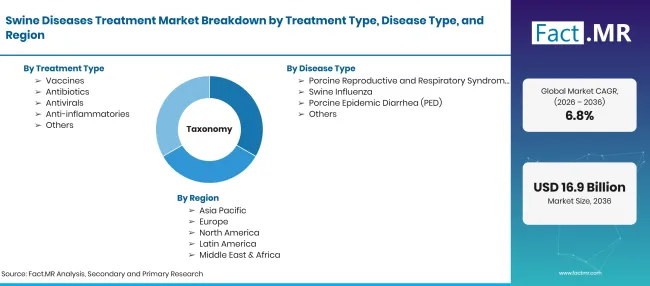
Swine Diseases Treatment Market Taxonomy | Source: Fact.MR
| Attribute | Details |
|---|---|
| Quantitative Units | USD billion |
| Market Definition | Veterinary vaccines, medicines and other pharmaceutical products used to prevent, manage and treat respiratory, reproductive and gastrointestinal diseases in pigs. |
| Treatment Type | Vaccines; Antibiotics; Antivirals; Anti-inflammatories; Others |
| Disease Type | Porcine Reproductive and Respiratory Syndrome (PRRS); Swine Influenza; Porcine Epidemic Diarrhea (PED); Others |
| Route of Administration | Injectable; Oral; Others |
| End-User | Clinics; Veterinary Hospitals; Others |
| Regions Covered | North America; Latin America; Western Europe; Eastern Europe; East Asia; South Asia & Pacific; Middle East & Africa |
| Countries Covered | Germany; Brazil; United States; United Kingdom; Japan |
| Companies Profiled | Boehringer Ingelheim; Zoetis; Elanco; Merck Animal Health; Ceva Santé Animale; HIPRA; Virbac; Phibro Animal Health |
| Forecast Period | 2026 to 2036 |
| Approach | Hybrid top-down and bottom-up model built on pig inventories, disease prevalence, vaccination schedules, treatment mix and veterinary purchasing patterns by country. |
Source: Fact.MR analysis. Updated Nov 9, 2026
How is the market segmented?
-
By Treatment Type
- Vaccines
- Antibiotics
- Antivirals
- Anti-inflammatories
- Others
-
By Disease Type
- Porcine Reproductive and Respiratory Syndrome (PRRS)
- Swine Influenza
- Porcine Epidemic Diarrhea (PED)
- Others
-
By Route of Administration
- Injectable
- Oral
- Others
-
By End-User
- Clinics
- Veterinary Hospitals
- Others
-
By Region
- North America
- Latin America
- Western Europe
- Eastern Europe
- East Asia
- South Asia & Pacific
- Middle East & Africa
Frequently Asked Questions
How large is the swine diseases treatment market in 2026?
What growth rate will the swine diseases treatment market record?
Which treatment type leads?
Which disease type leads?
Which route of administration leads?
Which end-user leads?
Which country will grow quickest?
Who are the main companies?
Program costs for smaller farms, antibiotic restrictions and partial vaccine protection against changing PRRS strains slow faster growth.
Who worked on this report


Preview the report firsthand - request a free sample
Free SampleGet the brochure for pricing and purchase details
Download PDF