- Base Value(2025): 5.4 Bn
- Estimated Value(2026): 5.7 Bn
- Forecast Value (2036): 9.2 Bn
- CAGR (2026 - 2036): 4.9%
Animal Antibiotics and Antimicrobials Market Forecast 2026 to 2036
In 2025, the animal antibiotics and antimicrobials market was valued at USD 5.4 billion. Based on Fact MR’s analysis, demand for animal antibiotics and antimicrobials is estimated to grow to USD 5.7 billion in 2026 and USD 9.2 billion by 2036. FMR projects a CAGR of 4.9% during the forecast period.
The absolute dollar growth from 2026 to 2036 is USD 3.5 billion. This growth is driven by increasing livestock production, rising demand for animal protein, and the need to control infectious diseases in farm animals. The market is further supported by regulatory frameworks promoting responsible use of antibiotics in livestock and innovations in veterinary drug formulations. However, challenges such as antimicrobial resistance concerns and strict regulations on antibiotic use may limit growth in some regions.
China leads with a CAGR of 6.6%, driven by its large-scale livestock industry and growing demand for veterinary drugs. India follows with 6.1%, supported by expanding poultry and dairy production. Germany grows at 5.6%, reflecting steady demand for veterinary antibiotics in Europe. France shows growth at 5.1%, fueled by livestock health initiatives and regulatory compliance. The United Kingdom grows at 4.7%, driven by stable demand in livestock care and preventive veterinary solutions.
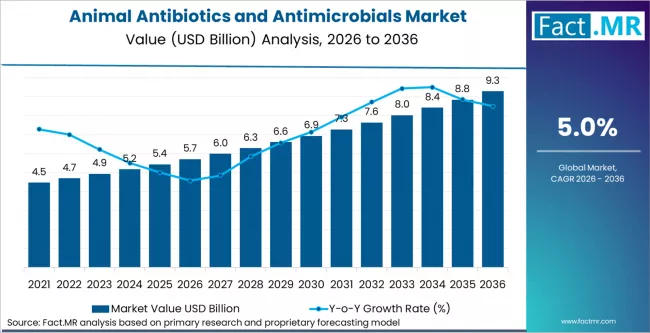
Animal Antibiotics And Antimicrobials Market Market Value Analysis | Source: Fact.MR
Animal Antibiotics and Antimicrobials Market
| Metric | Value |
|---|---|
| Estimated Value in (2026E) | USD 5.7 billion |
| Forecast Value in (2036F) | USD 9.2 billion |
| Forecast CAGR (2026 to 2036) | 4.9% |
Source: Fact.MR analysis. Updated Mar 7, 2026
Animal Antibiotics and Antimicrobials Market Definition
The Animal Antibiotics and Antimicrobials Market involves the development, manufacture, and sale of pharmaceutical agents used to prevent, treat, and control bacterial, fungal, and other microbial infections in livestock, companion animals, and aquaculture.
Market Inclusions
This report covers global and regional market sizes for animal antibiotics and antimicrobials over a defined forecast period, including drug classes (beta‑lactams, tetracyclines, macrolides, sulfonamides), animal types (cattle, poultry, swine, companion animals, aquaculture), and distribution channels (veterinary clinics, pharmacies, commercial farms).
Market Exclusions
The scope excludes non‑antimicrobial veterinary pharmaceuticals such as anthelmintics, vaccines, and nutritional supplements, as well as antibiotics used exclusively in human medicine without approved veterinary indications.
Research Methodology
- Primary Research: Interviews were conducted with veterinarians, pharmaceutical developers, and livestock health experts.
- Desk Research: Data was sourced from veterinary pharmacopoeias, regulatory filings, and industry reports.
- Market‑Sizing and Forecasting: A hybrid model combining top‑down animal health demand forecasts with bottom‑up sales and adoption data was used.
- Data Validation and Update Cycle: Findings were validated through expert review and aligned with recent production, approval, and usage statistics.
Summary of the Animal Antibiotics and Antimicrobials Market
- Market Definition
- The Animal Antibiotics and Antimicrobials Market covers the global production, trade, and use of pharmaceutical agents for food-producing and companion animals to prevent, treat, and control bacterial, fungal, and other microbial infections. The market includes veterinary antibiotics delivered via injections, oral solutions, powders, premixes, and other formulations.
- Demand Drivers
- Rising Demand for Animal Protein: Increasing global consumption of meat, dairy, and poultry products drives the need for healthy livestock.
- Preventive and Therapeutic Applications: Antibiotics and antimicrobials ensure disease-free herds, improving survival rates and productivity.
- Intensive Farming Practices: Large-scale livestock operations rely on antimicrobials to maintain herd health and optimize output.
- Regulatory Frameworks: Policies promoting responsible use and veterinary compliance support adoption of approved antimicrobial therapies.
- Innovation in Veterinary Drugs: Development of targeted, higher-value formulations aligns with antimicrobial resistance (AMR) mitigation strategies.
- Key Segments Analyzed
- Animal Type: Food-Producing Animals (66.2%), Companion Animals.
- Mode of Delivery: Injections (50.7%), Oral Solutions, Oral Powders, Premixes, Others.
- Product: Tetracyclines, Fluoroquinolones, Lincosamides, Cephalosporins, Aminoglycosides, Macrolides, Sulfonamides, Penicillins.
- End Use: Livestock Farms, Veterinary Clinics, Companion Animal Facilities.
- Analyst Opinion at Fact MR
- Shambhu Nath Jha, Principal Consultant at Fact MR, stated, "The animal antibiotics and antimicrobials market balances therapeutic demand and stewardship requirements. Structural growth is driven by livestock expansion, rising protein consumption, and regulatory compliance rather than indiscriminate antibiotic use."
- Strategic Implications / Executive Takeaways
- Focus on Targeted, Regulatory-Compliant Products: Adopt formulations aligned with AMR and feed additive restrictions.
- Expand Distribution in High-Growth Livestock Markets: Prioritize China (6.6% CAGR) and India (6.1% CAGR) for expansion of veterinary product lines.
- Invest in Advanced Delivery Methods: Promote injections and precise oral solutions for faster therapeutic effect and accurate dosing.
- Leverage Veterinary Partnerships: Collaborate with clinics, integrated farms, and public health programs to ensure product adoption.
- Portfolio Diversification: Include multiple classes of antibiotics to cover varied livestock species and infection types.
- Regional Insights
- East Asia (China): 6.6% CAGR, driven by large-scale livestock operations and regulatory-approved veterinary drug expansion.
- South Asia (India): 6.1% CAGR, supported by poultry, dairy growth, and government livestock programs.
- Western Europe: Germany 5.6%, France 5.1%, UK 4.7% CAGR, influenced by regulatory frameworks, veterinary approvals, and livestock health programs.
- Methodology
- Primary Research: Interviews with veterinarians, pharmaceutical developers, and livestock experts.
- Desk Research: Industry reports, veterinary pharmacopoeias, and regulatory filings.
- Market Sizing & Forecasting: Hybrid top-down demand forecast combined with bottom-up adoption and sales data validated via production and distribution statistics.
Segmental Analysis
Animal Antibiotics and Antimicrobials Market Analysis by Animal Type
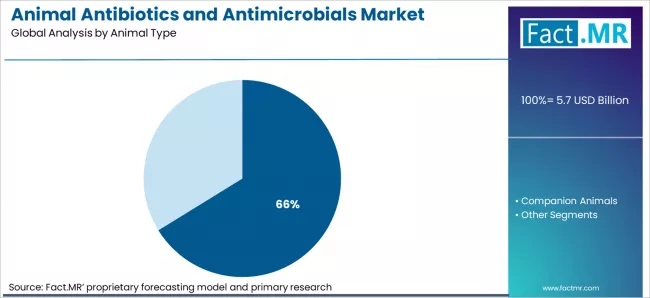
Animal Antibiotics And Antimicrobials Market Analysis By Animal Type | Source: Fact.MR
- Market Overview: Food-producing animals are expected to capture 66.2% of the market share by 2026. Antibiotics and antimicrobials are widely used in livestock such as poultry, cattle, and swine to prevent and treat bacterial infections, improve animal health, and maintain productivity in meat, milk, and egg production.
- Demand Drivers:
- Rising Global Demand for Animal Protein: Increasing consumption of meat, dairy, and poultry products drives the need for healthy, disease-free livestock, boosting the use of antibiotics and antimicrobials.
- Preventive and Therapeutic Applications: Antibiotics help manage common bacterial infections, ensuring higher survival rates and productivity in food-producing animals.
- Intensive Farming Practices: Large-scale livestock farming relies heavily on antibiotics and antimicrobials to maintain herd health and optimize output, supporting market growth.
Animal Antibiotics and Antimicrobials Market Analysis by Mode of Delivery
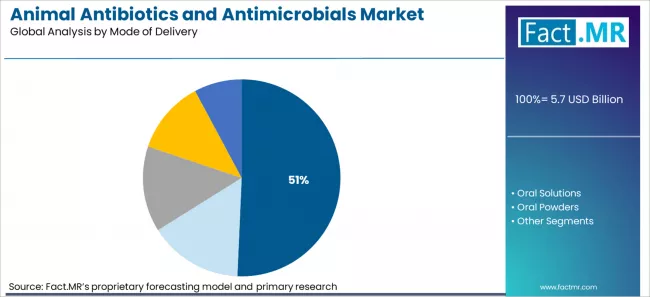
Animal Antibiotics And Antimicrobials Market Analysis By Mode Of Delivery | Source: Fact.MR
- Market Overview: Injections are projected to hold 50.7% of the market share by 2026. Injectable antibiotics and antimicrobials provide rapid and precise delivery of active ingredients, making them the preferred method for treating severe infections or administering vaccines in animals.
- Demand Drivers:
- Rapid Therapeutic Effect: Injectable delivery ensures faster absorption and higher bioavailability, providing immediate treatment for sick or at-risk animals.
- Targeted Administration: Injections allow accurate dosing per animal, minimizing wastage and ensuring optimal therapeutic outcomes.
- Veterinary Preference: Veterinarians often prefer injections for managing critical infections and administering preventive care, which drives their dominance over oral or premix forms in commercial and food-producing livestock.
Animal Antibiotics and Antimicrobials Market Drivers, Restraints, and Opportunities
FMR analysts observe that the animal antibiotics and antimicrobials market is a mature, regulation‑influenced segment shaped by longstanding use to treat and prevent infections in livestock, aquaculture, and companion animals. Historically, broad‑spectrum antibiotics supported herd health and productivity; as antimicrobial resistance (AMR) concerns rose and regulatory frameworks tightened, structural demand shifted toward judicious use, targeted therapies, and alternatives that reduce reliance on traditional agents. The 2026 valuation reflects this balance between ongoing therapeutic need and evolving stewardship policies.
While broad‑use, lower‑cost antibiotics remain significant in some regions, advanced formulations, veterinary‑specific antimicrobials, and stewardship‑aligned products are gaining share because they support targeted treatment with lower resistance risk. These higher‑value agents contribute to net market growth even as overall unit volumes plateau or decline in regulated markets due to usage restrictions and optimized dosing.
- Stewardship & Resistance Pressure: Policies aimed at reducing antimicrobial resistance push veterinarians toward targeted, certified antibiotics and controlled use protocols over indiscriminate treatments.
- Regulatory Controls: Bans or restrictions on growth‑promoting antibiotic use (e.g., in feed) in major markets influence formulation selection and drive adoption of approved antimicrobial therapies.
- Regional Dynamics: In North America and Europe, stringent AMR policies and veterinary guidelines accelerate uptake of regulated, targeted antimicrobials, while demand remains higher for broader agents in regions with looser controls.
Regional Analysis
The market analysis covers key global regions, including East Asia, South Asia, and Western Europe. It is segmented geographically, with specific market dynamics for each region. The full report provides a detailed market attractiveness analysis.
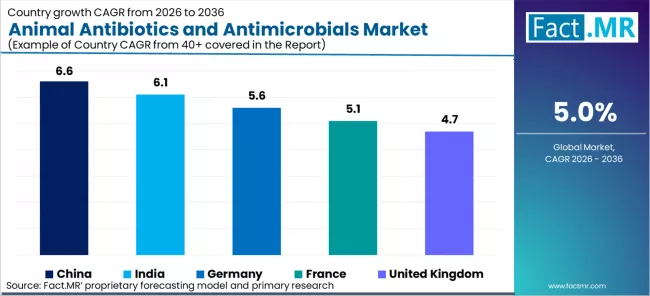
Animal Antibiotics And Antimicrobials Market Cagr Analysis By Country | Source: Fact.MR
| Country | CAGR (2026-2036) |
|---|---|
| China | 6.6% |
| India | 6.1% |
| Germany | 5.6% |
| France | 5.1% |
| United Kingdom | 4.7% |
Source: Fact.MR analysis. Updated Mar 7, 2026
Source: Fact MR (FMR) analysis, based on proprietary forecasting model and primary research
East Asia:
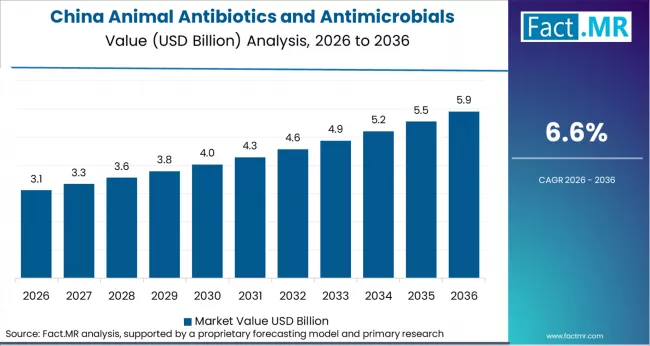
Animal Antibiotics And Antimicrobials Market Country Value Analysis | Source: Fact.MR
China is the largest market, supported by a growing livestock sector, rising demand for veterinary antibiotics, and regulatory approvals for animal health products. Key players include Zoetis, China Animal Husbandry Group, and Merck Animal Health.
- China: Demand for animal antibiotics and antimicrobials in China is projected to rise at 6.6% CAGR through 2036. Growth is supported by government livestock health programs (03-2025) and China Animal Husbandry Group’s expansion of veterinary product production (08-2025).
South Asia:
India is a significant market, driven by increasing poultry and dairy production, government livestock development initiatives, and rising adoption of veterinary drugs.
- India: Demand for animal antibiotics and antimicrobials in India is projected to rise at 6.1% CAGR through 2036. Growth is supported by national livestock health programs (05-2025) and Zoetis’ regional product distribution expansions (09-2025).
Western Europe:
Germany, France, and the United Kingdom are key markets, influenced by regulatory standards for animal health, veterinary drug approvals, and livestock management practices.
- Germany: Demand for animal antibiotics and antimicrobials in Germany is projected to rise at 5.6% CAGR through 2036. Growth is supported by federal veterinary programs (04-2025) and Merck Animal Health’s regional production expansions (08-2025).
- France: Demand for animal antibiotics and antimicrobials in France is projected to rise at 5.1% CAGR through 2036. Growth is influenced by government livestock monitoring programs (03-2025) and Zoetis’ facility upgrades (07-2025).
- United Kingdom: Demand for animal antibiotics and antimicrobials in the UK is projected to rise at 4.7% CAGR through 2036. Growth is supported by UK government veterinary health initiatives (06-2025) and regional production expansions by Merck Animal Health (09-2025).
Fact MR's analysis of the animal antibiotics and antimicrobials market in East Asia, South Asia, and Western Europe consists of country-wise assessments that include China, India, Germany, France, and the United Kingdom. Readers can find detailed trends, regulatory updates, and company-specific investments shaping market growth in these countries.
What is the Competitive Structure and Buyer Behavior in the Animal Antibiotics and Antimicrobials Market?
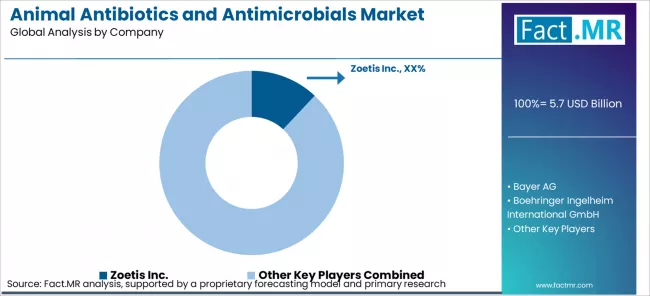
Animal Antibiotics And Antimicrobials Market Analysis By Company | Source: Fact.MR
The animal antibiotics and antimicrobials market is moderately concentrated, with major animal health and pharmaceutical firms such as Zoetis Inc., Bayer AG, Boehringer Ingelheim International GmbH, Ceva Santé Animale S.A., Dechra Pharmaceuticals PLC, Eli Lilly and Company, Merck & Co., Inc., and Elanco Animal Health Incorporated accounting for a substantial share of global sales. The primary competitive variables are spectrum of activity, efficacy, regulatory approval status, and formulation safety profiles, all of which heavily influence procurement by veterinarians, livestock producers, and integrated animal health programs. Companies with extensive R&D capabilities, broad product portfolios, regulatory expertise, and established distribution networks hold structural advantages because they can sustain product innovation, meet evolving regulatory requirements across regions, and ensure consistent supply to diverse livestock and companion animal segments.
Large buyers such as integrated animal production companies, veterinary chains, and government procurement programmes exert strong leverage by qualifying multiple suppliers, negotiating long‑term supply agreements tied to quality and compliance, and standardizing therapeutic protocols across operations. To manage supplier dependency, these buyers diversify approved vendors and emphasize consistent product quality and delivery reliability, which limits individual suppliers’ pricing power. As a result, competition focuses predominantly on demonstrated clinical performance, safety compliance, and reliable supply assurance rather than on price alone.
Recent Industry Developments
- "Animal-Only" Product Focus: Leading players like Zoetis and Elanco are shifting R&D toward ionophores and animal-specific antibiotics that do not cross-react with human medicine. This strategy insulates their portfolios from the "medically important" restrictions being passed by the FDA and EMA.
- Bacteriophage Cocktails: By mid-2026, the first commercial-scale bacteriophage cocktails targeting Salmonella and E. coli are expected to receive full FDA clearance. These biological alternatives are projected to displace 3-5% of the demand for traditional metaphylactic antibiotics in poultry and swine.
- Camel-Derived AMPs: In February 2026, researchers identified three novel antimicrobial peptides (AMPs) from dromedary camels that show significant activity against MRSA and multidrug-resistant E. coli without high toxicity. This discovery is fueling a 2026 trend in "nature-inspired" drug discovery for the next generation of veterinary anti-infectives.
Key Players of the Animal Antibiotics and Antimicrobials Market
- Zoetis Inc.
- Bayer AG
- Boehringer Ingelheim International GmbH
- Ceva Santé Animale S.A.
- Dechra Pharmaceuticals PLC
- Eli Lilly and Company
- Merck & Co., Inc.
- Elanco Animal Health Incorporated
Report Scope
| Metric | Value |
|---|---|
| Quantitative Units | USD 5.7 billion (2026) to USD 9.2 billion (2036), at a CAGR of 4.9% |
| Market Definition | The Animal Antibiotics and Antimicrobials Market covers global production, trade, and use of antibiotics and antimicrobial agents for food-producing and companion animals to prevent or treat infections. |
| Animal Type | Food-Producing Animals, Companion Animals |
| Mode of Delivery | Injections, Oral Solutions, Oral Powders, Premixes, Others |
| Product | Tetracyclines, Fluoroquinolones, Lincosamides, Cephalosporins, Aminoglycosides, Macrolides, Sulfonamides, Penicillins |
| End User | Livestock Farms, Veterinary Clinics, Companion Animal Facilities |
| Regions Covered | North America, Latin America, Europe, East Asia, South Asia, Oceania, Middle East & Africa |
| Countries Covered | United States, Canada, Mexico, Brazil, Germany, France, United Kingdom, Italy, Spain, China, India, Japan, South Korea, Australia, and 20+ other countries |
| Key Companies Profiled | Zoetis Inc., Bayer AG, Boehringer Ingelheim International GmbH, Ceva Santé Animale S.A., Dechra Pharmaceuticals PLC, Eli Lilly and Company, Merck & Co., Inc., Elanco Animal Health Incorporated |
| Forecast Period | 2026 to 2036 |
| Approach | Hybrid top-down and bottom-up market modeling validated through primary interviews with veterinary manufacturers and livestock producers, supported by trade data benchmarking and plant-level capacity verification. |
Source: Fact.MR analysis. Updated Mar 7, 2026
Bibliographies
- World Health Organization. (2023). Critically important antimicrobials for human medicine: Risk management strategies for antimicrobial use in food-producing animals. World Health Organization.
- Food and Agriculture Organization of the United Nations. (2023). Monitoring antimicrobial use and antimicrobial resistance in food-producing animals. Food and Agriculture Organization.
- World Organisation for Animal Health. (2024). Antimicrobial resistance and the prudent use of antimicrobial agents in veterinary medicine. World Organisation for Animal Health.
- U.S. Food and Drug Administration. (2023). Summary report on antimicrobials sold or distributed for use in food-producing animals. U.S. Food and Drug Administration.
- BioTechniques. (2026, February 24). Camel antimicrobials could help address emerging antibiotic resistance challenges. BioTechniques.
- European Medicines Agency. (2023). Antimicrobial consumption and resistance in veterinary medicine across European Union member states. European Medicines Agency.
- National Institute of Food and Agriculture. (2024). Antimicrobial stewardship in livestock production systems. U.S. Department of Agriculture.
This report addresses
- Market intelligence enabling comprehensive assessment of leading countries and product segments across the Animal Antibiotics and Antimicrobials Market globally.
- Market volume (sales units and revenue) estimates and 10-year revenue forecasts from 2026 to 2036, validated through veterinary procurement data, livestock health programs, and country-level demand modeling.
- Growth opportunity mapping across animal types (Food-Producing Animals, Companion Animals), modes of delivery (Injections, Oral Solutions, Oral Powders, Premixes, Others), and product classes (Tetracyclines, Fluoroquinolones, Lincosamides, Cephalosporins, Aminoglycosides, Macrolides, Sulfonamides, Penicillins).
- Segment and regional revenue forecasts by animal type, mode of delivery, product, end use, and geography across 40+ countries.
- Competition strategy analysis covering spectrum of activity, regulatory approval compliance, efficacy, formulation safety, and supply chain reliability, including major players like Zoetis Inc., Bayer AG, Boehringer Ingelheim International GmbH, Ceva Santé Animale S.A., Dechra Pharmaceuticals PLC, Eli Lilly and Company, Merck & Co., Inc., and Elanco Animal Health Incorporated.
- Product and regulatory compliance tracking aligned with veterinary pharmacopoeias, livestock health regulations, and antimicrobial stewardship guidelines.
- Regulatory impact analysis addressing livestock health policies, antimicrobial use restrictions, and veterinary practice regulations across key markets.
- Report delivery in PDF, Excel, PowerPoint, and interactive dashboard formats for executive, procurement, and operational planning use.
Segmentation
Animal Antibiotics and Antimicrobials Market Key Segments
-
Animal Type
- Food-Producing Animals
- Companion Animals
-
Mode of Delivery
- Injections
- Oral Solutions
- Oral Powders
- Premixes
- Others
-
Product
- Tetracyclines
- Fluoroquinolones
- Lincosamides
- Cephalosporins
- Aminoglycosides
- Macrolides
- Sulfonamides
- Penicillins
-
Region
- North America
- USA
- Canada
- Mexico
- Europe
- Germany
- UK
- France
- Italy
- Spain
- Nordic Countries
- BENELUX
- Rest of Europe
- Asia Pacific
- China
- Japan
- South Korea
- India
- Australia
- Rest of Asia Pacific
- Latin America
- Brazil
- Argentina
- Rest of Latin America
- Middle East and Africa
- Kingdom of Saudi Arabia
- United Arab Emirates
- South Africa
- Rest of Middle East and Africa
- Other Regions
- Oceania
- Central Asia
- Other Markets
- North America
Frequently Asked Questions
How large is the demand for Animal Antibiotics and Antimicrobials in the global market in 2026?
What will be the market size of Animal Antibiotics and Antimicrobials in the global market by 2036?
What is the expected demand growth for Animal Antibiotics and Antimicrobials in the global market between 2026 and 2036?
Which animal type is expected to dominate the market?
Which region is expected to show the highest growth rate for Animal Antibiotics and Antimicrobials?
How significant is the growth outlook for India in this market?
What is the growth outlook for Germany in the Animal Antibiotics and Antimicrobials market?
What is the growth forecast for France in the Animal Antibiotics and Antimicrobials market?
What is the growth forecast for the United Kingdom in the Animal Antibiotics and Antimicrobials market?
Which company is identified as a leading player in the Animal Antibiotics and Antimicrobials market?
What are Animal Antibiotics and Antimicrobials used for?
What does the Animal Antibiotics and Antimicrobials market include in this report?
How is the market forecast developed in this report?
What is meant by the Animal Antibiotics and Antimicrobials market in this report?
Who worked on this report


Preview the report firsthand - request a free sample
Free SampleGet the brochure for pricing and purchase details
Download PDF