- Market Value (2025): USD 1.67 Bn
- Estimated Value (2026): USD 1.8 Bn
- Forecast Value (2036): USD 3.2 Bn
- CAGR (2026-2036): 6.2%
What is the Tooling Resin Market forecast to be worth by 2036?
USD 1.77 billion in 2026 to USD 3.24 billion by 2036 at a 6.2% CAGR.
- The tooling resin market was valued at USD 1.67 billion in 2025, with aerospace lay-up tools and automotive prototype molds generating most purchases.
- Revenue will grow from USD 1.77 billion in 2026 to USD 3.24 billion by 2036 as composite parts move into more aircraft, vehicle and wind blade programs.
- A 6.2% CAGR reflects steady tool replacement in mature plants and fresh mold building for new composite lines.
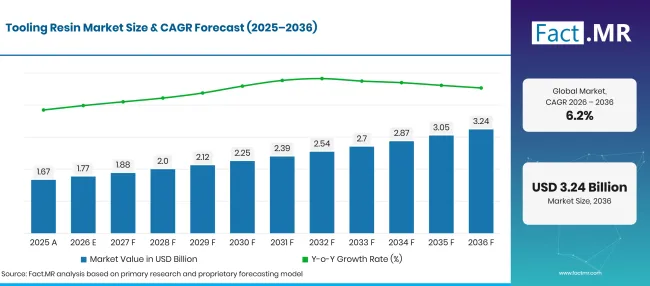
Tooling Resin Market Forecast Global | Source: Fact.MR
| Year | Basis | Market Value (USD billion) |
|---|---|---|
| 2025 | Actual | 1.67 |
| 2026 | Estimate | 1.77 |
| 2036 | Forecast | 3.24 |
| CAGR 2026 to 2036 | Forecast period | 6.2% |
Source: Fact.MR analysis. Updated Nov 6, 2026
What are the defining numbers behind Tooling Resin Market growth?
The 2026 to 2036 period will add USD 1.5 billion in new value, most of it from epoxy tooling for aerospace and transportation programs.
- Demand Drivers in the Market
- Aircraft output keeps mold shops busy with carbon fiber lay-up tools. Airbus delivered 793 commercial aircraft in 2025, up 4% on 2024 [1]. The company also booked 1,000 gross orders during the year, which points to higher build rates ahead. Each new rate step calls for extra tool sets that hold tolerance through hundreds of autoclave cycles.
- Wind blade production depends on long molds and plugs. The IEA expects global wind capacity to nearly double to over 2,000 GW by 2030 [2]. Blade makers need plug materials and infusion-ready mold surfaces that stay flat across tens of meters.
- Vehicle makers are adding composite and thermoformed parts to cut weight. Tier 1 suppliers use resin boards and pastes for styling models, checking fixtures and prototype molds before steel tools are cut.
- CNC milling of near-net-shape pastes is shortening the route from CAD data to finished mold. Shops apply paste over a light core and mill it to final shape, which reduces material waste and machining hours. Room-temperature curing pastes also let milling start within a day.
- Key Segments Analyzed
- By Material Type: Epoxy will account for 42.3% of 2026 revenue, since its low thermal expansion keeps prepreg molds accurate at autoclave temperatures.
- By Application: Aerospace will take 28.4% of 2026 demand, given that airframe parts need lay-up tools held to tight tolerances.
- By End-User Industry: Transportation will hold 52.8% of 2026 value, as vehicle, aircraft and boat makers share the same model and mold workflow.
- Analyst Opinion at Fact.MR
- Shambhu Nath Jha, Principal Consultant at Fact.MR, states, “Tooling resin suppliers will win on the number of cure cycles a mold survives and the hand finishing it avoids. Aircraft build rates and longer wind blades will pull demand toward high-temperature epoxy boards and machine-applied pastes. Suppliers that pair those materials with on-site application support will gain share as mold shops cut lead times. Recycled-content boards will also move from trial orders into standard purchasing.”
- Strategic Implications
- Manufacturers should widen high-temperature epoxy board and paste ranges, because aerospace buyers now ask for tools rated for repeated cures at about 180°C.
- Distributors should hold stock of boards, pastes and release agents close to aerospace and boatbuilding clusters. Shops in those areas tend to order in small and urgent lots.
- Mold shops should test recycled-content boards against their current grades, since several suppliers now offer them with similar machining behavior.
- Investors should look at firms that combine resin chemistry with mold engineering services, as that mix shortens customer approval cycles.
Japan will lead the country table at 8.0%, with motor vehicles driving factory output and model shops working on new platforms. Germany follows at 7.5%, where machinery makers and car plants keep pattern and fixture demand high. The United States at 6.8% relies on aircraft build rates and a wide composites supply chain. The United Kingdom grows at 6.0% on aerospace and motorsport engineering, while Brazil at 4.6% trails because composite tooling is still concentrated in a few aircraft and bus makers.
How does the Tooling Resin Market break down by segment?
Epoxy will lead Material Type at 42.3%; Aerospace will head Application at 28.4%; Transportation will hold End-User Industry at 52.8% in 2026.
Which Material Type leads?
Epoxy takes 42.3% of 2026 sales.
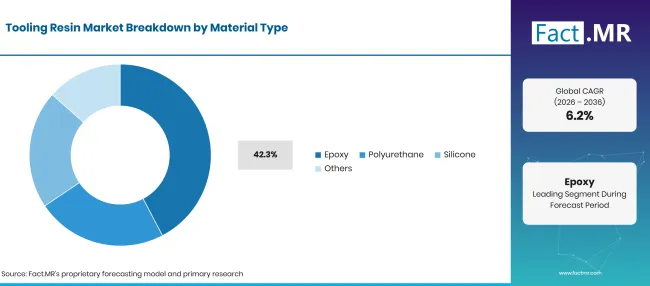
Tooling Resin Market Breakdown Material Type | Source: Fact.MR
| Material Type | Share (2026) |
| Epoxy (Leading segment) | 42.3% |
| Other segments combined | 57.7%* |
| Total | 100.0% |
Source: Fact.MR analysis. Updated Nov 6, 2026
Prepreg molds must keep their dimensions while they cure at high heat, and epoxy boards hold that line better than other resins. RAMPF notes that epoxy working boards are commonly used as composite lay-up tools, and its newer boards contain up to 30% chemically recycled raw materials [3]. The same chemistry links tooling to epoxy adhesives used to bond board blocks into large masters. Polyurethane serves styling models, patterns and thermoforming tools where lower heat resistance is acceptable. Silicone rubbers fill flexible molds for casting and short runs, and Others cover polyester and vinyl ester tooling gelcoats. Additive methods also compete here, since 3D printing materials now produce some prototype molds directly.
What supports Aerospace within Application?
Aerospace represents 28.4% of 2026 revenue.
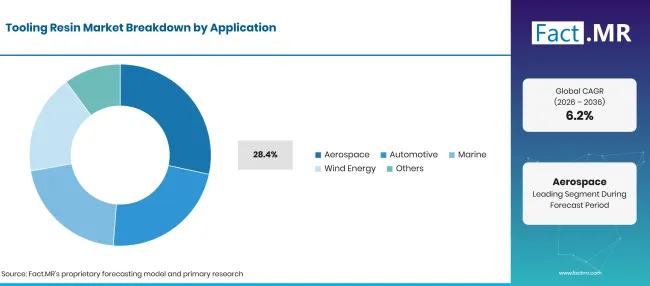
Tooling Resin Market Breakdown Application | Source: Fact.MR
| Application | Share (2026) |
| Aerospace (Leading segment) | 28.4% |
| Other segments combined | 71.6%* |
| Total | 100.0% |
Source: Fact.MR analysis. Updated Nov 6, 2026
Airframe programs use large carbon fiber skins that must match design data after cure. Hexcel states that its HexTool M61 molds keep dimensional stability and vacuum integrity after more than 500 cure cycles [4]. Growth in aerospace composites therefore feeds straight into tooling resin orders. Automotive uses tooling resin for design models, checking fixtures and composite part molds. Marine builders need hull and deck molds, while Wind Energy relies on plugs and molds for blades. Others include sporting goods, defense and industrial equipment. Wind blade work is lumpy, since one plug and mold set can serve a blade model for several years before replacement.
How does End-User Industry shape demand?
Transportation accounts for 52.8% of 2026 value.
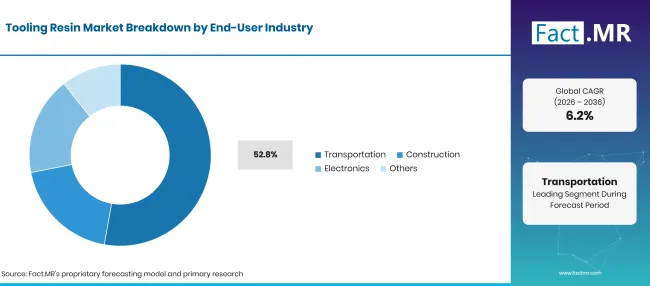
Tooling Resin Market Breakdown End User Industry | Source: Fact.MR
| End-User Industry | Share (2026) |
| Transportation (Leading segment) | 52.8% |
| Other segments combined | 47.2%* |
| Total | 100.0% |
Source: Fact.MR analysis. Updated Nov 6, 2026
Every vehicle, aircraft or boat part passes through model, mold and fixture work before series production starts. Electrification adds new body and battery enclosure parts to that list: global electric car sales passed 17 million in 2024, more than 20% of all car sales [5]. Suppliers of automotive composites need prototype tools for each new design. Construction uses tooling resin for architectural molds and precast panel patterns. Electronics buyers order small potting molds and fixtures, and Others cover consumer goods and medical device prototyping. These buyers order smaller volumes and favor fast-curing polyurethane and silicone grades over high-temperature epoxy.
What is accelerating Tooling Resin Market adoption, and what is holding it back?
Higher aircraft output, longer wind blades and new vehicle platforms all need fresh molds. Faster paste-and-mill methods also lower the cost of each tool. High-temperature epoxy systems remain costly, though, and poor curing can distort a tool. Metal tooling and 3D printed molds also compete for some jobs, especially in long production runs.
Drivers Impact Analysis
| DRIVER | (~) % IMPACT ON CAGR | GEOGRAPHIC RELEVANCE | IMPACT TIMELINE |
|---|---|---|---|
| More composite structures in aircraft manufacturing | +1.9% | North America, Western Europe, East Asia | Medium term (2-4 years) |
| Lighter vehicle and transportation components | +1.6% | Global | Medium term (2-4 years) |
| Wind blade production needing longer molds | +1.3% | Western Europe, North America, East Asia | Long term (>=4 years) |
| Faster CNC paste and board tooling methods | +0.9% | Global | Short term (<=2 years) |
Source: Fact.MR analysis. Updated Nov 6, 2026
Opportunity Impact Analysis
| OPPORTUNITY | (~) % IMPACT ON CAGR | GEOGRAPHIC RELEVANCE | IMPACT TIMELINE |
|---|---|---|---|
| High-temperature epoxy tooling for aerospace composites | +1.2% | North America, Western Europe, East Asia | Medium term (2-4 years) |
| Polyurethane boards for rapid prototyping and model making | +0.9% | Global | Short term (<=2 years) |
| Tooling materials for large wind blade molds | +0.8% | Western Europe, East Asia, North America | Long term (>=4 years) |
| Recycled-content boards and lower-emission formulations | +0.3% | Global | Long term (>=4 years) |
Source: Fact.MR analysis. Updated Nov 6, 2026
Restraints Impact Analysis
| RESTRAINT | (~) % IMPACT ON CAGR | GEOGRAPHIC RELEVANCE | IMPACT TIMELINE |
|---|---|---|---|
| High cost of high-performance epoxy tooling systems | -1.0% | Global | Short term (<=2 years) |
| Demanding processing and cure control | -0.7% | Global | Medium term (2-4 years) |
| Distortion from shrinkage or thermal expansion | -0.5% | Global | Short term (<=2 years) |
| Competition from metal and 3D printed tooling | -0.4% | Global | Long term (>=4 years) |
Source: Fact.MR analysis. Updated Nov 6, 2026
Which countries are scaling the Tooling Resin Market through 2036?
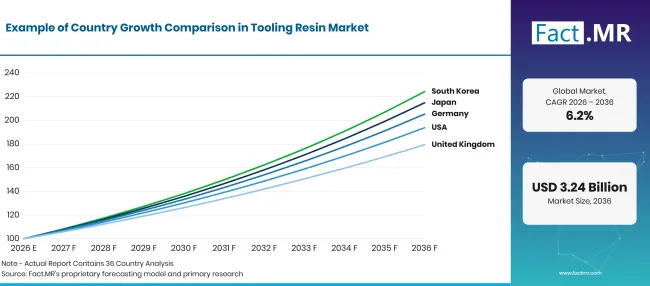
Tooling Resin Market Growth Index | Source: Fact.MR
| Country | CAGR (2026 to 2036) |
|---|---|
| Japan | 8.0% |
| Germany | 7.5% |
| United States | 6.8% |
| United Kingdom | 6.0% |
| Brazil | 4.6% |
Source: Fact.MR analysis. Updated Nov 6, 2026
What supports Japan’s adoption?
8.0% CAGR, driven by vehicle production and new model programs.
Japanese carmakers run large design studios that turn out clay and board models for every new platform. METI’s preliminary index for September 2026 put industrial production at 104.1, up 2.2% on the month, with motor vehicles the main contributor to the rise [6]. Local mold shops also supply aircraft parts makers in Aichi and Gifu, where carbon fiber lay-up tools are in steady use. Japanese buyers set strict surface finish targets, which favors fine-grained epoxy boards.
How is Germany developing demand?
7.5% CAGR, backed by car plants and machinery makers.
Germany combines a deep model-making trade with large vehicle and machine builders. Destatis reported that automotive new orders rose 10.5% in September 2026 from the month before [7]. Output of machinery and equipment grew 5.3% in August 2026, a sign of active fixture and jig work [8]. German board producers also supply mold shops across Europe from domestic plants. Wind blade tooling in the north adds a further outlet for large plug materials.
What is supporting United States adoption?
6.8% CAGR, helped by aircraft build rates and a broad composites base.
American demand centers on aerospace clusters in Washington, Kansas, Texas and the Southeast. Factory activity was firm in the latest data, with the Census Bureau reporting in November 2026 that manufacturers’ new orders rose 1.8% to USD 677.2 billion [9]. Boatbuilders in Florida and the Carolinas add a second stream of mold work. Their hull and deck tools are often built from carbon fiber and glass laminates.
How is the United Kingdom developing demand?
6.0% CAGR, reflecting aerospace and motorsport engineering.
The UK builds wings, engine parts and race cars, all of which use composite tooling. The government’s Advanced Manufacturing Sector Plan of June 2025 lists aerospace, automotive and advanced materials among priority industries [10]. The plan aims to nearly double annual business investment in the sector. Tooling board and resin suppliers in the Midlands and the North West serve these customers. Motorsport teams order small batches of high-temperature boards each season as car designs change.
How does Brazil perform?
4.6% CAGR, as aircraft and vehicle programs add tool demand slowly.
Brazil’s tooling demand comes from aircraft assembly in São Paulo state, bus and truck body makers, and blade plants for onshore wind farms. Vehicle electrification is starting from a low base: electric car sales more than doubled to 125,000 in 2024, a share of over 6% [5]. Imported epoxy boards and pastes serve most high-temperature jobs, so currency swings affect tool costs. Local distributors that hold stock and offer machining advice win repeat business from smaller shops.
Source: Fact.MR analysis. Updated Nov 6, 2026
Who leads the Tooling Resin Market?
Three groups shape competition. Board and paste makers such as Sika, RAMPF Group and Trelleborg supply the model and mold trade with epoxy and polyurethane boards, pastes and casting systems. RAMPF presented boatbuilding-focused RAKU TOOL boards and pastes in September 2025, including grades with recycled content [3], and it showed polyurethane boards and silicones for sports wall hold molds and thermoforming tools in April 2025 [11].
A second group, Hexcel and Gurit, ties tooling to wider composite material ranges. Hexcel sells HexTool prepreg-based tooling for aerospace molds [4], while Gurit pairs wind blade mold systems with core and resin supply and widened UK and Ireland distribution of its PET core in April 2026 [12]. Alchemie and Scott Bader form a third group of formulators that sell tooling resins, gelcoats and laminating systems to mold shops. Suppliers in all three groups compete on cure-cycle life, surface quality and application support. The firms that cut tool lead times for customers will gain the most ground through 2036.
Which companies are the key providers?
Key companies in the Tooling Resin Market include Sika, RAMPF Group, Hexcel, Gurit, Trelleborg, Alchemie and Scott Bader.
- Sika
- RAMPF Group
- Hexcel
- Gurit
- Trelleborg
- Alchemie
- Scott Bader
Bibliography
- [1] Airbus. (2026, January 12). Airbus reports 793 commercial aircraft deliveries in 2025.
- [2] International Energy Agency. (2025, October). Renewables 2025: Executive summary.
- [3] RAMPF Group. (2025, September 24). RAMPF Boosts Boatbuilding Efficiency With High-Performance Tooling Materials.
- [4] Hexcel. (2026, February 6). HexTool Tooling Material.
- [5] International Energy Agency. (2025, May 14). Global EV Outlook 2025: Executive summary.
- [6] Ministry of Economy, Trade and Industry. (2026, October 30). Indices of Industrial Production: Preliminary Report for September 2026.
- [7] Statistisches Bundesamt. (2026, November 5). New orders in manufacturing in September 2026: +4.4% on the previous month.
- [8] Statistisches Bundesamt. (2026, October 7). Production in August 2026: +2.0% on the previous month.
- [9] U.S. Census Bureau. (2026, November 3). Monthly Full Report on Manufacturers’ Shipments, Inventories, and Orders.
- [10] Department for Business and Trade. (2025, June 23). Advanced Manufacturing Sector Plan.
- [11] RAMPF Group. (2025, April 10). Materials and Processing Technology for Cost-Efficient Climbing Hold Manufacturing.
- [12] Gurit. (2026, April 16). Gurit Expands Distribution Network with Amari Plastics Partnership in the UK and Ireland.
This Report Answers
- How much new value will tooling resin add between 2026 and 2036?
- Why does epoxy hold first place among materials in prepreg mold work?
- Which aircraft programs and tool types shape aerospace demand?
- How do car, rail and boat makers use resin boards and pastes before series production?
- What explains the gap between Japan’s growth and Brazil’s slower pace?
- Where do board makers, composite suppliers and resin formulators each compete?
What does the Tooling Resin Market cover?
Tooling resin covers the liquid systems, boards and pastes that mold shops turn into masters, plugs and lay-up tools. Fixtures and checking gauges made from the same materials are also counted. Epoxy, polyurethane and silicone form the main chemistries, with polyester and vinyl ester tooling systems grouped under Others.
Value is counted at the first sale by the resin or board producer. Distributor margins are included where the producer sells through local stockists.
What is included in the scope?
Epoxy and polyurethane tooling boards, close contour pastes and casting resins.
Silicone rubbers sold for mold making and short-run casting. Tooling gelcoats, skin coats and laminating resins sold as part of a tooling system. Prepreg-based tooling materials, such as those used for wind turbine rotor blade plugs and aerospace molds, when sold for tool building.
What is excluded from the scope?
Finished molds, tools and fixtures sold by mold shops.
Metal tooling, including steel, aluminum and Invar molds. General-purpose adhesives, coatings and laminating resins not sold for tooling. Release agents, vacuum bagging films and other consumables.
How Was the Analysis Built?
The analysis draws on 120+ sources, 35+ company portfolios, 25+ countries, and more than 20 industry interviews.
- Primary Research: Primary research includes discussions with manufacturers, service providers, technology developers, distributors, end users, and subject-matter experts. These conversations examine purchasing priorities, product adoption, operational challenges, approval requirements, competitive positioning, and the factors that influence wider market acceptance.
- Desk Research: Desk research covers government statistics, regulatory publications, company filings, trade data, technical studies, industry associations, standards, public policy, and other authoritative sources. Every source used in the analysis is documented in the bibliography.
- Market Sizing and Forecasting: Market estimates combine historical performance, demand indicators, pricing and volume trends, segment shares, company participation, country-level growth, adoption patterns, investment activity, and barriers to market expansion.
- Data Validation and Update Cycle: Findings are validated by comparing primary interviews with public data, company activity, regulatory changes, trade patterns, and industry developments. Regular updates review new product launches, capacity changes, partnerships, approvals, and shifts in commercial adoption.
Segmentation
What is the report’s scope and coverage?
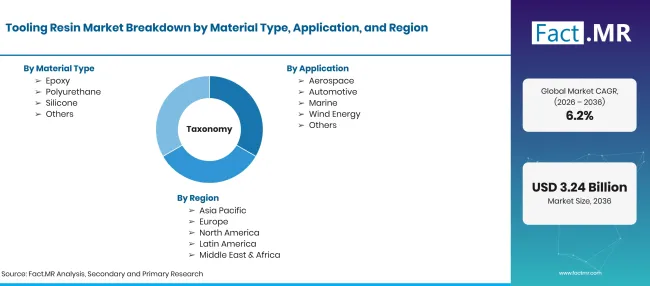
Tooling Resin Market Taxonomy | Source: Fact.MR
| Attribute | Details |
|---|---|
| Quantitative Units | USD billion |
| Market Definition | Revenue from epoxy, polyurethane, silicone and other resin systems sold for making models, patterns, molds, lay-up tools and fixtures. |
| Material Type | Epoxy; Polyurethane; Silicone; Others |
| Application | Aerospace; Automotive; Marine; Wind Energy; Others |
| End-User Industry | Transportation; Construction; Electronics; Others |
| Regions Covered | North America; Latin America; Western Europe; Eastern Europe; East Asia; South Asia & Pacific; Middle East & Africa |
| Countries Covered | Japan; Germany; United States; United Kingdom; Brazil |
| Companies Profiled | Sika; RAMPF Group; Hexcel; Gurit; Trelleborg; Alchemie; Scott Bader |
| Forecast Period | 2026 to 2036 |
| Approach | Composite part output by country was linked to tool counts, resin use per tool and supplier price lists to build the forecast. |
Source: Fact.MR analysis. Updated Nov 6, 2026
How is the market segmented?
-
By Material Type
- Epoxy
- Polyurethane
- Silicone
- Others
-
By Application
- Aerospace
- Automotive
- Marine
- Wind Energy
- Others
-
By End-User Industry
- Transportation
- Construction
- Electronics
- Others
-
By Region
- North America
- Latin America
- Western Europe
- Eastern Europe
- East Asia
- South Asia & Pacific
- Middle East & Africa
Frequently Asked Questions
How large is the tooling resin market in 2026?
What growth rate will the tooling resin market record?
Which material type leads?
Which application leads?
Which end-user leads?
Which country will grow quickest?
Who are the main companies?
What holds the market back?
Who worked on this report


Preview the report firsthand - request a free sample
Free SampleGet the brochure for pricing and purchase details
Download PDF