- Base Value(2025): 1.10 Bn
- Estimated Value(2026): 1.16 Bn
- Forecast Value (2036): 1.88 Bn
- CAGR (2026 - 2036): 5.00%
Resin Capsules Market Size, Market Forecast and Outlook By Fact.MR
The resin capsules market was valued at USD 1.10 billion in 2025, projected to reach USD 1.16 billion in 2026, and is forecast to expand to USD 1.88 billion by 2036 at a 5.00% CAGR. Structural anchoring requirements in construction and ground support bolt installation in mining operations are sustaining procurement of resin capsules across global infrastructure and resource extraction sectors. Resin capsules provide controlled, reliable adhesive bonding for rebar anchoring in concrete structures, rock bolt installation in underground mining, and heavy-duty fastener systems in manufacturing, eliminating the variability of site-mixed grout systems and delivering consistent bond strength in field conditions.
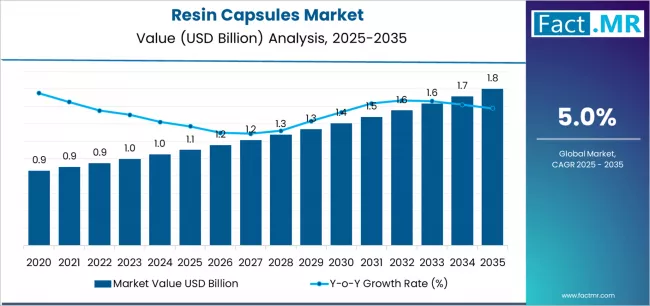
Resin Capsules Market Market Value Analysis | Source: Fact.MR
Summary of Resin Capsules Market
- Market Overview
- The market is valued at USD 1.10 billion in 2025 and is projected to reach USD 1.88 billion by 2036.
- The industry is expected to grow at a 5.00% CAGR from 2026 to 2036, creating an incremental opportunity of USD 0.72 billion.
- The market operates as a performance-critical anchoring consumable category where bond strength reliability, cure speed consistency, and underground safety certification define competitive positioning across construction, mining, and manufacturing end uses.
- Demand and Growth Drivers
- Infrastructure construction growth in emerging economies drives demand for pre-portioned resin capsule systems that deliver consistent structural anchoring performance without site-mixed grout variability.
- Underground mining ground support requirements sustain resin capsule procurement for rock bolt installation in coal, metal, and hard rock mining operations.
- Tightening structural anchoring performance standards in construction codes favour factory-controlled resin capsule products with documented bond strength and cure time certificates.
- Among key countries, India leads at 5.6% CAGR, followed by China at 5.3%, Germany at 5.0%, the USA at 4.8%, the UK at 4.7%, Japan at 4.6%, and Brazil at 4.5%.
- Product and Segment View
- Resin capsules are pre-portioned, two-component adhesive anchoring systems consisting of a resin compound and a hardener catalyst sealed in a glass or film cartridge, activated by mechanical mixing during bolt insertion.
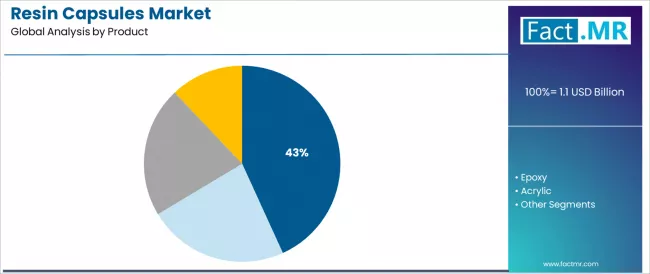
- Polyester accounts for 43.2% of the Product segment in 2026, preferred for its cost-effective bond strength and established performance record in construction rebar and mining rock bolt anchoring.
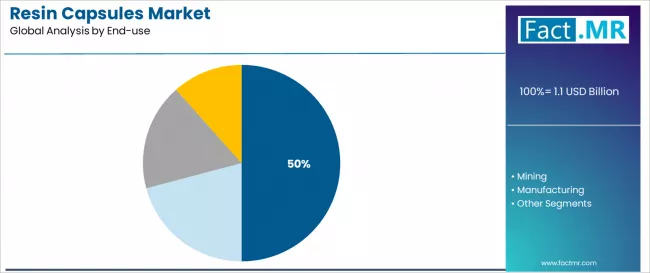
- Construction holds 50.0% of the End-use segment in 2026, reflecting structural anchoring demand in concrete rebar connections, facade fixing, and seismic retrofit applications.
- Scope includes polyester, epoxy, acrylic, and other resin capsule systems for construction, mining, manufacturing, and other anchoring applications. Mechanical expansion anchors, cement grout, and injectable resin cartridge systems are excluded.
- Geography and Competitive Outlook
- India and China are the fastest-growing markets, driven by infrastructure construction expansion and underground mining ground support demand.
- Germany and the USA anchor developed-market demand through precision construction anchoring standards and tunnelling project requirements.
- Competition is shaped by resin formulation performance, cure speed range, and underground safety certification, with Sika AG, Orica Limited, DYWIDAG-Systems International, Fischer, Arkema, and 3M among the principal suppliers.
- Analyst Opinion at Fact.MR
- Shambhu Nath Jha , Principal Consultant for Chemicals and Materials, opines: 'In my analysis, I have observed that the resin capsules market is transitioning from a commodity anchoring consumable to a performance-certified structural system. The decisive specification variable for construction engineers and mine safety officers is no longer bond strength alone but documented cure performance across a temperature range from minus 5 to plus 40 degrees Celsius. Resin capsule suppliers that provide certified cure time and bond strength data across this temperature envelope will capture specification positions in infrastructure projects and mining operations where standard products with narrow temperature tolerance face rejection.'
- Strategic Implications / Executive Takeaways
- Resin capsule manufacturers must develop formulations with documented cure performance across minus 5 to plus 40 degrees Celsius to meet specification requirements in diverse climate construction and mining environments.
- Mining product teams should invest in fast-cure capsule development for mechanized bolt installation systems that require sub-60-second gel times to maintain drilling cycle productivity.
- Construction channel partners need to establish structural engineering specification partnerships to embed resin capsule anchoring into building code compliance documentation at the design stage.
Resin Capsules Market Key Takeaways
| Metric | Details |
|---|---|
| Industry Size (2026) | USD 1.16 billion |
| Industry Value (2036) | USD 1.88 billion |
| CAGR (2026 to 2036) | 5.00% |
Source: Fact.MR analysis. Updated Apr 4, 2026
Between 2026 and 2036, the market is set to register an absolute dollar opportunity of USD 0.72 billion. This expansion reflects the convergence of infrastructure construction growth in emerging economies, underground mining activity expansion, and the tightening of structural anchoring performance standards that favour pre-portioned resin capsule systems over field-mixed alternatives. Resin raw material costs (unsaturated polyester, epoxy, styrene) introduce pricing variability linked to petrochemical market dynamics.
India leads with a 5.6% CAGR, driven by massive infrastructure development and mining sector expansion. China follows at 5.3%, supported by construction activity and underground coal mine ground support demand. Germany registers 5.0%, anchored by precision construction anchoring and tunnelling requirements. The USA tracks at 4.8%, the UK at 4.7%, Japan at 4.6%, and Brazil at 4.5%.
Why is the Resin Capsules Market Experiencing Steady Growth?
The resin capsules market grows by enabling mining operators, construction contractors, and infrastructure developers to access reliable rock anchoring solutions that support structural safety while meeting regulatory demand for ground support systems. Mining companies face mounting pressure to implement effective roof support technologies with proven load-bearing capabilities, with polyester resin capsule systems typically providing 20-30 ton anchoring capacity comparable to mechanical bolting alternatives, making these products essential for competitive positioning in unde11ound safety management. The ground control industry's need for versatile installation methods and geological compatibility creates demand for diverse resin formulations that can provide superior bond strength, maintain consistent performance across different rock types, and ensure regulatory compliance without compromising installation efficiency or operational safety standards.
Government initiatives promoting mine safety regulations and infrastructure quality standards drive adoption in coal mining operations, hard rock mining applications, and tunnel construction partnerships, where resin capsule performance has a direct impact on worker safety outcomes and structural integrity. The construction industry's growing focus on deep foundation anchoring and seismic retrofitting further expands market opportunities, with engineering research demonstrating measurable improvements in pull-out resistance, long-term durability, and installation speed compared to alternative anchoring methods. However, supply chain complexity during specialized resin procurement and the technical requirements for proper mixing activation and curing time management may limit accessibility among smaller contractors and developing regions with limited infrastructure for geotechnical engineering expertise and quality control systems.
Segmental Analysis
The market is segmented by product, end-use, and region. By product, the market is divided into polyester, epoxy, acrylic, and others. Based on end-use, the market is categorized into construction, mining, manufacturing, and others. Regionally, the market is divided into Europe, North America, Asia Pacific, Latin America, and Middle East & Africa.
What Makes Polyester the Dominant Product Segment in the Resin Capsules Market?
Resin Capsules Market Analysis By Product | Source: Fact.MR
The polyester segment represents the dominant force in the resin capsules market, capturing approximately 43.2% of total market share in 2035. This established product category encompasses solutions featuring rapid-setting chemical properties and cost-effective formulations, enabling efficient rock bolting installation and consistent bonding performance across all unde11ound mining and tunneling applications.
The polyester segment's market leadership stems from its superior operational characteristics, with products capable of meeting diverse installation requirements while maintaining high bond strength values and reliable curing profiles across all geological conditions. The polyester segment demonstrates strong growth trajectory with projected market value expanding from USD 0.46 billion in 2025 to USD 0.76 billion by 2035, driven by widespread adoption in coal mining and tunnel construction applications.
The epoxy segment maintains a substantial 27.3% market share in 2035, serving applications that require premium bonding performance with enhanced chemical resistance for specialized mining and industrial anchoring scenarios. These formulations offer high-quality anchoring solutions for demanding conditions while providing sufficient versatility to meet harsh environment demands and long-term durability requirements.
The epoxy segment is valued at USD 0.31 billion in 2025, projected to reach USD 0.48 billion by 2035. The acrylic segment accounts for approximately 20.5% of the market in 2035, serving water-saturated geological formations and specific construction applications. Others, including vinylester and polyurethane formulations, represent 9.0% market share, serving specialized industrial and marine anchoring requirements.
Key advantages driving the polyester segment include:
- Advanced formulation chemistry with proven rapid-setting characteristics that reduce installation time and enable immediate load application
- High cost-efficiency capabilities allowing widespread deployment across different mining operations without significant budget constraints
- Proven installation reliability, delivering consistent bond strength while maintaining ease of use against alternative chemical anchoring systems
- Broad regulatory acceptance enabling straightforward product approvals and mine safety compliance across multiple jurisdictions
How does the Construction Segment Lead End-Use Market Share?
Resin Capsules Market Analysis By End Use | Source: Fact.MR
Construction dominates the end-use segment with approximately 50.0% market share in 2035, reflecting the critical role of resin capsules in supporting global infrastructure development and ground anchoring applications worldwide.
The construction segment's market leadership is reinforced by extensive tunnel construction projects, foundation anchoring requirements, and rising demand for structural retrofitting in bridge construction, unde11ound parking facilities, and metro rail systems across developed and emerging markets. The construction segment is valued at USD 0.53 billion in 2025, projected to reach USD 0.88 billion by 2035.
The mining segment represents the second-largest end-use category, capturing 31.8% market share in 2035 valued at USD 0.34 billion in 2025, growing to USD 0.56 billion by 2035 through unde11ound coal mining expansion and hard rock mining development.
This segment benefits from mandatory ground support requirements and safety regulations that meet specific roof control standards, operational safety protocols, and geological stability demands in competitive mining markets. Manufacturing accounts for 14.2% market share in 2035, while others including marine and energy sector applications represent 4.0%.
Key market dynamics supporting end-use growth include:
- Construction expansion driven by infrastructure investment and urbanization, requiring reliable anchoring systems in complex projects
- Mining modernization trends require advanced ground support technologies for deeper excavations and challenging geological conditions
- Integration of automated installation equipment enabling efficient deployment and quality assurance
- Growing emphasis on application diversity driving demand for comprehensive, multi-purpose anchoring solutions
What are the Drivers, Restraints, and Key Trends of the Resin Capsules Market?
Resin Capsules Market Opportunity Matrix Growth Vs Value | Source: Fact.MR
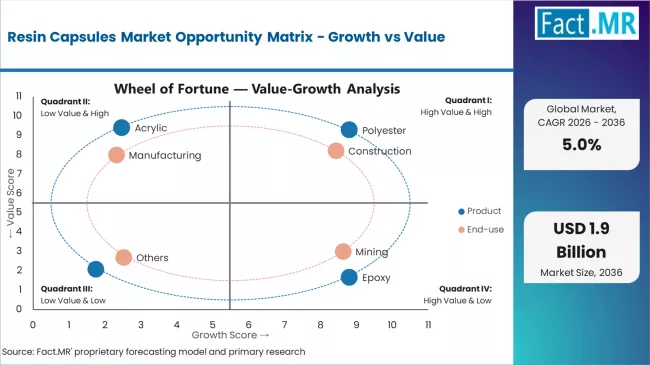
The market is driven by three concrete demand factors tied to infrastructure investment and mining sector growth. First, increasing global infrastructure development creates growing demand for tunnel construction and foundation anchoring solutions, with worldwide infrastructure spending expanding by 3-5% annually in major developing economies, requiring comprehensive ground support infrastructure. Second, unde11ound mining expansion and coal production growth drive increased adoption of resin capsule roof bolting systems, with mining operations extending to greater depths requiring enhanced ground control technologies by 2030. Third, technological advancements in resin formulation chemistry and capsule manufacturing enable more effective and reliable anchoring products that improve bond strength while reducing installation complexity and curing time requirements.
Market restraints include fluctuating petrochemical feedstock prices that can deter manufacturers from maintaining stable pricing strategies, particularly in markets where raw material procurement networks remain sensitive to oil price volatility. Technical performance limitations in extreme environmental conditions pose another significant challenge, as resin capsules demand specific temperature ranges and moisture conditions for optimal curing, potentially causing installation complications and reduced bond strength in challenging geological settings. Installation technique requirements and quality control protocols across different regions create additional market challenges for consistent performance, demanding ongoing investment in contractor training programs and technical support services.
Key trends indicate accelerated adoption in Asia Pacific markets, particularly China and India, where expanding infrastructure projects and growing coal mining activities drive comprehensive resin capsule utilization. Technology integration trends toward smart capsule designs with specific mixing enhancement features, performance monitoring capabilities, and quality assurance innovations enable proactive installation approaches that optimize bond strength and minimize installation failures. However, the market thesis could face disruption if significant advances in mechanical anchoring technologies or alternative ground support methods reduce reliance on chemical resin-based anchoring systems.
Analysis of the Resin Capsules Market by Key Countries
.webp "Top Country Growth Comparison Resin Capsules Market Cagr (2026 2036)")
Top Country Growth Comparison Resin Capsules Market Cagr (2026 2036) | Source: Fact.MR
| Country | CAGR (2026-2036) |
|---|---|
| India | 5.6% |
| China | 5.3% |
| Germany | 5.0% |
| USA | 4.8% |
| UK | 4.7% |
| Japan | 4.6% |
| Brazil | 4.5% |
Source: Fact.MR analysis. Updated Apr 4, 2026
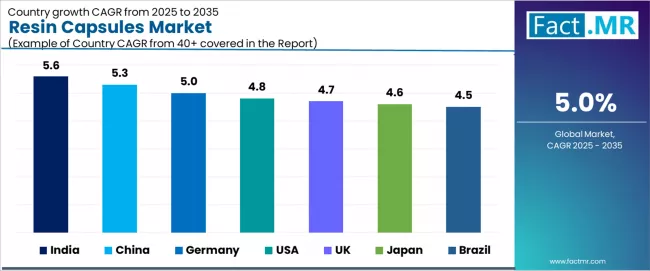
Resin Capsules Market Cagr Analysis By Country | Source: Fact.MR
The resin capsules market is expanding steadily, with India leading at a 5.6% CAGR through 2036, driven by massive infrastructure development programs, expanding coal mining operations, and growing metro rail construction projects in major cities. China follows at 5.3%, supported by extensive tunnel construction networks, unde11ound mining expansion, and Belt and Road infrastructure initiatives. Germany records 5.0%, reflecting strong construction standards, established mining support practices, and comprehensive quality requirements for anchoring systems.
The USA posts 4.8%, anchored by infrastructure rehabilitation programs, longwall coal mining operations, and commercial construction activity. UK advances at 4.7%, emphasizing tunnel infrastructure projects and mining industry applications with stringent safety requirements. Japan grows at 4.6%, with focus on seismic retrofitting applications and unde11ound construction in urban environments, while Brazil grows at 4.5%, representing emerging mining sector expansion and infrastructure modernization programs.
What is India’s Outlook in the Resin Capsules Market?
India demonstrates the strongest growth potential in the resin capsules market with a CAGR of 5.6% through 2036, with projected market size reaching USD 0.27 billion by 2036. The country's leadership position stems from massive infrastructure development programs, expanding coal mining operations, and growing metro rail construction projects enabling mainstream resin capsule adoption.
Growth is concentrated in major development regions, including Delhi NCR, Mumbai Metropolitan Region, Kolkata, and coal mining belts in Jharkhand and Odisha, where infrastructure contractors and mining companies are implementing comprehensive ground support systems for tunnel projects and unde11ound coal extraction.
Distribution channels through construction material suppliers, mining equipment distributors, and specialized anchoring system providers expand deployment across metro construction projects and Coal India subsidiaries. The country's growing infrastructure sector provides policy support for quality anchoring products, including Make in India manufacturing incentives and infrastructure development funds.
Key market factors:
- Demand concentrated in metro construction projects and coal mining regions with comprehensive ground support requirements
- Infrastructure growth through government investment programs, smart city initiatives, and mining expansion projects
- Comprehensive industrial ecosystem including growing geotechnical engineering expertise and construction technology adoption
- Technology integration featuring mechanized rock bolting equipment, quality control systems, and contractor training programs
How does China emerge as a High Growth Market for Resin Capsules?
In Beijing, Shanghai, Guangzhou, and major mining provinces including Shanxi and Inner Mongolia, the adoption of resin capsule products is accelerating across infrastructure projects and mining operations, driven by urbanization demands and energy security priorities.
The market demonstrates strong growth momentum with a CAGR of 5.3% through 2036, with projected market size reaching USD 0.38 billion by 2036, linked to extensive tunnel construction networks, unde11ound mining expansion, and Belt and Road infrastructure initiatives.
Construction companies and mining operators are implementing advanced resin capsule systems and mechanized installation equipment to enhance safety performance while meeting growing demand in expanding subway networks and coal production operations. The country's infrastructure development strategies create persistent demand for ground support products, while increasing emphasis on mining safety drives adoption of international standard anchoring technologies.
Key development areas:
- Metro construction and mining sectors leading resin capsule adoption with comprehensive safety programs
- Domestic manufacturing providing cost-competitive products with 80% local production capabilities
- Technology partnerships between international chemical companies and Chinese distributors are expanding market reach
- Integration of automated rock bolting equipment and comprehensive quality monitoring systems
What is the Resin Capsules Market Forecast for Germany?
The market in Germany leads in premium resin capsule applications based on integration with rigorous quality standards and comprehensive testing protocols for enhanced anchoring performance. The country shows steady potential with a CAGR of 5.0% through 2036, with projected market size reaching USD 0.28 billion by 2036, driven by strong construction standards, established mining support practices, and comprehensive quality requirements.
Construction contractors are adopting high-performance resin capsule formulations for tunnel projects and foundation anchoring, particularly in major infrastructure developments and specialized unde11ound construction demanding comprehensive engineering excellence. Technology deployment channels through established construction suppliers and technical distributors expand coverage across civil engineering firms and mining operations.
Leading market segments:
- Infrastructure projects and tunnel construction implementing advanced anchoring systems with rigorous quality control
- Mining operations with chemical suppliers, achieving 98% safety compliance rates through certified products
- Strategic collaborations between resin manufacturers and construction equipment providers are expanding market presence
- Focus on technical documentation and performance validation requirements
How is Emphasis on Infrastructure Renewal Opening Avenues for Growth in USA?
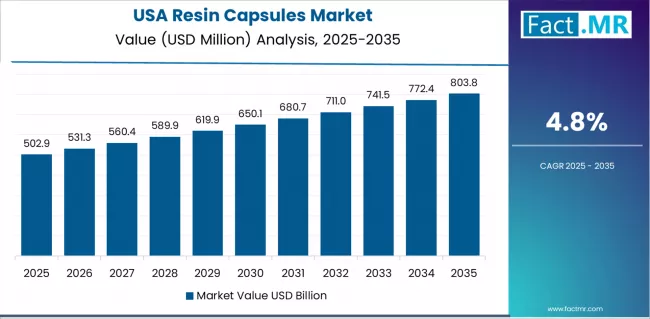
Resin Capsules Market Country Value Analysis | Source: Fact.MR
In major construction markets including infrastructure corridors, Appalachian coal mining regions, and metropolitan areas, contractors are implementing resin capsule systems to support tunnel rehabilitation and new construction projects, with documented installations showing reliable performance through comprehensive testing protocols.
The market shows steady growth potential with a CAGR of 4.8% through 2036, with projected market size reaching USD 0.43 billion by 2036, linked to infrastructure rehabilitation programs, longwall coal mining operations, and commercial construction activity.
Contractors benefit from established resin capsule technologies and comprehensive technical support services to ensure installation quality while meeting safety standards demanded by MSHA regulations and construction building codes. The country's mature construction market creates persistent demand for product reliability and technical innovation solutions that integrate with existing installation equipment and contractor training programs.
Market development factors:
- Infrastructure agencies and mining companies leading resin capsule utilization across USA
- Safety regulations including MSHA standards providing framework for product performance requirements
- Strategic partnerships between chemical manufacturers and construction distributors are expanding product availability
- Emphasis on installation training programs and technical support services across contractor networks
How will Heightened Infrastructure Investment Generate Demand for Resin Capsules in the UK?
The UK's resin capsules market demonstrates focused infrastructure engagement centered on tunnel construction and mining applications, with documented adoption of advanced anchoring systems achieving comprehensive safety performance in Crossrail and HS2 projects.
The country maintains stable growth momentum with a CAGR of 4.7% through 2036, with projected market size reaching USD 0.19 billion by 2036, driven by tunnel infrastructure projects and mining industry applications with stringent safety requirements.
Major infrastructure regions showcase advanced deployment of resin capsule systems where installation protocols integrate seamlessly with comprehensive quality assurance procedures and geotechnical monitoring programs.
Key market characteristics:
- Infrastructure projects and remaining coal mining operations driving resin capsule demand with emphasis on safety compliance
- Industry standards providing comprehensive guidelines for product selection and installation procedures
- Technology collaboration between UK construction firms and international resin manufacturers is expanding capabilities
- Emphasis on certified installer programs and quality documentation requirements
How will Seismic Applications Influence Resin Capsules Demand in Japan?
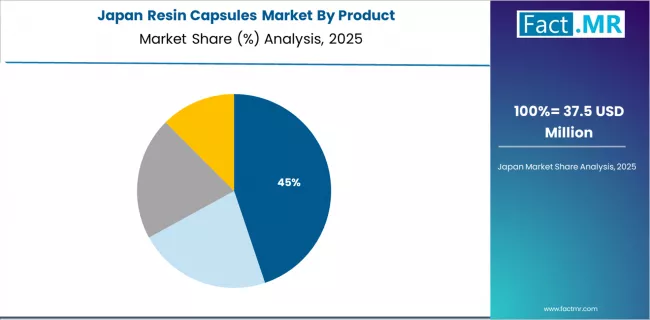
Resin Capsules Market Japan Market Share Analysis By Product | Source: Fact.MR
Japan's resin capsules market demonstrates specialized application focus on seismic retrofitting and urban unde11ound construction, with established quality standards supporting comprehensive anchoring requirements across earthquake-resistant infrastructure projects.
The country maintains steady growth momentum with a CAGR of 4.6% through 2036, with projected market size reaching USD 0.14 billion by 2036, representing focus on seismic retrofitting applications and unde11ound construction in urban environments.
Major construction markets showcase implementation of resin capsule systems where technical specifications address comprehensive seismic performance requirements and stringent quality control protocols.
Key market characteristics:
- Urban construction and seismic retrofitting projects driving specialized anchoring requirements
- Quality standards enabling rigorous performance testing with comprehensive certification programs
- Technology collaboration between Japanese construction firms and chemical suppliers is expanding product development
- Emphasis on technical training and installation quality verification methodologies
How will the Mining Sector Encourage Uptake of Resin Capsules in Brazil?
Brazil's market expansion is driven by mining sector development, including iron ore operations in Minas Gerais and infrastructure projects in São Paulo and Rio de Janeiro. The country demonstrates promising growth potential with a CAGR of 4.5% through 2036, with projected market size reaching USD 0.07 billion by 2036, supported by emerging mining sector expansion and infrastructure modernization programs.
Mining operators face implementation challenges related to import dependency for specialized resin formulations, requiring local distribution network development and technical support from international manufacturers. However, growing infrastructure investment and mining safety emphasis create compelling business cases for resin capsule adoption, particularly in unde11ound mining operations where ground support quality has direct impact on operational safety.
Market characteristics:
- Mining operations and infrastructure projects showing steady growth with increasing safety awareness
- Regional expansion trends focused on southeastern mining regions and major metropolitan infrastructure development
- Future projections indicate need for local technical support infrastructure and contractor training programs
- Growing emphasis on safety compliance and ground support quality standards
Europe Market Split by Country
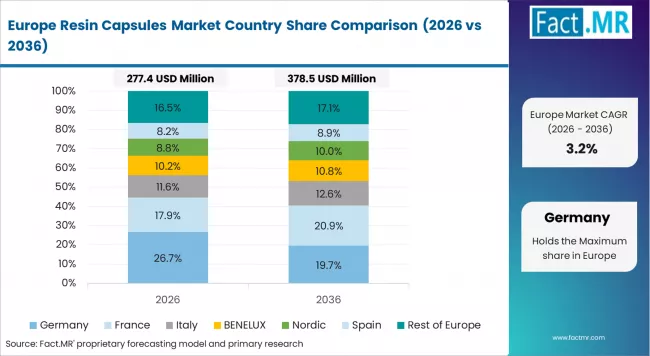
Resin Capsules Market Europe Country Market Share Analysis, 2026 & 2036 | Source: Fact.MR
The resin capsules market in Europe is projected to grow from USD 0.38 billion in 2026 to USD 0.62 billion by 2036, registering a CAGR of 5.0% over the forecast period. Germany is expected to maintain its leadership position with a 34.2% market share in 2026, maintaining approximately 33.8% by 2036, supported by its advanced construction infrastructure, comprehensive tunnel projects, and strong quality standards across major industrial regions.
UK follows with a 21.7% share in 2026, projected to reach 21.9% by 2036, driven by infrastructure megaprojects including HS2 and ongoing tunnel construction programs. France holds a 18.4% share in 2026, expected to reach 18.6% by 2036 through comprehensive metro expansion and mining support applications.
Italy commands a 12.3% share, while Spain accounts for 8.1% in 2026. The rest of Europe region is anticipated to maintain steady position, with collective share moving from 5.3% to 5.4% by 2036, attributed to increasing resin capsule adoption in Nordic tunnel projects and emerging Eastern European mining operations implementing modernization programs.
Competitive Landscape of the Resin Capsules Market
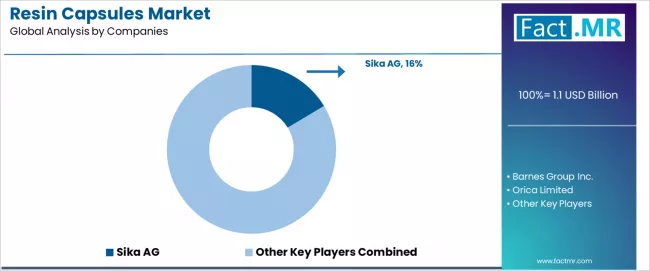
Resin Capsules Market Analysis By Company | Source: Fact.MR
The resin capsules market features approximately 10-15 meaningful players with moderate concentration, where the top three companies control roughly 40-45% of global market share through established product portfolios and extensive distribution networks serving construction and mining industries. Competition centers on product performance, technical support, and supply chain reliability rather than price competition alone.
Market leaders include Sika AG, Orica Limited, and Arkema SA, which maintain competitive advantages through comprehensive resin capsule product portfolios, global manufacturing and distribution capabilities, and deep expertise in the construction chemicals, mining explosives, and specialty chemicals sectors, creating high customer loyalty among contractors and mining operators.
These companies leverage established quality certifications and ongoing product innovation services to defend market positions while expanding into emerging markets and specialized application segments. Sika AG commands a 16.4% market share in 2035 through global construction chemicals leadership and comprehensive anchoring system solutions.
Challengers encompass Fischer Holding GmbH & Co. and Barnes Group Inc., which compete through specialized product offerings and strong positions in European construction markets and mining support systems. Industry specialists, including DYWIDAG-Systems International, Bohle AG, and Rawlplug, focus on specific geographical markets or application segments, offering differentiated capabilities in prestressing systems, glazing applications, and fastening solutions.
Regional players and emerging chemical manufacturers create competitive pressure through competitive pricing strategies and localized technical support, particularly in high-growth markets including China and India, where distribution network density provides advantages in contractor relationships and technical service delivery.
Market dynamics favor companies that combine proven resin formulations with comprehensive technical support programs that address the complete installation journey from product selection through quality assurance and performance verification. Strategic collaborations between resin manufacturers and rock bolting equipment providers accelerate technology integration, while distributor partnership programs enable market penetration and contractor training initiatives.
Global Resin Capsules Market - Stakeholder Contribution Framework
Resin capsule products represent a critical ground support technology that enables mining operators, construction contractors, and infrastructure developers to deliver reliable rock anchoring without complex installation procedures, typically providing 20-30 ton load capacity comparable to mechanical bolting alternatives while enabling rapid installation and immediate load application. With the market projected to grow from USD 1.1 billion in 2025 to USD 1.8 billion by 2035 at a 5.0% CAGR, these products offer compelling advantages - proven bond strength, installation efficiency, and comprehensive geological compatibility - making them essential for unde11ound mining operations (growing segment), tunnel construction projects (expanding adoption), and diverse infrastructure applications seeking effective ground support solutions. Scaling market penetration and product performance requires coordinated action across safety policy, industry standards, chemical manufacturers, equipment providers, and training institutions.
How Governments Could Spur Safety Standards and Market Development?
- Safety Regulation Programs: Include resin capsule performance requirements in national mining safety regulations and construction codes, providing clear guidelines for product specifications in unde11ound applications and supporting industry compliance through standardized testing protocols and certification programs.
- Infrastructure Investment & Mining Support: Implement accelerated infrastructure development programs requiring comprehensive ground support systems, provide funding for mining safety improvements including roof support modernization, and establish favorable procurement frameworks that encourage quality product adoption over lowest-cost alternatives.
- Regulatory Framework Development: Create streamlined chemical product approval processes balancing safety with innovation, establish clear performance standards for anchoring systems across mining and construction applications, and develop harmonized testing protocols that facilitate international trade and technology transfer.
- Training & Capacity Building: Fund vocational programs for unde11ound construction workers, mine roof bolters, and geotechnical technicians. Invest in training infrastructure that enables proper installation technique development and quality assurance capabilities before field deployment.
How Industry Bodies Could Support Market Development?
- Technical Standards & Certification: Define standardized performance specifications for resin capsule products across mining, tunneling, and construction applications, establish universal testing protocols for bond strength and curing characteristics, and create certification programs for installer competency that ensures consistent quality.
- Safety Education & Best Practices: Lead comprehensive training programs demonstrating proper installation techniques, emphasizing proven ground support performance, geological compatibility considerations, and superior safety outcomes compared to inadequate or improperly installed anchoring systems.
- Technology Assessment Standards: Develop consensus guidelines for product selection based on geological conditions, application requirements, and environmental factors, ensuring appropriate specification across different project types and geological settings.
How Manufacturers and Distributors Could Strengthen the Ecosystem?
- Advanced Product Development: Develop next-generation resin formulations with enhanced curing speed, improved temperature tolerance, and specialized viscosity characteristics that enhance installation reliability while expanding application range across diverse geological conditions.
- Technical Support Programs: Provide comprehensive installer training that integrates product knowledge, installation technique instruction, quality control procedures, and troubleshooting guidance, enabling contractors and mining operators to maximize installation success rates and long-term anchor performance.
- Distribution & Service Networks: Offer flexible supply chain programs for construction projects and mining operations, including just-in-time delivery options, technical field support services, and quality assurance assistance that keeps resin capsule applications current with evolving safety requirements and industry best practices.
Key Players in the Resin Capsules Market
- Sika AG
- Barnes Group Inc.
- Orica Limited
- DYWIDAG-Systems International
- Bohle AG
- Rawlplug
- Sormat OY
- Arkema SA
- Fischer Holding GmbH & Co.
- 3M Company
Bibliography
- European Organisation for Technical Assessment. (2024). EOTA TR 023: Assessment of chemical anchors in concrete. EOTA.
- International Council on Mining and Metals. (2025). ICMM mining safety: Ground support technology data. ICMM.
- American Concrete Institute. (2024). ACI 318: Building code requirements for structural concrete anchoring provisions. ACI.
- International Tunnelling and Underground Space Association. (2025). ITA technology review: Rock bolt anchoring systems. ITA.
- U.S. Geological Survey. (2025). Mineral commodity summaries: Mining industry production data. USGS.
This bibliography is provided for reader reference. The full Fact.MR report contains the complete reference list with primary research documentation.
This Report Addresses
- Market sizing and quantitative forecast metrics detailing resin capsule expenditure across global construction, mining, and manufacturing sectors through 2036.
- Segmentation analysis mapping adoption velocity across polyester, epoxy, acrylic, and other resin types and evaluating construction, mining, and manufacturing end-use dynamics.
- Country-level deployment intelligence comparing infrastructure investment, mining activity, and building code anchoring standard adoption across India, China, Germany, USA, UK, Japan, and Brazil.
- Competitive posture evaluation tracking resin formulation performance, cure speed range, temperature tolerance, and safety certification among leading capsule suppliers.
- Mining application assessment analyzing rock bolt installation automation trends, mechanized bolting system compatibility requirements, and underground safety certification frameworks.
- Regulatory compliance assessment identifying structural anchoring performance standards and mine safety ground support requirements across covered markets.
- Custom data delivery formats encompassing interactive dashboards, raw Excel datasets, and comprehensive PDF narrative reports.
Resin Capsules Market Definition
Resin capsules are pre-portioned, two-component chemical anchoring systems designed for structural bonding of reinforcement bars, rock bolts, and heavy-duty fasteners. Each capsule contains a reactive resin compound (polyester, epoxy, or acrylic) and a catalyst hardener sealed in a breakable glass or plastic cartridge. Activation occurs through mechanical spinning during anchor insertion, mixing the components and initiating cure. The market covers production, distribution, and sale of resin capsules globally.
Resin Capsules Market Inclusions
Market scope includes polyester, epoxy, acrylic, and other resin capsule systems for construction, mining, manufacturing, and other anchoring applications. Country coverage spans India, China, Germany, USA, UK, Japan, and Brazil. Forecast covers 2026 to 2036 with base year 2025.
Resin Capsules Market Exclusions
Mechanical expansion anchors, cementitious grout, injectable resin cartridge dispensing systems, and downstream construction assemblies and mining ground support engineering services are excluded.
Resin Capsules Market Research Methodology
- Primary Research: Analysts engaged with structural engineering specification managers, mine safety ground support officers, and construction fastener distribution executives to map anchoring requirements, product qualification protocols, and procurement cycles.
- Desk Research: Data collection phases aggregated national construction industry output statistics, mining production data, and building code anchoring standard adoption records from covered countries.
- Market-Sizing and Forecasting: Baseline values derive from a bottom-up aggregation of resin capsule shipment volumes by product type and end use, applying construction activity indices and mining production growth rates to project demand velocity.
- Data Validation and Update Cycle: Projections are tested against publicly reported construction expenditure data from national statistics agencies and mining industry output statistics from geological survey organisations.
Segmentation
Scope of the Report
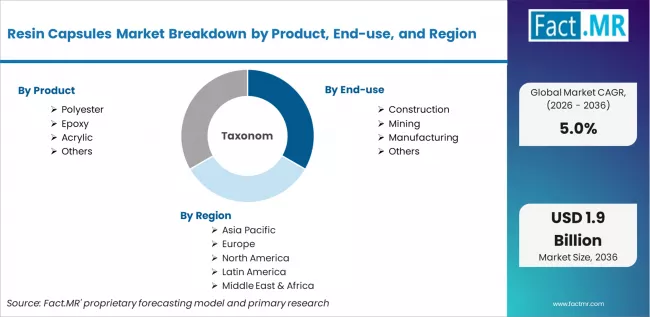
Resin Capsules Market Breakdown By Product, End Use, And Region | Source: Fact.MR
| Metric | Value |
|---|---|
| Quantitative Units | USD 1.16 billion to USD 1.88 billion, at a CAGR of 5.00% |
| Market Definition | Resin capsules encompass pre-portioned polyester, epoxy, acrylic, and other two-component chemical anchoring systems for rebar, rock bolt, and fastener installation in construction, mining, and manufacturing applications globally. |
| Product Segmentation | Polyester, Epoxy, Acrylic, Others |
| End-use Segmentation | Construction, Mining, Manufacturing, Others |
| Regions Covered | India, China, Germany, USA, UK, Japan, Brazil |
| Key Companies Profiled | Sika AG, Barnes Group Inc., Orica Limited, DYWIDAG-Systems International, Bohle AG, Rawlplug, Sormat OY, Arkema SA, Fischer Holding GmbH & Co., 3M Company |
| Forecast Period | 2026 to 2036 |
| Approach | Forecasting models apply a bottom-up methodology starting with construction and mining output data, cross-validated against resin capsule shipment records and anchoring product distribution statistics. |
Source: Fact.MR analysis. Updated Apr 4, 2026
Resin Capsules Market by Segments
-
Product :
- Polyester
- Epoxy
- Acrylic
- Others
-
End-use :
- Construction
- Mining
- Manufacturing
- Others
-
Region :
- Europe
- Germany
- UK
- France
- Italy
- Spain
- Nordic
- Rest of Europe
- North America
- USA
- Canada
- Mexico
- Asia Pacific
- China
- Japan
- South Korea
- India
- Australia & New Zealand
- ASEAN
- Rest of Asia Pacific
- Latin America
- Brazil
- Argentina
- Rest of Latin America
- Middle East & Africa
- Kingdom of Saudi Arabia
- Other GCC Countries
- Turkey
- South Africa
- Rest of Middle East & Africa
- Europe
Frequently Asked Questions
How large is the resin capsules market in 2026?
What will be the market size by 2036?
What is the expected demand growth between 2026 and 2036?
Which Product leads?
Which End-use commands the largest share?
Which country is the fastest-growing?
What is included in the scope?
What is excluded?
Who worked on this report


Preview the report firsthand - request a free sample
Free SampleGet the brochure for pricing and purchase details
Download PDF