Trail Mix Market

Trail Mix Market Size and Share Forecast Outlook 2025 to 2035

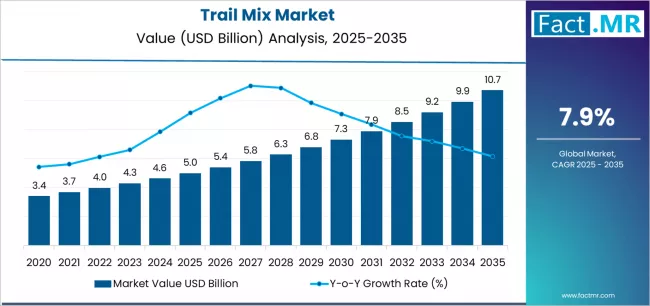
Trail mix market is projected to grow from USD 5.0 billion in 2025 to USD 10.7 billion by 2035, at a CAGR of 7.9%. Nuts & Seed Mix will dominate with a 45.0% market share, while conventional will lead the type segment with a 72.0% share.

Trail Mix Market Forecast and Outlook 2025 to 2035

The global trail mix market is projected to reach USD 10.7 billion by 2035, recording an absolute increase of USD 5.7 billion over the forecast period. The market is valued at USD 5.0 billion in 2025 and is set to rise at a CAGR of 7.9% during the assessment period.

Quick Stats for Trail Mix Market

  • Trail Mix Market Value (2025): USD 5.0 billion
  • Trail Mix Market Forecast Value (2035): USD 10.7 billion
  • Trail Mix Market Forecast CAGR: 7.9%
  • Leading Product in Trail Mix Market: Nuts & Seed Mix (45.0%)
  • Key Growth Regions in Trail Mix Market: Asia Pacific, North America, and Europe
  • Top Players in Trail Mix Market: The J.M. Smucker Company, PepsiCo Inc., General Mills Inc., Kellogg Company, Mars Incorporated, Hormel Foods Corporation, Second Nature Brands, Texas Star Nut & Food Co, National Raisin Company, Creative Snacks Co

Trail Mix Market Market Value Analysis

The overall market size is expected to grow by 2.1 times during the same period, supported by increasing demand from health-conscious consumers and expanding applications in on-the-go snacking occasions across both developed and emerging food markets. Additionally, growing application diversity in protein-enriched formulations, functional ingredient integration, and premium organic product categories creates expanding opportunities for trail mix innovation and specialized product developments.

Rising wellness awareness in Asia Pacific nations, coupled with expanding modern retail infrastructure through supermarket chains and e-commerce platforms, further accelerate market penetration across diverse consumer segments. The growing global demand for convenient nutrition solutions, particularly in workplace snacking applications and outdoor activity provisions, generates sustained requirements for high-quality nuts and seed blends and nutrient-dense dried fruit combinations.

Technical advancements in food processing technologies demonstrating measurable improvements in freshness retention, extended shelf life capabilities, and enhanced flavor profiles reinforce manufacturer confidence in trail mix production economics, while fitness lifestyle trends toward portable protein snacks deployment expand addressable market opportunities beyond traditional hiking applications into mainstream snacking supply chains.

Food manufacturers and wellness brands increasingly incorporate clean label specifications into trail mix development protocols, nutritional fortification strategies, and sustainable sourcing programs, creating mainstream consumption channels that extend beyond specialty outdoor applications into conventional snacking environments.

However, fluctuating commodity prices for nuts and dried fruits and stringent food safety requirements for allergen management and contamination control may pose challenges to market expansion. Supply chain complexity for premium organic ingredients in certain regions also influences production capacity, requiring manufacturers to develop diversified sourcing strategies catering to specific quality requirements across different geographical markets.

Ingredient availability constraints during seasonal harvest variations and the technical requirements for moisture control and packaging optimization operations may limit accessibility among smaller producers in developing regions with limited infrastructure for advanced trail mix manufacturing and quality assurance systems.

Trail Mix Market Year-over-Year Forecast 2025 to 2035

Between 2025 and 2030, the trail mix market is projected to expand from USD 5.0 billion to USD 7.3 billion, resulting in a value increase of USD 2.3 billion, which represents 40.4% of the total forecast growth for the decade. This phase of development will be shaped by rising demand for nuts and seed combinations and dried fruit blend adoption, product innovation in organic formulations and functional ingredient integration, as well as expanding integration with health and wellness initiatives and e-commerce distribution platforms. Companies are establishing competitive positions through investment in sustainable sourcing technology development, advanced packaging capabilities, and strategic market expansion across modern retail networks, online distribution channels, and specialty health food applications.

From 2030 to 2035, the market is forecast to grow from USD 7.3 billion to USD 10.7 billion, adding another USD 3.4 billion, which constitutes 59.6% of the overall ten-year expansion. This period is expected to be characterized by the expansion of specialized trail mix derivatives, including targeted protein-enriched formulations and customized flavor profiles tailored for specific consumer preferences, strategic collaborations between ingredient suppliers and snack food manufacturers, and an enhanced focus on sustainable packaging practices and reduced environmental impact certifications. The growing emphasis on clean label principles and functional nutrition technologies will drive demand for high-performance trail mix solutions across diverse snacking applications.

Trail Mix Market Key Takeaways

Metric Value
Market Value (2025) USD 5.0 billion
Market Forecast Value (2035) USD 10.7 billion
Forecast CAGR (2025-2035) 7.9%

Why is the Trail Mix Market Experiencing Robust Growth?

The trail mix market grows by enabling snack food manufacturers, health food brands, and retailers to access convenient nutrition solutions that support consumer wellness while meeting demand for portable eating occasions. Food companies and wellness product developers face mounting pressure to develop nutritious snacking options with proven ingredient quality and taste characteristics, with trail mix formulations typically providing balanced macronutrient profiles essential for energy provision and satiety delivery, making these products essential for competitive positioning in healthy snacking, outdoor recreation, and workplace nutrition categories. The snack food industry's need for clean label ingredients and recognizable component visibility creates demand for diverse trail mix varieties that can provide superior nutritional density, maintain natural ingredient integrity across different storage conditions, and ensure quality compliance without compromising taste appeal or consumer acceptance.

Government initiatives promoting healthy eating guidelines and reduced processed food consumption drive adoption in retail food channels, workplace wellness programs, and school nutrition operations, where trail mix availability has a direct impact on dietary quality outcomes and snacking behavior modification. The wellness industry's growing focus on protein intake optimization and sustained energy provision further expands market opportunities, with nutrition research demonstrating measurable health advantages from nut consumption patterns, including improved cardiovascular health markers and enhanced satiety responses. However, formulation complexity during product development and the technical requirements for allergen segregation and shelf life optimization operations may limit accessibility among smaller brands and developing markets with limited infrastructure for advanced trail mix production and food safety management systems.

Segmental Analysis

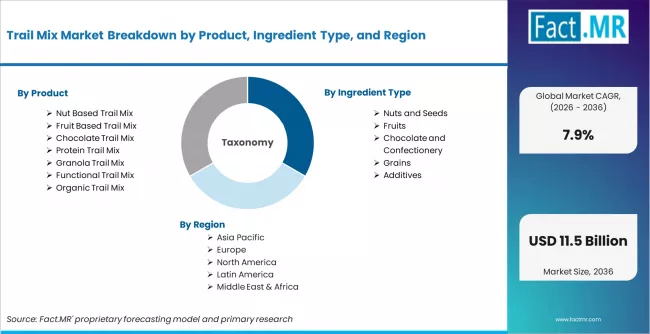
The market is segmented by product, type, distribution channel, and region. By product, the market is divided into nuts and seed mix, dried fruits mix, granola and cereal bar mix, and others. By type, the market covers organic and conventional. By distribution channel, segments include supermarkets and hypermarkets, convenience stores, specialty stores, and online. Regionally, the market is divided into Asia Pacific, North America, Europe, Latin America, and Middle East & Africa.

What Makes Nuts & Seed Mix the Dominant Product Segment in the Trail Mix Market?

Trail Mix Market Analysis By Product

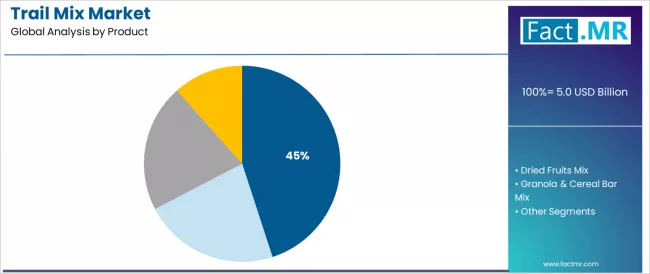
The nuts and seed mix segment represents the dominant force in the trail mix market, capturing approximately 45.0% of total market share in 2025. This established product category encompasses solutions featuring critical nutritional functionality for protein provision, healthy fat delivery, and satiety enhancement, including almond-based blends, cashew-based combinations, and mixed seed formulations that enable superior nutrient density, compelling taste profiles, and comprehensive wellness positioning across all snacking environments.

The nuts and seed mix segment's market leadership stems from its essential role in providing plant-based protein and heart-healthy fats, with nut-dominant formulations capable of meeting diverse consumer preferences while maintaining premium positioning and nutritional credibility across all retail channels. Within the nuts and seed mix segment, almond-based formulations account for 22.0% of total market share, driven by consumer familiarity and perceived health benefits, while cashew-based varieties represent 12.5% and mixed seeds comprise 10.5%.

The dried fruits mix segment maintains a substantial 32.0% market share, serving consumers who prefer naturally sweet formulations for energy provision, antioxidant content, and convenient fruit consumption. These applications offer appealing taste profiles for mainstream snacking markets and children's nutrition categories while providing sufficient nutritional benefits to meet wellness demands and natural ingredient requirements. Within dried fruits mix, raisins account for 14.0%, cranberries represent 9.5%, and mixed dried fruits comprise 8.5%. The granola and cereal bar mix segment accounts for approximately 15.0%, with granola clusters at 8.0% and cereal bar blends at 7.0%, serving applications requiring enhanced texture variety and breakfast-oriented positioning.

Key advantages driving the nuts and seed mix segment include:

  • Established nutritional credentials with protein content and healthy fats that reduce formulation complexity and ensure wellness positioning
  • Critical satiety functionality enabling sustained energy provision across different consumption occasions without significant caloric density concerns
  • Proven consumer acceptance, delivering familiar taste experiences while maintaining competitiveness against conventional snack alternatives
  • Broad retail presence enabling straightforward merchandising and premium pricing strategies across multiple distribution channels

Which Type Category Leads in the Global Trail Mix Market?

Trail Mix Market Analysis By Type

The conventional segment emerges as the leading type category in the trail mix market, capturing approximately 72.0% of total market share in 2025. This dominant type encompasses breakfast blends, savory mixes, and sweet blends, where conventional products enable accessible pricing, widespread availability, and broad consumer appeal. Within the conventional segment, breakfast blends account for 28.0% of total market share, followed by savory mixes at 24.0% and sweet blends at 20.0%, reflecting comprehensive penetration across different usage occasions and flavor preferences.

The organic segment maintains a substantial 28.0% market share, driven by premium positioning requirements, clean label preferences, and health-conscious consumer targeting serving applications demanding certified organic ingredients, pesticide-free sourcing, and sustainable agriculture support. Within organic products, organic nuts mix represents 11.5%, organic dried fruits account for 9.5%, and organic blends comprise 7.0%, demonstrating significant consumer willingness to pay premium prices for organic certification.

Key factors supporting conventional segment leadership include:

  • Cost-effective pricing infrastructure supporting mass market accessibility and high-volume consumption patterns
  • Established supply chains enabling efficient ingredient sourcing and competitive manufacturing economics
  • Broad flavor variety providing multiple product options and consumer choice across taste preferences
  • Mainstream retail distribution allowing convenient purchase access and impulse buying opportunities

How Do Different Distribution Channels Shape Market Dynamics?

Trail Mix Market Analysis By Distribution Channel

The supermarkets and hypermarkets segment represents the largest distribution channel in the trail mix market, capturing approximately 36.0% of total market share in 2025. This dominant channel encompasses large chain operations at 22.0% and regional chains at 14.0%, where supermarket distribution enables high product visibility, convenient consumer access, and comprehensive category representation. The supermarkets and hypermarkets segment's market leadership reflects established shopping patterns, one-stop shopping convenience, and extensive product assortment capabilities.

The online segment maintains a substantial 30.0% market share, driven by e-commerce marketplace penetration at 18.0% and direct-to-consumer brand sites at 12.0%, serving consumers seeking home delivery convenience, subscription options, and specialized product discovery. Convenience stores represent 20.0% of distribution, with fuel station shops at 11.0% and neighborhood stores at 9.0%, demonstrating important role in impulse purchasing and immediate consumption occasions.

Key distribution channel characteristics include:

  • Supermarket infrastructure supporting category education and promotional activities across broad consumer bases
  • E-commerce growth enabling subscription models and personalized product recommendations through digital engagement
  • Convenience channel accessibility providing impulse purchase opportunities and immediate gratification fulfillment
  • Multi-channel strategies optimizing brand reach and consumer touchpoint diversification across shopping preferences

What are the Drivers, Restraints, and Key Trends of the Trail Mix Market?

The market is driven by three concrete demand factors tied to lifestyle evolution and nutritional awareness. First, increasing health consciousness and clean eating trends creates growing demand for nutrient-dense snacking options, with global wellness product consumption expanding significantly across developed markets worldwide, requiring comprehensive healthy snacking infrastructure. Second, expanding on-the-go lifestyle patterns and busy consumer schedules drive increased adoption of portable nutrition solutions, with many food companies implementing convenient packaging innovations and single-serve formats by 2030. Third, technological advancements in food preservation and packaging technologies enable more effective freshness maintenance that extends shelf life while preserving nutritional quality and sensory characteristics.

Market restraints include fluctuating nut commodity prices that can impact manufacturers' profit margins, particularly in regions where tree nut production faces weather variability or supply-demand imbalances. Allergen management requirements pose another significant challenge, as trail mix products containing nuts face stringent labeling regulations and cross-contamination prevention protocols, potentially causing production complexity and liability concerns. Consumer perception challenges regarding caloric density create additional market obstacles for mainstream adoption, demanding ongoing education regarding appropriate portion sizes and nutritional context.

Key trends indicate accelerated adoption in Asia Pacific markets, particularly China and India, where urbanization and westernization of snacking habits drive comprehensive trail mix consumption growth. Product innovation trends toward functional ingredient additions with superfood integration, protein-enhanced formulations with added nutritional value, and sustainable packaging solutions enable optimized product positioning that appeals to environmentally conscious consumers and health-focused demographics. However, the market thesis could face disruption if significant advances in alternative protein snacking technologies or major shifts in dietary guidelines away from nut consumption fundamentally alter snacking paradigms and reduce reliance on traditional trail mix formulations.

Analysis of the Trail Mix Market by Key Countries

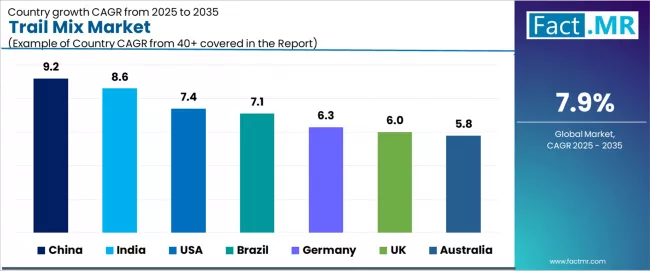
Trail Mix Market Cagr Analysis By Country

Country CAGR (2025-2035)
China 9.2%
India 8.6%
USA 7.4%
Brazil 7.1%
Germany 6.3%
UK 6.0%
Australia 5.8%

The trail mix market is expanding rapidly, with China leading at a 9.2% CAGR through 2035, driven by urbanization trends, westernization of snacking habits, and growing health consciousness among middle-class consumers. India follows at 8.6%, supported by rising disposable incomes, expanding modern retail infrastructure, and increasing awareness of convenient nutrition solutions. USA records 7.4%, reflecting mature market evolution with continued innovation in premium and functional product segments.

Brazil posts 7.1%, anchored by growing health awareness and expanding retail distribution networks with urban lifestyle adoption. Germany grows at 6.3%, with strong organic food preferences and established health food retail channels. UK advances at 6.0%, emphasizing premium snacking trends and online retail growth, while Australia grows steadily at 5.8%, driven by outdoor lifestyle culture and established healthy snacking preferences supporting consistent consumption patterns.

China Leads Global Market Expansion

China demonstrates the strongest growth potential in the trail mix market with a CAGR of 9.2% through 2035. The country's leadership position stems from rapid urbanization patterns, westernization of dietary habits, and expanding health consciousness enabling mainstream trail mix adoption.

Growth is concentrated in major metropolitan regions, including Beijing, Shanghai, Guangzhou, and Shenzhen, where modern retail infrastructure and expanding e-commerce platforms are implementing comprehensive healthy snacking categories for enhanced consumer choice and nutrition accessibility. Distribution channels through hypermarket chains, online marketplaces, and convenience store networks expand access across urban professionals and health-conscious consumers. The country's Healthy China 2030 initiative provides support for nutritious food consumption, including consumer education programs for balanced snacking.

Key market factors:

  • Urban demand concentrated in tier-1 and tier-2 cities with comprehensive modern retail networks
  • Infrastructure development through e-commerce logistics and cold chain distribution systems
  • Comprehensive consumer education ecosystem, including digital health platforms with proven wellness engagement
  • Market evolution featuring premium imported products, domestic brand development, and innovative flavor adaptations

India Emerges as High-Growth Market

In major urban centers including Mumbai, Delhi, Bangalore, and Hyderabad, the adoption and consumption of trail mix products is accelerating across modern retail channels and online platforms, driven by rising middle-class demographics and growing health awareness campaigns. The market demonstrates strong growth momentum with a CAGR of 8.6% through 2035, linked to increasing disposable incomes, expanding organized retail penetration, and sustained wellness trend adoption.

Indian consumers are implementing healthier snacking patterns and convenient nutrition solutions to enhance dietary quality while meeting busy lifestyle demands in expanding urban markets. The country's growing fitness culture creates persistent demand for protein-rich snacks, while increasing emphasis on preventive health drives adoption of nutrient-dense food products.

Key development areas:

  • Urban professionals and fitness enthusiasts leading trail mix consumption with comprehensive wellness integration
  • Modern retail expansion providing improved product availability with extensive distribution network development
  • Technology partnerships between international brands and domestic e-commerce platforms are expanding market reach
  • Integration of local flavor preferences and comprehensive affordability strategies

USA Shows Innovation-Driven Market Evolution

Trail Mix Market Country Value Analysis

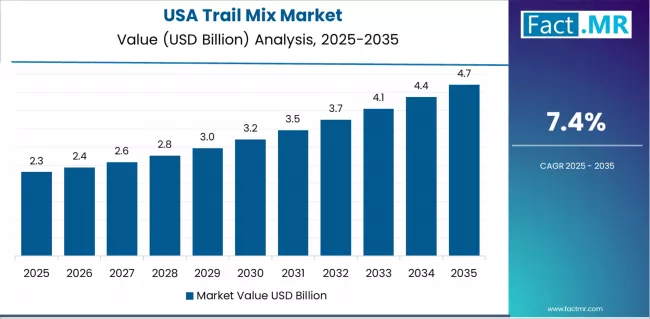
USA's market expansion is driven by continuous product innovation, including functional ingredient integration in specialty health food stores and premium organic positioning across multiple retail channels. The country demonstrates solid growth potential with a CAGR of 7.4% through 2035, supported by mature snacking culture, established health food retail infrastructure, and ongoing clean label product development.

American consumers face diverse product choices related to specialized dietary preferences and functional nutrition targets, supporting investment in innovative formulations and premium positioning strategies. However, sustained wellness trends and expanding online subscription models create compelling consumption patterns for trail mix products, particularly in health-conscious markets where specialty retail has direct impact on premium product penetration and brand loyalty development.

Key market characteristics:

  • Premium and functional segments showing robust growth with specialized product innovation
  • Regional expansion trends focused on organic certification and sustainable sourcing transparency
  • Future projections indicate continued premiumization and functional fortification program development
  • Growing emphasis on personalized nutrition and comprehensive dietary customization

Brazil Demonstrates Emerging Market Dynamics

Brazil's market expansion is driven by growing health awareness, including urban population wellness initiatives in major cities and expanding modern retail presence across metropolitan regions. The country demonstrates promising growth potential with a CAGR of 7.1% through 2035, supported by rising middle-class consumption, increasing fitness culture adoption, and expanding supermarket infrastructure.

Brazilian consumers face implementation opportunities related to affordable healthy snacking access and product education requirements, requiring investment in market development activities and support from international brand presence. However, growing urban lifestyle patterns and expanding retail distribution create compelling adoption potential for trail mix consumption, particularly in major cities where modern retail has direct impact on healthy food accessibility and consumer behavior evolution.

Key market characteristics:

  • Urban markets and fitness communities showing strong growth with expanding health consciousness
  • Regional development focused on supermarket penetration and online retail establishment
  • Strategic relationships between international brands and domestic distributors are expanding product availability
  • Emphasis on value positioning and comprehensive taste adaptation for local preferences

Germany Demonstrates Organic Market Leadership

The German market leads in organic product preference based on established environmental consciousness and advanced organic food retail infrastructure for enhanced sustainability positioning. The country shows robust potential with a CAGR of 6.3% through 2035, driven by strong organic certification demand, comprehensive health food retail presence, and established clean eating culture in major urban centers, including specialized organic supermarkets across major cities.

German consumers are adopting premium trail mix formulations with organic certification and sustainable sourcing transparency, particularly in regions with sophisticated health food retail networks and comprehensive environmental awareness. Technology deployment channels through established organic retailers and specialty health food stores expand coverage across environmentally conscious consumers and premium product segments.

Leading market segments:

  • Organic certified products in specialty retail channels implementing comprehensive sustainability protocols
  • Strategic partnerships with organic ingredient suppliers, achieving stringent certification standards and traceability requirements
  • Collaborative initiatives between retailers and brands are expanding organic market development
  • Focus on environmental sustainability and comprehensive supply chain transparency

UK Shows Premium Snacking Evolution

In major metropolitan regions including London, Manchester, Birmingham, and Leeds, health food retailers and online platforms are implementing comprehensive premium snacking strategies to address consumer wellness demands and provide convenient nutrition access, with documented retail facilities showing significant category expansion through enhanced product variety and brand availability. The market shows steady growth potential with a CAGR of 6.0% through 2035, linked to established premium snacking culture, strong online retail penetration, and ongoing health trend adoption in major regions.

Consumers adopt consistent healthy snacking approaches and convenient nutrition protocols to enhance dietary quality while maintaining busy lifestyle compatibility. The country's established health food retail infrastructure creates sustained demand for premium trail mix products and innovative formulation concepts that integrate with evolving consumer preferences.

Market development factors:

  • Premium retailers and online platforms leading trail mix distribution across UK
  • Health trend adoption and clean label preferences providing support for market development
  • Strategic relationships between specialty brands and retail partners are expanding category presence
  • Emphasis on flavor innovation and comprehensive nutritional transparency

Australia Shows Lifestyle-Driven Consumption

Australia's trail mix market demonstrates regional positioning focused on outdoor lifestyle culture and established healthy snacking preferences, with documented consumption patterns achieving consistent market presence through outdoor recreation activities and health-conscious consumer demographics in major urban centers.

The country maintains steady growth momentum with a CAGR of 5.8% through 2035, driven by active lifestyle prevalence, established health food retail presence, and comprehensive wellness culture integration. Major retail centers, including operations in Sydney, Melbourne, and Brisbane, showcase established trail mix category presence where outdoor lifestyle supports sustained demand and comprehensive healthy snacking programs.

Key market characteristics:

  • Outdoor recreation and fitness communities driving trail mix consumption with emphasis on convenient nutrition
  • Established retail infrastructure enabling consistent product availability with comprehensive distribution
  • Brand partnerships between local producers and retail chains are expanding market capabilities
  • Emphasis on natural ingredients and comprehensive product quality standards

Europe Market Split by Country

Trail Mix Market Europe Country Market Share Analysis, 2025 & 2035

The trail mix market in Europe is projected to grow from USD 1.1 billion in 2025 to USD 2.1 billion by 2035, registering a CAGR of 6.8% over the forecast period. Germany is expected to maintain its leadership position with a 28.9% market share in 2025, supported by its advanced organic food retail infrastructure, comprehensive health food distribution networks, and strong environmental consciousness across major consumer markets.

UK follows with a 22.4% share in 2025, driven by established premium snacking culture and integrated online retail platforms. France holds a 18.7% share in 2025 through its gourmet food tradition and specialty retail presence. Italy commands a 14.3% share, while Rest of Europe accounts for 15.7% in 2025.

By 2035, Germany is projected to hold 28.6% share, UK 22.6%, France 18.9%, Italy 14.2%, and Rest of Europe 15.7%, reflecting sustained growth momentum across all major European markets and increasing trail mix adoption in diversified retail applications implementing advanced healthy snacking programs.

Competitive Landscape of the Trail Mix Market

Trail Mix Market Analysis By Company

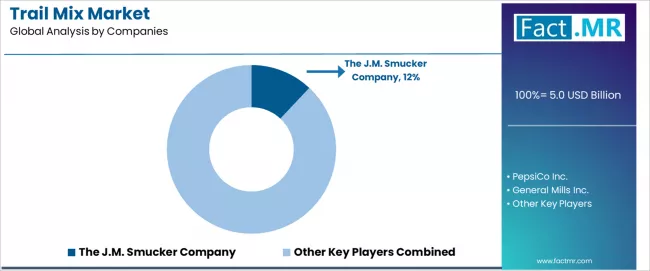
The trail mix market features approximately 35-45 meaningful players with moderate concentration, where the top three companies control roughly 28-38% of global market revenue through established snack food portfolios and extensive retail distribution relationships across consumer goods sectors.

Market leaders include The J.M. Smucker Company, PepsiCo Inc., and General Mills Inc., which maintain competitive advantages through comprehensive trail mix product portfolios, global distribution networks, and deep expertise in the snack food manufacturing and consumer packaged goods sectors, creating strong relationships among retail buyers and foodservice distributors.

These companies leverage established production facilities and ongoing product innovation initiatives to defend market positions while expanding into adjacent functional snacking applications and premium organic markets. The J.M. Smucker Company commands approximately 12.0% market share through integrated snack food solutions and strategic positioning in healthy snacking segments.

Challengers encompass Kellogg Company, Mars Incorporated, and Hormel Foods Corporation, which compete through diversified snack portfolios and strong brand recognition in key consumer markets. Specialty producers, including Second Nature Brands, Texas Star Nut & Food Co, and National Raisin Company, focus on specific geographical regions or product segments, offering differentiated capabilities in premium formulations, organic certification, and specialty retail presence.

Regional players and emerging brands create competitive pressure through innovative flavor development and strategic market positioning, particularly in high-growth markets including China and India, where local taste preferences provide advantages in product adaptation and consumer acceptance.

Market dynamics favor companies that combine sustainable ingredient sourcing with comprehensive quality management systems that address the complete value chain from raw material procurement through formulation development and retail distribution. Strategic investments in organic certification programs and functional ingredient integration enable product differentiation and market expansion across consumer segments.

Global Trail Mix Market - Stakeholder Contribution Framework

Trail mix products represent a critical convenient nutrition solution that enables consumers, retailers, and foodservice operators to access portable healthy snacking without substantial preparation requirements, typically providing essential protein and energy functionality with recognizable ingredient visibility while supporting diverse consumption occasions.

With the market projected to grow from USD 5.0 billion in 2025 to USD 10.7 billion by 2035 at a 7.9% CAGR, these products offer compelling advantages—convenient nutrition delivery, clean label ingredient composition, and versatile consumption applications-making them essential for nuts and seed formulations (largest segment), dried fruit combinations (expanding adoption), and diverse snacking applications seeking proven wholesome food solutions. Scaling market development and sustainable sourcing requires coordinated action across agricultural policy, food safety standards, ingredient suppliers, snack manufacturers, and nutrition education institutions.

How Governments Could Spur Local Production and Adoption?

  • Agricultural Development Programs: Include tree nut cultivation and dried fruit production in national agricultural strategies, providing targeted support for small-scale farmers in regions with suitable growing conditions and supporting local processing capabilities through infrastructure investment and technical assistance.
  • Nutrition Policy & Health Initiatives: Implement favorable guidelines promoting nutrient-dense snacking options, provide incentives for healthy food retail distribution, and establish clear nutritional standards that support trail mix positioning in workplace wellness and school nutrition programs.
  • Food Safety & Quality Standards: Create harmonized allergen labeling requirements across retail channels, establish clear quality specifications for ingredient processing, and develop comprehensive testing protocols that facilitate interstate commerce and consumer confidence.
  • Consumer Education & Awareness: Fund nutritional literacy programs emphasizing appropriate snacking choices, portion awareness campaigns, and healthy lifestyle integration. Invest in public health initiatives that promote convenient nutrition solutions and balanced dietary patterns.

How Industry Bodies Could Support Market Development?

  • Quality Standards & Certification: Define standardized ingredient specifications for trail mix components across different product categories, establish universal quality metrics for freshness and shelf life, and create certification programs for sustainable sourcing practices that manufacturers can communicate.
  • Market Education & Consumer Awareness: Lead communication initiatives that demonstrate appropriate consumption occasions, emphasizing nutritional benefits, ingredient transparency, and quality differentiation compared to conventional snack alternatives and processed food options.
  • Sustainability Frameworks: Develop environmental performance standards for ingredient sourcing operations, comprehensive carbon footprint methodologies for supply chain assessment, and responsible agriculture best practices, ensuring ethical sourcing across different production regions and supplier networks.

How Manufacturers and Technology Players Could Strengthen the Ecosystem?

  • Product Innovation Development: Develop next-generation trail mix formulations with functional ingredient additions, improved flavor systems with broader consumer appeal, and sustainable packaging solutions that enhance product freshness while reducing environmental impact and improving shelf life performance.
  • Supply Chain Integration: Provide transparent sourcing documentation that integrates traceability systems, quality assurance protocols, sustainability certifications, and allergen management procedures, enabling retailers to communicate product integrity and brand values effectively.
  • Distribution Network Optimization: Offer flexible fulfillment arrangements for retail partners and e-commerce channels, including direct store delivery services, subscription box integration, and inventory management support that keeps product availability consistent with consumer demand patterns and purchasing preferences.

Key Players in the Trail Mix Market

  • The J.M. Smucker Company
  • PepsiCo Inc.
  • General Mills Inc.
  • Kellogg Company
  • Mars Incorporated
  • Hormel Foods Corporation
  • Second Nature Brands
  • Texas Star Nut & Food Co.
  • National Raisin Company
  • Creative Snacks Co.

Scope of the Report

Items Values
Quantitative Units USD 5.0 Billion
Product Nuts & Seed Mix, Dried Fruits Mix, Granola & Cereal Bar Mix, Others
Type Organic, Conventional
Distribution Channel Supermarkets & Hypermarkets, Convenience Stores, Specialty Stores, Online
Regions Covered Asia Pacific, North America, Europe, Latin America, Middle East & Africa
Country Covered China, India, USA, Brazil, Germany, UK, Australia, and 40+ countries
Key Companies Profiled The J.M. Smucker Company, PepsiCo Inc., General Mills Inc., Kellogg Company, Mars Incorporated, Hormel Foods Corporation, Second Nature Brands, Texas Star Nut & Food Co, National Raisin Company, Creative Snacks Co
Additional Attributes Dollar sales by product categories, regional consumption trends across Asia Pacific, North America, and Europe, competitive landscape with snack food manufacturers and specialty brands, nutritional specifications and ingredient quality requirements, integration with retail distribution networks and e-commerce platforms.

Trail Mix Market by Segments

  • Product :

    • Nuts & Seed Mix
    • Dried Fruits Mix
    • Granola & Cereal Bar Mix
    • Others
  • Type :

    • Organic
    • Conventional
  • Distribution Channel :

    • Supermarkets & Hypermarkets
    • Convenience Stores
    • Specialty Stores
    • Online
  • Region :

    • Asia Pacific
      • China
      • Japan
      • South Korea
      • India
      • Australia & New Zealand
      • ASEAN
      • Rest of Asia Pacific
    • North America
      • USA
      • Canada
      • Mexico
    • Europe
      • Germany
      • France
      • United Kingdom
      • Italy
      • Rest of Europe
    • Latin America
      • Brazil
      • Rest of Latin America
    • Middle East & Africa
      • Kingdom of Saudi Arabia
      • Other GCC Countries
      • Turkey
      • South Africa
      • Rest of Middle East & Africa

Table of Content

  1. Executive Summary
    • Global Market Outlook
    • Demand to side Trends
    • Supply to side Trends
    • Technology Roadmap Analysis
    • Analysis and Recommendations
  2. Market Overview
    • Market Coverage / Taxonomy
    • Market Definition / Scope / Limitations
  3. Market Background
    • Market Dynamics
      • Drivers
      • Restraints
      • Opportunity
      • Trends
    • Scenario Forecast
      • Demand in Optimistic Scenario
      • Demand in Likely Scenario
      • Demand in Conservative Scenario
    • Opportunity Map Analysis
    • Product Life Cycle Analysis
    • Supply Chain Analysis
    • Investment Feasibility Matrix
    • Value Chain Analysis
    • PESTLE and Porter’s Analysis
    • Regulatory Landscape
    • Regional Parent Market Outlook
    • Production and Consumption Statistics
    • Import and Export Statistics
  4. Global Market Analysis 2020 to 2024 and Forecast, 2025 to 2035
    • Historical Market Size Value (USD Million) Analysis, 2020 to 2024
    • Current and Future Market Size Value (USD Million) Projections, 2025 to 2035
      • Y to o to Y Growth Trend Analysis
      • Absolute $ Opportunity Analysis
  5. Global Market Pricing Analysis 2020 to 2024 and Forecast 2025 to 2035
  6. Global Market Analysis 2020 to 2024 and Forecast 2025 to 2035, By Product
    • Introduction / Key Findings
    • Historical Market Size Value (USD Million) Analysis By Product, 2020 to 2024
    • Current and Future Market Size Value (USD Million) Analysis and Forecast By Product, 2025 to 2035
      • Nuts & Seed Mix
      • Dried Fruits Mix
      • Granola & Cereal Bar Mix
      • Others
    • Y to o to Y Growth Trend Analysis By Product, 2020 to 2024
    • Absolute $ Opportunity Analysis By Product, 2025 to 2035
  7. Global Market Analysis 2020 to 2024 and Forecast 2025 to 2035, By Type
    • Introduction / Key Findings
    • Historical Market Size Value (USD Million) Analysis By Type, 2020 to 2024
    • Current and Future Market Size Value (USD Million) Analysis and Forecast By Type, 2025 to 2035
      • Conventional
      • Organic
    • Y to o to Y Growth Trend Analysis By Type, 2020 to 2024
    • Absolute $ Opportunity Analysis By Type, 2025 to 2035
  8. Global Market Analysis 2020 to 2024 and Forecast 2025 to 2035, By Distribution Channel
    • Introduction / Key Findings
    • Historical Market Size Value (USD Million) Analysis By Distribution Channel, 2020 to 2024
    • Current and Future Market Size Value (USD Million) Analysis and Forecast By Distribution Channel, 2025 to 2035
      • Supermarkets & Hypermarkets
      • Convenience Stores
      • Specialty Stores
      • Online
    • Y to o to Y Growth Trend Analysis By Distribution Channel, 2020 to 2024
    • Absolute $ Opportunity Analysis By Distribution Channel, 2025 to 2035
  9. Global Market Analysis 2020 to 2024 and Forecast 2025 to 2035, By Region
    • Introduction
    • Historical Market Size Value (USD Million) Analysis By Region, 2020 to 2024
    • Current Market Size Value (USD Million) Analysis and Forecast By Region, 2025 to 2035
      • North America
      • Latin America
      • Western Europe
      • Eastern Europe
      • East Asia
      • South Asia and Pacific
      • Middle East & Africa
    • Market Attractiveness Analysis By Region
  10. North America Market Analysis 2020 to 2024 and Forecast 2025 to 2035, By Country
    • Historical Market Size Value (USD Million) Trend Analysis By Market Taxonomy, 2020 to 2024
    • Market Size Value (USD Million) Forecast By Market Taxonomy, 2025 to 2035
      • By Country
        • USA
        • Canada
        • Mexico
      • By Product
      • By Type
      • By Distribution Channel
    • Market Attractiveness Analysis
      • By Country
      • By Product
      • By Type
      • By Distribution Channel
    • Key Takeaways
  11. Latin America Market Analysis 2020 to 2024 and Forecast 2025 to 2035, By Country
    • Historical Market Size Value (USD Million) Trend Analysis By Market Taxonomy, 2020 to 2024
    • Market Size Value (USD Million) Forecast By Market Taxonomy, 2025 to 2035
      • By Country
        • Brazil
        • Chile
        • Rest of Latin America
      • By Product
      • By Type
      • By Distribution Channel
    • Market Attractiveness Analysis
      • By Country
      • By Product
      • By Type
      • By Distribution Channel
    • Key Takeaways
  12. Western Europe Market Analysis 2020 to 2024 and Forecast 2025 to 2035, By Country
    • Historical Market Size Value (USD Million) Trend Analysis By Market Taxonomy, 2020 to 2024
    • Market Size Value (USD Million) Forecast By Market Taxonomy, 2025 to 2035
      • By Country
        • Germany
        • UK
        • Italy
        • Spain
        • France
        • Nordic
        • BENELUX
        • Rest of Western Europe
      • By Product
      • By Type
      • By Distribution Channel
    • Market Attractiveness Analysis
      • By Country
      • By Product
      • By Type
      • By Distribution Channel
    • Key Takeaways
  13. Eastern Europe Market Analysis 2020 to 2024 and Forecast 2025 to 2035, By Country
    • Historical Market Size Value (USD Million) Trend Analysis By Market Taxonomy, 2020 to 2024
    • Market Size Value (USD Million) Forecast By Market Taxonomy, 2025 to 2035
      • By Country
        • Russia
        • Poland
        • Hungary
        • Balkan & Baltic
        • Rest of Eastern Europe
      • By Product
      • By Type
      • By Distribution Channel
    • Market Attractiveness Analysis
      • By Country
      • By Product
      • By Type
      • By Distribution Channel
    • Key Takeaways
  14. East Asia Market Analysis 2020 to 2024 and Forecast 2025 to 2035, By Country
    • Historical Market Size Value (USD Million) Trend Analysis By Market Taxonomy, 2020 to 2024
    • Market Size Value (USD Million) Forecast By Market Taxonomy, 2025 to 2035
      • By Country
        • China
        • Japan
        • South Korea
      • By Product
      • By Type
      • By Distribution Channel
    • Market Attractiveness Analysis
      • By Country
      • By Product
      • By Type
      • By Distribution Channel
    • Key Takeaways
  15. South Asia and Pacific Market Analysis 2020 to 2024 and Forecast 2025 to 2035, By Country
    • Historical Market Size Value (USD Million) Trend Analysis By Market Taxonomy, 2020 to 2024
    • Market Size Value (USD Million) Forecast By Market Taxonomy, 2025 to 2035
      • By Country
        • India
        • ASEAN
        • Australia & New Zealand
        • Rest of South Asia and Pacific
      • By Product
      • By Type
      • By Distribution Channel
    • Market Attractiveness Analysis
      • By Country
      • By Product
      • By Type
      • By Distribution Channel
    • Key Takeaways
  16. Middle East & Africa Market Analysis 2020 to 2024 and Forecast 2025 to 2035, By Country
    • Historical Market Size Value (USD Million) Trend Analysis By Market Taxonomy, 2020 to 2024
    • Market Size Value (USD Million) Forecast By Market Taxonomy, 2025 to 2035
      • By Country
        • Kingdom of Saudi Arabia
        • Other GCC Countries
        • Turkiye
        • South Africa
        • Other African Union
        • Rest of Middle East & Africa
      • By Product
      • By Type
      • By Distribution Channel
    • Market Attractiveness Analysis
      • By Country
      • By Product
      • By Type
      • By Distribution Channel
    • Key Takeaways
  17. Key Countries Market Analysis
    • USA
      • Pricing Analysis
      • Market Share Analysis, 2024
        • By Product
        • By Type
        • By Distribution Channel
    • Canada
      • Pricing Analysis
      • Market Share Analysis, 2024
        • By Product
        • By Type
        • By Distribution Channel
    • Mexico
      • Pricing Analysis
      • Market Share Analysis, 2024
        • By Product
        • By Type
        • By Distribution Channel
    • Brazil
      • Pricing Analysis
      • Market Share Analysis, 2024
        • By Product
        • By Type
        • By Distribution Channel
    • Chile
      • Pricing Analysis
      • Market Share Analysis, 2024
        • By Product
        • By Type
        • By Distribution Channel
    • Germany
      • Pricing Analysis
      • Market Share Analysis, 2024
        • By Product
        • By Type
        • By Distribution Channel
    • UK
      • Pricing Analysis
      • Market Share Analysis, 2024
        • By Product
        • By Type
        • By Distribution Channel
    • Italy
      • Pricing Analysis
      • Market Share Analysis, 2024
        • By Product
        • By Type
        • By Distribution Channel
    • Spain
      • Pricing Analysis
      • Market Share Analysis, 2024
        • By Product
        • By Type
        • By Distribution Channel
    • France
      • Pricing Analysis
      • Market Share Analysis, 2024
        • By Product
        • By Type
        • By Distribution Channel
    • India
      • Pricing Analysis
      • Market Share Analysis, 2024
        • By Product
        • By Type
        • By Distribution Channel
    • ASEAN
      • Pricing Analysis
      • Market Share Analysis, 2024
        • By Product
        • By Type
        • By Distribution Channel
    • Australia & New Zealand
      • Pricing Analysis
      • Market Share Analysis, 2024
        • By Product
        • By Type
        • By Distribution Channel
    • China
      • Pricing Analysis
      • Market Share Analysis, 2024
        • By Product
        • By Type
        • By Distribution Channel
    • Japan
      • Pricing Analysis
      • Market Share Analysis, 2024
        • By Product
        • By Type
        • By Distribution Channel
    • South Korea
      • Pricing Analysis
      • Market Share Analysis, 2024
        • By Product
        • By Type
        • By Distribution Channel
    • Russia
      • Pricing Analysis
      • Market Share Analysis, 2024
        • By Product
        • By Type
        • By Distribution Channel
    • Poland
      • Pricing Analysis
      • Market Share Analysis, 2024
        • By Product
        • By Type
        • By Distribution Channel
    • Hungary
      • Pricing Analysis
      • Market Share Analysis, 2024
        • By Product
        • By Type
        • By Distribution Channel
    • Kingdom of Saudi Arabia
      • Pricing Analysis
      • Market Share Analysis, 2024
        • By Product
        • By Type
        • By Distribution Channel
    • Turkiye
      • Pricing Analysis
      • Market Share Analysis, 2024
        • By Product
        • By Type
        • By Distribution Channel
    • South Africa
      • Pricing Analysis
      • Market Share Analysis, 2024
        • By Product
        • By Type
        • By Distribution Channel
  18. Market Structure Analysis
    • Competition Dashboard
    • Competition Benchmarking
    • Market Share Analysis of Top Players
      • By Regional
      • By Product
      • By Type
      • By Distribution Channel
  19. Competition Analysis
    • Competition Deep Dive
      • The J.M. Smucker Company
        • Overview
        • Product Portfolio
        • Profitability by Market Segments (Product/Age /Sales Channel/Region)
        • Sales Footprint
        • Strategy Overview
          • Marketing Strategy
          • Product Strategy
          • Channel Strategy
      • PepsiCo Inc.
      • General Mills Inc.
      • Kellogg Company
      • Mars Incorporated
      • Hormel Foods Corporation
      • Second Nature Brands
      • Texas Star Nut & Food Co.
      • National Raisin Company
      • Creative Snacks Co.
  20. Assumptions & Acronyms Used
  21. Research Methodology

List Of Table

  • Table 1: Global Market Value (USD Million) Forecast by Region, 2020 to 2035
  • Table 2: Global Market Value (USD Million) Forecast by Product, 2020 to 2035
  • Table 3: Global Market Value (USD Million) Forecast by Type, 2020 to 2035
  • Table 4: Global Market Value (USD Million) Forecast by Distribution Channel, 2020 to 2035
  • Table 5: North America Market Value (USD Million) Forecast by Country, 2020 to 2035
  • Table 6: North America Market Value (USD Million) Forecast by Product, 2020 to 2035
  • Table 7: North America Market Value (USD Million) Forecast by Type, 2020 to 2035
  • Table 8: North America Market Value (USD Million) Forecast by Distribution Channel, 2020 to 2035
  • Table 9: Latin America Market Value (USD Million) Forecast by Country, 2020 to 2035
  • Table 10: Latin America Market Value (USD Million) Forecast by Product, 2020 to 2035
  • Table 11: Latin America Market Value (USD Million) Forecast by Type, 2020 to 2035
  • Table 12: Latin America Market Value (USD Million) Forecast by Distribution Channel, 2020 to 2035
  • Table 13: Western Europe Market Value (USD Million) Forecast by Country, 2020 to 2035
  • Table 14: Western Europe Market Value (USD Million) Forecast by Product, 2020 to 2035
  • Table 15: Western Europe Market Value (USD Million) Forecast by Type, 2020 to 2035
  • Table 16: Western Europe Market Value (USD Million) Forecast by Distribution Channel, 2020 to 2035
  • Table 17: Eastern Europe Market Value (USD Million) Forecast by Country, 2020 to 2035
  • Table 18: Eastern Europe Market Value (USD Million) Forecast by Product, 2020 to 2035
  • Table 19: Eastern Europe Market Value (USD Million) Forecast by Type, 2020 to 2035
  • Table 20: Eastern Europe Market Value (USD Million) Forecast by Distribution Channel, 2020 to 2035
  • Table 21: East Asia Market Value (USD Million) Forecast by Country, 2020 to 2035
  • Table 22: East Asia Market Value (USD Million) Forecast by Product, 2020 to 2035
  • Table 23: East Asia Market Value (USD Million) Forecast by Type, 2020 to 2035
  • Table 24: East Asia Market Value (USD Million) Forecast by Distribution Channel, 2020 to 2035
  • Table 25: South Asia and Pacific Market Value (USD Million) Forecast by Country, 2020 to 2035
  • Table 26: South Asia and Pacific Market Value (USD Million) Forecast by Product, 2020 to 2035
  • Table 27: South Asia and Pacific Market Value (USD Million) Forecast by Type, 2020 to 2035
  • Table 28: South Asia and Pacific Market Value (USD Million) Forecast by Distribution Channel, 2020 to 2035
  • Table 29: Middle East & Africa Market Value (USD Million) Forecast by Country, 2020 to 2035
  • Table 30: Middle East & Africa Market Value (USD Million) Forecast by Product, 2020 to 2035
  • Table 31: Middle East & Africa Market Value (USD Million) Forecast by Type, 2020 to 2035
  • Table 32: Middle East & Africa Market Value (USD Million) Forecast by Distribution Channel, 2020 to 2035

List Of Figures

  • Figure 1: Global Market Pricing Analysis
  • Figure 2: Global Market Value (USD Million) Forecast 2020 to 2035
  • Figure 3: Global Market Value Share and BPS Analysis by Product, 2025 and 2035
  • Figure 4: Global Market Y to o to Y Growth Comparison by Product, 2025 to 2035
  • Figure 5: Global Market Attractiveness Analysis by Product
  • Figure 6: Global Market Value Share and BPS Analysis by Type, 2025 and 2035
  • Figure 7: Global Market Y to o to Y Growth Comparison by Type, 2025 to 2035
  • Figure 8: Global Market Attractiveness Analysis by Type
  • Figure 9: Global Market Value Share and BPS Analysis by Distribution Channel, 2025 and 2035
  • Figure 10: Global Market Y to o to Y Growth Comparison by Distribution Channel, 2025 to 2035
  • Figure 11: Global Market Attractiveness Analysis by Distribution Channel
  • Figure 12: Global Market Value (USD Million) Share and BPS Analysis by Region, 2025 and 2035
  • Figure 13: Global Market Y to o to Y Growth Comparison by Region, 2025 to 2035
  • Figure 14: Global Market Attractiveness Analysis by Region
  • Figure 15: North America Market Incremental Dollar Opportunity, 2025 to 2035
  • Figure 16: Latin America Market Incremental Dollar Opportunity, 2025 to 2035
  • Figure 17: Western Europe Market Incremental Dollar Opportunity, 2025 to 2035
  • Figure 18: Eastern Europe Market Incremental Dollar Opportunity, 2025 to 2035
  • Figure 19: East Asia Market Incremental Dollar Opportunity, 2025 to 2035
  • Figure 20: South Asia and Pacific Market Incremental Dollar Opportunity, 2025 to 2035
  • Figure 21: Middle East & Africa Market Incremental Dollar Opportunity, 2025 to 2035
  • Figure 22: North America Market Value Share and BPS Analysis by Country, 2025 and 2035
  • Figure 23: North America Market Value Share and BPS Analysis by Product, 2025 and 2035
  • Figure 24: North America Market Y to o to Y Growth Comparison by Product, 2025 to 2035
  • Figure 25: North America Market Attractiveness Analysis by Product
  • Figure 26: North America Market Value Share and BPS Analysis by Type, 2025 and 2035
  • Figure 27: North America Market Y to o to Y Growth Comparison by Type, 2025 to 2035
  • Figure 28: North America Market Attractiveness Analysis by Type
  • Figure 29: North America Market Value Share and BPS Analysis by Distribution Channel, 2025 and 2035
  • Figure 30: North America Market Y to o to Y Growth Comparison by Distribution Channel, 2025 to 2035
  • Figure 31: North America Market Attractiveness Analysis by Distribution Channel
  • Figure 32: Latin America Market Value Share and BPS Analysis by Country, 2025 and 2035
  • Figure 33: Latin America Market Value Share and BPS Analysis by Product, 2025 and 2035
  • Figure 34: Latin America Market Y to o to Y Growth Comparison by Product, 2025 to 2035
  • Figure 35: Latin America Market Attractiveness Analysis by Product
  • Figure 36: Latin America Market Value Share and BPS Analysis by Type, 2025 and 2035
  • Figure 37: Latin America Market Y to o to Y Growth Comparison by Type, 2025 to 2035
  • Figure 38: Latin America Market Attractiveness Analysis by Type
  • Figure 39: Latin America Market Value Share and BPS Analysis by Distribution Channel, 2025 and 2035
  • Figure 40: Latin America Market Y to o to Y Growth Comparison by Distribution Channel, 2025 to 2035
  • Figure 41: Latin America Market Attractiveness Analysis by Distribution Channel
  • Figure 42: Western Europe Market Value Share and BPS Analysis by Country, 2025 and 2035
  • Figure 43: Western Europe Market Value Share and BPS Analysis by Product, 2025 and 2035
  • Figure 44: Western Europe Market Y to o to Y Growth Comparison by Product, 2025 to 2035
  • Figure 45: Western Europe Market Attractiveness Analysis by Product
  • Figure 46: Western Europe Market Value Share and BPS Analysis by Type, 2025 and 2035
  • Figure 47: Western Europe Market Y to o to Y Growth Comparison by Type, 2025 to 2035
  • Figure 48: Western Europe Market Attractiveness Analysis by Type
  • Figure 49: Western Europe Market Value Share and BPS Analysis by Distribution Channel, 2025 and 2035
  • Figure 50: Western Europe Market Y to o to Y Growth Comparison by Distribution Channel, 2025 to 2035
  • Figure 51: Western Europe Market Attractiveness Analysis by Distribution Channel
  • Figure 52: Eastern Europe Market Value Share and BPS Analysis by Country, 2025 and 2035
  • Figure 53: Eastern Europe Market Value Share and BPS Analysis by Product, 2025 and 2035
  • Figure 54: Eastern Europe Market Y to o to Y Growth Comparison by Product, 2025 to 2035
  • Figure 55: Eastern Europe Market Attractiveness Analysis by Product
  • Figure 56: Eastern Europe Market Value Share and BPS Analysis by Type, 2025 and 2035
  • Figure 57: Eastern Europe Market Y to o to Y Growth Comparison by Type, 2025 to 2035
  • Figure 58: Eastern Europe Market Attractiveness Analysis by Type
  • Figure 59: Eastern Europe Market Value Share and BPS Analysis by Distribution Channel, 2025 and 2035
  • Figure 60: Eastern Europe Market Y to o to Y Growth Comparison by Distribution Channel, 2025 to 2035
  • Figure 61: Eastern Europe Market Attractiveness Analysis by Distribution Channel
  • Figure 62: East Asia Market Value Share and BPS Analysis by Country, 2025 and 2035
  • Figure 63: East Asia Market Value Share and BPS Analysis by Product, 2025 and 2035
  • Figure 64: East Asia Market Y to o to Y Growth Comparison by Product, 2025 to 2035
  • Figure 65: East Asia Market Attractiveness Analysis by Product
  • Figure 66: East Asia Market Value Share and BPS Analysis by Type, 2025 and 2035
  • Figure 67: East Asia Market Y to o to Y Growth Comparison by Type, 2025 to 2035
  • Figure 68: East Asia Market Attractiveness Analysis by Type
  • Figure 69: East Asia Market Value Share and BPS Analysis by Distribution Channel, 2025 and 2035
  • Figure 70: East Asia Market Y to o to Y Growth Comparison by Distribution Channel, 2025 to 2035
  • Figure 71: East Asia Market Attractiveness Analysis by Distribution Channel
  • Figure 72: South Asia and Pacific Market Value Share and BPS Analysis by Country, 2025 and 2035
  • Figure 73: South Asia and Pacific Market Value Share and BPS Analysis by Product, 2025 and 2035
  • Figure 74: South Asia and Pacific Market Y to o to Y Growth Comparison by Product, 2025 to 2035
  • Figure 75: South Asia and Pacific Market Attractiveness Analysis by Product
  • Figure 76: South Asia and Pacific Market Value Share and BPS Analysis by Type, 2025 and 2035
  • Figure 77: South Asia and Pacific Market Y to o to Y Growth Comparison by Type, 2025 to 2035
  • Figure 78: South Asia and Pacific Market Attractiveness Analysis by Type
  • Figure 79: South Asia and Pacific Market Value Share and BPS Analysis by Distribution Channel, 2025 and 2035
  • Figure 80: South Asia and Pacific Market Y to o to Y Growth Comparison by Distribution Channel, 2025 to 2035
  • Figure 81: South Asia and Pacific Market Attractiveness Analysis by Distribution Channel
  • Figure 82: Middle East & Africa Market Value Share and BPS Analysis by Country, 2025 and 2035
  • Figure 83: Middle East & Africa Market Value Share and BPS Analysis by Product, 2025 and 2035
  • Figure 84: Middle East & Africa Market Y to o to Y Growth Comparison by Product, 2025 to 2035
  • Figure 85: Middle East & Africa Market Attractiveness Analysis by Product
  • Figure 86: Middle East & Africa Market Value Share and BPS Analysis by Type, 2025 and 2035
  • Figure 87: Middle East & Africa Market Y to o to Y Growth Comparison by Type, 2025 to 2035
  • Figure 88: Middle East & Africa Market Attractiveness Analysis by Type
  • Figure 89: Middle East & Africa Market Value Share and BPS Analysis by Distribution Channel, 2025 and 2035
  • Figure 90: Middle East & Africa Market Y to o to Y Growth Comparison by Distribution Channel, 2025 to 2035
  • Figure 91: Middle East & Africa Market Attractiveness Analysis by Distribution Channel
  • Figure 92: Global Market - Tier Structure Analysis
  • Figure 93: Global Market - Company Share Analysis

- FAQs -

How big is the trail mix market in 2025?

The global trail mix market is estimated to be valued at USD 5.0 billion in 2025.

What will be the size of trail mix market in 2035?

The market size for the trail mix market is projected to reach USD 10.7 billion by 2035.

How much will be the trail mix market growth between 2025 and 2035?

The trail mix market is expected to grow at a 7.9% CAGR between 2025 and 2035.

What are the key product types in the trail mix market?

The key product types in trail mix market are nuts & seed mix, dried fruits mix, granola & cereal bar mix and others.

Which type segment to contribute significant share in the trail mix market in 2025?

In terms of type, conventional segment to command 72.0% share in the trail mix market in 2025.

Trail Mix Market