Trailer Mover Attachments Market Size, Share, Growth and Forecast (2026 - 2036)
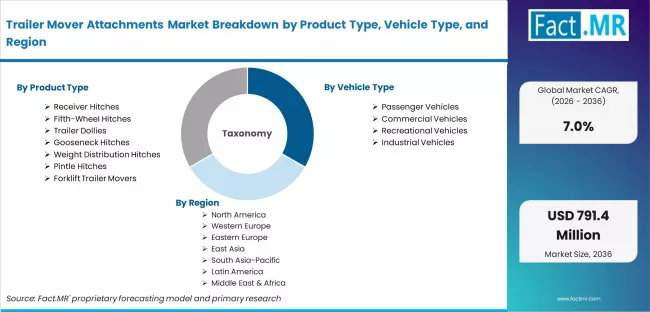
The Trailer Mover Attachments Market is segmented by Product Type, by Power Source, by Vehicle Type, by Towing Capacity, by Technology Level, and by Region. Forecast for 2026 to 2036.
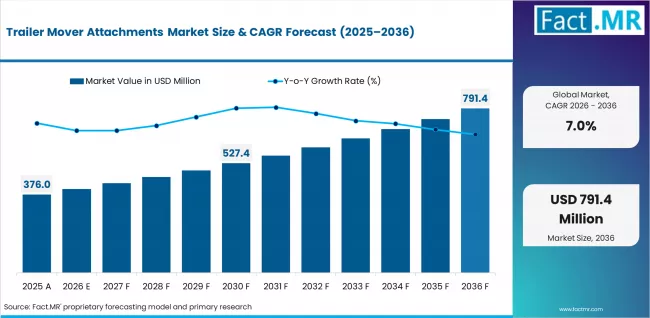
According to Fact.MR estimates, the trailer mover attachments market was valued at USD 376.0 million in 2025 and is projected to reach USD 402.3 million in 2026. The market is further forecast to expand to USD 791.4 million by 2036, registering a CAGR of 7.0% during the forecast period of 2026 to 2036. Receiver Hitches are expected to hold approximately 27.1% market share in 2026, while Forklift Trailer Movers are projected to witness the fastest growth through 2036, driven by rising warehouse automation and industrial trailer handling demand. By vehicle type, Passenger Vehicles are anticipated to account for nearly 36.2% share in 2026, supported by growing SUV and pickup truck towing applications. In terms of power source, Electric systems are expected to gain significant traction due to increasing adoption of battery-powered trailer maneuvering and smart towing technologies.
Trailer Mover Attachments Market Overview, Growth Outlook, and Forecast by Fact.MR
- In 2025, the trailer mover attachments market was valued at USD 376.0 million.
- Based on Fact.MR analysis, demand for trailer mover attachments is estimated to grow to USD 402.3 million in 2026 and USD 791.4 million by 2036.
- Fact.MR projects the market to expand at a CAGR of 7.0% during the forecast period of 2026 to 2036.
Summary of the Trailer Mover Attachments Market
- Market Snapshot
- In 2025, the global trailer mover attachments market was valued at approximately USD 376.0 million.
- The market is estimated to reach USD 402.3 million in 2026 and is projected to attain USD 791.4 million by 2036.
- Trailer mover attachments market is likely to expand at a CAGR of 7.0% during the forecast period.
- The market is anticipated to create an absolute dollar opportunity of USD 389.1 million between 2026 and 2036.
- Electric systems are projected to witness the fastest growth during the forecast period owing to rising adoption of battery-powered trailer maneuvering technologies.
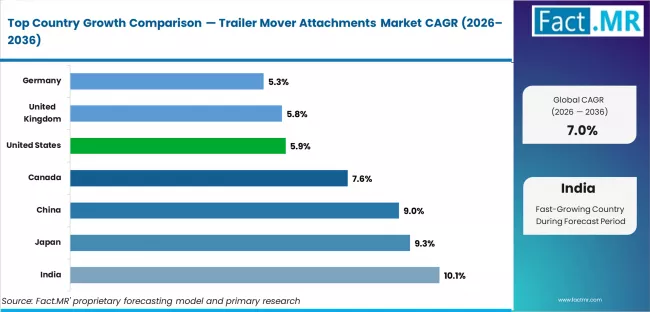
- India (10.1% CAGR), Japan (9.3% CAGR), and China (9.0% CAGR) are the key growth markets during the forecast period.
- Demand and Growth Drivers
- Demand for high maneuverability of trailer and high tractive force of tow vehicles in logistics, warehousing, industrial facilities is leading to the use of trailer mover attachments.
- Increasing warehouse automation and yard management systems are driving the adoption of Forklift Trailer Movers and Tow-Powered Trailer Handlers.
- Increase in ownership of recreational vehicles (RVs), camper trailers and boat trailers is driving the trailer dollies and other advanced towing products market.
- Trailing the market trend towards electric and semi-automated systems, more users are turning to electric trailer mover systems as they look for ways to reduce manual labor and increase efficiency.
- Growth in e-commerce, freight transportation and distribution center construction is driving the demand for commercial trailer moving equipment.
- Product and Segment View
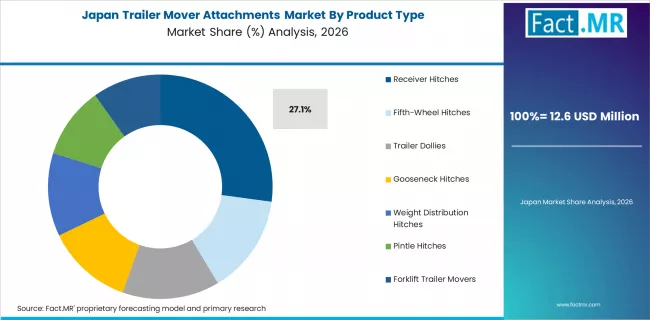
- Receiver hitches dominate the product type segment with a 27.1% share owing to their acceptance in all types of passenger vehicles, utility trailers and commercial towing.
- Multi-Fifth-Wheel Hitches have a market share of 14.3%, due to the growing use in heavy-duty towing and recreational vehicle (RV) applications. Passenger Vehicles dominate the vehicle type segment with a 36.2% share due to rising SUV and pickup truck towing demand.
- Commercial Vehicles hold 30.4% share due to growth in logistics, freight transportation and yard management. Electric systems are anticipated to dominate the power source segment with a 39.2% share, owing to rising adoption of battery-powered trailer movers and smart towing solutions.
- The 5,000–10,000 lbs segment dominates the market with a share of 35.2% by towing capacity, due to extensive usage in commercial towing, RV and utility trailers. Up to 5,000 lbs holds the share of 34.1%, with light-duty towing and personal trailers are the main applications.
- Conventional Systems account for 58.3% share by technology level, this is attributed to the significant installed base and low cost of components that allows for the operation of cost-effective towing solutions.
- Geography and Competitive Outlook
- The Asia Pacific serves as a potential revenue pocket for the trailer mover attachments market, attributable to the growing expansion of logistics, warehouse automation, and commercial vehicles in the region.
- Strong RV ownership and pickup truck towing culture, and trailer maneuvering solutions are still widely adopted in North America, thus holding the largest market share.
- Europe is growing steadily with rising caravan usage, sophisticated towing technologies and increasing take up of smart trailer assist systems.
- The expansion of the market can be attributed to innovations in electric trailer movers, remotely controlled systems for maneuvering, lightweight materials for hitches, and smart towing technologies.
- Leading Product/Market Companies Are Reese Towpower, CURT Manufacturing, B&W Trailer Hitches, Trailer Valet, Parkit360 etc. is a key company in this market.
- Analyst Opinion
- Shambhu Nath Jha, Principal Consultant at Fact.MR, says “Trailer mover attachments market is increasingly driven by rapid growth in logistics infrastructure, warehouse automation, and rising demand for efficient trailer maneuvering solutions. Market growth is being supported by increasing adoption of electric trailer movers, smart towing technologies, recreational vehicle towing applications, and industrial trailer handling systems across commercial transportation, warehousing, and recreational sectors.
Trailer Mover Attachments Market — At a Glance
| Attribute | Details |
|---|---|
| Market Value 2025 | USD 376.0 Million |
| Market Value 2026 | USD 402.3 Million |
| Market Value 2036 | USD 791.4 Million |
| Absolute Dollar Opportunity | USD 389.1 Million |
| Total Growth | 96.79% |
| CAGR | 7.00% |
| Growth Multiple | 2.0x |
| Key Demand Theme | Rising warehouse automation, growth in recreational towing activities, expansion of logistics infrastructure, increasing demand for electric trailer maneuvering systems, and adoption of smart towing technologies |
| Leading Product Type | Receiver Hitches |
| Product Type Share | 27.10% |
| Leading Vehicle Type | Passenger Vehicles |
| Vehicle Type Share | 36.20% |
| Leading Power Source | Electric |
| Power Source Share | 39.20% |
| Leading Towing Capacity | 5,000–10,000 lbs |
| Towing Capacity Share | 35.20% |
| Leading Technology Level | Conventional Systems |
| Technology Level Share | 58.25% |
| Key Growth Regions | East Asia, South Asia & Pacific, North America |
| Key Companies | Reese Towpower, CURT Manufacturing, B&W Trailer Hitches, Trailer Valet, Parkit360, MasterMover, Power Pusher, Airtug, DJ Products, Beacon Industries |
| Segmentation by Product Type | Receiver Hitches, Gooseneck Hitches, Fifth-Wheel Hitches, Pintle Hitches, Trailer Dollies, Forklift Trailer Movers, Weight Distribution Hitches |
| Segmentation by Power Source | Manual, Electric, Hydraulic, Hybrid/Smart Systems |
| Segmentation by Vehicle Type | Passenger Vehicles, Commercial Vehicles, Recreational Vehicles, Industrial Vehicles |
| Segmentation by Towing Capacity | Up to 5,000 lbs, 5,000–10,000 lbs, 10,000–15,000 lbs, Above 15,000 lbs |
| Segmentation by Technology Level | Conventional Systems, Semi-Autonomous Systems, Fully Autonomous Systems |
| Segmentation by Region | North America, Latin America, East Asia, South Asia & Pacific, Western Europe, Eastern Europe, Middle East & Africa |
Key Growth Drivers, Constraints, and Opportunities
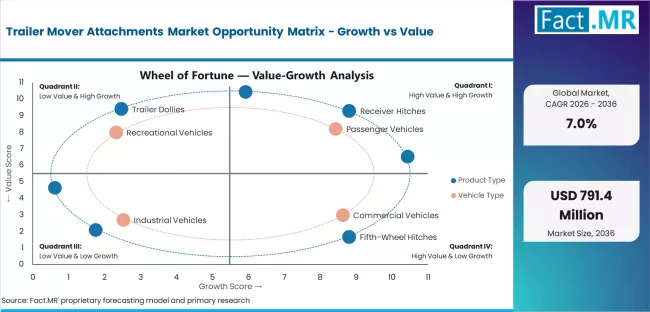
Key Factors Driving Growth
- The growing development of logistics infrastructure, warehousing, and e-commerce distribution centers are driving up the demand for trailer maneuvering and towing solutions.
- The increasing popularity of electric trailer movers, smart towing systems, and warehouse automation solutions is enhancing the operational efficiency and fueling the market growth.
- The rise in recreational vehicle (RV), camper trailer, and utility trailer ownership is contributing to an ongoing demand for sophisticated trailer handling and positioning systems.
| Growth Driver | Demand Impact | Time Horizon | Key Impact Area | Fact.MR Insight |
|---|---|---|---|---|
| Rising expansion of logistics infrastructure and warehouse automation | High | Short–Mid Term | Trailer handling efficiency & warehouse operations | Increasing deployment of automated warehouses, freight yards, and distribution centers is driving strong demand for trailer mover attachments and industrial trailer maneuvering systems. |
| Growing adoption of electric trailer movers and smart towing technologies | High | Short–Mid Term | Operational efficiency & safety | Industries and recreational vehicle users are increasingly adopting electric and remote-controlled trailer movers to improve maneuverability, reduce manual labor, and enhance towing precision. |
| Increasing recreational vehicle (RV) and utility trailer ownership | Medium-High | Short–Mid Term | Recreational towing & mobility solutions | Rising camper trailer, caravan, and utility trailer demand is supporting growth of trailer dollies, receiver hitches, and advanced towing accessories across recreational applications. |
| Advancements in semi-autonomous and remote-controlled trailer movement systems | Medium-High | Mid–Long Term | Smart maneuvering & operational safety | Integration of assisted steering, remote-control functionality, and intelligent trailer positioning systems is improving maneuvering accuracy, operational safety, and trailer docking efficiency |
Key Market Constraints
- The high upfront cost of electric and smart trailer movers acts as a barrier to entry for small operators and end users price sensitive.
- Lack of knowledge on advanced technologies for trailer maneuvering in the developing countries is hindering market growth.
- Reliance on traditional towing vehicles and standard hitch systems impedes the replacement demand for sophisticated trailer mover attachments.
Key Opportunity Areas
- Developments of warehouse automation, intelligence logistics infrastructure, and the industrial trailer processing business are bringing new opportunities in trailer mover attachments.
- Increasing demand in the aftermarket for trailer maneuvering upgrades for recreational vehicles, commercial fleets, and industrial towing applications presents strong growth potential.
- Rising penetration of remote-controlled, IoT-enabled and semi-autonomous trailer moving solutions is providing space for premium product positioning.
Segment-wise Analysis of the Trailer Mover Attachments Market
- Receiver Hitches account for 27.1% share of the product type segment in 2026, driven by widespread adoption across passenger vehicles, commercial towing operations, utility trailers, and recreational vehicle applications due to their versatility and compatibility.
- Passenger Vehicles hold 36.2% share of the vehicle type segment in 2026, supported by increasing SUV and pickup truck ownership, growing recreational towing activities, and rising demand for trailer maneuvering accessories.
- Electric systems account for 39.2% share of the power source segment in 2026, owing to increasing adoption of battery-powered trailer movers, operational efficiency benefits, and rising demand for low-noise and low-maintenance towing solutions.
The global Trailer Mover Attachments Market is segmented on the basis of product type, power type, vehicle type, towing capacity, technology, and region.
Which Product Type Segment Topped the Trailer Mover Attachments Market?
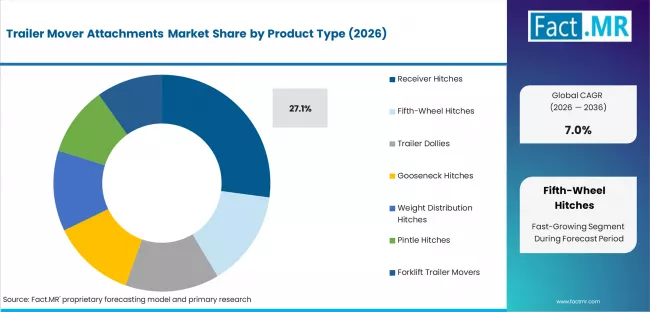
Receiver hitches are anticipated to have the largest share in the trailer mover attachments market by 2026 with 27.1% of market share. This can be associated to their adoption in passenger cars, commercial towing, utility trailers and recreation vehicles as they are versatile, compatible, and economical.
Which Vehicle Type Segment Accounts for the Highest Share in the Market?
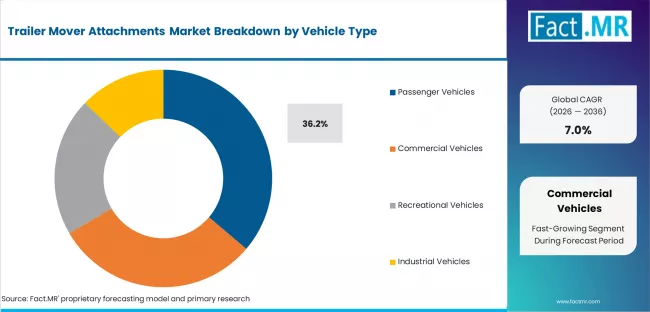
Passenger Vehicles are anticipated to hold the largest share of 36.2% in 2026. Their reign continues due to increasing SUV and pickup truck ownership, growing recreational towing, and use of towing accessories for personal and utility trailers.
Which Power Source Segment Leads the Market?
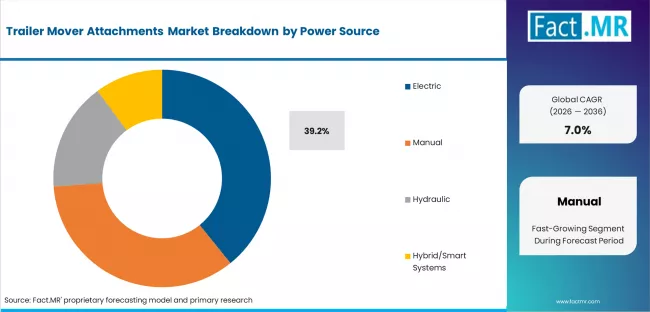
Electric systems are expected to hold the largest market share of 39.2% in 2026 owing to increasing adoption of battery-powered trailer movers, improved operational efficiency, reduced maintenance requirements, and rising demand for environmentally efficient trailer maneuvering solutions.
Which Towing Capacity Segment Holds the Largest Share in the Market?
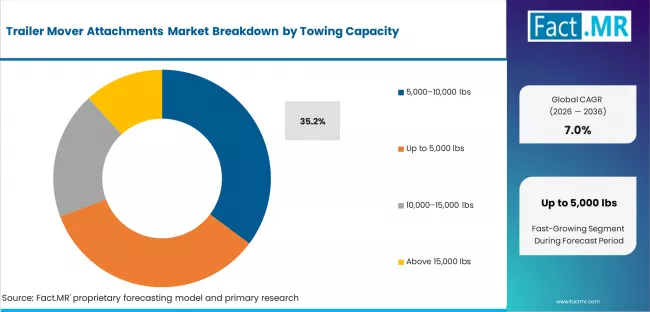
The 5,000–10,000 lbs segment is expected to be the leading towing capacity category, accounting for 35.2% share in 2026. This is supported by growing demand across commercial towing, utility trailer transportation, recreational vehicle towing, and medium-duty industrial applications.
Which Technology Level Segment Holds the Highest Share in the Market?
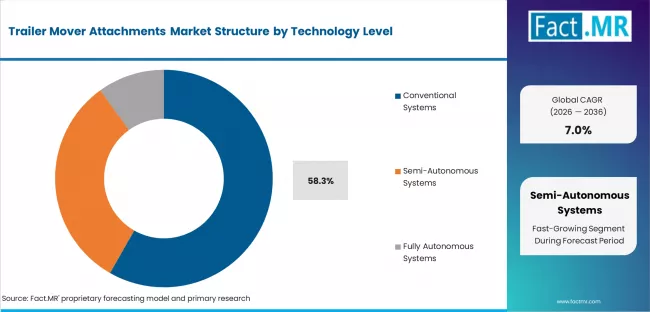
Conventional Systems lead the market with a 58.3% share in 2026, supported by their strong installed base, lower operational costs, broad compatibility across towing applications, and continued adoption in traditional trailer handling operations globally.
Regional Outlook Across Key Markets
- India is expected to register growth at a rate of 10.1%, attributed to the fast-paced growth of logistics infrastructure, warehouse automation, surge in demand for commercial vehicle, and growing acceptance of smart trailer maneuvering systems.
- The rate of growth in China is expected to be 9.0%, as a result of increasing freight transportation activities, warehouse refresher, industrial development, and growing needs of electric trailer movers.
- United Sates is predicted to register a growth of 5.9%, owing to high pick-up truck towing culture, RV ownership and increasing trailer maneuvering solutions penetration in logistics and recreational industries.
- Germany will swell at 5.3%, attributed to demand for industrial trailer handling, sophisticated automotive towing solutions, and modernization in logistics infrastructure. East Asia and South Asia & Pacific will continue to be the fastest-growing regional segments, attributed to the growing logistic activities, investments in industrial automation, and rapid development of warehouse infrastructure.
.webp)
CAGR Table
| Country | CAGR (%) |
|---|---|
| India | 10.1% |
| Japan | 9.3% |
| China | 9.0% |
| Canada | 7.6% |
| United States | 5.9% |
| United Kingdom | 5.8% |
| Germany | 5.3% |
Source: Fact.MR (FMR) analysis, based on proprietary forecasting model and primary research.
North America – The Advanced Towing & Recreational Vehicle Hub
The market in North America is considered to be highly advanced in terms of technology due to the presence of high recreational vehicle ownership, pick-up truck towing culture, warehouse automation, and Logistics Infrastructure development. Manufacturers are also paying more attention to electric trailer movers, intelligent towing systems and sophisticated maneuvering techniques for better efficiency of operation as well as in towing safety.
- U.S.: Demand for trailer mover attachments in the U.S. is projected to rise at 5.9% CAGR through 2036.
- Canada: Demand for trailer mover attachments in Canada is projected to rise at 7.6% CAGR through 2036.
Western Europe – The Advanced Caravan & Smart Towing Market
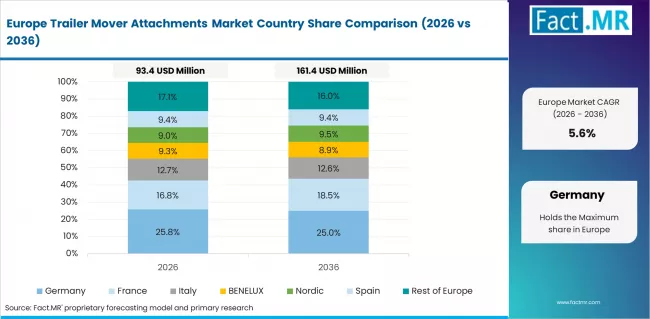
Western Europe represents a mature trailer towing and caravan mobility market supported by advanced automotive technologies, increasing caravan adoption, and strong focus on towing safety regulations. Companies are emphasizing lightweight hitch systems, intelligent trailer assist technologies, and electric trailer maneuvering solutions to improve towing precision and operational convenience.
- Germany: Demand for trailer mover attachments in Germany is projected to rise at 5.3% CAGR through 2036.
- U.K.: Demand for trailer mover attachments in the U.K. is projected to rise at 5.8% CAGR through 2036.
East Asia – The Industrial Automation & Smart Logistics Powerhouse
East Asia is a major industrial and logistics hub supported by rapid warehouse automation, manufacturing expansion, freight transportation growth, and smart logistics investments. Companies are expanding electric trailer mover production, forklift trailer handling systems, and intelligent towing technologies to support high-volume industrial operations and automated logistics infrastructure.
- China: Demand for trailer mover attachments in China is projected to rise at 9.0% CAGR through 2036.
- Japan: Demand for trailer mover attachments in Japan is projected to rise at 9.3% CAGR through 2036.
South Asia & Pacific – The Fastest-Growing Logistics & Industrial Mobility Market
South Asia & Pacific is emerging as the fastest-growing regional market due to rapid industrialization, infrastructure development, expansion of e-commerce logistics networks, and rising commercial vehicle demand. Trailer mover attachment manufacturers are strengthening regional distribution channels and industrial partnerships to address increasing demand for efficient trailer handling systems.
- India: Demand for trailer mover attachments in India is projected to rise at 10.1% CAGR through 2036.
Latin America – The Emerging Commercial Transportation & Logistics Market
The Latin American market is a developing market for trailer handling and towing equipment, driven by growing freight transport activity, warehouse construction and expansion, and growth in the construction and agricultural industries. Firms are broadening their portfolios with the addition of aftermarket towing solutions and industrial trailer steering systems to commit to regional growth.
- Brazil: Demand for trailer mover attachments in Brazil is projected to witness steady growth through 2036, supported by increasing logistics modernization and commercial transportation activities.
Middle East & Africa – The Expanding Industrial Infrastructure & Logistics Development Zone
The Middle East and Africa is a growth market, with logistics infrastructure, industrial diversification, warehousing, and transportation modernization projects being financed. Increasing commercial traffic and growth in industrial trailer handling works are providing opportunities for producers of trailer mover attachments in the region.
- KSA: Demand for trailer mover attachments in KSA is projected to experience stable growth through 2036, driven by increasing investments in logistics infrastructure, industrial development, and smart transportation initiatives.
Fact.MR’s analysis of the Trailer Mover Attachments Market provides a comprehensive regional outlook covering North America, Western Europe, East Asia, South Asia & Pacific, Latin America, and Middle East & Africa. Readers can access country-wise insights, towing technology adoption trends, logistics infrastructure developments, and demand dynamics shaping both mature and emerging trailer maneuvering equipment markets.
Competitive Benchmarking and Company Positioning
Leading Companies Shaping the Trailer Mover Attachments Market
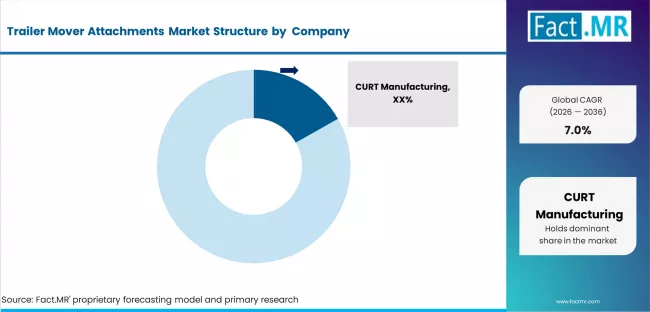
The trailer mover attachments industry has moderate fragmentation among its top players, which include Reese Towpower, CURT Manufacturing, B&W Trailer Hitches, Trailer Valet, and Parkit360. Competition within this market is characterized by towing capacities, maneuvering abilities, toughness, safety, and the implementation of electric trailer mover technology. The industry leaders derive their competitive advantage from their broad range of towing equipment products, large scale distribution of their products after purchase, and dominance in both recreation and commercial sectors. Competitive players are becoming more focused on the development of electric trailer movers, remote controlled systems, lightweight hitches, and towing technology.
Recent Industry Developments
- Ignite Attachments Launches Trailer Mover for Compact Loaders (2025)
- Ignite Attachments launched a trailer mover attachment designed for compact loaders to improve trailer positioning, maneuverability, and operational efficiency across construction, industrial, and material handling applications. The solution enables operators to move trailers safely in confined environments while reducing dependence on conventional towing vehicles.
- Ignite Trailer Mover Named to Construction Equipment’s Top 100 Products of 2025 (2025)
- Ignite Attachments received recognition for its trailer mover attachment in Construction Equipment’s Top 100 Products of 2025 list. The product was highlighted for improving trailer maneuvering efficiency, attachment versatility, and operational convenience across construction and industrial trailer handling operations.
- Sidekick Introduces Forklift-Operated Trailer Movers for Safer Yard Operations (2025)
- Sidekick introduced forklift-operated trailer movers designed to improve trailer maneuverability and operational safety in warehouse yards and logistics facilities. The system enables forklifts to reposition trailers more efficiently while reducing accident risks, improving visibility, and enhancing trailer handling precision in confined operational environments.
- MasterMover Highlights Manufacturing Predictions and Industrial Mobility Trends for 2025 (2025)
- MasterMover highlighted key manufacturing and industrial mobility trends for 2025, emphasizing growth in electric tug technologies, automation, AGV integration, and smart material handling systems. The company focused on improving operational efficiency, reducing manual handling risks, and supporting warehouse automation through advanced trailer movement technologies.
- Lippert Acquires RVibrake to Strengthen Flat Tow Brake Technology Portfolio (2025)
- Lippert announced the acquisition of RVibrake, a provider of flat tow brake systems for recreational towing applications. The acquisition strengthens Lippert’s towing technology portfolio and expands its capabilities in trailer braking, towing safety, and smart trailer control solutions across recreational vehicle and towing markets.
Leading Companies Shaping the Trailer Mover Attachments Market
- Reese Towpower
- CURT Manufacturing
- B&W Trailer Hitches
- Trailer Valet
- Parkit360
- MasterMover
- Power Pusher
- Airtug
- DJ Products
- Beacon Industries
Sources and Research References
- [1] Ignite Attachments, “Ignite Attachments Launches Trailer Mover for Compact Loaders”, May 2025
- [2] Ignite Attachments, “Ignite Trailer Mover Named to Construction Equipment's Top 100 Products of 2025”, November 2025
- [3] Sidekick Attachments, “Sidekick Introduces Forklift-Operated Trailer Movers for Safer Yard Operations”, March 2025
- [4] MasterMover, “Manufacturing Predictions for 2025”, January 2025
- [5] Lippert, “Lippert Acquires RVibrake, Leading Name in Flat Tow Brake Systems”, March 2025
Trailer Mover Attachments Market Definition
The trailer mover attachments market includes products and solutions that facilitate the movement, positioning, handling, and stabilization of trailers within commercial, industrial, recreational, and logistic applications. These attachments are mounted to tow vehicles, forklifts, yard trucks, or powered maneuvering systems to enhance efficiency of trailer handling and safety of operation. They consist of receiver hitches, fifth wheel hitches, gooseneck hitches, trailer dollies, forklift trailer movers, and weight distribution hitches. Such systems find applications in warehousing and freight, RV towing, building, farming, and even in industrial trailer handling processes.
Trailer Mover Attachments Market Inclusions
This report provides both the global and regional market size trailer mover attachments for the period 2026-2036. The report includes a segmentation based on product type, power type, vehicle type, towing capacity and technology level. Further to this, pricing analysis, growth trends, competitive landscape and demand outlook by major geographies is included. Furthermore, the report offers information on the trends in adoption on electric trailer movers, warehouse trailer handling solutions, recreational towing applications, aftermarket demand, OEM integration trends and technological advancements in smart towing and trailer maneuvering solutions for commercial, industrial, and recreational applications.
Trailer Mover Attachments Market Exclusions
The report does not cover solid trailer systems, towing vehicles, trailer frames, or standalone transport equipment not intended as trailer mover attachments. It does not cover general towing accessories like trailer lighting systems, brake controllers, cargo carriers, safety chains, or non-steering trailer parts. It also excludes full autonomous transport vehicles, fleet management software, or general warehouse automation solutions unless they are specifically integrated with trailer maneuvering. The scope for the report is limited to specialized trailer repair services, trailer hire businesses and the like aftersales vehicle accessories not related to trailers.
Trailer Mover Attachments Market Research Methodology
- Primary Research
- To capture up to date demand trends, pricing information, and technology adoption trends, interviews were held with manufacturers of trailer mover attachments, providers of towing equipment, distributors, warehouse automation companies, fleet operators, RV dealers and logistics professionals in the US and select other key regional players.
- Desk Research
- The sizing of the market, competitive benchmarking and analysis of industry trends were substantiated by company annual reports, investor presentations, OEM product catalogs, transportation statistics, trade journals, government automotive data, and logistics industry publications.
- Market-Sizing and Forecasting
- A hybrid market modeling approach combining bottom-up analysis (company revenues, product shipments, aftermarket sales, and unit installations) and top-down analysis (towing equipment industry benchmarks, trailer population data, warehouse automation trends, and RV sales statistics) was utilized to estimate and forecast the market accurately.
- Data Validation and Update Cycle
- Market projections and forecast assumptions are validated using the triangulation method based on interviews with industry experts, secondary research, and continuous tracking of macroeconomic indicators, logistics infrastructure spending, trends in demand for recreational vehicles, and advances in industrial automation.
Scope of Analysis

Parameter |
Details |
|---|---|
| Quantitative Units | USD 376.0 Million (2025) to USD 791.4 Million (2036), at a CAGR of 7.0% |
| Market Definition | The Trailer Mover Attachments Market covers products and systems designed for trailer maneuvering, towing, positioning, and stabilization across logistics, warehousing, industrial transportation, recreational vehicle towing, agriculture, and commercial applications. These systems include receiver hitches, gooseneck hitches, fifth-wheel hitches, pintle hitches, trailer dollies, forklift trailer movers, and weight distribution hitches integrated with towing vehicles, warehouse handling systems, and smart trailer maneuvering technologies to improve operational safety, maneuverability, and towing efficiency. |
| Regions Covered | North America, Eastern Europe, Western Europe, East Asia, South Asia & Pacific, Latin America, Middle East & Africa |
| Countries Covered | USA, Canada, UK, Germany, China, Japan, India, Brazil, Saudi Arabia, UAE, and 20+ countries |
| Key Companies | Reese Towpower, CURT Manufacturing, B&W Trailer Hitches, Trailer Valet, Parkit360, MasterMover, Power Pusher, Airtug, DJ Products, Beacon Industries |
| Forecast Period | 2026 to 2036 |
| Approach | Hybrid demand-side and top-down methodology based on logistics infrastructure expansion, warehouse automation growth, recreational towing demand, industrial trailer handling requirements, and increasing adoption of electric trailer maneuvering technologies, validated through primary interviews with towing equipment manufacturers, trailer mover attachment suppliers, warehouse operators, distributors, fleet managers, and recreational vehicle equipment providers across key regions. |
Analysis by Product Type, Power Source, Vehicle Type, Towing Capacity, Technology Level, and Region
-
Trailer Mover Attachments Market by Product Type:
- Receiver Hitches
- Gooseneck Hitches
- Fifth-Wheel Hitches
- Pintle Hitches
- Trailer Dollies
- Forklift Trailer Movers
- Weight Distribution Hitches
-
Trailer Mover Attachments Market by Power Source:
- Manual
- Hand-Push Systems
- Mechanical Crank Systems
- Electric
- Corded Systems
- Battery-Operated Systems
- Hydraulic
- Portable Hydraulic Systems
- Integrated Hydraulic Systems
- Hybrid/Smart Systems
- Electric-Hydraulic Systems
- Automated Smart Systems
- Manual
-
Trailer Mover Attachments Market by Vehicle Type:
- Passenger Vehicles
- SUVs
- Pickup Trucks
- Commercial Vehicles
- Light Commercial Vehicles
- Heavy Trucks
- Recreational Vehicles
- Campers
- Caravans
- Industrial Vehicles
- Forklifts
- Yard Trucks
- Tractors
- Passenger Vehicles
-
Trailer Mover Attachments Market by Towing Capacity:
- Up to 5,000 lbs
- 5,000–10,000 lbs
- 10,000–15,000 lbs
- Above 15,000 lbs
-
Trailer Mover Attachments Market by Technology Level:
- Conventional Systems
- Semi-Autonomous Systems
- Fully Autonomous Systems
-
Trailer Mover Attachments Market by Region:
- North America
- USA
- Canada
- Mexico
- Latin America
- Brazil
- Chile
- Rest of LATAM
- East Asia
- China
- Japan
- South Korea
- Taiwan
- South Asia & Pacific
- India
- Singapore
- Australia
- ASEAN
- Western Europe
- Germany
- France
- U.K.
- Italy
- Spain
- BENELUX
- Nordic
- Rest of Western Europe
- Eastern Europe
- Poland
- Hungary
- Czech Republic
- Balkan & Baltics
- Rest of Eastern Europe
- Middle East and Africa
- Kingdom of Saudi Arabia
- United Arab Emirates
- South Africa
- Rest of Middle East and Africa
- North America
- Frequently Asked Questions -
How large is the demand for Trailer Mover Attachments in the global market in 2025?
Demand for Trailer Mover Attachments in the global market is estimated to be valued at USD 376.0 million in 2025.
What will be the market size of Trailer Mover Attachments in the global market by 2036?
The market size for Trailer Mover Attachments is projected to reach USD 791.4 million by 2036.
What is the expected demand growth for Trailer Mover Attachments in the global market between 2026 and 2036?
Demand for Trailer Mover Attachments in the global market is expected to grow at a CAGR of 7.0% between 2026 and 2036, supported by increasing warehouse automation, logistics infrastructure expansion, recreational towing demand, and adoption of electric trailer maneuvering technologies.
Which product type segment is expected to dominate the market?
Receiver Hitches are expected to dominate the market, accounting for 27.1% share in 2026, driven by strong adoption across passenger vehicles, utility trailers, and commercial towing applications.
How significant is the growth outlook for India in this market?
India is expected to grow at a CAGR of 10.1%, supported by rapid logistics expansion, infrastructure development, warehouse modernization, and increasing commercial vehicle demand.
Which company is identified as a leading player in the Trailer Mover Attachments Market?
CURT Manufacturing is recognized as a leading player in this market, offering advanced towing systems, trailer hitches, and trailer maneuvering solutions across recreational, commercial, and industrial applications.
Table of Content
- Trailer Mover Attachments Market - Executive Summary
- Market Overview
- Market Definition and Introduction
- Market Taxonomy/ Research Scope
- Global Trailer Mover Attachments Market Demand Analysis 2021-2025 and Forecast, 2026–2036
- Historical Market Volume Analysis, 2021-2025
- Current and Future Market Volume Forecast, 2026–2036
- Y-o-Y Growth Trend Analysis
- Global Trailer Mover Attachments Market - Pricing Analysis
- Product Category and Country-Level Pricing Analysis
- Global Average Pricing Analysis Benchmark
- Factors Influencing Pricing
- Cost Structure Analysis: Elementary Deep Dive
- Competitive Pricing Strategies
- Price Trends and Forecasts
- Historical price trends
- Future price forecasts
- Global Trailer Mover Attachments Market Demand Analysis 2021-2025 and Forecast, 2026–2036
- Global Trailer Towing Equipment Market Outlook, 2025
- Penetration of Trailer Mover Attachments in Global Trailer Towing Equipment Market
- Trailer Mover Attachments: Consumer and End-User Perception Analysis
- Recent Developments in Trailer Mover Attachments, by Market Players
- Trailer Mover Attachments Production Analysis
- By Region
- By Key Companies
- Trade Scenario, 2025
- Import and Export Analysis
- By Region
- By Country
- Trailer Mover Attachments Raw Material and Component Sourcing
- By Key Importing Countries
- By Key Exporting Countries
- Investment Analysis in Trailer Mover Attachments, by Region
- Technology Evolution and Innovation Landscape
- Electric Trailer Movers
- Remote-Controlled Trailer Maneuvering Systems
- Semi-Autonomous and Smart Trailer Assist Technologies
- IoT-Enabled Trailer Monitoring and Predictive Maintenance Systems
- Supply Chain and Distribution Network Analysis
- OEM Sales Channels
- Aftermarket Distribution Analysis
- Dealer and E-commerce Sales Network
- Pricing Analysis of Trailer Mover Attachments
- By Product Type
- By Region
- By Technology Level
- Regulatory and Safety Compliance Analysis
- Towing Safety Standards
- Vehicle Load and Hitch Compliance Regulations
- Industrial Trailer Handling Safety Requirements
- Warehouse Automation and Logistics Infrastructure Impact Analysis
- Recreational Vehicle (RV) and Caravan Industry Impact Assessment
- Trailer Mover Attachments Market Opportunity Assessment
- Total Available Market (US$ Mn)
- Serviceable Addressable Market (US$ Mn)
- Serviceable Obtainable Market (US$ Mn)
- Porter’s Five Forces and PESTEL Analysis
- Investment Feasibility Analysis
- Macro-Economic Factors
- Forecast Factors - Relevance & Impact
- Industry Value and Supply Chain Analysis
- List of Key Channel Partners
- Profit Margin & Operating Margin at Each Node of Supply Chain.
- Notes on Value Added at Each Node in the Value Chain
- Factors Influencing Value Chain
- Market Dynamics
- Drivers
- Restraints
- Opportunity Analysis
- Key Regulations & Certifications
- Global Trailer Mover Attachments Market Analysis 2021-2025 and Forecast 2026–2036, By Product Type
- Introduction / Key Findings
- Market Size & Volume Analysis by Market Taxonomy, 2021–2036
- Receiver Hitches
- Gooseneck Hitches
- Fifth-Wheel Hitches
- Pintle Hitches
- Trailer Dollies
- Forklift Trailer Movers
- Weight Distribution Hitches
- Market Attractiveness Analysis by Product Type
- Global Trailer Mover Attachments Market Analysis 2021-2025 and Forecast 2026–2036, By Power Source
- Introduction / Key Findings
- Market Size & Volume Analysis by Market Taxonomy, 2021–2036
- Manual
- Hand-Push
- Mechanical Crank
- Electric
- Corded
- Battery Operated
- Hydraulic
- Portable Hydraulic
- Integrated Hydraulic
- Hybrid/Smart Systems
- Electric-Hydraulic
- Automated Smart Systems
- Manual
- Market Attractiveness Analysis by Power Source
- Global Trailer Mover Attachments Market Analysis 2021-2025 and Forecast 2026–2036, By Vehicle Type
- Introduction / Key Findings
- Market Size & Volume Analysis by Market Taxonomy, 2021–2036
- Passenger Vehicles
- SUVs
- Pickup Trucks
- Commercial Vehicles
- Light Commercial Vehicles
- Heavy Trucks
- Recreational Vehicles
- Campers
- Caravans
- Industrial Vehicles
- Forklifts
- Yard Trucks
- Tractors
- Passenger Vehicles
- Market Attractiveness Analysis by Vehicle Type
- Global Trailer Mover Attachments Market Analysis 2021-2025 and Forecast 2026–2036, By Towing Capacity
- Introduction / Key Findings
- Market Size & Volume Analysis by Market Taxonomy, 2021–2036
- Up to 5,000 lbs
- 5,000–10,000 lbs
- 10,000–15,000 lbs
- Above 15,000 lbs
- Market Attractiveness Analysis by Towing Capacity
- Global Trailer Mover Attachments Market Analysis 2021-2025 and Forecast 2026–2036, By Technology Level
- Introduction / Key Findings
- Market Size & Volume Analysis by Market Taxonomy, 2021–2036
- Conventional Systems
- Semi-Autonomous Systems
- Fully Autonomous Systems
- Market Attractiveness Analysis by Technology Level
- Global Trailer Mover Attachments Market Analysis and Forecast, by Region
- Introduction / Key Findings
- Market Size & Volume Analysis by Market Taxonomy, 2021–2036
- North America
- Latin America
- Western Europe
- Eastern Europe
- East Asia
- South Asia & Pacific
- Middle East & Africa
- Market Attractiveness Analysis by Region
- North America Trailer Mover Attachments Market Analysis and Forecast
- Market Size & Volume Analysis by Market Taxonomy, 2021–2036
- By Country
- United States
- Canada
- Mexico
- By Taxonomy
- By Country
- Market Attractiveness Analysis By Country & Taxonomy
- Market Size & Volume Analysis by Market Taxonomy, 2021–2036
- Latin America Trailer Mover Attachments Market Analysis and Forecast
- Market Size & Volume Analysis by Market Taxonomy, 2021–2036
- By Country
- Brazil
- Chile
- Rest of LATAM
- By Taxonomy
- By Country
- Market Attractiveness Analysis By Country & Taxonomy
- Market Size & Volume Analysis by Market Taxonomy, 2021–2036
- Western Europe Trailer Mover Attachments Market Analysis and Forecast
- Market Size & Volume Analysis by Market Taxonomy, 2021–2036
- By Country
- Germany
- Italy
- France
- United Kingdom
- Spain
- BENELUX
- Nordics
- Rest of Western Europe
- By Taxonomy
- By Country
- Market Attractiveness Analysis By Country & Taxonomy
- Market Size & Volume Analysis by Market Taxonomy, 2021–2036
- Eastern Europe Trailer Mover Attachments Market Analysis and Forecast
- Market Size & Volume Analysis by Market Taxonomy, 2021–2036
- By Country
- Russia
- Hungary
- Poland
- Balkan & Baltics
- Rest of Eastern Europe
- By Taxonomy
- By Country
- Market Attractiveness Analysis By Country & Taxonomy
- Market Size & Volume Analysis by Market Taxonomy, 2021–2036
- East Asia Trailer Mover Attachments Market Analysis and Forecast
- Market Size & Volume Analysis by Market Taxonomy, 2021–2036
- By Country
- China
- Japan
- South Korea
- By Taxonomy
- By Country
- Market Attractiveness Analysis By Country & Taxonomy
- Market Size & Volume Analysis by Market Taxonomy, 2021–2036
- South Asia & Pacific Trailer Mover Attachments Market Analysis and Forecast
- Market Size & Volume Analysis by Market Taxonomy, 2021–2036
- By Country
- India
- ASEAN
- Australia & New Zealand
- Rest of South Asia & Pacific
- By Taxonomy
- By Country
- Market Attractiveness Analysis By Country & Taxonomy
- Market Size & Volume Analysis by Market Taxonomy, 2021–2036
- Middle East & Africa Trailer Mover Attachments Market Analysis and Forecast
- Market Size & Volume Analysis by Market Taxonomy, 2021–2036
- By Country
- Kingdom of Saudi Arabia
- Other GCC Countries
- Turkiye
- South Africa
- Other African Union
- By Taxonomy
- By Country
- Market Attractiveness Analysis By Country & Taxonomy
- Market Size & Volume Analysis by Market Taxonomy, 2021–2036
- Country-level Trailer Mover Attachments Market Analysis and Forecast
- Introduction
- Market Value Proportion Analysis, By Key Countries
- Global Vs. Country Growth Comparison
- United States Trailer Mover Attachments Market Analysis
- Market Size & Volume Analysis by Market Taxonomy, 2021–2036
- By Product Type
- By Power Source
- By Vehicle Type
- By Towing Capacity
- By Technology Level
- Market Size & Volume Analysis by Market Taxonomy, 2021–2036
-
- Canada Trailer Mover Attachments Market Analysis
- Mexico Trailer Mover Attachments Market Analysis
- Brazil Trailer Mover Attachments Market Analysis
- Chile Trailer Mover Attachments Market Analysis
- Germany Trailer Mover Attachments Market Analysis
- France Trailer Mover Attachments Market Analysis
- Italy Trailer Mover Attachments Market Analysis
- Spain Trailer Mover Attachments Market Analysis
- United Kingdom Trailer Mover Attachments Market Analysis
- BENELUX Trailer Mover Attachments Market Analysis
- Nordics Trailer Mover Attachments Market Analysis
- Poland Trailer Mover Attachments Market Analysis
- Russia Trailer Mover Attachments Market Analysis
- Hungary Trailer Mover Attachments Market Analysis
- Balkan & Baltics Trailer Mover Attachments Market Analysis
- China Trailer Mover Attachments Market Analysis
- Japan Trailer Mover Attachments Market Analysis
- South Korea Trailer Mover Attachments Market Analysis
- India Trailer Mover Attachments Market Analysis
- ASEAN Trailer Mover Attachments Market Analysis
- ANZ Trailer Mover Attachments Market Analysis
- KSA Trailer Mover Attachments Market Analysis
- Other GCC Countries Trailer Mover Attachments Market Analysis
- South Africa Trailer Mover Attachments Market Analysis
- Turkiye Trailer Mover Attachments Market Analysis
- Trailer Mover Attachments Market Structure Analysis
- Market Analysis by Tier of Companies
- Market Share Analysis of Top Players
- Market Space for New Brands and Dollar Opportunity
- Market Presence Analysis
- Regional Footprint of Players
- Product Footprint by Players
- Application Footprint by Players
- Trailer Mover Attachments Competition Analysis
- Competition Dashboard
- Pricing Analysis by Competition
- Competition Benchmarking
- Competition Deep Dive
- Reese Towpower
- Overview
- Product Portfolio
- Sales Footprint
- Key Developments
- SWOT Analysis
- Strategy Overview
- Key Financials
- CURT Manufacturing
- B&W Trailer Hitches
- Trailer Valet
- Parkit360
- MasterMover
- Power Pusher
- Airtug
- DJ Products
- Beacon Industries
- Other Prominent Players
- Reese Towpower
- Primary Insights
- Assumption & Acronyms Used
- Research Methodology & Data Sources
- Introduction
List Of Table
- Table 1: Global Market Value (USD Mn) Forecast by Region, 2021 to 2036
- Table 2: Global Market Volume (Units) Forecast by Region, 2021 to 2036
- Table 3: Global Market Value (USD Mn) Forecast by Product Type, 2021 to 2036
- Table 4: Global Market Volume (Units) Forecast by Product Type, 2021 to 2036
- Table 5: Global Market Value (USD Mn) Forecast by Power Source, 2021 to 2036
- Table 6: Global Market Volume (Units) Forecast by Power Source, 2021 to 2036
- Table 7: Global Market Value (USD Mn) Forecast by Vehicle Type, 2021 to 2036
- Table 8: Global Market Volume (Units) Forecast by Vehicle Type, 2021 to 2036
- Table 9: Global Market Value (USD Mn) Forecast by Towing Capacity, 2021 to 2036
- Table 10: Global Market Volume (Units) Forecast by Towing Capacity, 2021 to 2036
- Table 11: Global Market Value (USD Mn) Forecast by Technology Level, 2021 to 2036
- Table 12: Global Market Volume (Units) Forecast by Technology Level, 2021 to 2036
- Table 13: North America Market Value (USD Mn) Forecast by Country, 2021 to 2036
- Table 14: North America Market Volume (Units) Forecast by Country, 2021 to 2036
- Table 15: North America Market Value (USD Mn) Forecast by Product Type, 2021 to 2036
- Table 16: North America Market Volume (Units) Forecast by Product Type, 2021 to 2036
- Table 17: North America Market Value (USD Mn) Forecast by Power Source, 2021 to 2036
- Table 18: North America Market Volume (Units) Forecast by Power Source, 2021 to 2036
- Table 19: North America Market Value (USD Mn) Forecast by Vehicle Type, 2021 to 2036
- Table 20: North America Market Volume (Units) Forecast by Vehicle Type, 2021 to 2036
- Table 21: North America Market Value (USD Mn) Forecast by Towing Capacity, 2021 to 2036
- Table 22: North America Market Volume (Units) Forecast by Towing Capacity, 2021 to 2036
- Table 23: North America Market Value (USD Mn) Forecast by Technology Level, 2021 to 2036
- Table 24: North America Market Volume (Units) Forecast by Technology Level, 2021 to 2036
- Table 25: Latin America Market Value (USD Mn) Forecast by Country, 2021 to 2036
- Table 26: Latin America Market Volume (Units) Forecast by Country, 2021 to 2036
- Table 27: Latin America Market Value (USD Mn) Forecast by Product Type, 2021 to 2036
- Table 28: Latin America Market Volume (Units) Forecast by Product Type, 2021 to 2036
- Table 29: Latin America Market Value (USD Mn) Forecast by Power Source, 2021 to 2036
- Table 30: Latin America Market Volume (Units) Forecast by Power Source, 2021 to 2036
- Table 31: Latin America Market Value (USD Mn) Forecast by Vehicle Type, 2021 to 2036
- Table 32: Latin America Market Volume (Units) Forecast by Vehicle Type, 2021 to 2036
- Table 33: Latin America Market Value (USD Mn) Forecast by Towing Capacity, 2021 to 2036
- Table 34: Latin America Market Volume (Units) Forecast by Towing Capacity, 2021 to 2036
- Table 35: Latin America Market Value (USD Mn) Forecast by Technology Level, 2021 to 2036
- Table 36: Latin America Market Volume (Units) Forecast by Technology Level, 2021 to 2036
- Table 37: Western Europe Market Value (USD Mn) Forecast by Country, 2021 to 2036
- Table 38: Western Europe Market Volume (Units) Forecast by Country, 2021 to 2036
- Table 39: Western Europe Market Value (USD Mn) Forecast by Product Type, 2021 to 2036
- Table 40: Western Europe Market Volume (Units) Forecast by Product Type, 2021 to 2036
- Table 41: Western Europe Market Value (USD Mn) Forecast by Power Source, 2021 to 2036
- Table 42: Western Europe Market Volume (Units) Forecast by Power Source, 2021 to 2036
- Table 43: Western Europe Market Value (USD Mn) Forecast by Vehicle Type, 2021 to 2036
- Table 44: Western Europe Market Volume (Units) Forecast by Vehicle Type, 2021 to 2036
- Table 45: Western Europe Market Value (USD Mn) Forecast by Towing Capacity, 2021 to 2036
- Table 46: Western Europe Market Volume (Units) Forecast by Towing Capacity, 2021 to 2036
- Table 47: Western Europe Market Value (USD Mn) Forecast by Technology Level, 2021 to 2036
- Table 48: Western Europe Market Volume (Units) Forecast by Technology Level, 2021 to 2036
- Table 49: Eastern Europe Market Value (USD Mn) Forecast by Country, 2021 to 2036
- Table 50: Eastern Europe Market Volume (Units) Forecast by Country, 2021 to 2036
- Table 51: Eastern Europe Market Value (USD Mn) Forecast by Product Type, 2021 to 2036
- Table 52: Eastern Europe Market Volume (Units) Forecast by Product Type, 2021 to 2036
- Table 53: Eastern Europe Market Value (USD Mn) Forecast by Power Source, 2021 to 2036
- Table 54: Eastern Europe Market Volume (Units) Forecast by Power Source, 2021 to 2036
- Table 55: Eastern Europe Market Value (USD Mn) Forecast by Vehicle Type, 2021 to 2036
- Table 56: Eastern Europe Market Volume (Units) Forecast by Vehicle Type, 2021 to 2036
- Table 57: Eastern Europe Market Value (USD Mn) Forecast by Towing Capacity, 2021 to 2036
- Table 58: Eastern Europe Market Volume (Units) Forecast by Towing Capacity, 2021 to 2036
- Table 59: Eastern Europe Market Value (USD Mn) Forecast by Technology Level, 2021 to 2036
- Table 60: Eastern Europe Market Volume (Units) Forecast by Technology Level, 2021 to 2036
- Table 61: East Asia Market Value (USD Mn) Forecast by Country, 2021 to 2036
- Table 62: East Asia Market Volume (Units) Forecast by Country, 2021 to 2036
- Table 63: East Asia Market Value (USD Mn) Forecast by Product Type, 2021 to 2036
- Table 64: East Asia Market Volume (Units) Forecast by Product Type, 2021 to 2036
- Table 65: East Asia Market Value (USD Mn) Forecast by Power Source, 2021 to 2036
- Table 66: East Asia Market Volume (Units) Forecast by Power Source, 2021 to 2036
- Table 67: East Asia Market Value (USD Mn) Forecast by Vehicle Type, 2021 to 2036
- Table 68: East Asia Market Volume (Units) Forecast by Vehicle Type, 2021 to 2036
- Table 69: East Asia Market Value (USD Mn) Forecast by Towing Capacity, 2021 to 2036
- Table 70: East Asia Market Volume (Units) Forecast by Towing Capacity, 2021 to 2036
- Table 71: East Asia Market Value (USD Mn) Forecast by Technology Level, 2021 to 2036
- Table 72: East Asia Market Volume (Units) Forecast by Technology Level, 2021 to 2036
- Table 73: South Asia and Pacific Market Value (USD Mn) Forecast by Country, 2021 to 2036
- Table 74: South Asia and Pacific Market Volume (Units) Forecast by Country, 2021 to 2036
- Table 75: South Asia and Pacific Market Value (USD Mn) Forecast by Product Type, 2021 to 2036
- Table 76: South Asia and Pacific Market Volume (Units) Forecast by Product Type, 2021 to 2036
- Table 77: South Asia and Pacific Market Value (USD Mn) Forecast by Power Source, 2021 to 2036
- Table 78: South Asia and Pacific Market Volume (Units) Forecast by Power Source, 2021 to 2036
- Table 79: South Asia and Pacific Market Value (USD Mn) Forecast by Vehicle Type, 2021 to 2036
- Table 80: South Asia and Pacific Market Volume (Units) Forecast by Vehicle Type, 2021 to 2036
- Table 81: South Asia and Pacific Market Value (USD Mn) Forecast by Towing Capacity, 2021 to 2036
- Table 82: South Asia and Pacific Market Volume (Units) Forecast by Towing Capacity, 2021 to 2036
- Table 83: South Asia and Pacific Market Value (USD Mn) Forecast by Technology Level, 2021 to 2036
- Table 84: South Asia and Pacific Market Volume (Units) Forecast by Technology Level, 2021 to 2036
- Table 85: Middle East & Africa Market Value (USD Mn) Forecast by Country, 2021 to 2036
- Table 86: Middle East & Africa Market Volume (Units) Forecast by Country, 2021 to 2036
- Table 87: Middle East & Africa Market Value (USD Mn) Forecast by Product Type, 2021 to 2036
- Table 88: Middle East & Africa Market Volume (Units) Forecast by Product Type, 2021 to 2036
- Table 89: Middle East & Africa Market Value (USD Mn) Forecast by Power Source, 2021 to 2036
- Table 90: Middle East & Africa Market Volume (Units) Forecast by Power Source, 2021 to 2036
- Table 91: Middle East & Africa Market Value (USD Mn) Forecast by Vehicle Type, 2021 to 2036
- Table 92: Middle East & Africa Market Volume (Units) Forecast by Vehicle Type, 2021 to 2036
- Table 93: Middle East & Africa Market Value (USD Mn) Forecast by Towing Capacity, 2021 to 2036
- Table 94: Middle East & Africa Market Volume (Units) Forecast by Towing Capacity, 2021 to 2036
- Table 95: Middle East & Africa Market Value (USD Mn) Forecast by Technology Level, 2021 to 2036
- Table 96: Middle East & Africa Market Volume (Units) Forecast by Technology Level, 2021 to 2036
List Of Figures
- Figure 1: Global Market Volume (Units) Forecast 2021–2036
- Figure 2: Global Market Pricing Analysis
- Figure 3: Global Market Value (USD Mn) Forecast 2021–2036
- Figure 4: Global Market Value Share and BPS Analysis by Product Type, 2026 and 2036
- Figure 5: Global Market Y-o-Y Growth Comparison by Product Type, 2026 to 2036
- Figure 6: Global Market Attractiveness Analysis by Product Type
- Figure 7: Global Market Value Share and BPS Analysis by Power Source, 2026 and 2036
- Figure 8: Global Market Y-o-Y Growth Comparison by Power Source, 2026 to 2036
- Figure 9: Global Market Attractiveness Analysis by Power Source
- Figure 10: Global Market Value Share and BPS Analysis by Vehicle Type, 2026 and 2036
- Figure 11: Global Market Y-o-Y Growth Comparison by Vehicle Type, 2026 to 2036
- Figure 12: Global Market Attractiveness Analysis by Vehicle Type
- Figure 13: Global Market Value Share and BPS Analysis by Towing Capacity, 2026 and 2036
- Figure 14: Global Market Y-o-Y Growth Comparison by Towing Capacity, 2026 to 2036
- Figure 15: Global Market Attractiveness Analysis by Towing Capacity
- Figure 16: Global Market Value Share and BPS Analysis by Technology Level, 2026 and 2036
- Figure 17: Global Market Y-o-Y Growth Comparison by Technology Level, 2026 to 2036
- Figure 18: Global Market Attractiveness Analysis by Technology Level
- Figure 19: Global Market Value (USD Mn) Share and BPS Analysis by Region, 2026 and 2036
- Figure 20: Global Market Y-o-Y Growth Comparison by Region, 2026 to 2036
- Figure 21: Global Market Attractiveness Analysis by Region
- Figure 22: North America Market Incremental $ Opportunity, 2026 to 2036
- Figure 23: Latin America Market Incremental $ Opportunity, 2026 to 2036
- Figure 24: Western Europe Market Incremental $ Opportunity, 2026 to 2036
- Figure 25: Eastern Europe Market Incremental $ Opportunity, 2026 to 2036
- Figure 26: East Asia Market Incremental $ Opportunity, 2026 to 2036
- Figure 27: South Asia and Pacific Market Incremental $ Opportunity, 2026 to 2036
- Figure 28: Middle East & Africa Market Incremental $ Opportunity, 2026 to 2036
- Figure 29: North America Market Value Share and BPS Analysis by Country, 2026 and 2036
- Figure 30: North America Market Value Share and BPS Analysis by Product Type, 2026 and 2036
- Figure 31: North America Market Y-o-Y Growth Comparison by Product Type, 2026 to 2036
- Figure 32: North America Market Attractiveness Analysis by Product Type
- Figure 33: North America Market Value Share and BPS Analysis by Power Source, 2026 and 2036
- Figure 34: North America Market Y-o-Y Growth Comparison by Power Source, 2026 to 2036
- Figure 35: North America Market Attractiveness Analysis by Power Source
- Figure 36: North America Market Value Share and BPS Analysis by Vehicle Type, 2026 and 2036
- Figure 37: North America Market Y-o-Y Growth Comparison by Vehicle Type, 2026 to 2036
- Figure 38: North America Market Attractiveness Analysis by Vehicle Type
- Figure 39: North America Market Value Share and BPS Analysis by Towing Capacity, 2026 and 2036
- Figure 40: North America Market Y-o-Y Growth Comparison by Towing Capacity, 2026 to 2036
- Figure 41: North America Market Attractiveness Analysis by Towing Capacity
- Figure 42: North America Market Value Share and BPS Analysis by Technology Level, 2026 and 2036
- Figure 43: North America Market Y-o-Y Growth Comparison by Technology Level, 2026 to 2036
- Figure 44: North America Market Attractiveness Analysis by Technology Level
- Figure 45: Latin America Market Value Share and BPS Analysis by Country, 2026 and 2036
- Figure 46: Latin America Market Value Share and BPS Analysis by Product Type, 2026 and 2036
- Figure 47: Latin America Market Y-o-Y Growth Comparison by Product Type, 2026 to 2036
- Figure 48: Latin America Market Attractiveness Analysis by Product Type
- Figure 49: Latin America Market Value Share and BPS Analysis by Power Source, 2026 and 2036
- Figure 50: Latin America Market Y-o-Y Growth Comparison by Power Source, 2026 to 2036
- Figure 51: Latin America Market Attractiveness Analysis by Power Source
- Figure 52: Latin America Market Value Share and BPS Analysis by Vehicle Type, 2026 and 2036
- Figure 53: Latin America Market Y-o-Y Growth Comparison by Vehicle Type, 2026 to 2036
- Figure 54: Latin America Market Attractiveness Analysis by Vehicle Type
- Figure 55: Latin America Market Value Share and BPS Analysis by Towing Capacity, 2026 and 2036
- Figure 56: Latin America Market Y-o-Y Growth Comparison by Towing Capacity, 2026 to 2036
- Figure 57: Latin America Market Attractiveness Analysis by Towing Capacity
- Figure 58: Latin America Market Value Share and BPS Analysis by Technology Level, 2026 and 2036
- Figure 59: Latin America Market Y-o-Y Growth Comparison by Technology Level, 2026 to 2036
- Figure 60: Latin America Market Attractiveness Analysis by Technology Level
- Figure 61: Western Europe Market Value Share and BPS Analysis by Country, 2026 and 2036
- Figure 62: Western Europe Market Value Share and BPS Analysis by Product Type, 2026 and 2036
- Figure 63: Western Europe Market Y-o-Y Growth Comparison by Product Type, 2026 to 2036
- Figure 64: Western Europe Market Attractiveness Analysis by Product Type
- Figure 65: Western Europe Market Value Share and BPS Analysis by Power Source, 2026 and 2036
- Figure 66: Western Europe Market Y-o-Y Growth Comparison by Power Source, 2026 to 2036
- Figure 67: Western Europe Market Attractiveness Analysis by Power Source
- Figure 68: Western Europe Market Value Share and BPS Analysis by Vehicle Type, 2026 and 2036
- Figure 69: Western Europe Market Y-o-Y Growth Comparison by Vehicle Type, 2026 to 2036
- Figure 70: Western Europe Market Attractiveness Analysis by Vehicle Type
- Figure 71: Western Europe Market Value Share and BPS Analysis by Towing Capacity, 2026 and 2036
- Figure 72: Western Europe Market Y-o-Y Growth Comparison by Towing Capacity, 2026 to 2036
- Figure 73: Western Europe Market Attractiveness Analysis by Towing Capacity
- Figure 74: Western Europe Market Value Share and BPS Analysis by Technology Level, 2026 and 2036
- Figure 75: Western Europe Market Y-o-Y Growth Comparison by Technology Level, 2026 to 2036
- Figure 76: Western Europe Market Attractiveness Analysis by Technology Level
- Figure 77: Eastern Europe Market Value Share and BPS Analysis by Country, 2026 and 2036
- Figure 78: Eastern Europe Market Value Share and BPS Analysis by Product Type, 2026 and 2036
- Figure 79: Eastern Europe Market Y-o-Y Growth Comparison by Product Type, 2026 to 2036
- Figure 80: Eastern Europe Market Attractiveness Analysis by Product Type
- Figure 81: Eastern Europe Market Value Share and BPS Analysis by Power Source, 2026 and 2036
- Figure 82: Eastern Europe Market Y-o-Y Growth Comparison by Power Source, 2026 to 2036
- Figure 83: Eastern Europe Market Attractiveness Analysis by Power Source
- Figure 84: Eastern Europe Market Value Share and BPS Analysis by Vehicle Type, 2026 and 2036
- Figure 85: Eastern Europe Market Y-o-Y Growth Comparison by Vehicle Type, 2026 to 2036
- Figure 86: Eastern Europe Market Attractiveness Analysis by Vehicle Type
- Figure 87: Eastern Europe Market Value Share and BPS Analysis by Towing Capacity, 2026 and 2036
- Figure 88: Eastern Europe Market Y-o-Y Growth Comparison by Towing Capacity, 2026 to 2036
- Figure 89: Eastern Europe Market Attractiveness Analysis by Towing Capacity
- Figure 90: Eastern Europe Market Value Share and BPS Analysis by Technology Level, 2026 and 2036
- Figure 91: Eastern Europe Market Y-o-Y Growth Comparison by Technology Level, 2026 to 2036
- Figure 92: Eastern Europe Market Attractiveness Analysis by Technology Level
- Figure 93: East Asia Market Value Share and BPS Analysis by Country, 2026 and 2036
- Figure 94: East Asia Market Value Share and BPS Analysis by Product Type, 2026 and 2036
- Figure 95: East Asia Market Y-o-Y Growth Comparison by Product Type, 2026 to 2036
- Figure 96: East Asia Market Attractiveness Analysis by Product Type
- Figure 97: East Asia Market Value Share and BPS Analysis by Power Source, 2026 and 2036
- Figure 98: East Asia Market Y-o-Y Growth Comparison by Power Source, 2026 to 2036
- Figure 99: East Asia Market Attractiveness Analysis by Power Source
- Figure 100: East Asia Market Value Share and BPS Analysis by Vehicle Type, 2026 and 2036
- Figure 101: East Asia Market Y-o-Y Growth Comparison by Vehicle Type, 2026 to 2036
- Figure 102: East Asia Market Attractiveness Analysis by Vehicle Type
- Figure 103: East Asia Market Value Share and BPS Analysis by Towing Capacity, 2026 and 2036
- Figure 104: East Asia Market Y-o-Y Growth Comparison by Towing Capacity, 2026 to 2036
- Figure 105: East Asia Market Attractiveness Analysis by Towing Capacity
- Figure 106: East Asia Market Value Share and BPS Analysis by Technology Level, 2026 and 2036
- Figure 107: East Asia Market Y-o-Y Growth Comparison by Technology Level, 2026 to 2036
- Figure 108: East Asia Market Attractiveness Analysis by Technology Level
- Figure 109: South Asia and Pacific Market Value Share and BPS Analysis by Country, 2026 and 2036
- Figure 110: South Asia and Pacific Market Value Share and BPS Analysis by Product Type, 2026 and 2036
- Figure 111: South Asia and Pacific Market Y-o-Y Growth Comparison by Product Type, 2026 to 2036
- Figure 112: South Asia and Pacific Market Attractiveness Analysis by Product Type
- Figure 113: South Asia and Pacific Market Value Share and BPS Analysis by Power Source, 2026 and 2036
- Figure 114: South Asia and Pacific Market Y-o-Y Growth Comparison by Power Source, 2026 to 2036
- Figure 115: South Asia and Pacific Market Attractiveness Analysis by Power Source
- Figure 116: South Asia and Pacific Market Value Share and BPS Analysis by Vehicle Type, 2026 and 2036
- Figure 117: South Asia and Pacific Market Y-o-Y Growth Comparison by Vehicle Type, 2026 to 2036
- Figure 118: South Asia and Pacific Market Attractiveness Analysis by Vehicle Type
- Figure 119: South Asia and Pacific Market Value Share and BPS Analysis by Towing Capacity, 2026 and 2036
- Figure 120: South Asia and Pacific Market Y-o-Y Growth Comparison by Towing Capacity, 2026 to 2036
- Figure 121: South Asia and Pacific Market Attractiveness Analysis by Towing Capacity
- Figure 122: South Asia and Pacific Market Value Share and BPS Analysis by Technology Level, 2026 and 2036
- Figure 123: South Asia and Pacific Market Y-o-Y Growth Comparison by Technology Level, 2026 to 2036
- Figure 124: South Asia and Pacific Market Attractiveness Analysis by Technology Level
- Figure 125: Middle East & Africa Market Value Share and BPS Analysis by Country, 2026 and 2036
- Figure 126: Middle East & Africa Market Value Share and BPS Analysis by Product Type, 2026 and 2036
- Figure 127: Middle East & Africa Market Y-o-Y Growth Comparison by Product Type, 2026 to 2036
- Figure 128: Middle East & Africa Market Attractiveness Analysis by Product Type
- Figure 129: Middle East & Africa Market Value Share and BPS Analysis by Power Source, 2026 and 2036
- Figure 130: Middle East & Africa Market Y-o-Y Growth Comparison by Power Source, 2026 to 2036
- Figure 131: Middle East & Africa Market Attractiveness Analysis by Power Source
- Figure 132: Middle East & Africa Market Value Share and BPS Analysis by Vehicle Type, 2026 and 2036
- Figure 133: Middle East & Africa Market Y-o-Y Growth Comparison by Vehicle Type, 2026 to 2036
- Figure 134: Middle East & Africa Market Attractiveness Analysis by Vehicle Type
- Figure 135: Middle East & Africa Market Value Share and BPS Analysis by Towing Capacity, 2026 and 2036
- Figure 136: Middle East & Africa Market Y-o-Y Growth Comparison by Towing Capacity, 2026 to 2036
- Figure 137: Middle East & Africa Market Attractiveness Analysis by Towing Capacity
- Figure 138: Middle East & Africa Market Value Share and BPS Analysis by Technology Level, 2026 and 2036
- Figure 139: Middle East & Africa Market Y-o-Y Growth Comparison by Technology Level, 2026 to 2036
- Figure 140: Middle East & Africa Market Attractiveness Analysis by Technology Level
- Figure 141: Global Market – Tier Structure Analysis
- Figure 142: Global Market – Company Share Analysis