- Market Value (2025): USD 273.9 Mn
- Estimated Value (2026): USD 292.5 Mn
- Forecast Value (2036): USD 564.7 Mn
- CAGR (2026-2036): 6.8%
What is the Refrigerated Trailer Door Lock Market forecast to be worth by 2036?
USD 292.5 million in 2026 to USD 564.7 million by 2036 at 6.8% CAGR.
- The refrigerated trailer door lock market crossed a valuation of USD 273.9 million in 2025.
- Demand is projected to increase from USD 292.5 million in 2026 to USD 564.7 million by 2036.
- The market is forecast to record 6.8% CAGR from 2026 to 2036 as cold-chain carriers tighten trailer access checks and seal custody.
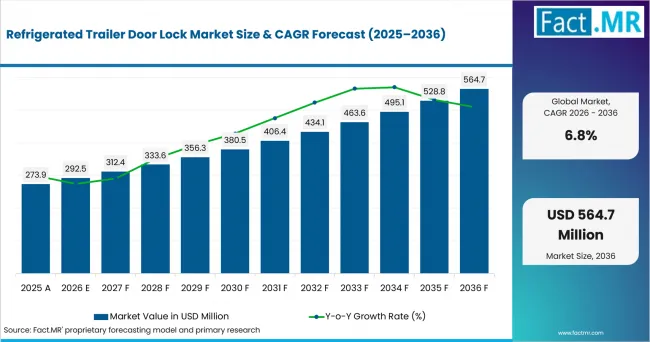
Refrigerated Trailer Door Lock Market Value Analysis | Source: Fact.MR
What are the defining numbers behind Refrigerated Trailer Door Lock Market growth?
USD 272.2 million absolute opportunity by 2036, led by Refrigerated Trailer Door Locks and Single Compartment trailers.
- Demand Drivers in the Market
- Cold-chain carriers need locks that remain usable on frequent fresh-produce lanes. USDA AMS reported that U.S. truck shipments of fresh produce were 7.71 million tons in the fourth quarter of 2025.
- Food distributors require simple custody routines because dock teams often handle temperature-sensitive goods under short loading windows.
- Trailer rental companies benefit from locks that fit varied door-bar distances without changing the refrigerated trailer body.
- Key Segments Analyzed
- By Product: Refrigerated Trailer Door Locks are expected to hold 56.9% share in 2026 owing to direct use on rear trailer doors.
- By Compartments: Single Compartment is projected to account for 66.8% share in 2026 due to its wider use in standard reefer routes.
- Analyst Opinion at Fact.MR
- Shambhu Nath Jha, Principal Consultant at Fact.MR, “Reefer-door locking is a small hardware decision with direct bearing on cargo custody. Fleet operators are expected to ask for lock strength, access control and driver usability before price is discussed. Suppliers that combine corrosion resistance with route-level security proof are positioned to earn repeat orders.”
- Strategic Implications
- Fleet operators should standardize lock types across reefer assets so drivers follow the same loading and delivery routine.
- Trailer OEMs should align lock mounting points with door seals so extra security hardware does not damage insulation performance.
- Hardware suppliers should show mechanical and power-locking options together. As adjacent commercial-vehicle evidence, Eberhard described service-truck-body locking systems in June 2025 that cover the handle, linkage, latch and locking mechanism, with mechanical and power-locking options.
- Investors should separate direct door-lock hardware exposure from broader fleet telematics unless the system controls the cargo door.
The USA is expected to post 6.3% CAGR through 2036 supported by refrigerated truckload activity and cargo-theft controls. Germany is projected to record 6.0% CAGR owing to EU road freight scale and food movements. South Korea is anticipated to advance at 5.4% CAGR as online grocery and parcel routes raise access-control discipline. France is estimated to reach 4.7% CAGR because road freight remains central to inland logistics. Italy is forecast to register 4.0% CAGR due to road-heavy food distribution and regional freight concentration.
How does the Refrigerated Trailer Door Lock Market break down by segment?
Refrigerated Trailer Door Locks lead Product at 56.9%; Single Compartment leads Compartments at 66.8%.
Which product dominates?
Refrigerated Trailer Door Locks are projected to account for 56.9% share in 2026.
Refrigerated trailer door locks are projected to account for 56.9% share in 2026 as rear-door control remains the direct purchase case. Key locks retain demand where fleets want simple driver accountability. Keyless and keypad-based locks are used where route managers need code changes without rekeying. Biometric locks remain selective because the operating environment is harsher than indoor access control. Buyers usually start with fit and durability before they consider connected features. A lock that blocks the door seal or slows dock work is unlikely to pass a fleet trial.
What leads the Compartments segment?
Single Compartment is expected to hold 66.8% share in 2026.
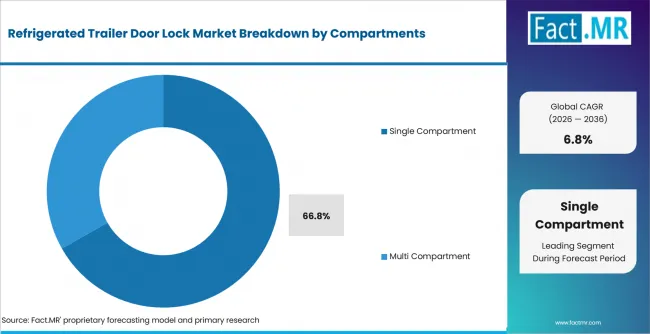
Refrigerated Trailer Door Lock Market Analysis By Compartments | Source: Fact.MR
Single compartment trailers are expected to hold 66.8% share in 2026 because standard refrigerated trailers use simpler route planning and fewer interior access decisions. Dedicated-load trailers support customers that want one cargo owner and one temperature range. Eurostat reported 312.2 billion tonne-kilometres of EU road freight for food products, beverages and tobacco in 2024, equal to 16.7% of EU road-freight performance. That freight base supports practical rear-door locking where delivery proof remains part of cold-chain discipline.
What is accelerating Refrigerated Trailer Door Lock Market adoption, and what is holding it back?
Cargo-security pressure drives it; hardware fit and operating discipline restrain it.
Drivers Impact Analysis
| DRIVER | (~) % IMPACT ON CAGR | GEOGRAPHIC RELEVANCE | IMPACT TIMELINE |
|---|---|---|---|
| Cargo theft exposure | +2.0% | USA and cross-border routes | Short term (<= 2 years) |
| Cold-chain freight volume | +1.6% | USA, Germany, France, Italy | Short term (<= 2 years) |
| Food and beverage road freight | +1.2% | Europe and South Korea | Medium term (2-4 years) |
| Single-compartment reefer use | +0.9% | Global fleet operators | Medium term (2-4 years) |
| Credential-control procedures | +0.6% | Large carriers and distributors | Long term (>= 4 years) |
Source: Fact.MR analysis. Updated Aug 17, 2026
- Cargo theft exposure: Strategic cargo theft has become a larger security issue for refrigerated and high-value freight. Door locks gain budget support when they are tied to seal control and driver verification. Fleet managers are expected to test hardware against theft exposure and claims handling.
- Cold-chain freight volume: Refrigerated truckload movements keep rear-door hardware in daily use. Locks that jam at the dock can delay delivery and weaken route discipline. Suppliers are expected to focus on hardware that remains reliable across frequent stops.
- Food and beverage road freight: Food cargo creates steady demand for cold-chain control points. Door locks are estimated to benefit where carriers treat proof of closure as part of shipment quality. Replacement purchases are expected to follow routes with repeated handovers.
- Single-compartment reefer use: Single compartment trailers keep lock selection simple because one rear-door control serves most shipments. Standard reefer fleets are expected to prefer keyed or keyless locks that drivers can use without special training. Multi-zone units are likely to create selective demand.
- Credential-control procedures: Carriers need a clear answer to who held the credential or code before delivery. Credential-control routines are expected to support replacement cycles even when trailers stay in service. Suppliers gain when lock systems fit existing logs, seals and dock routines.
Opportunity Impact Analysis
| OPPORTUNITY | (~) % IMPACT ON CAGR | GEOGRAPHIC RELEVANCE | IMPACT TIMELINE |
|---|---|---|---|
| Keyless retrofit programs | +1.1% | USA and South Korea | Medium term (2-4 years) |
| High-security cargo-door locks | +0.8% | Cross-border and urban routes | Short term (<= 2 years) |
| Reefer rental fleet standardization | +0.6% | Europe and North America | Medium term (2-4 years) |
| Tamper-evidence integration | +0.5% | Food and pharma logistics | Long term (>= 4 years) |
Source: Fact.MR analysis. Updated Aug 17, 2026
- Keyless retrofit programs: Keyless locks create opportunity where carriers need code rotation after driver changes. Managers can reset access without replacing hardware after route changes. Adoption is expected to remain most active in fleets with dense delivery schedules.
- Reefer rental fleet standardization: Rental fleets need lock systems that survive several customer cycles. Standardized hardware reduces training needs and simplifies spare-credential control. Demand is anticipated to rise where operators measure lock replacement against lost cargo and downtime.
- Tamper-evidence integration: Door locks are expected to connect more often with seals, driver logs and telematics alerts. Integration does not replace mechanical strength at the rear door. It helps carriers prove custody when receivers question temperature records or door events.
Restraints Impact Analysis
| RESTRAINT | (~) % IMPACT ON CAGR | GEOGRAPHIC RELEVANCE | IMPACT TIMELINE |
|---|---|---|---|
| Door-bar compatibility | -1.0% | Mixed trailer fleets | Short term (<= 2 years) |
| Driver compliance gaps | -0.8% | Multi-stop distribution | Short term (<= 2 years) |
| Corrosion and washdown wear | -0.6% | Cold-chain routes | Medium term (2-4 years) |
| Price sensitivity in replacement buying | -0.5% | Small carriers | Medium term (2-4 years) |
Source: Fact.MR analysis. Updated Aug 17, 2026
- Door-bar compatibility: Trailer doors vary by bar spacing, handle design and body age. A lock that fits one reefer fleet is not guaranteed to fit another.
- Corrosion and washdown wear: Refrigerated trailers face moisture, salt, cleaning chemicals and temperature changes. Hardware that corrodes or jams creates delay at the dock. Buyers therefore favor weather resistance over cosmetic design.
- Price sensitivity in replacement buying: Smaller carriers often replace only after a loss, audit finding or failed lock. Premium electronic options face more scrutiny when routes use simple single-compartment trailers.
Which countries are scaling Refrigerated Trailer Door Lock Market fastest?
- The country comparison spans 2.3 percentage points and forms three practical growth bands across the forecast period.
- The USA remains 0.3 percentage point above Germany as cargo-theft exposure and refrigerated freight checks support the upper band.
- Germany remains 0.6 percentage point above South Korea owing to EU road-freight scale and food logistics depth.
- South Korea remains 0.7 percentage point above France as mobile commerce raises delivery reliability requirements.
- France remains 0.7 percentage point above Italy because inland freight relies heavily on road transport.
- Italy closes the displayed range as food and beverage road freight remains material while regional route concentration shapes replacement timing.
Comparable CAGRs create different entry conditions due to fleet size, route density, lock compatibility and cargo-security procedures. Full report coverage includes North America, Latin America, Europe, East Asia, South Asia and Pacific, Middle East and Africa.
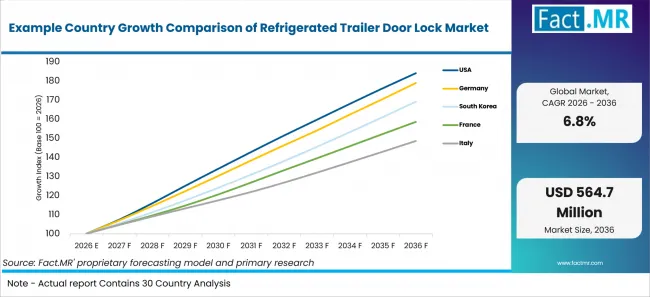
Example Country Growth Comparison Of Refrigerated Trailer Door Lock Market | Source: Fact.MR
| Country | CAGR (2026-2036) |
|---|---|
| USA | 6.3% |
| Germany | 6.0% |
| South Korea | 5.4% |
| France | 4.7% |
| Italy | 4.0% |
Source: Fact.MR analysis. Updated Aug 17, 2026
What supports USA adoption?
6.3% CAGR, supported by refrigerated truckload visibility and cargo-theft controls.
The USA’s growth reflects a cold-chain market where carriers treat rear-door control as part of cargo proof. USDA AMS uses AgRTQ to track refrigerated truckload movements by volume and rates for fresh fruit and vegetable markets. Fleets are expected to favor locks that drivers can apply quickly during dock turns. The buying case is strongest where route audits and theft checks meet at delivery. Fit across older reefers remains the main screening point before standardization.
What supports Germany adoption?
6.0% CAGR, led by road-freight scale and food logistics depth.
Germany’s growth is tied to large road-freight flows and frequent food distribution activity. Reefer fleets are expected to value lock durability because route density puts more cycles on handles and door bars. Local procurement is expected to favor systems that installers can document before they enter multi-depot use.
How is South Korea developing demand?
5.4% CAGR, driven by mobile commerce and controlled food delivery.
South Korea’s demand is shaped by fast delivery expectations and dense urban routes. The Ministry of Data and Statistics reported online shopping transaction value of KRW 24.1613 trillion in November 2025, up 6.8% from November 2024. Cold-chain operators are expected to favor keyless access where route managers need code changes without replacing lock hardware. Humid operating conditions keep corrosion resistance and simple driver training central to adoption.
How does France perform?
4.7% CAGR, shaped by road-dominant inland freight and compliance pressure.
France performs steadily because inland freight remains heavily road-based. SDES reported 344 billion tonne-kilometres of domestic terrestrial freight transport, excluding oil pipelines, in 2024; road accounted for 89% of terrestrial freight on the same basis. Trailer-security demand is expected to follow multi-stop food and retail replenishment routes where door seals and lock routines support handover proof. Carriers are expected to balance extra hardware with maintenance time, so simple mechanical reliability remains commercially valuable.
What supports Italy adoption?
4.0% CAGR, supported by road-heavy food freight and regional logistics concentration.
Italy’s adoption is concentrated in road-heavy food movement and northern distribution corridors. Istat reported 156.9 million tonnes of food products, beverages and tobacco moved by road in 2024. Replacement demand is expected to follow operator trials because fit, corrosion resistance and lock access remain visible checks before fleet-wide purchasing. Regional concentration also makes service access relevant, since repair support must be close to freight lanes and refrigerated depots.
Who leads the Refrigerated Trailer Door Lock Market?
Direct hardware relevance is clearest among trailer security specialists, access-hardware manufacturers and cargo-door assurance providers.
The competitive field spans direct trailer-lock specialists, adjacent vehicle-access hardware, connected cargo-door solutions and distribution. Fleet buyers are expected to compare physical fit, outdoor durability and driver usability before they discuss connected features. Eberhard Manufacturing brings adjacent vehicle-access hardware experience across latches, handles and locking systems. Wabash provides a connected cargo-door route when cargo custody moves toward software-backed proof. Destata Transport UAB / Cargo Locking Systems, REAL Locks & Security Co., Ltd. and PACLOCK complete the profiled ecosystem. Their roles are not equivalent, so the company set should be read as an ecosystem profile rather than a peer group of dedicated refrigerated-trailer lock manufacturers.
Which companies are profiled in the refrigerated trailer door-lock market?
Key companies include Destata Transport UAB / Cargo Locking Systems, Eberhard Manufacturing Company, REAL Locks & Security Co., Ltd., Wabash, and PACLOCK; their roles range from direct trailer-lock manufacturing to connected cargo-door solutions, adjacent vehicle-access hardware, and distribution.
- Destata Transport UAB / Cargo Locking Systems
- Eberhard Manufacturing Company
- REAL Locks & Security Co., Ltd.
- Wabash
- PACLOCK
Bibliography
- U.S. Department of Agriculture, Agricultural Marketing Service. (2026, March). Agricultural Refrigerated Truck Quarterly: Quarter 4, 2025.
- Eberhard Product Team. (2025, June 3). Integrated locking systems for service truck bodies. Eberhard.
- Eurostat. (2025, July 9). EU road freight transport sees 0.6% increase in 2024.
- Federal Bureau of Investigation. (2026, June 8). FBI Philadelphia warns transportation and logistics industry of rising cargo theft threats.
- Istat. (2026, February 20). Il trasporto di merci su strada e su ferrovia – Anno 2024 [Road and rail freight transport – Year 2024].
- Ministry of Data and Statistics. (2026, January 2). Online shopping in November 2025.
- Service des données et études statistiques. (2026, April 20). Chiffres clés des transports – Édition 2026 [Key figures for transport – 2026 edition].
- Wabash. (2026, February 9). Wabash unveils next-generation cargo assurance solution at Manifest 2026.
This Report Answers
- The report provides strategic intelligence on refrigerated trailer door locks across Product and Compartments choices that shape refrigerated trailer systems and cold-chain security programs.
- Segment analysis covers Refrigerated Trailer Door Locks and Single Compartment trailers as the share leaders within the 2026 market, alongside adjacent trailer refrigeration units.
- Country outlook evaluates the USA and Germany alongside South Korea, France and Italy. The analysis links cargo-theft exposure with food cold chain logistics where door control affects handover proof.
- Competitive analysis profiles lock hardware providers, access-system suppliers and connected cargo-door platforms. Related demand connects with cargo security seals where tamper evidence is part of access control.
- Scope assessment covers keyed locks, keyless locks and keypad-based locks. It also considers how commercial refrigeration equipment buyers view door security near trailer and storage interfaces.
What does the Refrigerated Trailer Door Lock Market cover?
Refrigerated trailer door locks cover hardware and access systems used to secure rear doors and cargo-door control points on temperature-controlled trailers.
The Refrigerated Trailer Door Lock Market covers keyed locks, keyless locks, keypad-based locks and biometric lock options used on refrigerated trailer doors. Coverage includes standard and dedicated-load trailers where rear-door access is the main custody point. It also includes multi compartment, dual temperature and multi zone use cases where door access affects cargo separation. The scope treats a lock as in-market only when it secures the refrigerated trailer door or a directly related cargo-door access point. Related cold-chain demand is linked to food cold chain systems and truck refrigeration unit systems.
What is included in the scope?
The scope includes door-locking hardware and access-control products used directly on refrigerated trailers. It includes locks that fit rear door bars, roll-up handles and trailer-door control points.
Product coverage includes key locks, keyless locks, keypad-based locks, biometric locks and other door-lock products. Compartment coverage includes single compartment trailers and multi compartment units. The scope also covers routes tied to food distribution, with links to food logistics networks and agricultural food loss reduction when trailer security supports product protection.
What is excluded from the scope?
General vehicle alarms, warehouse door locks and unrelated access-control systems remain outside the scope of this market.
The scope excludes locks that do not secure refrigerated trailer doors or cargo-door access points. It excludes trailer couplers, king pin locks and tow hitch lock accessories unless the product is sold as part of a refrigerated trailer door-security package. General fleet telematics revenue is excluded unless the feature directly supports door access control or cargo custody.
How Was the Analysis Built?
The analysis draws on 120+ sources, 35+ company portfolios, 25+ countries, and more than 20 industry interviews.
- Primary Research: Primary research includes discussions with manufacturers, service providers, technology developers, distributors, end users, procurement teams, and subject-matter experts. These conversations examine purchasing priorities, product adoption, operational challenges, approval requirements, competitive positioning, and the factors that influence wider market acceptance.
- Desk Research: Desk research covers government statistics, regulatory publications, company filings, trade data, technical studies, industry associations, standards, public policy, and other authoritative sources. Every source used in the analysis is documented in the bibliography.
- Market Sizing and Forecasting: Market estimates combine historical performance, demand indicators, pricing and volume trends, segment shares, company participation, country-level growth, adoption patterns, investment activity, and barriers to market expansion.
- Data Validation and Update Cycle: Findings are validated by comparing primary interviews with public data, company activity, regulatory changes, trade patterns, and industry developments. Regular updates review new product launches, capacity changes, partnerships, approvals, procurement trends, and shifts in commercial adoption.
Segmentation
What is the report’s scope and coverage?
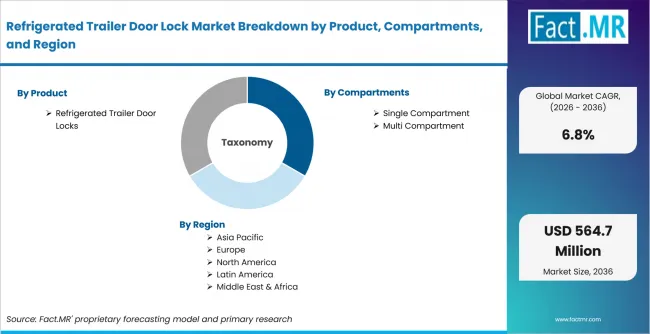
Refrigerated Trailer Door Lock Market Breakdown By Product, Compartments, And Region | Source: Fact.MR
| Attribute | Details |
|---|---|
| Quantitative Units | USD million |
| Market Definition | Mechanical and electronic locking hardware used on refrigerated trailer doors where cargo security, driver access control and door-seal integrity shape purchase decisions |
| Product | Refrigerated Trailer Door Locks; Key Locks; Keyless Locks; Keypad Based Locks; Biometric Locks; Other Locks |
| Compartments | Single Compartment; Standard Refrigerated Trailers; Dedicated Load Trailers; Multi Compartment; Dual Temperature Trailers; Multi Zone Trailers |
| Regions Covered | North America; Latin America; Europe; East Asia; South Asia and Pacific; Middle East and Africa |
| Countries Covered | USA; Germany; South Korea; France; Italy |
| Key Companies Profiled | Destata Transport UAB / Cargo Locking Systems; Eberhard Manufacturing Company; REAL Locks & Security Co., Ltd.; Wabash; PACLOCK |
| Forecast Period | 2026 to 2036 |
| Approach | Hybrid top-down and bottom-up approach using refrigerated trailer fleet activity; road freight movement; food and beverage logistics; cargo-theft exposure; lock compatibility; credential-control requirements; country adoption patterns and company portfolio review |
Source: Fact.MR analysis. Updated Aug 17, 2026
How is the market segmented?
-
By Product:
- Refrigerated Trailer Door Locks
- Key Locks
- Keyless Locks
- Keypad Based Locks
- Biometric Locks
- Other Locks
- Refrigerated Trailer Door Locks
-
By Compartments:
- Single Compartment
- Standard Refrigerated Trailers
- Dedicated Load Trailers
- Multi Compartment
- Dual Temperature Trailers
- Multi Zone Trailers
- Single Compartment
-
By Region:
- North America
- Latin America
- Europe
- East Asia
- South Asia and Oceania
- Middle East and Africa
Frequently Asked Questions
How big is the refrigerated trailer door lock market in 2026?
What is the CAGR of the refrigerated trailer door lock market from 2026 to 2036?
Which product leads the refrigerated trailer door lock market?
Which compartment type leads the refrigerated trailer door lock market?
Who are the leading companies in the refrigerated trailer door lock market?
Who worked on this report


Preview the report firsthand - request a free sample
Free SampleGet the brochure for pricing and purchase details
Download PDF