- Market Value (2025): USD 560.0 Mn
- Estimated Value (2026): USD 606.0 Mn
- Forecast Value (2036): USD 1,240.0 Mn
- CAGR (2026-2036): 7.4%
What is the Two-Part Dispensers Market forecast to be worth by 2036?
USD 1,240.0 million by 2036 at 7.4% CAGR.
- The Two-Part Dispensers Market reached USD 560.0 million in 2025.
- Demand is projected to increase from USD 606.0 million in 2026 to USD 1,240.0 million by 2036.
- The market is forecast to record a 7.4% CAGR from 2026 to 2036.
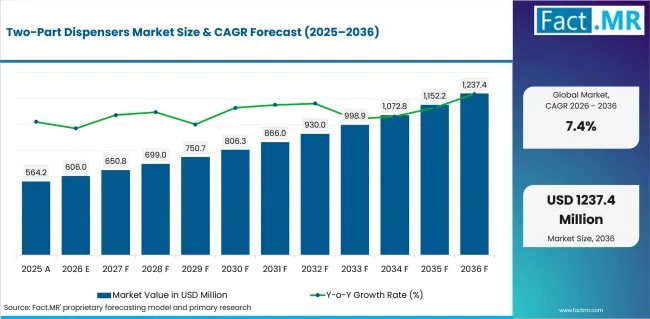
Two Part Dispensers Market Value Analysis | Source: Fact.MR
What are the defining numbers behind Two-Part Dispensers Market growth?
An absolute opportunity of USD 634.0 million is expected between 2026 and 2036.
- Demand Drivers in the Market
- Cartridge dispensers provide a lower-capital way to apply two-component adhesives while preserving the intended ratio through prepacked dual cartridges.
- Pneumatic actuation applies consistent force to both cartridge chambers, reducing operator fatigue and improving shot repeatability compared with manual hand pressure.
- Electronics assembly uses two-part materials for potting, sealing and structural bonding at workstations that do not always justify bulk meter-mix equipment.
- Prepacked material kits shorten setup and reduce contamination because operators replace the cartridge and mixer instead of cleaning bulk pumps and hoses.
- Digital shot control and battery-powered dispensers extend two-part processing into high-mix, repair and field applications where portability and repeatability matter.
- Key Segments Analyzed
- Cartridge dispensers account for 36.0% of Dispenser Format in 2026 because prepacked components preserve the intended ratio while reducing setup and cleaning requirements.
- Pneumatic holds 36.0% of Actuation in 2026 because regulated air provides consistent force across dual cartridges with less operator effort.
- Electronics represents 38.0% of End User in 2026 because cartridge systems provide controlled application of potting, sealing and bonding materials around high-value assemblies.
- Analyst Opinion at Fact.MR
- Shambhu Nath Jha, Principal Consultant at Fact.MR, states, "Buyer decisions in the Two-Part Dispensers Market will centre on a controlled entry point into two-component bonding without a full bulk meter-mix installation. Buyers will compare the 2026 segment leaders with qualification evidence and the operating cost of the full process. Suppliers that support application trials and preserve formulation or equipment consistency can move more quickly into repeat production."
- Strategic Implications
- Suppliers should document the process conditions that allow Cartridge dispensers to deliver repeatable performance.
- Customer trials should use the intended substrate, fluid path or process stream before commercial qualification.
- Regional technical support is important in China and Germany because adoption depends on local production or infrastructure conditions.
- Commercial positioning should distinguish qualified application performance from general material or equipment capability.
How does the Two-Part Dispensers Market break down by segment?
The market is segmented by Dispenser Format, Actuation and End User.
Why do Cartridge dispensers lead Dispenser Format?
Cartridge dispensers are projected to account for a 36.9% share in 2026.
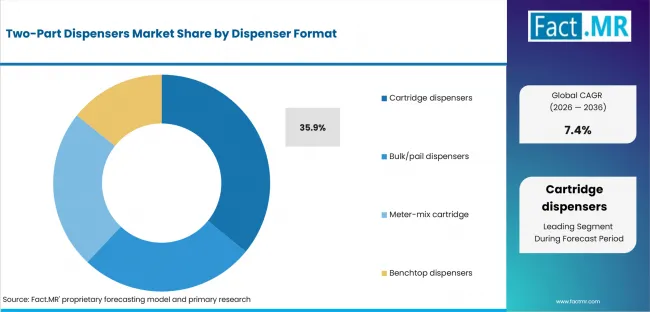
Two Part Dispensers Market Analysis By Dispenser Format | Source: Fact.MR
cartridges keep the two components separated until use while preserving the supplier-defined ratio, reducing weighing and setup work at the workstation.
The format suits lower-volume and high-mix production because users can change materials by replacing the cartridge and static mixer instead of cleaning a bulk system.
Why does Pneumatic lead Actuation?
Pneumatic is projected to account for a 35.6% share in 2026.
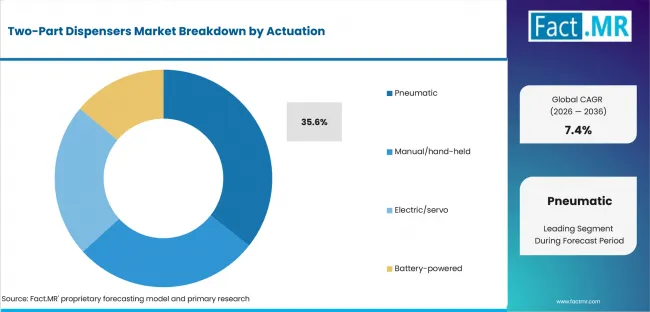
Two Part Dispensers Market Analysis By Actuation | Source: Fact.MR
Pneumatic dispensers use regulated air to apply repeatable force to both cartridge chambers, improving consistency compared with manual trigger pressure.
They avoid the cost and programming burden of servo systems, making pneumatic actuation practical across production and repair workstations.
Why do Electronics lead End User?
Electronics are projected to account for a 38.0% share in 2026.
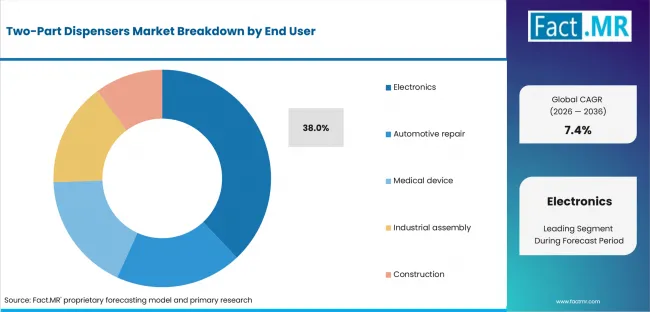
Two Part Dispensers Market Analysis By End User | Source: Fact.MR
Electronics manufacturers use two-part epoxies, urethanes and silicones for potting, sealing and structural bonding around boards and components.
Cartridge dispensing reduces hand-mixing errors while keeping capital and setup requirements below those of bulk meter-mix systems.
What is accelerating Two-Part Dispensers Market adoption, and what is holding it back?
Drivers Impact Analysis
| Factor | (~) % Impact on CAGR | Geographic Relevance | Impact Timeline |
|---|---|---|---|
| Lower-capital use of Cartridge dispensers | +2.0% | China | Short term (<= 2 years) |
| Repeatable force through Pneumatic | +1.6% | Germany | Medium term (2-4 years) |
| Use across Electronics | +1.2% | USA | Long term (>= 4 years) |
Opportunity Impact Analysis
| Factor | (~) % Impact on CAGR | Geographic Relevance | Impact Timeline |
|---|---|---|---|
| Digital shot control | +1.0% | China | Short term (<= 2 years) |
| Battery-powered field dispensing | +0.8% | Germany | Medium term (2-4 years) |
| Prepacked material kits | +0.6% | USA | Long term (>= 4 years) |
Restraints Impact Analysis
| Factor | (~) % Impact on CAGR | Geographic Relevance | Impact Timeline |
|---|---|---|---|
| Uneven component flow | -1.0% | China | Short term (<= 2 years) |
| Mixer pressure | -0.7% | Germany | Medium term (2-4 years) |
| Disposable cost | -0.5% | USA | Long term (>= 4 years) |
Which countries are scaling the Two-Part Dispensers Market through 2036?
- China: China has broad electrical-equipment, automotive and general manufacturing capacity.
- Germany: Germany combines automotive production with electrical equipment and industrial automation.
- USA: The USA has diverse electrical-equipment, power-electronics and industrial applications.
- Japan: Japan has precision electrical and automotive manufacturing with established supplier qualification.
- India: India is expanding automotive, electrical-equipment and industrial assembly.
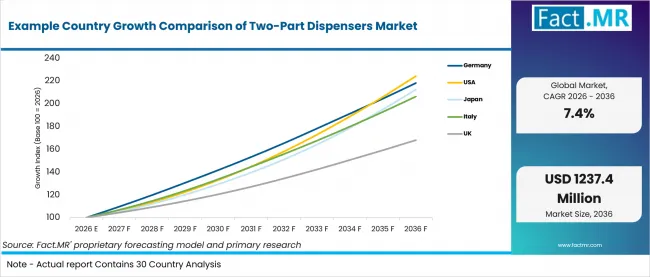
Example Country Growth Comparison Of Two Part Dispensers Market | Source: Fact.MR
Country CAGR (2026-2036)
| Country | CAGR (2026-2036) |
|---|---|
| Germany | 7.9% |
| USA | 8.5% |
| Japan | 7.9% |
| India | 9.5% |
What is driving Germany's growth through 2036?
Germany is forecast to expand at a 7.9% CAGR from 2026 to 2036.
Germany's automotive, machinery and electrical-equipment sectors maintain a strong base for qualified materials and automated assembly; recent orders also showed growth in electrical equipment.
Pneumatic cartridge systems fit distributed assembly and repair stations where bulk metering is not economical.
What is driving the USA's growth through 2036?
The USA is forecast to expand at an 8.5% CAGR from 2026 to 2036.
U.S. manufacturing includes electronics, aerospace and industrial equipment, while current semiconductor and advanced-packaging investment is adding new pilot and production capacity.
Battery-powered and digitally controlled dispensers broaden use where portable equipment must still provide repeatable shots.
What is driving Japan's growth through 2036?
Japan is forecast to expand at a 7.9% CAGR from 2026 to 2036.
Japan combines automotive and precision-electronics manufacturing with new semiconductor investment, creating production environments where repeatability and supplier qualification are central.
Cartridge systems suit high-mix production by simplifying material changes and reducing cleaning while preserving the supplier-defined ratio.
What is driving India's growth through 2036?
India is forecast to expand at a 9.5% CAGR from 2026 to 2036.
India is expanding electronics-component and automotive manufacturing, supported by the Electronics Component Manufacturing Scheme and other localization programmes.
Cartridge dispensers provide a practical entry point for manufacturers that need better ratio control before volumes justify bulk automated systems.
Who leads the Two-Part Dispensers Market?
Nordson (EFD) is positioned through dispensing equipment and application support. Sulzer (Mixpac) and Graco compete through metering accuracy, compatible consumables or automation integration.
Competition is shaped by deposit repeatability and maintenance. Buyers also assess whether controllers, valves, mixers or tips can be sourced as one validated process chain.
Local service matters because setup and preventive maintenance affect production yield.
Which companies are the key providers?
Key companies profiled include Nordson (EFD); Sulzer (Mixpac); Graco; ViscoTec; Dopag (Hilger u. Kern); and Adhesive Dispensing Ltd.
- Nordson (EFD)
- Sulzer (Mixpac)
- Graco
- ViscoTec
- Dopag (Hilger u. Kern)
- Adhesive Dispensing Ltd
Bibliography
- International Federation of Robotics. (2025). World Robotics 2025: Industrial Robots. IFR.
- National Institute of Standards and Technology. (2025). Smart Manufacturing Systems and Process Control. U.S. Department of Commerce.
- IPC. (2024). Electronics Assembly Process Control and Materials Standards. IPC.
- U.S. Department of Commerce. (2025). CHIPS for America Advanced Packaging Manufacturing Program. U.S. Government.
- U.S. Department of Energy. (2025). Advanced Manufacturing and Automation Programmes. U.S. Government.
- Ministry of Industry and Information Technology, China. (2026). Development of the Electronic Information Manufacturing Industry in 2025. Government of China.
- Federal Ministry for Economic Affairs and Climate Action, Germany. (2025). Industrial and Automotive Transformation Programmes. Government of Germany.
- Ministry of Economy, Trade and Industry, Japan. (2025). Strategy for Semiconductor and Digital Industry Revitalization. Government of Japan.
- Ministry of Electronics and Information Technology, India. (2025). Electronics Manufacturing and Components Programme. Government of India.
- Sulzer Mixpac. (2026). Two-Component Cartridge Systems and Static Mixers. Sulzer.
- Nordson EFD. (2026). Two-Component Cartridge Dispensing Systems. Nordson.
This Report Answers
- The report examines demand across Dispenser Format, Actuation, End User.
- Segment analysis explains the operating reason behind each leading category.
- Country analysis evaluates the listed markets and adoption conditions through 2036.
- Competitive analysis reviews the listed companies and clarifies ownership or research roles where relevant.
- The analysis considers qualification, process control and application fit that influence purchasing decisions.
What does the Two-Part Dispensers Market cover?
Two-part cartridge and bulk dispensers for controlled application of epoxies, urethanes and silicones in manual, semi-automated and benchtop assembly settings.
The assessment follows the stated segmentation by Dispenser Format, Actuation, End User. Revenue is counted only where the stated product or equipment is sold for the listed applications.
What is included in the scope?
The scope includes Cartridge dispensers, Bulk/pail dispensers, Meter-mix cartridge, Benchtop dispensers.
It also covers Manual/hand-held, Pneumatic, Electric/servo, Battery-powered.
Demand is assessed across End User: Electronics, Automotive repair, Medical device, Industrial assembly, Construction.
What is excluded from the scope?
Adhesives, sealants and other fluids are excluded; revenue is limited to the stated dispensing equipment or consumable.
General pumps and automation hardware are excluded when not configured for precision dispensing.
Contract manufacturing services are outside the market.
How Was the Analysis Built?
The analysis combines product scope, segment demand, country outlook and supplier coverage.
- Primary Research: Interviews focus on dispensing-equipment manufacturers, distributors, production engineers and end users.
- Desk Research: The review covers robotics data, smart-manufacturing evidence, assembly standards and supplier technical documents.
- Market Sizing and Forecasting: Estimates combine installed equipment, replacement cycles, consumable use, automation level and realized pricing.
- Data Validation and Update Cycle: Findings are checked against public evidence and supplier portfolios. Updates review product launches, ownership changes and automation investment.
What is the report's scope and coverage?
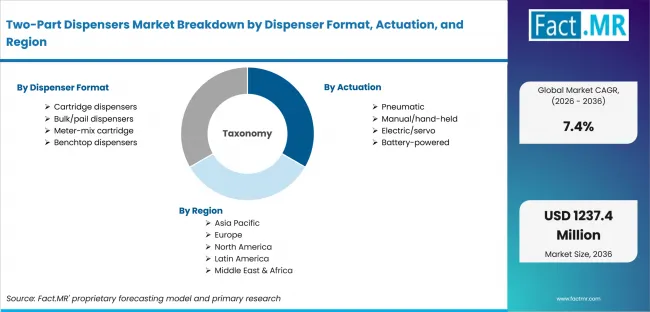
Two Part Dispensers Market Breakdown By Dispenser Format, Actuation, And Region | Source: Fact.MR
| Attribute | Details |
|---|---|
| Quantitative Units | USD million |
| Market Definition | Two-part cartridge and bulk dispensers for controlled application of epoxies, urethanes and silicones in manual, semi-automated and benchtop assembly settings. |
| Segments Covered | Dispenser Format; Actuation; End User |
| Regions Covered | North America; Latin America; Europe; East Asia; South Asia and Oceania; Middle East and Africa |
| Countries Covered | China; Germany; USA; Japan; India |
| Key Companies Profiled | Nordson (EFD); Sulzer (Mixpac); Graco; ViscoTec; Dopag (Hilger u. Kern); Adhesive Dispensing Ltd |
| Forecast Period | 2026 to 2036 |
| Base Year | 2025 |
| Market Value, 2026 | USD 606.0 million |
| Market Value, 2036 | USD 1,240.0 million |
| CAGR, 2026-2036 | 7.4% |
| Absolute Opportunity | USD 634.0 million |
| Approach | Combines installed equipment, replacement cycles, consumable use, automation level and realized pricing. |
How is the market segmented?
-
By Dispenser Format
- Cartridge dispensers
- Bulk/pail dispensers
- Meter-mix cartridge
- Benchtop dispensers
-
By Actuation
- Manual/hand-held
- Pneumatic
- Electric/servo
- Battery-powered
-
By End User
- Electronics
- Automotive repair
- Medical device
- Industrial assembly
- Construction
-
By Region
- North America
- Latin America
- Western Europe
- Eastern Europe
- East Asia
- South Asia and Pacific
- Middle East & Africa