- Base Value(2026): 1.3 Bn
- Estimated Value(2026): 1.3 Bn
- Forecast Value (2036): 3.4 Bn
- CAGR (2026 - 2036): 10.0%
Cancer Tumor Profiling Forecast in UK 2026 to 2036
Cancer tumor profiling’s scope in the UK is projected to rise from USD 1.32 billion in 2026 to nearly USD 3.43 billion in 2036. the market will rise at a CAGR of 10.00% which Growth stems from increasing clinical dependence on precision oncology frameworks and wider inclusion of genomic testing across national healthcare systems. England’s oncology networks continue to influence adoption patterns through established diagnostic ecosystems and strong molecular testing capacity.
Key Takeaways from the UK Cancer Tumor Profiling Industry
- UK Cancer Tumor Profiling Sales Value (2026): USD 1.32 billion
- UK Cancer Tumor Profiling Forecast Value (2036): USD 3.43 billion
- UK Cancer Tumor Profiling Forecast CAGR: 10.00%
- Leading Technique in UK Cancer Tumor Profiling Industry: Genomics (39.20%)
- Key Growth Regions in UK Cancer Tumor Profiling Industry: England, Scotland, Wales, and Northern Ireland
- Regional Leadership: England holds the leading position in demand
- Key Players in UK Cancer Tumor Profiling Industry: Illumina Incorporated, QIAGEN N.V., Exact Sciences Corporation, NeoGenomics Laboratories Incorporated, Guardant Health Incorporated, Foundation Medicine Incorporated, Oxford Gene Technology, Bruker Spatial Biology Incorporated, GenomeDX, Thermo Fisher Scientific Incorporated
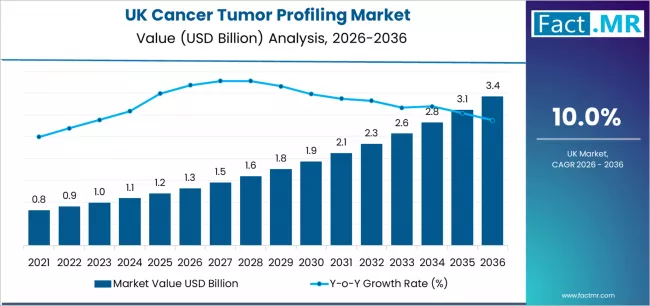
Uk Cancer Tumor Profiling Market Market Value Analysis | Source: Fact.MR
Investment momentum strengthens as clinicians seek real-time molecular insights that support therapy alignment. Next-generation sequencing platforms gain broader acceptance as mutation visibility and evidence strength become central to treatment planning. Liquid biopsy adoption advances as minimally invasive diagnostic options improve patient accessibility and reduce delays in clinical decision-making.
UK institutions expand their capabilities by integrating bioinformatics pipelines, improving data interpretation consistency, and supporting unified molecular reporting practices. These efforts reflect an ongoing shift toward coordinated diagnostic standards and measurable outcome improvements within oncology programs.
From 2030 to 2036, demand is projected to move from USD 2.16 billion to USD 3.43 billion, adding USD 1.27 billion of incremental activity. This period is expected to reflect deeper integration of genomic medicine, accelerated development of customizable profiling technologies, and broader deployment of quality-controlled molecular workflows across healthcare environments.
Cancer tumor profiling gains momentum as clinicians prioritize evidence-driven treatment selection, research groups intensify biomarker discovery activity, and healthcare providers pursue stronger diagnostic precision across UK cancer care pathways.
UK Cancer Tumor Profiling Industry
| Metric | Value |
|---|---|
| UK Cancer Tumor Profiling Sales Value (2026) | USD 1.32 billion |
| UK Cancer Tumor Profiling Forecast Value (2036) | USD 3.43 billion |
| UK Cancer Tumor Profiling Forecast CAGR (2026-2036) | 10.00% |
Source: Fact.MR analysis. Updated Dec 16, 2025
Category
| Category | Segments |
|---|---|
| Technique | Genomics, Proteomics, Metabolomics, Epigenetics |
| End User | Hospital Laboratories, Independent and Reference Laboratories, Research and Academic Institutes, Pharmaceutical and Biotechnology Companies |
| Technology | Sequencing Techniques, Immunohistochemistry, In Situ Hybridization, qPCR, Microarray |
| Application | Personalized Cancer Medicine, Oncological Diagnostics, Research |
| Region | England, Scotland, Wales, Northern Ireland |
Source: Fact.MR analysis. Updated Dec 16, 2025
Segmental Analysis
Which Technique Leads Cancer Tumor Profiling Adoption in the UK?
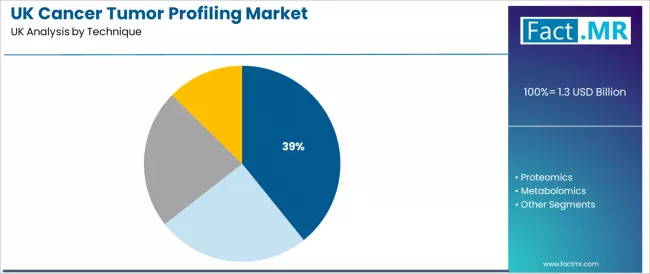
Uk Cancer Tumor Profiling Market Analysis By Technique | Source: Fact.MR
Genomics holds the largest share at 39.2% due to its established sequencing accuracy, strong clinical compatibility, and wide integration across existing diagnostic workflows. UK healthcare facilities rely on genomic platforms because they support mutation-level precision without requiring disruptive changes to current diagnostic pathways. Advances in sequencing performance and system reliability continue to strengthen clinician confidence, ensuring stable adoption across high-volume cancer care settings.
Prominent Takeaways
- Genomic platforms offer high mutation-detection accuracy and seamless workflow integration.
- Proven reliability and supplier maturity sustain widespread clinical acceptance.
Why are Hospital Laboratories the Primary End-User in the UK?
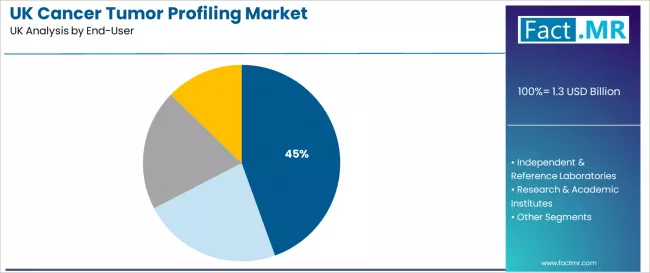
Uk Cancer Tumor Profiling Market Analysis By End User | Source: Fact.MR
Hospital laboratories represent 44.5% of total cancer tumor profiling procedures. This is due to their central role in diagnostic testing and multidisciplinary cancer care. These facilities manage the UK's most comprehensive testing workloads, making tumor profiling essential for treatment planning, pathology assessments, and molecular decision support. High patient throughput and extensive oncology infrastructure, especially across major networks in England, reinforce the need for integrated profiling systems aligned with clinical performance standards.
Major Trends
- Hospital laboratories require advanced profiling to support diagnostic accuracy and treatment decisions.
- Concentrated oncology infrastructure elevates demand for systems that enhance care consistency and clinical expertise.
What are the Drivers, Restraints, and Key Trends in the UK Cancer Tumor Profiling Industry?
UK cancer tumor profiling activity gains momentum as clinical teams pursue greater diagnostic depth and treatment accuracy. Demand rises as hospitals expand precision-focused pathways and adopt genomic insights to refine therapy decisions. England’s oncology networks shape much of this shift, guiding evaluation standards and influencing technology rollouts across neighbouring regions. The field still navigates slow validation cycles, legacy diagnostic preferences, and cost sensitivities that shape institutional decision-making. Regulatory expectations also steer investment choices, creating measured adoption patterns across public healthcare facilities.
AI-enabled interpretation tools elevate confidence in complex genomic data. Centralized quality systems stabilise testing performance and reduce variability between laboratories. Integrated diagnostic platforms strengthen coordination across clinical sites and support wider use of high-value genomic techniques. Collaborative research clusters emerging across the UK strengthen supplier credibility, accelerate validation work, and ease the burden of individual technical investments, allowing consistent deployment of advanced profiling capabilities.
Analysis of UK Cancer Tumor Profiling Industry by Key Countries
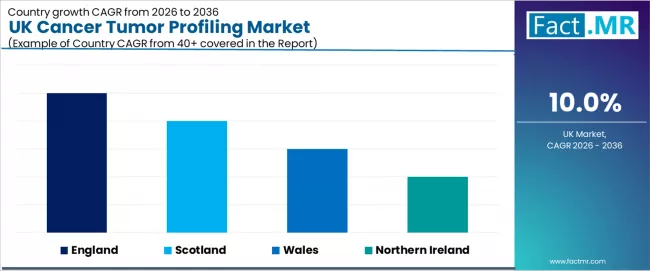
Uk Cancer Tumor Profiling Market Cagr Analysis By Country | Source: Fact.MR
| Region | CAGR (2026-2036) |
|---|---|
| England | 10.20% |
| Scotland | 10.00% |
| Wales | 9.80% |
| Northern Ireland | 9.60% |
Source: Fact.MR analysis. Updated Dec 16, 2025
Why does England Lead Cancer Tumor Profiling Demand?
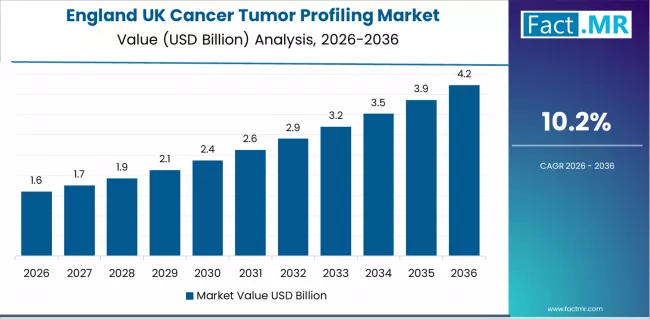
Uk Cancer Tumor Profiling Market Country Value Analysis | Source: Fact.MR
England’s cancer tumor profiling demand is set to rise at a CAGR of 10.20% through 2036. Clinical communities across London and surrounding regions continue to embrace precision-led diagnostic thinking, creating strong momentum for next-generation profiling systems. Hospitals leaning toward early detection strategies now view profiling tools as essential parts of patient management rather than optional upgrades.
Healthcare groups are shaping investment flows by prioritizing innovation pipelines that strengthen diagnostic accuracy and reduce procedural ambiguity. Suppliers are responding with broader development programs that match England’s appetite for clinically validated, scalable, and operationally stable profiling technologies.
- Hospitals are pursuing profiling systems that support consistent clinical decision-making and long-term treatment planning across varied therapeutic settings.
- Investment strength in medical innovation is encouraging trials, pilot deployments, and upgraded testing models that widen commercial and clinical feasibility.
Why does Scotland Show Strong Growth?
Scotland’s market is progressing at a CAGR of 10.00%, shaped by a robust clinical network and a culture of research-driven healthcare operations. Edinburgh and Glasgow anchor much of the region’s diagnostic innovation, creating an environment where profiling technologies gain traction with fewer adoption hurdles.
Regional health boards are refining oncology pathways and inviting suppliers to co-develop solutions that complement existing testing architectures. This collaboration is turning Scotland into an attractive landscape for high-value profiling deployments and specialized genomic workflows aligned with patient-centric care.
- Strong clinical clusters are enabling integration of genomic systems within established care models.
- Growing awareness among oncologists is supporting steady demand for profiling tools that enhance accuracy and strengthen Scotland’s clinical ecosystem.
Why does Wales Show Consistent Expansion?
Wales is expanding at a CAGR of 9.80%, supported by a healthcare system working toward modernization objectives and wider diagnostic reliability. Hospitals across the region are increasing their reliance on profiling tools as oncology programs refine early detection and patient monitoring standards.
Decision makers see profiling as a route to elevate care quality while managing rising treatment complexity. Suppliers are reinforcing this shift through targeted collaborations, training programs, and infrastructure support designed to fit the operational realities of Wales’ clinical environment.
- Regional healthcare priorities are accelerating the move toward profiling-enabled diagnostics that improve confidence in therapeutic planning.
- Broader optimization efforts across hospital networks are opening pathways for diversified profiling applications.
What Factors underpin Cancer Tumor Profiling Demand in Northern Ireland?
Northern Ireland continues to advance at a CAGR of 9.60%, shaped by expanding diagnostic capacity and growing interest in genomic-based decision pathways. Hospitals adopting newer oncology frameworks are evaluating profiling technologies as strategic upgrades that strengthen clinical precision.
Regional development plans are encouraging investment in shared genomic infrastructure, creating an ecosystem where multi-site diagnostic projects can operate with greater coordination. Supplier engagement is rising as healthcare groups seek scalable tools that enhance service consistency across varied facility sizes.
- Facility expansion and diagnostic diversification are strengthening the case for profiling adoption across key oncology units.
- Joint clinical initiatives are supporting shared genomic resources that elevate diagnostic capability across Northern Ireland.
Competitive Landscape of the UK Cancer Tumor Profiling Industry
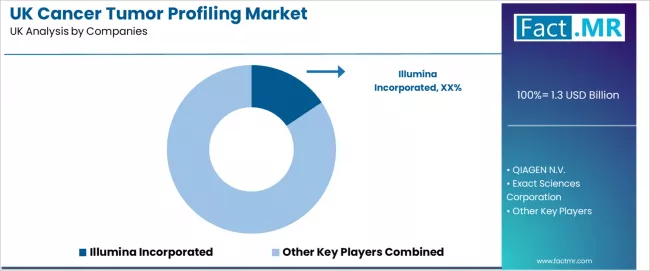
Uk Cancer Tumor Profiling Market Analysis By Company | Source: Fact.MR
Competition in the UK cancer tumor profiling landscape spans specialized diagnostic firms, genomic technology innovators, and integrated solution providers. Large healthcare corporations shape the field through research depth, validation capabilities, and continuous application development.
Companies are directing resources toward diagnostic refinement, infrastructure strengthening, distribution enhancements, and rigorous testing frameworks, creating stronger pathways for reliable and accessible profiling solutions across clinical and healthcare settings. Strategic partnerships and research-focused ecosystems continue to influence how players expand their reach and reinforce long-term relevance across UK medical environments.
Illumina Incorporated delivers a broad suite of tumor profiling offerings supported by clinical development expertise, quality-driven systems, and distribution networks tailored for national healthcare needs. QIAGEN N.V. provides genomic solutions designed for clinical deployment, custom integrations, and specialized technical support that align with UK and global healthcare projects.
Foundation Medicine Incorporated maintains focus on advanced profiling platforms that combine genomic interpretation with structured diagnostic workflows and strong quality stewardship. NeoGenomics Laboratories Incorporated supports UK healthcare organisations through profiling application development and diagnostic refinement programmes that strengthen precision-focused clinical decision pathways.
Key Players in UK Cancer Tumor Profiling Industry
- Illumina Incorporated
- QIAGEN N.V.
- Exact Sciences Corporation
- NeoGenomics Laboratories Incorporated
- Guardant Health Incorporated
- Foundation Medicine Incorporated
- Oxford Gene Technology
- Bruker Spatial Biology Incorporated
- GenomeDX
- Thermo Fisher Scientific Incorporated
Segmentation
Scope of the Report
| Item | Value |
|---|---|
| Quantitative Units | USD 3.43 billion |
| Technique | Genomics, Proteomics, Metabolomics, Epigenetics |
| Technology | Sequencing Techniques, Immunohistochemistry, In Situ Hybridization, qPCR, Microarray |
| Application | Personalized Cancer Medicine, Oncological Diagnostics, Research |
| Regions Covered | England, Scotland, Wales, Northern Ireland |
| Key Companies | Illumina Incorporated, QIAGEN N.V., Exact Sciences Corporation, NeoGenomics Laboratories Incorporated, Guardant Health Incorporated, Foundation Medicine Incorporated, Oxford Gene Technology, Bruker Spatial Biology Incorporated, GenomeDX, Thermo Fisher Scientific Incorporated, Regional tumor profiling specialists |
| Additional Attributes | Sales by technique and technology segment; regional demand trends across England, Scotland, Wales, and Northern Ireland; competitive landscape with established tumor profiling suppliers and specialized diagnostic developers; clinical preferences for genomics versus proteomics technologies; integration with healthcare programs and advanced diagnostic policies, particularly advanced in the England region |
Source: Fact.MR analysis. Updated Dec 16, 2025
UK Cancer Tumor Profiling Industry by Segments
-
Technique :
- Genomics
- Proteomics
- Metabolomics
- Epigenetics
-
End-User :
- Hospital Laboratories
- Independent & Reference Laboratories
- Research & Academic Institutes
- Pharmaceutical & Biotechnology Companies
-
Technology :
- Sequencing Techniques
- Immunohistochemistry
- In Situ Hybridization
- qPCR
- Microarray
-
Application :
- Personalized Cancer Medicine
- Oncological Diagnostics
- Research
-
Region :
- England
- Scotland
- Wales
- Northern Ireland
Frequently Asked Questions
How big is the demand for cancer tumor profiling in UK in 2026?
What will be the size of cancer tumor profiling in UK in 2036?
How much will be the demand for cancer tumor profiling in UK growth between 2026 and 2036?
What are the key product types in the cancer tumor profiling in UK?
Which end-user segment is expected to contribute significant share in the cancer tumor profiling in UK in 2026?
Who worked on this report


Preview the report firsthand - request a free sample
Free SampleGet the brochure for pricing and purchase details
Download PDF