- Base Value(2025): 75.60 Mn
- Estimated Value(2026): 78.32 Mn
- Forecast Value (2036): 111.55 Mn
- CAGR (2026 - 2036): 3.6%
Fluoroelastomers Industry Analysis in the United Kingdom Market Size, Market Forecast and Outlook By Fact.MR
The fluoroelastomers industry in the United Kingdom was valued at USD 75.60 million in 2025, projected to reach USD 78.32 million in 2026, and is forecast to expand to USD 111.55 million by 2036 at a 3.6% CAGR. Persistent demand from automotive powertrain sealing, chemical processing equipment gaskets, and aerospace fluid handling components sustains core fluoroelastomer consumption across UK manufacturing and maintenance operations. Original equipment manufacturers and aftermarket service providers that previously accepted standard nitrile or EPDM seals now face operating temperature and chemical exposure thresholds that only fluoroelastomer compounds can withstand.

Fluoroelastomers Industry Analysis In The United Kingdom Market Value Analysis | Source: Fact.MR
Summary of Fluoroelastomers Industry Analysis in the United Kingdom
- Market Overview
- The fluoroelastomers industry in the United Kingdom is valued at USD 75.60 million in 2025 and is projected to reach USD 111.55 million by 2036.
- The industry is expected to grow at a 3.6% CAGR from 2026 to 2036, creating an incremental opportunity of USD 33.23 million.
- The market is a specification-driven, temperature-critical elastomer category where chemical resistance, thermal stability, and sealing reliability define material selection across automotive, chemical, and aerospace applications.
- Demand and Growth Drivers
- Demand is sustained by automotive OEM requirements for high-temperature sealing compounds capable of withstanding increasingly compact and thermally stressed powertrain environments.
- Chemical processing facilities upgrading gasket and seal materials for aggressive solvent, acid, and high-temperature service conditions generate consistent fluoroelastomer replacement volumes.
- Aerospace fluid handling and fuel system sealing applications mandate fluoroelastomer materials that meet stringent aviation certification and chemical exposure specifications.
- England leads at 3.8% CAGR, driven by concentrated automotive manufacturing and chemical processing clusters generating the majority of UK fluoroelastomer consumption.
- Product and Segment View
- The market covers fluorine-containing synthetic rubber compounds processed into seals, O-rings, gaskets, and molded components that resist chemical attack, high temperatures, and aggressive fluids in demanding service environments.
- Compounds & Molded Parts lead by Form with 67.0% share in 2026, reflecting the predominance of ready-to-install sealing components over raw polymer procurement in UK manufacturing supply chains.
- Automotive Seals & O-Rings lead by End Use with 48.0% share in 2026, anchored by under-hood sealing, fuel system, and transmission gasket requirements across UK vehicle production and aftermarket channels.
- Scope includes FKM and FFKM fluoroelastomer compounds and molded parts, while excluding silicone rubber, nitrile rubber, EPDM, and fluoroplastic (PTFE) products.
- Geography and Competitive Outlook
- England is the primary demand center due to its concentrated automotive manufacturing and chemical processing base, while Scotland sustains demand through oil and gas service operations.
- Wales and Northern Ireland maintain niche consumption through aerospace component production and industrial equipment maintenance applications.
- Competition is shaped by polymer grade availability, compounding expertise, and OEM specification compliance, with key players including DuPont, AGC Chemicals, Solvay, Daikin Chemicals, 3M, Zeon Corporation, Kuraray, Kureha Corporation, Zhejiang Huafon, and Shin-Etsu Chemical.
- Analyst Opinion at Fact.MR
- Shambhu Nath Jha , Principal Consultant for Specialty Polymers, opines: 'In my analysis, I have observed that UK fluoroelastomer demand is transitioning from generic seal replacement to application-engineered compound specification. Automotive OEMs and chemical plant operators that continue specifying standard fluoroelastomer grades without matching compound formulations to specific temperature, pressure, and chemical exposure profiles face premature seal failure and unplanned maintenance costs. Compounders and molders that invest in application-specific formulation testing and OEM qualification programs position themselves for specification lock-in that insulates their order books from price-based competition.'
- Strategic Implications / Executive Takeaways
- Fluoroelastomer compounders must develop application-specific formulation portfolios aligned with automotive, chemical, and aerospace OEM qualification requirements to secure specification lock-in.
- Seal and gasket distributors should consolidate fluoroelastomer compound sourcing into framework agreements that guarantee grade availability and delivery reliability for OEM production schedules.
- Maintenance engineers must adopt condition-based fluoroelastomer seal replacement protocols to optimize service intervals and avoid premature failure in high-temperature and chemically aggressive operating environments.
Fluoroelastomers Industry Analysis in the United Kingdom Market Key Takeaways
| Metric | Details |
|---|---|
| Industry Size (2026) | USD 78.32 million |
| Industry Value (2036) | USD 111.55 million |
| CAGR (2026 to 2036) | 3.6% |
Source: Fact.MR analysis. Updated Apr 6, 2026
Source: Fact.MR, 2026
The USD 33.23 million incremental opportunity over the forecast period reflects steady specification-driven growth rather than a capacity expansion surge. Automotive OEMs tightening under-hood thermal management requirements and chemical processors upgrading gasket materials for aggressive solvent service create sustained replacement and new-build demand streams. Fluoropolymer feedstock pricing, particularly for vinylidene fluoride and hexafluoropropylene monomers, introduces cost volatility that compounders manage through indexed supply contracts with molding houses and seal distributors.
Within the United Kingdom, England sets the pace at a 3.8% CAGR, propelled by concentrated automotive manufacturing clusters and a dense network of chemical processing facilities that generate the majority of fluoroelastomer seal and gasket consumption. Scotland and Wales maintain stable demand through oil and gas service operations and aerospace component manufacturing programs. Northern Ireland sustains niche consumption through specialized industrial equipment maintenance and agricultural machinery sealing applications.
Why is the UK Fluoroelastomers Demand Growing?
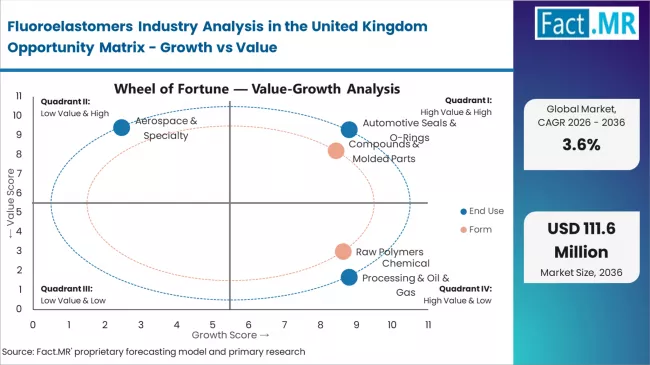
Fluoroelastomers Industry Analysis In The United Kingdom Opportunity Matrix Growth Vs Value | Source: Fact.MR
Demand expansion is being supported by the accelerating emphasis on automotive manufacturing excellence and industrial processing optimization nationwide, with the United Kingdom maintaining its position as an advanced engineering hub, and the corresponding need for high-performance sealing solutions for automotive, chemical processing, and aerospace applications. Modern manufacturers rely on fluoroelastomers technologies to ensure component reliability, operational safety, and optimal pathway achievement toward stringent industry standards.
Automotive companies and industrial processors are increasingly investing in fluoroelastomers sourcing and integrated material solutions to enhance product durability, access polymer innovations, and demonstrate engineering leadership in competitive manufacturing environments. Industry standards and quality requirements are establishing standardized application pathways that require material enhancement systems and performance assurance, with UK operations often pioneering commercial implementation of advanced fluoroelastomers technologies.
Opportunity Pathways - Demand for Fluoroelastomers in the United Kingdom
The fluoroelastomers demand in the United Kingdom is positioned for steady expansion, growing from USD 75.6 million in 2025 to USD 107.5 million by 2035, reflecting a 3.6% CAGR. Rising adoption of high-performance sealing products in automotive operations, industrial processing, and aerospace applications is driving growth as manufacturers seek material solutions that maximize chemical resistance characteristics and comply with industry safety standards. Additionally, demand from automotive sealing applications and advanced manufacturing implementations strengthens opportunities for both sophisticated polymer platforms and integrated industrial solutions.
Manufacturers focusing on production optimization, polymer integration, and advanced engineering capabilities stand to gain from evolving industry standards and manufacturer expectations for material reliability, and component performance.
- Pathway A - Automotive Sealing Applications and High-Performance InnovationsAutomotive manufacturers face increasing demands for advanced fluoroelastomers solutions in vehicle component formulations. Premium sealing systems enable enhanced performance characteristics and comprehensive reliability capabilities without compromising safety profiles. Solutions targeting automotive companies, component suppliers, and premium vehicle segments can achieve strong adoption rates through performance optimization and quality assurance improvements. Estimated revenue opportunity: USD 4.5-5.4 million.
- Pathway B - Compounds & Molded Parts and Manufacturing EfficiencyThe growth in manufacturing efficiency, processing precision, and production optimization creates robust demand for high-performance compounds and molded parts ensuring consistency in production processes. Manufacturers offering advanced molded solutions for automotive applications can build relationships with automotive companies and component distributors. Estimated revenue opportunity: USD 3.6-4.5 million.
- Pathway C - Chemical Processing Integration and Industrial ApplicationsIndustrial operators are increasingly adopting fluoroelastomers products for reliable chemical processing equipment. Collaborations with engineering innovators for integrated industrial solutions can unlock significant contracts and long-term partnerships in chemical plants and processing facilities. Estimated revenue opportunity: USD 3.0-3.8 million.
- Pathway D - Aerospace and Specialty Performance ApplicationsAerospace requirements and extreme environment demands are driving preference for material platforms with superior temperature resistance capabilities. Suppliers offering comprehensive specialized solutions with exceptional performance characteristics can differentiate offerings and attract aerospace manufacturers. Estimated revenue opportunity: USD 2.4-3.0 million.
- Pathway E - Raw Polymers and Custom Formulation ChannelsSpecialty manufacturing applications require specialized material configurations with optimized processing features and enhanced formulation flexibility. Manufacturers investing in custom formulation development can secure advantages in serving specialized industrial applications. Estimated revenue opportunity: USD 2.0-2.6 million.
- Pathway F - Technical Development and Engineering Support ServicesComprehensive technical services offering formulation guidance, performance optimization, and ongoing engineering support create recurring revenue opportunities. Companies building strong technical support capabilities can capture ongoing relationships and enhance manufacturer satisfaction across automotive and industrial networks. Estimated revenue opportunity: USD 1.6-2.1 million.
Segmental Analysis
The industry is segmented by end use, form, and region. By end use, the industry is divided into automotive seals & O-rings, chemical processing & oil & gas, and aerospace & specialty categories. In terms of form, the industry is segmented into compounds & molded parts and raw polymers. Regionally, the industry is divided into England, Scotland, Wales, and Northern Ireland, with England representing a key growth and innovation hub for advanced manufacturing applications.
By End Use, Automotive Seals & O-rings Segment Accounts for 48.0% Share
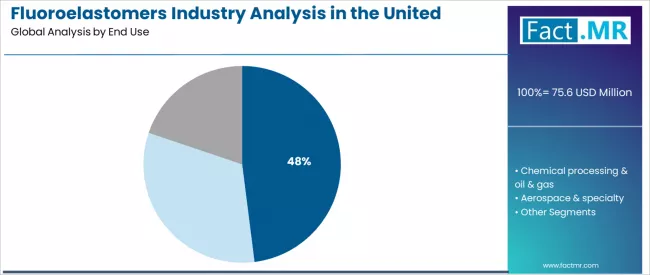
Fluoroelastomers Industry Analysis In The United Kingdom Analysis By End Use | Source: Fact.MR
The automotive seals & O-rings segment is projected to account for 48.0% of UK fluoroelastomers demand in 2025, making it the leading end use category across the sector. This dominance reflects the operational requirements and performance needs of automotive sealing systems for existing vehicle manufacturing facilities and component applications where product reliability is optimized through superior chemical resistance characteristics and durable sealing architecture.
In the United Kingdom, where substantial automotive manufacturing requires advanced material integration without complete production line redesign, fluoroelastomers platforms provide practical pathways for performance enhancement while maintaining component quality. Continuous innovations are improving temperature resistance, sealing characteristics, and manufacturing integration parameters, enabling manufacturers to achieve high reliability standards while maximizing production efficiency.
The segment's strong position is reinforced by the extensive existing automotive component portfolios requiring enhanced performance capabilities and growing availability of fluoroelastomers suppliers with proven commercial experience.
- Component reliability and existing manufacturing system integration make fluoroelastomers platforms the preferred material for enhancing automotive engine and transmission sealing applications.
- Performance durability and material sourcing track records are enhancing manufacturer confidence and product viability across commercial adoption initiatives.
By Form, Compounds & Molded Parts Segment Accounts for 67.0% Share
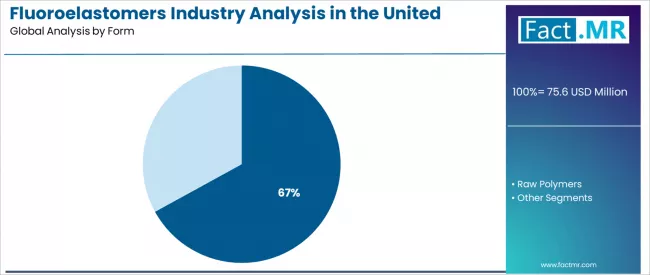
Fluoroelastomers Industry Analysis In The United Kingdom Analysis By Form | Source: Fact.MR
The compounds & molded parts segment is expected to represent 67.0% of UK fluoroelastomers demand in 2025, highlighting the critical importance of manufacturing operations requiring ready-to-use component solutions. Automotive and industrial facilities including production plants, component manufacturers, and processing operations generate consistent demand for fluoroelastomers forms that are technically and economically favorable for advanced manufacturing applications.
The segment benefits from form characteristics that often provide superior processing performance compared to raw polymer alternatives, reducing production time and improving efficiency. Compounds & molded parts applications also access enhanced operational optimization through precision manufacturing that improves component integration and production appeal.
In the United Kingdom, where manufacturing operations represent substantial portions of industrial production, processing excellence requires material integration across diverse production facilities. In England and Scotland regions, where major manufacturing concentrations are significant, fluoroelastomers demand is elevated by emphasis on maintaining production efficiency while achieving performance targets.
- Production optimization and favorable manufacturing economics make this a leading form segment for advanced material technologies.
- Manufacturing requirements and efficiency demands drive consistent demand across automotive production facilities, component manufacturers, and industrial processing plants.
What are the Drivers, Restraints, and Key Trends in the UK Fluoroelastomers Demand?
UK fluoroelastomers demand is advancing steadily due to increasing automotive manufacturing requirements and growing recognition of advanced material technology necessity for high-performance sealing development, with England region serving as a key driver of innovation and application development. The sector faces challenges including high production costs and manufacturing capacity limitations, need for specialized polymer infrastructure development, and ongoing concerns regarding regulatory compliance pathways and technical performance considerations.
Industry safety regulations and regional-level quality standards, particularly manufacturing innovation programs in England and Scotland regions, continue to influence fluoroelastomers selection and adoption timelines.
Expansion of Automotive Manufacturing and Quality Standards
The enhancement of automotive production standards, gaining particular significance through vehicle performance trends and emission regulation campaigns, is enabling fluoroelastomers suppliers to achieve differentiation without prohibitive application costs, providing predictable demand patterns through manufacturer requirements and performance preferences. Enhanced industry acceptance offering substantial opportunities for reliable sealing systems and validated applications provide foundational dynamics while allowing suppliers to secure commercial agreements and automotive partnerships.
These trends are particularly valuable for innovative suppliers and premium material development that require substantial polymer investments without immediate cost advantages.
Deployment of Advanced Polymerization Methods and Precision Manufacturing Systems
Modern fluoroelastomers suppliers and premium chemical companies are establishing advanced production networks and centralized manufacturing facilities that improve operational efficiency through polymerization technology and economies of scale. Integration of precision compounding systems, high-efficiency production technology, and coordinated quality management enables more efficient fluoroelastomers production across multiple application categories.
Advanced production concepts also support next-generation industrial applications including specialized formulation integration, manufacturing cluster optimization, and regional fluoroelastomers supply networks that optimize cost-level economics while enabling comprehensive quality monitoring across production regions, with UK developments increasingly adopting collaborative manufacturing models to reduce individual company costs and accelerate commercialization.
Analysis of UK Fluoroelastomers Demand by Key Region
.webp "Top Country Growth Comparison Fluoroelastomers Industry Analysis In The United Kingdom Cagr (2026 2036)")
Top Country Growth Comparison Fluoroelastomers Industry Analysis In The United Kingdom Cagr (2026 2036) | Source: Fact.MR
| Region | CAGR (2026-2036) |
|---|---|
| England | 3.80% |
| Scotland | 3.50% |
| Wales | 3.20% |
| Northern Ireland | 2.90% |
Source: Fact.MR analysis. Updated Apr 6, 2026

Fluoroelastomers Industry Analysis In The United Kingdom Cagr Analysis By Country | Source: Fact.MR
The UK fluoroelastomers demand is witnessing steady growth, supported by rising automotive manufacturing requirements, expanding industrial processing initiatives, and the deployment of advanced polymer materials across regions. England leads the nation with a 3.8% CAGR, reflecting progressive manufacturing innovation trends, substantial industrial development, and early adoption of premium material systems.
Scotland follows with a 3.5% CAGR, driven by extensive manufacturing infrastructure, favorable industrial demographics, and concentration of automotive operations that enhance application development. Wales grows at 3.2%, as industrial innovation and manufacturing modernization opportunities increasingly drive fluoroelastomers deployment. Northern Ireland demonstrates growth at 2.9%, supported by expanding industrial facilities and regional manufacturing initiatives.
England Leads National Growth with Innovation and Premium Industrial Applications

Fluoroelastomers Industry Analysis In The United Kingdom Country Value Analysis | Source: Fact.MR
Demand for fluoroelastomers in England is projected to exhibit steady growth with a CAGR of 3.8% through 2036, driven by progressive manufacturing requirements, substantial industrial development creating premium material opportunities, and concentration of advanced engineering innovation across London, Manchester, and Birmingham industrial areas.
As the dominant region with extensive automotive infrastructure and innovation-focused industrial policies, England's emphasis on comprehensive manufacturing excellence and material leadership is creating significant demand for advanced fluoroelastomers systems with proven performance characteristics and reliable polymer potential. Major automotive manufacturers and fluoroelastomers suppliers are establishing comprehensive application development programs to support technology advancement and premium component deployment across diverse applications.
- Industrial trends and material performance preferences are requiring comprehensive quality management strategies and formulation solutions, driving demand for fluoroelastomers systems with demonstrated performance enhancement capabilities and permanent quality assurance throughout diverse manufacturing operations.
- Innovation ecosystem strength and manufacturing technology capital availability are supporting deployment of next-generation material technologies and novel application pathways that enhance product viability, reduce production costs, and create new differentiation opportunities across automotive and industrial applications, positioning England as a national manufacturing leadership region.
Scotland Demonstrates Strong Potential with Manufacturing Infrastructure
Demand for fluoroelastomers in Scotland is expanding at a CAGR of 3.5%, supported by extensive manufacturing facilities including automotive operations, advanced production plants, and specialty component processors generating concentrated demand favorable for fluoroelastomers systems. The region's manufacturing characteristics, featuring substantial industrial production infrastructure and material requirements ideal for premium polymer integration, provide operational advantages.
Engineering expertise concentrated in Glasgow, Edinburgh, and regional production corridors facilitates application development and manufacturing management. Fluoroelastomers suppliers and chemical companies are implementing comprehensive commercialization strategies to serve expanding precision-focused requirements throughout Scotland.
- Manufacturing concentration and favorable production economics are creating opportunities for specialized fluoroelastomers suppliers that can integrate advanced material systems with existing industrial operations.
- Material performance positioning and quality awareness are building regional competitive advantages in automotive applications, enabling comprehensive product development and manufacturer cluster enhancement that meets operational targets while accessing premium pricing opportunities.
Wales Maintains Steady Growth with Industrial Expansion
Demand for fluoroelastomers in Wales is growing at a CAGR of 3.2%, driven by substantial industrial facilities from manufacturing operations, advanced engineering establishments, and regional component production requiring advanced material pathways.
The region's industrial base, supporting critical manufacturing operations, is increasingly adopting advanced material technologies to maintain competitiveness while meeting performance expectations. Operators and fluoroelastomers suppliers are investing in application integration systems and regional distribution infrastructure to address growing manufacturing management requirements.
- Industrial modernization imperatives and manufacturing competitiveness concerns are facilitating adoption of fluoroelastomers technologies that enable continued operations while achieving performance enhancement across automotive plants, advanced manufacturing establishments, and industrial facilities.
- Engineering innovation opportunities including regional material development and polymer utilization for enhanced manufacturing experiences are creating unique regional advantages and diversified application types throughout Wales industrial operations.
Northern Ireland Shows Progressive Adoption with Industrial Modernization
Demand for fluoroelastomers in Northern Ireland is advancing at a CAGR of 2.9%, supported by expanding industrial facilities, regional material development including premium manufacturing and engineering operations, and growing emphasis on innovation solutions across the region.
Industrial modernization and manufacturing facility expansion are driving consideration of fluoroelastomers systems as performance enhancement pathways. Premium operators and fluoroelastomers suppliers are developing regional capabilities to support emerging application deployment requirements.
- Industrial expansion and manufacturing diversification are creating economic drivers for innovation technologies and fluoroelastomers deployment across automotive and industrial facilities seeking competitive differentiation pathways.
- Regional industrial cooperation and coordinated material development are establishing consistent innovation environments and shared manufacturing infrastructure that support multi-regional application projects throughout Northern Ireland industrial operations.
Competitive Landscape of UK Fluoroelastomers Demand

Fluoroelastomers Industry Analysis In The United Kingdom Analysis By Company | Source: Fact.MR
UK fluoroelastomers demand is defined by competition among specialized chemical companies, polymer innovators, and integrated material providers, with major chemical corporations maintaining significant influence through innovation resources and application development capabilities. Companies are investing in fluoroelastomers advancement, production infrastructure optimization, distribution network structures, and comprehensive technical services to deliver effective, reliable, and high-performance sealing materials across UK automotive and industrial applications.
Strategic partnerships, manufacturing infrastructure development, and commercial application execution are central to strengthening competitive positioning and presence across performance characteristics, production efficiency, and polymer technology applications.
DuPont, internationally recognized chemical leader, leads with 13% share, offering comprehensive material solutions including polymer production, application development, and technical services with focus on automotive sealing applications, performance reliability, and quality optimization across UK operations. AGC Chemicals, operating with chemical expertise, provides innovative material solutions leveraging polymer platforms, application development, and engineering capabilities.
Solvay delivers chemical platform services including advanced polymerization development, production optimization, and material innovation serving UK and international industrial projects. Daikin Chemicals emphasizes comprehensive material solutions with integrated polymer capabilities, specialty formulations, and application features leveraging advanced chemical expertise. 3M offers fluoroelastomers application development and material distribution operations for automotive manufacturers and industrial companies across UK operations.
Key Players in UK Fluoroelastomers Industry
- DuPont
- AGC Chemicals
- Solvay
- Daikin Chemicals
- 3M
- Zeon Corporation
- Kuraray
- Kureha Corporation
- Zhejiang Huafon
- Shin-Etsu Chemical
Bibliography
- Society of Motor Manufacturers and Traders. (2024). UK automotive production and trade data report. SMMT.
- Health and Safety Executive. (2024). Chemical plant maintenance and integrity management guidance. HSE UK.
- European Chemicals Agency. (2024). REACH regulation: Fluoropolymer and fluoroelastomer substance evaluation status. ECHA.
- British Standards Institution. (2024). BS EN 681: Elastomeric seals for water supply and drainage. BSI.
- UK Department for Business and Trade. (2024). Advanced manufacturing sector report: Aerospace and automotive supply chain analysis. DBT.
This bibliography is provided for reader reference. The full Fact.MR report contains the complete reference list with primary research documentation.
This Report Addresses
- Market sizing and quantitative forecast metrics detailing fluoroelastomer expenditure across automotive, chemical, aerospace, and industrial sealing applications in the United Kingdom through 2036.
- Segmentation analysis mapping compound and molded part consumption patterns across end-use application categories and form types.
- Sub-regional deployment intelligence comparing concentrated automotive and chemical manufacturing demand in England against specialized consumption in Scotland, Wales, and Northern Ireland.
- Regulatory assessment analyzing how REACH substance evaluation proceedings and automotive emissions standards shape fluoroelastomer material specification and procurement.
- Competitive posture evaluation tracking polymer grade availability, compounding expertise, and OEM qualification program coverage.
- Capital project strategic guidance defining the compound formulation and application testing specifications required for fluoroelastomer seal procurement upgrades.
- Custom data delivery formats encompassing interactive dashboards, raw Excel datasets, and comprehensive PDF narrative reports.
Fluoroelastomers Industry Analysis in the United Kingdom Market Definition
Fluoroelastomers in the United Kingdom refer to the class of fluorine-containing synthetic rubber materials processed into seals, O-rings, gaskets, and custom-molded components that deliver chemical resistance, high-temperature stability, and low permeability in automotive, chemical, aerospace, and industrial sealing applications. These materials are supplied as raw polymer grades for custom compounding or as pre-formulated compounds and finished molded parts. Primary purchasers include automotive OEMs, chemical plant operators, aerospace component manufacturers, and industrial seal distributors.
Fluoroelastomers Industry Analysis in the United Kingdom Market Inclusions
Market scope includes FKM (fluorocarbon elastomer) and FFKM (perfluoroelastomer) grades supplied as raw polymers, pre-compounded materials, and finished molded sealing components. Coverage extends to automotive, chemical processing, oil and gas, aerospace, and industrial end-use categories. UK-level and sub-regional market sizing is provided across the 2026 to 2036 forecast period.
Fluoroelastomers Industry Analysis in the United Kingdom Market Exclusions
Silicone rubber, nitrile rubber (NBR), EPDM, and other non-fluorinated elastomers are excluded. Fluoroplastic products such as PTFE seals and linings are not covered. Fluoroelastomer production equipment and processing machinery fall outside the analytical scope.
Fluoroelastomers Industry Analysis in the United Kingdom Market Research Methodology
- Primary Research: Analysts engaged with automotive OEM sealing engineers, chemical plant maintenance managers, and fluoroelastomer compound distributors to map material specification patterns and replacement cycle frequencies.
- Desk Research: Data collection phases aggregated automotive production volume disclosures, chemical plant maintenance expenditure reports, and fluoropolymer monomer pricing data from commodity reporting services.
- Market-Sizing and Forecasting: Baseline values derive from a bottom-up aggregation of fluoroelastomer compound shipment volumes across end-use categories, applying application-specific replacement rates to project future demand in the UK market.
- Data Validation and Update Cycle: Projections are tested against publicly reported specialty polymer division revenues from leading fluorochemical producers and cross-referenced with UK automotive production and chemical processing output databases.
Segmentation
Scope of the Report
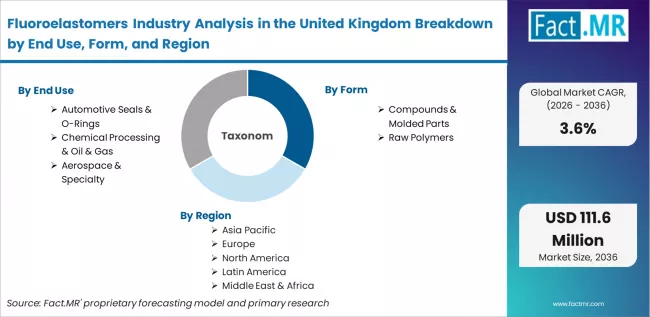
Fluoroelastomers Industry Analysis In The United Kingdom Breakdown By End Use, Form, And Region | Source: Fact.MR
| Metric | Value |
|---|---|
| Quantitative Units | USD 78.32 million to USD 111.55 million, at a CAGR of 3.6% |
| Market Definition | Fluoroelastomers Industry in the United Kingdom encompasses fluorine-containing synthetic rubber compounds and molded components that deliver chemical resistance, thermal stability, and sealing reliability for automotive, chemical, aerospace, and industrial applications across the UK. |
| End Use Segmentation | Automotive Seals & O-Rings, Chemical Processing & Oil & Gas, Aerospace & Specialty |
| Form Segmentation | Compounds & Molded Parts, Raw Polymers |
| Regions Covered | England, Scotland, Wales, Northern Ireland (UK sub-regions) |
| Countries Covered | United Kingdom (sub-regional analysis: England, Scotland, Wales, Northern Ireland) |
| Key Companies Profiled | DuPont, AGC Chemicals, Solvay, Daikin Chemicals, 3M, Zeon Corporation, Kuraray, Kureha Corporation, Zhejiang Huafon, Shin-Etsu Chemical |
| Forecast Period | 2026 to 2036 |
| Approach | Forecasting models apply a bottom-up methodology starting with UK fluoroelastomer compound shipment data and end-use application volumes, projecting demand by sealing application category and form. |
Source: Fact.MR analysis. Updated Apr 6, 2026
UK Fluoroelastomers Industry by Segments
-
End Use :
- Automotive seals & O-rings
- Chemical processing & oil & gas
- Aerospace & specialty
-
Form :
- Compounds & molded parts
- Raw polymers
-
Region :
- England
- Scotland
- Wales
- Northern Ireland
Frequently Asked Questions
How large is the demand for Fluoroelastomers in the United Kingdom in 2026?
What will be the market size of Fluoroelastomers in the United Kingdom by 2036?
What is the expected demand growth for Fluoroelastomers in the United Kingdom between 2026 and 2036?
Which End Use is poised to lead sales by 2026?
How significant is the role of Compounds & Molded Parts in Fluoroelastomer consumption in 2026?
What is driving demand in England?
What is Fluoroelastomers and what is it mainly used for?
What is included in the scope of this report?
What is excluded from the scope of this report?
How does Fact.MR build and validate the Fluoroelastomers forecast?
What does zero reliance on speculative third-party market research mean here?
Who worked on this report


Preview the report firsthand - request a free sample
Free SampleGet the brochure for pricing and purchase details
Download PDF