- Base Value(2025): 0.6 Bn
- Estimated Value(2025): 0.6 Bn
- Forecast Value (2035): 1.2 Bn
- CAGR (2025 - 2035): 7.0%
Demand for Laparoscopic Devices in UK 2025 to 2035
The demand for laparoscopic devices in the UK is projected to grow from USD 0.62 billion in 2025 to approximately USD 1.22 billion by 2035, with demand forecast to expand at a compound annual growth rate (CAGR) of 7.0% between 2025 and 2035.
Growth is driven by expanding minimally invasive surgery adoption initiatives and increasing adoption of advanced robot-assisted surgical solutions across UK healthcare sectors, particularly in England where NHS modernization programs and ambulatory surgical center expansion are accelerating laparoscopic device deployment.
Quick Stats for UK Laparoscopic Devices Industry
- UK Laparoscopic Devices Sales Value (2025): USD 0.62 billion
- UK Laparoscopic Devices Forecast Value (2035): USD 1.22 billion
- UK Laparoscopic Devices Forecast CAGR: 7.0%
- Leading Product Type in UK Laparoscopic Devices Industry: Energy Systems (21.4%)
- Key Growth Regions in UK Laparoscopic Devices Industry: England, Scotland, Wales, and Northern Ireland
- Regional Leadership: England holds the leading position in demand
- Key Players in UK Laparoscopic Devices Industry: Medtronic plc, Karl Storz SE & Co. KG, Olympus Corporation, Johnson & Johnson Services Incorporated, B. Braun Melsungen AG, CONMED Corporation, Intuitive Surgical Incorporated, Becton Dickinson and Company, The Cooper Companies Incorporated, Richard Wolf GmbH
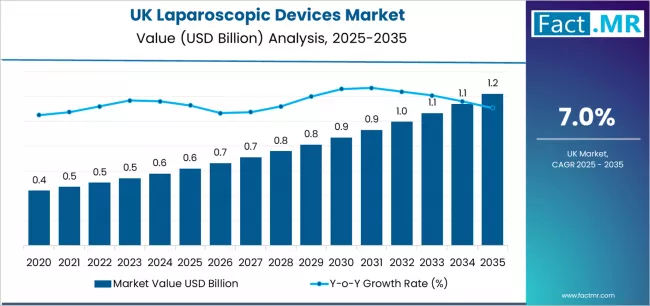
Uk Laparoscopic Devices Market Market Value Analysis | Source: Fact.MR
Increasing integration of advanced energy system technologies in surgical applications and growing adoption of specialized bariatric surgery platforms continue to drive demand. Hospitals and ambulatory surgical centers are expanding their laparoscopic device investments to address the growing complexity of modern surgical requirements and patient safety specifications, with UK facilities leading investments in advanced minimally invasive surgical systems.
The energy systems segment is projected to register 21.4% of laparoscopic device demand in 2025. Laparoscopic energy systems are widely used in surgical configurations because they enable efficient tissue sealing, reliable hemostasis characteristics, and proven surgical precision that enhance operative quality. They also support diverse surgical applications and specialty preferences across minimally invasive environments, improving surgical characteristics and effectiveness.
Bariatric surgery applications are expected to account for 28.2% of laparoscopic device demand in 2025. Laparoscopic devices are widely used for bariatric procedures because they provide proven performance enhancement and comprehensive support for demanding surgical requirements. Their integration enhances surgical character, application capabilities, and patient outcomes by enabling improved procedural differentiation and authentic performance positioning during minimally invasive operations.
From 2030 to 2035, demand is forecast to grow from USD 0.91 billion to USD 1.22 billion, adding another USD 0.31 billion, which constitutes 51.7% of the overall ten-year expansion. This period is expected to be characterized by expansion of advanced robot-assisted system integration, development of specialized energy device formulations and customized surgical products, and implementation of quality assurance systems across different surgical applications. The growing adoption of AI-powered surgical assistance principles and enhanced procedural customization requirements, particularly in England and Scotland regions, will drive demand for more sophisticated laparoscopic device systems and integrated surgical platforms.
The laparoscopic devices industry is experiencing steady growth in the UK primarily due to the increasing adoption of advanced minimally invasive surgical alternatives and the expansion of robot-assisted surgery integration initiatives. The country's emphasis on surgical modernization and healthcare infrastructure development necessitates investment in effective laparoscopic device systems (surgical support, patient safety) and advanced energy products (quality enhancement, performance verification) for surgical operations and procedural functions.
UK Laparoscopic Devices Industry Key Takeaways
| Metric | Value |
|---|---|
| UK Laparoscopic Devices Sales Value (2025) | USD 0.62 billion |
| UK Laparoscopic Devices Forecast Value (2035) | USD 1.22 billion |
| UK Laparoscopic Devices Forecast CAGR (2025-2035) | 7.0% |
Source: Fact.MR analysis. Updated Dec 15, 2025
Why is the UK Laparoscopic Devices Industry Growing?
Modern surgeons and healthcare practitioners rely on professional laparoscopic device systems to ensure surgical competitiveness, procedural improvement, and optimal pathway achievement toward patient care goals. Advanced surgical requirements necessitate comprehensive laparoscopic device solutions including specialized energy capabilities, surgical support systems, and quality enhancement infrastructure to address diverse application needs and performance specifications.
Surgeons and healthcare practitioners are emphasizing sourcing and integrated energy solutions to enhance surgical profiles, access performance optimization trends, and demonstrate procedural leadership in competitive healthcare environments. Advanced quality policies and laparoscopic device performance requirements are establishing standardized surgical pathways that require professional systems and performance assurance, with UK facilities often pioneering large-scale implementation of advanced laparoscopic device technologies.
Segmental Analysis
The industry is segmented by product, application, and region. By product, the industry is divided into energy systems, trocars, laparoscopes, robot-assisted systems, and others categories. In terms of application, industry is segmented into bariatric surgery, general surgery, gynecological surgery, and others. Regionally, the industry is divided into England, Scotland, Wales, and Northern Ireland.
By Product, Which Segment Captures the Largest Share in UK’s Laparoscopic Devices Ecosystem?
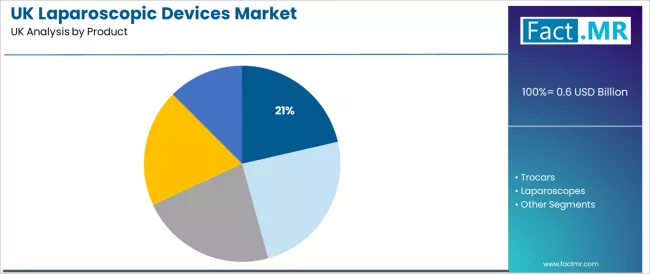
Uk Laparoscopic Devices Market Analysis By Product | Source: Fact.MR
Energy systems account for 21.4% of laparoscopic device demand in 2025 in UK, making it the leading product category across the sector. This dominance reflects the surgical performance requirements and proven capabilities of energy systems for existing surgical operations and minimally invasive applications where surgical precision is optimized through established sealing capabilities and integrated quality architecture.
In the UK, where substantial hospital populations require laparoscopic device integration without complete surgical modification, energy platforms provide practical pathways for procedural enhancement while maintaining surgical integrity. Continuous innovations are improving surgical consistency, energy characteristics, and device integration parameters, enabling surgeons to achieve high performance standards while maximizing reliability. The segment's strong position is reinforced by the extensive existing surgical infrastructure requiring laparoscopic device adoption and growing availability of energy suppliers with proven commercial experience.
- Surgical compatibility and existing procedure integration make energy platforms the preferred product type for enhancing surgical operations and minimally invasive installations.
- Performance reliability and commercial demonstration track records are enhancing surgeon confidence and system viability across large-scale adoption initiatives.
Which Application Category Makes Maximum Use of Laparoscopic Devices in UK?
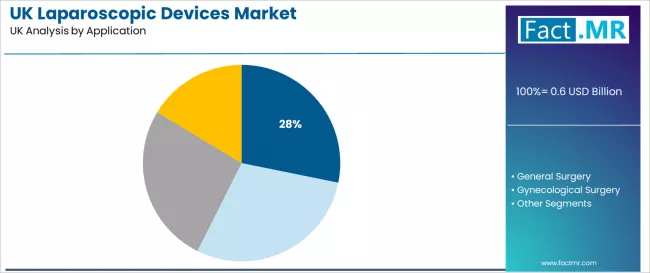
Uk Laparoscopic Devices Market Analysis By Application | Source: Fact.MR
Bariatric surgery applications are expected to represent 28.2% of laparoscopic device demand in 2025, demonstrating the significant role of weight loss procedures requiring comprehensive surgical support solutions. Bariatric surgery facilities including major surgical centers, specialized hospitals, weight loss programs, and patient-to-surgeon initiatives generate consistent demand for laparoscopic device systems that are technically and operationally favorable for bariatric applications.
The segment benefits from performance characteristics that provide surgical optimization and integration capabilities for weight loss processes. In the UK, where bariatric surgery represents substantial portions of minimally invasive procedures, surgical excellence requires laparoscopic device integration across diverse surgical facilities. In England regions, where bariatric concentrations are significant, laparoscopic device demand is elevated by emphasis on maintaining surgical excellence while achieving patient outcomes targets.
- Surgical requirements and procedural optimization drive consistent demand across major surgical centers, specialized hospitals, weight loss programs, and patient-to-surgeon initiatives.
- The integration of laparoscopic device-based solutions enhances the efficiency, consistency, and effectiveness of bariatric processes, further supporting the sector's need for high-performance surgical systems in both primary and secondary applications.
What are the Drivers, Restraints, and Key Trends in the UK Laparoscopic Devices Industry?
The country's laparoscopic device demand is advancing steadily due to increasing minimally invasive surgery requirements and growing recognition of surgical necessity for healthcare development, with England region serving as a key driver of innovation and application development.
The sector faces challenges including competition from alternative surgical systems, need for specialized device validation development, and ongoing concerns regarding equipment costs and regulatory considerations. National healthcare guidelines and regional-level infrastructure initiatives, particularly surgical programs in England and Scotland regions, continue to influence laparoscopic device selection and adoption timelines.
Expansion of Minimally Invasive Surgery Requirements and Performance Standards
The enhancement of surgical regulations, gaining particular significance through healthcare standards and advanced surgical programs, is enabling laparoscopic device suppliers to achieve differentiation without prohibitive development costs, providing predictable demand patterns through surgical requirements and surgeon preferences.
Enhanced quality standards offering substantial opportunities for professional laparoscopic device systems and integrated applications provide foundational dynamics while allowing suppliers to secure surgical agreements and healthcare partnerships. These trends are particularly valuable for first-mover suppliers and advanced system development that require substantial technical investments without immediate cost advantages.
Incorporation of Robot-Assisted Technologies and Quality Validation Systems
Modern laparoscopic device suppliers and healthcare companies are establishing advanced surgical networks and centralized quality management facilities that improve surgical effectiveness through technical standardization and performance validation. Integration of surgical optimization systems, high-precision energy technologies, and coordinated quality management enables more efficient laparoscopic device delivery across multiple surgical locations.
Advanced surgical concepts also support next-generation healthcare applications including specialized device integration, surgical optimization, and regional laparoscopic device supply networks that optimize system-level economics while enabling comprehensive performance monitoring across surgical regions, with UK developments increasingly adopting collaborative research models to reduce individual supplier costs and accelerate validation.
Analysis of UK Laparoscopic Devices Industry by Key Regions
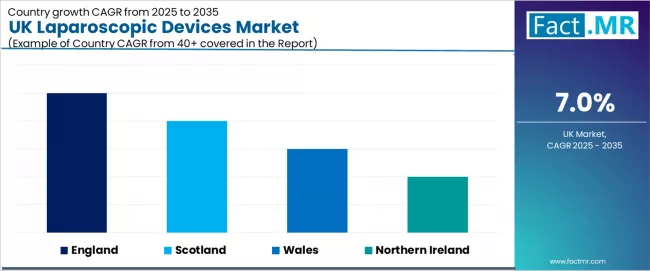
Uk Laparoscopic Devices Market Cagr Analysis By Country | Source: Fact.MR
| Region | CAGR (2025-2035) |
|---|---|
| England | 7.2% |
| Scotland | 7.0% |
| Wales | 6.8% |
| Northern Ireland | 6.6% |
Source: Fact.MR analysis. Updated Dec 15, 2025
The UK laparoscopic devices industry is witnessing steady growth, supported by rising minimally invasive surgery requirements, expanding healthcare initiatives, and the deployment of advanced laparoscopic device technologies across regions. England leads the nation with a 7.2% CAGR, reflecting progressive surgical trends, substantial healthcare innovation, and early adoption of professional laparoscopic device systems.
Scotland follows with a 7.0% CAGR, driven by extensive surgical infrastructure, favorable surgeon demographics, and concentration of specialized operations that enhance application development. Wales grows at 6.8%, as healthcare modernization and surgical opportunities increasingly drive laparoscopic device adoption. Northern Ireland demonstrates growth at 6.6%, supported by expanding surgical facilities and regional healthcare initiatives.
Why Does England Lead Laparoscopic Device Demand?
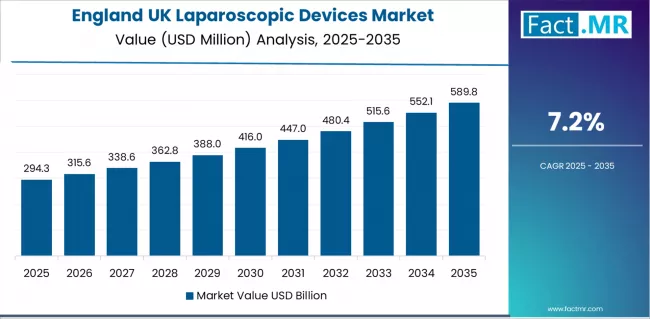
Uk Laparoscopic Devices Market Country Value Analysis | Source: Fact.MR
Demand for laparoscopic devices in England is projected to exhibit strong growth with a CAGR of 7.2% through 2035, driven by progressive surgical preferences, substantial healthcare development creating advanced laparoscopic device opportunities, and concentration of surgical advancement across London and surrounding metropolitan areas.
As the dominant region with extensive surgical infrastructure and quality-focused healthcare policies, England's emphasis on comprehensive surgical excellence and healthcare leadership is creating significant demand for professional laparoscopic device systems with proven effectiveness and reliable application potential. Major laparoscopic device suppliers and healthcare companies are establishing comprehensive healthcare development programs to support innovation advancement and advanced system deployment across diverse applications.
- Healthcare development trends and surgical preferences are requiring comprehensive surgical management strategies and laparoscopic device solutions, driving demand for systems with demonstrated surgical enhancement capabilities and permanent performance assurance throughout diverse surgical operations.
- Innovation ecosystem strength and healthcare capital availability are supporting deployment of next-generation laparoscopic device technologies and novel application pathways that enhance commercial viability, reduce surgical costs, and create new healthcare opportunities across surgical and quality-focused applications, positioning England as a national healthcare leadership region.
Why Does Scotland Show Strong Growth?
Demand for laparoscopic devices in Scotland is expanding at a CAGR of 7.0%, supported by extensive surgical facilities including large-scale healthcare programs, surgical operations, and medical companies generating concentrated demand favorable for laparoscopic device systems. The region's surgical characteristics, featuring substantial healthcare networks and surgical requirements ideal for laparoscopic device integration, provide natural advantages.
Surgical expertise concentrated in Edinburgh, Glasgow, and regional healthcare corridors facilitates application development and surgical management. Laparoscopic device suppliers and healthcare companies are implementing comprehensive healthcare strategies to serve expanding quality-focused requirements throughout Scotland.
- Surgical concentration and favorable application economics are creating opportunities for specialized laparoscopic device suppliers that can integrate surgical systems with existing healthcare operations.
- Laparoscopic device positioning and surgical awareness are building regional competitive advantages in healthcare applications, enabling comprehensive surgical development and procedural cluster enhancement that meets healthcare targets while accessing advanced pricing opportunities.
Why Does Wales Show Consistent Expansion?
Demand for laparoscopic devices in Wales is growing at a CAGR of 6.8%, driven by substantial surgical facilities from healthcare operations, surgical distributors, and regional operators requiring laparoscopic device pathways.
The region's surgical base, supporting critical healthcare operations, is increasingly adopting laparoscopic device technologies to maintain competitiveness while meeting surgical expectations. Healthcare companies and laparoscopic device suppliers are investing in surgical integration systems and regional supply infrastructure to address growing surgical management requirements.
- Healthcare modernization imperatives and surgical competitiveness concerns are facilitating adoption of laparoscopic device technologies that enable continued surgical operations while achieving procedural enhancement across healthcare operations, surgical distributors, and operator facilities.
- Surgical optimization opportunities including regional healthcare development and laparoscopic device utilization for enhanced healthcare operations are creating unique regional advantages and diversified application types throughout Wales surgical operations.
What Factors Underpin Laparoscopic Device Demand in Northern Ireland?
Demand for laparoscopic devices in Northern Ireland is advancing at a CAGR of 6.6%, supported by expanding surgical facilities, regional healthcare development including surgical and procedural operations, and growing emphasis on healthcare solutions across the region.
Surgical modernization and healthcare facility expansion are driving consideration of laparoscopic device systems as surgical enhancement pathways. Healthcare companies and laparoscopic device suppliers are developing regional capabilities to support emerging surgical deployment requirements.
- Surgical expansion and healthcare diversification are creating economic drivers for laparoscopic device technologies and system adoption across surgical and healthcare facilities seeking competitive differentiation pathways.
- Regional surgical cooperation and coordinated healthcare development are establishing consistent laparoscopic device environments and shared surgical infrastructure that support multi-regional surgical projects throughout Northern Ireland surgical operations.
Competitive Landscape of UK Laparoscopic Devices Industry
UK laparoscopic devices industry is defined by competition among specialized surgical manufacturers, medical device companies, and integrated solution providers, with major healthcare corporations maintaining significant influence through research resources and application development capabilities. Companies are investing in surgical advancement, quality assurance healthcare optimization, distribution network structures, and comprehensive technical validation services to deliver effective, reliable, and accessible surgical enhancement solutions across UK surgical and healthcare applications. Strategic partnerships, research healthcare development, and first-mover application execution are central to strengthening competitive positioning and presence across healthcare, quality-focused, and surgical applications.
Medtronic plc leads with a 15.2% share, offering comprehensive laparoscopic device solutions including healthcare development, quality assurance, and distribution services with focus on surgical applications, procedures, and accessibility across UK operations. Karl Storz SE & Co. KG delivers full-service surgical supply including healthcare distribution, custom integration, and technical support serving UK and international surgical projects.
Olympus Corporation emphasizes comprehensive advanced solutions with integrated surgical capabilities, quality management, and healthcare features leveraging healthcare sector expertise. Johnson & Johnson Services Incorporated offers laparoscopic device application development and surgical optimization operations for surgical and healthcare applications across UK operations.
UK Laparoscopic Devices Industry - Stakeholder Contribution Framework
The UK laparoscopic devices industry is a critical backbone for national healthcare delivery and surgical excellence transition, supporting minimally invasive procedures, surgical innovation, and healthcare modernization. With projected demand driven by surgical quality targets, healthcare modernization, and advancement of surgical technology, the sector's resilience depends on collaborative engagement among government agencies, healthcare operators, device manufacturers, and investors to build capacity, enhance supply chain security, and foster innovation.
How the UK Government Could Accelerate Healthcare Modernization and Industry Competitiveness?
- Strategic Healthcare Fund: Dedicate funding through HM Treasury and the Department of Health and Social Care for strategic surgical enhancement projects, including advanced laparoscopic systems and minimally invasive surgical equipment.
- Tax Incentives for Strategic Manufacturing: Offer enhanced capital allowances and R&D tax credits for domestic investments in surgical device manufacturing, advanced surgical equipment production, and facility expansion.
- Critical Supply Chain Support: Implement policies and strategic stockpiles for key materials and surgical components to mitigate import dependency and price volatility, ensuring healthcare delivery.
- Standardized Technical & Planning Frameworks: Introduce unified national policy statements and technical standards for surgical device manufacturing, healthcare integration, and regulatory processes to streamline adoption timelines and boost investor confidence.
- Regulatory & Approval Reform: Expedite medical device licensing and approval for nationally significant healthcare projects that enhance surgical capacity and integrate advanced technologies.
- Digital Healthcare Mandates: Promote the deployment of surgical devices with integrated monitoring and digital surgical technologies as part of smart healthcare and digital transformation strategies.
How Industry Bodies & Associations (e.g., ABHI, NHS England) Could Strengthen Sector Coordination and Technical Leadership?
- Unified Technical & Skills Standards: Develop consensus-based benchmarks for surgical device specifications, procedural practices, and healthcare compliance to ensure safety, interoperability, and system-wide efficiency.
- Workforce Development Programs: Create accredited training pathways and skills development programs for surgical technicians, healthcare engineers, and minimally invasive surgery specialists to address the critical skills shortage.
- Collaborative R&D Consortia: Establish joint industry programs to drive innovation in surgical device technology, advanced minimally invasive systems, and surgical monitoring capabilities.
- Performance & Clinical Data Repositories: Build centralized industry databases for surgical device performance, clinical outcomes, and procedural best practices to inform better design, maintenance standards, and risk assessment.
- Public & Political Outreach: Promote the strategic role of surgical device infrastructure in healthcare delivery, economic growth, and clinical goals through coordinated industry campaigns.
How Device Manufacturers & Technology Suppliers Could Capture Value and Drive Innovation?
- Advanced Domestic Manufacturing: Invest in state-of-the-art production lines for laparoscopic devices, advanced surgical systems, and integrated monitoring solutions.
- Integrated System Solutions: Develop comprehensive offerings that combine device supply with accessories, training services, monitoring software, and lifetime performance guarantees.
- Supply Chain Digitalization: Implement digital traceability from raw material sourcing to final deployment, ensuring material provenance, quality compliance, and performance tracking.
- Partnership with Research Institutions: Collaborate with universities and healthcare research centers on next-generation technologies, such as AI-powered surgical assistance and advanced minimally invasive systems.
- Manufacturing Optimization: Introduce automation, advanced process control, and modular production designs to improve throughput, reduce energy consumption in production, and lower manufacturing costs.
How Healthcare Providers & System Operators (e.g., NHS Trusts, Private Hospitals) Could Optimize Surgical Efficiency and Demand Expansion?
- Digital Healthcare Integration: Create integrated surgical systems with real-time data from device monitoring to optimize surgical performance, predict maintenance, and simulate healthcare scenarios.
- Scale-up of Strategic Projects: Proactively develop and finance large-scale surgical device projects for specialized procedures, healthcare modernization, and surgical capacity enhancement.
- Collaborative Supply Ecosystems: Develop long-term framework agreements and partnerships with device manufacturers to ensure consistent quality, secure production capacity, and facilitate multi-year planning.
- Pilot-to-Healthcare Deployment Transition: Use phased testing for new surgical technologies before full-scale healthcare deployment.
- Lifecycle Cost Optimization: Invest in higher-specification, more durable surgical systems during initial procurement to reduce long-term maintenance, replacement costs, and system downtime.
How Engineering, Procurement & Construction (EPC) Firms Could Unlock Project Innovation and Demand Access?
- Design and Installation Expertise: Develop specialized installation methodologies for challenging healthcare environments, including complex surgical facilities and integrated operating theaters.
- Modular and Pre-configured Solutions: Integrate pre-configured surgical systems, modular operating theaters, and advanced healthcare technologies into project designs to reduce installation time and operational disruption.
- Advanced Project Delivery Systems: Offer integrated platforms that include comprehensive healthcare system handover with all device records, maintenance data, and monitoring system interfaces.
- Design for Operability & Maintenance: Partner with healthcare operators to provide co-engineered surgical systems optimized for ease of installation, long-term monitoring, and future accessibility for maintenance.
- Digital Platform Development: Launch project management platforms for standardized surgical device libraries, procurement tracking, and streamlined quality assurance documentation.
How Investors and Financial Enablers Could Unlock Growth and Technology Scalability?
- Venture Capital for Technology Startups: Support early-stage companies developing novel surgical materials, robotic surgical systems, and AI-driven healthcare optimization software.
- Healthcare and Modernization Financing: Provide long-term capital for healthcare replacement programs, surgical facility upgrades, and new surgical technology acquisitions through healthcare bonds and infrastructure funds.
- Public-Private Investment Platforms: Create co-financed funds for first-of-a-kind pilot projects demonstrating new surgical technologies or innovative financing models.
- Strategic Consolidation Funding: Back mergers and acquisitions that consolidate surgical device companies to achieve scale and geographic reach.
- Performance-Linked Financing Models: Tie loan terms and investor returns to key performance indicators like improved surgical outcomes, enhanced healthcare availability, and enhanced project delivery timelines.
- Healthcare Transition Financing Programs: Channel innovation-oriented funds into surgical systems dedicated to healthcare modernization, surgical excellence, and healthcare upgrades for clinical advancement.
Key Players in UK Laparoscopic Devices Industry
- Medtronic plc.
- Karl Storz SE & Co. KG
- Olympus Corporation
- Johnson & Johnson Services Incorporated
- B. Braun Melsungen AG
- CONMED Corporation
- Intuitive Surgical Incorporated
- Becton Dickinson and Company
- The Cooper Companies Incorporated
- Richard Wolf GmbH
Segmentation
Scope of the Report
| Item | Value |
|---|---|
| Quantitative Units | USD 1.22 billion |
| Product | Energy Systems, Trocars, Laparoscopes, Robot-Assisted Systems, Others |
| Application | Bariatric Surgery, General Surgery, Gynecological Surgery, Others |
| Regions Covered | England, Scotland, Wales, Northern Ireland |
| Key Companies | Medtronic Public Limited Company, Karl Storz SE & Co. KG, Olympus Corporation, Johnson & Johnson Services Incorporated, B. Braun Melsungen AG, CONMED Corporation, Intuitive Surgical Incorporated, Becton Dickinson and Company, The Cooper Companies Incorporated, Richard Wolf GmbH, Regional laparoscopic device specialists |
| Additional Attributes | Sales by product and application segment; regional demand trends across England, Scotland, Wales, and Northern Ireland; competitive landscape with established laparoscopic device suppliers and specialized healthcare developers; quality preferences for energy systems versus robot-assisted technologies; integration with surgical programs and advanced healthcare policies, particularly advanced in the England region |
Source: Fact.MR analysis. Updated Dec 15, 2025
UK Laparoscopic Devices Industry by Segments
-
Product :
- Energy Systems
- Trocars
- Laparoscopes
- Robot-Assisted Systems
- Others
-
Application :
- Bariatric Surgery
- General Surgery
- Gynecological Surgery
- Others
-
Region :
- England
- Scotland
- Wales
- Northern Ireland
Frequently Asked Questions
How big is the demand for laparoscopic devices in UK in 2025?
What will be the size of laparoscopic devices in UK in 2035?
How much will be the demand for laparoscopic devices in UK growth between 2025 and 2035?
What are the key product types in the laparoscopic devices in UK?
Which application segment is expected to contribute significant share in the laparoscopic devices in UK in 2025?
Who worked on this report


Preview the report firsthand - request a free sample
Free SampleGet the brochure for pricing and purchase details
Download PDF