- Market Value (2025): USD 18.4 Bn
- Estimated Value (2026): USD 20.1 Bn
- Forecast Value (2036): USD 50.1 Bn
- CAGR (2026-2036): 9.5%
What is the Unmanned Sea Systems Market forecast to be worth by 2036?
USD 20.1 billion in 2026 to USD 50.1 billion by 2036 at a 9.5% CAGR.
- At USD 18.4 billion in 2025, the Unmanned Sea Systems Market included surface and underwater systems used for defense missions and commercial survey work.
- Worldwide revenue is projected to reach from USD 20.1 billion in 2026 to USD 50.1 billion by 2036 as maritime operators add autonomous survey capability and naval fleets expand remote operations.
- The industry is forecast to register a 9.5% CAGR between 2026 and 2036 as mission payloads and fleet integration become central purchasing requirements.
| Year | Basis | Market Value (USD billion) |
|---|---|---|
| 2025 | Actual | 18.4 |
| 2026 | Estimate | 20.1 |
| 2036 | Forecast | 50.1 |
| CAGR 2026 to 2036 | Forecast period | 9.5% |
Source: Fact.MR analysis. Updated Nov 11, 2026
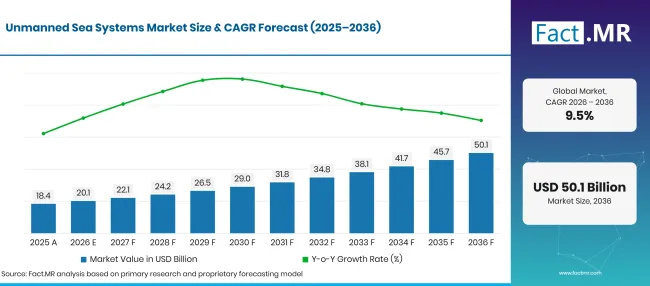
Unmanned Sea Systems Market Forecast Global | Source: Fact.MR
What are the defining numbers behind Unmanned Sea Systems Market growth?
The market is forecast to add USD 30.0 billion in annual value by 2036, with unmanned surface vehicles and defense applications accounting for important parts of demand.
- Demand Drivers in the Market
- Naval mine-countermeasure teams need unmanned craft that can search hazardous water without placing crews in the minefield. On February 3, 2025, Naval Sea Systems Command announced a USD 7.7 million advanced material order awarded to Bollinger Shipyards for a Mine Countermeasures Unmanned Surface Vehicle.
- Fleet commanders place value on systems that can launch from ships or shore and exchange information with existing combat platforms. On March 14, 2025, the UK Ministry of Defence announced delivery of Ariadne, the Royal Navy’s first end-to-end autonomous mine-hunting vessel, under a joint UK–France programme valued at GBP 361 million.
- Offshore survey contractors look for longer subsea missions and reliable mapping payloads. Kongsberg Discovery announced a March 2026 HUGIN order for DOF that includes its Listen sensor for work associated with Brazilian offshore fields.
- Ocean researchers use unmanned vehicles where water depth or mission duration makes conventional operations difficult. NOAA reported in July 2025 that the Orpheus vehicle imaged the seabed at a depth of 5,645 metres near the Mariana region.
- Key Segments Analyzed
- By Type: Surface Vehicles are projected to account for 61.4% of 2026 value because they can support patrol and mine-countermeasure work while maintaining communication links above the water.
- By Application: Defense represents 48.2% of 2026 sales as naval buyers invest in vehicles, control links and sensors designed for specific missions.
- By System: Propulsion leads with 34.2% of 2026 spending, reflecting the importance of operating range, endurance and power consumption.
- By End-User: Military users capture 48.8% of 2026 demand as navies evaluate unmanned craft for surveillance, reconnaissance and mine-countermeasure operations.
- Analyst Opinion at Fact.MR
- Shambhu Nath Jha, Principal Consultant at Fact.MR, states, “For maritime buyers, a successful trial is only the beginning of a purchasing decision. A vehicle must also integrate with existing ships, communicate reliably and return safely after completing a mission. Operators assess field support, sensor flexibility and the cost of repeated deployments alongside vessel performance.”
- Strategic Implications
- Vehicle builders can design equipment for quick payload changes so the same hull supports different maritime tasks without major rebuilding.
- Naval programme teams need to assess launch and recovery requirements early because even a suitable test vehicle may be difficult to operate from an existing ship.
- Offshore service operators benefit from comparing usable survey hours and data quality against the full cost of vessel support before committing to a fleet.
- Sensor companies can simplify navigation and communication integration across underwater and surface platforms, reducing engineering effort across multiple vehicle types.
Germany is forecast to record 11.3% CAGR through 2036 as its navy tests underwater autonomy. Brazil follows at 10.3% alongside offshore survey and naval trials. The USA is projected at 9.3%, supported by mine-countermeasure programmes. UK demand advances at 8.3% as autonomous naval systems enter fleet testing. Japan records 7.4% as unmanned maritime assets develop alongside crewed forces.
How does the Unmanned Sea Systems Market break down by segment?
Surface Vehicles lead Type at 61.4%; Defense leads Application at 48.2%; Propulsion leads System at 34.2%; Military leads End-User at 48.8%.
Which Type dominates?
Surface Vehicles account for 61.4% of 2026 value.
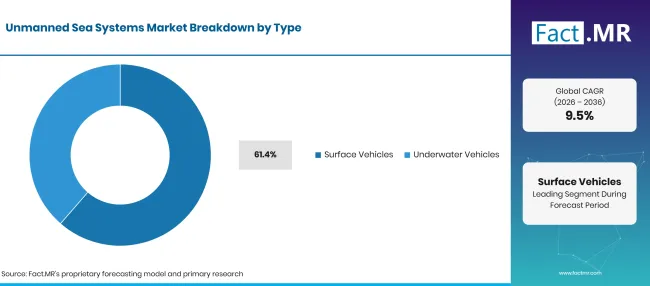
Unmanned Sea Systems Market Breakdown Type | Source: Fact.MR
| Type | Share (2026) |
|---|---|
| Surface Vehicles (Leading segment) | 61.4% |
| Other segments combined | 38.6% |
| Total | 100.0% |
Source: Fact.MR analysis. Updated Nov 11, 2026
Surface platforms can carry radar and optical sensors while maintaining routine radio communication above water. Military customers can use these craft for coastal surveillance and mine detection. Underwater vehicles serve a different task when an operator needs to map the seabed or inspect submerged structures. Autonomous underwater designs limit the need for constant piloting, while remotely operated vehicles suit hands-on inspection.
What leads the Application segment?
Defense applications represent 48.2% of 2026 demand.
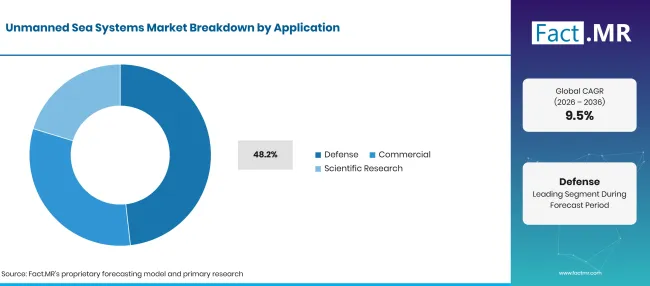
Unmanned Sea Systems Market Breakdown Application | Source: Fact.MR
| Application | Share (2026) |
|---|---|
| Defense (Leading segment) | 48.2% |
| Other segments combined | 51.8% |
| Total | 100.0% |
Source: Fact.MR analysis. Updated Nov 11, 2026
Defense customers assess mission readiness as a complete system that includes communication and secure control. Naval users also need a reliable way to recover the craft following a fault or a completed survey. Commercial applications include oil and gas inspection and routine offshore data collection. Scientific research places more weight on the accuracy of observations and the ability to repeat a survey route.
How does System shape demand?
Propulsion captures 34.2% of 2026 system value.
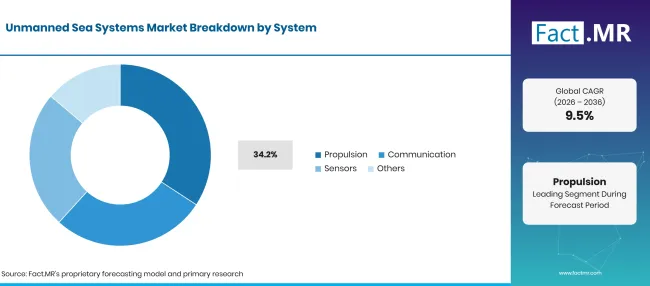
Unmanned Sea Systems Market Breakdown System | Source: Fact.MR
| System | Share (2026) |
|---|---|
| Propulsion (Leading segment) | 34.2% |
| Other segments combined | 65.8% |
| Total | 100.0% |
Source: Fact.MR analysis. Updated Nov 11, 2026
Propulsion determines how far a surface craft can travel or how long an underwater system can remain on task. Energy storage and drive design influence the number of trips a fleet must make. Communication links are essential when vehicles send status updates from offshore waters. Sensor packages turn vehicle movement into usable surveys and reconnaissance.
Which End-User segment leads?
Military users lead with 48.8% of 2026 spending.
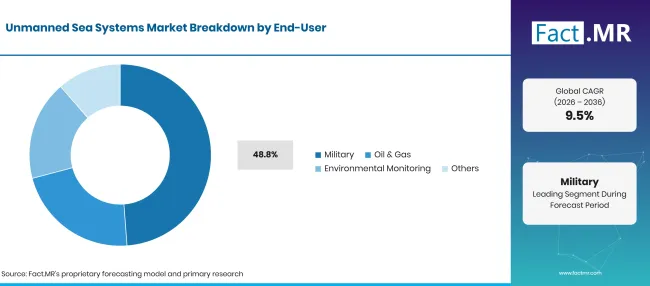
Unmanned Sea Systems Market Breakdown End User | Source: Fact.MR
| End-User | Share (2026) |
|---|---|
| Military (Leading segment) | 48.8% |
| Other segments combined | 51.2% |
| Total | 100.0% |
Source: Fact.MR analysis. Updated Nov 11, 2026
Military programmes combine vehicle qualification with operational exercises and the testing of command systems. Commercial operators usually compare a vehicle with the cost of a crewed survey vessel or a remotely operated inspection package. Environmental monitoring programmes need consistent measurements collected across repeated routes. Universities and institutes may choose smaller systems that are easier to transport.
What is accelerating Unmanned Sea Systems Market adoption, and what is holding it back?
Naval mine clearance and more detailed seabed surveys encourage investment in unmanned systems, while endurance, communications and launch requirements influence the speed of adoption. Drivers Impact Analysis
| DRIVER | (~) % IMPACT ON CAGR | GEOGRAPHIC RELEVANCE | IMPACT TIMELINE |
|---|---|---|---|
| Naval mine-countermeasure systems | +1.3% | North America, Western Europe | Medium term |
| Offshore pipeline and seabed surveys | +1.1% | Latin America, North America | Medium term |
| Coastal surveillance and patrol | +0.8% | East Asia, Europe | Short term |
| Reusable mission payloads | +0.6% | Global | Medium term |
| Ocean research and monitoring | +0.5% | Global | Long term |
Source: Fact.MR analysis. Updated Nov 11, 2026
Opportunity Impact Analysis
| OPPORTUNITY | (~) % IMPACT ON CAGR | GEOGRAPHIC RELEVANCE | IMPACT TIMELINE |
|---|---|---|---|
| Seabed infrastructure inspection | +0.8% | Atlantic, offshore Brazil | Medium term |
| Long-duration autonomous mapping | +0.6% | Global | Long term |
| Ship-compatible launch and recovery | +0.5% | North America, Europe | Medium term |
| Multi-purpose sensor integration | +0.4% | Global | Short term |
Source: Fact.MR analysis. Updated Nov 11, 2026
Restraints Impact Analysis
| RESTRAINT | (~) % IMPACT ON CAGR | GEOGRAPHIC RELEVANCE | IMPACT TIMELINE |
|---|---|---|---|
| Vehicle and sensor acquisition cost | -0.7% | Global | Short term |
| Underwater communication limits | -0.5% | Global | Medium term |
| Launch and recovery complexity | -0.4% | Offshore regions | Short term |
| Mission assurance requirements | -0.3% | Defense markets | Long term |
Source: Fact.MR analysis. Updated Nov 11, 2026
Which countries are scaling the Unmanned Sea Systems Market through 2036?
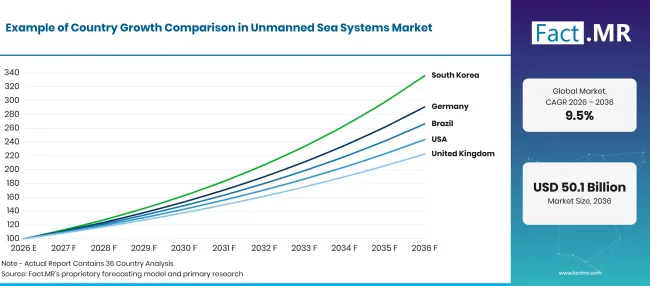
Unmanned Sea Systems Market Growth Index | Source: Fact.MR
| Country | CAGR (2026 to 2036) |
|---|---|
| Germany | 11.3% |
| Brazil | 10.3% |
| USA | 9.3% |
| UK | 8.3% |
| Japan | 7.4% |
Source: Fact.MR analysis. Updated Nov 11, 2026
Why is Germany advancing unmanned sea system adoption?
11.3% CAGR, tied to naval underwater surveillance and system qualification.
Germany’s naval teams are placing greater attention on underwater observation systems that can operate alongside existing ships. In February 2026, the Bundeswehr described the handover of a Blue Whale unmanned underwater vehicle measuring 10.9 metres in length. Navigation must remain reliable below the surface, and launch arrangements must fit naval routines.
How are offshore and naval applications shaping Brazil’s market?
10.3% CAGR, linked to offshore surveys and naval surface trials.
Brazil’s offshore energy industry creates a practical setting for unmanned underwater survey work, especially where operators need repeated checks of assets at sea. In September 2025, the Brazilian Navy’s CASNAV described two unmanned surface vessels in its development programme. Weather conditions affect when surface and subsea equipment can be recovered.
What is driving unmanned maritime system deployment in the USA?
9.3% CAGR, supported by mine-countermeasure and ocean survey work.
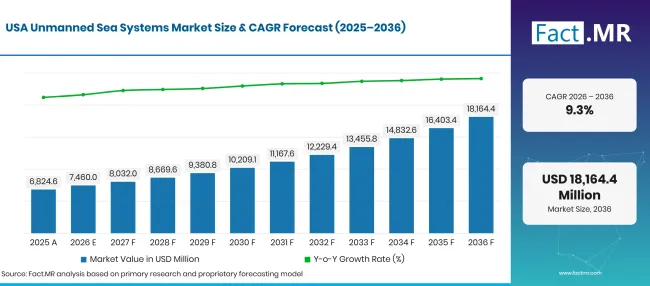
Unmanned Sea Systems Market Forecast Usa | Source: Fact.MR
The United States has naval testing programmes and commercial survey operators that use unmanned maritime platforms for different tasks. In May 2026, the U.S. Navy selected seven companies for medium unmanned surface vessel demonstrations at sea. Military users place particular weight on safe recovery and secure control.
How is mine-clearance activity influencing UK adoption?
8.3% CAGR, associated with autonomous mine clearance and underwater trials.
The United Kingdom is using mine clearance as a practical route for bringing unmanned systems into naval service. In October 2025, UK Defence Innovation reported that the CETUS autonomous underwater test vehicle weighed 20 tonnes and had begun Royal Navy trials earlier that year. Separate mine-hunting programmes are bringing surface craft into service with shore or ship-based control.
Where is Japan expanding the role of unmanned maritime systems?
7.4% CAGR, linked to unmanned coastal defense and ship integration.
Japan is looking at unmanned maritime systems as one part of its wider plans for monitoring coastal waters. In December 2025, the Ministry of Defense published an FY2026 allocation of about JPY 277.3 billion for unmanned defense capabilities across several domains. Work with existing naval vessels is expected to guide system selection as operators assess how autonomous craft fit day-to-day missions.
Who leads the Unmanned Sea Systems Market?
Marine autonomy companies serve different parts of the unmanned sea systems market. General Dynamics Mission Systems supplies Bluefin underwater vehicles for missions that need mapping and subsea observation. Kongsberg Gruppen, through Kongsberg Discovery, offers the HUGIN autonomous underwater vehicle family for seabed survey work.
Thales connects surface craft with sonar and remote-control equipment used for mine clearance. These suppliers compete on the full operating package, including the sensors carried onboard and the ability to return information that crews can use. Naval customers also examine how an unmanned craft communicates with ships already in service.
Lockheed Martin Corporation and Northrop Grumman Corporation participate in wider naval autonomy and mission-system work. RTX Corporation is relevant through marine sensing and naval electronics, although its position differs from companies selling complete underwater vehicle families. BAE Systems works across maritime control and autonomous systems, while Saab AB supplies underwater systems through its naval technology businesses.
L3Harris Technologies supplies Iver underwater vehicles used for seabed survey and naval mine work. In February 2025, the Royal Navy reported that three Iver4 580 vehicles had entered service with its Mine and Threat Exploitation Group. Teledyne Technologies competes through the Teledyne Marine portfolio of gliders and subsea instruments. In October 2025, Teledyne Marine announced the launch of its Redwing Slocum Sentinel glider for a long-range ocean observation mission.
Which companies are the key providers?
Key companies include Lockheed Martin Corporation; General Dynamics Mission Systems; RTX Corporation; Northrop Grumman Corporation; BAE Systems; Thales Group; Kongsberg Gruppen ASA; Saab AB; L3Harris Technologies, Inc.; Teledyne Technologies Incorporated.
- Lockheed Martin Corporation
- General Dynamics Mission Systems
- RTX Corporation
- Northrop Grumman Corporation
- BAE Systems
- Thales Group
- Kongsberg Gruppen ASA
- Saab AB
- L3Harris Technologies, Inc.
- Teledyne Technologies Incorporated
Bibliography
- Bundeswehr. (2026, February 25). Blue Whale: Marine erhält neues Unterwassersystem.
- Centro de Análises de Sistemas Navais. (2025, September 26). Projeto de Desenvolvimento do Veículo de Superfície Não Tripulado (VSNT.
- Kongsberg Discovery. (2026, March 12). Kongsberg Listen scores commercial breakthrough with DOF HUGIN order.
- Naval Sea Systems Command. (2025, February 3). U.S. Navy Awards Contract for Deployment of Future Mine Countermeasures Capabilities.
- National Oceanic and Atmospheric Administration. (2025, July 7). New Autonomous Vehicle Helps Advance Understanding of the Deep Ocean and its Critical Minerals.
- Royal Navy. (2025, February 25). New uncrewed vessels to support Royal Navy minehunting operations.
- Teledyne Marine. (2025, October 21). Teledyne Marine’s Slocum Sentinel “Redwing” Glider Successfully Launched in Historic Global Ocean Mission.
- UK Ministry of Defence. (2025, March 14). First uncrewed mine countermeasures vessel delivered to UK Royal Navy, supporting British jobs and boosting British security.
- UK Defence Innovation. (2025, October 1). UKDI: Three naval testbeds transform defence innovation.
- [United States Navy. (2026, May 29). U.S. Navy Announces Seven Companies Selected for MUSV Marketplace At-Sea Demonstrations.
This Report Answers
- The report examines where surface and underwater vehicles meet different operating needs and how buyers compare mission suitability.
- Application analysis separates defense tasks from offshore survey contracts and scientific observations.
- System coverage explains how propulsion, communication and sensors affect vehicle selection and operating costs.
- Country outlooks compare different naval programmes and commercial uses in Germany, Brazil, the USA, the UK and Japan.
- Competitive coverage distinguishes vehicle producers from broader maritime system integrators without attaching company shares.
What does the Unmanned Sea Systems Market cover?
The scope covers complete unmanned maritime platforms designed for surface and subsea operation. It includes systems sold for naval patrols and mine-countermeasure missions as well as commercial subsea mapping.
What is included in the scope?
Autonomous and remotely operated surface craft count when they are built for professional maritime missions.
Underwater vehicles are included when sold as operational platforms with their standard control and mission equipment. Vehicle-based propulsion and sensor systems remain part of the complete-system value.
What is excluded from the scope?
Crewed ships and submarines fall outside the revenue boundary.
Airborne drones are excluded even when they operate from naval vessels. Spare sensors sold independently and standalone survey-service fees are outside the complete-vehicle definition unless bundled into the platform sale.
How Was the Analysis Built?
The analysis draws on 120+ sources, 35+ company portfolios, 25+ countries, and more than 20 industry interviews.
- Primary Research: Primary research includes discussions with manufacturers, service providers, technology developers, distributors, end users, and subject-matter experts. These conversations examine purchasing priorities, product adoption, operational challenges, approval requirements, competitive positioning, and the factors that influence wider market acceptance.
- Desk Research: Desk research covers government statistics, regulatory publications, company filings, trade data, technical studies, industry associations, standards, public policy, and other authoritative sources. Every source used in the analysis is documented in the bibliography.
- Market Sizing and Forecasting: Market estimates combine historical performance, demand indicators, pricing and volume trends, segment shares, company participation, country-level growth, adoption patterns, investment activity, and barriers to market expansion.
- Data Validation and Update Cycle: Findings are validated by comparing primary interviews with public data, company activity, regulatory changes, trade patterns, and industry developments. Regular updates review new product launches, capacity changes, partnerships, approvals, and shifts in commercial adoption.
Segmentation
What is the report’s scope and coverage?
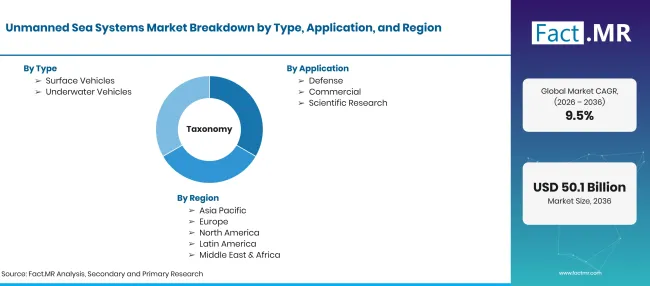
Unmanned Sea Systems Market Taxonomy | Source: Fact.MR
| Attribute | Details |
|---|---|
| Quantitative Units | USD Billion |
| Market Definition | Unmanned vehicles operating on the sea surface or underwater for naval, commercial, research and monitoring missions. |
| Type | Surface Vehicles; Underwater Vehicles |
| Application | Defense; Commercial; Scientific Research |
| System | Propulsion; Communication; Sensors; Others |
| End-User | Military; Oil & Gas; Environmental Monitoring; Others |
| Regions Covered | North America; Latin America; Western Europe; Eastern Europe; East Asia; South Asia & Pacific; Middle East & Africa |
| Countries Covered | Germany; Brazil; USA; UK; Japan |
| Companies Profiled | Lockheed Martin Corporation; General Dynamics Mission Systems; RTX Corporation; Northrop Grumman Corporation; BAE Systems; Thales Group; Kongsberg Gruppen ASA; Saab AB; L3Harris Technologies, Inc.; Teledyne Technologies Incorporated |
| Forecast Period | 2026 to 2036 |
| Approach | Market sizing across platform sales, mission applications, user categories and country-level demand indicators. |
Source: Fact.MR analysis. Updated Nov 11, 2026
How is the market segmented?
-
By Type
- Surface Vehicles
- Underwater Vehicles
-
By Application
- Defense
- Commercial
- Scientific Research
-
By System
- Propulsion
- Communication
- Sensors
- Others
-
By End-User
- Military
- Oil & Gas
- Environmental Monitoring
- Others
-
By Region
- North America
- Latin America
- Western Europe
- Eastern Europe
- East Asia
- South Asia & Pacific
- Middle East & Africa
Frequently Asked Questions
How big is the Unmanned Sea Systems Market in 2026?
What is the CAGR of the Unmanned Sea Systems Market from 2026 to 2036?
Which type leads the Unmanned Sea Systems Market?
Which application leads the Unmanned Sea Systems Market?
Who are the leading companies in the Unmanned Sea Systems Market?
Who worked on this report


Preview the report firsthand - request a free sample
Free SampleGet the brochure for pricing and purchase details
Download PDF