- Market Value (2025): USD 5.05 Bn
- Estimated Value (2026): USD 5.68 Bn
- Forecast Value (2036): USD 18.4 Bn
- CAGR (2026-2036): 12.5%
What is the Unmanned Underwater Vehicles (UUV) Market forecast to be worth by 2036?
USD 5.7 billion in 2026 to USD 18.4 billion by 2036 at a 12.5% CAGR.
- Worth USD 5.05 billion in 2025, the unmanned underwater vehicles market drew most of its revenue from offshore survey and subsea inspection work.
- Revenue will grow from USD 5.68 billion in 2026 to USD 18.4 billion by 2036 as navies order mine-hunting and seabed-security vehicles alongside commercial fleets.
- A 12.5% CAGR from 2026 to 2036 will follow from deeper-rated autonomous vehicles that cover more seabed per mission.
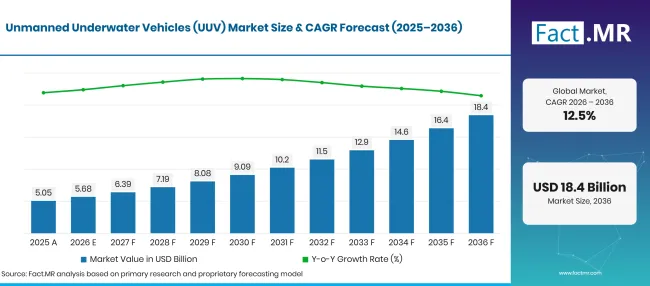
Unmanned Underwater Vehicles Uuv Market Forecast Global | Source: Fact.MR
| Year | Basis | Market Value (USD billion) |
|---|---|---|
| 2025 | Actual | 5.05 |
| 2026 | Estimate | 5.68 |
| 2036 | Forecast | 18.4 |
| CAGR 2026 to 2036 | Forecast period | 12.5% |
Source: Fact.MR analysis. Updated Oct 30, 2026
What are the defining numbers behind Unmanned Underwater Vehicles (UUV) Market growth?
The 2026 to 2036 period adds USD 12.7 billion in new value, led by offshore energy and naval programs.
- Demand Drivers in the Market
- Navies want to watch the seabed with fewer crewed ships. The UK Ministry of Defence said in December 2025 that MOD and industry had committed £14 million of seedcorn funding to its Atlantic Bastion undersea program, and 26 UK and European firms bid with anti-submarine sensor proposals [1]. Programs of this kind create steady orders for sensor-carrying autonomous vehicles.
- Damage to undersea cables has put infrastructure protection on the defense agenda. NATO launched Baltic Sentry in January 2025 after cables linking Estonia and Finland were damaged on December 25, 2024 [2]. Patrols that cover pipelines and cables need vehicles able to inspect the seabed repeatedly.
- Large parts of national waters remain poorly charted. The U.S. Interagency Working Group on Ocean and Coastal Mapping reported that 68% of the 787,000 square nautical miles of the Alaska Arctic was unmapped at the end of 2025 [3]. Hydrographic offices and survey contractors turn to AUVs to close such gaps faster than ship-based sonar alone.
- Offshore oil and gas fields need inspection for their whole working life. Pipelines, risers and wellheads are checked on fixed cycles, and work-class ROVs carry out the repair tasks that follow.
- Better batteries and onboard processing let one vehicle do more per dive. Operators can now review sonar data during a mission and send the vehicle back to a target without recovering it.
- Key Segments Analyzed
- By Type: Autonomous Underwater Vehicles (AUV) will hold 54.2% share in 2026, since they survey wide areas without a tether to a support vessel.
- By Application: Commercial Exploration will account for 42.6% share in 2026 through seabed mapping and pipeline route surveys for offshore energy.
- By Propulsion System: Electric will capture 67.3% share in 2026, given that battery-driven thrusters run quietly and suit compact hulls.
- By End-User: Oil and Gas will command 79.9% share in 2026 as producers book inspection, maintenance and repair work on subsea assets.
- Analyst Opinion at Fact.MR
- Shambhu Nath Jha, Principal Consultant at Fact.MR, states, “Offshore producers still write most of the cheques, because every subsea field needs inspection for decades. The faster change is on the naval side, where mine hunting and cable protection are moving from crewed ships to vehicles. Suppliers that pair long battery endurance with sonar data the operator can trust will win repeat orders from both groups.”
- Strategic Implications
- Vehicle makers should design modular payload bays, so one hull can switch between pipeline inspection, mine hunting and mapping sensors.
- Offshore operators should move routine pipeline and riser surveys to AUVs, keeping work-class ROVs for intervention tasks.
- Defense ministries should fund launch and recovery from existing ships and submarines, since host-platform integration often delays fielding.
- Sensor and battery suppliers should qualify cells and sonar heads for pressure ratings beyond 6,000 metres to reach deep-water customers.
At 14.4% CAGR, Germany will move ahead as its navy adds drone-based mine hunting. Brazil follows at 13.1%, with pre-salt fields demanding constant subsea inspection. The United States reaches 11.9% through Gulf of America production and naval autonomy programs. For the United Kingdom, a 10.6% pace reflects submarine-launched vehicles and seabed security work. Japan rounds off the group at 9.4%, where deep-ocean research drives vehicle development.
How does the Unmanned Underwater Vehicles (UUV) Market break down by segment?
Autonomous Underwater Vehicles (AUV) will lead Type at 54.2%; Commercial Exploration will top Application at 42.6%; Electric will head Propulsion System at 67.3%; Oil and Gas will hold first place in End-User at 79.9%.
Which Type leads?
AUVs take 54.2% of 2026 sales.
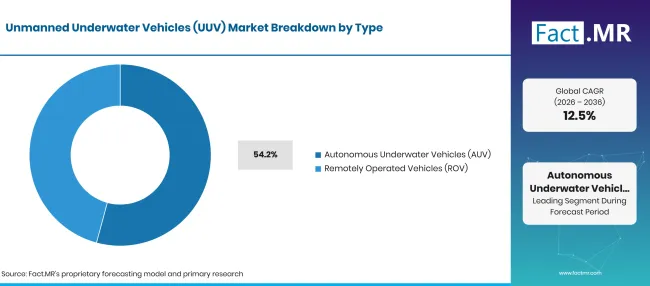
Unmanned Underwater Vehicles Uuv Market Breakdown Type | Source: Fact.MR
| Type | Share (2026) |
|---|---|
| Autonomous Underwater Vehicles (AUV) (Leading segment) | 54.2% |
| Other segments combined | 45.8%* |
| Total | 100.0% |
Source: Fact.MR analysis. Updated Oct 30, 2026
Survey companies prefer vehicles that follow a pre-planned track for a full day while the mother ship does other work. AUVs carry multibeam echosounders and synthetic aperture sonar over large areas without a tether. Remotely operated vehicles remain the tool for valve turning, cleaning and repair, and rental fleets of underwater drones serve short inspection jobs. Depth ratings keep rising. NOAA Ocean Exploration reported in July 2025 that the Orpheus AUV completed several dives below 5,600 metres and imaged polymetallic nodules at 5,645 metres east of the Mariana Trench [4]. Demand for autonomous underwater vehicles grows as such depths become routine.
What supports Commercial Exploration within Application?
Commercial Exploration represents 42.6% of 2026 revenue.
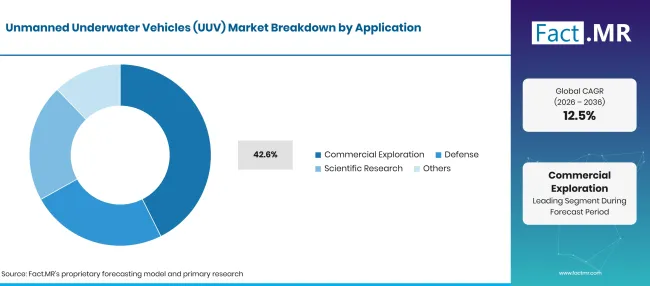
Unmanned Underwater Vehicles Uuv Market Breakdown Application | Source: Fact.MR
| Application | Share (2026) |
|---|---|
| Commercial Exploration (Leading segment) | 42.6% |
| Other segments combined | 57.4%* |
| Total | 100.0% |
Source: Fact.MR analysis. Updated Oct 30, 2026
Energy companies map routes, check pipelines and assess the seabed before every new subsea development. Survey contractors bundle vehicles, sonar and data processing into long-term contracts with field operators. In March 2026, Kongsberg Discovery announced that DOF ordered a HUGIN 3000 AUV with Kongsberg Listen electromagnetic sensing for deep-water survey and inspection off Brazil [5]. Defense covers mine countermeasures and reconnaissance, while scientific research funds deep-ocean exploration. Cable route surveys for submarine power cables add work for offshore wind developers.
How does Propulsion System shape demand?
Electric drives take a 67.3% share in 2026.
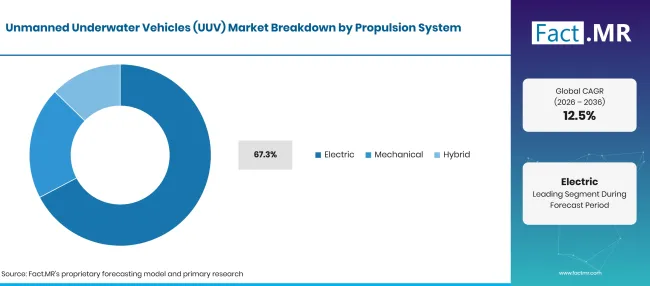
Unmanned Underwater Vehicles Uuv Market Breakdown Propulsion System | Source: Fact.MR
| Propulsion System | Share (2026) |
|---|---|
| Electric (Leading segment) | 67.3% |
| Other segments combined | 32.7%* |
| Total | 100.0% |
Source: Fact.MR analysis. Updated Oct 30, 2026
Small and mid-size vehicles have little room for fuel or engines. Battery-powered thrusters give fine control during hovering and produce low noise, which helps sonar imaging and covert naval work. Pressure-tolerant lithium-ion batteries set mission length for most AUVs. Hybrid systems that combine batteries with diesel generators serve extra-large vehicles such as Boeing’s Orca, which travel for weeks. Mechanical and hydraulic drives stay in heavy work-class ROVs powered from the surface.
What leads the End-User segment?
Oil and Gas accounts for 48.2% of 2026 demand.
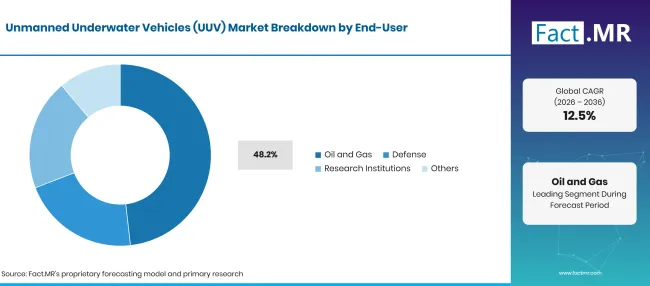
Unmanned Underwater Vehicles Uuv Market Breakdown End User | Source: Fact.MR
| End-User | Share (2026) |
|---|---|
| Oil and Gas (Leading segment) | 79.9% |
| Other segments combined | 20.1%* |
| Total | 100.0% |
Source: Fact.MR analysis. Updated Oct 30, 2026
Offshore producers must inspect pipelines, risers and wellheads under strict integrity rules for the life of each field. Work-class ROVs with manipulators handle the repair work that follows each inspection. Oceaneering won a multi-year contract in May 2025 from bp Mauritania Investments Limited for inspection, maintenance and repair at the Greater Tortue Ahmeyim field, served by a vessel carrying two of its subsea robots [6]. Defense agencies and research institutions buy fewer vehicles but specify higher autonomy and deeper ratings.
What is accelerating Unmanned Underwater Vehicles (UUV) Market adoption, and what is holding it back?
Offshore inspection cycles, naval mine hunting and seabed mapping push buyers toward vehicles that work without divers. High vehicle and sensor costs, along with weak underwater communication, still slow adoption among smaller operators.
Drivers Impact Analysis
| DRIVER | (~) % IMPACT ON CAGR | GEOGRAPHIC RELEVANCE | IMPACT TIMELINE |
|---|---|---|---|
| Offshore pipeline, riser and wellhead inspection with AUVs and ROVs | +2.1% | Global | Short term (<= 2 years) |
| Naval spending on mine countermeasures and undersea surveillance | +1.8% | North America, Western Europe, East Asia | Medium term (2-4 years) |
| Advances in autonomy, navigation and sonar resolution | +1.3% | Global | Medium term (2-4 years) |
| Seabed mapping and deep-ocean research programs | +0.8% | East Asia, North America, Western Europe | Long term (>= 4 years) |
Source: Fact.MR analysis. Updated Oct 30, 2026
Opportunity Impact Analysis
| OPPORTUNITY | (~) % IMPACT ON CAGR | GEOGRAPHIC RELEVANCE | IMPACT TIMELINE |
|---|---|---|---|
| Long-endurance AUVs for deep-water survey | +0.8% | Global | Medium term (2-4 years) |
| Modular sensor payloads shared across commercial and defense missions | +0.6% | Global | Medium term (2-4 years) |
| Resident vehicles docked on the seabed for offshore inspection | +0.5% | North America, Latin America, Western Europe | Short term (<= 2 years) |
| Protection of undersea cables and pipelines | +0.4% | Western Europe, North America, East Asia | Long term (>= 4 years) |
Source: Fact.MR analysis. Updated Oct 30, 2026
Restraints Impact Analysis
| RESTRAINT | (~) % IMPACT ON CAGR | GEOGRAPHIC RELEVANCE | IMPACT TIMELINE |
|---|---|---|---|
| High upfront cost of vehicles, payloads and launch equipment | -0.6% | Global | Short term (<= 2 years) |
| Limits of underwater communication, navigation and recovery | -0.4% | Global | Medium term (2-4 years) |
| Shortage of trained operators and maintenance support | -0.3% | Latin America, Middle East & Africa | Medium term (2-4 years) |
Source: Fact.MR analysis. Updated Oct 30, 2026
Which countries are scaling the Unmanned Underwater Vehicles (UUV) Market through 2036?
| Country | CAGR (2026 to 2036) |
|---|---|
| Germany | 14.4% |
| Brazil | 13.1% |
| United States | 11.9% |
| United Kingdom | 10.6% |
| Japan | 9.4% |
Source: Fact.MR analysis. Updated Oct 30, 2026
What supports Germany’s adoption?
14.4% CAGR, driven by navy investment in drone-based mine countermeasures.
The Bundeswehr reported in May 2025 that its contract covers four autonomous SeaCat drones, with options for more, to be integrated with Class 332 minehunters [7]. SeaCat uses synthetic aperture sonar to image the seabed at depths of up to 300 metres [7]. Offshore wind adds civil inspection work, with the Bundesnetzagentur counting 9.5 GW of offshore wind capacity in the North and Baltic Seas at the end of 2025 [8].
How is Brazil developing demand?
13.1% CAGR, backed by deep-water oil output from pre-salt fields.
Brazil’s National Agency of Petroleum, Natural Gas and Biofuels reported that oil production averaged about 3.8 million barrels per day in 2025, up 12% from 2024 [9]. Pre-salt fields supplied roughly 80% of that output [9]. These fields lie in deep water, so operators rely on ROVs and AUVs for pipeline surveys, riser checks and seabed mapping.
What is supporting the United States’ adoption?
11.9% CAGR, reflecting Gulf of America development and Navy autonomy programs.
The U.S. Energy Information Administration reported that Gulf of America crude output averaged 1.9 million barrels per day in 2025, helped by five new projects including Whale and Ballymore [10]. Each new deep-water project adds subsea equipment that needs regular inspection. The Navy also funds mine-hunting and extra-large autonomous vehicles built by domestic suppliers.
How is the United Kingdom scaling demand?
10.6% CAGR, helped by submarine-launched autonomy and seabed security.
The Royal Navy reported in July 2025 that uncrewed underwater vehicles were launched and recovered through the torpedo tube of a submarine in the Mediterranean under Project Scylla [11]. The work, delivered with L3Harris through AUKUS Pillar 2, supports underwater reconnaissance and seabed warfare [11]. North Sea pipelines and cables keep commercial inspection demand steady.
How does Japan perform?
9.4% CAGR, as deep-ocean science shapes vehicle design.
JAMSTEC reported in May 2026 that its Urashima 8000 AUV sent downsampled side-scan sonar images to the surface at up to about 58 kbps from 7,000 to 7,500 metres in the Japan Trench [12]. Near real-time imaging lets researchers adjust a survey while the vehicle is still submerged. Deep-trench science missions also test sensors that later reach commercial survey vehicles.
Who leads the Unmanned Underwater Vehicles (UUV) Market?
Three groups shape supply. Survey AUV specialists compete on endurance and sensor quality. Kongsberg Discovery sells the HUGIN family, and Teledyne Marine offers Gavia, Osprey and SeaRaptor vehicles. L3Harris builds the Iver range. In March 2026, Kongsberg won a DOF order for a HUGIN 3000 fitted with its Listen sensor for work off Brazil [5].
Defense primes compete on mission integration. General Dynamics Mission Systems supplies Bluefin vehicles for mine hunting, and Boeing builds the Orca extra-large vehicle. ATLAS ELEKTRONIK offers the SeaCat hybrid AUV, the drone type ordered for German minehunters [7]. L3Harris also supported the Royal Navy’s Project Scylla trials in 2025 [11]. Saab and Oceaneering anchor the inspection group with Sabertooth and work-class ROVs, and Oceaneering added a bp contract in Mauritania in May 2025 [6]. Proven depth ratings and payload integration will separate the winners as naval and offshore orders grow.
Which companies are the key providers?
Key companies include Kongsberg Discovery; Teledyne Marine; Saab AB; General Dynamics Mission Systems; The Boeing Company; ATLAS ELEKTRONIK GmbH; L3Harris Technologies, Inc.; and Oceaneering International, Inc.
- Kongsberg Discovery
- Teledyne Marine
- Saab AB
- General Dynamics Mission Systems
- The Boeing Company
- ATLAS ELEKTRONIK GmbH
- L3Harris Technologies, Inc.
- Oceaneering International, Inc.
Bibliography
- [1] Ministry of Defence, United Kingdom. (2025, December 8). UK unveils new undersea warfare technology to counter threat from Russia.
- [2] NATO Supreme Headquarters Allied Powers Europe. (2025, January 14). Baltic Sentry to enhance NATO’s presence in the Baltic Sea.
- [3] Interagency Working Group on Ocean and Coastal Mapping, NOAA. (2026, March). 2026 Progress Report: Unmapped U.S. Waters.
- [4] NOAA Ocean Exploration. (2025, July 7). New Autonomous Vehicle Helps Advance Understanding of the Deep Ocean and its Critical Minerals.
- [5] Kongsberg. (2026, March). Kongsberg Listen scores commercial breakthrough with DOF HUGIN order.
- [6] Oceaneering International. (2025, May 7). Oceaneering Announces Award of Inspection, Maintenance, and Repair Contract by bp Mauritania Investments Limited.
- [7] Bundeswehr. (2025, May 13). Neue SeaCat-Drohnen: Modernisierung der Minenjagdboote zur Seeminenabwehr [New SeaCat drones: Modernizing minehunters for mine defense].
- [8] Bundesnetzagentur. (2026, January 8). Growth in renewable energy in 2025.
- [9] Agência Nacional do Petróleo, Gás Natural e Biocombustíveis (ANP). (2026, June 30). ANP divulga dados consolidados do setor regulado em 2025 [ANP releases consolidated data for the regulated sector in 2025].
- [10] U.S. Energy Information Administration. (2026, March 31). U.S. crude oil production rose in 2025, setting new record.
- [11] Royal Navy. (2025, July 22). Royal Navy launches autonomous vehicles from submarine in pioneering trial.
- [12] Japan Agency for Marine-Earth Science and Technology. (2026, May 15). Successful real-time transmission of sonar images via high-speed acoustic communication from the 8,000 m class AUV Urashima 8000.
This Report Answers
- How much will UUV revenue grow between 2026 and 2036, and which buyers add the most value?
- For type, application, propulsion and end-user, readers learn which subsegment leads and why buyers choose it.
- Naval programs, offshore output and ocean research frame the comparison of Germany, Brazil, the United States, the United Kingdom and Japan.
- Vehicle makers and service operators are grouped by role, with their recent contracts and product lines.
- Battery limits, underwater communication and operator skills are weighed as checks on adoption.
What does the Unmanned Underwater Vehicles (UUV) Market cover?
Autonomous underwater vehicles and remotely operated vehicles form the two vehicle types in this market. AUVs follow pre-programmed missions using onboard navigation, while ROVs stay connected to a surface vessel by a tether that carries power and control signals.
Buyers include offshore energy companies, navies, survey contractors and research institutes. Vehicles differ by depth rating, payload capacity, endurance and degree of autonomy, from hand-launched units to extra-large naval vehicles.
What is included in the scope?
Complete AUVs and ROVs sold with their standard navigation, sonar and camera payloads are counted, across electric, mechanical and hybrid propulsion. Torpedo-tube launched and extra-large naval vehicles are included.
Vehicles used for offshore wind foundation checks are in scope, while airborne wind turbine drone inspection stays outside. Small inspection-class underwater robots count when they are sold for professional survey or inspection work.
What is excluded from the scope?
Crewed submersibles, submarines, unmanned surface vessels and aerial drones are left out. Sonar heads, batteries and navigation units sold separately as spare parts are also excluded.
Offshore service revenue from vessel charter, data processing and diving is not counted, unless it forms part of a vehicle sale.
How Was the Analysis Built?
The analysis draws on 120+ sources, 35+ company portfolios, 25+ countries, and more than 20 industry interviews.
- Primary Research: Primary research includes discussions with manufacturers, service providers, technology developers, distributors, end users, and subject-matter experts. These conversations examine purchasing priorities, product adoption, operational challenges, approval requirements, competitive positioning, and the factors that influence wider market acceptance.
- Desk Research: Desk research covers government statistics, regulatory publications, company filings, trade data, technical studies, industry associations, standards, public policy, and other authoritative sources. Every source used in the analysis is documented in the bibliography.
- Market Sizing and Forecasting: Market estimates combine historical performance, demand indicators, pricing and volume trends, segment shares, company participation, country-level growth, adoption patterns, investment activity, and barriers to market expansion.
- Data Validation and Update Cycle: Findings are validated by comparing primary interviews with public data, company activity, regulatory changes, trade patterns, and industry developments. Regular updates review new product launches, capacity changes, partnerships, approvals, and shifts in commercial adoption.
Segmentation
What is the report’s scope and coverage?
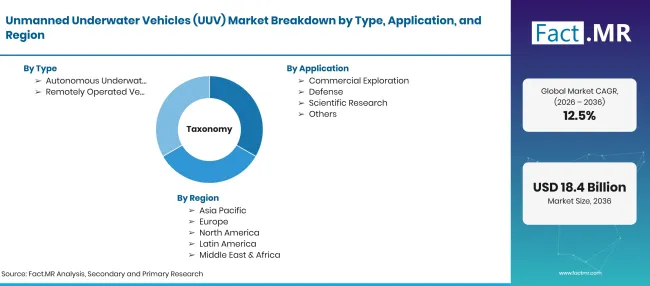
Unmanned Underwater Vehicles Uuv Market Taxonomy | Source: Fact.MR
| Attribute | Details |
|---|---|
| Quantitative Units | USD billion |
| Market Definition | Uncrewed vehicles that operate below the water surface, either autonomously or under remote control. The scope covers AUVs and ROVs sold for commercial exploration, defense, scientific research and other underwater work. |
| Type | Autonomous Underwater Vehicles (AUV); Remotely Operated Vehicles (ROV) |
| Application | Commercial Exploration; Defense; Scientific Research; Others |
| Propulsion System | Electric; Mechanical; Hybrid |
| End-User | Oil and Gas; Defense; Research Institutions; Others |
| Regions Covered | North America; Latin America; Western Europe; Eastern Europe; East Asia; South Asia & Pacific; Middle East & Africa |
| Countries Covered | Germany; Brazil; United States; United Kingdom; Japan |
| Companies Profiled | Kongsberg Discovery; Teledyne Marine; Saab AB; General Dynamics Mission Systems; The Boeing Company; ATLAS ELEKTRONIK GmbH; L3Harris Technologies, Inc.; Oceaneering International, Inc. |
| Forecast Period | 2026 to 2036 |
| Approach | Hybrid top-down and bottom-up approach using offshore field and pipeline counts; naval mine-countermeasure and seabed-security programs; vehicle prices by type and depth rating; propulsion split; and supplier portfolio review. |
Source: Fact.MR analysis. Updated Oct 30, 2026
How is the market segmented?
-
By Type
- Autonomous Underwater Vehicles (AUV)
- Remotely Operated Vehicles (ROV)
-
By Application
- Commercial Exploration
- Defense
- Scientific Research
- Others
-
By Propulsion System
- Electric
- Mechanical
- Hybrid
-
By End-User
- Oil and Gas
- Defense
- Research Institutions
- Others
-
By Region
- North America
- Latin America
- Western Europe
- Eastern Europe
- East Asia
- South Asia & Pacific
- Middle East & Africa
Frequently Asked Questions
How big is the unmanned underwater vehicles market in 2026?
What is the CAGR of the unmanned underwater vehicles market from 2026 to 2036?
Which type leads the unmanned underwater vehicles market?
Which application leads the unmanned underwater vehicles market?
Which propulsion system leads the unmanned underwater vehicles market?
Which end-user leads the unmanned underwater vehicles market?
Which country will grow the most in the unmanned underwater vehicles market?
Who are the main companies in the unmanned underwater vehicles market?
Who worked on this report


Preview the report firsthand - request a free sample
Free SampleGet the brochure for pricing and purchase details
Download PDF