- Market Value (2025): USD 478.1 Mn
- Estimated Value (2026): USD 525.0 Mn
- Forecast Value (2036): USD 1337.2 Mn
- CAGR (2026-2036): 9.8%
What is the UV Cure Silicones Market forecast to be worth by 2036?
USD 1337.2 million by 2036 at 9.8% CAGR.
- The UV Cure Silicones Market reached USD 478.1 million in 2025.
- Demand is projected to increase from USD 525.0 million in 2026 to USD 1337.2 million by 2036.
- The market is forecast to record a 9.8% CAGR from 2026 to 2036.
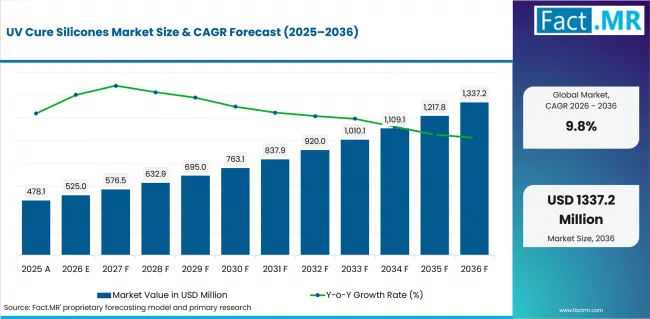
Uv Cure Silicones Market Value Analysis | Source: Fact.MR
What are the defining numbers behind UV Cure Silicones Market growth?
An absolute opportunity of USD 815.0 million is expected between 2026 and 2036.
- Demand Drivers in the Market
- Electronics protection requires materials that cure within a defined station time while maintaining adhesion or protection on the finished assembly. Buyers therefore qualify the formulation and the exposure process together.
- UV radical (acrylate-silicone) supports rapid light-initiated cure and can be adjusted for viscosity, flexibility or optical behaviour. This gives formulators a practical base for the applications listed in the stated taxonomy.
- Coatings leads its 2026 segment because installed equipment and package geometry favour its operating window. RadTech and IPC guidance show that spectral output, thickness and shadowing must be considered during qualification.
- Public semiconductor and electronics programmes in the USA and East Asia are adding assembly and packaging capacity. Each new line creates demand for qualified coatings, encapsulants or adhesive gels with local process support.
- Manufacturers are replacing manual cure judgements with controlled UV dose and inspection. Materials that support fluorescence, traceable recipes and a wider cure window reduce rework and improve repeatability.
- Key Segments Analyzed
- UV radical (acrylate-silicone) accounts for 33.0% of Cure Mechanism in 2026 because acrylate functionality gives fast surface cure while silicone supports flexibility.
- Coatings holds 38.0% of Product Form in 2026 because thin films receive more uniform UV exposure than deep volumes.
- Electronics protection represents 24.0% of Application in 2026 because UV cure shortens handling time on protected boards and components.
- Electronics manufacturers captures 43.0% of End User in 2026 because they control the material specification and the line where dispense, cure and inspection occur.
- Analyst Opinion at Fact.MR
- Shambhu Nath Jha, Senior Consultant at Fact.MR, states, "Buyer decisions in the UV Cure Silicones Market will centre on silicone flexibility and environmental protection delivered without a long moisture or thermal cure. Buyers will compare the 2026 segment leaders with qualification evidence and the operating cost of the full process. Suppliers that support application trials and preserve formulation or equipment consistency can move more quickly into repeat production."
- Strategic Implications
- Suppliers should document the process conditions that allow UV radical (acrylate-silicone) to deliver repeatable performance.
- Customer trials should use the intended substrate, fluid path or process stream before commercial qualification.
- Regional technical support is important in China and Japan because adoption depends on local production or infrastructure conditions.
- Commercial positioning should distinguish qualified application performance from general material or equipment capability.
How does the UV Cure Silicones Market break down by segment?
The market is segmented by Cure Mechanism, Product Form, Application and End User.
Why does UV radical (acrylate-silicone) lead Cure Mechanism?
UV radical (acrylate-silicone) is projected to account for a 32.7% share in 2026.
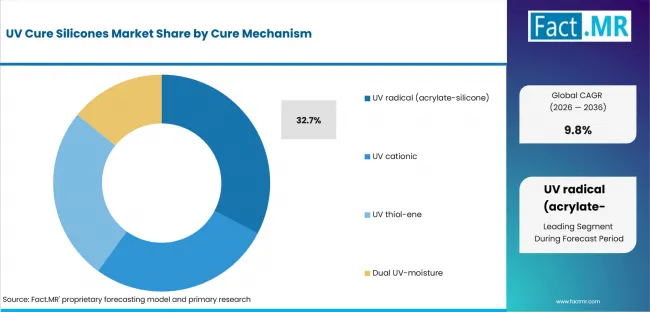
Uv Cure Silicones Market Analysis By Cure Mechanism | Source: Fact.MR
UV radical systems suit electronics protection because exposed material can cure within seconds under broad-spectrum UV or UV-LED light. Dow's UV-curable silicone conformal coatings use this approach while retaining a silicone-based protective layer for electronic assemblies.
The chemistry is particularly useful for thin coatings and localized protection where most of the applied material can be reached directly by light. Silicone contributes flexibility and environmental protection, while the acrylate functionality provides the rapid primary cure needed for short production cycles.
Why do Coatings lead Product Form?
Coatings are projected to account for a 37.6% share in 2026.
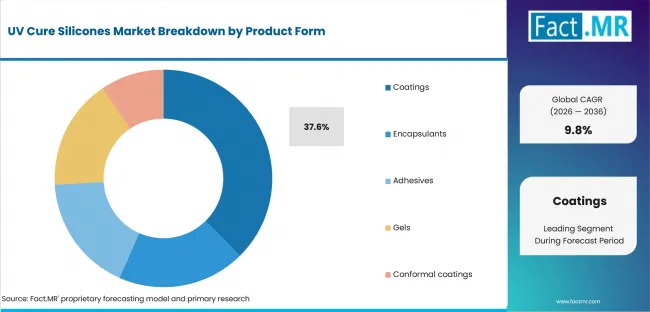
Uv Cure Silicones Market Analysis By Product Form | Source: Fact.MR
Coatings benefit from UV curing because a thin film exposes a large proportion of the applied material directly to the light source. This allows manufacturers to secure the protective layer quickly before the assembly moves to inspection or subsequent processing.
Silicone conformal coatings are already used to protect printed circuit boards and electronic components against humidity and corrosion while providing dielectric insulation and vibration resistance. Dow also offers UV or UV-LED-curable versions with secondary moisture cure for areas that remain shadowed.
Why does Electronics protection lead Application?
Electronics protection is projected to account for a 24.0% share in 2026.
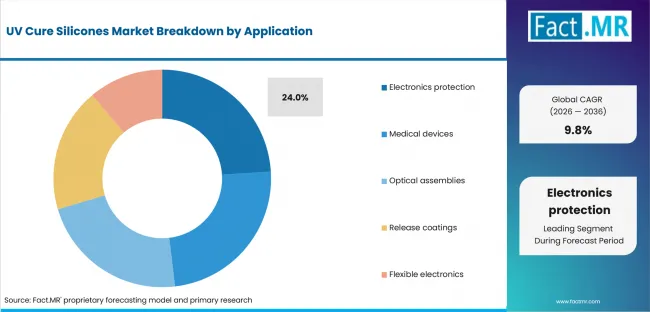
Uv Cure Silicones Market Analysis By Application | Source: Fact.MR
Electronic assemblies require protection from moisture, corrosion and mechanical stress without adding a rigid structural layer around the board. Silicone coatings address this need through dielectric insulation and flexibility, making them relevant to automotive electronics and other assemblies exposed to vibration or changing temperatures.
UV curing adds a production advantage because the exposed coating can reach handling condition quickly. Where components create shadowed regions, dual-cure silicone systems can use secondary moisture cure to complete protection beyond the direct light path.
Why do Electronics manufacturers lead End User?
Electronics manufacturers are projected to account for a 43.0% share in 2026.
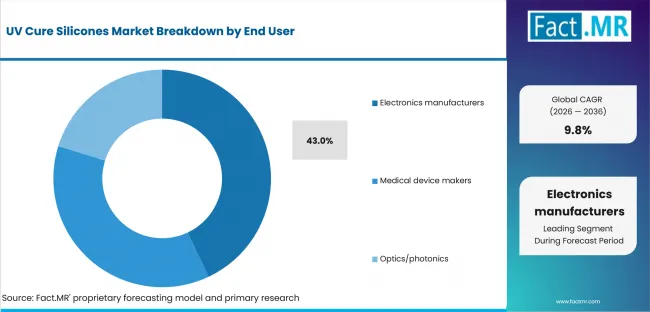
Uv Cure Silicones Market Analysis By End User | Source: Fact.MR
Electronics manufacturers control the production line on which coating thickness, dispensing method and cure exposure must work together. A material that performs well in isolation can still fail qualification if it does not flow around board features correctly or leaves uncured regions beneath components.
Manufacturers also bear the cost of coating defects through rework and delayed production. Supplier trials on actual assemblies therefore influence approval because they allow cure coverage and adhesion to be evaluated under the intended line conditions before the material enters volume use.
What is accelerating UV Cure Silicones Market adoption, and what is holding it back?
Drivers Impact Analysis
| Factor | (~) % Impact on CAGR | Geographic Relevance | Impact Timeline |
|---|---|---|---|
| Rapid electronics protection using UV-curable silicone systems | +2.7% | China, South Korea, Japan, USA and Germany | Short term (<= 2 years) |
| Shorter coating cycle times through UV and UV-LED curing | +2.2% | China, Japan, South Korea, USA and Europe | Medium term (2-4 years) |
| Growth in automotive and high-density electronic modules | +1.6% | China, Germany, Japan, South Korea and USA | Long term (>= 4 years) |
Opportunity Impact Analysis
| Factor | (~) % Impact on CAGR | Geographic Relevance | Impact Timeline |
|---|---|---|---|
| Dual-cure systems for shadowed board regions | +1.4% | China, Japan, South Korea, USA and Germany | Short term (<= 2 years) |
| UV-LED-compatible silicone coatings | +1.1% | Japan, China, South Korea, USA and Europe | Medium term (2-4 years) |
| Flexible protection for power-electronics assemblies | +0.8% | Germany, China, USA, Japan and South Korea | Long term (>= 4 years) |
Restraints Impact Analysis
| Factor | (~) % Impact on CAGR | Geographic Relevance | Impact Timeline |
|---|---|---|---|
| Incomplete cure in regions outside the direct light path | -1.3% | Global | Short term (<= 2 years) |
| Silicone contamination controls in sensitive assembly environments | -1.0% | Global | Medium term (2-4 years) |
| Adhesion variability across mixed electronic substrates | -0.7% | Global | Long term (>= 4 years) |
Dow's use of secondary moisture cure for shadowed areas confirms that incomplete UV exposure is a real process constraint rather than a country-specific issue.
Which countries are scaling the UV Cure Silicones Market through 2036?
- Japan: Japan is adding advanced semiconductor capacity alongside established automotive and precision-electronics manufacturing. METI selected Rapidus for next-generation semiconductor support and plans JPY 100 billion of fiscal 2025 investment through the Information-technology Promotion Agency.
- USA: Domestic semiconductor and advanced-packaging investment is creating additional production environments for electronic protection materials. The U.S. Department of Commerce finalized USD 1.4 billion in CHIPS advanced-packaging awards to move new technologies toward scaled manufacturing.
- Germany: Germany's automotive and electrical-equipment industries provide demand for coatings used on control electronics and power modules. In May 2026, new orders for electrical equipment increased 5.7%, while automotive production rose 3.6% from the previous month.
- South Korea: South Korea's semiconductor manufacturing strategy is expanding device production while addressing domestic materials and equipment capability. A December 2025 plan included KRW 4.5 trillion of public and private investment in a new foundry and identified materials, components and equipment as areas requiring further development.
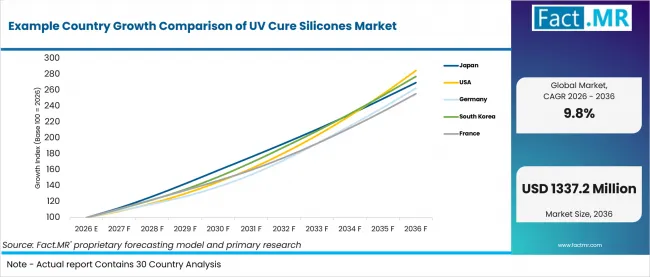
Example Country Growth Comparison Of Uv Cure Silicones Market | Source: Fact.MR
Country CAGR (2026-2036)
| Country | CAGR (2026-2036) |
|---|---|
| Japan | 10.4% |
| USA | 10.9% |
| Germany | 10.2% |
| South Korea | 10.6% |
What is driving Japan's growth through 2036?
Japan is forecast to expand at a 10.4% CAGR from 2026 to 2036.
Japan is building a domestic advanced-semiconductor cluster around Rapidus in Hokkaido. METI selected Rapidus for support under its next-generation semiconductor programme and plans JPY 100 billion of fiscal 2025 investment.
AIST is also establishing an open R&D centre for advanced semiconductors in Chitose. More pilot and production activity increases the number of electronic assemblies requiring qualified protective materials, while Japan's automotive and precision-electronics base creates additional demand for coatings that maintain flexibility after thermal cycling.
What is driving the USA's growth through 2036?
The USA is forecast to expand at a 10.9% CAGR from 2026 to 2036.
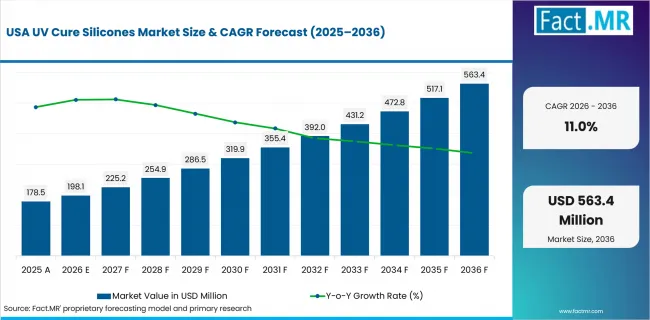
Uv Cure Silicones Market Country Value Analysis | Source: Fact.MR
The USA is adding advanced semiconductor packaging capacity alongside existing aerospace and power-electronics manufacturing. The Department of Commerce finalized USD 1.4 billion in awards through the National Advanced Packaging Manufacturing Program to validate packaging technologies and transition them toward domestic scale production.
Additional packaging and electronic-module production creates more surfaces requiring moisture and environmental protection. UV-curable silicone coatings can shorten the time between application and handling, while dual-cure systems address regions beneath components that direct UV light cannot reach.
What is driving Germany's growth through 2036?
Germany is forecast to expand at a 10.2% CAGR from 2026 to 2036.
Germany's automotive and electrical-equipment industries provide a direct demand base for protective silicone coatings around control electronics and power modules. New orders for electrical equipment increased 5.7% in May 2026, while automotive production increased 3.6% from the previous month.
Electrified vehicles add more power electronics and control systems that must operate despite temperature variation and vibration. Flexible silicone coatings fit these environments because they provide dielectric and moisture protection without forming a rigid layer around the assembly.
What is driving South Korea's growth through 2036?
South Korea is forecast to expand at a 10.6% CAGR from 2026 to 2036.
South Korea continues to deepen its semiconductor manufacturing ecosystem. A government industry plan announced KRW 4.5 trillion of public and private investment in a new 12-inch foundry while highlighting remaining gaps in semiconductor materials and equipment.
Greater domestic semiconductor and electronics output increases the number of coating processes that require local qualification. UV-curable silicone suppliers can benefit where manufacturers need rapid primary cure combined with flexibility and secondary cure around shadowed components.
Who leads the UV Cure Silicones Market?
Dow is positioned as a leading supplier through electronics materials and application support. Momentive and Shin-Etsu Chemical compete through light-curable formulations and process-development capability.
Competition is determined by cure-window stability and adhesion on mixed substrates. Buyers also assess fluorescence, shelf life and support for lamp or UV-LED qualification.
Regional application laboratories matter because dispense geometry and cure equipment change the usable process window.
Which companies are the key providers?
- Dow
- Momentive
- Shin-Etsu Chemical
- Wacker Chemie
- Dymax
- Elkem Silicones
Bibliography
- U.S. Environmental Protection Agency. (2001). Ultraviolet and Electron Beam Cured Coatings, Inks and Adhesives. U.S. Government.
- IPC. (2018). IPC-CC-830C: Qualification and Performance of Electrical Insulating Compound for Printed Wiring Assemblies. IPC.
- IPC. (2013). IPC-HDBK-830: Guidelines for Design, Selection and Application of Conformal Coatings. IPC.
- RadTech International North America. (2013). The State of UV-LED Curing: An Investigation of Chemistry and Applications. RadTech.
- U.S. Department of Commerce. (2025). CHIPS for America Advanced Packaging Manufacturing Program. U.S. Government.
- Ministry of Industry and Information Technology, China. (2026). Development of the Electronic Information Manufacturing Industry in 2025. Government of China.
- Ministry of Economy, Trade and Industry, Japan. (2025). Strategy for Semiconductor and Digital Industry Revitalization. Government of Japan.
- Federal Ministry for Economic Affairs and Climate Action, Germany. (2025). Industrial and Automotive Transformation Programmes. Government of Germany.
- Ministry of Trade, Industry and Energy, Republic of Korea. (2025). High-Tech Strategic Industry and Materials Development Measures. Government of the Republic of Korea.
- Dow. (2026). UV-Curable Silicone Materials for Electronics Protection. Dow.
- Momentive. (2026). UV-Cure Silicone Coatings and Encapsulants. Momentive.
This Report Answers
- The report examines demand across Cure Mechanism, Product Form, Application, End User.
- Segment analysis explains the operating reason behind each leading category.
- Country analysis evaluates the listed markets and adoption conditions through 2036.
- Competitive analysis reviews the listed companies and clarifies ownership or research roles where relevant.
What does the UV Cure Silicones Market cover?
UV-curable silicone materials combining silicone flexibility and thermal stability with rapid UV cure for coatings, encapsulants and adhesives in electronics and medical use.
The assessment follows the stated segmentation by Cure Mechanism, Product Form, Application, End User. Revenue is counted only where the stated product or equipment is sold for the listed applications.
What is included in the scope?
The scope includes UV cationic, UV radical (acrylate-silicone), UV thiol-ene, Dual UV-moisture.
It also covers Coatings, Encapsulants, Adhesives, Gels, Conformal coatings.
Demand is assessed across Application: Electronics protection, Medical devices, Optical assemblies, Release coatings, Flexible electronics; End User: Electronics manufacturers, Medical device makers, Optics/photonics.
What is excluded from the scope?
Conventional solvent-borne or ambient-cure materials without a UV-curing function are excluded.
UV lamps, LED heads and dispensing equipment are excluded as standalone revenue.
General coatings or adhesives are outside the market when they are not qualified for the listed applications.
How Was the Analysis Built?
The analysis combines product scope, segment demand, country outlook and supplier coverage.
- Primary Research: Interviews focus on formulation suppliers, UV-equipment specialists, electronics manufacturers and application engineers.
- Desk Research: The review covers UV-curing guidance, electronics standards, semiconductor investment and supplier technical documents.
- Market Sizing and Forecasting: Estimates combine application production, material consumption per assembly, realized pricing, chemistry mix and cure-system penetration.
- Data Validation and Update Cycle: Findings are checked against public evidence and supplier portfolios. Updates review formulation changes, UV-LED conversion and electronics production capacity.
What is the report's scope and coverage?
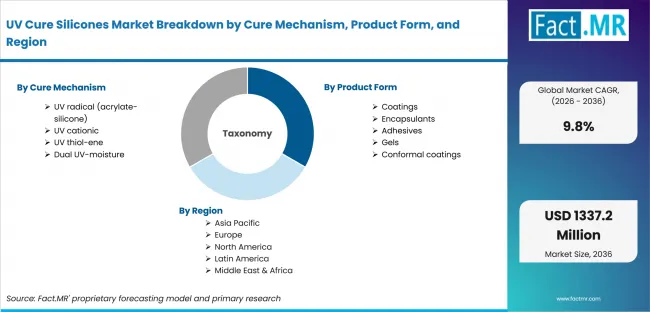
Uv Cure Silicones Market Breakdown By Cure Mechanism, Product Form, And Region | Source: Fact.MR
| Attribute | Details |
|---|---|
| Quantitative Units | USD 525.0 million in 2026 to USD 1,340.0 million by 2036 at a 9.8% CAGR |
| Market Definition | UV-curable silicone materials combining silicone flexibility and thermal stability with rapid UV cure for coatings, encapsulants and adhesives in electronics and medical use. |
| Segments Covered | Cure Mechanism; Product Form; Application; End User |
| Regions Covered | North America; Latin America; Europe; East Asia; South Asia and Oceania; Middle East and Africa |
| Countries Covered | China; Japan; USA; Germany; South Korea |
| Key Companies Profiled | Dow; Momentive; Shin-Etsu Chemical; Wacker Chemie; Dymax; Elkem Silicones |
| Forecast Period | 2026 to 2036 |
| Base Year | 2025 |
| Market Value, 2026 | USD 525.0 million |
| Market Value, 2036 | USD 1,340.0 million |
| CAGR, 2026-2036 | 9.8% |
| Absolute Opportunity | USD 815.0 million |
| Approach | Combines application production, material consumption per assembly, realized pricing, chemistry mix and cure-system penetration. |
How is the market segmented?
-
By Cure Mechanism
- UV cationic
- UV radical (acrylate-silicone)
- UV thiol-ene
- Dual UV-moisture
-
By Product Form
- Coatings
- Encapsulants
- Adhesives
- Gels
- Conformal coatings
-
By Application
- Electronics protection
- Medical devices
- Optical assemblies
- Release coatings
- Flexible electronics
-
By End User
- Electronics manufacturers
- Medical device makers
- Optics/photonics