- Base Value(2026): 0.7 Bn
- Estimated Value(2026): 0.7 Bn
- Forecast Value (2036): 1.8 Bn
- CAGR (2026 - 2036): 9.1%
UV-Stabilized PCR Polymer Market Forecast and Outlook 2026 to 2036
The global UV-stabilized PCR polymer market is projected to total USD 0.74 billion in 2026, advancing to USD 1.77 billion by 2036, progressing at a CAGR of 9.1%. This vigorous expansion is driven by the critical intersection of circular economy mandates and the performance requirements of durable goods.
Key Takeaways from the UV-Stabilized PCR Polymer Market
- Market Value for 2026: USD 0.74 Billion
- Market Value for 2036: USD 1.77 Billion
- Forecast CAGR 2026 to 2036: 9.1%
- Leading Technology Segment (2026): UV Absorbers + HALS Systems (42.2%)
- Leading Packaging Format Segment (2026): Bottles, Crates, Pallets (40.0%)
- Leading Material Segment (2026): PCR-HDPE / PCR-PP (49.2%)
- Leading End-Use Segment (2026): Outdoor & Durable Packaging (38.0%)
- Key Growth Countries: India (11.5% CAGR), China (10.5% CAGR), USA (8.0% CAGR), Brazil (7.5% CAGR), Germany (7.0% CAGR), Japan (4.6% CAGR)
- Key Players in the Market: BASF SE, Clariant AG, Kingfa Sci. & Tech. Co., Ltd., Bhansali Engineering Polymers Ltd., Braskem S.A., Mitsubishi Chemical Group, Avient Corporation, Dow Inc., Lanxess AG
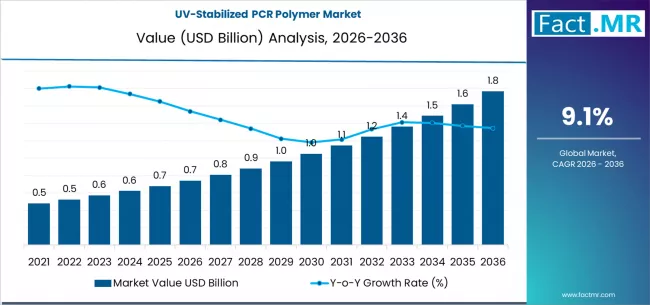
Uv Stabilized Pcr Polymer Market Market Value Analysis | Source: Fact.MR
As regulations and brand commitments push for higher recycled content across industries, the inherent vulnerability of PCR plastics to photo-degradation creates a fundamental need for advanced stabilization. The market growth is underpinned by the expansion of PCR applications beyond simple packaging into long-life, outdoor, and industrial sectors where material longevity is paramount.
The strong leadership of combined UV absorber and Hindered Amine Light Stabilizer (HALS) systems, which hold a 42.2% share, reflecting the need for robust, multi-mechanism protection, characterizes the market. The demand is most pronounced in outdoor & durable packaging applications, constituting 38.0% of the market, with bottles, crates, and pallets being the dominant format at 40.0%. PCR-HDPE and PCR-PP collectively form the material backbone, accounting for 49.2% of demand due to their high recyclate availability and suitability for stabilized, durable products.
Metric
| Metric | Value |
|---|---|
| Market Value (2026) | USD 0.74 Billion |
| Market Forecast Value (2036) | USD 1.77 Billion |
| Forecast CAGR 2026 to 2036 | 9.1% |
Source: Fact.MR analysis. Updated Jan 12, 2026
Category
| Category | Segments |
|---|---|
| End-Use | Outdoor & Durable Packaging, Automotive & Industrial, Logistics & Bulk Packs, Agriculture Packaging, Outdoor FMCG, Specialty Polymers |
| Packaging Format | Bottles, Crates, Pallets; Containers & Housings; Reusable Crates; Canisters & Drums; Others |
| Material | PCR-HDPE/ PCR-PP; rPP/rPE; PCR Polyolefins; PCR-HDPE; Others |
| Technology | UV Absorbers + HALS Stabilizer Systems; Long-life UV Stabilization Packages; Cost-efficient UV Masterbatch Compounding; Additive Dose Optimization; Others |
| Region | North America, Latin America, Western Europe, Eastern Europe, East Asia, South Asia & Pacific, Middle East & Africa |
Source: Fact.MR analysis. Updated Jan 12, 2026
Segmental Analysis
By Technology, Which Stabilization Approach Offers the Most Comprehensive Protection?
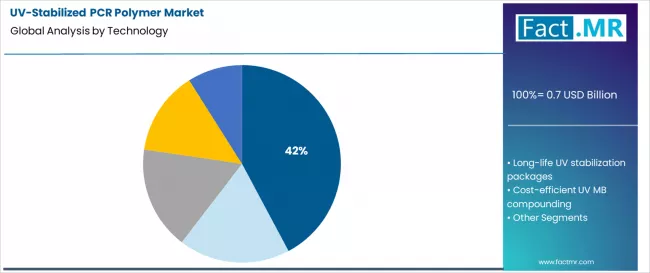
Uv Stabilized Pcr Polymer Market Analysis By Technology | Source: Fact.MR
The combination of UV absorbers and HALS stabilizer systems commands a leading 42.2% share. This synergistic approach is preferred for demanding applications because UV absorbers act as a first line of defense by filtering harmful radiation, while HALS compounds neutralize free radicals generated during the photo-oxidation process, thereby preserving the polymer's mechanical properties and color over extended periods.
This dual-mechanism is essential for ensuring the multi-year service life expected from products like outdoor furniture, automotive components, and industrial crates made from PCR content.
By End-Use, Which Sector is Most Critical for Driving Performance Specifications?
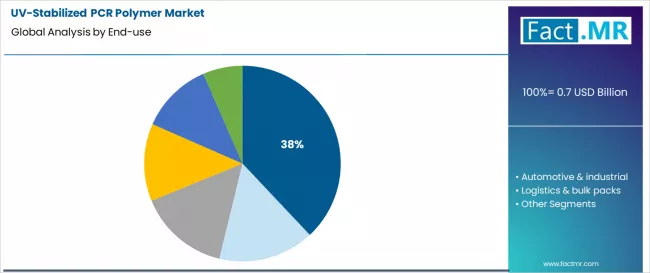
Uv Stabilized Pcr Polymer Market Analysis By End Use | Source: Fact.MR
Outdoor & durable packaging constitutes the primary end-use segment at 38.0%. This sector includes items like shipping pallets, agricultural crates, and outdoor storage bins that face constant exposure to sunlight and weathering.
The use of PCR materials in these applications is entirely contingent on effective UV stabilization to prevent embrittlement, cracking, and color fade, which would lead to premature product failure. The growth here directly fuels demand for high-load, robust stabilization packages capable of withstanding harsh environmental stress.
By Packaging Format, Which Segment Demands the Highest Level of Material Integrity?
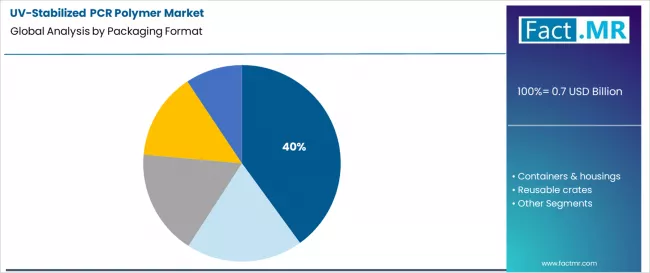
Uv Stabilized Pcr Polymer Market Analysis By Packaging Format | Source: Fact.MR
Bottles, crates, and pallets represent the leading format with a 40.0% share, particularly for non-food chemical containers, dairy crates, and logistics pallets. These items are subject to significant mechanical load, impact, and outdoor exposure.
Utilizing PCR polymers in these formats requires UV stabilization not just for appearance, but crucially for maintaining structural integrity and load-bearing capacity throughout the product's lifecycle, creating a high-value market for advanced additive systems.
What are the Principal Drivers, Constraints, and Evolving Dynamics of this Market?
The primary market driver is the regulatory and corporate push for incorporating PCR content into durable goods, moving beyond single-use packaging. Mandates like the EU’s End-of-Life Vehicle Directive and sustainability goals in construction and logistics create non-negotiable demand for performance-grade recycled plastics, with UV stabilization being the essential enabler for these long-life applications.
A significant restraint is the technical complexity and cost of formulating effective stabilizer systems for highly variable PCR feedstocks. The inconsistent history of PCR polymer chains makes them more difficult to stabilize than virgin resin, requiring sophisticated and often customized additive packages that elevate material costs.
A major opportunity lies in the automotive and electrical & electronics sectors, where brands seek sustainable material options for non-aesthetic, structural components. This opens a frontier for stabilization technologies that can meet stringent thermal and mechanical performance standards in these industries. The dominant market trend is the shift from simple additive blending to integrated polymer engineering.
Leading players are no longer just selling stabilizers; they are developing and selling pre-compounded, fully stabilized PCR polymer grades with certified performance data, offering a complete material solution to OEMs and processors.
Analysis of the UV-Stabilized PCR Polymer Market by Key Countries
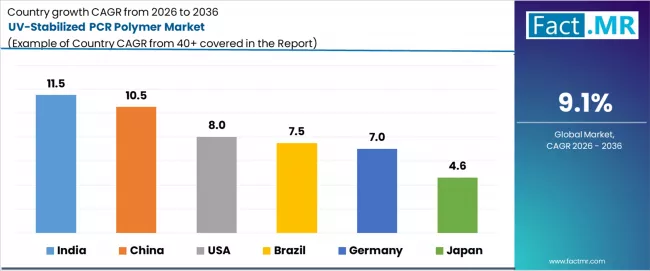
Uv Stabilized Pcr Polymer Market Cagr Analysis By Country | Source: Fact.MR
| Country | CAGR 2026 to 2036 |
|---|---|
| India | 11.5% |
| China | 10.5% |
| USA | 8.0% |
| Brazil | 7.5% |
| Germany | 7.0% |
| Japan | 4.6% |
Source: Fact.MR analysis. Updated Jan 12, 2026
How is India's Manufacturing and Infrastructure Boom Catalyzing Demand?
India’s leading CAGR of 11.5% is fueled by its rapid growth in manufacturing, automotive production, and urban infrastructure development. The demand for cost-effective, durable materials for items like industrial crates, pallets, and automotive interior parts is immense.
The market is characterized by a strong need for highly cost-optimized UV masterbatch solutions that can deliver adequate protection for the country’s intense solar radiation, with growth driven by both domestic consumption and export-oriented manufacturing sectors seeking sustainable material credentials.
What is Driving China's Demand in Automotive and Specialty Applications?
China’s robust 10.5% CAGR is propelled by its world-leading electric vehicle (EV) production and ambitions in high-tech manufacturing. The automotive sector, in particular, is a key driver, seeking UV-stabilized PCR compounds for under-the-hood components, interior trims, and exterior bumper facias to meet both sustainability and performance targets.
The growth of its logistics and export economy creates sustained demand for stabilized PCR in shipping and bulk handling equipment, supported by a rapidly maturing domestic recycling ecosystem for engineering plastics.
How does USA’s Regulatory Tailwinds and Brand Activism Shape the Market?
State-level extended producer responsibility (EPR) laws and voluntary corporate commitments targeting durable goods significantly drive the USA’s 8.0% growth. The migration of PCR use from packaging into building & construction products such as decking, and fencing and automotive parts creates a new wave of demand for high-performance stabilization.
The market is sophisticated, with a focus on achieving regulatory certifications and meeting the precise technical data sheet requirements of large OEMs, favoring suppliers with strong R&D and technical service capabilities.
Why is Brazil's Agricultural Sector a Key Growth Pillar?
Brazil’s 7.5% CAGR is closely tied to the scale of its agricultural industry. There is massive and growing demand for UV-stabilized PCR-HDPE and PCR-PP in applications such as pesticide containers, irrigation system components, and bulk produce crates that must withstand prolonged tropical sun exposure.
The market is driven by the need for robust, weatherable solutions that also meet chemical resistance requirements, with growth further supported by regional sustainability initiatives in agribusiness.
What defines Germany's Role as a High-Standard, Regulatory-Driven Market?
Germany’s 7.0% CAGR reflects its position as a mature, innovation-led market governed by the strictest EU regulations. Demand is driven by the automotive industry’s closed-loop recycling mandates and the construction sector’s green building standards.
The focus is intensely on premium, high-efficiency stabilization systems that can guarantee product longevity of 10+ years for outdoor applications. Success in this market requires not only technical superiority but also comprehensive lifecycle assessment data to prove environmental benefit, pushing the technology towards next-generation, non-migrating stabilizer chemistries.
How does Japan's focus on Quality and Precision Engineering Influence its Market?
Japan’s 4.6% CAGR, while more moderate, represents a high-value niche focused on precision and quality. Demand stems from the automotive and E&E sectors, where even components made with PCR content must meet exceptional standards for color retention, surface finish, and long-term reliability in compact, heat-sensitive devices.
The market prioritizes ultra-efficient, low-dosage stabilization packages and highly consistent, pre-compounded PCR engineering plastic grades from trusted suppliers, with less emphasis on pure cost-competitiveness.
Competitive Landscape of the UV-Stabilized PCR Polymer Market
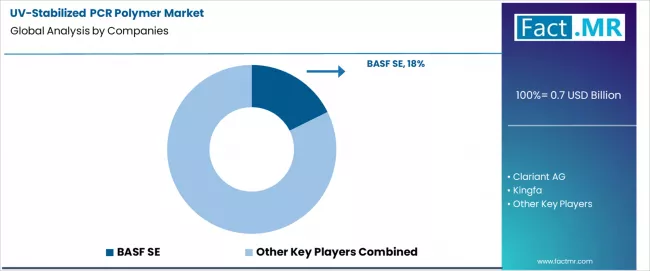
Uv Stabilized Pcr Polymer Market Analysis By Company | Source: Fact.MR
The competitive landscape features a blend of global chemical conglomerates, specialized additive suppliers, and forward-integrated compounders. Competition is intensifying along two primary axes: technological innovation in stabilizer chemistry and vertical integration into PCR sourcing and compounding.
Leaders are distinguished by their ability to provide not just additives, but fully formulated, performance-guaranteed PCR polymer grades, reducing complexity for processors. The battleground is increasingly shifting to long-term supply agreements and co-development projects with major OEMs in automotive and electronics, where material specifications are rigorous.
Success in this market requires deep application-specific knowledge to tailor solutions for different polymer types and end-use environments. Companies are investing heavily in weathering testing laboratories and application simulation software to predict product lifespan. Competition is influenced by the capacity to secure consistent supplies of high-quality PCR feedstock and to navigate the complex regulatory landscapes across different regions, making partnerships with large recyclers a critical strategic asset.
Key Players in the UV-Stabilized PCR Polymer Market
- BASF SE
- Clariant AG
- Kingfa Sci. & Tech. Co., Ltd.
- Bhansali Engineering Polymers Ltd.
- Braskem S.A.
- Mitsubishi Chemical Group
- Avient Corporation
- Dow Inc.
- Lanxess AG
- Others
References
- American Chemistry Council (ACC) (2025).Performance Guidelines for Recycled Plastics in Durable Goods Applications. ACC Plastics Division.
- European Chemicals Agency (ECHA) (2024).Guidance on the Assessment of Additives in the Context of Recycled Polymer Registration. ECHA.
- International Organization for Standardization (ISO) (2024).ISO 4892-3: Plastics - Methods of exposure to laboratory light sources - Part 3: Fluorescent UV lamps. ISO.
- Plastics Europe. (2025).Circular Economy for Plastics: A European Analysis - Focus on Technical Recyclates for New Applications.
- Society of Automotive Engineers (SAE) International. (2024).SAE J 2527: Performance Based Standard for Accelerated Exposure of Automotive Exterior Materials Using a Controlled Irradiance Xenon-Arc Apparatus.
- The Society of the Plastics Industry (PLASTICS) (2025).Position Paper on the Use of Stabilized PCR in Building & Construction.
Segmentation
Scope of Report
| Items | Values & Coverage |
|---|---|
| Quantitative Units | USD Billion |
| Technology | UV Absorbers + HALS Systems, Long-life Stabilization Packages, Cost-efficient UV Masterbatches, Additive Dose Optimization, Others |
| Packaging Format | Bottles, Crates, Pallets; Containers & Housings; Reusable Crates; Canisters & Drums; Others |
| End-Use | Outdoor & Durable Packaging, Automotive & Industrial, Logistics & Bulk Packs, Agriculture Packaging, Outdoor FMCG, Specialty Polymers |
| Material | PCR-HDPE, PCR-PP, rPP, rPE, PCR Polyolefins, Others |
| Key Countries | India, China, USA, Brazil, Germany, Japan |
| Key Companies | BASF SE, Clariant AG, Kingfa, Bhansali Engineering, Braskem, Mitsubishi Chemical, Avient, Dow Inc., Lanxess AG, Others |
| Additional Analysis | Accelerated weathering test data correlation for PCR vs. virgin polymers; analysis of stabilizer migration and long-term efficacy; total cost of ownership models for stabilized PCR in durable goods; impact of chemical recycling on UV stabilizer requirements; regulatory pathways for PCR content in automotive and construction applications. |
Source: Fact.MR analysis. Updated Jan 12, 2026
Market by Segments
-
End-Use :
- Outdoor & Durable Packaging
- Automotive & Industrial
- Logistics & Bulk Packs
- Agriculture Packaging
- Outdoor FMCG
- Specialty Polymers
-
Packaging Format :
- Bottles, Crates, Pallets
- Containers & Housings
- Reusable Crates
- Canisters & Drums
- Others
-
Material :
- PCR-HDPE/PCR-PP
- rPP/rPE
- PCR Polyolefins
- PCR-HDPE
- Others
-
Region :
-
North America
- USA
- Canada
-
Latin America
- Brazil
- Mexico
- Argentina
- Rest of Latin America
-
Western Europe
- Germany
- France
- Italy
- Spain
- UK
- BENELUX
- Rest of Western Europe
-
Eastern Europe
- Russia
- Poland
- Czech Republic
- Rest of Eastern Europe
-
East Asia
- China
- Japan
- South Korea
- Rest of East Asia
-
South Asia & Pacific
- India
- ASEAN
- Australia
- Rest of South Asia & Pacific
-
MEA
- GCC Countries
- South Africa
- Turkiye
- Rest of MEA
-
Frequently Asked Questions
How big is the uv-stabilized pcr polymer market in 2026?
What will be the size of uv-stabilized pcr polymer market in 2036?
How much will be the uv-stabilized pcr polymer market growth between 2026 and 2036?
What are the key product types in the uv-stabilized pcr polymer market?
Which packaging format segment to contribute significant share in the uv-stabilized pcr polymer market in 2026?
Who worked on this report


Preview the report firsthand - request a free sample
Free SampleGet the brochure for pricing and purchase details
Download PDF