UV-Stable PCR Polycarbonate Solutions Market (2026 - 2036)
UV-Stable PCR Polycarbonate Solutions Market Size and Share Forecast Outlook 2026 to 2036
Core Findings
UV-Stable PCR Polycarbonate Solutions Market Forecast Outlook 2026 to 2036
The UV-stable PCR polycarbonate solutions market is projected to reach USD 1.1 billion in 2026 and grow to USD 3.6 billion by 2036, reflecting a CAGR of 12.6%.
Key Takeaways from UV-Stable PCR Polycarbonate Solutions Market
- UV-Stable PCR Polycarbonate Solutions Market Value (2026): USD 1.1 billion
- UV-Stable PCR Polycarbonate Solutions Market Forecast Value (2036): USD 3.6 billion
- UV-Stable PCR Polycarbonate Solutions Market Forecast CAGR 2026 to 2036: 12.6%
- Leading Segment in UV-Stable PCR Polycarbonate Solutions Market: UV absorbers and HALS systems (52%)
- Key Growth Region in UV-Stable PCR Polycarbonate Solutions Market: Asia Pacific
- Key Players in UV-Stable PCR Polycarbonate Solutions Market: Covestro AG, LANXESS AG, SABIC (Saudi Basic Industries Corporation), Avient Corporation, Mitsubishi Chemical Group Corporation, Teijin Limited, Kingfa Science & Technology Group Co., Ltd., Wanhua Chemical Group Co., Ltd.
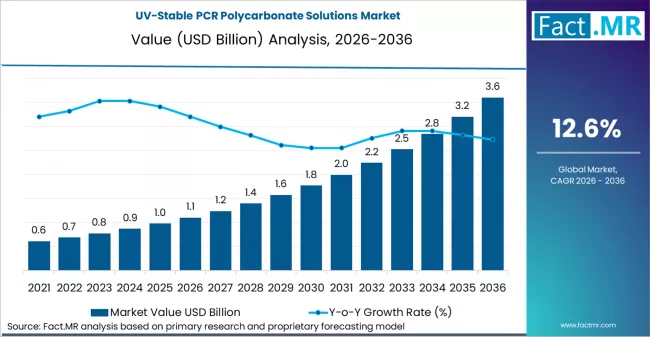
The market’s growth quality is largely shaped by its high concentration in specific applications, particularly in industries requiring durable, UV-resistant materials like automotive, electronics, and construction. End-use dependency is a key driver, as the demand for UV-stable PCR polycarbonate is tightly linked to the performance standards of these sectors. Variability in these industries’ demand cycles could influence volume stability, creating challenges in ensuring consistent growth.
The need for long-term sustainability and regulatory compliance is driving demand, but companies in this space must contend with fluctuations in raw material availability and shifts in consumer preferences. As a result, growth will be less about volume surges and more about securing stable, high-quality demand across these dependent applications, requiring companies to manage risk and maintain adaptability.
UV-Stable PCR Polycarbonate Solutions Market
| Metric | Value |
|---|---|
| Estimated Value in (2026E) | USD 1.1 billion |
| Forecast Value in (2036F) | USD 3.6 billion |
| Forecast CAGR 2026 to 2036 | 12.6% |
Category
| Category | Segments |
|---|---|
| End-use | Electronics and outdoor components; Automotive and appliances; Precision electronics; Mass electronics housings; Display components |
| Product Type | UV-stabilized PC compounds; Impact-modified PC; High-clarity PC; Injection grades; Others |
| Material Grade | PCR-PC; PCR-PC blends; Others |
| Stabilization Technology | UV absorbers and HALS systems; Weathering-resistant compounding; Optical stability control; Cost-optimized stabilizers; Others |
| Region | North America; Europe; Asia Pacific; Latin America; Middle East & Africa |
Segmental Analysis
What Is the Impact of Material Grade on the UV-Stable PCR Polycarbonate Solutions Market?
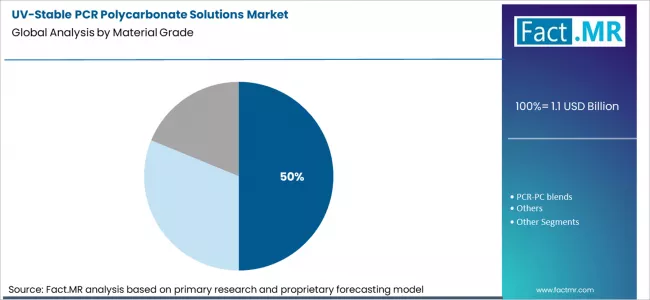
In the UV-stable PCR polycarbonate solutions market, material grade plays a vital role in ensuring the longevity and performance of the product under sunlight exposure. PCR-PC leads the market with a 50% share due to its excellent balance of strength, clarity, and UV stability, making it ideal for applications in outdoor and high-visibility products. The ability to maintain these properties while being made from recycled polycarbonate is a key driver in the adoption of PCR-PC. As the demand for sustainable and durable materials increases, PCR-PC will continue to be a preferred choice in industries such as automotive, electronics, and construction, where UV stability and recyclability are crucial.
How Does Stabilisation Technology Influence the UV-Stable PCR Polycarbonate Solutions Market?
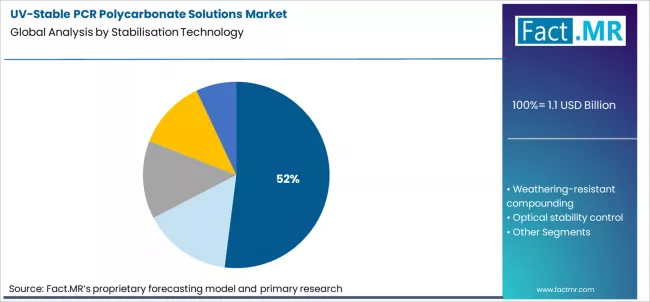
Stabilisation technology is essential for enhancing the durability and UV resistance of PCR polycarbonate, with UV absorbers and HALS (Hindered Amine Light Stabilizer) systems holding a 52% share. These technologies work by absorbing harmful UV rays and preventing the degradation of the material, thus ensuring its performance over time. UV absorbers and HALS systems play a critical role in extending the life of polycarbonate products exposed to sunlight. As industries continue to prioritize sustainability and long-lasting materials, the demand for stabilisation technologies that provide effective UV protection will remain strong, supporting the growth of the UV-stable PCR polycarbonate solutions market.
What are the Drivers, Restraints, and Key Trends in the UV Stable PCR Polycarbonate Solutions Market?
Demand for ultraviolet (UV)stable post consumer recycled (PCR) polycarbonate solutions has been shaped by requirements from manufacturers that produce outdoor and high exposure components, including protective housings, lighting fixtures, and transparent covers. Product engineers specify PCR polycarbonate grades that maintain optical clarity and mechanical integrity after prolonged UV exposure. Procurement teams and quality assurance groups favor suppliers that provide documented UV stability performance and traceability of PCR feedstock to support compliance with product standards and recycled content mandates.
Variability in PCR polycarbonate feedstock quality affects UV resistance, color stability, and impact strength, creating formulation and processing challenges for converters. Some compounders adjust additive packages and processing conditions to achieve target weathering performance while meeting specification tolerances. Limited availability of validated UV stable PCR polycarbonate grades has constrained broader adoption in applications where prolonged UV exposure is a performance requirement. Work on improving feedstock sorting, decontamination, and consistent characterization of recycled polycarbonate is progressing. Collaboration among recyclers, compounders, and OEM technical teams aims to expand PCR polycarbonate solutions that balance UV stability with functional, aesthetic, and regulatory requirements.
Analysis of the UV-Stable PCR Polycarbonate Solutions Market by Key Country
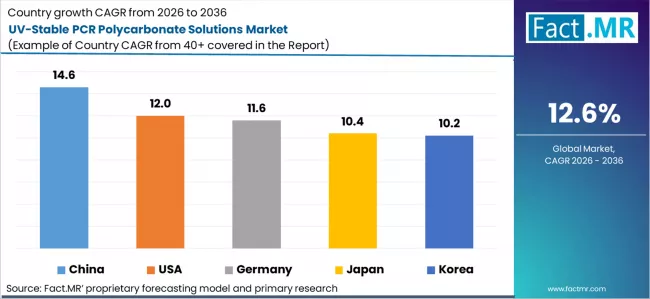
| Country | CAGR (2026-2036) |
|---|---|
| Germany | 11.6% |
| USA | 12% |
| Japan | 10.4% |
| China | 14.6% |
| Korea | 10.2% |
The report covers an in-depth analysis of 40+ countries; top-performing countries are highlighted below.
What is the Outlook on the UV-Stable PCR Polycarbonate Solutions Market in Germany?
Germany market in UV-stable PCR polycarbonate solutions is projected to grow at a CAGR of 11.6% from 2026 to 2036. The demand for UV-stable PCR polycarbonate solutions is increasing as industries, particularly automotive, electronics, and packaging, seek sustainable and durable materials. These materials are essential for applications requiring both environmental responsibility and high performance. With Germany’s strong commitment to sustainability and circular economy practices, the market for UV-stable PCR polycarbonate solutions is expected to grow steadily, supported by both regulatory frameworks and increasing consumer demand for eco-friendly products.
What is the Demand for UV-Stable PCR Polycarbonate Solutions in the USA?
USA sales of UV-stable PCR polycarbonate solutions are expected to grow at a CAGR of 12% from 2026 to 2036. The USA’s demand for UV-stable PCR polycarbonate solutions is driven by the need for sustainable, high-performance materials in industries such as automotive, electronics, and construction. With the increasing focus on reducing plastic waste and improving the sustainability of production processes, these materials are becoming increasingly popular. The market for UV-stable PCR polycarbonate solutions in the USA is expected to experience steady growth, supported by advancements in recycling technologies and regulatory support for green manufacturing.
What is the Sales Outlook on UV-Stable PCR Polycarbonate Solutions in Japan?
Japan demand for UV-stable PCR polycarbonate solutions is projected to grow at a CAGR of 10.4% from 2026 to 2036. Japan’s demand for sustainable, high-performance materials in applications such as automotive parts, electronics, and packaging is driving the adoption of UV-stable PCR polycarbonate solutions. These materials offer the required durability and UV resistance while contributing to environmental sustainability. With Japan’s focus on innovation in green technologies and its regulatory push for sustainable production, the market for UV-stable PCR polycarbonate solutions is expected to grow steadily in the coming years.
What is the Demand for UV-Stable PCR Polycarbonate Solutions in China?
China market in UV-stable PCR polycarbonate solutions is projected to grow at a CAGR of 14.6% from 2026 to 2036. As China’s manufacturing and automotive industries continue to expand, the need for UV-stable and sustainable materials is increasing. UV-stable PCR polycarbonate solutions are gaining traction for their ability to meet performance requirements while offering environmentally friendly alternatives. With China’s strong focus on sustainability, waste reduction, and recycling initiatives, the market for UV-stable PCR polycarbonate solutions is expected to experience significant growth over the next decade.
What is the Sales Outlook on UV-Stable PCR Polycarbonate Solutions in Korea?
Korea market in UV-stable PCR polycarbonate solutions is expected to grow at a CAGR of 10.2% from 2026 to 2036. The demand for UV-stable PCR polycarbonate solutions in Korea is increasing due to the country’s commitment to sustainable manufacturing practices in industries such as automotive, electronics, and packaging. These solutions are key to reducing environmental impact while maintaining high product performance. As Korea continues to prioritize environmental responsibility and green technologies, the market for UV-stable PCR polycarbonate solutions is expected to grow steadily, supported by both local industry needs and international trends in sustainability.
How Are Key Players Competing in the UV Stable PCR Polycarbonate Solutions Market?
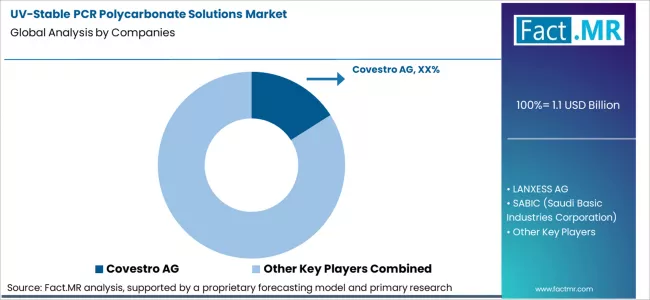
Competition among leading suppliers of UV stable post consumer recycled (PCR) polycarbonate solutions is shaped by the development of formulations that retain optical clarity and mechanical integrity under prolonged ultraviolet exposure. Covestro AG and LANXESS AG are positioned with stabilized PCR polycarbonate grades engineered for outdoor use and long term service in lighting and electrical housings. SABIC and Avient Corporation focus on tailored compound offerings that balance UV resistance with consistent processing behaviour across injection and extrusion applications. Mitsubishi Chemical Group Corporation and Teijin Limited pursue specialty solutions that emphasise surface quality and weathering performance. Kingfa Science & Technology Group Co., Ltd. and Wanhua Chemical Group Co., Ltd. highlight scalable supply and quality consistency to satisfy global demand. Competitive positioning reflects the ability to meet qualification requirements tied to UV ageing performance and recycled content standards reported in market analysis.
Product brochures and technical documentation serve as primary tools for differentiation. Covestro and LANXESS materials typically specify ultraviolet stability metrics and accelerated weathering data relevant to exterior applications. SABIC and Avient literature outlines performance parameters, including impact retention and colour stability, linked to PCR feedstock integration. Mitsubishi Chemical and Teijin publications detail resin grades suited for compounded UV resistance under specified lighting and temperature conditions. Kingfa and Wanhua brochures present comparative property charts and processing recommendations to assist material selectors in evaluating mechanical strength, transparency, and stabiliser dispersion characteristics. Technical brochures are used to communicate compliance with outdoor exposure benchmarks and support specification decisions by OEMs and compounders.
Key Players of the UV-Stable PCR Polycarbonate Solutions Market
- Covestro AG
- LANXESS AG
- SABIC (Saudi Basic Industries Corporation)
- Avient Corporation
- Mitsubishi Chemical Group Corporation
- Teijin Limited
- Kingfa Science & Technology Group Co., Ltd.
- Wanhua Chemical Group Co., Ltd.
Scope of the Report
| Items | Values |
|---|---|
| Quantitative Units (2026) | USD Billion |
| End-use | Electronics and outdoor components, Automotive and appliances, Precision electronics, Mass electronics housings, Display components |
| Product Type | UV-stabilized PC compounds, Impact-modified PC, High-clarity PC, Injection grades, Others |
| Material Grade | PCR-PC, PCR-PC blends, PCR-PC, Others |
| Stabilization Technology | UV absorbers and HALS systems, Weathering-resistant compounding, Optical stability control, Cost-optimized stabilizers, Others |
| Regions Covered | North America, Europe, Asia Pacific, Latin America, Middle East & Africa |
| Countries Covered | United States, Canada, Mexico, Brazil, Germany, United Kingdom, France, Italy, Spain, China, Japan, South Korea, India, Australia & New Zealand |
| Key Companies Profiled | Covestro AG, LANXESS AG, SABIC (Saudi Basic Industries Corporation), Avient Corporation, Mitsubishi Chemical Group Corporation, Teijin Limited, Kingfa Science & Technology Group Co., Ltd., Wanhua Chemical Group Co., Ltd. |
| Additional Attributes | Dollar revenue by end-use, product type, material grade, and stabilization technology; regional demand trends, competitive landscape, technological advancements in UV-stable PCR polycarbonate solutions, and innovations in stabilization and weathering resistance technologies |
UV-Stable PCR Polycarbonate Solutions Market Key Segments
-
End-use:
- Electronics and outdoor components
- Automotive and appliances
- Precision electronics
- Mass electronics housings
- Display components
-
Product Type:
- UV-stabilized PC compounds
- Impact-modified PC
- High-clarity PC
- Injection grades
- Others
-
Material Grade:
- PCR-PC
- PCR-PC blends
- Others
-
Stabilization Technology:
- UV absorbers and HALS systems
- Weathering-resistant compounding
- Optical stability control
- Cost-optimized stabilizers
- Others
-
Region:
- North America
- USA
- Canada
- Mexico
- Europe
- Germany
- UK
- France
- Italy
- Spain
- Nordic Countries
- BENELUX
- Rest of Europe
- Asia Pacific
- China
- Japan
- South Korea
- India
- Australia
- Rest of Asia Pacific
- Latin America
- Brazil
- Argentina
- Rest of Latin America
- Middle East and Africa
- Kingdom of Saudi Arabia
- United Arab Emirates
- South Africa
- Rest of Middle East and Africa
- Other Regions
- Oceania
- Central Asia
- Other Markets
- North America
Bibliographies
- International Organization for Standardization. (2024). ISO 22095: Chain of custody-General terminology and models.
- International Electrotechnical Commission. (2023). IEC TR 62635: Guidelines for end-of-life treatment of electrical and electronic equipment.
- European Commission, Joint Research Centre. (2023). Recycling of engineering plastics from WEEE: Degradation and stabilisation.
- National Institute of Standards and Technology. (2024). Durability and environmental aging of recycled thermoplastics.
- USA Environmental Protection Agency. (2023). Engineering plastics recycling and performance considerations.
Table of Content
- Executive Summary
- Global Market Outlook
- Demand to side Trends
- Supply to side Trends
- Technology Roadmap Analysis
- Analysis and Recommendations
- Market Overview
- Market Coverage / Taxonomy
- Market Definition / Scope / Limitations
- Market Background
- Market Dynamics
- Drivers
- Restraints
- Opportunity
- Trends
- Scenario Forecast
- Demand in Optimistic Scenario
- Demand in Likely Scenario
- Demand in Conservative Scenario
- Opportunity Map Analysis
- Product Life Cycle Analysis
- Supply Chain Analysis
- Investment Feasibility Matrix
- Value Chain Analysis
- PESTLE and Porter’s Analysis
- Regulatory Landscape
- Regional Parent Market Outlook
- Production and Consumption Statistics
- Import and Export Statistics
- Market Dynamics
- Global Market Analysis 2021 to 2025 and Forecast, 2026 to 2036
- Historical Market Size Value (USD Million) Analysis, 2021 to 2025
- Current and Future Market Size Value (USD Million) Projections, 2026 to 2036
- Y to o to Y Growth Trend Analysis
- Absolute $ Opportunity Analysis
- Global Market Pricing Analysis 2021 to 2025 and Forecast 2026 to 2036
- Global Market Analysis 2021 to 2025 and Forecast 2026 to 2036, By End-use
- Introduction / Key Findings
- Historical Market Size Value (USD Million) Analysis By End-use, 2021 to 2025
- Current and Future Market Size Value (USD Million) Analysis and Forecast By End-use, 2026 to 2036
- Electronics and outdoor components
- Automotive and appliances
- Precision electronics
- Mass electronics housings
- Display components
- Electronics and outdoor components
- Y to o to Y Growth Trend Analysis By End-use, 2021 to 2025
- Absolute $ Opportunity Analysis By End-use, 2026 to 2036
- Global Market Analysis 2021 to 2025 and Forecast 2026 to 2036, By Product Type
- Introduction / Key Findings
- Historical Market Size Value (USD Million) Analysis By Product Type, 2021 to 2025
- Current and Future Market Size Value (USD Million) Analysis and Forecast By Product Type, 2026 to 2036
- UV-stabilised PC compounds
- Impact-modified PC
- High-clarity PC
- Injection grades
- Others
- UV-stabilised PC compounds
- Y to o to Y Growth Trend Analysis By Product Type, 2021 to 2025
- Absolute $ Opportunity Analysis By Product Type, 2026 to 2036
- Global Market Analysis 2021 to 2025 and Forecast 2026 to 2036, By Material Grade
- Introduction / Key Findings
- Historical Market Size Value (USD Million) Analysis By Material Grade, 2021 to 2025
- Current and Future Market Size Value (USD Million) Analysis and Forecast By Material Grade, 2026 to 2036
- PCR-PC
- PCR-PC blends
- Others
- PCR-PC
- Y to o to Y Growth Trend Analysis By Material Grade, 2021 to 2025
- Absolute $ Opportunity Analysis By Material Grade, 2026 to 2036
- Global Market Analysis 2021 to 2025 and Forecast 2026 to 2036, By Stabilisation Technology
- Introduction / Key Findings
- Historical Market Size Value (USD Million) Analysis By Stabilisation Technology, 2021 to 2025
- Current and Future Market Size Value (USD Million) Analysis and Forecast By Stabilisation Technology, 2026 to 2036
- UV absorbers and HALS systems
- Weathering-resistant compounding
- Optical stability control
- Cost-optimised stabilisers
- Others
- UV absorbers and HALS systems
- Y to o to Y Growth Trend Analysis By Stabilisation Technology, 2021 to 2025
- Absolute $ Opportunity Analysis By Stabilisation Technology, 2026 to 2036
- Global Market Analysis 2021 to 2025 and Forecast 2026 to 2036, By Region
- Introduction
- Historical Market Size Value (USD Million) Analysis By Region, 2021 to 2025
- Current Market Size Value (USD Million) Analysis and Forecast By Region, 2026 to 2036
- North America
- Latin America
- Western Europe
- Eastern Europe
- East Asia
- South Asia and Pacific
- Middle East & Africa
- Market Attractiveness Analysis By Region
- North America Market Analysis 2021 to 2025 and Forecast 2026 to 2036, By Country
- Historical Market Size Value (USD Million) Trend Analysis By Market Taxonomy, 2021 to 2025
- Market Size Value (USD Million) Forecast By Market Taxonomy, 2026 to 2036
- By Country
- USA
- Canada
- Mexico
- By End-use
- By Product Type
- By Material Grade
- By Stabilisation Technology
- By Country
- Market Attractiveness Analysis
- By Country
- By End-use
- By Product Type
- By Material Grade
- By Stabilisation Technology
- Key Takeaways
- Latin America Market Analysis 2021 to 2025 and Forecast 2026 to 2036, By Country
- Historical Market Size Value (USD Million) Trend Analysis By Market Taxonomy, 2021 to 2025
- Market Size Value (USD Million) Forecast By Market Taxonomy, 2026 to 2036
- By Country
- Brazil
- Chile
- Rest of Latin America
- By End-use
- By Product Type
- By Material Grade
- By Stabilisation Technology
- By Country
- Market Attractiveness Analysis
- By Country
- By End-use
- By Product Type
- By Material Grade
- By Stabilisation Technology
- Key Takeaways
- Western Europe Market Analysis 2021 to 2025 and Forecast 2026 to 2036, By Country
- Historical Market Size Value (USD Million) Trend Analysis By Market Taxonomy, 2021 to 2025
- Market Size Value (USD Million) Forecast By Market Taxonomy, 2026 to 2036
- By Country
- Germany
- UK
- Italy
- Spain
- France
- Nordic
- BENELUX
- Rest of Western Europe
- By End-use
- By Product Type
- By Material Grade
- By Stabilisation Technology
- By Country
- Market Attractiveness Analysis
- By Country
- By End-use
- By Product Type
- By Material Grade
- By Stabilisation Technology
- Key Takeaways
- Eastern Europe Market Analysis 2021 to 2025 and Forecast 2026 to 2036, By Country
- Historical Market Size Value (USD Million) Trend Analysis By Market Taxonomy, 2021 to 2025
- Market Size Value (USD Million) Forecast By Market Taxonomy, 2026 to 2036
- By Country
- Russia
- Poland
- Hungary
- Balkan & Baltic
- Rest of Eastern Europe
- By End-use
- By Product Type
- By Material Grade
- By Stabilisation Technology
- By Country
- Market Attractiveness Analysis
- By Country
- By End-use
- By Product Type
- By Material Grade
- By Stabilisation Technology
- Key Takeaways
- East Asia Market Analysis 2021 to 2025 and Forecast 2026 to 2036, By Country
- Historical Market Size Value (USD Million) Trend Analysis By Market Taxonomy, 2021 to 2025
- Market Size Value (USD Million) Forecast By Market Taxonomy, 2026 to 2036
- By Country
- China
- Japan
- South Korea
- By End-use
- By Product Type
- By Material Grade
- By Stabilisation Technology
- By Country
- Market Attractiveness Analysis
- By Country
- By End-use
- By Product Type
- By Material Grade
- By Stabilisation Technology
- Key Takeaways
- South Asia and Pacific Market Analysis 2021 to 2025 and Forecast 2026 to 2036, By Country
- Historical Market Size Value (USD Million) Trend Analysis By Market Taxonomy, 2021 to 2025
- Market Size Value (USD Million) Forecast By Market Taxonomy, 2026 to 2036
- By Country
- India
- ASEAN
- Australia & New Zealand
- Rest of South Asia and Pacific
- By End-use
- By Product Type
- By Material Grade
- By Stabilisation Technology
- By Country
- Market Attractiveness Analysis
- By Country
- By End-use
- By Product Type
- By Material Grade
- By Stabilisation Technology
- Key Takeaways
- Middle East & Africa Market Analysis 2021 to 2025 and Forecast 2026 to 2036, By Country
- Historical Market Size Value (USD Million) Trend Analysis By Market Taxonomy, 2021 to 2025
- Market Size Value (USD Million) Forecast By Market Taxonomy, 2026 to 2036
- By Country
- Kingdom of Saudi Arabia
- Other GCC Countries
- Turkiye
- South Africa
- Other African Union
- Rest of Middle East & Africa
- By End-use
- By Product Type
- By Material Grade
- By Stabilisation Technology
- By Country
- Market Attractiveness Analysis
- By Country
- By End-use
- By Product Type
- By Material Grade
- By Stabilisation Technology
- Key Takeaways
- Key Countries Market Analysis
- USA
- Pricing Analysis
- Market Share Analysis, 2025
- By End-use
- By Product Type
- By Material Grade
- By Stabilisation Technology
- Canada
- Pricing Analysis
- Market Share Analysis, 2025
- By End-use
- By Product Type
- By Material Grade
- By Stabilisation Technology
- Mexico
- Pricing Analysis
- Market Share Analysis, 2025
- By End-use
- By Product Type
- By Material Grade
- By Stabilisation Technology
- Brazil
- Pricing Analysis
- Market Share Analysis, 2025
- By End-use
- By Product Type
- By Material Grade
- By Stabilisation Technology
- Chile
- Pricing Analysis
- Market Share Analysis, 2025
- By End-use
- By Product Type
- By Material Grade
- By Stabilisation Technology
- Germany
- Pricing Analysis
- Market Share Analysis, 2025
- By End-use
- By Product Type
- By Material Grade
- By Stabilisation Technology
- UK
- Pricing Analysis
- Market Share Analysis, 2025
- By End-use
- By Product Type
- By Material Grade
- By Stabilisation Technology
- Italy
- Pricing Analysis
- Market Share Analysis, 2025
- By End-use
- By Product Type
- By Material Grade
- By Stabilisation Technology
- Spain
- Pricing Analysis
- Market Share Analysis, 2025
- By End-use
- By Product Type
- By Material Grade
- By Stabilisation Technology
- France
- Pricing Analysis
- Market Share Analysis, 2025
- By End-use
- By Product Type
- By Material Grade
- By Stabilisation Technology
- India
- Pricing Analysis
- Market Share Analysis, 2025
- By End-use
- By Product Type
- By Material Grade
- By Stabilisation Technology
- ASEAN
- Pricing Analysis
- Market Share Analysis, 2025
- By End-use
- By Product Type
- By Material Grade
- By Stabilisation Technology
- Australia & New Zealand
- Pricing Analysis
- Market Share Analysis, 2025
- By End-use
- By Product Type
- By Material Grade
- By Stabilisation Technology
- China
- Pricing Analysis
- Market Share Analysis, 2025
- By End-use
- By Product Type
- By Material Grade
- By Stabilisation Technology
- Japan
- Pricing Analysis
- Market Share Analysis, 2025
- By End-use
- By Product Type
- By Material Grade
- By Stabilisation Technology
- South Korea
- Pricing Analysis
- Market Share Analysis, 2025
- By End-use
- By Product Type
- By Material Grade
- By Stabilisation Technology
- Russia
- Pricing Analysis
- Market Share Analysis, 2025
- By End-use
- By Product Type
- By Material Grade
- By Stabilisation Technology
- Poland
- Pricing Analysis
- Market Share Analysis, 2025
- By End-use
- By Product Type
- By Material Grade
- By Stabilisation Technology
- Hungary
- Pricing Analysis
- Market Share Analysis, 2025
- By End-use
- By Product Type
- By Material Grade
- By Stabilisation Technology
- Kingdom of Saudi Arabia
- Pricing Analysis
- Market Share Analysis, 2025
- By End-use
- By Product Type
- By Material Grade
- By Stabilisation Technology
- Turkiye
- Pricing Analysis
- Market Share Analysis, 2025
- By End-use
- By Product Type
- By Material Grade
- By Stabilisation Technology
- South Africa
- Pricing Analysis
- Market Share Analysis, 2025
- By End-use
- By Product Type
- By Material Grade
- By Stabilisation Technology
- USA
- Market Structure Analysis
- Competition Dashboard
- Competition Benchmarking
- Market Share Analysis of Top Players
- By Regional
- By End-use
- By Product Type
- By Material Grade
- By Stabilisation Technology
- Competition Analysis
- Competition Deep Dive
- Covestro AG
- Overview
- Product Portfolio
- Profitability by Market Segments (Product/Age /Sales Channel/Region)
- Sales Footprint
- Strategy Overview
- Marketing Strategy
- Product Strategy
- Channel Strategy
- LANXESS AG
- SABIC (Saudi Basic Industries Corporation)
- Avient Corporation
- Mitsubishi Chemical Group Corporation
- Teijin Limited
- Kingfa Science & Technology Group Co., Ltd.
- Wanhua Chemical Group Co., Ltd.
- Covestro AG
- Competition Deep Dive
- Assumptions & Acronyms Used
- Research Methodology
List Of Table
- Table 1: Global Market Value (USD Million) Forecast by Region, 2021 to 2036
- Table 2: Global Market Value (USD Million) Forecast by End-use, 2021 to 2036
- Table 3: Global Market Value (USD Million) Forecast by Product Type, 2021 to 2036
- Table 4: Global Market Value (USD Million) Forecast by Material Grade, 2021 to 2036
- Table 5: Global Market Value (USD Million) Forecast by Stabilisation Technology, 2021 to 2036
- Table 6: North America Market Value (USD Million) Forecast by Country, 2021 to 2036
- Table 7: North America Market Value (USD Million) Forecast by End-use, 2021 to 2036
- Table 8: North America Market Value (USD Million) Forecast by Product Type, 2021 to 2036
- Table 9: North America Market Value (USD Million) Forecast by Material Grade, 2021 to 2036
- Table 10: North America Market Value (USD Million) Forecast by Stabilisation Technology, 2021 to 2036
- Table 11: Latin America Market Value (USD Million) Forecast by Country, 2021 to 2036
- Table 12: Latin America Market Value (USD Million) Forecast by End-use, 2021 to 2036
- Table 13: Latin America Market Value (USD Million) Forecast by Product Type, 2021 to 2036
- Table 14: Latin America Market Value (USD Million) Forecast by Material Grade, 2021 to 2036
- Table 15: Latin America Market Value (USD Million) Forecast by Stabilisation Technology, 2021 to 2036
- Table 16: Western Europe Market Value (USD Million) Forecast by Country, 2021 to 2036
- Table 17: Western Europe Market Value (USD Million) Forecast by End-use, 2021 to 2036
- Table 18: Western Europe Market Value (USD Million) Forecast by Product Type, 2021 to 2036
- Table 19: Western Europe Market Value (USD Million) Forecast by Material Grade, 2021 to 2036
- Table 20: Western Europe Market Value (USD Million) Forecast by Stabilisation Technology, 2021 to 2036
- Table 21: Eastern Europe Market Value (USD Million) Forecast by Country, 2021 to 2036
- Table 22: Eastern Europe Market Value (USD Million) Forecast by End-use, 2021 to 2036
- Table 23: Eastern Europe Market Value (USD Million) Forecast by Product Type, 2021 to 2036
- Table 24: Eastern Europe Market Value (USD Million) Forecast by Material Grade, 2021 to 2036
- Table 25: Eastern Europe Market Value (USD Million) Forecast by Stabilisation Technology, 2021 to 2036
- Table 26: East Asia Market Value (USD Million) Forecast by Country, 2021 to 2036
- Table 27: East Asia Market Value (USD Million) Forecast by End-use, 2021 to 2036
- Table 28: East Asia Market Value (USD Million) Forecast by Product Type, 2021 to 2036
- Table 29: East Asia Market Value (USD Million) Forecast by Material Grade, 2021 to 2036
- Table 30: East Asia Market Value (USD Million) Forecast by Stabilisation Technology, 2021 to 2036
- Table 31: South Asia and Pacific Market Value (USD Million) Forecast by Country, 2021 to 2036
- Table 32: South Asia and Pacific Market Value (USD Million) Forecast by End-use, 2021 to 2036
- Table 33: South Asia and Pacific Market Value (USD Million) Forecast by Product Type, 2021 to 2036
- Table 34: South Asia and Pacific Market Value (USD Million) Forecast by Material Grade, 2021 to 2036
- Table 35: South Asia and Pacific Market Value (USD Million) Forecast by Stabilisation Technology, 2021 to 2036
- Table 36: Middle East & Africa Market Value (USD Million) Forecast by Country, 2021 to 2036
- Table 37: Middle East & Africa Market Value (USD Million) Forecast by End-use, 2021 to 2036
- Table 38: Middle East & Africa Market Value (USD Million) Forecast by Product Type, 2021 to 2036
- Table 39: Middle East & Africa Market Value (USD Million) Forecast by Material Grade, 2021 to 2036
- Table 40: Middle East & Africa Market Value (USD Million) Forecast by Stabilisation Technology, 2021 to 2036
List Of Figures
- Figure 1: Global Market Pricing Analysis
- Figure 2: Global Market Value (USD Million) Forecast 2021 to 2036
- Figure 3: Global Market Value Share and BPS Analysis by End-use, 2026 and 2036
- Figure 4: Global Market Y to o to Y Growth Comparison by End-use, 2026 to 2036
- Figure 5: Global Market Attractiveness Analysis by End-use
- Figure 6: Global Market Value Share and BPS Analysis by Product Type, 2026 and 2036
- Figure 7: Global Market Y to o to Y Growth Comparison by Product Type, 2026 to 2036
- Figure 8: Global Market Attractiveness Analysis by Product Type
- Figure 9: Global Market Value Share and BPS Analysis by Material Grade, 2026 and 2036
- Figure 10: Global Market Y to o to Y Growth Comparison by Material Grade, 2026 to 2036
- Figure 11: Global Market Attractiveness Analysis by Material Grade
- Figure 12: Global Market Value Share and BPS Analysis by Stabilisation Technology, 2026 and 2036
- Figure 13: Global Market Y to o to Y Growth Comparison by Stabilisation Technology, 2026 to 2036
- Figure 14: Global Market Attractiveness Analysis by Stabilisation Technology
- Figure 15: Global Market Value (USD Million) Share and BPS Analysis by Region, 2026 and 2036
- Figure 16: Global Market Y to o to Y Growth Comparison by Region, 2026 to 2036
- Figure 17: Global Market Attractiveness Analysis by Region
- Figure 18: North America Market Incremental Dollar Opportunity, 2026 to 2036
- Figure 19: Latin America Market Incremental Dollar Opportunity, 2026 to 2036
- Figure 20: Western Europe Market Incremental Dollar Opportunity, 2026 to 2036
- Figure 21: Eastern Europe Market Incremental Dollar Opportunity, 2026 to 2036
- Figure 22: East Asia Market Incremental Dollar Opportunity, 2026 to 2036
- Figure 23: South Asia and Pacific Market Incremental Dollar Opportunity, 2026 to 2036
- Figure 24: Middle East & Africa Market Incremental Dollar Opportunity, 2026 to 2036
- Figure 25: North America Market Value Share and BPS Analysis by Country, 2026 and 2036
- Figure 26: North America Market Value Share and BPS Analysis by End-use, 2026 and 2036
- Figure 27: North America Market Y to o to Y Growth Comparison by End-use, 2026 to 2036
- Figure 28: North America Market Attractiveness Analysis by End-use
- Figure 29: North America Market Value Share and BPS Analysis by Product Type, 2026 and 2036
- Figure 30: North America Market Y to o to Y Growth Comparison by Product Type, 2026 to 2036
- Figure 31: North America Market Attractiveness Analysis by Product Type
- Figure 32: North America Market Value Share and BPS Analysis by Material Grade, 2026 and 2036
- Figure 33: North America Market Y to o to Y Growth Comparison by Material Grade, 2026 to 2036
- Figure 34: North America Market Attractiveness Analysis by Material Grade
- Figure 35: North America Market Value Share and BPS Analysis by Stabilisation Technology, 2026 and 2036
- Figure 36: North America Market Y to o to Y Growth Comparison by Stabilisation Technology, 2026 to 2036
- Figure 37: North America Market Attractiveness Analysis by Stabilisation Technology
- Figure 38: Latin America Market Value Share and BPS Analysis by Country, 2026 and 2036
- Figure 39: Latin America Market Value Share and BPS Analysis by End-use, 2026 and 2036
- Figure 40: Latin America Market Y to o to Y Growth Comparison by End-use, 2026 to 2036
- Figure 41: Latin America Market Attractiveness Analysis by End-use
- Figure 42: Latin America Market Value Share and BPS Analysis by Product Type, 2026 and 2036
- Figure 43: Latin America Market Y to o to Y Growth Comparison by Product Type, 2026 to 2036
- Figure 44: Latin America Market Attractiveness Analysis by Product Type
- Figure 45: Latin America Market Value Share and BPS Analysis by Material Grade, 2026 and 2036
- Figure 46: Latin America Market Y to o to Y Growth Comparison by Material Grade, 2026 to 2036
- Figure 47: Latin America Market Attractiveness Analysis by Material Grade
- Figure 48: Latin America Market Value Share and BPS Analysis by Stabilisation Technology, 2026 and 2036
- Figure 49: Latin America Market Y to o to Y Growth Comparison by Stabilisation Technology, 2026 to 2036
- Figure 50: Latin America Market Attractiveness Analysis by Stabilisation Technology
- Figure 51: Western Europe Market Value Share and BPS Analysis by Country, 2026 and 2036
- Figure 52: Western Europe Market Value Share and BPS Analysis by End-use, 2026 and 2036
- Figure 53: Western Europe Market Y to o to Y Growth Comparison by End-use, 2026 to 2036
- Figure 54: Western Europe Market Attractiveness Analysis by End-use
- Figure 55: Western Europe Market Value Share and BPS Analysis by Product Type, 2026 and 2036
- Figure 56: Western Europe Market Y to o to Y Growth Comparison by Product Type, 2026 to 2036
- Figure 57: Western Europe Market Attractiveness Analysis by Product Type
- Figure 58: Western Europe Market Value Share and BPS Analysis by Material Grade, 2026 and 2036
- Figure 59: Western Europe Market Y to o to Y Growth Comparison by Material Grade, 2026 to 2036
- Figure 60: Western Europe Market Attractiveness Analysis by Material Grade
- Figure 61: Western Europe Market Value Share and BPS Analysis by Stabilisation Technology, 2026 and 2036
- Figure 62: Western Europe Market Y to o to Y Growth Comparison by Stabilisation Technology, 2026 to 2036
- Figure 63: Western Europe Market Attractiveness Analysis by Stabilisation Technology
- Figure 64: Eastern Europe Market Value Share and BPS Analysis by Country, 2026 and 2036
- Figure 65: Eastern Europe Market Value Share and BPS Analysis by End-use, 2026 and 2036
- Figure 66: Eastern Europe Market Y to o to Y Growth Comparison by End-use, 2026 to 2036
- Figure 67: Eastern Europe Market Attractiveness Analysis by End-use
- Figure 68: Eastern Europe Market Value Share and BPS Analysis by Product Type, 2026 and 2036
- Figure 69: Eastern Europe Market Y to o to Y Growth Comparison by Product Type, 2026 to 2036
- Figure 70: Eastern Europe Market Attractiveness Analysis by Product Type
- Figure 71: Eastern Europe Market Value Share and BPS Analysis by Material Grade, 2026 and 2036
- Figure 72: Eastern Europe Market Y to o to Y Growth Comparison by Material Grade, 2026 to 2036
- Figure 73: Eastern Europe Market Attractiveness Analysis by Material Grade
- Figure 74: Eastern Europe Market Value Share and BPS Analysis by Stabilisation Technology, 2026 and 2036
- Figure 75: Eastern Europe Market Y to o to Y Growth Comparison by Stabilisation Technology, 2026 to 2036
- Figure 76: Eastern Europe Market Attractiveness Analysis by Stabilisation Technology
- Figure 77: East Asia Market Value Share and BPS Analysis by Country, 2026 and 2036
- Figure 78: East Asia Market Value Share and BPS Analysis by End-use, 2026 and 2036
- Figure 79: East Asia Market Y to o to Y Growth Comparison by End-use, 2026 to 2036
- Figure 80: East Asia Market Attractiveness Analysis by End-use
- Figure 81: East Asia Market Value Share and BPS Analysis by Product Type, 2026 and 2036
- Figure 82: East Asia Market Y to o to Y Growth Comparison by Product Type, 2026 to 2036
- Figure 83: East Asia Market Attractiveness Analysis by Product Type
- Figure 84: East Asia Market Value Share and BPS Analysis by Material Grade, 2026 and 2036
- Figure 85: East Asia Market Y to o to Y Growth Comparison by Material Grade, 2026 to 2036
- Figure 86: East Asia Market Attractiveness Analysis by Material Grade
- Figure 87: East Asia Market Value Share and BPS Analysis by Stabilisation Technology, 2026 and 2036
- Figure 88: East Asia Market Y to o to Y Growth Comparison by Stabilisation Technology, 2026 to 2036
- Figure 89: East Asia Market Attractiveness Analysis by Stabilisation Technology
- Figure 90: South Asia and Pacific Market Value Share and BPS Analysis by Country, 2026 and 2036
- Figure 91: South Asia and Pacific Market Value Share and BPS Analysis by End-use, 2026 and 2036
- Figure 92: South Asia and Pacific Market Y to o to Y Growth Comparison by End-use, 2026 to 2036
- Figure 93: South Asia and Pacific Market Attractiveness Analysis by End-use
- Figure 94: South Asia and Pacific Market Value Share and BPS Analysis by Product Type, 2026 and 2036
- Figure 95: South Asia and Pacific Market Y to o to Y Growth Comparison by Product Type, 2026 to 2036
- Figure 96: South Asia and Pacific Market Attractiveness Analysis by Product Type
- Figure 97: South Asia and Pacific Market Value Share and BPS Analysis by Material Grade, 2026 and 2036
- Figure 98: South Asia and Pacific Market Y to o to Y Growth Comparison by Material Grade, 2026 to 2036
- Figure 99: South Asia and Pacific Market Attractiveness Analysis by Material Grade
- Figure 100: South Asia and Pacific Market Value Share and BPS Analysis by Stabilisation Technology, 2026 and 2036
- Figure 101: South Asia and Pacific Market Y to o to Y Growth Comparison by Stabilisation Technology, 2026 to 2036
- Figure 102: South Asia and Pacific Market Attractiveness Analysis by Stabilisation Technology
- Figure 103: Middle East & Africa Market Value Share and BPS Analysis by Country, 2026 and 2036
- Figure 104: Middle East & Africa Market Value Share and BPS Analysis by End-use, 2026 and 2036
- Figure 105: Middle East & Africa Market Y to o to Y Growth Comparison by End-use, 2026 to 2036
- Figure 106: Middle East & Africa Market Attractiveness Analysis by End-use
- Figure 107: Middle East & Africa Market Value Share and BPS Analysis by Product Type, 2026 and 2036
- Figure 108: Middle East & Africa Market Y to o to Y Growth Comparison by Product Type, 2026 to 2036
- Figure 109: Middle East & Africa Market Attractiveness Analysis by Product Type
- Figure 110: Middle East & Africa Market Value Share and BPS Analysis by Material Grade, 2026 and 2036
- Figure 111: Middle East & Africa Market Y to o to Y Growth Comparison by Material Grade, 2026 to 2036
- Figure 112: Middle East & Africa Market Attractiveness Analysis by Material Grade
- Figure 113: Middle East & Africa Market Value Share and BPS Analysis by Stabilisation Technology, 2026 and 2036
- Figure 114: Middle East & Africa Market Y to o to Y Growth Comparison by Stabilisation Technology, 2026 to 2036
- Figure 115: Middle East & Africa Market Attractiveness Analysis by Stabilisation Technology
- Figure 116: Global Market - Tier Structure Analysis
- Figure 117: Global Market - Company Share Analysis
- Frequently Asked Questions -
How big is the uv-stable pcr polycarbonate solutions market in 2026?
The global uv-stable pcr polycarbonate solutions market is estimated to be valued at USD 1.1 billion in 2026.
What will be the size of uv-stable pcr polycarbonate solutions market in 2036?
The market size for the uv-stable pcr polycarbonate solutions market is projected to reach USD 3.6 billion by 2036.
How much will be the uv-stable pcr polycarbonate solutions market growth between 2026 and 2036?
The uv-stable pcr polycarbonate solutions market is expected to grow at a 12.6% CAGR between 2026 and 2036.
What are the key product types in the uv-stable pcr polycarbonate solutions market?
The key product types in uv-stable pcr polycarbonate solutions market are electronics and outdoor components, automotive and appliances, precision electronics, mass electronics housings and display components.
Which product type segment to contribute significant share in the uv-stable pcr polycarbonate solutions market in 2026?
In terms of product type, uv-stabilised pc compounds segment to command 45.0% share in the uv-stable pcr polycarbonate solutions market in 2026.