Depolymerization Catalysts for PET and Polyesters Market
Depolymerization Catalysts for PET and Polyesters Market Size and Share Forecast Outlook 2026 to 2036
Depolymerization catalysts for PET and polyesters market is projected to grow from USD 0.7 billion in 2026 to USD 1.4 billion by 2036, at a CAGR of 7.9%. Metal-acetates (zinc acetate, manganese acetate) will dominate with a 28.0% market share, while glycolysis will lead the depolymerization route segment with a 36.0% share.
Depolymerization Catalysts for PET and Polyesters Market Forecast and Outlook 2026 to 2036
The global depolymerization catalysts for PET and polyesters market is valued at USD 0.71 billion in 2026 and is projected to reach USD 1.52 billion by 2036, expanding at a CAGR of 7.9% over the forecast period.
Demand is supported by the need to recover polymer-grade monomers from post-consumer and post-industrial waste streams, where mechanical recycling alone struggles with color, odor, and property retention requirements. Catalyst performance is increasingly evaluated on end-to-end economics, including conversion, selectivity, byproduct control, energy intensity, and purification load.
Key Takeaways from the Depolymerization Catalysts for PET and Polyesters Market
- Market Value for 2026: USD 0.71 Billion
- Market Value for 2036: USD 1.52 Billion
- Forecast CAGR (2026-2036): 7.9%
- Leading Catalyst Type Share (2026): Metal-acetates (zinc acetate, manganese acetate) (28%)
- Leading Depolymerization Route Share (2026): Glycolysis (36%)
- Leading Supply Model Share (2026): Bulk homogeneous catalysts supplied as chemical reagents (44.00%)
- Leading End-Product Share (2026): Bottle-grade PET monomer recovery (40.0%)
- Key Players in the Market: Ioniqa Technologies, Carbios, Loop Industries, Eastman, Gr3n
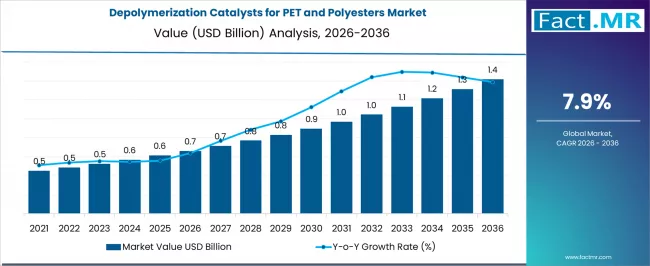
Segment mix reflects a market that is still balancing industrial familiarity with newer, higher-selectivity approaches. Metal-acetates (zinc acetate, manganese acetate) lead catalyst type adoption with a 28% share, aligned with their established role in PET glycolysis systems. On the route side, glycolysis holds a 36% share, supported by practical operating conditions and well-understood downstream purification sequences. On commercialization format, bulk homogeneous catalysts supplied as chemical reagents account for 44.00%, indicating that many operators still prioritize simple dosing and rapid qualification during scale-up.
End-product priorities reinforce where early revenues are concentrated. Bottle-grade PET monomer recovery represents 40.0% of end-product demand, reflecting the commercial premium for food-contact and high-clarity applications. Buyers are targeting consistent monomer purity and stable impurity profiles that can support repolymerization without compromising resin performance. Projects are also expanding into textile-grade and specialty chemistry outputs, especially where process integration improves overall yield and reduces waste handling complexity.
Depolymerization Catalysts for PET and Polyesters Market
| Metric | Value |
|---|---|
| Market Value (2026) | USD 0.71 Billion |
| Market Forecast Value (2036) | USD 1.52 Billion |
| Forecast CAGR (2026-2036) | 7.9% |
Category
| Category | Segments |
|---|---|
| Catalyst Type | Metal-acetates (zinc acetate, manganese acetate), Organometallic Lewis-acid catalysts (Ti, Sn, Al derivatives), Basic alkoxide and alkali catalysts (Na, K alkoxides, ethoxide), Ionic-liquid and task-specific solvent catalysts, Heterogeneous solid catalysts, Enzymatic biocatalysts, Proprietary multi-functional catalyst blends, Others |
| Depolymerization Route | Glycolysis, Methanolysis, Enzymatic hydrolysis, Aminolysis, Microwave assisted thermal and catalytic depolymerization, Solvolysis, Others |
| Supply Model | Bulk homogeneous catalysts supplied as chemical reagents, Immobilized and heterogeneous catalyst systems, Enzyme supply, Integrated catalyst and process packs, Others |
| End-Product | Bottle-grade PET monomer recovery, Fiber and textile-grade polyester feedstock, Packaging film and thermoforming grades, Specialty high-value chemicals from depolymerization, Industrial resins and intermediate oligomers, Others |
| Region | North America, Latin America, Western Europe, Eastern Europe, East Asia, South Asia and Pacific, MEA |
Segmental Analysis
By Catalyst Type, Which Chemistry Holds the Broadest Industrial Adoption?
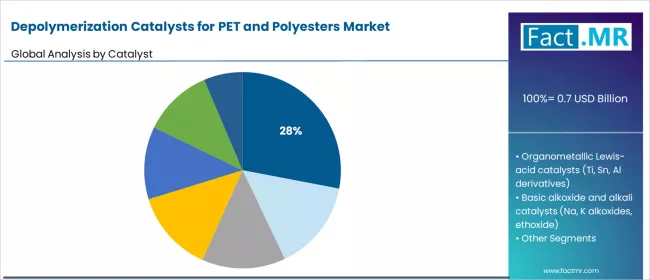
Metal-acetates lead the segment with a 28% share. They remain a preferred starting point for many glycolysis-based systems because procurement is straightforward, dosing is simple, and operator familiarity reduces commissioning risk. For plants that are still stabilizing feedstock variability, these catalysts offer predictable reaction behavior, which helps maintain steady throughput.
Their adoption is also supported by practical considerations in upstream waste preparation. Mixed bale inputs carry additives, labels, barrier layers, and variable moisture content. A catalyst family with broad operating tolerance can reduce the need for extremely tight feedstock specifications in early commercial stages. Buyers also weigh downstream effects such as salt formation, filtration frequency, and washing requirements. Metal-acetate systems are often selected when the purification train is designed around mature separation steps rather than novel recovery approaches.
By Depolymerization Route, Which Pathway Offers the Most Deployable Throughput?
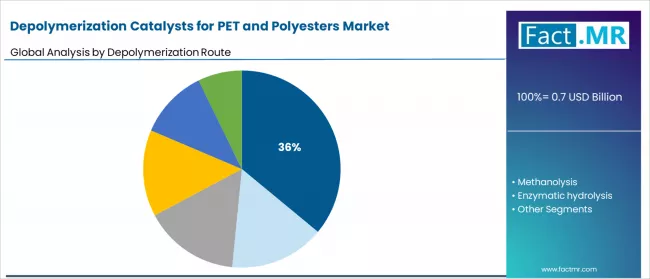
Glycolysis holds the largest route share at 36%. The route aligns with practical reaction conditions, relatively accessible reactants, and established intermediates that can be purified toward repolymerization-grade streams. Commercial plants value route designs that fit conventional equipment and support staged scale-up, including modular capacity additions as feedstock contracts expand.
Glycolysis also provides flexibility in product strategy. Operators can target monomer recovery for bottle-grade applications or adjust the purification intensity to serve industrial resins and intermediate oligomers. This allows projects to align output with offtake readiness. It also supports risk management, since early-stage plants may prioritize stable intermediate sales while optimizing for full polymer-grade monomer recovery.
By Supply Model, Which Delivery Format Best Fits Commercial Operations?
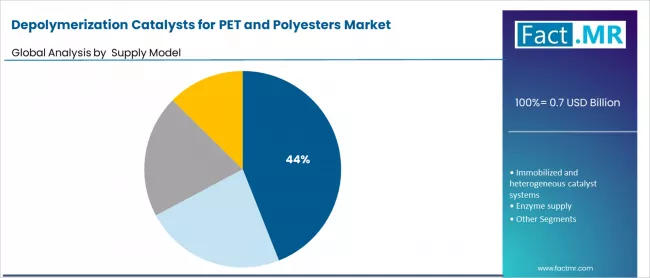
Bulk homogeneous catalysts supplied as chemical reagents account for 44.00% share. This format matches early commercialization realities. Plants often require fast troubleshooting, flexible dosing, and predictable supply continuity. Reagent-style supply lowers qualification time and supports rapid process iterations while operators tune feedstock preparation and impurity removal.
Immobilized and heterogeneous catalyst systems are gaining attention where catalyst separation and reuse improve lifecycle economics. They can reduce downstream filtration and neutralization steps, support longer run times, and simplify waste streams. Adoption depends on reliable activity retention under real feedstock conditions, where contaminants can foul active sites and reduce catalyst life.
By End-Product, Where is Demand Concentrated Today?
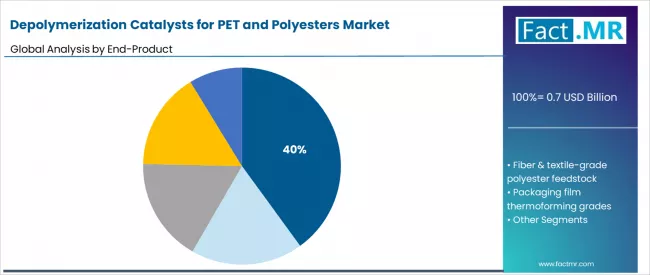
Bottle-grade PET monomer recovery leads with a 40.0% share, driven by the value placed on high-clarity, food-contact compliant resin pathways. Brand commitments and packaging regulations increase the need for recycled content that behaves like virgin PET. Depolymerization routes supported by effective catalysts can reduce variability that often limits mechanical recycled PET in sensitive applications.
Textile-grade polyester feedstock, packaging film and thermoforming grades, and industrial resins represent additional demand pools. These segments can provide volume stability when bottle-grade offtake is competitive or capacity-limited. Specialty high-value chemicals from depolymerization remain an opportunity area, particularly for operators that can separate and valorize additive-derived fractions or use intermediates in adjacent chemical production lines.
What are the Drivers, Restraints, and Key Trends of the Depolymerization Catalysts for PET and Polyesters Market?
Market expansion is driven by the need to recover polymer-grade building blocks from increasingly complex plastic waste. Packaging and textile value chains are under pressure to deliver higher recycled content with consistent performance. Depolymerization offers a route to reduce quality loss across recycling loops, especially for applications that are sensitive to haze, odor, and mechanical property drift. Catalysts sit at the center of this value proposition
Key restraints are tied to feedstock inconsistency and operating complexity. Post-consumer PET streams vary by region, collection quality, and sorting performance. Contaminants such as PVC traces, polyolefin caps, labels, inks, and multilayer structures can reduce yields or increase catalyst consumption. Catalyst deactivation, fouling, and changes in selectivity raise downtime risk. Plants must invest in pretreatment systems and analytical controls to keep output quality consistent. These costs directly affect the catalyst value equation.
Key trends point toward tighter integration and more specialized offerings. Development is shifting toward catalysts that perform under real waste conditions, not just clean feedstocks. Systems that maintain selectivity with mixed bales and colored streams gain buyer interest. Heterogeneous and immobilized catalyst systems are being positioned to reduce separation complexity and support reuse economics. Integrated catalyst and process packs are becoming more common, especially when technology providers want to reduce adoption friction and accelerate commissioning.
Analysis of the Depolymerization Catalysts for PET and Polyesters Market by Key Countries
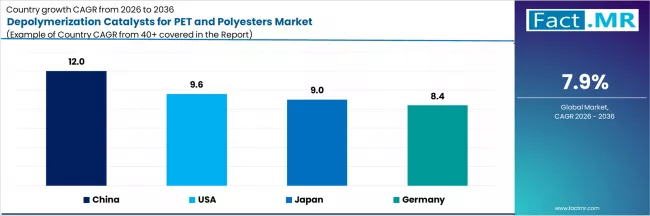
| Country | CAGR (2026-2036) |
|---|---|
| China | 12.00% |
| USA | 9.60% |
| Germany | 8.40% |
| Japan | 9.00% |
Why does China Show Faster Uptake in Depolymerization Catalyst Demand?
China’s 12.00% growth reflects scale in PET consumption and rising activity in chemical recycling capacity buildouts. The market favors solutions that can manage mixed and variable feedstock streams while maintaining usable yields. Catalyst demand is strengthened where operators target high-volume outputs tied to packaging and consumer goods supply chains. Local supply availability and the ability to scale catalyst production also influence adoption.
How does the USA’s Circular Packaging Pull Support Market Growth?
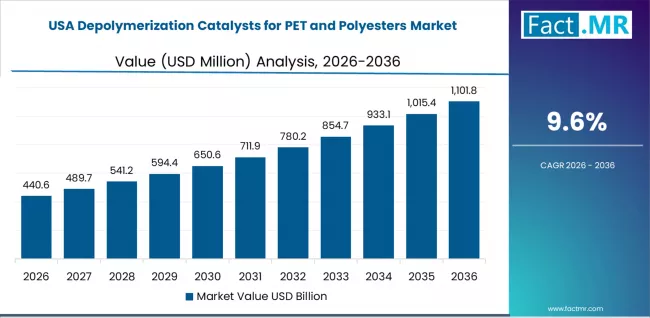
The USA posts a 9.60% CAGR, supported by bottle-to-bottle targets and increasing commitments to recycled content. Depolymerization is used to address applications where mechanical recycled PET has limitations. Catalyst demand rises where projects aim for consistent monomer purity and low variability across batches. Buyers prioritize catalyst systems that support stable operations alongside robust analytical quality control.
What Underpins Germany’s Development Path for Depolymerization Catalysts?
Germany’s 8.40% growth is shaped by high operating standards and emphasis on process efficiency. Buyers place weight on predictable output specifications, emissions control, and waste handling discipline. Catalyst systems that simplify separation steps and reduce wastewater loads are valued. Heterogeneous and immobilized catalysts can align well with these operational priorities if stability is proven in continuous runs.
How Does Japan’s Quality-First Recycling Model Influence Catalyst Choices?
Japan’s 9.00% growth is tied to quality-driven end markets and strict performance expectations for recycled materials. Catalyst selection leans toward selectivity, controlled byproduct formation, and stable purification outcomes. Enzymatic and specialized catalyst systems attract attention where they improve monomer purity and reduce thermal degradation risk. Adoption depends on demonstrable long-run performance and supply assurance.
Competitive Landscape of the Depolymerization Catalysts for PET and Polyesters Market
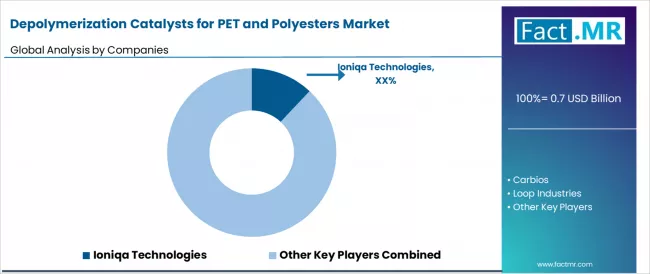
Competition is shaped by technology developers, chemical suppliers, and integrated process players that combine catalyst know-how with engineering execution. Differentiation centers on selectivity under contaminated feedstock conditions, robustness in continuous operations, and the ability to deliver polymer-grade outputs with predictable impurity profiles. Buyers often compare offerings based on conversion efficiency, catalyst lifetime, ease of separation, and the cost of downstream purification per tonne of monomer.
Business models vary. Some players focus on proprietary catalyst systems tied to a specific route, supported by licensing or process partnerships. Others position themselves as integrated circular materials platforms, where catalyst selection is embedded into a broader technology stack that includes pretreatment, depolymerization, purification, and repolymerization. Strategic alliances with waste collectors, sorting firms, and brand owners are becoming important, since feedstock quality and offtake security influence plant economics as much as chemistry.
Scale-up capability is a major competitive lever. Commercial operators want reproducible performance from pilot to multi-kiloton production. Companies that can provide reference plant performance, validated material specifications, and stable supply chains for catalyst inputs gain credibility. Technical service, on-site commissioning support, and quality assurance documentation are also key factors in catalyst procurement decisions.
Key Players in the Depolymerization Catalysts for PET and Polyesters Market
- Ioniqa Technologies
- Carbios
- Loop Industries
- Eastman Chemical Company
- Gr3n
Scope of Report
| Items | Values |
|---|---|
| Quantitative Units | USD Billion |
| Catalyst Type | Metal-acetates (zinc acetate, manganese acetate), Organometallic Lewis-acid catalysts (Ti, Sn, Al derivatives), Basic alkoxide and alkali catalysts (Na, K alkoxides, ethoxide), Ionic-liquid and task-specific solvent catalysts, Heterogeneous solid catalysts, Enzymatic biocatalysts, Proprietary multi-functional catalyst blends, Others |
| Depolymerization Route | Glycolysis, Methanolysis, Enzymatic hydrolysis, Aminolysis, Microwave assisted thermal and catalytic depolymerization, Solvolysis, Others |
| Supply Model | Bulk homogeneous catalysts supplied as chemical reagents, Immobilized and heterogeneous catalyst systems, Enzyme supply, Integrated catalyst and process packs, Others |
| End-Product | Bottle-grade PET monomer recovery, Fiber and textile-grade polyester feedstock, Packaging film and thermoforming grades, Specialty high-value chemicals from depolymerization, Industrial resins and intermediate oligomers, Others |
| Key Countries | China, USA, Germany, Japan |
| Key Companies | Ioniqa Technologies, Carbios, Loop Industries, Eastman Chemical Company, Gr3n |
| Additional Analysis | Catalyst performance benchmarking by feedstock quality, catalyst separation and recovery approaches, impurity management in monomer purification, economics of catalyst dosing versus yield, route selection aligned to end-product specifications |
Depolymerization Catalysts for PET and Polyesters Market by Segments
-
Catalyst Type :
- Metal-acetates (zinc acetate, manganese acetate)
- Organometallic Lewis-acid catalysts (Ti, Sn, Al derivatives)
- Basic alkoxide and alkali catalysts (Na, K alkoxides, ethoxide)
- Ionic-liquid and task-specific solvent catalysts
- Heterogeneous solid catalysts
- Enzymatic biocatalysts
- Proprietary multi-functional catalyst blends
- Others
-
Depolymerization Route :
- Glycolysis
- Methanolysis
- Enzymatic hydrolysis
- Aminolysis
- Microwave assisted thermal and catalytic depolymerization
- Solvolysis
- Others
-
Supply Model :
- Bulk homogeneous catalysts supplied as chemical reagents
- Immobilized and heterogeneous catalyst systems
- Enzyme supply
- Integrated catalyst and process packs
- Others
-
End-Product :
- Bottle-grade PET monomer recovery
- Fiber and textile-grade polyester feedstock
- Packaging film and thermoforming grades
- Specialty high-value chemicals from depolymerization
- Industrial resins and intermediate oligomers
- Others
-
Region :
-
North America
- USA
- Canada
-
Latin America
- Brazil
- Mexico
- Argentina
- Rest of Latin America
-
Western Europe
- Germany
- UK
- France
- Spain
- Italy
- BENELUX
- Rest of Western Europe
-
Eastern Europe
- Czech Republic
- Poland
- Russia
- Rest of Eastern Europe
-
East Asia
- China
- Japan
- South Korea
- Rest of East Asia
-
South Asia and Pacific
- India
- Indonesia
- Australia
- Rest of South Asia and Pacific
-
MEA
- GCC Countries
- Turkiye
- Saudi Arabia
- Rest of MEA
-
Table of Content
- Executive Summary
- Global Market Outlook
- Demand to side Trends
- Supply to side Trends
- Technology Roadmap Analysis
- Analysis and Recommendations
- Market Overview
- Market Coverage / Taxonomy
- Market Definition / Scope / Limitations
- Market Background
- Market Dynamics
- Drivers
- Restraints
- Opportunity
- Trends
- Scenario Forecast
- Demand in Optimistic Scenario
- Demand in Likely Scenario
- Demand in Conservative Scenario
- Opportunity Map Analysis
- Product Life Cycle Analysis
- Supply Chain Analysis
- Investment Feasibility Matrix
- Value Chain Analysis
- PESTLE and Porter’s Analysis
- Regulatory Landscape
- Regional Parent Market Outlook
- Production and Consumption Statistics
- Import and Export Statistics
- Market Dynamics
- Global Market Analysis 2021 to 2025 and Forecast, 2026 to 2036
- Historical Market Size Value (USD Million) Analysis, 2021 to 2025
- Current and Future Market Size Value (USD Million) Projections, 2026 to 2036
- Y to o to Y Growth Trend Analysis
- Absolute $ Opportunity Analysis
- Global Market Pricing Analysis 2021 to 2025 and Forecast 2026 to 2036
- Global Market Analysis 2021 to 2025 and Forecast 2026 to 2036, By Catalyst
- Introduction / Key Findings
- Historical Market Size Value (USD Million) Analysis By Catalyst, 2021 to 2025
- Current and Future Market Size Value (USD Million) Analysis and Forecast By Catalyst, 2026 to 2036
- Metal-acetates (zinc acetate, manganese acetate)
- Organometallic Lewis-acid catalysts (Ti, Sn, Al derivatives)
- Basic alkoxide and alkali catalysts (Na, K alkoxides, ethoxide)
- Ionic-liquid and task-specific solvent catalysts
- Heterogeneous solid catalysts
- Enzymatic biocatalysts
- Proprietary multi-functional catalyst blends
- Metal-acetates (zinc acetate, manganese acetate)
- Y to o to Y Growth Trend Analysis By Catalyst, 2021 to 2025
- Absolute $ Opportunity Analysis By Catalyst, 2026 to 2036
- Global Market Analysis 2021 to 2025 and Forecast 2026 to 2036, By Depolymerization Route
- Introduction / Key Findings
- Historical Market Size Value (USD Million) Analysis By Depolymerization Route, 2021 to 2025
- Current and Future Market Size Value (USD Million) Analysis and Forecast By Depolymerization Route, 2026 to 2036
- Glycolysis
- Methanolysis
- Enzymatic hydrolysis
- Aminolysis
- Microwave assisted thermal & catalytic depolymerization
- Solvolysis
- Glycolysis
- Y to o to Y Growth Trend Analysis By Depolymerization Route, 2021 to 2025
- Absolute $ Opportunity Analysis By Depolymerization Route, 2026 to 2036
- Global Market Analysis 2021 to 2025 and Forecast 2026 to 2036, By Supply Model
- Introduction / Key Findings
- Historical Market Size Value (USD Million) Analysis By Supply Model, 2021 to 2025
- Current and Future Market Size Value (USD Million) Analysis and Forecast By Supply Model, 2026 to 2036
- Bulk homogeneous catalysts supplied as chemical reagents
- Immobilized and heterogeneous catalyst systems
- Enzyme supply
- Integrated catalyst & process packs
- Bulk homogeneous catalysts supplied as chemical reagents
- Y to o to Y Growth Trend Analysis By Supply Model, 2021 to 2025
- Absolute $ Opportunity Analysis By Supply Model, 2026 to 2036
- Global Market Analysis 2021 to 2025 and Forecast 2026 to 2036, By End-Product
- Introduction / Key Findings
- Historical Market Size Value (USD Million) Analysis By End-Product, 2021 to 2025
- Current and Future Market Size Value (USD Million) Analysis and Forecast By End-Product, 2026 to 2036
- Bottle-grade PET monomer recovery
- Fiber & textile-grade polyester feedstock
- Packaging film thermoforming grades
- Specialty high-value chemicals from depolymerization
- Industrial resins & intermediate oligomers
- Bottle-grade PET monomer recovery
- Y to o to Y Growth Trend Analysis By End-Product, 2021 to 2025
- Absolute $ Opportunity Analysis By End-Product, 2026 to 2036
- Global Market Analysis 2021 to 2025 and Forecast 2026 to 2036, By Region
- Introduction
- Historical Market Size Value (USD Million) Analysis By Region, 2021 to 2025
- Current Market Size Value (USD Million) Analysis and Forecast By Region, 2026 to 2036
- North America
- Latin America
- Western Europe
- Eastern Europe
- East Asia
- South Asia and Pacific
- Middle East & Africa
- Market Attractiveness Analysis By Region
- North America Market Analysis 2021 to 2025 and Forecast 2026 to 2036, By Country
- Historical Market Size Value (USD Million) Trend Analysis By Market Taxonomy, 2021 to 2025
- Market Size Value (USD Million) Forecast By Market Taxonomy, 2026 to 2036
- By Country
- USA
- Canada
- Mexico
- By Catalyst
- By Depolymerization Route
- By Supply Model
- By End-Product
- By Country
- Market Attractiveness Analysis
- By Country
- By Catalyst
- By Depolymerization Route
- By Supply Model
- By End-Product
- Key Takeaways
- Latin America Market Analysis 2021 to 2025 and Forecast 2026 to 2036, By Country
- Historical Market Size Value (USD Million) Trend Analysis By Market Taxonomy, 2021 to 2025
- Market Size Value (USD Million) Forecast By Market Taxonomy, 2026 to 2036
- By Country
- Brazil
- Chile
- Rest of Latin America
- By Catalyst
- By Depolymerization Route
- By Supply Model
- By End-Product
- By Country
- Market Attractiveness Analysis
- By Country
- By Catalyst
- By Depolymerization Route
- By Supply Model
- By End-Product
- Key Takeaways
- Western Europe Market Analysis 2021 to 2025 and Forecast 2026 to 2036, By Country
- Historical Market Size Value (USD Million) Trend Analysis By Market Taxonomy, 2021 to 2025
- Market Size Value (USD Million) Forecast By Market Taxonomy, 2026 to 2036
- By Country
- Germany
- UK
- Italy
- Spain
- France
- Nordic
- BENELUX
- Rest of Western Europe
- By Catalyst
- By Depolymerization Route
- By Supply Model
- By End-Product
- By Country
- Market Attractiveness Analysis
- By Country
- By Catalyst
- By Depolymerization Route
- By Supply Model
- By End-Product
- Key Takeaways
- Eastern Europe Market Analysis 2021 to 2025 and Forecast 2026 to 2036, By Country
- Historical Market Size Value (USD Million) Trend Analysis By Market Taxonomy, 2021 to 2025
- Market Size Value (USD Million) Forecast By Market Taxonomy, 2026 to 2036
- By Country
- Russia
- Poland
- Hungary
- Balkan & Baltic
- Rest of Eastern Europe
- By Catalyst
- By Depolymerization Route
- By Supply Model
- By End-Product
- By Country
- Market Attractiveness Analysis
- By Country
- By Catalyst
- By Depolymerization Route
- By Supply Model
- By End-Product
- Key Takeaways
- East Asia Market Analysis 2021 to 2025 and Forecast 2026 to 2036, By Country
- Historical Market Size Value (USD Million) Trend Analysis By Market Taxonomy, 2021 to 2025
- Market Size Value (USD Million) Forecast By Market Taxonomy, 2026 to 2036
- By Country
- China
- Japan
- South Korea
- By Catalyst
- By Depolymerization Route
- By Supply Model
- By End-Product
- By Country
- Market Attractiveness Analysis
- By Country
- By Catalyst
- By Depolymerization Route
- By Supply Model
- By End-Product
- Key Takeaways
- South Asia and Pacific Market Analysis 2021 to 2025 and Forecast 2026 to 2036, By Country
- Historical Market Size Value (USD Million) Trend Analysis By Market Taxonomy, 2021 to 2025
- Market Size Value (USD Million) Forecast By Market Taxonomy, 2026 to 2036
- By Country
- India
- ASEAN
- Australia & New Zealand
- Rest of South Asia and Pacific
- By Catalyst
- By Depolymerization Route
- By Supply Model
- By End-Product
- By Country
- Market Attractiveness Analysis
- By Country
- By Catalyst
- By Depolymerization Route
- By Supply Model
- By End-Product
- Key Takeaways
- Middle East & Africa Market Analysis 2021 to 2025 and Forecast 2026 to 2036, By Country
- Historical Market Size Value (USD Million) Trend Analysis By Market Taxonomy, 2021 to 2025
- Market Size Value (USD Million) Forecast By Market Taxonomy, 2026 to 2036
- By Country
- Kingdom of Saudi Arabia
- Other GCC Countries
- Turkiye
- South Africa
- Other African Union
- Rest of Middle East & Africa
- By Catalyst
- By Depolymerization Route
- By Supply Model
- By End-Product
- By Country
- Market Attractiveness Analysis
- By Country
- By Catalyst
- By Depolymerization Route
- By Supply Model
- By End-Product
- Key Takeaways
- Key Countries Market Analysis
- USA
- Pricing Analysis
- Market Share Analysis, 2025
- By Catalyst
- By Depolymerization Route
- By Supply Model
- By End-Product
- Canada
- Pricing Analysis
- Market Share Analysis, 2025
- By Catalyst
- By Depolymerization Route
- By Supply Model
- By End-Product
- Mexico
- Pricing Analysis
- Market Share Analysis, 2025
- By Catalyst
- By Depolymerization Route
- By Supply Model
- By End-Product
- Brazil
- Pricing Analysis
- Market Share Analysis, 2025
- By Catalyst
- By Depolymerization Route
- By Supply Model
- By End-Product
- Chile
- Pricing Analysis
- Market Share Analysis, 2025
- By Catalyst
- By Depolymerization Route
- By Supply Model
- By End-Product
- Germany
- Pricing Analysis
- Market Share Analysis, 2025
- By Catalyst
- By Depolymerization Route
- By Supply Model
- By End-Product
- UK
- Pricing Analysis
- Market Share Analysis, 2025
- By Catalyst
- By Depolymerization Route
- By Supply Model
- By End-Product
- Italy
- Pricing Analysis
- Market Share Analysis, 2025
- By Catalyst
- By Depolymerization Route
- By Supply Model
- By End-Product
- Spain
- Pricing Analysis
- Market Share Analysis, 2025
- By Catalyst
- By Depolymerization Route
- By Supply Model
- By End-Product
- France
- Pricing Analysis
- Market Share Analysis, 2025
- By Catalyst
- By Depolymerization Route
- By Supply Model
- By End-Product
- India
- Pricing Analysis
- Market Share Analysis, 2025
- By Catalyst
- By Depolymerization Route
- By Supply Model
- By End-Product
- ASEAN
- Pricing Analysis
- Market Share Analysis, 2025
- By Catalyst
- By Depolymerization Route
- By Supply Model
- By End-Product
- Australia & New Zealand
- Pricing Analysis
- Market Share Analysis, 2025
- By Catalyst
- By Depolymerization Route
- By Supply Model
- By End-Product
- China
- Pricing Analysis
- Market Share Analysis, 2025
- By Catalyst
- By Depolymerization Route
- By Supply Model
- By End-Product
- Japan
- Pricing Analysis
- Market Share Analysis, 2025
- By Catalyst
- By Depolymerization Route
- By Supply Model
- By End-Product
- South Korea
- Pricing Analysis
- Market Share Analysis, 2025
- By Catalyst
- By Depolymerization Route
- By Supply Model
- By End-Product
- Russia
- Pricing Analysis
- Market Share Analysis, 2025
- By Catalyst
- By Depolymerization Route
- By Supply Model
- By End-Product
- Poland
- Pricing Analysis
- Market Share Analysis, 2025
- By Catalyst
- By Depolymerization Route
- By Supply Model
- By End-Product
- Hungary
- Pricing Analysis
- Market Share Analysis, 2025
- By Catalyst
- By Depolymerization Route
- By Supply Model
- By End-Product
- Kingdom of Saudi Arabia
- Pricing Analysis
- Market Share Analysis, 2025
- By Catalyst
- By Depolymerization Route
- By Supply Model
- By End-Product
- Turkiye
- Pricing Analysis
- Market Share Analysis, 2025
- By Catalyst
- By Depolymerization Route
- By Supply Model
- By End-Product
- South Africa
- Pricing Analysis
- Market Share Analysis, 2025
- By Catalyst
- By Depolymerization Route
- By Supply Model
- By End-Product
- USA
- Market Structure Analysis
- Competition Dashboard
- Competition Benchmarking
- Market Share Analysis of Top Players
- By Regional
- By Catalyst
- By Depolymerization Route
- By Supply Model
- By End-Product
- Competition Analysis
- Competition Deep Dive
- Ioniqa Technologies
- Overview
- Product Portfolio
- Profitability by Market Segments (Product/Age /Sales Channel/Region)
- Sales Footprint
- Strategy Overview
- Marketing Strategy
- Product Strategy
- Channel Strategy
- Carbios
- Loop Industries
- Eastman Chemical Company
- Gr3n
- Ioniqa Technologies
- Competition Deep Dive
- Assumptions & Acronyms Used
- Research Methodology
List Of Table
- Table 1: Global Market Value (USD Million) Forecast by Region, 2021 to 2036
- Table 2: Global Market Value (USD Million) Forecast by Catalyst, 2021 to 2036
- Table 3: Global Market Value (USD Million) Forecast by Depolymerization Route, 2021 to 2036
- Table 4: Global Market Value (USD Million) Forecast by Supply Model, 2021 to 2036
- Table 5: Global Market Value (USD Million) Forecast by End-Product, 2021 to 2036
- Table 6: North America Market Value (USD Million) Forecast by Country, 2021 to 2036
- Table 7: North America Market Value (USD Million) Forecast by Catalyst, 2021 to 2036
- Table 8: North America Market Value (USD Million) Forecast by Depolymerization Route, 2021 to 2036
- Table 9: North America Market Value (USD Million) Forecast by Supply Model, 2021 to 2036
- Table 10: North America Market Value (USD Million) Forecast by End-Product, 2021 to 2036
- Table 11: Latin America Market Value (USD Million) Forecast by Country, 2021 to 2036
- Table 12: Latin America Market Value (USD Million) Forecast by Catalyst, 2021 to 2036
- Table 13: Latin America Market Value (USD Million) Forecast by Depolymerization Route, 2021 to 2036
- Table 14: Latin America Market Value (USD Million) Forecast by Supply Model, 2021 to 2036
- Table 15: Latin America Market Value (USD Million) Forecast by End-Product, 2021 to 2036
- Table 16: Western Europe Market Value (USD Million) Forecast by Country, 2021 to 2036
- Table 17: Western Europe Market Value (USD Million) Forecast by Catalyst, 2021 to 2036
- Table 18: Western Europe Market Value (USD Million) Forecast by Depolymerization Route, 2021 to 2036
- Table 19: Western Europe Market Value (USD Million) Forecast by Supply Model, 2021 to 2036
- Table 20: Western Europe Market Value (USD Million) Forecast by End-Product, 2021 to 2036
- Table 21: Eastern Europe Market Value (USD Million) Forecast by Country, 2021 to 2036
- Table 22: Eastern Europe Market Value (USD Million) Forecast by Catalyst, 2021 to 2036
- Table 23: Eastern Europe Market Value (USD Million) Forecast by Depolymerization Route, 2021 to 2036
- Table 24: Eastern Europe Market Value (USD Million) Forecast by Supply Model, 2021 to 2036
- Table 25: Eastern Europe Market Value (USD Million) Forecast by End-Product, 2021 to 2036
- Table 26: East Asia Market Value (USD Million) Forecast by Country, 2021 to 2036
- Table 27: East Asia Market Value (USD Million) Forecast by Catalyst, 2021 to 2036
- Table 28: East Asia Market Value (USD Million) Forecast by Depolymerization Route, 2021 to 2036
- Table 29: East Asia Market Value (USD Million) Forecast by Supply Model, 2021 to 2036
- Table 30: East Asia Market Value (USD Million) Forecast by End-Product, 2021 to 2036
- Table 31: South Asia and Pacific Market Value (USD Million) Forecast by Country, 2021 to 2036
- Table 32: South Asia and Pacific Market Value (USD Million) Forecast by Catalyst, 2021 to 2036
- Table 33: South Asia and Pacific Market Value (USD Million) Forecast by Depolymerization Route, 2021 to 2036
- Table 34: South Asia and Pacific Market Value (USD Million) Forecast by Supply Model, 2021 to 2036
- Table 35: South Asia and Pacific Market Value (USD Million) Forecast by End-Product, 2021 to 2036
- Table 36: Middle East & Africa Market Value (USD Million) Forecast by Country, 2021 to 2036
- Table 37: Middle East & Africa Market Value (USD Million) Forecast by Catalyst, 2021 to 2036
- Table 38: Middle East & Africa Market Value (USD Million) Forecast by Depolymerization Route, 2021 to 2036
- Table 39: Middle East & Africa Market Value (USD Million) Forecast by Supply Model, 2021 to 2036
- Table 40: Middle East & Africa Market Value (USD Million) Forecast by End-Product, 2021 to 2036
List Of Figures
- Figure 1: Global Market Pricing Analysis
- Figure 2: Global Market Value (USD Million) Forecast 2021 to 2036
- Figure 3: Global Market Value Share and BPS Analysis by Catalyst, 2026 and 2036
- Figure 4: Global Market Y to o to Y Growth Comparison by Catalyst, 2026 to 2036
- Figure 5: Global Market Attractiveness Analysis by Catalyst
- Figure 6: Global Market Value Share and BPS Analysis by Depolymerization Route, 2026 and 2036
- Figure 7: Global Market Y to o to Y Growth Comparison by Depolymerization Route, 2026 to 2036
- Figure 8: Global Market Attractiveness Analysis by Depolymerization Route
- Figure 9: Global Market Value Share and BPS Analysis by Supply Model, 2026 and 2036
- Figure 10: Global Market Y to o to Y Growth Comparison by Supply Model, 2026 to 2036
- Figure 11: Global Market Attractiveness Analysis by Supply Model
- Figure 12: Global Market Value Share and BPS Analysis by End-Product, 2026 and 2036
- Figure 13: Global Market Y to o to Y Growth Comparison by End-Product, 2026 to 2036
- Figure 14: Global Market Attractiveness Analysis by End-Product
- Figure 15: Global Market Value (USD Million) Share and BPS Analysis by Region, 2026 and 2036
- Figure 16: Global Market Y to o to Y Growth Comparison by Region, 2026 to 2036
- Figure 17: Global Market Attractiveness Analysis by Region
- Figure 18: North America Market Incremental Dollar Opportunity, 2026 to 2036
- Figure 19: Latin America Market Incremental Dollar Opportunity, 2026 to 2036
- Figure 20: Western Europe Market Incremental Dollar Opportunity, 2026 to 2036
- Figure 21: Eastern Europe Market Incremental Dollar Opportunity, 2026 to 2036
- Figure 22: East Asia Market Incremental Dollar Opportunity, 2026 to 2036
- Figure 23: South Asia and Pacific Market Incremental Dollar Opportunity, 2026 to 2036
- Figure 24: Middle East & Africa Market Incremental Dollar Opportunity, 2026 to 2036
- Figure 25: North America Market Value Share and BPS Analysis by Country, 2026 and 2036
- Figure 26: North America Market Value Share and BPS Analysis by Catalyst, 2026 and 2036
- Figure 27: North America Market Y to o to Y Growth Comparison by Catalyst, 2026 to 2036
- Figure 28: North America Market Attractiveness Analysis by Catalyst
- Figure 29: North America Market Value Share and BPS Analysis by Depolymerization Route, 2026 and 2036
- Figure 30: North America Market Y to o to Y Growth Comparison by Depolymerization Route, 2026 to 2036
- Figure 31: North America Market Attractiveness Analysis by Depolymerization Route
- Figure 32: North America Market Value Share and BPS Analysis by Supply Model, 2026 and 2036
- Figure 33: North America Market Y to o to Y Growth Comparison by Supply Model, 2026 to 2036
- Figure 34: North America Market Attractiveness Analysis by Supply Model
- Figure 35: North America Market Value Share and BPS Analysis by End-Product, 2026 and 2036
- Figure 36: North America Market Y to o to Y Growth Comparison by End-Product, 2026 to 2036
- Figure 37: North America Market Attractiveness Analysis by End-Product
- Figure 38: Latin America Market Value Share and BPS Analysis by Country, 2026 and 2036
- Figure 39: Latin America Market Value Share and BPS Analysis by Catalyst, 2026 and 2036
- Figure 40: Latin America Market Y to o to Y Growth Comparison by Catalyst, 2026 to 2036
- Figure 41: Latin America Market Attractiveness Analysis by Catalyst
- Figure 42: Latin America Market Value Share and BPS Analysis by Depolymerization Route, 2026 and 2036
- Figure 43: Latin America Market Y to o to Y Growth Comparison by Depolymerization Route, 2026 to 2036
- Figure 44: Latin America Market Attractiveness Analysis by Depolymerization Route
- Figure 45: Latin America Market Value Share and BPS Analysis by Supply Model, 2026 and 2036
- Figure 46: Latin America Market Y to o to Y Growth Comparison by Supply Model, 2026 to 2036
- Figure 47: Latin America Market Attractiveness Analysis by Supply Model
- Figure 48: Latin America Market Value Share and BPS Analysis by End-Product, 2026 and 2036
- Figure 49: Latin America Market Y to o to Y Growth Comparison by End-Product, 2026 to 2036
- Figure 50: Latin America Market Attractiveness Analysis by End-Product
- Figure 51: Western Europe Market Value Share and BPS Analysis by Country, 2026 and 2036
- Figure 52: Western Europe Market Value Share and BPS Analysis by Catalyst, 2026 and 2036
- Figure 53: Western Europe Market Y to o to Y Growth Comparison by Catalyst, 2026 to 2036
- Figure 54: Western Europe Market Attractiveness Analysis by Catalyst
- Figure 55: Western Europe Market Value Share and BPS Analysis by Depolymerization Route, 2026 and 2036
- Figure 56: Western Europe Market Y to o to Y Growth Comparison by Depolymerization Route, 2026 to 2036
- Figure 57: Western Europe Market Attractiveness Analysis by Depolymerization Route
- Figure 58: Western Europe Market Value Share and BPS Analysis by Supply Model, 2026 and 2036
- Figure 59: Western Europe Market Y to o to Y Growth Comparison by Supply Model, 2026 to 2036
- Figure 60: Western Europe Market Attractiveness Analysis by Supply Model
- Figure 61: Western Europe Market Value Share and BPS Analysis by End-Product, 2026 and 2036
- Figure 62: Western Europe Market Y to o to Y Growth Comparison by End-Product, 2026 to 2036
- Figure 63: Western Europe Market Attractiveness Analysis by End-Product
- Figure 64: Eastern Europe Market Value Share and BPS Analysis by Country, 2026 and 2036
- Figure 65: Eastern Europe Market Value Share and BPS Analysis by Catalyst, 2026 and 2036
- Figure 66: Eastern Europe Market Y to o to Y Growth Comparison by Catalyst, 2026 to 2036
- Figure 67: Eastern Europe Market Attractiveness Analysis by Catalyst
- Figure 68: Eastern Europe Market Value Share and BPS Analysis by Depolymerization Route, 2026 and 2036
- Figure 69: Eastern Europe Market Y to o to Y Growth Comparison by Depolymerization Route, 2026 to 2036
- Figure 70: Eastern Europe Market Attractiveness Analysis by Depolymerization Route
- Figure 71: Eastern Europe Market Value Share and BPS Analysis by Supply Model, 2026 and 2036
- Figure 72: Eastern Europe Market Y to o to Y Growth Comparison by Supply Model, 2026 to 2036
- Figure 73: Eastern Europe Market Attractiveness Analysis by Supply Model
- Figure 74: Eastern Europe Market Value Share and BPS Analysis by End-Product, 2026 and 2036
- Figure 75: Eastern Europe Market Y to o to Y Growth Comparison by End-Product, 2026 to 2036
- Figure 76: Eastern Europe Market Attractiveness Analysis by End-Product
- Figure 77: East Asia Market Value Share and BPS Analysis by Country, 2026 and 2036
- Figure 78: East Asia Market Value Share and BPS Analysis by Catalyst, 2026 and 2036
- Figure 79: East Asia Market Y to o to Y Growth Comparison by Catalyst, 2026 to 2036
- Figure 80: East Asia Market Attractiveness Analysis by Catalyst
- Figure 81: East Asia Market Value Share and BPS Analysis by Depolymerization Route, 2026 and 2036
- Figure 82: East Asia Market Y to o to Y Growth Comparison by Depolymerization Route, 2026 to 2036
- Figure 83: East Asia Market Attractiveness Analysis by Depolymerization Route
- Figure 84: East Asia Market Value Share and BPS Analysis by Supply Model, 2026 and 2036
- Figure 85: East Asia Market Y to o to Y Growth Comparison by Supply Model, 2026 to 2036
- Figure 86: East Asia Market Attractiveness Analysis by Supply Model
- Figure 87: East Asia Market Value Share and BPS Analysis by End-Product, 2026 and 2036
- Figure 88: East Asia Market Y to o to Y Growth Comparison by End-Product, 2026 to 2036
- Figure 89: East Asia Market Attractiveness Analysis by End-Product
- Figure 90: South Asia and Pacific Market Value Share and BPS Analysis by Country, 2026 and 2036
- Figure 91: South Asia and Pacific Market Value Share and BPS Analysis by Catalyst, 2026 and 2036
- Figure 92: South Asia and Pacific Market Y to o to Y Growth Comparison by Catalyst, 2026 to 2036
- Figure 93: South Asia and Pacific Market Attractiveness Analysis by Catalyst
- Figure 94: South Asia and Pacific Market Value Share and BPS Analysis by Depolymerization Route, 2026 and 2036
- Figure 95: South Asia and Pacific Market Y to o to Y Growth Comparison by Depolymerization Route, 2026 to 2036
- Figure 96: South Asia and Pacific Market Attractiveness Analysis by Depolymerization Route
- Figure 97: South Asia and Pacific Market Value Share and BPS Analysis by Supply Model, 2026 and 2036
- Figure 98: South Asia and Pacific Market Y to o to Y Growth Comparison by Supply Model, 2026 to 2036
- Figure 99: South Asia and Pacific Market Attractiveness Analysis by Supply Model
- Figure 100: South Asia and Pacific Market Value Share and BPS Analysis by End-Product, 2026 and 2036
- Figure 101: South Asia and Pacific Market Y to o to Y Growth Comparison by End-Product, 2026 to 2036
- Figure 102: South Asia and Pacific Market Attractiveness Analysis by End-Product
- Figure 103: Middle East & Africa Market Value Share and BPS Analysis by Country, 2026 and 2036
- Figure 104: Middle East & Africa Market Value Share and BPS Analysis by Catalyst, 2026 and 2036
- Figure 105: Middle East & Africa Market Y to o to Y Growth Comparison by Catalyst, 2026 to 2036
- Figure 106: Middle East & Africa Market Attractiveness Analysis by Catalyst
- Figure 107: Middle East & Africa Market Value Share and BPS Analysis by Depolymerization Route, 2026 and 2036
- Figure 108: Middle East & Africa Market Y to o to Y Growth Comparison by Depolymerization Route, 2026 to 2036
- Figure 109: Middle East & Africa Market Attractiveness Analysis by Depolymerization Route
- Figure 110: Middle East & Africa Market Value Share and BPS Analysis by Supply Model, 2026 and 2036
- Figure 111: Middle East & Africa Market Y to o to Y Growth Comparison by Supply Model, 2026 to 2036
- Figure 112: Middle East & Africa Market Attractiveness Analysis by Supply Model
- Figure 113: Middle East & Africa Market Value Share and BPS Analysis by End-Product, 2026 and 2036
- Figure 114: Middle East & Africa Market Y to o to Y Growth Comparison by End-Product, 2026 to 2036
- Figure 115: Middle East & Africa Market Attractiveness Analysis by End-Product
- Figure 116: Global Market - Tier Structure Analysis
- Figure 117: Global Market - Company Share Analysis
- FAQs -
How big is the depolymerization catalysts for PET and polyesters market in 2026?
The global depolymerization catalysts for PET and polyesters market is estimated to be valued at USD 0.7 billion in 2026.
What will be the size of depolymerization catalysts for PET and polyesters market in 2036?
The market size for the depolymerization catalysts for PET and polyesters market is projected to reach USD 1.4 billion by 2036.
How much will be the depolymerization catalysts for PET and polyesters market growth between 2026 and 2036?
The depolymerization catalysts for PET and polyesters market is expected to grow at a 7.9% CAGR between 2026 and 2036.
What are the key product types in the depolymerization catalysts for PET and polyesters market?
The key product types in depolymerization catalysts for PET and polyesters market are metal-acetates (zinc acetate, manganese acetate), organometallic lewis-acid catalysts (ti, sn, al derivatives), basic alkoxide and alkali catalysts (na, k alkoxides, ethoxide), ionic-liquid and task-specific solvent catalysts, heterogeneous solid catalysts , enzymatic biocatalysts and proprietary multi-functional catalyst blends .
Which depolymerization route segment to contribute significant share in the depolymerization catalysts for PET and polyesters market in 2026?
In terms of depolymerization route, glycolysis segment to command 36.0% share in the depolymerization catalysts for PET and polyesters market in 2026.