- Base Value(2025): 12.8 Bn
- Forecast Value (2035): 21.7 Bn
- CAGR (2035): 5.4%
Polymer Seal Market Outlook (2025 to 2035)
The global polymer seal market is projected to increase from USD 12.8 billion in 2025 to USD 21.7 billion by 2035, with a CAGR of 5.4% during the forecast period. Growth is driven by the increasing demand for high-performance sealing solutions across various industries, including aerospace, automotive, construction, and electronics.
The necessity for enhanced durability and efficacy is the driving force behind this demand. Their use makes them ideal for applications that require high durability, chemical resistance, and reliable sealing performance in demanding environments across various industries.
-2025-to-2035.webp)
Polymer Seal Market By Material Value (USD Billion) 2025 To 2035 | Source: Fact.MR
What are the Drivers of the Polymer Seal Market?
The growing automotive industry is increasingly relying on advanced sealing materials to ensure engine efficiency, minimize emissions, and enhance vehicle longevity, making it a key driver of the polymer seal market. A wide range of growth factors spanning multiple high-performance applications characterizes this market.
The demand for polymer sealing materials has been further bolstered by the increasing production of electric vehicles, which require specialized sealing to protect electrical components from environmental factors. The market has also expanded as a result of the increasing emphasis on fuel efficiency and stringent emission regulations, which have necessitated the implementation of high-performance sealing solutions.
The aerospace sector's expansion is another substantial growth factor, as polymer sealing materials are indispensable for the operational reliability and safety of aircraft. Fuel systems, hydraulic systems, and airframes are among the numerous applications in which these materials are employed to prevent leakages and withstand extreme temperatures and pressures.
The subsequent increase in aircraft production and the growing number of air passengers are expected to drive demand for polymer sealing materials in the aerospace industry. Additionally, the market has expanded due to advancements in materials science, which have enabled the development of innovative sealing solutions that offer superior performance and durability.
The polymer sealing material market is also significantly influenced by the construction industry. Due to the accelerated advancement of infrastructure and urbanization on a global scale, there is a growing need for resilient sealing solutions to ensure the structural integrity of structures and infrastructure.
Insulation, waterproofing, and protection against environmental factors are all achieved through the extensive use of polymer sealing materials in construction applications, such as the sealing of junctions, windows, and doors. In the construction sector, the demand for high-performance sealing materials has been further stimulated by the growing emphasis on energy-efficient and sustainable building practices.
What are the Regional Trends of the Polymer Seal Market?
Distinct dynamics are observed in the regional trends of the polymer seal market in key global regions. The Asia-Pacific region is the largest and fastest-growing market, driven by the high demand from automotive, manufacturing, and construction sectors, particularly in China and India, as well as rapid industrialization and infrastructure development.
The region serves as a strategic hub for the production and consumption of polymer seals, due to its favorable regulatory environment, abundant raw materials, and cost-effective labor. The market in China is particularly robust as a result of its ongoing industrial development and its dominant position in automotive manufacturing.
Established industries, such as pharmaceuticals, oil and gas, and automotive, are key drivers of North America's strong presence in the market. The region's emphasis on technological advancements and stringent regulatory standards facilitates the adoption of advanced and eco-friendly sealing solutions.
The European market is mature, with a robust automotive and industrial foundation that is bolstered by the demand for fuel-efficient, lightweight vehicles and the necessity to adhere to rigorous regulations.
The market in South Asia & Oceania is experiencing accelerated growth driven by the industrialization, aviation, and automotive manufacturing sectors. An expanding manufacturing sector and infrastructure initiatives, particularly in Brazil and Mexico, as well as an increased emphasis on renewable energy and oil and gas investments, are currently creating growth opportunities in Latin America.
Infrastructure development and the oil and gas industry's requirement for high-performance sealing solutions, particularly for pipelines and refineries, are the primary factors driving the Middle East & Africa region. Consequently, despite the Asia-Pacific region being the leader in terms of both growth and market share, North America and Europe remain significant due to their technological innovation and regulatory environments.
Additionally, the industrial and infrastructure sectors of emerging markets in Latin America and the Middle East & Africa present new growth opportunities.
What are the Challenges and Restraining Factors of the Polymer Seal market?
The market faces several key challenges and restraining factors that impact its growth and development. One major challenge is the fluctuation in raw material prices, which can increase production costs and reduce profit margins for manufacturers.
Additionally, intense competition within the industry puts pressure on companies to continually innovate and differentiate their products, often requiring significant investment in research and development. Another restraining factor is the stringent regulatory standards imposed by industries such as pharmaceuticals, food and beverage, and healthcare, which require polymer seals to meet high safety and quality criteria.
Complying with these regulations can be costly and time-consuming, particularly for smaller manufacturers. The market also faces supply chain disruptions, which can delay the delivery of raw materials and finished products, thereby affecting overall production efficiency.
Furthermore, the availability of alternative sealing materials such as metals and ceramics, which offer superior performance in certain extreme conditions, poses a competitive threat to polymer seals. Environmental concerns regarding the use and disposal of polymer-based products are also increasingly influencing market dynamics, as industries seek more sustainable and eco-friendly solutions.
The need for continuous technological advancements to meet evolving industry demands adds to the operational and financial burden on manufacturers, especially as end-user industries require seals with enhanced durability, chemical resistance, and temperature stability.
Country-Wise Outlook
U.S. polymer seal market sees growth driven by growth in hydraulic and pneumatic equipment
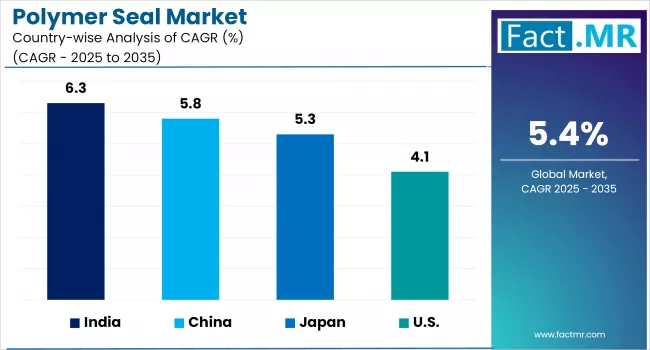
Polymer Seal Market By Material By Country | Source: Fact.MR
The U.S. polymer seal market is experiencing steady growth, primarily driven by increasing demand for efficient sealing solutions across various industries, including automotive, oil and gas, pharmaceuticals, and aerospace.
This growth is fueled by factors including the expansion of the automotive sector, which requires polymer seals for engines, transmissions, and fuel systems, as well as the expanding oil and gas industry, where polymer seals are essential in pumps, valves, and pipelines.
Additionally, the rising adoption of polymer seals in the pharmaceutical and medical sectors, advancements in polymer technology leading to high-performance seals, and the need to comply with stringent regulatory standards in industries such as healthcare and food and beverage, are significant growth drivers.
-2025-to-2035.webp)
US Polymer Seal Market By Material Value (USD Billion) 2025 To 2035 | Source: Fact.MR
Rapid industrialization and urbanization, especially in North America, further contribute to the market’s expansion by increasing infrastructure development and manufacturing activities. Despite challenges such as alternative sealing materials and fluctuating raw material prices, the outlook for the polymer seal market remains positive, with ongoing research and development and a focus on customization and sustainability expected to unlock new opportunities in the coming years.
China Witnesses Rapid Market Growth Backed by Technological Advancements
In China, the polymer seal market is expanding rapidly, predominantly due to the country's expanding automotive and construction sectors. Due to urbanization, large-scale infrastructure projects, and the expansion of manufacturing capabilities, there has been a significant increase in the demand for MS polymers, which are commonly used in adhesives and sealants.
Bonding, sealing, waterproofing, and insulation are widely used in both new construction projects and renovation activities, with advanced materials like MS polymers playing a significant role. Rapid urbanization and infrastructure expansion in China are among the major factors fueling this demand.
Particularly for electric vehicles, the utilization of polymer-based sealants and adhesives is increasing due to the necessity for lightweight, durable, and high-performance materials in vehicle manufacturing. China's emphasis on sophisticated manufacturing and material science has resulted in numerous new launches and innovations in the polymer seal sector in 2025.
The "Made in China 2025" initiative is currently in the process of developing novel polymer sealing solutions for strategic industries, including aerospace, energy-saving vehicles, high-end equipment manufacturing, and advanced rail transit. In an effort to satisfy both industrial and national security requirements, these advancements prioritize lightweight construction, partial intelligence, comfort, and multi-functional composite protection.
Additionally, the 28th China Adhesives and Sealants Expo 2025 in Shanghai and the Shanghai Sealing Material Exhibition are significant industry events that serve as platforms for the presentation of most recent polymer seal products and technologies by prominent companies. These events serve as indicators of the sector's rapid growth and the introduction of novel solutions to the market.
Japan Sees Advancements in Manufacturing Technologies Which Fuels Demand for Polymer Seal
Continuous improvements in precision engineering, automation, and the integration of smart technologies are enhancing the performance and reliability of polymer seals, making them more attractive for high-tech applications.
Multiple industries including automotive, aerospace, manufacturing, and electronics are increasingly requiring seals that can withstand extreme temperatures, pressures, and chemical exposures while maintaining durability and flexibility.
There is a surge in hybrid sealants that combine properties of different resins, offering improved cross-linking, durability, and environmental resistance. Silyl-modified polymers are gaining traction for their faster curing times, enhanced adhesion to challenging substrates, and higher temperature resistance.
Companies like Shin-Etsu Polymer and WACKER have introduced new silicone-based sealing solutions, including high-density silicone sponge sheets and specialty silicone rubbers with superior waterproofing, weather resistance, and durability. WACKER recently opened new specialty silicone facilities in Japan to support this innovation wave.
Category-wise Analysis
Polyurethane (PU) to Exhibit Leading by Material
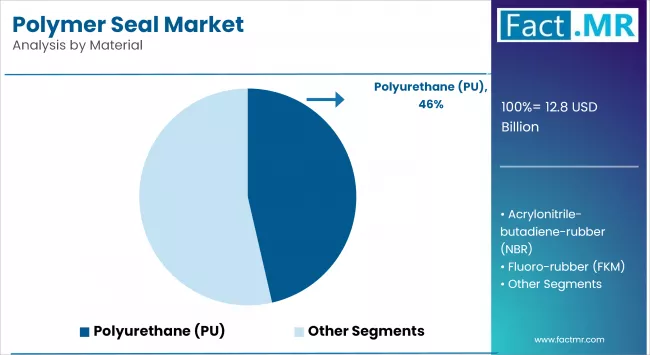
Polymer Seal Market By Material | Source: Fact.MR
Polyurethane (PU) seals lead the market due to their flexibility, durability, and resistance to abrasion and environmental factors, making them highly popular in construction, automotive, and industrial applications, particularly in the rapidly growing Asia Pacific region.
NBR seals are widely used due to their excellent resistance to oils and fuels, making them a standard choice in the automotive and machinery sectors. Fluoro-rubber (FKM) seals are preferred in demanding environments, such as the automotive, aerospace, and chemical processing industries, due to their superior chemical and heat resistance.
PTFE seals, renowned for their exceptional chemical inertness and temperature stability, are crucial in industries such as pharmaceuticals and food processing, where contamination and chemical compatibility are paramount. Other materials, such as EPDM and silicone, serve niche applications requiring weather resistance or flexibility at low temperatures.
Hydraulic & pneumatic to Exhibit leading by Product Type
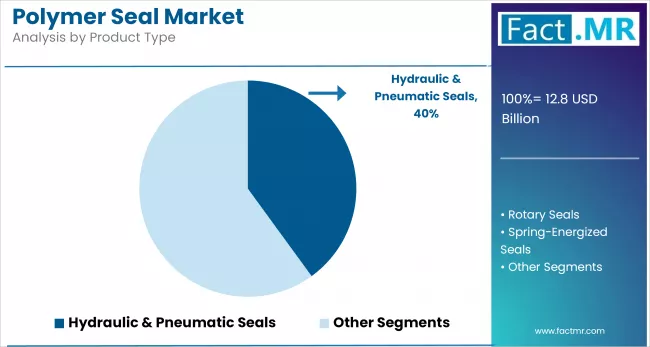
Polymer Seal Market By Material By Product Type | Source: Fact.MR
The hydraulic & pneumatic seals segment is experiencing steady growth due to rising demand for efficient and reliable sealing solutions across diverse industries. These seals, made from advanced synthetic polymers, are crucial for preventing leakage and maintaining the integrity of mechanical systems in various sectors, including automotive, aerospace, oil and gas, and pharmaceuticals. Their ability to withstand extreme temperatures, pressures, and chemical exposure makes them suitable for a wide range of applications.
Spring energized seals are expected to witness the fastest growth, fueled by their superior performance in extreme environments, including high-pressure, high-temperature, and chemically aggressive applications. Their increasing adoption in aerospace, oil & gas, and medical devices is accelerating market expansion.
Transportation to Exhibit Leading by End-Use
The transportation equipment segment holds the largest share in the market, led by strong demand from the automotive, aircraft, marine, and railroad industries. High-performance materials and cleaning agents, such as isopropyl acetate, are widely used in manufacturing, maintenance, and surface treatment processes, particularly for automotive and aerospace components.
The healthcare sector is expected to witness the fastest revenue growth, driven by increasing demand for high-purity solvents in medical device production, surgical tool cleaning, and pharmaceutical applications. The sector’s focus on hygiene, precision, and regulatory compliance continues to drive the adoption of advanced cleaning fluids and solvents.
OEMs to Exhibit Leading by Sales Channel
OEMs (Original Equipment Manufacturers) account for the largest share of the market, as they integrate isopropyl acetate and related solutions during the production of vehicles, electronics, and industrial machinery. The emphasis on quality control and in-house formulation drives significant volume demand through this channel.
The aftermarket segment is projected to grow at the fastest pace, driven by increasing maintenance, repair, and overhaul (MRO) activities across various sectors, including transportation, healthcare, and industrial machinery. The need for effective and safe cleaning and degreasing solutions in operational environments is driving this growth.
Competitive Analysis
The polymer seal market is becoming increasingly competitive, with a mix of established multinational corporations and emerging players competing on the basis of product durability, innovation, and customization. Key players, including Saint-Gobain, Chesterton, SKF AB, Parker Hannifin, and Trelleborg, have developed robust global distribution networks, particularly across North America, Europe, and the Asia-Pacific region.
These companies offer a broad range of sealing solutions tailored for industries like automotive, aerospace, industrial machinery, and consumer goods.
Sustainability and service differentiation are becoming increasingly important. Many companies now offer recyclable or long-life seals, aligning product development with environmental regulations, and providing value-added services such as maintenance support, performance monitoring, and material testing.
These services help end-users in critical sectors maintain operational efficiency and extend equipment life. As industries demand more reliable, environmentally conscious, and high-performance sealing systems, companies that combine product innovation with customer-focused service and sustainability leadership are best positioned to thrive in this evolving market.
Key players in the polymer seal industry include Saint-Gobain, Chesterton, SKF AB, Advanced Seals & Gaskets Ltd., Eriks NV, Bal Seal, Parker Hannifin, Trelleborg, DLI Seals Ltd., Greene-Tweed, Meggit, Herzog Dichtungen AG, SHS-Dichtungen-GmbH, Novotema, Specialised Polymer Engineering Ltd., TRP Polymer Solutions Ltd., Carco and other players.
Recent Development
- In February 2025, DIAMANT Polymer GmbH expanded its presence into the North American market by acquiring DIAMANT Polymers Inc., based in Cincinnati, Ohio. The US subsidiary will manufacture and distribute DIAMANT products in North America, with plans to expand production of select products within the US in the future.
(Source: https://diamant-polymer.de/en/press-releases/diamant-polymer-expands-into-the-north-american-market-with-company-acquisition/)
- In January 2025, Advanced EMC Technologies is focusing on developing polymer seals specifically designed for reusable rocket technology, addressing the unique and demanding requirements of the aerospace industry.
(Source: https://advanced-emc.com/polymer-seals-for-reusable-rocket-technology-the-future-of-aerospace-sealing-solutions)
Segmentation
Segmentation of Polymer Seal Market
-
By Material :
- Polyurethane (PU)
- Acrylonitrile-butadiene-rubber (NBR)
- Fluoro-rubber (FKM)
- Polytetrafluoroethylene (PTFE)
- Other Material Types
-
By Product Type :
- Hydraulic & Pneumatic Seals
- Rotary Seals
- Spring Energized Seals
-
By End-Use :
- Transportation Equipment
- Automotive & Components
- Aircraft & Components
- Railroad Equipment
- Marine Transportation & Components
- Industrial Machinery & Equipment
- Electronic Apparatus & Appliances
- Healthcare
- Medical Devices & Component Manufacturing
- Surgical Tool Manufacturing
- Oil and Gas Extraction
- Construction Infrastructure & Utilities
- MRO, Other Manufacturing & Assembly Cleaning Fluids
- Others
-
By Sales Channel :
- OEMs
- Aftermarket
-
By Region :
- North America
- Latin America
- Western Europe
- Eastern Europe
- East Asia
- South Asia & Pacific
- Middle East & Africa
Frequently Asked Questions
What is the Global Polymer Seal Market Size in 2025?
Who are the Major Players Operating in the Polymer Seal Market?
What is the Estimated Valuation of the Polymer Seal Market by 2035?
What Value CAGR Did the Polymer Seal Market Exhibit Over the Last Five Years?
Who worked on this report


Preview the report firsthand - request a free sample
Free SampleGet the brochure for pricing and purchase details
Download PDF