Vaccine Market
Vaccine Market Size and Share Forecast Outlook 2026 to 2036
Vaccine market is projected to grow from USD 71.9 million in 2026 to USD 132.2 million by 2036, at a CAGR of 6.3%. Subunit Vaccines will dominate with a 34.0% market share, while parenteral will lead the route of administration segment with a 84.0% share.
Vaccine Market Forecast and Outlook 2026 to 2036
The global vaccine market will reach USD 132.2 billion by 2036, recording an absolute increase of USD 60.3 billion over the forecast period. The market is valued at USD 71.9 billion in 2026 and is set to rise at a CAGR of 6.3% during the assessment period.
The market is expected to grow 1.8x, supported by increasing demand from national immunization programs and expanding applications in adult vaccination schedules across both developed and emerging healthcare markets.
Key Takeaways from the Vaccine Market
- Vaccine Market Value (2026): USD 71.9 billion
- Vaccine Market Forecast Value (2036): USD 132.2 billion
- Vaccine Market Forecast CAGR: 6.3%
- Leading Type in Vaccine Market: Recombinant Vaccines (32.0%)
- Key Growth Regions in Vaccine Market: Asia Pacific, North America, and Europe
- Top Players in Vaccine Market: Pfizer Inc., Moderna Inc., Merck & Co., Inc., GlaxoSmithKline plc, Sanofi, Johnson & Johnson, Serum Institute of India, CSL Seqirus, AstraZeneca, Novavax Inc.
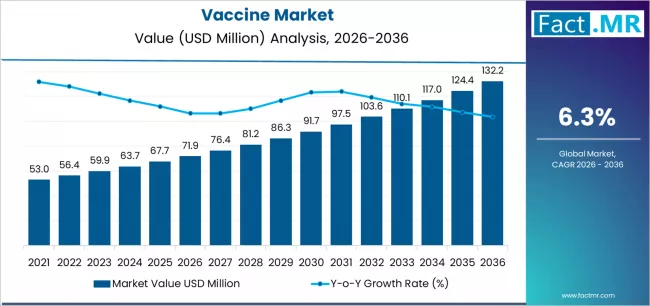
Between 2026 and 2030, the vaccine market is projected to expand from USD 71.9 billion to USD 96.9 billion, resulting in a value increase of USD 25.0 billion, which represents 41.5% of the total forecast growth for the decade. This phase will be shaped by rising demand for recombinant vaccine platforms and mRNA vaccine technologies, product innovation in adjuvant formulations and delivery system optimization, as well as expanding integration with digital health tracking initiatives and cold chain monitoring platforms.
From 2030 to 2036, the market is forecast to grow from USD 96.9 billion to USD 132.2 billion, adding another USD 35.3 billion, which constitutes 58.5% of the overall ten-year expansion. This period will witness the expansion of specialized vaccine products, including personalized cancer vaccines and combination vaccine formulations tailored for specific population demographics, strategic collaborations between vaccine manufacturers and healthcare systems, and an enhanced focus on pandemic preparedness infrastructure and rapid response manufacturing capabilities.
Vaccine Market
| Metric | Value |
|---|---|
| Market Value (2026) | USD 71.9 billion |
| Market Forecast Value (2036) | USD 132.2 billion |
| Forecast CAGR (2026-2036) | 6.3% |
Category
| Category | Segments |
|---|---|
| Type | Subunit Vaccines, Inactivated, Live Attenuated, mRNA Vaccines, Viral Vector Vaccines |
| Route of Administration | Oral, Parenteral, Nasal |
| Disease Indication | Viral Diseases, Bacterial Vaccines, Cancer Vaccines, Allergy Vaccines |
| Age Group | Pediatric, Adult |
| Distribution Channel | Hospital & Retail Pharmacies, Government Suppliers, Others |
| Region | Asia Pacific, North America, Europe, Latin America, Middle East & Africa |
Segmental Analysis
Which Vaccine Type Holds the Largest Share in the Market?
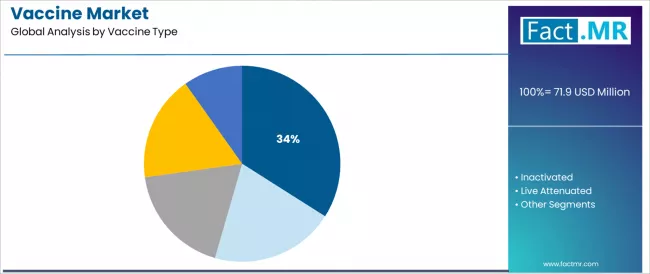
Subunit vaccines hold a 34% share, supported by favorable safety profiles, dependable immune responses, and broad use across pediatric and adult programs. Their continued inclusion in national immunization schedules ensures stable and recurring procurement.
Inactivated, live attenuated, mRNA, and viral vector platforms divide the remaining demand based on disease requirements and evolving development pipelines. Interest in advanced platforms remains steady, although overall growth has normalized compared to recent surges.
Key Takeaways
- Subunit vaccines remain the most widely adopted category.
- Advanced platforms continue progressing as developers expand into new indications.
Which Route of Administration Dominates the Vaccine Market?
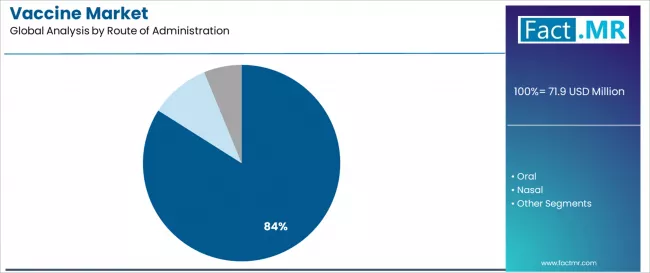
Parenteral administration accounts for approximately 84% of total vaccine delivery due to its compatibility with most licensed vaccines and its central role in mass immunization programs. Established clinical infrastructure further supports consistent use across regions.
Oral and nasal routes form a smaller portion of the market and are primarily used where ease of administration or mucosal immunity offers clear benefits. Their broader application remains limited by formulation and stability challenges.
Key Takeaways
- Injectable formats continue to anchor global immunization efforts.
- Alternative routes gain gradual attention for targeted applications.
Which Disease Indication Represents the Largest Portion of Vaccine Demand?
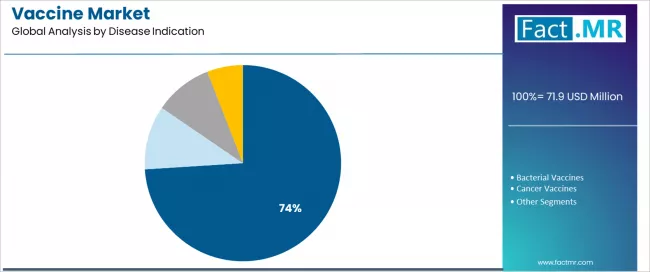
Vaccines for viral diseases contribute an estimated 74% of total market demand, driven by high-volume programs for influenza, hepatitis, HPV, and multiple childhood combinations. National immunization policies reinforce consistent uptake across these indications.
Bacterial, cancer, and allergy vaccines hold the remaining share. Bacterial vaccines maintain steady use in pneumococcal and meningococcal protection, while cancer vaccines occupy a smaller but steadily advancing segment supported by increasing clinical development.
- Viral vaccines dominate due to broad coverage and recurring public health priorities.
- Cancer vaccine research continues to expand the future commercial landscape.
Which Age Group Generates the Largest Share of Vaccine Consumption?
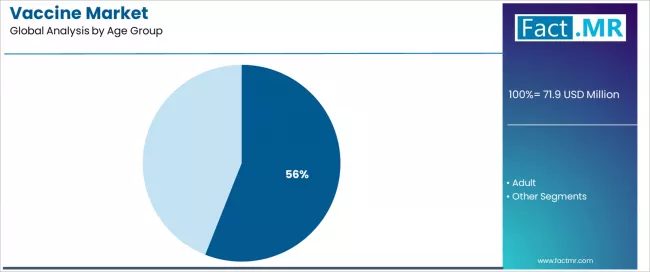
Pediatric vaccination represents 56% of global demand as birth-to-childhood schedules remain mandatory in most countries. Strong compliance rates support predictable year-to-year consumption.
Adult vaccination forms the remaining share and continues growing due to rising awareness of influenza, shingles, HPV catch-up, and respiratory disease prevention. Aging populations also support long-term expansion in this category.
Key Takeaways
- Pediatric vaccines remain the foundation of routine immunization efforts.
- Adult vaccination continues to rise with greater focus on preventive care.
Which Distribution Channel Leads Vaccine Delivery?
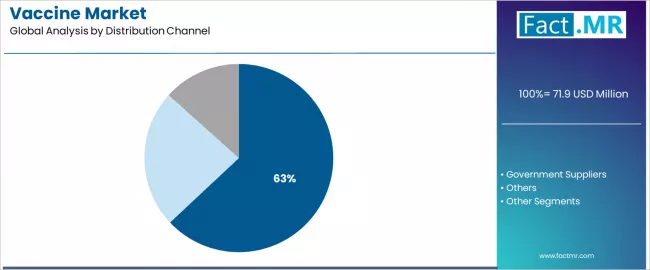
Hospital and retail pharmacies account for 63% of global vaccine distribution, supported by their central role in adult immunization programs and their accessibility for routine and seasonal vaccinations. These settings also maintain strong cold-chain capabilities that enable broad vaccine availability.
Government suppliers hold the remaining share and continue to drive bulk procurement for childhood vaccination programs and public health campaigns. Their involvement is crucial for ensuring equitable access to essential vaccines.
Key Takeaways
- Pharmacies play an increasingly important role in adult and seasonal vaccination uptake.
- Government procurement remains essential for large-scale childhood coverage.
What are the Drivers, Restraints, and Key Trends of the Vaccine Market?
The vaccine market is driven by government-backed immunization programs, expanded pandemic preparedness efforts, and advancements in next-generation vaccine technologies. Rising investments in vaccination infrastructure and broader coverage targets strengthen demand across routine and outbreak-response segments.
Preparedness strategies for emerging infectious diseases encourage adoption of rapid-response platforms and sustained stockpiling, while innovations in mRNA and viral vector technologies improve development efficiency and manufacturing adaptability.
Restraints stem from persistent vaccine hesitancy, distribution and cold-chain limitations, and affordability constraints in lower-income regions. Public acceptance challenges can slow immunization uptake, while temperature-sensitive logistics requirements increase costs and risk of product loss in underserved markets.
Key trends include rapid manufacturing expansion across Asia Pacific, movement toward thermostable and novel delivery technologies, and broader adoption of platform-based vaccine development. These shifts enhance production resilience, reduce dependency on ultra-cold storage, and support more flexible global immunization strategies.
Analysis of the Vaccine Market by Key Countries

| Country | CAGR (2026-2036) |
|---|---|
| India | 7.5% |
| China | 7.2% |
| Brazil | 6.8% |
| USA | 6.4% |
| UK | 6.1% |
| Japan | 5.7% |
| Germany | 5.3% |
How will the Vaccine Market Evolve in India?
India demonstrates the strongest growth potential in the vaccine market with a CAGR of 7.5% through 2036. The country's leadership position stems from expanding immunization programs and local manufacturing enabling mainstream vaccine adoption.
Growth is concentrated in major manufacturing hubs, including Pune, Hyderabad, Chennai, and Ahmedabad, where biotechnology clusters and expanding vaccine production facilities are implementing comprehensive immunization supply for enhanced universal immunization programs and export market applications.
Key market factors:
- Industrial demand concentrated in vaccine manufacturing zones and government procurement networks with comprehensive cold chain infrastructure
- Infrastructure development through Mission Indradhanush programs and universal immunization coverage expansion initiatives
How will China Contribute to the Global Vaccine Market’s Expansion?
In China, the production and distribution of vaccines is accelerating across government immunization programs and private vaccination services, driven by high-volume vaccine output and rising adult vaccination.
The market demonstrates strong growth momentum with a CAGR of 7.2% through 2036, linked to government health security initiatives, integrated vaccine manufacturing infrastructure, and sustained domestic immunization demand.
Vaccine manufacturers adopt advanced technologies and quality management systems to enhance production capacity while meeting growing demand in expanding adult vaccination sectors and pandemic preparedness stockpiles.
The country's Healthy China 2030 initiatives create persistent demand for vaccines, while increasing emphasis on biotechnology self-sufficiency drives adoption of indigenous vaccine development platforms.
Key development areas:
- Government immunization programs and disease control centers leading vaccine consumption with comprehensive vaccination schedules
- Integrated cold chain networks providing efficient distribution with extensive refrigeration infrastructure
How does Brazil Demonstrate Strategic Regional Position in the Vaccine Market?
Brazil's market expansion is driven by strengthening national immunization network, including comprehensive vaccination programs in São Paulo and Rio de Janeiro, and expanding public health operations across multiple states. The country demonstrates promising growth potential with a CAGR of 6.8% through 2036, supported by universal healthcare system integration, increasing disease surveillance capabilities, and growing participation in international vaccine procurement mechanisms.
Growing public health investment and expanding vaccine manufacturing capabilities create compelling opportunities for vaccine adoption, particularly in regions where national immunization programs have direct impact on communicable disease prevention and maternal-child health outcomes.
Key market characteristics:
- Public health system and government vaccination programs showing comprehensive coverage expansion with substantial vaccine requirement increases
- Regional expansion trends focused on Amazon region access and rural healthcare delivery strengthening
How will USA Exhibit Growth in the Global Vaccine Market?
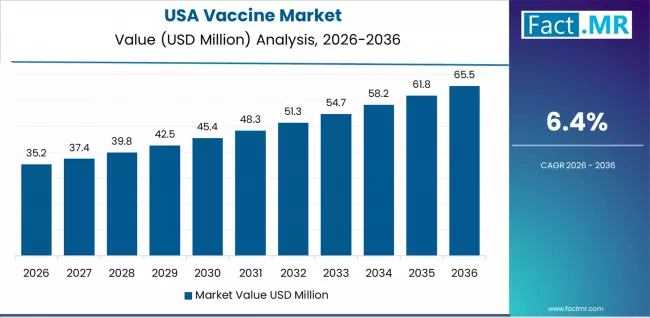
The vaccine market in USA leads in advanced vaccine technology adoption based on growth of recombinant and mRNA vaccine adoption for enhanced public health preparedness. The country shows steady potential with a CAGR of 6.4% through 2036, driven by comprehensive vaccine research funding, established biotechnology industry presence, and the expansion of adult vaccination recommendations across all age groups.
American vaccine manufacturers are adopting next-generation platforms and rapid development capabilities to enhance pandemic response while maintaining innovation leadership demanded by infectious disease threats and biodefense requirements.
Leading market segments:
- Private healthcare providers and pharmacy chains implementing comprehensive vaccination services
- Strategic partnerships with government agencies, achieving national vaccine stockpile requirements and emergency preparedness targets
How will the Market for Vaccines expand in the UK?
In the UK, vaccine developers and public health agencies are implementing comprehensive immunization strategies to optimize population coverage and improve disease surveillance outcomes, with documented success through COVID-19 vaccine development programs and rapid deployment protocols.
The market shows steady growth potential with a CAGR of 6.1% through 2036, linked to robust R&D and infectious disease surveillance, and ongoing investment in vaccine manufacturing capacity within the UK.
Market development factors:
- National immunization programs and public health agencies leading vaccine deployment across UK
- Research excellence initiatives providing support for vaccine development and clinical evaluation programs
How does Japan Show Demographic Opportunity?

Japan's vaccine market demonstrates strategic positioning focused on aging population requiring additional vaccinations, with documented expansion of adult immunization recommendations, achieving improved coverage for seasonal influenza and shingles prevention through systematic vaccination programs in elderly care settings.
The country maintains steady growth momentum with a CAGR of 5.7% through 2036, driven by demographic aging trends, established healthcare insurance coverage, and strategic emphasis on preventive healthcare interventions.
Major pharmaceutical companies showcase advanced vaccine manufacturing operations where quality standards achieve stringent regulatory requirements supporting delivery of seasonal influenza vaccines and pneumococcal immunizations through comprehensive distribution networks.
Key market characteristics:
- Healthcare providers and municipal health centers driving vaccine consumption with emphasis on elderly population protection
- National health insurance programs enabling broad vaccination access with comprehensive reimbursement frameworks
How will Emphasis on Adult Immunization Influence the Vaccine Market in Germany?
Germany's vaccine market demonstrates sophisticated positioning focused on emphasis on adult boosters and tech-driven vaccine demand, characterized by advanced integration with occupational health programs and comprehensive vaccination recommendations across adult populations.
The country shows steady growth momentum with a CAGR of 5.3% through 2036, driven by aging demographics, travel medicine requirements, and competitive manufacturing capabilities for vaccine export markets.
Germany's emphasis on evidence-based vaccination policy and comprehensive vaccine safety monitoring creates sustained demand for high-quality vaccines that support population health protection initiatives. The market benefits from strong relationships between German pharmaceutical companies and European health agencies, creating comprehensive regulatory ecosystems that prioritize vaccine quality and public confidence.
Key market characteristics:
- Occupational health services and primary care physicians driving vaccine consumption with emphasis on adult immunization gaps
- Statutory health insurance programs enabling vaccination access with comprehensive coverage policies
Competitive Landscape of the Vaccine Market

The vaccine market features approximately 25-35 meaningful players with moderate to high concentration, where the top three companies control roughly 35-45% of global market share through established manufacturing operations and extensive distribution relationships across government procurement agencies and healthcare systems.
Market leaders include Pfizer Inc., Moderna Inc., and Merck & Co., Inc., which maintain competitive advantages through comprehensive vaccine product portfolios, global manufacturing networks, and deep expertise in the immunology and biotechnology sectors, creating strong relationships with government health agencies and international immunization organizations. These companies leverage established production facilities and ongoing research pipelines to defend market positions while expanding into adjacent therapeutic vaccine applications and novel platform technologies.
Regional producers and emerging biotechnology companies create competitive pressure through innovative platform technologies and strategic market positioning, particularly in high-growth markets including India and China, where local manufacturing capabilities provide advantages in government procurement and export opportunities.
Market dynamics favor companies that combine advanced biotechnology platforms with comprehensive regulatory expertise that addresses the complete value chain from antigen discovery through clinical development and commercial manufacturing. Strategic investments in mRNA platforms and rapid response capabilities enable competitive differentiation and pandemic preparedness across global health security frameworks.
Key Players in the Vaccine Market
- Pfizer Inc.
- Moderna Inc.
- Merck & Co., Inc.
- GlaxoSmithKline plc
- Sanofi S.A.
- Johnson & Johnson
- Serum Institute of India
- CSL Seqirus
- AstraZeneca
- Novavax Inc.
Scope of the Report
| Items | Values |
|---|---|
| Quantitative Units | USD 71.9 Billion |
| Type | Subunit Vaccines (Recombinant Vaccines, Conjugate Vaccines, Toxoid Vaccines), Inactivated, Live Attenuated, mRNA Vaccines, Viral Vector Vaccines |
| Disease Indication | Viral Diseases (Hepatitis, Influenza, HPV, MMR, Rotavirus, Herpes Zoster, COVID-19, Others), Bacterial Vaccines (Meningococcal Diseases, Pneumococcal Diseases, DPT, Others), Cancer Vaccines, Allergy Vaccines |
| Age Group | Pediatric, Adult |
| Route of Administration | Oral, Parenteral, Nasal |
| Distribution Channel | Hospital & Retail Pharmacies, Government Suppliers, Others |
| Regions Covered | Asia Pacific, North America, Europe, Latin America, Middle East & Africa |
| Country Covered | India, China, Brazil, USA, UK, Japan, Germany, and 40+ countries |
| Key Companies Profiled | Pfizer Inc., Moderna Inc., Merck & Co., Inc., GlaxoSmithKline plc, Sanofi, Johnson & Johnson, Serum Institute of India, CSL Seqirus, AstraZeneca, Novavax Inc. |
| Additional Attributes | Dollar sales by vaccine type and disease indication categories, regional immunization coverage trends across Asia Pacific, North America, and Europe, competitive landscape with pharmaceutical manufacturers and biotechnology companies, regulatory approval pathways and safety requirements, integration with national immunization programs and cold chain distribution systems. |
Vaccine Market by Segments
-
Vaccine Type :
- Subunit Vaccines
- Recombinant Vaccines
- Conjugate Vaccines
- Toxoid Vaccines
- Inactivated
- Live Attenuated
- mRNA Vaccines
- Viral Vector Vaccines
- Subunit Vaccines
-
Route of Administration :
- Oral
- Parenteral
- Nasal
-
Disease Indication :
- Viral Diseases
- Hepatitis
- Influenza
- HPV
- MMR
- Rotavirus
- Herpes Zoster
- COVID-19
- Others
- Bacterial Vaccines
- Meningococcal Diseases
- Pneumococcal Diseases
- DPT
- Others
- Cancer Vaccines
- Allergy Vaccines
- Viral Diseases
-
Age Group :
- Pediatric
- Adult
-
Distribution Channel :
- Hospital & Retail Pharmacies
- Government Suppliers
- Others
-
Region :
- Asia Pacific
- China
- Japan
- South Korea
- India
- Australia & New Zealand
- ASEAN
- Rest of Asia Pacific
- North America
- USA
- Canada
- Mexico
- Europe
- Germany
- France
- UK
- Italy
- Spain
- Rest of Europe
- Latin America
- Brazil
- Rest of Latin America
- Middle East & Africa
- Kingdom of Saudi Arabia
- Other GCC Countries
- Turkey
- South Africa
- Rest of Middle East & Africa
- Asia Pacific
Table of Content
- Executive Summary
- Global Market Outlook
- Demand to side Trends
- Supply to side Trends
- Technology Roadmap Analysis
- Analysis and Recommendations
- Market Overview
- Market Coverage / Taxonomy
- Market Definition / Scope / Limitations
- Market Background
- Market Dynamics
- Drivers
- Restraints
- Opportunity
- Trends
- Scenario Forecast
- Demand in Optimistic Scenario
- Demand in Likely Scenario
- Demand in Conservative Scenario
- Opportunity Map Analysis
- Product Life Cycle Analysis
- Supply Chain Analysis
- Investment Feasibility Matrix
- Value Chain Analysis
- PESTLE and Porter’s Analysis
- Regulatory Landscape
- Regional Parent Market Outlook
- Production and Consumption Statistics
- Import and Export Statistics
- Market Dynamics
- Global Market Analysis 2021 to 2025 and Forecast, 2026 to 2036
- Historical Market Size Value (USD Million) Analysis, 2021 to 2025
- Current and Future Market Size Value (USD Million) Projections, 2026 to 2036
- Y to o to Y Growth Trend Analysis
- Absolute $ Opportunity Analysis
- Global Market Pricing Analysis 2021 to 2025 and Forecast 2026 to 2036
- Global Market Analysis 2021 to 2025 and Forecast 2026 to 2036, By Vaccine Type
- Introduction / Key Findings
- Historical Market Size Value (USD Million) Analysis By Vaccine Type, 2021 to 2025
- Current and Future Market Size Value (USD Million) Analysis and Forecast By Vaccine Type, 2026 to 2036
- Subunit Vaccines
- Inactivated
- Live Attenuated
- mRNA Vaccines
- Viral Vector Vaccines
- Y to o to Y Growth Trend Analysis By Vaccine Type, 2021 to 2025
- Absolute $ Opportunity Analysis By Vaccine Type, 2026 to 2036
- Global Market Analysis 2021 to 2025 and Forecast 2026 to 2036, By Route of Administration
- Introduction / Key Findings
- Historical Market Size Value (USD Million) Analysis By Route of Administration, 2021 to 2025
- Current and Future Market Size Value (USD Million) Analysis and Forecast By Route of Administration, 2026 to 2036
- Parenteral
- Oral
- Nasal
- Y to o to Y Growth Trend Analysis By Route of Administration, 2021 to 2025
- Absolute $ Opportunity Analysis By Route of Administration, 2026 to 2036
- Global Market Analysis 2021 to 2025 and Forecast 2026 to 2036, By Disease Indication
- Introduction / Key Findings
- Historical Market Size Value (USD Million) Analysis By Disease Indication, 2021 to 2025
- Current and Future Market Size Value (USD Million) Analysis and Forecast By Disease Indication, 2026 to 2036
- Viral Diseases
- Bacterial Vaccines
- Cancer Vaccines
- Allergy Vaccines
- Y to o to Y Growth Trend Analysis By Disease Indication, 2021 to 2025
- Absolute $ Opportunity Analysis By Disease Indication, 2026 to 2036
- Global Market Analysis 2021 to 2025 and Forecast 2026 to 2036, By Age Group
- Introduction / Key Findings
- Historical Market Size Value (USD Million) Analysis By Age Group, 2021 to 2025
- Current and Future Market Size Value (USD Million) Analysis and Forecast By Age Group, 2026 to 2036
- Pediatric
- Adult
- Y to o to Y Growth Trend Analysis By Age Group, 2021 to 2025
- Absolute $ Opportunity Analysis By Age Group, 2026 to 2036
- Global Market Analysis 2021 to 2025 and Forecast 2026 to 2036, By Distribution Channel
- Introduction / Key Findings
- Historical Market Size Value (USD Million) Analysis By Distribution Channel, 2021 to 2025
- Current and Future Market Size Value (USD Million) Analysis and Forecast By Distribution Channel, 2026 to 2036
- Hospital & Retail Pharmacies
- Government Suppliers
- Others
- Y to o to Y Growth Trend Analysis By Distribution Channel, 2021 to 2025
- Absolute $ Opportunity Analysis By Distribution Channel, 2026 to 2036
- Global Market Analysis 2021 to 2025 and Forecast 2026 to 2036, By Region
- Introduction
- Historical Market Size Value (USD Million) Analysis By Region, 2021 to 2025
- Current Market Size Value (USD Million) Analysis and Forecast By Region, 2026 to 2036
- North America
- Latin America
- Western Europe
- Eastern Europe
- East Asia
- South Asia and Pacific
- Middle East & Africa
- Market Attractiveness Analysis By Region
- North America Market Analysis 2021 to 2025 and Forecast 2026 to 2036, By Country
- Historical Market Size Value (USD Million) Trend Analysis By Market Taxonomy, 2021 to 2025
- Market Size Value (USD Million) Forecast By Market Taxonomy, 2026 to 2036
- By Country
- USA
- Canada
- Mexico
- By Vaccine Type
- By Route of Administration
- By Disease Indication
- By Age Group
- By Distribution Channel
- By Country
- Market Attractiveness Analysis
- By Country
- By Vaccine Type
- By Route of Administration
- By Disease Indication
- By Age Group
- By Distribution Channel
- Key Takeaways
- Latin America Market Analysis 2021 to 2025 and Forecast 2026 to 2036, By Country
- Historical Market Size Value (USD Million) Trend Analysis By Market Taxonomy, 2021 to 2025
- Market Size Value (USD Million) Forecast By Market Taxonomy, 2026 to 2036
- By Country
- Brazil
- Chile
- Rest of Latin America
- By Vaccine Type
- By Route of Administration
- By Disease Indication
- By Age Group
- By Distribution Channel
- By Country
- Market Attractiveness Analysis
- By Country
- By Vaccine Type
- By Route of Administration
- By Disease Indication
- By Age Group
- By Distribution Channel
- Key Takeaways
- Western Europe Market Analysis 2021 to 2025 and Forecast 2026 to 2036, By Country
- Historical Market Size Value (USD Million) Trend Analysis By Market Taxonomy, 2021 to 2025
- Market Size Value (USD Million) Forecast By Market Taxonomy, 2026 to 2036
- By Country
- Germany
- UK
- Italy
- Spain
- France
- Nordic
- BENELUX
- Rest of Western Europe
- By Vaccine Type
- By Route of Administration
- By Disease Indication
- By Age Group
- By Distribution Channel
- By Country
- Market Attractiveness Analysis
- By Country
- By Vaccine Type
- By Route of Administration
- By Disease Indication
- By Age Group
- By Distribution Channel
- Key Takeaways
- Eastern Europe Market Analysis 2021 to 2025 and Forecast 2026 to 2036, By Country
- Historical Market Size Value (USD Million) Trend Analysis By Market Taxonomy, 2021 to 2025
- Market Size Value (USD Million) Forecast By Market Taxonomy, 2026 to 2036
- By Country
- Russia
- Poland
- Hungary
- Balkan & Baltic
- Rest of Eastern Europe
- By Vaccine Type
- By Route of Administration
- By Disease Indication
- By Age Group
- By Distribution Channel
- By Country
- Market Attractiveness Analysis
- By Country
- By Vaccine Type
- By Route of Administration
- By Disease Indication
- By Age Group
- By Distribution Channel
- Key Takeaways
- East Asia Market Analysis 2021 to 2025 and Forecast 2026 to 2036, By Country
- Historical Market Size Value (USD Million) Trend Analysis By Market Taxonomy, 2021 to 2025
- Market Size Value (USD Million) Forecast By Market Taxonomy, 2026 to 2036
- By Country
- China
- Japan
- South Korea
- By Vaccine Type
- By Route of Administration
- By Disease Indication
- By Age Group
- By Distribution Channel
- By Country
- Market Attractiveness Analysis
- By Country
- By Vaccine Type
- By Route of Administration
- By Disease Indication
- By Age Group
- By Distribution Channel
- Key Takeaways
- South Asia and Pacific Market Analysis 2021 to 2025 and Forecast 2026 to 2036, By Country
- Historical Market Size Value (USD Million) Trend Analysis By Market Taxonomy, 2021 to 2025
- Market Size Value (USD Million) Forecast By Market Taxonomy, 2026 to 2036
- By Country
- India
- ASEAN
- Australia & New Zealand
- Rest of South Asia and Pacific
- By Vaccine Type
- By Route of Administration
- By Disease Indication
- By Age Group
- By Distribution Channel
- By Country
- Market Attractiveness Analysis
- By Country
- By Vaccine Type
- By Route of Administration
- By Disease Indication
- By Age Group
- By Distribution Channel
- Key Takeaways
- Middle East & Africa Market Analysis 2021 to 2025 and Forecast 2026 to 2036, By Country
- Historical Market Size Value (USD Million) Trend Analysis By Market Taxonomy, 2021 to 2025
- Market Size Value (USD Million) Forecast By Market Taxonomy, 2026 to 2036
- By Country
- Kingdom of Saudi Arabia
- Other GCC Countries
- Turkiye
- South Africa
- Other African Union
- Rest of Middle East & Africa
- By Vaccine Type
- By Route of Administration
- By Disease Indication
- By Age Group
- By Distribution Channel
- By Country
- Market Attractiveness Analysis
- By Country
- By Vaccine Type
- By Route of Administration
- By Disease Indication
- By Age Group
- By Distribution Channel
- Key Takeaways
- Key Countries Market Analysis
- USA
- Pricing Analysis
- Market Share Analysis, 2025
- By Vaccine Type
- By Route of Administration
- By Disease Indication
- By Age Group
- By Distribution Channel
- Canada
- Pricing Analysis
- Market Share Analysis, 2025
- By Vaccine Type
- By Route of Administration
- By Disease Indication
- By Age Group
- By Distribution Channel
- Mexico
- Pricing Analysis
- Market Share Analysis, 2025
- By Vaccine Type
- By Route of Administration
- By Disease Indication
- By Age Group
- By Distribution Channel
- Brazil
- Pricing Analysis
- Market Share Analysis, 2025
- By Vaccine Type
- By Route of Administration
- By Disease Indication
- By Age Group
- By Distribution Channel
- Chile
- Pricing Analysis
- Market Share Analysis, 2025
- By Vaccine Type
- By Route of Administration
- By Disease Indication
- By Age Group
- By Distribution Channel
- Germany
- Pricing Analysis
- Market Share Analysis, 2025
- By Vaccine Type
- By Route of Administration
- By Disease Indication
- By Age Group
- By Distribution Channel
- UK
- Pricing Analysis
- Market Share Analysis, 2025
- By Vaccine Type
- By Route of Administration
- By Disease Indication
- By Age Group
- By Distribution Channel
- Italy
- Pricing Analysis
- Market Share Analysis, 2025
- By Vaccine Type
- By Route of Administration
- By Disease Indication
- By Age Group
- By Distribution Channel
- Spain
- Pricing Analysis
- Market Share Analysis, 2025
- By Vaccine Type
- By Route of Administration
- By Disease Indication
- By Age Group
- By Distribution Channel
- France
- Pricing Analysis
- Market Share Analysis, 2025
- By Vaccine Type
- By Route of Administration
- By Disease Indication
- By Age Group
- By Distribution Channel
- India
- Pricing Analysis
- Market Share Analysis, 2025
- By Vaccine Type
- By Route of Administration
- By Disease Indication
- By Age Group
- By Distribution Channel
- ASEAN
- Pricing Analysis
- Market Share Analysis, 2025
- By Vaccine Type
- By Route of Administration
- By Disease Indication
- By Age Group
- By Distribution Channel
- Australia & New Zealand
- Pricing Analysis
- Market Share Analysis, 2025
- By Vaccine Type
- By Route of Administration
- By Disease Indication
- By Age Group
- By Distribution Channel
- China
- Pricing Analysis
- Market Share Analysis, 2025
- By Vaccine Type
- By Route of Administration
- By Disease Indication
- By Age Group
- By Distribution Channel
- Japan
- Pricing Analysis
- Market Share Analysis, 2025
- By Vaccine Type
- By Route of Administration
- By Disease Indication
- By Age Group
- By Distribution Channel
- South Korea
- Pricing Analysis
- Market Share Analysis, 2025
- By Vaccine Type
- By Route of Administration
- By Disease Indication
- By Age Group
- By Distribution Channel
- Russia
- Pricing Analysis
- Market Share Analysis, 2025
- By Vaccine Type
- By Route of Administration
- By Disease Indication
- By Age Group
- By Distribution Channel
- Poland
- Pricing Analysis
- Market Share Analysis, 2025
- By Vaccine Type
- By Route of Administration
- By Disease Indication
- By Age Group
- By Distribution Channel
- Hungary
- Pricing Analysis
- Market Share Analysis, 2025
- By Vaccine Type
- By Route of Administration
- By Disease Indication
- By Age Group
- By Distribution Channel
- Kingdom of Saudi Arabia
- Pricing Analysis
- Market Share Analysis, 2025
- By Vaccine Type
- By Route of Administration
- By Disease Indication
- By Age Group
- By Distribution Channel
- Turkiye
- Pricing Analysis
- Market Share Analysis, 2025
- By Vaccine Type
- By Route of Administration
- By Disease Indication
- By Age Group
- By Distribution Channel
- South Africa
- Pricing Analysis
- Market Share Analysis, 2025
- By Vaccine Type
- By Route of Administration
- By Disease Indication
- By Age Group
- By Distribution Channel
- USA
- Market Structure Analysis
- Competition Dashboard
- Competition Benchmarking
- Market Share Analysis of Top Players
- By Regional
- By Vaccine Type
- By Route of Administration
- By Disease Indication
- By Age Group
- By Distribution Channel
- Competition Analysis
- Competition Deep Dive
- Pfizer Inc.
- Overview
- Product Portfolio
- Profitability by Market Segments (Product/Age /Sales Channel/Region)
- Sales Footprint
- Strategy Overview
- Marketing Strategy
- Product Strategy
- Channel Strategy
- Moderna Inc.
- Merck & Co., Inc.
- GlaxoSmithKline plc
- Sanofi
- Johnson & Johnson
- Serum Institute of India
- CSL Seqirus
- AstraZeneca
- Novavax Inc.
- Pfizer Inc.
- Competition Deep Dive
- Assumptions & Acronyms Used
- Research Methodology
- Figure 70: East Asia Market Y to o to Y Growth Comparison by Formulation, 2026 to 2036
- Figure 71: East Asia Market Attractiveness Analysis by Formulation
- Figure 72: South Asia and Pacific Market Value Share and BPS Analysis by Country, 2026 and 2036
- Figure 73: South Asia and Pacific Market Value Share and BPS Analysis by Type, 2026 and 2036
- Figure 74: South Asia and Pacific Market Y to o to Y Growth Comparison by Type, 2026 to 2036
- Figure 75: South Asia and Pacific Market Attractiveness Analysis by Type
- Figure 76: South Asia and Pacific Market Value Share and BPS Analysis by Application, 2026 and 2036
- Figure 77: South Asia and Pacific Market Y to o to Y Growth Comparison by Application, 2026 to 2036
- Figure 78: South Asia and Pacific Market Attractiveness Analysis by Application
- Figure 79: South Asia and Pacific Market Value Share and BPS Analysis by Formulation, 2026 and 2036
- Figure 80: South Asia and Pacific Market Y to o to Y Growth Comparison by Formulation, 2026 to 2036
- Figure 81: South Asia and Pacific Market Attractiveness Analysis by Formulation
- Figure 82: Middle East & Africa Market Value Share and BPS Analysis by Country, 2026 and 2036
- Figure 83: Middle East & Africa Market Value Share and BPS Analysis by Type, 2026 and 2036
- Figure 84: Middle East & Africa Market Y to o to Y Growth Comparison by Type, 2026 to 2036
- Figure 85: Middle East & Africa Market Attractiveness Analysis by Type
- Figure 86: Middle East & Africa Market Value Share and BPS Analysis by Application, 2026 and 2036
- Figure 87: Middle East & Africa Market Y to o to Y Growth Comparison by Application, 2026 to 2036
- Figure 88: Middle East & Africa Market Attractiveness Analysis by Application
- Figure 89: Middle East & Africa Market Value Share and BPS Analysis by Formulation, 2026 and 2036
- Figure 90: Middle East & Africa Market Y to o to Y Growth Comparison by Formulation, 2026 to 2036
- Figure 91: Middle East & Africa Market Attractiveness Analysis by Formulation
- Figure 92: Global Market - Tier Structure Analysis
- Figure 93: Global Market - Company Share Analysis
List Of Table
- Table 1: Global Market Value (USD Million) Forecast by Region, 2021 to 2036
- Table 2: Global Market Value (USD Million) Forecast by Vaccine Type, 2021 to 2036
- Table 3: Global Market Value (USD Million) Forecast by Route of Administration, 2021 to 2036
- Table 4: Global Market Value (USD Million) Forecast by Disease Indication, 2021 to 2036
- Table 5: Global Market Value (USD Million) Forecast by Age Group, 2021 to 2036
- Table 6: Global Market Value (USD Million) Forecast by Distribution Channel, 2021 to 2036
- Table 7: North America Market Value (USD Million) Forecast by Country, 2021 to 2036
- Table 8: North America Market Value (USD Million) Forecast by Vaccine Type, 2021 to 2036
- Table 9: North America Market Value (USD Million) Forecast by Route of Administration, 2021 to 2036
- Table 10: North America Market Value (USD Million) Forecast by Disease Indication, 2021 to 2036
- Table 11: North America Market Value (USD Million) Forecast by Age Group, 2021 to 2036
- Table 12: North America Market Value (USD Million) Forecast by Distribution Channel, 2021 to 2036
- Table 13: Latin America Market Value (USD Million) Forecast by Country, 2021 to 2036
- Table 14: Latin America Market Value (USD Million) Forecast by Vaccine Type, 2021 to 2036
- Table 15: Latin America Market Value (USD Million) Forecast by Route of Administration, 2021 to 2036
- Table 16: Latin America Market Value (USD Million) Forecast by Disease Indication, 2021 to 2036
- Table 17: Latin America Market Value (USD Million) Forecast by Age Group, 2021 to 2036
- Table 18: Latin America Market Value (USD Million) Forecast by Distribution Channel, 2021 to 2036
- Table 19: Western Europe Market Value (USD Million) Forecast by Country, 2021 to 2036
- Table 20: Western Europe Market Value (USD Million) Forecast by Vaccine Type, 2021 to 2036
- Table 21: Western Europe Market Value (USD Million) Forecast by Route of Administration, 2021 to 2036
- Table 22: Western Europe Market Value (USD Million) Forecast by Disease Indication, 2021 to 2036
- Table 23: Western Europe Market Value (USD Million) Forecast by Age Group, 2021 to 2036
- Table 24: Western Europe Market Value (USD Million) Forecast by Distribution Channel, 2021 to 2036
- Table 25: Eastern Europe Market Value (USD Million) Forecast by Country, 2021 to 2036
- Table 26: Eastern Europe Market Value (USD Million) Forecast by Vaccine Type, 2021 to 2036
- Table 27: Eastern Europe Market Value (USD Million) Forecast by Route of Administration, 2021 to 2036
- Table 28: Eastern Europe Market Value (USD Million) Forecast by Disease Indication, 2021 to 2036
- Table 29: Eastern Europe Market Value (USD Million) Forecast by Age Group, 2021 to 2036
- Table 30: Eastern Europe Market Value (USD Million) Forecast by Distribution Channel, 2021 to 2036
- Table 31: East Asia Market Value (USD Million) Forecast by Country, 2021 to 2036
- Table 32: East Asia Market Value (USD Million) Forecast by Vaccine Type, 2021 to 2036
- Table 33: East Asia Market Value (USD Million) Forecast by Route of Administration, 2021 to 2036
- Table 34: East Asia Market Value (USD Million) Forecast by Disease Indication, 2021 to 2036
- Table 35: East Asia Market Value (USD Million) Forecast by Age Group, 2021 to 2036
- Table 36: East Asia Market Value (USD Million) Forecast by Distribution Channel, 2021 to 2036
- Table 37: South Asia and Pacific Market Value (USD Million) Forecast by Country, 2021 to 2036
- Table 38: South Asia and Pacific Market Value (USD Million) Forecast by Vaccine Type, 2021 to 2036
- Table 39: South Asia and Pacific Market Value (USD Million) Forecast by Route of Administration, 2021 to 2036
- Table 40: South Asia and Pacific Market Value (USD Million) Forecast by Disease Indication, 2021 to 2036
- Table 41: South Asia and Pacific Market Value (USD Million) Forecast by Age Group, 2021 to 2036
- Table 42: South Asia and Pacific Market Value (USD Million) Forecast by Distribution Channel, 2021 to 2036
- Table 43: Middle East & Africa Market Value (USD Million) Forecast by Country, 2021 to 2036
- Table 44: Middle East & Africa Market Value (USD Million) Forecast by Vaccine Type, 2021 to 2036
- Table 45: Middle East & Africa Market Value (USD Million) Forecast by Route of Administration, 2021 to 2036
- Table 46: Middle East & Africa Market Value (USD Million) Forecast by Disease Indication, 2021 to 2036
- Table 47: Middle East & Africa Market Value (USD Million) Forecast by Age Group, 2021 to 2036
- Table 48: Middle East & Africa Market Value (USD Million) Forecast by Distribution Channel, 2021 to 2036
List Of Figures
- Figure 1: Global Market Pricing Analysis
- Figure 2: Global Market Value (USD Million) Forecast 2021 to 2036
- Figure 3: Global Market Value Share and BPS Analysis by Vaccine Type, 2026 and 2036
- Figure 4: Global Market Y to o to Y Growth Comparison by Vaccine Type, 2026 to 2036
- Figure 5: Global Market Attractiveness Analysis by Vaccine Type
- Figure 6: Global Market Value Share and BPS Analysis by Route of Administration, 2026 and 2036
- Figure 7: Global Market Y to o to Y Growth Comparison by Route of Administration, 2026 to 2036
- Figure 8: Global Market Attractiveness Analysis by Route of Administration
- Figure 9: Global Market Value Share and BPS Analysis by Disease Indication, 2026 and 2036
- Figure 10: Global Market Y to o to Y Growth Comparison by Disease Indication, 2026 to 2036
- Figure 11: Global Market Attractiveness Analysis by Disease Indication
- Figure 12: Global Market Value Share and BPS Analysis by Age Group, 2026 and 2036
- Figure 13: Global Market Y to o to Y Growth Comparison by Age Group, 2026 to 2036
- Figure 14: Global Market Attractiveness Analysis by Age Group
- Figure 15: Global Market Value Share and BPS Analysis by Distribution Channel, 2026 and 2036
- Figure 16: Global Market Y to o to Y Growth Comparison by Distribution Channel, 2026 to 2036
- Figure 17: Global Market Attractiveness Analysis by Distribution Channel
- Figure 18: Global Market Value (USD Million) Share and BPS Analysis by Region, 2026 and 2036
- Figure 19: Global Market Y to o to Y Growth Comparison by Region, 2026 to 2036
- Figure 20: Global Market Attractiveness Analysis by Region
- Figure 21: North America Market Incremental Dollar Opportunity, 2026 to 2036
- Figure 22: Latin America Market Incremental Dollar Opportunity, 2026 to 2036
- Figure 23: Western Europe Market Incremental Dollar Opportunity, 2026 to 2036
- Figure 24: Eastern Europe Market Incremental Dollar Opportunity, 2026 to 2036
- Figure 25: East Asia Market Incremental Dollar Opportunity, 2026 to 2036
- Figure 26: South Asia and Pacific Market Incremental Dollar Opportunity, 2026 to 2036
- Figure 27: Middle East & Africa Market Incremental Dollar Opportunity, 2026 to 2036
- Figure 28: North America Market Value Share and BPS Analysis by Country, 2026 and 2036
- Figure 29: North America Market Value Share and BPS Analysis by Vaccine Type, 2026 and 2036
- Figure 30: North America Market Y to o to Y Growth Comparison by Vaccine Type, 2026 to 2036
- Figure 31: North America Market Attractiveness Analysis by Vaccine Type
- Figure 32: North America Market Value Share and BPS Analysis by Route of Administration, 2026 and 2036
- Figure 33: North America Market Y to o to Y Growth Comparison by Route of Administration, 2026 to 2036
- Figure 34: North America Market Attractiveness Analysis by Route of Administration
- Figure 35: North America Market Value Share and BPS Analysis by Disease Indication, 2026 and 2036
- Figure 36: North America Market Y to o to Y Growth Comparison by Disease Indication, 2026 to 2036
- Figure 37: North America Market Attractiveness Analysis by Disease Indication
- Figure 38: North America Market Value Share and BPS Analysis by Age Group, 2026 and 2036
- Figure 39: North America Market Y to o to Y Growth Comparison by Age Group, 2026 to 2036
- Figure 40: North America Market Attractiveness Analysis by Age Group
- Figure 41: North America Market Value Share and BPS Analysis by Distribution Channel, 2026 and 2036
- Figure 42: North America Market Y to o to Y Growth Comparison by Distribution Channel, 2026 to 2036
- Figure 43: North America Market Attractiveness Analysis by Distribution Channel
- Figure 44: Latin America Market Value Share and BPS Analysis by Country, 2026 and 2036
- Figure 45: Latin America Market Value Share and BPS Analysis by Vaccine Type, 2026 and 2036
- Figure 46: Latin America Market Y to o to Y Growth Comparison by Vaccine Type, 2026 to 2036
- Figure 47: Latin America Market Attractiveness Analysis by Vaccine Type
- Figure 48: Latin America Market Value Share and BPS Analysis by Route of Administration, 2026 and 2036
- Figure 49: Latin America Market Y to o to Y Growth Comparison by Route of Administration, 2026 to 2036
- Figure 50: Latin America Market Attractiveness Analysis by Route of Administration
- Figure 51: Latin America Market Value Share and BPS Analysis by Disease Indication, 2026 and 2036
- Figure 52: Latin America Market Y to o to Y Growth Comparison by Disease Indication, 2026 to 2036
- Figure 53: Latin America Market Attractiveness Analysis by Disease Indication
- Figure 54: Latin America Market Value Share and BPS Analysis by Age Group, 2026 and 2036
- Figure 55: Latin America Market Y to o to Y Growth Comparison by Age Group, 2026 to 2036
- Figure 56: Latin America Market Attractiveness Analysis by Age Group
- Figure 57: Latin America Market Value Share and BPS Analysis by Distribution Channel, 2026 and 2036
- Figure 58: Latin America Market Y to o to Y Growth Comparison by Distribution Channel, 2026 to 2036
- Figure 59: Latin America Market Attractiveness Analysis by Distribution Channel
- Figure 60: Western Europe Market Value Share and BPS Analysis by Country, 2026 and 2036
- Figure 61: Western Europe Market Value Share and BPS Analysis by Vaccine Type, 2026 and 2036
- Figure 62: Western Europe Market Y to o to Y Growth Comparison by Vaccine Type, 2026 to 2036
- Figure 63: Western Europe Market Attractiveness Analysis by Vaccine Type
- Figure 64: Western Europe Market Value Share and BPS Analysis by Route of Administration, 2026 and 2036
- Figure 65: Western Europe Market Y to o to Y Growth Comparison by Route of Administration, 2026 to 2036
- Figure 66: Western Europe Market Attractiveness Analysis by Route of Administration
- Figure 67: Western Europe Market Value Share and BPS Analysis by Disease Indication, 2026 and 2036
- Figure 68: Western Europe Market Y to o to Y Growth Comparison by Disease Indication, 2026 to 2036
- Figure 69: Western Europe Market Attractiveness Analysis by Disease Indication
- Figure 70: Western Europe Market Value Share and BPS Analysis by Age Group, 2026 and 2036
- Figure 71: Western Europe Market Y to o to Y Growth Comparison by Age Group, 2026 to 2036
- Figure 72: Western Europe Market Attractiveness Analysis by Age Group
- Figure 73: Western Europe Market Value Share and BPS Analysis by Distribution Channel, 2026 and 2036
- Figure 74: Western Europe Market Y to o to Y Growth Comparison by Distribution Channel, 2026 to 2036
- Figure 75: Western Europe Market Attractiveness Analysis by Distribution Channel
- Figure 76: Eastern Europe Market Value Share and BPS Analysis by Country, 2026 and 2036
- Figure 77: Eastern Europe Market Value Share and BPS Analysis by Vaccine Type, 2026 and 2036
- Figure 78: Eastern Europe Market Y to o to Y Growth Comparison by Vaccine Type, 2026 to 2036
- Figure 79: Eastern Europe Market Attractiveness Analysis by Vaccine Type
- Figure 80: Eastern Europe Market Value Share and BPS Analysis by Route of Administration, 2026 and 2036
- Figure 81: Eastern Europe Market Y to o to Y Growth Comparison by Route of Administration, 2026 to 2036
- Figure 82: Eastern Europe Market Attractiveness Analysis by Route of Administration
- Figure 83: Eastern Europe Market Value Share and BPS Analysis by Disease Indication, 2026 and 2036
- Figure 84: Eastern Europe Market Y to o to Y Growth Comparison by Disease Indication, 2026 to 2036
- Figure 85: Eastern Europe Market Attractiveness Analysis by Disease Indication
- Figure 86: Eastern Europe Market Value Share and BPS Analysis by Age Group, 2026 and 2036
- Figure 87: Eastern Europe Market Y to o to Y Growth Comparison by Age Group, 2026 to 2036
- Figure 88: Eastern Europe Market Attractiveness Analysis by Age Group
- Figure 89: Eastern Europe Market Value Share and BPS Analysis by Distribution Channel, 2026 and 2036
- Figure 90: Eastern Europe Market Y to o to Y Growth Comparison by Distribution Channel, 2026 to 2036
- Figure 91: Eastern Europe Market Attractiveness Analysis by Distribution Channel
- Figure 92: East Asia Market Value Share and BPS Analysis by Country, 2026 and 2036
- Figure 93: East Asia Market Value Share and BPS Analysis by Vaccine Type, 2026 and 2036
- Figure 94: East Asia Market Y to o to Y Growth Comparison by Vaccine Type, 2026 to 2036
- Figure 95: East Asia Market Attractiveness Analysis by Vaccine Type
- Figure 96: East Asia Market Value Share and BPS Analysis by Route of Administration, 2026 and 2036
- Figure 97: East Asia Market Y to o to Y Growth Comparison by Route of Administration, 2026 to 2036
- Figure 98: East Asia Market Attractiveness Analysis by Route of Administration
- Figure 99: East Asia Market Value Share and BPS Analysis by Disease Indication, 2026 and 2036
- Figure 100: East Asia Market Y to o to Y Growth Comparison by Disease Indication, 2026 to 2036
- Figure 101: East Asia Market Attractiveness Analysis by Disease Indication
- Figure 102: East Asia Market Value Share and BPS Analysis by Age Group, 2026 and 2036
- Figure 103: East Asia Market Y to o to Y Growth Comparison by Age Group, 2026 to 2036
- Figure 104: East Asia Market Attractiveness Analysis by Age Group
- Figure 105: East Asia Market Value Share and BPS Analysis by Distribution Channel, 2026 and 2036
- Figure 106: East Asia Market Y to o to Y Growth Comparison by Distribution Channel, 2026 to 2036
- Figure 107: East Asia Market Attractiveness Analysis by Distribution Channel
- Figure 108: South Asia and Pacific Market Value Share and BPS Analysis by Country, 2026 and 2036
- Figure 109: South Asia and Pacific Market Value Share and BPS Analysis by Vaccine Type, 2026 and 2036
- Figure 110: South Asia and Pacific Market Y to o to Y Growth Comparison by Vaccine Type, 2026 to 2036
- Figure 111: South Asia and Pacific Market Attractiveness Analysis by Vaccine Type
- Figure 112: South Asia and Pacific Market Value Share and BPS Analysis by Route of Administration, 2026 and 2036
- Figure 113: South Asia and Pacific Market Y to o to Y Growth Comparison by Route of Administration, 2026 to 2036
- Figure 114: South Asia and Pacific Market Attractiveness Analysis by Route of Administration
- Figure 115: South Asia and Pacific Market Value Share and BPS Analysis by Disease Indication, 2026 and 2036
- Figure 116: South Asia and Pacific Market Y to o to Y Growth Comparison by Disease Indication, 2026 to 2036
- Figure 117: South Asia and Pacific Market Attractiveness Analysis by Disease Indication
- Figure 118: South Asia and Pacific Market Value Share and BPS Analysis by Age Group, 2026 and 2036
- Figure 119: South Asia and Pacific Market Y to o to Y Growth Comparison by Age Group, 2026 to 2036
- Figure 120: South Asia and Pacific Market Attractiveness Analysis by Age Group
- Figure 121: South Asia and Pacific Market Value Share and BPS Analysis by Distribution Channel, 2026 and 2036
- Figure 122: South Asia and Pacific Market Y to o to Y Growth Comparison by Distribution Channel, 2026 to 2036
- Figure 123: South Asia and Pacific Market Attractiveness Analysis by Distribution Channel
- Figure 124: Middle East & Africa Market Value Share and BPS Analysis by Country, 2026 and 2036
- Figure 125: Middle East & Africa Market Value Share and BPS Analysis by Vaccine Type, 2026 and 2036
- Figure 126: Middle East & Africa Market Y to o to Y Growth Comparison by Vaccine Type, 2026 to 2036
- Figure 127: Middle East & Africa Market Attractiveness Analysis by Vaccine Type
- Figure 128: Middle East & Africa Market Value Share and BPS Analysis by Route of Administration, 2026 and 2036
- Figure 129: Middle East & Africa Market Y to o to Y Growth Comparison by Route of Administration, 2026 to 2036
- Figure 130: Middle East & Africa Market Attractiveness Analysis by Route of Administration
- Figure 131: Middle East & Africa Market Value Share and BPS Analysis by Disease Indication, 2026 and 2036
- Figure 132: Middle East & Africa Market Y to o to Y Growth Comparison by Disease Indication, 2026 to 2036
- Figure 133: Middle East & Africa Market Attractiveness Analysis by Disease Indication
- Figure 134: Middle East & Africa Market Value Share and BPS Analysis by Age Group, 2026 and 2036
- Figure 135: Middle East & Africa Market Y to o to Y Growth Comparison by Age Group, 2026 to 2036
- Figure 136: Middle East & Africa Market Attractiveness Analysis by Age Group
- Figure 137: Middle East & Africa Market Value Share and BPS Analysis by Distribution Channel, 2026 and 2036
- Figure 138: Middle East & Africa Market Y to o to Y Growth Comparison by Distribution Channel, 2026 to 2036
- Figure 139: Middle East & Africa Market Attractiveness Analysis by Distribution Channel
- Figure 140: Global Market - Tier Structure Analysis
- Figure 141: Global Market - Company Share Analysis
- FAQs -
How big is the vaccine market in 2026?
The global vaccine market is estimated to be valued at USD 71.9 million in 2026.
What will be the size of vaccine market in 2036?
The market size for the vaccine market is projected to reach USD 132.2 million by 2036.
How much will be the vaccine market growth between 2026 and 2036?
The vaccine market is expected to grow at a 6.3% CAGR between 2026 and 2036.
What are the key product types in the vaccine market?
The key product types in vaccine market are subunit vaccines , inactivated, live attenuated, mrna vaccines and viral vector vaccines.
Which route of administration segment to contribute significant share in the vaccine market in 2026?
In terms of route of administration, parenteral segment to command 84.0% share in the vaccine market in 2026.