- Base Value(2025): 5.6 Bn
- Estimated Value(2026): 5.8 Bn
- Forecast Value (2036): 9.0 Bn
- CAGR (2026 - 2036): 4.4%
Vaccine Delivery Devices Market Analysis and Forecast by Fact.MR
The vaccine delivery devices market, valued at USD 5.6 billion in 2025, is expanding at a 4.4% CAGR to reach USD 8.993 billion by 2036. Vaccine delivery devices encompass conventional syringes and needles, safety and auto-disable devices, and needle-free and microarray systems used in public immunization programs, hospital-based vaccination, pharmacy administration, and traveler health services. Growth reflects expanding global immunization coverage, the introduction of new vaccines requiring delivery device procurement, and the development of needle-free technologies for improved patient acceptance. The USD 3.147 billion incremental opportunity between 2026 and 2036 is concentrated in safety device adoption and needle-free technologies across developed and emerging markets.
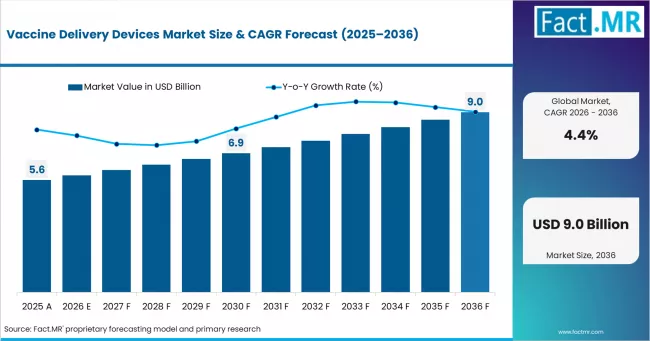
Vaccine Delivery Devices Market Market Value Analysis | Source: Fact.MR
Summary of Vaccine Delivery Devices Market
- Market Snapshot
- Market value in 2025: USD 5.6 billion
- Projected value in 2026: USD 5.846 billion; forecast to reach USD 8.993 billion by 2036
- CAGR from 2026 to 2036: 4.4%
- Incremental opportunity (2026 to 2036): USD 3.147 billion
- Conventional syringes and needles lead device demand with 63.0% share in 2025
- USA and Mexico lead country-level growth, followed by Germany and France
- Demand and Growth Drivers
- Global immunization coverage continues to expand through WHO Expanded Programme on Immunization targets, with each vaccine dose requiring a delivery device as a mandatory consumable.
- New vaccine introductions (RSV, malaria, updated COVID boosters) expand the immunization schedule and generate incremental device procurement beyond existing routine vaccination demand.
- Safety syringe mandates are accelerating the transition from conventional to auto-disable and safety-engineered devices, driven by WHO safe injection policies and national sharps injury prevention legislation.
- Pharmacy-based vaccination programs are expanding in developed markets, creating new delivery device consumption points outside traditional public health and hospital settings.
- Product and Segment View
- Conventional syringes and needles hold 63.0% of device demand, reflecting continued dominance in routine vaccination programs globally.
- Public programs account for 58.0% of setting share, driven by national immunization programs and WHO-supported vaccination campaigns.
- Single-use devices hold 54.2% of deployment share, reflecting the universal adoption of single-use injection equipment for vaccination.
- Key segmentation includes:
- Device: Conventional Syringes/Needles, Safety/Auto-Disable, Needle-Free/Microarray
- Setting: Public Programs, Hospitals/Clinics, Pharmacies/Others
- Antigen Program: Pediatric EPI, Adult Flu/COVID, Travelers/Others
- End Use: Public Health Programs, Healthcare Facilities, Clinics, Pharmacies
- Deployment: Single Use Devices, Reusable Devices
- Geography and Competitive Outlook
- North America is the largest revenue region, with the USA contributing USD 2.032 billion in 2025.
- Latin America is a growth corridor, with Mexico recording strong CAGR driven by immunization program expansion.
- Europe maintains steady growth, shaped by adult vaccination mandate expansion and safety device adoption.
- BD leads the competitive field with a 20.0% market share, followed by Terumo, Nipro, West Pharmaceutical Services, and Gerresheimer.
- Analyst Opinion
- The vaccine delivery devices market is a consumable category where demand is structurally linked to vaccination volume. Each vaccine dose requires a delivery device, creating a proportional consumption relationship that grows with immunization coverage expansion and new vaccine introductions. Fact.MR expects the fastest revenue growth to concentrate in safety and auto-disable devices, where mandatory adoption policies are upgrading the average device price point from conventional syringes. Needle-free and microarray technologies represent longer-term growth vectors that could fundamentally change the device mix, but are currently in early-stage commercial deployment. The COVID pandemic permanently expanded adult vaccination infrastructure, creating a sustained increase in non-pediatric delivery device demand.
Key Growth Drivers, Constraints, and Opportunities
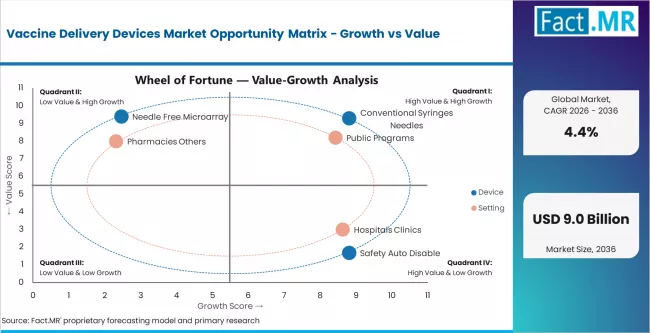
Vaccine Delivery Devices Market Opportunity Matrix Growth Vs Value | Source: Fact.MR
Key Factors Driving Growth
- Immunization coverage expansion: Global vaccination coverage targets and catch-up campaigns generate proportional device consumption, with each vaccine dose requiring a delivery device.
- Safety device mandates: WHO safe injection policies and national legislation mandating safety-engineered syringes are driving device upgrades from conventional to higher-value safety formats.
- New vaccine introductions: RSV, malaria, and updated respiratory vaccines expand the immunization schedule, generating incremental device procurement beyond existing routine demand.
Key Market Constraints
- Conventional syringe pricing pressure: Conventional syringes face intense price competition, with commodity pricing compressing manufacturer margins in the high-volume, low-value segment.
- Needle-free technology adoption barriers: Needle-free devices carry significant price premiums and require clinical training, limiting adoption to well-funded programs and specialty settings.
- Supply chain disruption risk: Global syringe production is concentrated among a small number of large manufacturers, creating supply vulnerability during demand surges.
Key Opportunity Areas
- Microarray patch development: Dissolvable microneedle patches that deliver vaccines through the skin without hypodermic needles are advancing through clinical development, offering potential for self-administered vaccination.
- Adult vaccination infrastructure: The permanent expansion of adult vaccination infrastructure post-COVID creates sustained demand for delivery devices serving annual flu, COVID booster, and new adult vaccine programs.
- UNICEF and GAVI procurement expansion: Multilateral procurement programs for developing countries create large-volume device tenders that sustain manufacturing capacity and pricing stability.
Segment-wise Analysis of the Vaccine Delivery Devices Market
- Conventional syringes and needles lead device demand at 63.0%, dominant in routine vaccination globally.
- Public programs hold 58.0% of setting share, driven by national immunization programs.
- Pediatric EPI accounts for 44.0% of antigen program demand.
Which device type dominates the Vaccine Delivery Devices Market?
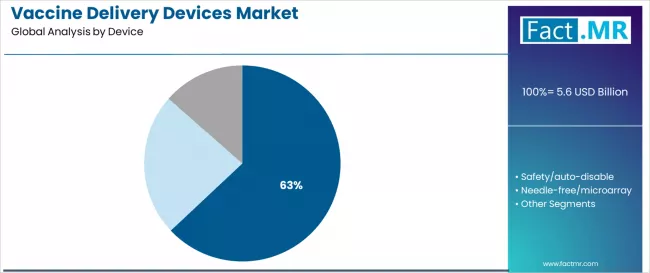
Vaccine Delivery Devices Market Analysis By Device | Source: Fact.MR
Conventional syringes and needles hold a 63.0% share of device demand in 2025. The dominance reflects the continued global reliance on hypodermic injection as the standard vaccine delivery method, with 0.5 mL and 0.05 mL syringes serving as the workhorse devices across routine immunization programs. Conventional devices offer low unit cost, universal clinical familiarity, and compatibility with all injectable vaccine formulations.
Safety and auto-disable devices account for the second-largest share and are the fastest-growing device category. WHO recommendations for auto-disable syringes in immunization programs and national sharps injury prevention legislation are driving the transition from conventional to safety formats. Needle-free and microarray technologies are in early commercial stages.
Which setting dominates the Vaccine Delivery Devices Market?
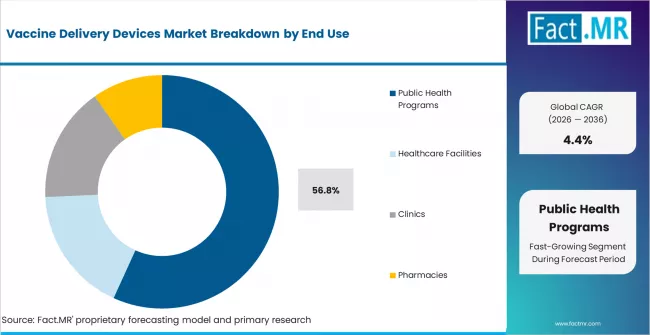
Vaccine Delivery Devices Market Analysis By End Use | Source: Fact.MR
Public programs account for 58.0% of setting demand. National immunization programs and WHO-supported vaccination campaigns generate the highest volume of vaccine doses administered, creating proportional device consumption. Public program procurement is typically managed through centralized tender processes or multilateral procurement (UNICEF Supply Division), resulting in competitive pricing.
Hospitals, clinics, and pharmacies represent the remaining setting demand. Pharmacy-based vaccination, which expanded substantially during the COVID pandemic, has created a permanent new device consumption channel in developed markets.
Which antigen program dominates the Vaccine Delivery Devices Market?
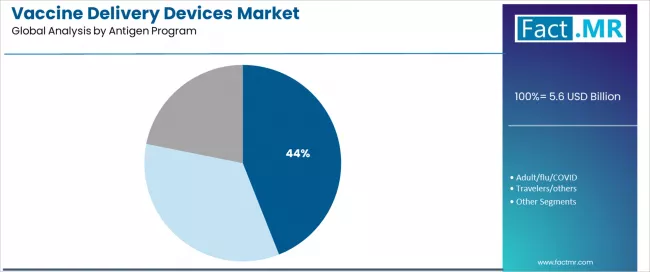
Vaccine Delivery Devices Market Analysis By Antigen Program | Source: Fact.MR
Pediatric EPI accounts for 44.0% of antigen program demand. The share reflects the high number of vaccine doses in the childhood immunization schedule (12 to 20+ doses per child depending on national schedule) administered across the birth cohort of approximately 140 million children annually worldwide.
Adult flu/COVID programs hold the second-largest share, reflecting the permanent expansion of adult vaccination infrastructure following the COVID pandemic. Traveler and other vaccination programs contribute a smaller but growing share.
Which Product Trend is Shaping the Next Phase of Growth in the Vaccine Delivery Devices Market?
Microneedle array patch technology is shaping the next delivery paradigm for vaccine administration. These devices use arrays of microscopic needles (typically 50 to 500 microns) that penetrate only the epidermis, delivering vaccine antigens to the immune-rich skin layer without reaching pain receptors or requiring clinical injection skills. Dissolvable microneedle patches can be self-administered, potentially eliminating the need for healthcare worker involvement and reducing the cold chain requirements for thermostable patch formulations. Clinical trials for measles-rubella and influenza microneedle patches are demonstrating immunogenicity comparable to conventional injection.
The commercial potential of microneedle patches extends beyond efficacy to operational advantages in immunization programs. Self-administration capability could enable vaccination through community health workers, pharmacies, and even mail delivery, dramatically expanding vaccination access in remote and underserved areas. The elimination of sharps waste addresses a significant operational and environmental challenge in mass immunization campaigns. Fact.MR projects that first commercial microneedle vaccine patch approvals may occur by 2028 to 2030, with initial adoption in developed-market adult vaccination programs where self-administration convenience drives willingness to pay premium pricing.
Regional Outlook Across Key Markets
.webp "Top Country Growth Comparison Vaccine Delivery Devices Market Cagr (2026 2036)")
Top Country Growth Comparison Vaccine Delivery Devices Market Cagr (2026 2036) | Source: Fact.MR
- North America is the largest revenue region, with the USA contributing USD 2.032 billion in 2025.
- Latin America is a growing corridor, with Mexico recording strong CAGR.
- Europe maintains steady growth, shaped by adult vaccination expansion and safety device adoption.
- East Asia records growth driven by immunization program modernization.
CAGR Table
| Country | CAGR (%) |
|---|---|
| USA | 4.8% |
| Mexico | 4.6% |
| Germany | 4.2% |
| France | 4.1% |
| South Korea | 4.1% |
| United Kingdom | 3.9% |
| Japan | 3.9% |
Source: Fact.MR analysis. Updated Apr 30, 2026
Source: Fact.MR analysis, based on proprietary forecasting model and primary research.
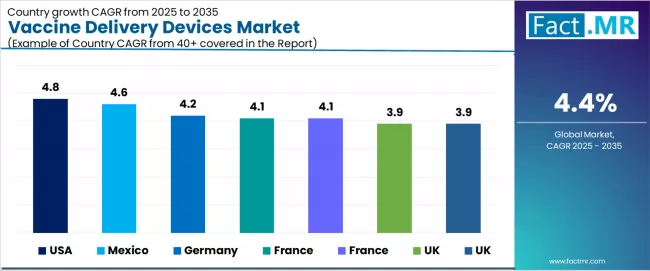
Vaccine Delivery Devices Market Cagr Analysis By Country | Source: Fact.MR
USA: Adult vaccination expansion and technology adoption
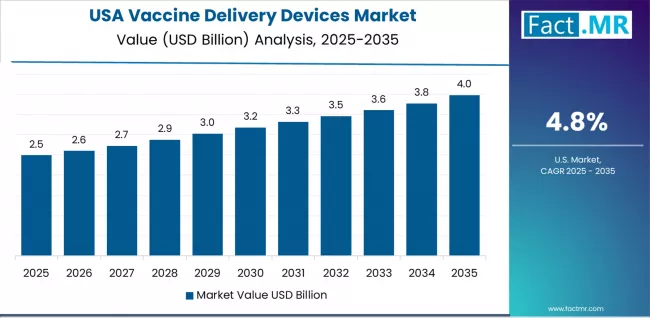
Vaccine Delivery Devices Market Country Value Analysis | Source: Fact.MR
The USA contributes USD 2.032 billion in 2025. Growth reflects the permanent expansion of adult vaccination infrastructure post-COVID, pharmacy-based vaccination program growth, and early adoption of next-generation delivery technologies. CDC immunization recommendations and commercial insurance coverage for preventive vaccines support broad vaccination access. The USA is the primary market for premium-priced needle-free and microneedle delivery technologies.
- Growth anchor: Permanent adult vaccination infrastructure and willingness to adopt premium delivery technologies drive steady growth.
Mexico: Immunization program expansion
Mexico records strong growth driven by government investment in national immunization program coverage expansion, increasing availability of new vaccines in the public schedule, and growing pharmacy-based vaccination access. The transition from conventional to safety syringes in public programs is increasing per-device procurement value.
- Growth anchor: Immunization program expansion and safety syringe adoption create dual volume and value growth.
Germany: Adult vaccination mandate and safety device standards
Germany leads European growth supported by expanding adult vaccination recommendations, statutory health insurance coverage for preventive vaccination, and EU safety device directives that mandate safety-engineered injection equipment in healthcare settings.
- Growth anchor: Adult vaccination expansion and EU safety directives drive consistent device procurement growth.
South Korea: Immunization modernization and technology adoption
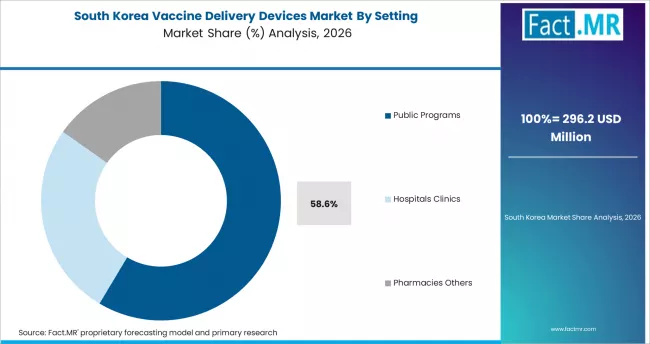
Vaccine Delivery Devices Market South Korea Market Share Analysis By Setting | Source: Fact.MR
South Korea records solid growth driven by advanced immunization program management, high vaccination coverage rates, and early adoption of safety-engineered delivery devices. Korean public health agencies demonstrate high responsiveness to WHO immunization technology recommendations.
- Growth anchor: Advanced immunization management and technology responsiveness support consistent device demand.
Competitive Benchmarking and Company Positioning
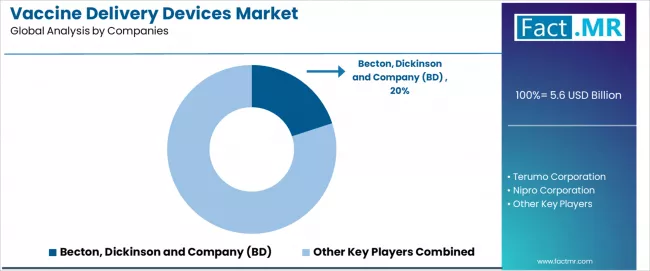
Vaccine Delivery Devices Market Analysis By Company | Source: Fact.MR
Vaccine Delivery Devices Market Analysis By Company
- BD leads with 20.0% market share, anchored by its dominant position in hypodermic syringe and needle manufacturing with established relationships across public health programs, hospitals, and pharmacies globally.
- Terumo and Nipro compete in the broad injection device tier, with Terumo maintaining strength in safety-engineered syringes and Nipro in high-volume conventional syringe manufacturing.
- West Pharmaceutical Services and Gerresheimer maintain positions through prefillable syringe components and specialized delivery device systems respectively.
The competitive field is moderately concentrated, with BD commanding a dominant position through manufacturing scale, UNICEF supply agreements, and global hospital distribution relationships. BD syringes are the default specification in many national immunization program tenders.
Competition from Terumo, Nipro, and emerging manufacturers in India and China is primarily price-based in the conventional syringe segment. Safety syringe competition is more differentiated, with device mechanism design, clinical usability, and waste management characteristics creating procurement preference differences.
Needle-free technology companies including PharmaJet and Vaxxas compete in the emerging technology tier, with commercial deployment currently limited to specialized programs and clinical trials.
Key Companies in the Vaccine Delivery Devices Market
Becton Dickinson and Company (BD), Terumo Corporation, Nipro Corporation, West Pharmaceutical Services Inc., Gerresheimer AG, Schott Pharma AG, PharmaJet Inc., Vaxxas Pty Ltd, Micron Biomedical Inc., and AptarGroup Inc. are the principal companies operating in the global vaccine delivery devices market.
Recent Industry Developments
- BD: safety syringe portfolio expansion (2025)
- BD expanded its safety-engineered syringe portfolio in 2025, launching new auto-disable syringe configurations designed for WHO Expanded Programme on Immunization specifications and UNICEF procurement requirements.
- PharmaJet: needle-free injector clinical validation (2025)
- PharmaJet published clinical validation data in 2025 demonstrating immunogenicity equivalence between its needle-free jet injector and conventional needle-syringe delivery for multiple vaccine antigens.
- Vaxxas: microneedle patch clinical advancement (2025)
- Vaxxas advanced its high-density microarray patch technology through clinical trials in 2025, demonstrating successful vaccine delivery and immune response for influenza and measles-rubella antigens.
- Gerresheimer: prefillable syringe capacity expansion (2026)
- Gerresheimer expanded prefillable syringe manufacturing capacity in early 2026, adding production lines designed for combination vaccine delivery where prefilled presentation improves administration efficiency and reduces preparation errors.
Leading Companies Shaping the Vaccine Delivery Devices Market
-
Global Players
- Becton, Dickinson and Company (BD)
- Terumo Corporation
- Nipro Corporation
- West Pharmaceutical Services, Inc.
- Gerresheimer AG
- Schott Pharma AG
-
Regional Players
- PharmaJet, Inc.
- AptarGroup, Inc.
- Hindustan Syringes and Medical Devices
- Star Syringe Ltd
-
Emerging / Start-up Players
- Vaxxas Pty Ltd
- Micron Biomedical, Inc.
- Vaxess Technologies
Sources and Research References
- BD Annual Report 2024 and Injection Systems Division Presentations
- WHO/UNICEF Immunization Coverage Estimates
- UNICEF Supply Division Vaccine and Injection Device Procurement Data
- CDC Immunization Schedule and Recommendations
- GAVI Vaccine Alliance Market Shaping Reports
- PharmaJet Clinical Validation Publications
All numerical data in this report is derived from Fact.MR proprietary research. Source references are provided for contextual and directional validation only.
Key Questions This Report Addresses
- What is the projected size of the vaccine delivery devices market by 2036?
- Which device type holds the largest share?
- What CAGR is expected from 2026 to 2036?
- Which country is growing fastest?
- Who is the leading company?
- What is the incremental opportunity between 2026 and 2036?
- How is microneedle technology affecting the market?
- What role do safety device mandates play?
Vaccine Delivery Devices Market Definition
The vaccine delivery devices market covers injection devices and delivery systems used to administer vaccines in human immunization programs. Products include conventional hypodermic syringes and needles, safety-engineered and auto-disable syringes, and needle-free delivery devices including jet injectors and microneedle array patches.
Vaccine Delivery Devices Market Inclusions
- Conventional hypodermic syringes and needles for vaccine administration
- Safety-engineered and auto-disable syringes for sharps injury prevention
- Needle-free jet injectors for intradermal and intramuscular vaccine delivery
- Microneedle array patches for transdermal vaccine delivery
Vaccine Delivery Devices Market Exclusions
- Therapeutic injection devices for non-vaccine drug administration
- Insulin injection devices and diabetes management systems
- Vaccine cold chain equipment (refrigerators, cold boxes, ice packs)
- Vaccine vials, prefilled syringes, and primary packaging containers
Vaccine Delivery Devices Market Research Methodology
- Bottom-up revenue modeling using vaccine dose volumes, device-per-dose consumption rates, and average device pricing across 15+ countries
- Primary interviews with national immunization program managers, hospital pharmacy directors, and vaccine delivery device procurement officers
- Cross-referencing WHO/UNICEF immunization coverage data and vaccine procurement statistics
- Validation through syringe manufacturer production volumes, UNICEF supply division procurement data, and national tender records
- Forecasting calibrated against immunization coverage targets, new vaccine introduction schedules, and safety device mandate timelines
- Company-level revenue triangulation using annual reports and injection device division disclosures
Segmentation
Scope of Analysis
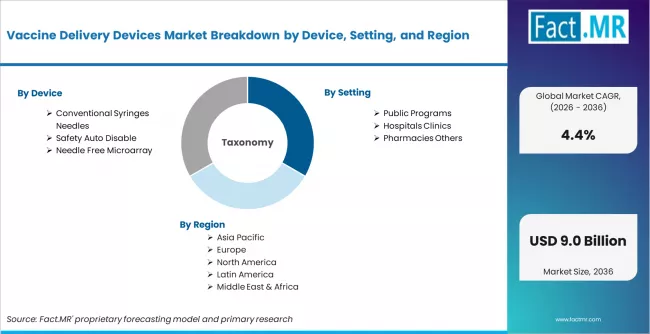
Vaccine Delivery Devices Market Breakdown By Device, Setting, And Region | Source: Fact.MR
| Parameter | Details |
|---|---|
| Market size (2025) | USD 5.6 billion |
| Forecast period | 2026 to 2036 |
| CAGR | 4.4% |
| Base year | 2025 |
| Units | USD Billion |
| Segments covered | Device (Conventional, Safety/Auto-Disable, Needle-Free/Microarray); Setting (Public Programs, Hospitals/Clinics, Pharmacies); Antigen Program (Pediatric EPI, Adult Flu/COVID, Travelers); End Use (Public Health, Healthcare Facilities, Clinics, Pharmacies); Deployment (Single Use, Reusable) |
| Regions covered | North America, Latin America, Europe, East Asia, South Asia and Pacific, Middle East and Africa |
| Countries profiled | USA, Mexico, Germany, France, South Korea, UK, Japan |
| Companies profiled | BD, Terumo, Nipro, West Pharmaceutical Services, Gerresheimer, PharmaJet |
| Forecasting approach | Bottom-up revenue modeling validated through primary research, immunization volume analysis, and company-level financial triangulation |
Source: Fact.MR analysis. Updated Apr 30, 2026
Market Segmentation Analysis
-
Vaccine Delivery Devices Market Market Segmented by Device:
- Conventional Syringes Needles
- Disposable Syringes
- Reusable Syringes
- Standard Hypodermic Needles
- Safety Auto Disable
- Auto Disable Syringes
- Safety Engineered Needles
- Retractable Syringes
- Needle Free Microarray
- Jet Injectors
- Microarray Patches
- Transdermal Delivery Systems
- Conventional Syringes Needles
-
Vaccine Delivery Devices Market Market Segmented by Setting:
- Public Programs
- National Immunization Programs
- Non Government Organization Programs
- Outreach Campaigns
- Hospitals Clinics
- Public Hospitals
- Private Hospitals
- Clinics and Nursing Centers
- Pharmacies Others
- Retail Pharmacies
- Online Pharmacies
- Community Health Centers
- Public Programs
-
Vaccine Delivery Devices Market Market Segmented by Antigen Program:
- Pediatric EPI
- Routine Childhood Vaccination
- Newborn Immunization
- Booster Programs
- Adult Flu COVID
- Seasonal Influenza Vaccination
- COVID Vaccination Programs
- Occupational Vaccination
- Travelers Others
- Travel Vaccination
- Military Vaccination
- Emergency Vaccination Programs
- Pediatric EPI
-
Vaccine Delivery Devices Market Market Segmented by End Use:
- Public Health Programs
- Government Programs
- National Immunization Programs
- Global Health Initiatives
- Healthcare Facilities
- Hospitals
- Public Hospitals
- Private Hospitals
- Clinics
- Primary Care Clinics
- Vaccination Centers
- Specialty Clinics
- Pharmacies
- Retail Pharmacies
- Chain Pharmacies
- Independent Pharmacies
- Public Health Programs
-
Vaccine Delivery Devices Market Market Segmented by Deployment:
- Single Use Devices
- Disposable Systems
- Pre Sterilized Devices
- Ready to Use Devices
- Reusable Devices
- Multi Use Systems
- Sterilizable Devices
- Refillable Systems
- Single Use Devices
-
Vaccine Delivery Devices Market Market by Region:
- North America
- USA
- Canada
- Mexico
- Latin America
- Brazil
- Chile
- Rest of Latin America
- Western Europe
- Germany
- UK
- Italy
- Spain
- France
- Nordic
- BENELUX
- Rest of Western Europe
- Eastern Europe
- Russia
- Poland
- Hungary
- Balkan & Baltic
- Rest of Eastern Europe
- East Asia
- China
- Japan
- South Korea
- South Asia and Pacific
- India
- ASEAN
- Australia & New Zealand
- Rest of South Asia and Pacific
- Middle East & Africa
- Kingdom of Saudi Arabia
- Other GCC Countries
- Turkiye
- South Africa
- Other African Union
- Rest of Middle East & Africa
- North America
Frequently Asked Questions
What is the current size of the vaccine delivery devices market?
What growth rate is expected?
What will the market be worth by 2036?
Which device leads?
Which country is growing fastest?
Who is the market leader?
What is the USA market value?
Who worked on this report


Preview the report firsthand - request a free sample
Free SampleGet the brochure for pricing and purchase details
Download PDF