- Market Value (2025): USD 2.18 Bn
- Estimated Value (2026): USD 2.31 Bn
- Forecast Value (2036): USD 4.17 Bn
- CAGR (2026-2036): 6.1%
What is the Value-added Hair Oils Market forecast to be worth by 2036?
USD 2.3 billion in 2026 to USD 4.2 billion by 2036 at a 6.1% CAGR.
- According to Fact.MR analysis, the value-added hair oils market was valued at USD 2.18 billion in 2025.
- Industry revenue is projected to reach from USD 2.31 billion in 2026 to USD 4.17 billion by 2036 as brands extend targeted nourishment ranges and reach shoppers through more sales channels.
- Sales are forecast to advance at a 6.1% CAGR between 2026 and 2036, with purchases shaped by repeat use and differences in product positioning.
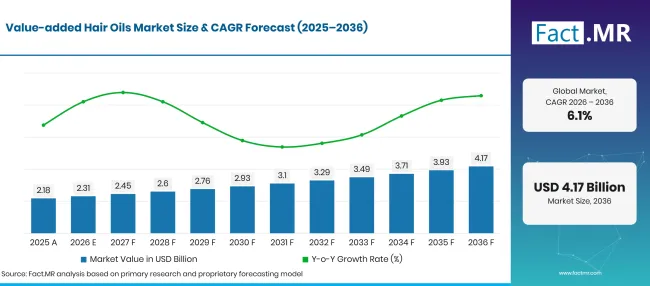
Value Added Hair Oils Market Forecast Global | Source: Fact.MR
| Year | Basis | Market Value (USD billion) |
|---|---|---|
| 2025 | Estimate | 2.18 |
| 2026 | Estimate | 2.31 |
| 2036 | Forecast | 4.17 |
| CAGR 2026 to 2036 | Forecast period | 6.1% |
Source: Fact.MR analysis. Updated Oct 27, 2026
What are the defining numbers behind Value-added Hair Oils Market growth?
USD 1.9 billion absolute opportunity by 2036, with Ayurvedic oils and hair nourishment central to the product mix.
- Demand Drivers in the Market
- Hair-care shoppers increasingly distinguish a basic oil from a formula presented for dryness, softness or scalp comfort. Ingredient lists and directions for use give consumers a practical way to compare bottles without relying entirely on brand claims.
- Online discovery offers smaller hair-oil ranges shelf space beyond physical stores. Germany’s Federal Statistical Office recorded that 70% of people aged 16 to 74 bought or ordered goods online in the three months before their 2025 survey [1].
- Regular hair-care routines can support repeat orders and larger refill packs. Customers use hair oils before washing or as a finishing step, so clear directions and pack sizes help them choose a suitable product.
- Specialized ingredients give brands a reason to explain product differences clearly. Marico introduced Parachute Advansed Olive Enriched Coconut Hair Oil in September 2025, placing an olive-and-coconut blend within its hair nourishment range [6].
- Key Segments Analyzed
- By Product Type: Ayurvedic oils account for 32.4% of 2026 value, reflecting purchases built around familiar botanical formulations and traditional oiling routines.
- By Application: Hair Nourishment represents 36.2% of 2026 value, as shoppers commonly seek manageable hair and an everyday conditioning step. essential oils may appear as ingredients in some value-added blends used for hair nourishment.
- By Distribution Channel: Online Retail captures 38.7% of 2026 sales, connecting specialist blends with consumers who compare ingredients and reviews.
- By End-User: Men account for 40.1% of 2026 value, with purchase choices spanning scalp-focused oils and regular grooming products.
- Analyst Opinion at Fact.MR
- Shambhu Nath Jha, Principal Consultant at Fact.MR, states, “Hair-oil brands compete by explaining how specialist blends differ from familiar base oils. Hair-oil brands can develop repeat sales when the formula suits a recognizable routine, while excessive benefit claims risk disappointing consumers. Online listings improve discovery, although product performance and a convenient price per use remain important to repeat purchases.”
- Strategic Implications
- Manufacturers should make each formulation’s intended use clear and keep ingredient information consistent between packaging and digital product pages.
- Distributors can group hair oils by nourishment, scalp-care use and texture so shoppers find suitable options without confusing different benefit claims.
- Online retailers should display bottle size and use instructions prominently, making value comparisons easier across brands and pack formats.
- Brand teams can test smaller formats for first-time purchases while keeping larger packs available for households that already use the oil regularly.
The United Kingdom has the highest stated country CAGR at 7.7%, followed by Germany at 7.3%. Japan follows at 6.8%, Brazil at 6.2% and the United States at 5.0%. These rates describe different sales outlooks and should be read alongside each country’s channel mix and local product preferences.
How does the Value-added Hair Oils Market break down by segment?
Ayurvedic oils lead Product Type at 32.4%; Hair Nourishment leads Application at 36.2%; Online Retail leads Distribution Channel at 38.7%; Men lead End-User at 40.1%.
Which Product Type dominates?
Ayurvedic accounts for 32.4% of 2026 value.
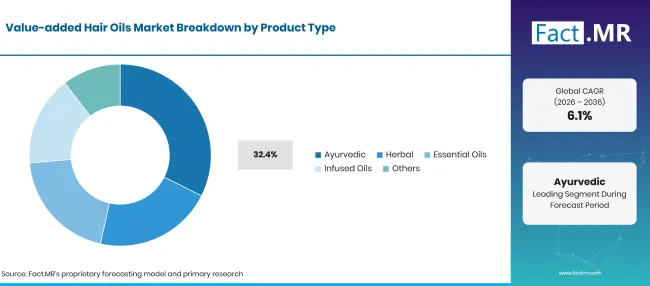
Value Added Hair Oils Market Breakdown Product Type | Source: Fact.MR
| Product Type | Share (2026) |
|---|---|
| Ayurvedic (Leading segment) | 32.4% |
| Other segments combined | 67.6% |
| Total | 100.0% |
Source: Fact.MR analysis. Updated Oct 27, 2026
Ayurvedic products use familiar oiling traditions as a point of recognition for shoppers. Their formulas can contain several plant-derived ingredients, but the exact contents differ by brand and should be checked on each label. Herbal oils provide another route for shoppers who prefer recognizable plant ingredients. Essential oil blends usually need clear usage guidance, particularly where concentrated fragrant materials are involved.
What leads the Application segment?
Hair Nourishment accounts for 36.2% of 2026 value.
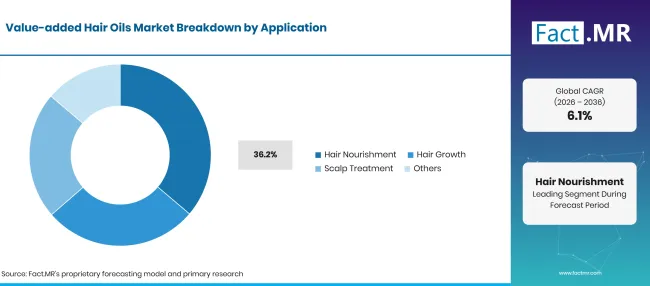
Value Added Hair Oils Market Breakdown Application | Source: Fact.MR
| Application | Share (2026) |
|---|---|
| Hair Nourishment (Leading segment) | 36.2% |
| Other segments combined | 63.8% |
| Total | 100.0% |
Source: Fact.MR analysis. Updated Oct 27, 2026
Hair nourishment is a broad everyday use, covering oil application intended to improve the feel and manageability of hair. Shoppers may prefer a lighter oil for regular use and a richer formula before washing. Hair Growth products are positioned around a different consumer concern, so labels need careful wording and evidence for any measurable result. Scalp Treatment offerings depend on how the product is used and whether the ingredients suit the scalp.
How does Distribution Channel shape sales?
Online Retail accounts for 38.7% of 2026 value.
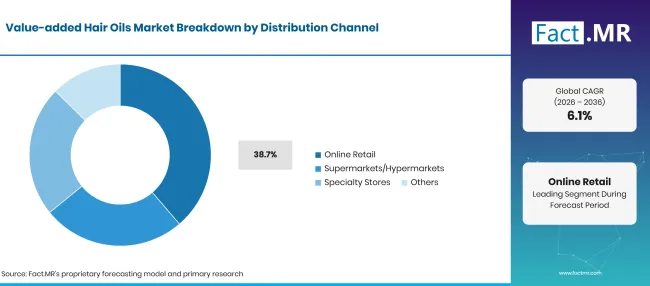
Value Added Hair Oils Market Breakdown Distribution Channel | Source: Fact.MR
| Distribution Channel | Share (2026) |
|---|---|
| Online Retail (Leading segment) | 38.7% |
| Other segments combined | 61.3% |
| Total | 100.0% |
Source: Fact.MR analysis. Updated Oct 27, 2026
Online retail lets consumers compare ingredients and find niche hair oils even when a nearby shop carries only a small range. Reviews help with discovery but cannot replace clear labels or substantiated claims.
Which End-User group accounts for the largest share?
Men accounts for 40.1% of 2026 value.
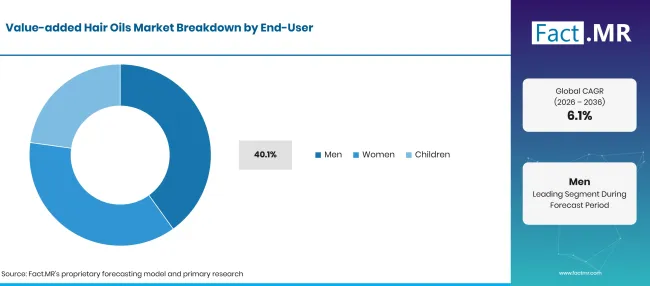
Value Added Hair Oils Market Breakdown End User | Source: Fact.MR
| End-User | Share (2026) |
|---|---|
| Men (Leading segment) | 40.1% |
| Other segments combined | 59.9% |
| Total | 100.0% |
Source: Fact.MR analysis. Updated Oct 27, 2026
The men’s segment covers value-added hair oils bought for grooming and scalp-care routines. Product acceptance depends on how easily oil fits into an ordinary schedule, with texture and washing requirements affecting repeat use. Women buy across a wide range of formats, from regular conditioning oils to ingredient-focused treatments. Children’s products require careful attention to directions and age suitability.
What is accelerating Value-added Hair Oils Market adoption, and what is holding it back?
Sales depend on consumers recognizing a useful difference between basic oil and a specialist formula. Clear ingredient information supports purchase decisions, while labeling obligations and competing price points influence how brands position their ranges.
Drivers Impact Analysis
| DRIVER | (~) % IMPACT ON CAGR | GEOGRAPHIC RELEVANCE | IMPACT TIMELINE |
|---|---|---|---|
| Specific nourishment positioning | +1.0% | Global | Short term (<= 2 years) |
| Wider online product discovery | +0.8% | Global | Short to medium term |
| Regular home hair-care routines | +0.7% | Global | Medium term (2–4 years) |
| Botanical ingredient choice | +0.5% | Asia and selected export markets | Medium term (2–4 years) |
| Range extension by existing brands | +0.4% | Global | Medium term (2–4 years) |
Source: Fact.MR analysis. Updated Oct 27, 2026
Opportunity Impact Analysis
| OPPORTUNITY | (~) % IMPACT ON CAGR | GEOGRAPHIC RELEVANCE | IMPACT TIMELINE |
|---|---|---|---|
| Clearer scalp-specific directions | +0.8% | Global | Medium term (2–4 years) |
| Smaller trial packs | +0.6% | Global | Short term (<= 2 years) |
| Ingredient-comparison shopping pages | +0.5% | Global | Medium term (2–4 years) |
| Suitable lightweight textures | +0.4% | Global | Long term (>= 4 years) |
Source: Fact.MR analysis. Updated Oct 27, 2026
Restraints Impact Analysis
| RESTRAINT | (~) % IMPACT ON CAGR | GEOGRAPHIC RELEVANCE | IMPACT TIMELINE |
|---|---|---|---|
| Price comparison with basic oils | -0.8% | Global | Short term (<= 2 years) |
| Ingredient sensitivity and labeling | -0.6% | Europe and other regulated markets | Medium term (2–4 years) |
| Unsubstantiated benefit claims | -0.5% | Global | Short term (<= 2 years) |
| Complex product choice | -0.4% | Global | Medium term (2–4 years) |
Source: Fact.MR analysis. Updated Oct 27, 2026
Which countries are scaling the Value-added Hair Oils Market through 2036?
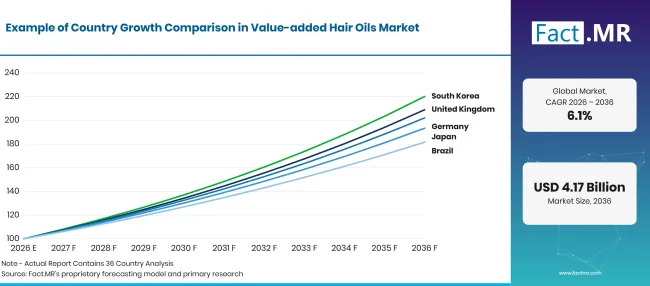
Value Added Hair Oils Market Growth Index | Source: Fact.MR
| Country | CAGR (2026 to 2036) |
|---|---|
| United Kingdom | 7.7% |
| Germany | 7.3% |
| Japan | 6.8% |
| Brazil | 6.2% |
| United States | 5.0% |
Source: Fact.MR analysis. Updated Oct 27, 2026
How is the United Kingdom developing hair-oil sales?
7.7% CAGR, with online discovery and product comparison shaping sales.
The United Kingdom is forecast to advance at 7.7% CAGR between 2026 and 2036. Online stores help consumers compare botanical blends and read directions before choosing oils for pre-wash care or a lighter finishing routine. The Office for National Statistics reported in August 2026 that internet transactions represented 27.4% of Great Britain’s retail sales in 2025 [4].
What supports Germany’s hair-oil adoption?
7.3% CAGR, linked to informed online shoppers and careful product labeling.
Germany is projected to record 7.3% CAGR between 2026 and 2036 as consumers compare oil blends through established drugstores and digital shops. Destatis reported in August 2026 that online shopping was widely used in Germany in 2025 [7]. Hair nourishment offers a familiar use for products that explain application frequency and suitable hair types.
How does Japan approach value-added hair oils?
6.8% CAGR, with ingredient-focused beauty buying and mixed retail channels.
Japanese value-added hair oils are forecast to expand at 6.8% CAGR between 2026 and 2036, reflecting purchases shaped by texture and careful product comparisons. The Ministry of Economy, Trade and Industry reported in August 2025 that online sales of cosmetics and pharmaceuticals reached JPY 1,015 billion in 2024 [5]. This wider beauty retail channel offers room to explain how a light finishing oil differs from a pre-wash scalp oil.
What shapes Brazil’s outlook?
6.2% CAGR, with mobile discovery and varied household price points.
Brazil is expected to register 6.2% CAGR from 2026 to 2036, with first purchases shaped by bottle price and access through local stores. The Brazilian statistics agency IBGE reported in July 2026 that 52.7% of internet users placed an online purchase or order during 2025 [2]. Digital listings widen the choice of herbal and infused blends beyond nearby shelves.
What is influencing United States sales?
5.0% CAGR, built around defined hair-care routines and large retail networks.
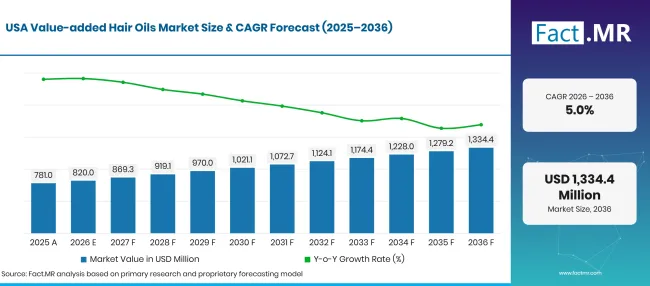
Value Added Hair Oils Market Forecast Usa | Source: Fact.MR
The United States is forecast to grow at 5.0% CAGR through 2036 as consumers consider oils alongside conditioners and scalp-care products in large retail networks. The U.S. Census Bureau reported in March 2026 that e-commerce accounted for 16.4% of total U.S. retail sales during 2025 [3]. Online product pages give specialist brands space to describe pre-wash use and finishing textures.
Who leads the Value-added Hair Oils Market?
Competition includes Indian hair-oil specialists and international personal-care groups. Marico sells Parachute Advansed products while Bajaj Consumer Care offers Almond Drops Hair Oil. Dabur, Emami and Himalaya have botanical personal-care portfolios.
Hair-oil specialists can explain their blends through familiar ingredients. Wider beauty groups can place oils among shampoos and treatments. Online shoppers also compare bottle size and the ease of using each formula.
Which companies are the key providers?
Key companies include Marico Limited; Dabur India Limited; Emami Limited; Hindustan Unilever Limited; Kenvue Inc. (Johnson’s); Himalaya Wellness Company; and Bajaj Consumer Care Limited.
- Marico Limited
- Dabur India Limited
- Emami Limited
- Hindustan Unilever Limited
- Kenvue Inc. (Johnson’s)
- Himalaya Wellness Company
- Bajaj Consumer Care Limited
Bibliography
- [1] Statistisches Bundesamt (Destatis). (2026, April 20). Personen, die das Internet zu privaten Zwecken nutzen und online einkaufen im Zeitvergleich. Destatis source
- [2] Instituto Brasileiro de Geografia e Estatística. (2026, July 2). Proporção de usuários da internet no país ultrapassou 90% da população de 10 anos ou mais, em 2025. IBGE source
- [3] U.S. Census Bureau. (2026, March 10). Quarterly retail e-commerce sales: Fourth quarter 2025. U.S. Census Bureau PDF
- [4] Office for National Statistics. (2026, August 21). Internet sales as a percentage of total retail sales (ratio) (%). ONS source
- [5] Ministry of Economy, Trade and Industry. (2025, August 26). Results of FY2024 E-Commerce Market Survey Compiled. METI source
- [6] Marico Limited. (2025, September 9). Marico launches Parachute Advansed Olive Enriched Coconut Hair Oil, elevating the benefits of Olive in haircare. Marico source
- [7] Statistisches Bundesamt (Destatis). (2026, August 25). Onlineshopping weit verbreitet 2025. Destatis source
This Report Answers
- How value-added hair-oil revenue changes between 2026 and 2036.
- Which product, application, distribution and end-user categories account for the stated shares.
- How ingredient choice and oiling routines shape purchase decisions.
- Where the five country growth outlooks differ and what local channels imply.
- How packaging, product claims and portfolio differences affect competition.
What does the Value-added Hair Oils Market cover?
The market covers formulated hair oils sold with added product benefits such as nourishment, texture improvement or a defined scalp-care use. Ayurvedic and herbal oils belong here when positioned for hair care. Infused oils and suitable essential oil blends are included when sold as finished consumer hair-oil products. The revenue boundary concerns finished product sales, not raw botanical ingredients traded between manufacturers.
What is included in the scope?
The scope includes leave-on or pre-wash hair oils in retail-ready packs, sold online and in stores. A product qualifies when the brand presents it for hair use with a clear additional care purpose. The analysis considers pack size, intended application and purchase channel, because these affect product comparisons.
What is excluded from the scope?
Cooking oils and plain carrier oils marketed solely as general ingredients are outside the finished hair-care boundary. Shampoos, conditioners, colorants, scalp medicines and styling products without an oil format are excluded. Essential oils sold only as raw fragrance inputs also fall outside the market until they become an eligible finished hair-oil product.
How Was the Analysis Built?
The analysis draws on 120+ sources, 35+ company portfolios, 25+ countries, and more than 20 industry interviews.
- Primary Research: Primary research includes discussions with manufacturers, service providers, technology developers, distributors, end users, and subject-matter experts. These conversations examine purchasing priorities, product adoption, operational challenges, approval requirements, competitive positioning, and the factors that influence wider market acceptance.
- Desk Research: Desk research covers government statistics, regulatory publications, company filings, trade data, technical studies, industry associations, standards, public policy, and other authoritative sources. Every source used in the analysis is documented in the bibliography.
- Market Sizing and Forecasting: Market estimates combine historical performance, demand indicators, pricing and volume trends, segment shares, company participation, country-level growth, adoption patterns, investment activity, and barriers to market expansion.
- Data Validation and Update Cycle: Findings are validated by comparing primary interviews with public data, company activity, regulatory changes, trade patterns, and industry developments. Regular updates review new product launches, capacity changes, partnerships, approvals, and shifts in commercial adoption.
Segmentation
What is the report’s scope and coverage?
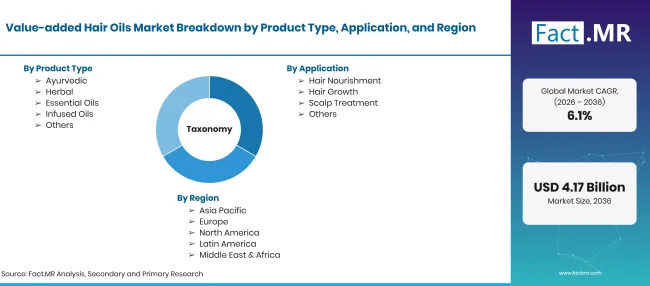
Value Added Hair Oils Market Taxonomy | Source: Fact.MR
| Attribute | Details |
|---|---|
| Quantitative Units | USD billion in 2026 and 2036; CAGR for 2026 to 2036 |
| Market Definition | Hair oils presented with added botanical, conditioning or targeted hair-care benefits beyond basic oiling |
| Product Type | Ayurvedic; Herbal; Essential Oils; Infused Oils; Others |
| Application | Hair Nourishment; Hair Growth; Scalp Treatment; Others |
| Distribution Channel | Online Retail; Supermarkets/Hypermarkets; Specialty Stores; Others |
| End-User | Men; Women; Children; Others |
| Regions Covered | North America; Latin America; Western Europe; Eastern Europe; East Asia; South Asia & Pacific; Middle East & Africa |
| Countries Covered | United Kingdom; Germany; Japan; Brazil; United States |
| Companies Profiled | Marico Limited; Dabur India Limited; Emami Limited; Hindustan Unilever Limited; Kenvue Inc. (Johnson’s); Himalaya Wellness Company; and Bajaj Consumer Care Limited |
| Forecast Period | 2026 to 2036 |
| Approach | Product category assessment, company portfolio review, retail channel analysis and official public statistics |
Source: Fact.MR analysis. Updated Oct 27, 2026
How is the market segmented?
-
By Product Type
- Ayurvedic
- Herbal
- Essential Oils
- Infused Oils
- Others
-
By Application
- Hair Nourishment
- Hair Growth
- Scalp Treatment
- Others
-
By Distribution Channel
- Online Retail
- Supermarkets/Hypermarkets
- Specialty Stores
- Others
-
By End-User
- Men
- Women
- Children
- Others
-
By Region
- North America
- Latin America
- Western Europe
- Eastern Europe
- East Asia
- South Asia & Pacific
- Middle East & Africa
Frequently Asked Questions
How big is the value-added hair oils market in 2026?
What is the projected market value in 2036?
Which product type holds the largest share?
Which application accounts for the highest share?
Who are the main companies in the value-added hair oils market?
Who worked on this report


Preview the report firsthand - request a free sample
Free SampleGet the brochure for pricing and purchase details
Download PDF