- Market Value (2025):USD 680.7 Mn
- Estimated Value (2026):USD 721.6 Mn
- Forecast Value (2036): USD 1293.5 Mn
- CAGR (2026-2036): 6.0%
How Big Is the Watering and Water Hose Timers Market in 2026?
The global watering and water hose timers market is valued at USD 721.6 million in 2026, up from USD 680.7 million in 2025, and is projected by Fact.MR to reach USD 1293.5 million by 2036, expanding at a 6.0% CAGR from 2026 to 2036 and generating USD 572.0 million over the 10-year forecast period.
| Market Metric | Valuation / Share / Forecast Benchmark |
|---|---|
| 2025 Market Size (Historical) | USD 680.7 million |
| 2026 Market Size (Estimated) | USD 721.6 million |
| 2036 Market Size (Projected) | USD 1293.5 million |
| CAGR (2026 to 2036) | 6.0% |
| Incremental Dollar Opportunity (2026 to 2036) | USD 572.0 million (1.79x the 2026 base) |
| Dominant Product Type (2026 share) | Smart timers, 42.3% (about USD 305.2 million) |
| Leading Application (2026 share) | Residential, 47.6% (about USD 343.5 million) |
| Leading Distribution Channel (2026 share) | Online stores, 36.4% (about USD 262.7 million) |
| Largest Country Markets (2026 share) | United States 28.0%, Germany 18.0%, Japan 14.0% |
| Fastest-Growing Countries (CAGR, 2026 to 2036) | Japan 7.7%, Brazil 6.1%, Germany 5.7% |
| Leading Tier-1 Companies | Orbit Irrigation Products, Rain Bird, Gardena, Hunter Industries, The Toro Company |
Source: Fact.MR analysis. Updated Nov 13, 2026
Source: Fact.MR analysis of the watering and water hose timers market, 2026.
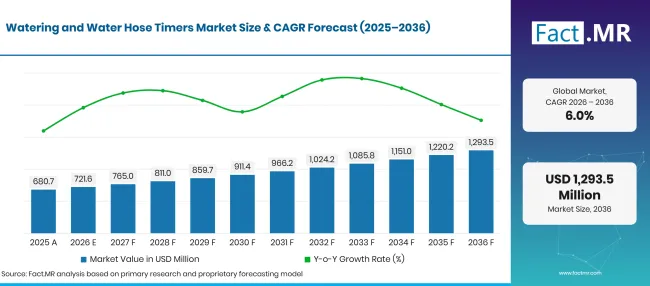
Watering And Water Hose Timers Market Forecast Global | Source: Fact.MR
Executive Market Overview
Demand for watering and water hose timers is led by homeowners, the largest buyer group with 48.9% of 2026 revenue, who use them to water lawns, beds, vegetable plots and pots on schedule without standing at the tap. Residential use makes up 47.6% of 2026 revenue, and landscapers who maintain many small sites account for much of the rest. A timer is often the first step towards automated watering, bought in spring or before a summer holiday and then added to as the garden grows. Together, the United States (28.0%), Germany (18.0%) and Japan (14.0%) hold 60.0% of revenue. Suburban gardens are spreading faster in China, Australia, Southeast Asia and the Gulf, lifting sales outside the five named countries at 7.2% a year.
Revenue from smart Bluetooth and Wi-Fi timers already reaches 42.3% of the market, well ahead of their unit share, because basic dial timers sell at low prices through supermarkets and DIY stores. Multi-zone outlets, rain delay and weather-linked scheduling explain most of the price gap, and buyers who trade up rarely go back to mechanical models. Seasonality is strong, with most sales falling between March and July in the northern hemisphere, so retailer stocking decisions shape annual results. Japan (7.7% CAGR), Brazil (6.1%) and the rest of the world grow faster than the global 6.0%, while Germany (5.7%), the United States (4.9%) and the United Kingdom (4.5%) trail. Fact.MR sizes the market to include mechanical, digital and smart timers that fit a garden tap or hose line, while excluding in-ground irrigation controllers, solenoid valves sold separately, sprinklers, hoses and drip kits sold without a timer.
Analyst Perspective
"Hose timer revenue will grow faster than unit sales, because homeowners are trading up from simple dial timers to app-controlled, multi-zone units with rain delay and weather-based scheduling. The main risk is price competition on online marketplaces, where low-cost unbranded timers can undercut established brands before buyers see any difference in reliability."
Shambhu Nath Jha, Principal Consultant, Fact.MR
Major Market Trends and Insights
- Multi-Zone Timers Move Into the Mass Market: Sales of two-outlet and multi-zone hose timers are rising because many gardens need different schedules for lawn sprinklers and drip lines. Rain Bird (March 2026) launched its 1- and 2-station Electronic Hose End Timers, with the 2-station model running two zones on independent schedules and both offering rain delays and manual watering. Rain Bird (accessed November 2026) lists run times of up to 6 hours per cycle per station and a working pressure of 15 to 90 psi for the range. Gilmour (accessed November 2026) and Melnor (accessed November 2026) also sell dual-port and multi-zone electronic timers, so multi-zone is fast becoming a standard mid-range feature rather than a premium one.
- App Control and Weather Data Replace Fixed Clocks: Adoption of connected timers is growing as homeowners expect to change watering from a phone and skip cycles after rain. Orbit (accessed November 2026) links its B-hyve hose faucet timers to local weather data for automatic schedule changes, and Hunter Industries (accessed November 2026) offers its BTT Bluetooth tap timers in 1- and 2-zone versions with a cycling mode for greenhouses and terraces. Claber (accessed November 2026) has removed battery changes altogether with its solar-powered Tempo myAquaSolar. These features also support the wider smart irrigation controller market, as buyers who start with a smart tap timer often move on to whole-garden systems.
- Online Marketplaces Become the Main Shop Window: Purchases through online marketplaces already account for 36.4% of 2026 revenue, because buyers can compare outlets, programming options and reviews before ordering a low-ticket item. Rain Bird (March 2026) made its new hose-end timers available on Amazon and through authorised retailers at launch, and most brands now run their own web stores. Online listings also make spare parts and replacement units easy to find, which supports repeat buying. Supermarkets and DIY stores remain important for impulse and replacement purchases in spring, when timers sit next to hoses and sprinklers.
What Are the Main Drivers, Restraints, and Opportunities?
Hose timer demand rests on garden automation and pressure to cut outdoor water waste. Price sensitivity and dependence on batteries and wireless links restrain adoption, while smart, water-saving features are the main opportunity to raise revenue per unit.
Driver: Garden Automation and Outdoor Water Efficiency
Interest in automated watering is rising because homeowners want gardens watered while they are at work or away, and utilities want less water wasted on lawns.
The Environmental Protection Agency (accessed November 2026) estimates that US residential outdoor water use is nearly 8 billion gallons a day and that as much as 50% may be lost to overwatering and inefficient irrigation. Hotter summers add to the case, as the Ministry of Agriculture, Forestry and Fisheries (March 2026) recorded Japan's hottest summer on record in 2025. A timer that waters at set times, early in the morning, and skips cycles after rain addresses all of these needs, and pairs naturally with sales in the garden hose market.
Restraint: Price Sensitivity, Batteries and Connectivity
Price is the main barrier for smart hose timers, which cost several times more than a basic dial timer, and buyers with small gardens often see little reason to pay extra.
Connected models need batteries and a stable Bluetooth or Wi-Fi link at the outdoor tap, which can fail in exposed spots or far from the house. Fitting problems with different tap threads add to returns, and frost damage shortens product life where timers are left outside in winter. Many buyers therefore stay with mechanical timers that simply open and close the valve, which caps the average selling price in the entry segment.
Opportunity: Water-Saving Smart Features and Rainwater Systems
Spending on water-saving smart features lets suppliers sell at higher prices and win repeat customers.
Rain Bird (December 2025) added a Simple-Set dial timer with runs of 1 to 120 minutes and automatic shut-off for buyers who want automation without an app, with fewer moving parts than a mechanical timer. POWER FOR ALL Alliance (February 2026) reported that Gardena's new battery rainwater tank pumps offer eleven preset irrigation programmes, linking rainwater storage to scheduled watering. Timers that work with rain barrels, soil moisture sensors and the drip irrigation market can widen the product range beyond the tap and raise basket size.
How Is the Watering and Water Hose Timers Market Segmented?
Fact.MR segments watering and water hose timers by product type, application, distribution channel, end user and country, valuing every segment in USD million at the point of sale.
| Segmentation Axis | Sub-Segments Covered | 2026 Leading Segment & Share | Main Growth Benchmark (2026 to 2036) |
|---|---|---|---|
| Product Type | Smart timers, mechanical timers, digital timers | Smart timers, 42.3% (USD 305.2 million) | Global market 6.0% CAGR, USD 721.6 million to USD 1,293.6 million |
| Application | Residential, commercial, agricultural, others | Residential, 47.6% (USD 343.5 million) | USD 572.0 million added across all applications |
| Distribution Channel | Online stores, supermarkets and hypermarkets, specialty stores, others | Online stores, 36.4% (USD 262.7 million) | Global market grows 1.79x by 2036 |
| End User | Homeowners, landscapers, farmers, others | Homeowners, 48.9% (USD 352.9 million) | Homeowners remain the largest buyer group through 2036 |
| Region / Country | North America, Latin America, Europe, East Asia, South Asia and Pacific, Middle East and Africa | United States, 28.0% (USD 202.0 million) | Japan fastest at 7.7% CAGR; United Kingdom slowest named country at 4.5% |
Source: Fact.MR analysis. Updated Nov 13, 2026
Source: Fact.MR analysis of the watering and water hose timers market, 2026.
Why Does the Smart Timer Segment Lead by Product Type?
Revenue from smart timers reaches 42.3% of 2026 revenue, about USD 305.2 million, because they sell at much higher prices than dial timers and are taking a growing share of new purchases.
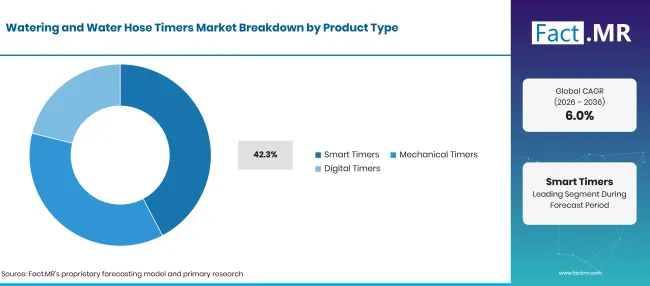
Watering And Water Hose Timers Market Breakdown Product Type | Source: Fact.MR
App scheduling, weather-based skipping and multi-zone control let one device handle a whole garden, and many models record water use. Orbit (accessed November 2026), Hunter Industries (accessed November 2026) and Claber (accessed November 2026), with its solar-powered Tempo myAquaSolar, all compete in this tier. Digital timers with an LCD and push buttons sit in the middle of the price range, while mechanical timers still lead in units at the low end.
Why Does the Residential Segment Lead by Application?
Use of hose timers in residential gardens accounts for 47.6% of 2026 revenue, about USD 343.5 million.
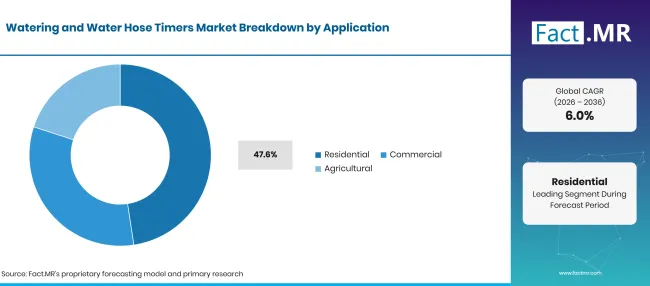
Watering And Water Hose Timers Market Breakdown Application | Source: Fact.MR
A hose-end timer is the cheapest way to automate a lawn or bed without installing an in-ground system, and it works with sprinklers, soaker hoses and drip lines. Renters and owners of small gardens favour timers because they need no digging or wiring. Commercial users such as small hotels, schools and offices follow, while farms generally use dedicated irrigation controllers rather than tap timers.
Why Does the Online Segment Lead by Distribution Channel?
Sales through online stores take 36.4% of 2026 revenue, about USD 262.7 million.
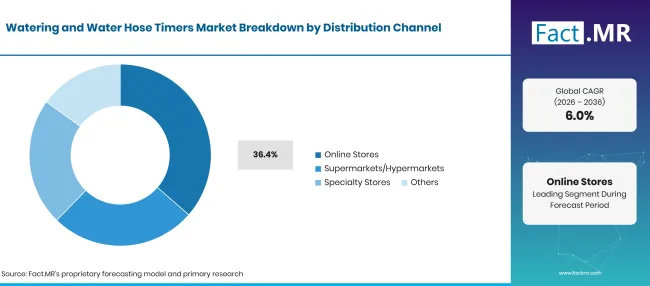
Watering And Water Hose Timers Market Breakdown Distribution Channel | Source: Fact.MR
Hose timers are light, easy to ship and bought on specification, so buyers compare outlets, run times and battery life online and read reviews on reliability. Rain Bird (March 2026) launched its new hose-end timers on Amazon, and most brands now sell through their own web stores as well. Supermarkets and hypermarkets follow with seasonal displays, while specialty garden centres keep a role where buyers need advice on fittings and system design.
Why Does the Homeowner Segment Lead by End User?
Purchases by homeowners account for 48.9% of 2026 revenue, about USD 352.9 million.
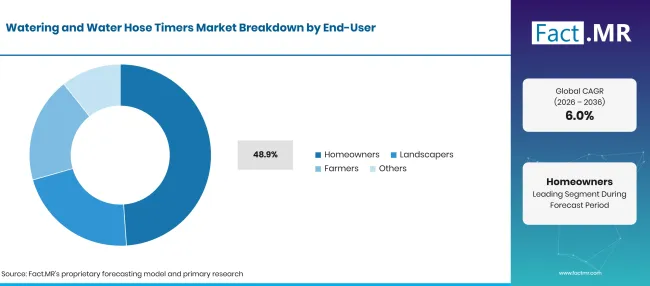
Watering And Water Hose Timers Market Breakdown End User | Source: Fact.MR
They use timers for lawns, flower beds, vegetable gardens and patio pots, and many own more than one. Landscapers buy timers for client gardens and small commercial sites, often choosing durable digital models they can programme once for the season. Farmers use tap timers mainly for greenhouses and small plots. Strong spring and summer seasonality makes retail timing and stock levels important for reaching homeowners.
Watering and Water Hose Timers Market by Region and Country (2026 to 2036)
Hose timer revenue is concentrated in the United States, Germany, Japan, the United Kingdom and Brazil, which together account for 80.0% of 2026 revenue (USD 577.2 million), slipping to 77.5% by 2036 as the rest of the world grows faster. Japan gains the most share, while the United States and the United Kingdom lose share as their markets mature.
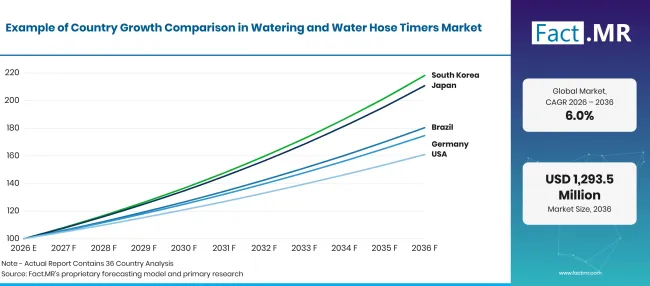
Watering And Water Hose Timers Market Growth Index | Source: Fact.MR
| Country | 2026 Revenue | 2036 Revenue | 10-Year Addition | 2026 to 2036 CAGR | Global Share (2026 → 2036) |
|---|---|---|---|---|---|
| United States | USD 202.0 million | USD 326.0 million | USD 124.0 million | 4.9% | 28.0% → 25.2% |
| Germany | USD 129.9 million | USD 226.1 million | USD 96.2 million | 5.7% | 18.0% → 17.5% |
| Japan | USD 101.0 million | USD 212.1 million | USD 111.1 million | 7.7% | 14.0% → 16.4% |
| United Kingdom | USD 86.6 million | USD 134.5 million | USD 47.9 million | 4.5% | 12.0% → 10.4% |
| Brazil | USD 57.7 million | USD 104.4 million | USD 46.7 million | 6.1% | 8.0% → 8.1% |
| Rest of world | USD 144.4 million | USD 290.5 million | USD 146.1 million | 7.2% | 20.0% → 22.5% |
| Global total | USD 721.6 million | USD 1,293.6 million | USD 572.0 million | 6.0% | 100.0% → 100.0% |
Source: Fact.MR analysis. Updated Nov 13, 2026
Source: Fact.MR analysis of the watering and water hose timers market, 2026.
United States
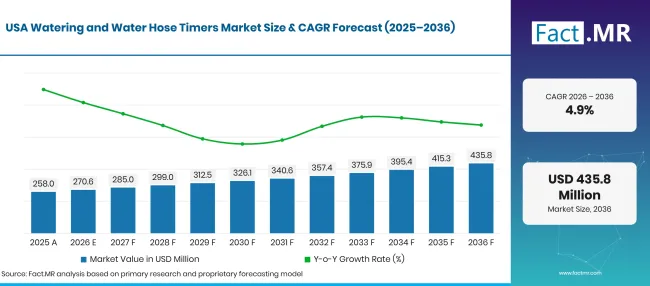
Watering And Water Hose Timers Market Forecast Usa | Source: Fact.MR
Sales of hose timers in the United States are projected to rise from USD 202.0 million in 2026 to USD 326.0 million by 2036 at a 4.9% CAGR, adding USD 124.0 million (1.61x), while the US share falls from 28.0% to 25.2%. Large suburban lawns and drought-prone western states drive demand, and the Environmental Protection Agency (accessed November 2026) promotes weather-based and soil-moisture irrigation controls through WaterSense. Water utilities in several states offer rebates for efficient irrigation products, which supports trading up. Orbit, Rain Bird, Melnor and Gilmour compete closely through home-improvement chains and Amazon.
Germany
Demand for hose timers in Germany, the second-largest market, is projected to grow from USD 129.9 million in 2026 to USD 226.1 million by 2036 at a 5.7% CAGR. The USD 96.2 million addition (1.74x) comes with a slight share dip from 18.0% to 17.5%. Hot, dry summers are pushing gardeners to water more carefully, and the Federal Environment Ministry (July 2026) warns that heat and drought periods are becoming more frequent. Gardena, based in Ulm, dominates the retail shelf with timers that plug into its click-fit hose system, and allotment gardens add a large base of small-plot users.
Japan
Adoption of watering timers in Japan is the fastest among the named markets, lifting revenue from USD 101.0 million in 2026 to USD 212.1 million by 2036 at a 7.7% CAGR. It adds USD 111.1 million (2.10x) and lifts its share from 14.0% to 16.4%. Record heat is changing watering habits, and the Ministry of Agriculture, Forestry and Fisheries (March 2026) reported that Japan's summer 2025 average temperature was 2.36°C above normal, the highest since records began in 1898. Compact timers for small gardens, balconies and home vegetable plots suit Japanese housing, and an ageing population values automated watering that reduces daily effort.
United Kingdom
UK hose timer revenue grows from USD 86.6 million in 2026 to USD 134.5 million by 2036 at a 4.5% CAGR, the slowest of the named countries. That adds USD 47.9 million (1.55x), while the UK share eases from 12.0% to 10.4%. Most purchases replace older dial timers or add a second unit for greenhouses and beds, and hosepipe bans in dry summers can cut sales in some years. Hozelock (accessed November 2026) sells Select and Select Plus controllers with preset programmes and up to seven days of rain delay, competing with Gardena and Claber in garden centres.
Brazil
Purchases of hose timers in Brazil are projected to rise from USD 57.7 million in 2026 to USD 104.4 million by 2036 at a 6.1% CAGR, adding USD 46.7 million (1.81x) and edging its share from 8.0% to 8.1%. Water allocation is a national issue, with the National Water and Sanitation Agency (accessed November 2026) reporting that irrigation took 50.3% of Brazil's water withdrawals in 2024. Large farms use dedicated systems, so hose timer demand comes mainly from urban gardens, condominiums and small horticulture plots, where affordable electronic models are gaining ground through online retail.
Rest of World
Outside the named countries, hose timer revenue is projected to climb from USD 144.4 million in 2026 to USD 290.5 million by 2036 at a 7.2% CAGR, adding USD 146.1 million (2.01x) and raising the share from 20.0% to 22.5%. Australia, China, South Korea, the Gulf states and South Africa lead this group, where water restrictions and new suburban housing support timed watering. Low-cost timers sold online compete strongly with branded products in these markets, and many are made by the same Chinese factories that supply private-label ranges.
Competitive Environment and Notable Companies
The hose timer supply base is led by Orbit Irrigation Products, Rain Bird, Gardena, Hunter Industries and The Toro Company, which form the Tier-1 group, each selling timers alongside wider irrigation ranges. Tier-2 includes Gilmour, Melnor, Claber and Hozelock, which focus on garden watering through retail channels, plus many unbranded makers selling online. Large retailers also sell timers under their own labels, made by contract manufacturers in China. Brand owners compete for seasonal shelf space and search ranking as much as on product features.
How Are Companies Positioned in the Watering and Water Hose Timers Market?
Competition among hose timer brands splits by technology and channel. Orbit and Hunter lead with app-controlled Bluetooth and Wi-Fi timers, while Rain Bird and Toro build on their irrigation brands with programmable electronic tap timers. Gardena and Hozelock compete on complete garden watering systems in Europe, where the timer is sold as part of a connector and hose range. Melnor and Gilmour cover North American retail shelves with dial, digital and multi-zone models at a wide spread of prices.
What Matters When a Buyer Selects a Watering and Water Hose Timer Supplier?
Buyers of hose timers start with fit to the existing tap and hose, followed by the number of outlets, maximum run time and operating pressure. They then compare programming ease, battery life, rain-delay and manual-watering options, and for smart models the quality of the app. Melnor (accessed November 2026) offers schedules from once a week up to 24 times a day, showing how wide the range of options has become. Warranty, spare parts and retail availability in spring decide many purchases.
Which Capabilities Distinguish Product Offers?
Product offers in hose timers are now separated by connectivity, zone count and power source. The Toro Company (accessed November 2026) sells an electronic tap timer with up to eight start times a day, Gilmour (accessed November 2026) adds a built-in flow meter and an ECO cycle that splits watering into shorter runs, and Claber (accessed November 2026) uses solar power to remove battery changes. Gardena (accessed November 2026) offers Water Control Flex with up to six cycles a day and Select with three independent schedules, plus smart models in its system.
How Does Geographic Reach Affect Competition?
Retail reach shapes hose timer sales, because seasonal shelf space in DIY chains, garden centres and marketplaces decides most purchases. Orbit, Rain Bird and Melnor are strongest in North America, while Gardena, Hozelock and Claber lead in Europe. Brands entering Brazil, India and Southeast Asia need local tap-thread fittings and lower price points to compete with imported unbranded timers. Strong after-sales support and easy returns also matter online, where poor reviews can sink a product within a season.
| Verified Company Evidence (2025 to 2026) | Commercial Effect | Buyer Action |
|---|---|---|
| 1 December 2025: Rain Bird launched the Simple-Set Hose End Timer with a dial for runs of 1 to 120 minutes and automatic shut-off (Rain Bird, December 2025). | Adds an easy entry-level electronic model that competes with mechanical dial timers. | Compare dial-set electronic timers with mechanical units on accuracy and battery life. |
| 3 February 2026: Gardena's new battery rainwater tank pumps were announced with eleven preset irrigation programmes (POWER FOR ALL Alliance, February 2026). | Links rainwater storage to scheduled watering and widens the timed-watering category. | Check whether a pump with built-in programmes replaces a separate tap timer for rain-barrel gardens. |
| 27 March 2026: Rain Bird launched 1- and 2-station Electronic Hose End Timers, available on Amazon and through authorised retailers (Rain Bird, March 2026). | Brings independent two-zone scheduling to a mass-market price point. | Use 2-station models where lawns and drip lines need different schedules. |
Source: Fact.MR analysis. Updated Nov 13, 2026
Source: Verified corporate disclosures and Fact.MR analysis, 2026. Table 5: Watering and Water Hose Timers Market Representative Company Overview
| Company | Core Positioning | Verified Activity & Source Attribution |
|---|---|---|
| Orbit Irrigation Products (Tier-1) | B-hyve smart hose faucet timers and Bluetooth timers | B-hyve timers adjust schedules from local weather data (Orbit, accessed November 2026). |
| Rain Bird (Tier-1) | Electronic hose-end timers and irrigation controllers | Launched 1- and 2-station Electronic Hose End Timers (Rain Bird, March 2026). |
| Gardena (Tier-1) | Water Control timers and smart garden watering systems | Offers Water Control Flex, Select and smart models (Gardena, accessed November 2026). |
| Hunter Industries (Tier-1) | BTT Bluetooth tap timers | BTT range in 1- and 2-zone models with smartphone control (Hunter Industries, accessed November 2026). |
| The Toro Company (Tier-1) | Battery electronic tap timers | Electronic tap timer with seven-day calendar and up to eight start times a day (The Toro Company, accessed November 2026). |
| Gilmour (Tier-2) | Dual-port electronic water timers | Dual Port Electronic Water Timer with flow meter and ECO cycling (Gilmour, accessed November 2026). |
| Melnor (Tier-2) | AquaTimer digital and multi-zone timers | Sells 2- and 4-zone electronic and Bluetooth water timers (Melnor, accessed November 2026). |
| Claber (Tier-2) | Tap timers including solar-powered models | Tempo myAquaSolar is a battery-free solar tap timer with app programming (Claber, accessed November 2026). |
| Hozelock (Tier-2) | Select and Select Plus water controllers | Select Plus offers up to three daily programmes and up to seven days of rain delay (Hozelock, accessed November 2026). |
Source: Fact.MR analysis. Updated Nov 13, 2026
Research Sources and Bibliography
- Claber. (Accessed 2026, November 12). Tempo myAquaSolar and programmable tap timers.
- Environmental Protection Agency. (Accessed 2026, November 12). WaterSense labeled irrigation controllers.
- Federal Environment Ministry. (2026, July 14). Kann das Wasser im Sommer knapp werden? (Can water run short in summer?).
- Gardena. (Accessed 2026, November 12). Water Control tap timers.
- Gilmour. (Accessed 2026, November 12). Dual Port Electronic Water Timer.
- Hozelock. (Accessed 2026, November 12). Select and Select Plus water controllers.
- Hunter Industries. (Accessed 2026, November 12). BTT Bluetooth tap timer.
- Melnor. (Accessed 2026, November 12). AquaTimer water timers.
- Ministry of Agriculture, Forestry and Fisheries. (2026, March 27).(2025 climate change impact survey report, preliminary).
- National Water and Sanitation Agency. (Accessed 2026, November 12). Conjuntura dos recursos hídricos 2025: Usos da água.
- Orbit. (Accessed 2026, November 12). What is B-hyve?
- POWER FOR ALL Alliance. (2026, February 3). Using water intelligently: Clever pump solutions for home and garden.
- Rain Bird. (Accessed 2026, November 12). Electronic Hose End Timer product page.
- Rain Bird. (2025, December 1). Rain Bird launches Simple-Set Hose End Timer designed for time and water savings.
- Rain Bird. (2026, March 27). Rain Bird launches Electronic Hose End Timers with dual-station option for added flexibility.
- The Toro Company. (Accessed 2026, November 12). Electronic tap timer.
Segmentation
Watering and Water Hose Timers Market Report Scope and Research Methodology
Fact.MR builds the hose timer estimate from unit sales by product type in each country, multiplied by average retail selling prices for mechanical, digital and smart models. Unit assumptions are tested against garden-owning households, outdoor water-use data, retailer listings and manufacturer launch disclosures. Country revenue is counted where the timer is sold. The five named countries are modelled individually, and all other countries form the rest-of-world residual.
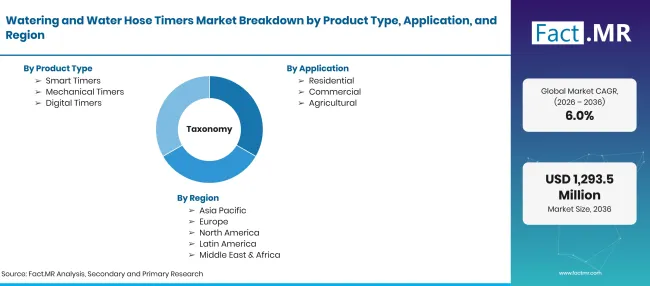
Watering And Water Hose Timers Market Taxonomy | Source: Fact.MR
| Coverage Field | Report Scope |
|---|---|
| Market definition | Timers that attach to a garden tap or hose line to start and stop watering automatically |
| Product types | Smart timers, mechanical timers and digital timers |
| Variants | Single and multi-outlet; Bluetooth and Wi-Fi; battery and solar-powered models |
| Ingredients included | Valve body, solenoid or mechanical valve, controller, display, wireless module and tap fittings |
| Packaging formats | Retail boxed single units, multi-zone kits and bundles with drip or sprinkler kits |
| Distribution channels | Online stores, supermarkets and hypermarkets, specialty and garden stores, others |
| End users | Homeowners, landscapers, farmers and others |
| Exclusions | In-ground irrigation controllers, separately sold solenoid valves, sprinklers, hoses and drip kits without a timer |
| Quantitative units | USD million for value; percentage for share and CAGR |
| Volume basis | Units of timers sold, counted once at first retail sale |
| Value basis | Retail selling price in the country of sale, constant 2026 USD |
| Regions covered | North America, Latin America, Europe, East Asia, South Asia and Pacific, Middle East and Africa |
| National coverage | United States, Germany, Japan, United Kingdom, Brazil, with the rest of the world as a residual |
| Companies covered | Orbit Irrigation Products, Rain Bird, Gardena, Hunter Industries, The Toro Company, Gilmour, Melnor, Claber, Hozelock |
Source: Fact.MR analysis. Updated Nov 13, 2026
Source: Fact.MR analysis of the watering and water hose timers market, 2026.
Frequently Asked Questions
How big is the watering and water hose timers market in 2026?
How fast is the watering and water hose timers market expected to grow through 2036?
Which product type leads the watering and water hose timers market?
Which application leads the watering and water hose timers market?
Which distribution channel leads the watering and water hose timers market?
Which country is the largest watering and water hose timers market?
Which country is expected to grow fastest in the watering and water hose timers market?
What limits growth in the watering and water hose timers market?
Who worked on this report


Preview the report firsthand - request a free sample
Free SampleGet the brochure for pricing and purchase details
Download PDF