Trail Camera Market Size, Share, Growth and Forecast (2026 - 2036)
The global Trail Camera Market is segmented by Product Type (Standard Trail Cameras, Wireless Trail Cameras), Pixel Size Flash Type, Trigger Speed, Application, with forecasts covering the period from 2026 to 2036.
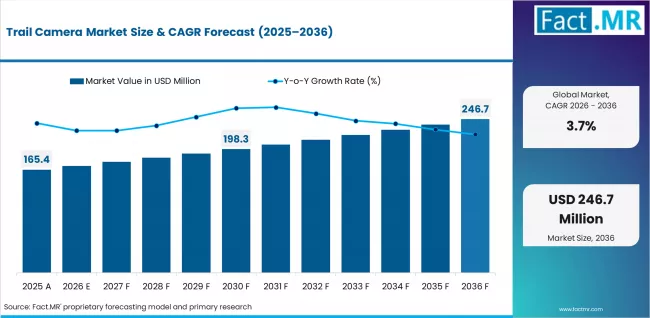
According to Fact.MR estimates, the Trail Camera market stood at USD 165.4 million in 2025. The market is projected to reach USD 170.7 million in 2026 and climb to USD 246.7 million by 2036, progressing at a CAGR of 3.7%. Low glow flash type is anticipated to account for nearly 52% share of the flash type segment, while hunting is expected to remain the leading application with around 56% share.
Trail Camera Market Overview, Growth Outlook and Forecast By Fact.MR
In 2025, the global Trail Camera Market was valued at approximately USD 165.4 million. The market is estimated to reach USD 170.7 million in 2026 and is projected to attain USD 246.7 million by 2036, expanding at a CAGR of 3.7% during the forecast period. The market is anticipated to create an absolute dollar opportunity of USD 74.8 million between 2026 and 2036.
Summary of Trail Camera Market
- Market Snapshot
- Global trail camera market revenue stood at USD 165.4 Mn in 2025 and is forecast to reach USD 246.7 Mn by 2036.
- At a 3.7% CAGR from 2026 to 2036, this market is set to expand ~1.5x in value, adding USD 76 Mn in absolute opportunity.
- Market growth is driven by increasing demand for wildlife monitoring, hunting surveillance, property security, and outdoor recreational imaging solutions. Rising adoption of motion-activated cameras with infrared night vision, wireless connectivity, and remote monitoring capabilities is significantly supporting market expansion.
- Growing interest in wildlife observation, conservation research, and smart outdoor surveillance systems is further accelerating demand for technologically advanced trail cameras across residential, commercial, and forestry applications.
- Demand and Growth Drivers
- The growing interest in hunting, camping, and other outdoor recreational activities is fueling the demand of trail cameras with superior imaging capabilities and trigger features.
- Research, habitat monitoring and conservation research with trail cameras is increasing in use by government agencies and environmental organizations.
- Increased demand in residential and utility applications is being supported by the increasing demand to monitor their property remotely, farm monitoring, and perimeter security.
- Innovations in technology like cellular connections, Wi-Fi, GPS tagging, HD video capture, and AI-based recognition of animals are enhancing the functionality of products and ease of use.
- Growing popularity of online sales and direct-to-consumer channels is enhancing accessibility and providing more penetration of the product across the globe.
- Product and Segment View
- Cellular trail cameras account for 39.6% of market share in 2026, emerging as the leading segment due to real-time image transmission capabilities
- Hunting applications account for 41.8% share in 2026, making them the dominant use case driven by growing outdoor activity participation
- Key segmentation includes:
- Product Type: Cellular, Wi-Fi-enabled, Standard trail cameras
- Application: Hunting, Wildlife monitoring, Security & surveillance, Others
- Distribution Channel: Online, Offline retail
- These systems enable:
- Motion-triggered image and video capture
- Remote monitoring via connected platforms
- Enhanced surveillance in inaccessible areas
- Geography and Competitive Outlook
- North America is the most promising regional market due to the good hunting culture, animal monitoring schemes as well as the need to engage in outdoor activities.
- Europe is experiencing stable demand due to wildlife observation and forestry management applications.
- Asia Pacific is becoming a growth area as outdoor recreation trends are growing as well as growing utilization in agricultural land monitoring.
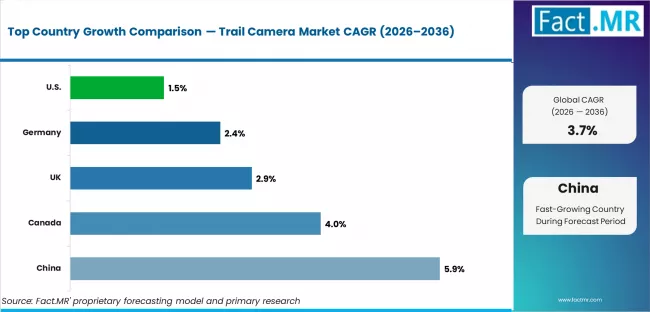
- China (5.9%) and Canada (4.0) are the key growth markets, and the United Kingdom, Germany, and the United States are still experiencing steady growth.
Some of the major players in this market are Browning Trail Cameras, Wildgame Innovations LLC, Vista Outdoor Inc., GG Telecom, Moultrie Mobile, Reconyx Inc., Stealth Cam, Primos Hunting, Covert Scouting Cameras and Tactacam.
Trail Camera Market — At a Glance
| Attribute | Details |
|---|---|
| Market Value 2025 | USD 165.4 Mn |
| Market Value 2036 | USD 246.7 Mn |
| Absolute Dollar Opportunity | USD 76 Mn |
| CAGR | 3.70% |
| Growth Multiple | 1.5x |
| Key Demand Theme | Increasing demand for wildlife monitoring and smart outdoor surveillance solutions |
| Leading Product Type | Standard Trail Cameras |
| Fastest Growing Product | Wireless / Cellular Trail Cameras |
| Leading Pixel Size | 8 to 12 MP |
| Preferred Flash Type | Low Glow |
| Key Application | Hunting |
| Key Growth Regions | North America, Europe, Asia Pacific |
| Key Companies | Browning Trail Cameras, Wildgame Innovations, Vista Outdoor, GG Telecom, Moultrie Mobile, Reconyx, Stealth Cam, Primos Hunting, Covert Scouting Cameras, Tactacam |
| Segmentation by Product Type | Standard, Wireless, Cellular, Wi-Fi |
| Segmentation by Pixel Size | <8 MP, 8 to 12 MP, >12 MP |
| Segmentation by Flash Type | White Flash, Low Glow, No Glow |
| Segmentation by Trigger Speed | Up to 0.25 Sec, 0.25 Sec to 0.75 Sec, Above 0.75 Sec |
| Segmentation by Application | Hunting, Wildlife Monitoring, Others (Residential, Utility, Commercial) |
| Segmentation by Sales Channel | Modern Trade Channels, Independent/Brick & Mortar Outlets, Direct to Customer, Third Party Online Channel |
| Segmentation by Region | North America, Latin America, Western Europe, Eastern Europe, East Asia, South Asia & Pacific, Middle East & Africa |
Growing utilization of trail cameras to hunt, observe wildlife and survey land throughout North America and Europe mainly supports market growth. Demand is also high amongst hunters, private landowners, forestry operators and outdoor users who need reliable remote monitoring solutions.
A move to wireless trail cameras, especially cellular and Wi-Fi enabled trail cameras is a major growth driver. These products have real time transmission of images, mobile connectivity, cloud storage integration and enhanced operational convenience, which means that replacement of the traditional models is high.
Growing application in wildlife studies, habitat surveys and conservation initiatives by government agencies, universities and environmental protection agencies are also benefiting the market. The growing attention to biodiversity measurement and anti-poaching monitoring is aiding both the new and mature markets.
The current technological developments such as the increase in image quality, the rate of triggering, the night vision of infrared, the ability of the solar-assisted power system, and adjustable motion detection by artificial intelligence are enhancing product performance and broadening the area of application. Moreover, the increasing popularity of trail cameras as a security solution in farms, monitoring rural property, and remote protection of assets is projected to create a long-lasting demand until 2036.
Segment-wise Analysis of the Trail Camera Market
Which Product Type Segment Dominates the Trail Camera Market?
Standard Trail Cameras Leading Installed Base, While Wireless Models Drive Future Revenue Growth
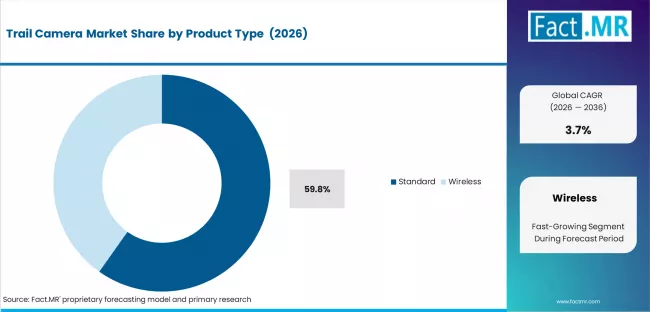
The Standard Trail Camera account for half of all train camera sales worldwide, and is estimated to constitute about 59.8% of the total market value in 2026. High base of installed conventional devices, lower initial cost, easy operation and continued use by entry-level hunters, landowners, and casual outdoor users are the main sources of support of this leadership. The standard models are still popular in price-sensitive markets where mobile connectivity is not a necessity.
The standard trail cameras are still enjoying wide applications in the hunting and farm fields, cabins, and simple wildlife observation areas where reliable image capture and battery economy are the main buying factors. Their low cost of ownership and extensive retail presence still contribute to their volume sales worldwide.
Nevertheless, there is also a structural change in the market towards Wireless Trail Cameras that is likely to grow to 56.4% market share in 2036, an increase compared to the 40.2% in 2026 and hence the fastest growing product segment. The increase in the cellular connectivity, remote alerts, app-based controls, and cloud storage is increasing the use of connected camera platforms.
With convenience, real-time monitoring, and minimized site visits becoming important to the user, wireless models will gain more premiums revenue within the forecast period. Although the standard cameras will remain as the leader in terms of scale in the near future, the wireless products are expected to be the main long-term growth driver of the market.
Which Application Segment Dominates the Trail Camera Market?
Wildlife Monitoring Emerging as the Largest Revenue Contributor Amid Expanding Conservation and Research Use Cases
Wildlife Monitoring is expected to be the dominant application segment in the world Trail Camera Market with a total market value of 40.7% in 2026. The rising demand is being propelled by the growing adoption of trail cameras in the biodiversity assessment, species population investigation, migration monitoring, forestry monitoring, and conservation projects in both developed and emerging markets.
Key Growth Drivers, Constraints, and Market Scope
Where is the Real Growth Coming From?
Wireless Connectivity, Wildlife Monitoring, and Multi-Use Surveillance Driving Trail Camera Demand
The major growth opportunity in the world Trail Camera Market lies in the trend towards replacing conventional stand-alone products with wireless trail cameras, especially cellular and Wi-Fi-enabled devices. These gadgets offer real-time image, remote access, mobile notification, and cloud-based data management, which enhance convenience in operations among users. Consequently, connected models with premium connectors are producing greater average selling prices and replacement demand acceleration among established user groups.
Regional Outlook Across Key Markets
The report on the global Trail Camera Market categorizes key regions, including South Asia & Pacific, Middle East & Africa, North America, Latin America, Western Europe, Eastern Europe, and East Asia. It provides geographic segmentation where market dynamics vary based on factors such as hunting participation rates, wildlife conservation activity, outdoor recreation culture, agricultural land monitoring demand, rural security needs, and adoption of wireless surveillance technologies.
The analysis further offers a comprehensive assessment of regional market attractiveness over the forecast period using parameters such as growth in connected trail camera adoption, expansion of biodiversity monitoring programs, outdoor retail penetration, mobile network availability for cellular models, and consumer spending on recreational equipment. Regional demand is also influenced by differences in income levels, land ownership patterns, regulatory frameworks related to hunting and wildlife management, and awareness of remote monitoring solutions, which collectively shape the growth trajectory of the global Trail Camera Market.
.webp)
| Country | CAGR (%) |
|---|---|
| China | 5.9% |
| Canada | 4.0% |
| UK | 2.9% |
| Germany | 2.4% |
| U.S. | 1.5% |
Source: Fact MR (FMR) analysis, based on proprietary forecasting model and primary research.
South Asia & Pacific
South Asia & Pacific is emerging as a high-growth region in the Trail Camera Market, supported by expanding agricultural land monitoring, biodiversity programs, and increasing adoption of affordable wireless surveillance solutions.
- India: India is projected to grow at a CAGR of 6.1%, driven by rising use of trail cameras in farm security, forest monitoring, and wildlife conservation initiatives.
- Southeast Asia & Australia: Demand is supported by wildlife research activity, ranch security, remote property surveillance, and growing outdoor recreation markets. Australia remains a notable contributor due to widespread use in wildlife observation and rural land management.
Middle East & Africa
The Middle East & Africa represents a developing, opportunity-driven market supported by growing demand for remote land surveillance, anti-poaching initiatives, and infrastructure asset monitoring.
- Growth is driven by increasing deployment in wildlife reserves, desert land monitoring, agricultural estates, and remote site protection.
- While the region currently holds a smaller share of global revenue, improving awareness and wider product availability are expected to support long-term adoption.
North America
North America remains the largest and most mature regional market, characterized by high hunting participation, established outdoor retail channels, and strong adoption of premium connected cameras.
- United States: The U.S. is expected to grow at a CAGR of 1.5%, reflecting a mature replacement-driven market supported by strong installed base and high consumer awareness.
- Canada: Canada is projected to grow at 4.0% CAGR, supported by wildlife monitoring demand, hunting usage, and remote land surveillance applications.
- The region continues to lead in adoption of cellular trail cameras, subscription-based connectivity models, and premium imaging technology.
Latin America
Latin America represents a moderate-growth market supported by agricultural expansion, ranch monitoring needs, and increasing demand for low-cost outdoor surveillance tools.
- Growth is driven by rising use across farms, private landholdings, and conservation reserves.
- Improving e-commerce access and expanding rural security requirements are expected to support gradual market development.
Europe
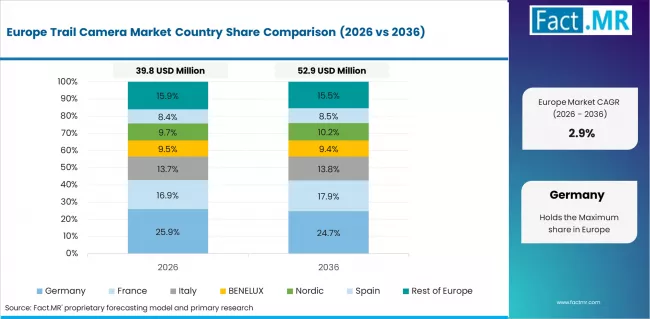
Europe is a stable and regulation-driven market, supported by wildlife management programs, environmental monitoring, and rural property security demand.
- United Kingdom: The UK is expected to grow at 2.9% CAGR, driven by conservation projects, estate monitoring, and recreational outdoor usage.
- Germany: Germany is projected to grow at 2.4% CAGR, supported by forest monitoring, wildlife research, and demand for high-quality imaging products.
- The region is witnessing increasing adoption of no-glow and connected cameras for discreet monitoring applications.
East Asia
East Asia is a strategically important region supported by electronics manufacturing strength and growing domestic demand for smart outdoor surveillance solutions.
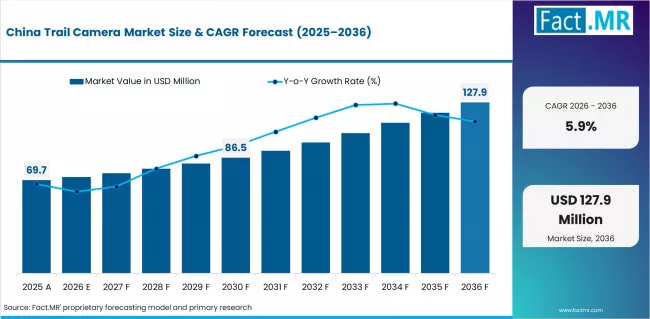
- China: China is projected to grow at a CAGR of 5.9%, making it one of the fastest-growing country-level markets globally. Growth is supported by rising domestic consumption, smart device adoption, and large-scale manufacturing capabilities.
- The region benefits from strong supply-chain integration, competitive pricing, and increasing use of trail cameras in agriculture and wildlife observation.
The Fact.MR's analysis covers the growth prospect of the Trail Camera Market in detail along with the various factors that are boosting and restraining the market, and the country-level contributions such as China (5. 9%), Canada (4.0%), United Kingdom (2.9%), Germany (2. 4%), United States (1.5%), others. The report examines factors such as hunting participation, wildlife conservation expenditures, rural land ownership, mobile connectivity penetration, e-commerce distribution, and wireless monitoring technology adoption by region.
Following long-term industry trends like increasing adoption of cellular trail cameras, expanded cloud-connected ecosystems, further use in wildlife monitoring, and additional applications in farm security, regional markets should continue to steadily developing. The study analyzes pricing trends, cost of components, battery technology, subscription revenue model and retail channel expansion that are anticipated to impact the future direction of the Trail Camera Market in key regions.
Competitive Benchmarking and Company Positioning
How Are Key Players Competing in the Trail Camera Market?
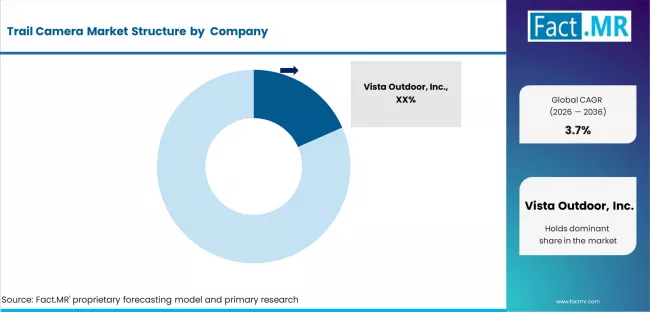
Major outdoor brands, connected camera specialists, and value-focused producers lead the global Trail Camera Market, such as Browning Trail Cameras, Wildgame Innovations LLC, Vista Outdoor, Inc. (Bushnell), GG Telecom (SPYPOINT), Moultrie Mobile, Reconyx, Inc., Stealth Cam, Primos Hunting, Covert Scouting Cameras, and Tactacam. The market also consists of local and private-label players, especially in the low-price categories.
Competition is somewhat fragmented with focus on quality of images, wireless capability, trigger speed, battery life, ruggedness, pricing and channel reach. Top players are diversifying their offerings in line with standard, cellular and Wi-Fi based connected camera models that cater to different consumer price ranges and application requirements.
Leading Companies Shaping the Trail Camera Market
- Browning Trail Cameras
- Wildgame Innovations LLC
- Vista Outdoor, Inc.
- GG Telecom
- Moultrie Mobile
- Reconyx, Inc
- Stealth Cam
- Primos Hunting
- Covert Scouting Cameras
- Tactacam
Research Methodology – Trail Camera Market
The evaluation of the Trail Camera Market is based on the application of a suitable methodology that includes detailed secondary research, multiple rounds of primary validation, and conservative quantitative modeling. More than 120 secondary sources were verified, including annual reports, product catalogs, customs databases, outdoor retail data, hunting association statistics, wildlife agency publications, and paid industry databases. More than 65 product portfolios at a company level were benchmarked alongside pricing references to understand category penetration in standard, cellular and wifi trail cameras. Historical data of the market from 2021 to 2025 has been studied to forecast baseline demand and to estimate the 2026 market value of USD 170.7 million.
Market sizing was developed using a demand-side model covering over 30 country-level markets across North America, Europe, East Asia, South Asia & Pacific, Latin America, and Middle East & Africa. Consumption patterns were assessed across key applications including hunting, wildlife monitoring, and rural security. Product demand was weighted using indicators such as hunting license volumes, protected forest area, agricultural land coverage, rural property ownership, e-commerce penetration, and mobile network availability for cellular devices. A parallel top-down model incorporated macroeconomic indicators such as consumer spending, outdoor recreation growth, and electronics adoption rates to validate regional demand estimates.
Fact.MR applied triangulation using supply-side variables including manufacturer shipments, ASP trends, retail channel mix, component pricing, and new product launch frequency. More than 40 pricing points were tracked across entry-level, mid-range, and premium camera categories to estimate average selling price movement. Wireless models were benchmarked separately to account for recurring revenue streams from data plans and cloud subscriptions. Forecast models also incorporated replacement cycles ranging from 3 to 5 years depending on product category and usage intensity.
Primary research included more than 25 detailed interviews with manufacturers, distributors, outdoor retailers, telecom partners, landowners, hunters, and wildlife monitoring professionals conducted during the study period. Approximately 35% of respondents represented manufacturers and distributors, 30% channel partners, and 35% end users and institutional buyers. These discussions were used to validate assumptions related to product demand, pricing elasticity, technology adoption, and regional sales outlook.
The final dataset was validated through multi-stage reconciliation of shipment estimates, retail sales patterns, import-export flows, and expert commentary. Sensitivity testing was conducted on key variables such as connectivity adoption, battery cost trends, seasonal demand concentration, and regional pricing dispersion. This methodology ensures a high-confidence market outlook, supporting strategic decisions related to investment, expansion, product positioning, and long-term growth in the global Trail Camera Market.
Sources and Research References
- Browning Trail Cameras introduced the Defender Vision Pro Live Stream cellular trail camera, expanding premium connected camera offerings with real-time remote monitoring capabilities. [1]
- Tactacam launched the REVEAL Premier Cellular Trail Camera and power accessories, strengthening its connected outdoor monitoring portfolio and expanding cellular trail camera offerings. [2]
- Tactacam announced the new Ultra Camera launch, enhancing its REVEAL product family with upgraded imaging and field monitoring features. [3]
- Browning Trail Cameras continued expansion of its Browning Defender series, reinforcing its position in the wireless trail camera segment with connected monitoring solutions. [4]
- SPYPOINT (GG Telecom) launched the FLEX-RANGE hybrid cellular and satellite trail camera, expanding monitoring capabilities in remote low-signal environments. [5]
Key Questions This Report Addresses
- How big is the opportunity?
- Where is the growth coming from?
- Which segments matter the most?
- What is shaping the market trajectory?
- Who controls the market today?
- Where are the untapped opportunities?
- How should you compete and win?
Trail Camera Market Definition
Trail cameras are self-contained, weatherproof shooting solutions equipped with movement and heat sensors to take pictures or videos of outdoor activity. These are commonly employed in remote surveillance in places where 24/7 human supervision or traditional wired surveillance is not viable. Trail cameras allow one to monitor wildlife movement, protect land property and gather field information with minimal operation interference.
There is a wide variety of products in the Trail Camera Market, both standard trail cameras and wireless trail cameras that may be cellular or Wi-Fi enabled. Products are differentiated in terms of image resolution, flash technology, speed at triggering, battery life, storage space, and connectivity products. Flash configurations are usually white flash, low glow and no glow systems where the user can choose how much he/she wants to see and how he/she wants to perform at night depending on application needs.
These devices are produced to provide quality monitoring under extreme weather conditions in the outdoor setting, long-lasting applications using energy-saving system, solar charging capability, tough casing, and IR night vision. Trail cameras are increasingly becoming smarter and connected as they integrate mobile applications, cloud storage, GPS tagging, and AI-assisted motion detection to enhance usability and real-time decision-making.
The market has a very diverse group of end users with hunters, wildlife researchers, forestry agencies, farmers, ranch operators, private landowners, and commercial property managers. Hunting and wildlife surveillance are still key applications, and it is being used in farm security, rural surveillance, utility monitoring and remote infrastructure protection. The institutional demand is also growing in terms of biodiversity research, conservation activities and anti-poaching campaigns.
The Trail Camera Market is a mix of international brands, local producers, and electronics dealers that compete based on product innovation, imaging quality, connectivity performance, and pricing policy. With the increase in demand of intelligent outdoor surveillance, trail cameras are no longer viewed as passive means of recording but as a field intelligence tool that is connected and capable of providing long term security, environmental control, and visibility of remote assets.
Trail Camera Market Inclusions
The report covers global and regional market size estimates and forecasts for the Trail Camera Market from 2026 to 2036, including:
- Segment Analysis: Based on Product Type (Standard Trail Cameras, Wireless Trail Cameras (Cellular Trail Cameras, Wi-Fi Trail Cameras)), Pixel Size (<8 MP, 8 to 12 MP, >12 MP), Flash Type (White Flash, Low Glow, No Glow), Trigger Speed (Up to 0.25 Sec, 0.25 Sec to 0.75 Sec, Above 0.75 Sec), Application (Hunting, Wildlife Monitoring, Others (Residential Security, Utility Monitoring, Commercial Surveillance)), Sales Channel (Modern Trade Channels, Independent/Brick and Mortar Outlets, Direct to Customer, Third Party Online Channel), and Region (North America, Latin America, Western Europe, Eastern Europe, East Asia, South Asia & Pacific, Middle East & Africa).
- Regional Play: Analysis of demand variations across North America, Western Europe, Eastern Europe, East Asia, South Asia & Pacific, Latin America, and Middle East & Africa, considering factors such as hunting participation rates, wildlife conservation spending, outdoor recreation trends, agricultural land monitoring needs, rural security demand, and adoption of wireless monitoring technologies across developed and emerging markets.
- Pricing and Cost Analysis: Assessment of pricing trends across entry-level, mid-range, and premium trail camera categories, including cost components such as imaging sensors, batteries, wireless modules, infrared flash systems, storage hardware, and rugged housing materials. The report also evaluates pricing differences between standard and connected models, along with recurring costs associated with cellular data plans and cloud storage subscriptions.
- Technology and Innovation Landscape: Insights into advancements in cellular connectivity, Wi-Fi integration, AI-enabled motion detection, high-resolution imaging, infrared night vision, solar charging systems, cloud storage platforms, and mobile app-based camera management. The report highlights the increasing role of connected ecosystems in improving remote monitoring efficiency and user convenience.
- Market Trends and Dynamics: Analysis of key growth drivers and opportunities, including rising demand for hunting surveillance equipment, increasing deployment in wildlife monitoring and conservation programs, growing use in farm and rural property security, and transition toward smart connected cameras. The section also evaluates challenges such as battery dependency, network coverage limitations, pricing pressure from low-cost imports, and seasonal sales concentration.
- Competitive Landscape: Coverage of key market participants such as Browning Trail Cameras, Wildgame Innovations LLC, Vista Outdoor, Inc. (Bushnell), GG Telecom (SPYPOINT), Moultrie Mobile, Reconyx, Inc., Stealth Cam, Primos Hunting, Covert Scouting Cameras, and Tactacam, with insights into product portfolios, geographic presence, pricing strategies, connectivity ecosystems, and distribution expansion initiatives.
Trail Camera Market Exclusions
The scope excludes:
- General-purpose consumer cameras and home security cameras: These are regular CCTV cameras, smart doorbells, action cameras, dash cams, home surveillance cameras that are not purposely designed to be trail cameras but still can be used as such in autonomous outdoor motion sensing applications.
- Professional wildlife filming and broadcasting equipment: Cinema cameras, documentary filming systems, drones, and stationary professional imaging equipment employed to create wildlife media are excluded unless packaged as trail camera systems.
- Software-based solutions and mobile applications: Image management applications, cloud storage solutions or analytics software, or AI recognition software sold independently from any trail camera hardware, are not included.
- Industrial surveillance & enterprise security solutions: Industrial CCTV systems, access control systems, and commercial security systems are not offered unless they can be delivered specifically as trail camera based secure remote monitoring system solutions.
- Professional military and defense equipment for field surveillance: Tactical reconnaissance cameras, border surveillance systems and special defense systems etc.
- Military and defense-grade field surveillance equipment: Tactical reconnaissance cameras, border monitoring systems, and specialized defense surveillance devices are excluded from the scope.
- In-house custom-built monitoring systems: Proprietary or self-assembled camera systems developed internally by farms, research institutions, or landowners without commercial market sales are excluded, except for benchmarking purposes.
- Low-scale informal and unbranded products: Unorganized local products lacking standardized specifications, measurable sales channels, or reliable commercial data are excluded where comparability and market visibility are insufficient.
- Rental, leasing, and short-term equipment services: Temporary camera rental programs or field equipment leasing services are not considered unless accompanied by direct hardware sales recognized within the trail camera market.
- Non-outdoor recreational imaging devices: Binocular cameras, spotting scopes with recording functions, and handheld wildlife photography devices are excluded, as the scope focuses on fixed-position, motion-activated trail camera systems.
Analysis by Product Type, Pixel Size, Flash Type, Trigger Speed, Applications, Sales Channel and Region
-
By Product Type:
- Standard
- Wireless
- Cellular
- Wi-Fi
-
By Pixel Size:
- Below 8 MP
- 8 MP to 12 MP
- Above 12 MP
-
By Flash Type:
- White Flash
- Low Glow
- No Glow
-
By Trigger Speed:
- Up to 0.25 Sec
- 0.25 Sec to 0.75 Sec
- Above 0.75 Sec
-
By Applications:
- Hunting
- Wildlife Monitoring
- Others (Residential, Utility, Commercial)
-
By Sales Channel:
- Modern Trade Channels
- Independent / Brick and Mortar Outlets
- Direct to Customer
- Third Party Online Channel
-
Region:
- North America
- United States
- Canada
- Mexico
- Latin America
- Brazil
- Chile
- Rest of Latin America
- Western Europe
- Germany
- Italy
- France
- United Kingdom
- Spain
- BENELUX
- Nordic Countries
- Rest of Western Europe
- Eastern Europe
- Russia
- Hungary
- Poland
- Balkan & Baltic Countries
- Rest of Eastern Europ
- East Asia
- China
- Japan
- South Korea
- South Asia & Pacific
- India
- ASEAN
- Australia & New Zealand
- Rest of South Asia
- Middle East & Africa
- Kingdom of Saudi Arabia
- Other GCC Countries
- Türkiye
- South Africa
- Rest of Africa
- Rest of Middle East & Africa
- North America
- Frequently Asked Questions -
What is the current size of the global Trail Camera Market?
The global Trail Camera Market is valued at approximately USD 165.4 million in 2025, supported by growing demand for hunting surveillance equipment, wildlife monitoring systems, and rural property security solutions.
How large will the market be by 2036?
The market is projected to reach around USD 246.7 million by 2036, reflecting steady expansion driven by wireless camera adoption, conservation deployments, and increasing use in farm and land monitoring applications.
What is the expected growth rate of the market?
The global Trail Camera Market is expected to grow at a CAGR of approximately 3.7% from 2026 to 2036, indicating stable long-term growth supported by product innovation and connected monitoring demand.
Which application segment is leading the market?
Wildlife Monitoring is the leading application segment, driven by increasing deployment across biodiversity research, habitat observation, anti-poaching programs, and conservation initiatives globally.
Who are the major industry participants?
Key companies operating in the market include: • Browning Trail Cameras • Wildgame Innovations LLC • Vista Outdoor, Inc. (Bushnell) • GG Telecom (SPYPOINT) • Moultrie Mobile • Reconyx, Inc. • Stealth Cam • Tactacam
Which region is expected to show the highest growth rate in the market?
East Asia and South Asia & Pacific are expected to exhibit the highest growth rates, supported by rising agricultural monitoring demand, expanding wildlife programs, and increasing adoption of smart surveillance technologies.
How strong is the growth outlook for China?
China is expected to witness strong growth at a CAGR of 5.9%, driven by domestic demand expansion, competitive manufacturing capabilities, and rising use of smart outdoor monitoring devices.
What is the growth outlook for Canada in this market?
Canada is projected to grow at a CAGR of 4.0%, supported by strong hunting participation, wildlife management activity, and increasing use of trail cameras across remote land areas.
What is the growth outlook for the United States in this market?
The United States represents the largest and most mature market, characterized by high hunting participation, strong outdoor retail networks, and early adoption of premium cellular trail cameras.
Which European markets are highlighted in this analysis?
The United Kingdom and Germany are key European markets, supported by wildlife conservation activity, forest monitoring demand, and growing adoption of connected trail camera systems.
Table of Content
- Trail Camera Market - Executive Summary
- Market Overview
- Market Definition and Introduction
- Market Taxonomy/ Research Scope
- Global Trail Camera Market Demand Analysis 2021-2025 and Forecast, 2026–2036
- Historical Market Volume Analysis, 2021-2025
- Current and Future Market Volume Forecast, 2026–2036
- Y-o-Y Growth Trend Analysis
- Global Trail Camera Market - Pricing Analysis
- Product Category and Country-Level Pricing Analysis
- Global Average Pricing Analysis Benchmark
- Factors Influencing Pricing
- Cost Structure Analysis: Elementary Deep Dive
- Competitive Pricing Strategies
- Price Trends and Forecasts
- Historical price trends
- Future price forecasts
- Global Trail Camera Market Demand Analysis 2021-2025 and Forecast, 2026–2036
- Historical Market Value Analysis, 2021-2025
- Current and Future Market Value Forecast, 2026–2036
- Y-o-Y Growth Trend Analysis
- Absolute $ Opportunity Analysis
- Market Background and Foundation Data
- Global Outdoor Surveillance Camera Market Overview, 2025
- By Product Type
- By Connectivity Type
- By Application
- By Region
- Penetration of Trail Cameras in Global Outdoor Surveillance Camera Market, 2025
- Evolution of Trail Cameras (Conventional → Wireless → Smart Connected)
- Stage 1: Film / Basic Motion Trigger Cameras
- Stage 2: Digital SD Card Trail Cameras
- Stage 3: Cellular / Wi-Fi Trail Cameras
- Stage 4: AI-Enabled / Smart Connected Trail Cameras
- Consumer Adoption and Usage Trends
- Share of Hunting vs Non-Hunting Users
- Adoption of Cellular vs Non-Cellular Cameras
- Consumer Preference for Multi-Camera Setups
- % of Rural Landowners Using Remote Monitoring Cameras
- Outdoor Recreation and Land Monitoring Trends
- Growth in Hunting Participation and Licensing
- Rise in Wildlife Observation and Conservation Programs
- Expansion of Farm Security and Rural Surveillance Use Cases
- Increasing Demand for Remote Asset Monitoring
- Trail Camera Market Opportunity Assessment
- Total Available Market (US$ Mn)
- Serviceable Addressable Market (US$ Mn)
- Serviceable Obtainable Market (US$ Mn)
- Technology and Connectivity Landscape
- Penetration of Cellular Trail Cameras
- Wi-Fi / Bluetooth Enabled Camera Adoption
- Growth in Solar-Powered Trail Cameras
- Mobile App and Cloud Storage Integration Trends
- Retail and Distribution Foundation Analysis
- Share of Online vs Offline Sales
- Growth of Direct-to-Consumer Channels
- Specialty Outdoor Retailer Importance
- Seasonal Demand Trends by Channel
- Porter’s Five Forces and PESTEL Analysis
- Investment Feasibility Analysis
- Macro-Economic Factors
- Forecast Factors - Relevance & Impact
- Industry Value and Supply Chain Analysis
- List of Key Channel Partners
- Profit Margin & Operating Margin at Each Node of Supply Chain.
- Notes on Value Added at Each Node in the Value Chain
- Factors Influencing Value Chain
- Market Dynamics
- Drivers
- Restraints
- Opportunity Analysis
- Key Regulations & Certifications
- Global Outdoor Surveillance Camera Market Overview, 2025
- Global Trail Camera Market Analysis 2021-2025 and Forecast 2026–2036, By Product Type
- Introduction / Key Findings
- Market Size & Volume Analysis by Market Taxonomy, 2021–2036
- Standard
- Wireless
- Cellular
- Wi-Fi
- Market Attractiveness Analysis by Product Type
- Global Trail Camera Market Analysis 2021-2025 and Forecast 2026–2036, By Pixel Size
- Introduction / Key Findings
- Market Size & Volume Analysis by Market Taxonomy, 2021–2036
- <8 MP
- 8 to 12 MP
- >12 MP
- Market Attractiveness Analysis by Pixel Size
- Global Trail Camera Market Analysis 2021-2025 and Forecast 2026–2036, By Flash Type
- Introduction / Key Findings
- Market Size & Volume Analysis by Market Taxonomy, 2021–2036
- White Flash
- Low Glow
- No Glow
- Market Attractiveness Analysis by Flash Type
- Global Trail Camera Market Analysis 2021-2025 and Forecast 2026–2036, By Trigger Speed
- Introduction / Key Findings
- Market Size & Volume Analysis by Market Taxonomy, 2021–2036
- upto 0.25 Sec
- 0.25 Sec to 0.75 Sec
- Above 0.75 Sec
- Market Attractiveness Analysis by Trigger Speed
- Global Trail Camera Market Analysis 2021-2025 and Forecast 2026–2036, By Applications
- Introduction / Key Findings
- Market Size & Volume Analysis by Market Taxonomy, 2021–2036
- Hunting
- Wildlife Monitoring
- Others (Residential, Utility, Commercial)
- Market Attractiveness Analysis by Applications
- Global Trail Camera Market Analysis 2021-2025 and Forecast 2026–2036, By Sales Channel
- Introduction / Key Findings
- Market Size & Volume Analysis by Market Taxonomy, 2021–2036
- Modern Trade Channels
- Independent/Brick and Mortar Outlets
- Direct to customer
- Third Party Online Channel
- Market Attractiveness Analysis by Sales Channel
- Global Trail Camera Market Analysis and Forecast, by Region
- Introduction / Key Findings
- Market Size & Volume Analysis by Market Taxonomy, 2021–2036
- North America
- Latin America
- Western Europe
- Eastern Europe
- East Asia
- South Asia & Pacific
- Middle East & Africa
- Market Attractiveness Analysis by Region
- North America Trail Camera Market Analysis and Forecast
- Market Size & Volume Analysis by Market Taxonomy, 2021–2036
- By Country
- United States
- Canada
- Mexico
- By Taxonomy
- By Product Type
- By Pixel Size
- By Flash Type
- By Trigger Speed
- By Applications
- By Sales Channel
- By Country
- Market Attractiveness Analysis by Country & Taxonomy
- Market Size & Volume Analysis by Market Taxonomy, 2021–2036
- Latin America Trail Camera Market Analysis and Forecast
- Market Size & Volume Analysis by Market Taxonomy, 2021–2036
- By Country
- Brazil
- Chile
- Rest of LATAM
- By Taxonomy
- By Product Type
- By Pixel Size
- By Flash Type
- By Trigger Speed
- By Applications
- By Sales Channel
- By Country
- Market Attractiveness Analysis by Country & Taxonomy
- Market Size & Volume Analysis by Market Taxonomy, 2021–2036
- Western Europe Trail Camera Market Analysis and Forecast
- Market Size & Volume Analysis by Market Taxonomy, 2021–2036
- By Country
- Germany
- Italy
- France
- United Kingdom
- Spain
- BENELUX
- Nordics
- Rest of Western Europe
- By Taxonomy
- By Product Type
- By Pixel Size
- By Flash Type
- By Trigger Speed
- By Applications
- By Sales Channel
- By Country
- Market Attractiveness Analysis by Country & Taxonomy
- Market Size & Volume Analysis by Market Taxonomy, 2021–2036
- Eastern Europe Trail Camera Market Analysis and Forecast
- Market Size & Volume Analysis by Market Taxonomy, 2021–2036
- By Country
- Russia
- Hungary
- Poland
- Balkan & Baltics
- Rest of Eastern Europe
- By Taxonomy
- By Product Type
- By Pixel Size
- By Flash Type
- By Trigger Speed
- By Applications
- By Sales Channel
- By Country
- Market Attractiveness Analysis by Country & Taxonomy
- Market Size & Volume Analysis by Market Taxonomy, 2021–2036
- East Asia Trail Camera Market Analysis and Forecast
- Market Size & Volume Analysis by Market Taxonomy, 2021–2036
- By Country
- China
- Japan
- South Korea
- By Taxonomy
- By Product Type
- By Pixel Size
- By Flash Type
- By Trigger Speed
- By Applications
- By Sales Channel
- By Country
- Market Attractiveness Analysis by Country & Taxonomy
- Market Size & Volume Analysis by Market Taxonomy, 2021–2036
- South Asia & Pacific Trail Camera Market Analysis and Forecast
- Market Size & Volume Analysis by Market Taxonomy, 2021–2036
- By Country
- India
- ASEAN
- Australia & New Zealand
- Rest of South Asia & Pacific
- By Taxonomy
- By Product Type
- By Pixel Size
- By Flash Type
- By Trigger Speed
- By Applications
- By Sales Channel
- By Country
- Market Attractiveness Analysis by Country & Taxonomy
- Market Size & Volume Analysis by Market Taxonomy, 2021–2036
- Middle East & Africa Trail Camera Market Analysis and Forecast
- Market Size & Volume Analysis by Market Taxonomy, 2021–2036
- By Country
- Kingdom of Saudi Arabia
- Other GCC Countries
- Turkiye
- South Africa
- Other African Union
- By Taxonomy
- By Product Type
- By Pixel Size
- By Flash Type
- By Trigger Speed
- By Applications
- By Sales Channel
- By Country
- Market Attractiveness Analysis by Country & Taxonomy
- Market Size & Volume Analysis by Market Taxonomy, 2021–2036
- Country-level Trail Camera Market Analysis and Forecast
- Introduction
- Market Value Proportion Analysis, By Key Countries
- Global Vs. Country Growth Comparison
- United States Trail Camera Market Analysis
- Market Size & Volume Analysis by Market Taxonomy, 2021–2036
- By Product Type
- By Pixel Size
- By Flash Type
- By Trigger Speed
- By Applications
- By Sales Channel
- Market Size & Volume Analysis by Market Taxonomy, 2021–2036
- *Same Analysis will be providing for each of the countries mentioned below
- Canada Trail Camera Market Analysis
- Mexico Trail Camera Market Analysis
- Brazil Trail Camera Market Analysis
- Chile Trail Camera Market Analysis
- Germany Trail Camera Market Analysis
- France Trail Camera Market Analysis
- Italy Trail Camera Market Analysis
- Spain Trail Camera Market Analysis
- United Kingdom Trail Camera Market Analysis
- BENELUX Trail Camera Market Analysis
- Nordics Trail Camera Market Analysis
- Poland Trail Camera Market Analysis
- Russia Trail Camera Market Analysis
- Hungary Trail Camera Market Analysis
- Balkan & Baltics Trail Camera Market Analysis
- China Trail Camera Market Analysis
- Japan Trail Camera Market Analysis
- South Korea Trail Camera Market Analysis
- India Trail Camera Market Analysis
- ASEAN Trail Camera Market Analysis
- ANZ Trail Camera Market Analysis
- KSA Trail Camera Market Analysis
- Other GCC Countries Trail Camera Market Analysis
- South Africa Trail Camera Market Analysis
- Turkiye Trail Camera Market Analysis
- Introduction
- Trail Camera Market Structure Analysis
- Market Analysis by Tier of Companies
- Market Share Analysis of Top Players
- Market Space for New Brands and Dollar Opportunity
- Market Presence Analysis
- Regional Footprint of Players
- Product Footprint by Players
- Application Footprint by Players
- Trail Camera Competition Analysis
- Competition Dashboard
- Pricing Analysis by Competition
- Competition Benchmarking
- Competition Deep Dive
- Browning Trail Cameras
- Overview
- Product Portfolio
- Sales Footprint
- Key Developments
- SWOT Analysis
- Strategy Overview
- Key Financials
- Wildgame Innovations LLC
- Vista Outdoor, Inc.
- GG Telecom
- Moultrie Mobile
- Reconyx, Inc
- Stealth Cam
- Primos Hunting
- Covert Scouting Cameras
- Tactacam
- Other Prominent Players
- Browning Trail Cameras
- Primary Insights
- Assumption & Acronyms Used
- Research Methodology & Data Sources
List Of Table
- Table 1: Global Market Value (USD Mn) Forecast by Region, 2021 to 2036
- Table 2: Global Market Volume (Units) Forecast by Region, 2021 to 2036
- Table 3: Global Market Value (USD Mn) Forecast by Product Type,2021 to 2036
- Table 4: Global Market Volume (Units) Forecast by Product Type,2021 to 2036
- Table 5: Global Market Value (USD Mn) Forecast by Pixel Size, 2021 to 2036
- Table 6: Global Market Volume (Units) Forecast by Pixel Size, 2021 to 2036
- Table 7: Global Market Value (USD Mn) Forecast by Flash Type, 2021 to 2036
- Table 8: Global Market Volume (Units) Forecast by Flash Type, 2021 to 2036
- Table 9: Global Market Value (USD Mn) Forecast by Trigger Speed, 2021 to 2036
- Table 10: Global Market Volume (Units) Forecast by Trigger Speed, 2021 to 2036
- Table 11: Global Market Value (USD Mn) Forecast by Applications, 2021 to 2036
- Table 12: Global Market Volume (Units) Forecast by Applications, 2021 to 2036
- Table 13: Global Market Value (USD Mn) Forecast by Sales Channel, 2021 to 2036
- Table 14: Global Market Volume (Units) Forecast by Sales Channel, 2021 to 2036
- Table 15: North America Market Value (USD Mn) Forecast by Country, 2021 to 2036
- Table 16: North America Market Volume (Units) Forecast by Country, 2021 to 2036
- Table 17: North America Market Value (USD Mn) Forecast by Product Type,2021 to 2036
- Table 18: North America Market Volume (Units) Forecast by Product Type,2021 to 2036
- Table 19: North America Market Value (USD Mn) Forecast by Pixel Size, 2021 to 2036
- Table 20: North America Market Volume (Units) Forecast by Pixel Size, 2021 to 2036
- Table 21: North America Market Value (USD Mn) Forecast by Flash Type, 2021 to 2036
- Table 22: North America Market Volume (Units) Forecast by Flash Type, 2021 to 2036
- Table 23: North America Market Value (USD Mn) Forecast by Trigger Speed, 2021 to 2036
- Table 24: North America Market Volume (Units) Forecast by Trigger Speed, 2021 to 2036
- Table 25: North America Market Value (USD Mn) Forecast by Applications, 2021 to 2036
- Table 26: North America Market Volume (Units) Forecast by Applications, 2021 to 2036
- Table 27: North America Market Value (USD Mn) Forecast by Sales Channel, 2021 to 2036
- Table 28: North America Market Volume (Units) Forecast by Sales Channel, 2021 to 2036
- Table 29: Latin America Market Value (USD Mn) Forecast by Country, 2021 to 2036
- Table 30: Latin America Market Volume (Units) Forecast by Country, 2021 to 2036
- Table 31: Latin America Market Value (USD Mn) Forecast by Product Type,2021 to 2036
- Table 32: Latin America Market Volume (Units) Forecast by Product Type,2021 to 2036
- Table 33: Latin America Market Value (USD Mn) Forecast by Pixel Size, 2021 to 2036
- Table 34: Latin America Market Volume (Units) Forecast by Pixel Size, 2021 to 2036
- Table 35: Latin America Market Value (USD Mn) Forecast by Flash Type, 2021 to 2036
- Table 36: Latin America Market Volume (Units) Forecast by Flash Type, 2021 to 2036
- Table 37: Latin America Market Value (USD Mn) Forecast by Trigger Speed, 2021 to 2036
- Table 38: Latin America Market Volume (Units) Forecast by Trigger Speed, 2021 to 2036
- Table 39: Latin America Market Value (USD Mn) Forecast by Applications, 2021 to 2036
- Table 40: Latin America Market Volume (Units) Forecast by Applications, 2021 to 2036
- Table 41: Latin America Market Value (USD Mn) Forecast by Sales Channel, 2021 to 2036
- Table 42: Latin America Market Volume (Units) Forecast by Sales Channel, 2021 to 2036
- Table 43: Western Europe Market Value (USD Mn) Forecast by Country, 2021 to 2036
- Table 44: Western Europe Market Volume (Units) Forecast by Country, 2021 to 2036
- Table 45: Western Europe Market Value (USD Mn) Forecast by Product Type,2021 to 2036
- Table 46: Western Europe Market Volume (Units) Forecast by Product Type,2021 to 2036
- Table 47: Western Europe Market Value (USD Mn) Forecast by Pixel Size, 2021 to 2036
- Table 48: Western Europe Market Volume (Units) Forecast by Pixel Size, 2021 to 2036
- Table 49: Western Europe Market Value (USD Mn) Forecast by Flash Type, 2021 to 2036
- Table 50: Western Europe Market Volume (Units) Forecast by Flash Type, 2021 to 2036
- Table 51: Western Europe Market Value (USD Mn) Forecast by Trigger Speed, 2021 to 2036
- Table 52: Western Europe Market Volume (Units) Forecast by Trigger Speed, 2021 to 2036
- Table 53: Western Europe Market Value (USD Mn) Forecast by Applications, 2021 to 2036
- Table 54: Western Europe Market Volume (Units) Forecast by Applications, 2021 to 2036
- Table 55: Western Europe Market Value (USD Mn) Forecast by Sales Channel, 2021 to 2036
- Table 56: Western Europe Market Volume (Units) Forecast by Sales Channel, 2021 to 2036
- Table 57: Eastern Europe Market Value (USD Mn) Forecast by Country, 2021 to 2036
- Table 58: Eastern Europe Market Volume (Units) Forecast by Country, 2021 to 2036
- Table 59: Eastern Europe Market Value (USD Mn) Forecast by Product Type,2021 to 2036
- Table 60: Eastern Europe Market Volume (Units) Forecast by Product Type,2021 to 2036
- Table 61: Eastern Europe Market Value (USD Mn) Forecast by Pixel Size, 2021 to 2036
- Table 62: Eastern Europe Market Volume (Units) Forecast by Pixel Size, 2021 to 2036
- Table 63: Eastern Europe Market Value (USD Mn) Forecast by Flash Type, 2021 to 2036
- Table 64: Eastern Europe Market Volume (Units) Forecast by Flash Type, 2021 to 2036
- Table 65: Eastern Europe Market Value (USD Mn) Forecast by Trigger Speed, 2021 to 2036
- Table 66: Eastern Europe Market Volume (Units) Forecast by Trigger Speed, 2021 to 2036
- Table 67: Eastern Europe Market Value (USD Mn) Forecast by Applications, 2021 to 2036
- Table 68: Eastern Europe Market Volume (Units) Forecast by Applications, 2021 to 2036
- Table 69: Eastern Europe Market Value (USD Mn) Forecast by Sales Channel, 2021 to 2036
- Table 70: Eastern Europe Market Volume (Units) Forecast by Sales Channel, 2021 to 2036
- Table 71: East Asia Market Value (USD Mn) Forecast by Country, 2021 to 2036
- Table 72: East Asia Market Volume (Units) Forecast by Country, 2021 to 2036
- Table 73: East Asia Market Value (USD Mn) Forecast by Product Type,2021 to 2036
- Table 74: East Asia Market Volume (Units) Forecast by Product Type,2021 to 2036
- Table 75: East Asia Market Value (USD Mn) Forecast by Pixel Size, 2021 to 2036
- Table 76: East Asia Market Volume (Units) Forecast by Pixel Size, 2021 to 2036
- Table 77: East Asia Market Value (USD Mn) Forecast by Flash Type, 2021 to 2036
- Table 78: East Asia Market Volume (Units) Forecast by Flash Type, 2021 to 2036
- Table 79: East Asia Market Value (USD Mn) Forecast by Trigger Speed, 2021 to 2036
- Table 80: East Asia Market Volume (Units) Forecast by Trigger Speed, 2021 to 2036
- Table 81: East Asia Market Value (USD Mn) Forecast by Applications, 2021 to 2036
- Table 82: East Asia Market Volume (Units) Forecast by Applications, 2021 to 2036
- Table 83: East Asia Market Value (USD Mn) Forecast by Sales Channel, 2021 to 2036
- Table 84: East Asia Market Volume (Units) Forecast by Sales Channel, 2021 to 2036
- Table 85: South Asia and Pacific Market Value (USD Mn) Forecast by Country, 2021 to 2036
- Table 86: South Asia and Pacific Market Volume (Units) Forecast by Country, 2021 to 2036
- Table 87: South Asia and Pacific Market Value (USD Mn) Forecast by Product Type,2021 to 2036
- Table 88: South Asia and Pacific Market Volume (Units) Forecast by Product Type,2021 to 2036
- Table 89: South Asia and Pacific Market Value (USD Mn) Forecast by Pixel Size, 2021 to 2036
- Table 90: South Asia and Pacific Market Volume (Units) Forecast by Pixel Size, 2021 to 2036
- Table 91: South Asia and Pacific Market Value (USD Mn) Forecast by Flash Type, 2021 to 2036
- Table 92: South Asia and Pacific Market Volume (Units) Forecast by Flash Type, 2021 to 2036
- Table 93: South Asia and Pacific Market Value (USD Mn) Forecast by Trigger Speed, 2021 to 2036
- Table 94: South Asia and Pacific Market Volume (Units) Forecast by Trigger Speed, 2021 to 2036
- Table 95: South Asia and Pacific Market Value (USD Mn) Forecast by Applications, 2021 to 2036
- Table 96: South Asia and Pacific Market Volume (Units) Forecast by Applications, 2021 to 2036
- Table 97: South Asia and Pacific Market Value (USD Mn) Forecast by Sales Channel, 2021 to 2036
- Table 98: South Asia and Pacific Market Volume (Units) Forecast by Sales Channel, 2021 to 2036
- Table 99: Middle East & Africa Market Value (USD Mn) Forecast by Country, 2021 to 2036
- Table 100: Middle East & Africa Market Volume (Units) Forecast by Country, 2021 to 2036
- Table 101: Middle East & Africa Market Value (USD Mn) Forecast by Product Type,2021 to 2036
- Table 102: Middle East & Africa Market Volume (Units) Forecast by Product Type,2021 to 2036
- Table 103: Middle East & Africa Market Value (USD Mn) Forecast by Pixel Size, 2021 to 2036
- Table 104: Middle East & Africa Market Volume (Units) Forecast by Pixel Size, 2021 to 2036
- Table 105: Middle East & Africa Market Value (USD Mn) Forecast by Flash Type, 2021 to 2036
- Table 106: Middle East & Africa Market Volume (Units) Forecast by Flash Type, 2021 to 2036
- Table 107: Middle East & Africa Market Value (USD Mn) Forecast by Trigger Speed, 2021 to 2036
- Table 108: Middle East & Africa Market Volume (Units) Forecast by Trigger Speed, 2021 to 2036
- Table 109: Middle East & Africa Market Value (USD Mn) Forecast by Applications, 2021 to 2036
- Table 110: Middle East & Africa Market Volume (Units) Forecast by Applications, 2021 to 2036
- Table 111: Middle East & Africa Market Value (USD Mn) Forecast by Sales Channel, 2021 to 2036
- Table 112: Middle East & Africa Market Volume (Units) Forecast by Sales Channel, 2021 to 2036
List Of Figures
- Figure 1: Global Market Volume (Units) Forecast 2021–2036
- Figure 2: Global Market Pricing Analysis
- Figure 3: Global Market Value (USD Mn) Forecast 2021–2036
- Figure 4: Global Market Value Share and BPS Analysis by Product Type, 2026 and 2036
- Figure 5: Global Market Y-o-Y Growth Comparison by Product Type, 2026 to 2036
- Figure 6: Global Market Attractiveness Analysis by Product Type
- Figure 7: Global Market Value Share and BPS Analysis by Pixel Size, 2026 and 2036
- Figure 8: Global Market Y-o-Y Growth Comparison by Pixel Size, 2026 to 2036
- Figure 9: Global Market Attractiveness Analysis by Pixel Size
- Figure 10: Global Market Value Share and BPS Analysis by Flash Type, 2026 and 2036
- Figure 11: Global Market Y-o-Y Growth Comparison by Flash Type, 2026 to 2036
- Figure 12: Global Market Attractiveness Analysis by Flash Type
- Figure 13: Global Market Value Share and BPS Analysis by Trigger Speed, 2026 and 2036
- Figure 14: Global Market Y-o-Y Growth Comparison by Trigger Speed, 2026 to 2036
- Figure 15: Global Market Attractiveness Analysis by Trigger Speed
- Figure 16: Global Market Value Share and BPS Analysis by Applications, 2026 and 2036
- Figure 17: Global Market Y-o-Y Growth Comparison by Applications, 2026 to 2036
- Figure 18: Global Market Attractiveness Analysis by Applications
- Figure 19: Global Market Value Share and BPS Analysis by Sales Channel, 2026 and 2036
- Figure 20: Global Market Y-o-Y Growth Comparison by Sales Channel, 2026 to 2036
- Figure 21: Global Market Attractiveness Analysis by Sales Channel
- Figure 22: Global Market Value (USD Mn) Share and BPS Analysis by Region, 2026 and 2036
- Figure 23: Global Market Y-o-Y Growth Comparison by Region, 2026 to 2036
- Figure 24: Global Market Attractiveness Analysis by Region
- Figure 25: North America Market Incremental $ Opportunity, 2026 to 2036
- Figure 26: Latin America Market Incremental $ Opportunity, 2026 to 2036
- Figure 27: Western Europe Market Incremental $ Opportunity, 2026 to 2036
- Figure 28: Eastern Europe Market Incremental $ Opportunity, 2026 to 2036
- Figure 29: East Asia Market Incremental $ Opportunity, 2026 to 2036
- Figure 30: South Asia and Pacific Market Incremental $ Opportunity, 2026 to 2036
- Figure 31: Middle East & Africa Market Incremental $ Opportunity, 2026 to 2036
- Figure 32: North America Market Value Share and BPS Analysis by Country, 2026 and 2036
- Figure 33: North America Market Value Share and BPS Analysis by Product Type,2026 and 2036
- Figure 34: North America Market Y-o-Y Growth Comparison by Product Type,2026 to 2036
- Figure 35: North America Market Attractiveness Analysis by Product Type
- Figure 36: North America Market Value Share and BPS Analysis by Pixel Size, 2026 and 2036
- Figure 37: North America Market Y-o-Y Growth Comparison by Pixel Size, 2026 to 2036
- Figure 38: North America Market Attractiveness Analysis by Pixel Size
- Figure 39: North America Market Value Share and BPS Analysis by Flash Type, 2026 and 2036
- Figure 40: North America Market Y-o-Y Growth Comparison by Flash Type, 2026 to 2036
- Figure 41: North America Market Attractiveness Analysis by Flash Type
- Figure 42: North America Market Value Share and BPS Analysis by Trigger Speed, 2026 and 2036
- Figure 43: North America Market Y-o-Y Growth Comparison by Trigger Speed, 2026 to 2036
- Figure 44: North America Market Attractiveness Analysis by Trigger Speed
- Figure 45: North America Market Value Share and BPS Analysis by Applications, 2026 and 2036
- Figure 46: North America Market Y-o-Y Growth Comparison by Applications, 2026 to 2036
- Figure 47: North America Market Attractiveness Analysis by Applications
- Figure 48: North America Market Value Share and BPS Analysis by Sales Channel, 2026 and 2036
- Figure 49: North America Market Y-o-Y Growth Comparison by Sales Channel, 2026 to 2036
- Figure 50: North America Market Attractiveness Analysis by Sales Channel
- Figure 51: Latin America Market Value Share and BPS Analysis by Country, 2026 and 2036
- Figure 52: Latin America Market Value Share and BPS Analysis by Product Type,2026 and 2036
- Figure 53: Latin America Market Y-o-Y Growth Comparison by Product Type,2026 to 2036
- Figure 54: Latin America Market Attractiveness Analysis by Product Type
- Figure 55: Latin America Market Value Share and BPS Analysis by Pixel Size, 2026 and 2036
- Figure 56: Latin America Market Y-o-Y Growth Comparison by Pixel Size, 2026 to 2036
- Figure 57: Latin America Market Attractiveness Analysis by Pixel Size
- Figure 58: Latin America Market Value Share and BPS Analysis by Flash Type, 2026 and 2036
- Figure 59: Latin America Market Y-o-Y Growth Comparison by Flash Type, 2026 to 2036
- Figure 60: Latin America Market Attractiveness Analysis by Flash Type
- Figure 61: Latin America Market Value Share and BPS Analysis by Trigger Speed, 2026 and 2036
- Figure 62: Latin America Market Y-o-Y Growth Comparison by Trigger Speed, 2026 to 2036
- Figure 63: Latin America Market Attractiveness Analysis by Trigger Speed
- Figure 64: Latin America Market Value Share and BPS Analysis by Applications, 2026 and 2036
- Figure 65: Latin America Market Y-o-Y Growth Comparison by Applications, 2026 to 2036
- Figure 66: Latin America Market Attractiveness Analysis by Applications
- Figure 67: Latin America Market Value Share and BPS Analysis by Sales Channel, 2026 and 2036
- Figure 68: Latin America Market Y-o-Y Growth Comparison by Sales Channel, 2026 to 2036
- Figure 69: Latin America Market Attractiveness Analysis by Sales Channel
- Figure 70: Western Europe Market Value Share and BPS Analysis by Country, 2026 and 2036
- Figure 71: Western Europe Market Value Share and BPS Analysis by Product Type,2026 and 2036
- Figure 72: Western Europe Market Y-o-Y Growth Comparison by Product Type,2026 to 2036
- Figure 73: Western Europe Market Attractiveness Analysis by Product Type
- Figure 74: Western Europe Market Value Share and BPS Analysis by Pixel Size, 2026 and 2036
- Figure 75: Western Europe Market Y-o-Y Growth Comparison by Pixel Size, 2026 to 2036
- Figure 76: Western Europe Market Attractiveness Analysis by Pixel Size
- Figure 77: Western Europe Market Value Share and BPS Analysis by Flash Type, 2026 and 2036
- Figure 78: Western Europe Market Y-o-Y Growth Comparison by Flash Type, 2026 to 2036
- Figure 79: Western Europe Market Attractiveness Analysis by Flash Type
- Figure 80: Western Europe Market Value Share and BPS Analysis by Trigger Speed, 2026 and 2036
- Figure 81: Western Europe Market Y-o-Y Growth Comparison by Trigger Speed, 2026 to 2036
- Figure 82: Western Europe Market Attractiveness Analysis by Trigger Speed
- Figure 83: Western Europe Market Value Share and BPS Analysis by Applications, 2026 and 2036
- Figure 84: Western Europe Market Y-o-Y Growth Comparison by Applications, 2026 to 2036
- Figure 85: Western Europe Market Attractiveness Analysis by Applications
- Figure 86: Western Europe Market Value Share and BPS Analysis by Sales Channel, 2026 and 2036
- Figure 87: Western Europe Market Y-o-Y Growth Comparison by Sales Channel, 2026 to 2036
- Figure 88: Western Europe Market Attractiveness Analysis by Sales Channel
- Figure 89: Eastern Europe Market Value Share and BPS Analysis by Country, 2026 and 2036
- Figure 90: Eastern Europe Market Value Share and BPS Analysis by Product Type,2026 and 2036
- Figure 91: Eastern Europe Market Y-o-Y Growth Comparison by Product Type,2026 to 2036
- Figure 92: Eastern Europe Market Attractiveness Analysis by Product Type
- Figure 93: Eastern Europe Market Value Share and BPS Analysis by Pixel Size, 2026 and 2036
- Figure 94: Eastern Europe Market Y-o-Y Growth Comparison by Pixel Size, 2026 to 2036
- Figure 95: Eastern Europe Market Attractiveness Analysis by Pixel Size
- Figure 96: Eastern Europe Market Value Share and BPS Analysis by Flash Type, 2026 and 2036
- Figure 97: Eastern Europe Market Y-o-Y Growth Comparison by Flash Type, 2026 to 2036
- Figure 98: Eastern Europe Market Attractiveness Analysis by Flash Type
- Figure 99: Eastern Europe Market Value Share and BPS Analysis by Trigger Speed, 2026 and 2036
- Figure 100: Eastern Europe Market Y-o-Y Growth Comparison by Trigger Speed, 2026 to 2036
- Figure 101: Eastern Europe Market Attractiveness Analysis by Trigger Speed
- Figure 102: Eastern Europe Market Value Share and BPS Analysis by Applications, 2026 and 2036
- Figure 103: Eastern Europe Market Y-o-Y Growth Comparison by Applications, 2026 to 2036
- Figure 104: Eastern Europe Market Attractiveness Analysis by Applications
- Figure 105: Eastern Europe Market Value Share and BPS Analysis by Sales Channel, 2026 and 2036
- Figure 106: Eastern Europe Market Y-o-Y Growth Comparison by Sales Channel, 2026 to 2036
- Figure 107: Eastern Europe Market Attractiveness Analysis by Sales Channel
- Figure 108: East Asia Market Value Share and BPS Analysis by Country, 2026 and 2036
- Figure 109: East Asia Market Value Share and BPS Analysis by Product Type,2026 and 2036
- Figure 110: East Asia Market Y-o-Y Growth Comparison by Product Type,2026 to 2036
- Figure 111: East Asia Market Attractiveness Analysis by Product Type
- Figure 112: East Asia Market Value Share and BPS Analysis by Pixel Size, 2026 and 2036
- Figure 113: East Asia Market Y-o-Y Growth Comparison by Pixel Size, 2026 to 2036
- Figure 114: East Asia Market Attractiveness Analysis by Pixel Size
- Figure 115: East Asia Market Value Share and BPS Analysis by Flash Type, 2026 and 2036
- Figure 116: East Asia Market Y-o-Y Growth Comparison by Flash Type, 2026 to 2036
- Figure 117: East Asia Market Attractiveness Analysis by Flash Type
- Figure 118: East Asia Market Value Share and BPS Analysis by Trigger Speed, 2026 and 2036
- Figure 119: East Asia Market Y-o-Y Growth Comparison by Trigger Speed, 2026 to 2036
- Figure 120: East Asia Market Attractiveness Analysis by Trigger Speed
- Figure 121: East Asia Market Value Share and BPS Analysis by Applications, 2026 and 2036
- Figure 122: East Asia Market Y-o-Y Growth Comparison by Applications, 2026 to 2036
- Figure 123: East Asia Market Attractiveness Analysis by Applications
- Figure 124: East Asia Market Value Share and BPS Analysis by Sales Channel, 2026 and 2036
- Figure 125: East Asia Market Y-o-Y Growth Comparison by Sales Channel, 2026 to 2036
- Figure 126: East Asia Market Attractiveness Analysis by Sales Channel
- Figure 127: South Asia and Pacific Market Value Share and BPS Analysis by Country, 2026 and 2036
- Figure 128: South Asia and Pacific Market Value Share and BPS Analysis by Product Type,2026 and 2036
- Figure 129: South Asia and Pacific Market Y-o-Y Growth Comparison by Product Type,2026 to 2036
- Figure 130: South Asia and Pacific Market Attractiveness Analysis by Product Type
- Figure 131: South Asia and Pacific Market Value Share and BPS Analysis by Pixel Size, 2026 and 2036
- Figure 132: South Asia and Pacific Market Y-o-Y Growth Comparison by Pixel Size, 2026 to 2036
- Figure 133: South Asia and Pacific Market Attractiveness Analysis by Pixel Size
- Figure 134: South Asia and Pacific Market Value Share and BPS Analysis by Flash Type, 2026 and 2036
- Figure 135: South Asia and Pacific Market Y-o-Y Growth Comparison by Flash Type, 2026 to 2036
- Figure 136: South Asia and Pacific Market Attractiveness Analysis by Flash Type
- Figure 137: South Asia and Pacific Market Value Share and BPS Analysis by Trigger Speed, 2026 and 2036
- Figure 138: South Asia and Pacific Market Y-o-Y Growth Comparison by Trigger Speed, 2026 to 2036
- Figure 139: South Asia and Pacific Market Attractiveness Analysis by Trigger Speed
- Figure 140: South Asia and Pacific Market Value Share and BPS Analysis by Applications, 2026 and 2036
- Figure 141: South Asia and Pacific Market Y-o-Y Growth Comparison by Applications, 2026 to 2036
- Figure 142: South Asia and Pacific Market Attractiveness Analysis by Applications
- Figure 143: South Asia and Pacific Market Value Share and BPS Analysis by Sales Channel, 2026 and 2036
- Figure 144: South Asia and Pacific Market Y-o-Y Growth Comparison by Sales Channel, 2026 to 2036
- Figure 145: South Asia and Pacific Market Attractiveness Analysis by Sales Channel
- Figure 146: Middle East & Africa Market Value Share and BPS Analysis by Country, 2026 and 2036
- Figure 147: Middle East & Africa Market Value Share and BPS Analysis by Product Type,2026 and 2036
- Figure 148: Middle East & Africa Market Y-o-Y Growth Comparison by Product Type,2026 to 2036
- Figure 149: Middle East & Africa Market Attractiveness Analysis by Product Type
- Figure 150: Middle East & Africa Market Value Share and BPS Analysis by Pixel Size, 2026 and 2036
- Figure 151: Middle East & Africa Figure 1: Global Market Volume (Units) Forecast 2021–2036
- Figure 2: Global Market Pricing Analysis
- Figure 3: Global Market Value (USD Mn) Forecast 2021–2036
- Figure 4: Global Market Value Share and BPS Analysis by Product Type, 2026 and 2036
- Figure 5: Global Market Y-o-Y Growth Comparison by Product Type, 2026 to 2036
- Figure 6: Global Market Attractiveness Analysis by Product Type
- Figure 7: Global Market Value Share and BPS Analysis by Pixel Size, 2026 and 2036
- Figure 8: Global Market Y-o-Y Growth Comparison by Pixel Size, 2026 to 2036
- Figure 9: Global Market Attractiveness Analysis by Pixel Size
- Figure 10: Global Market Value Share and BPS Analysis by Flash Type, 2026 and 2036
- Figure 11: Global Market Y-o-Y Growth Comparison by Flash Type, 2026 to 2036
- Figure 12: Global Market Attractiveness Analysis by Flash Type
- Figure 13: Global Market Value Share and BPS Analysis by Trigger Speed, 2026 and 2036
- Figure 14: Global Market Y-o-Y Growth Comparison by Trigger Speed, 2026 to 2036
- Figure 15: Global Market Attractiveness Analysis by Trigger Speed
- Figure 16: Global Market Value Share and BPS Analysis by Applications, 2026 and 2036
- Figure 17: Global Market Y-o-Y Growth Comparison by Applications, 2026 to 2036
- Figure 18: Global Market Attractiveness Analysis by Applications
- Figure 19: Global Market Value Share and BPS Analysis by Sales Channel, 2026 and 2036
- Figure 20: Global Market Y-o-Y Growth Comparison by Sales Channel, 2026 to 2036
- Figure 21: Global Market Attractiveness Analysis by Sales Channel
- Figure 22: Global Market Value (USD Mn) Share and BPS Analysis by Region, 2026 and 2036
- Figure 23: Global Market Y-o-Y Growth Comparison by Region, 2026 to 2036
- Figure 24: Global Market Attractiveness Analysis by Region
- Figure 25: North America Market Incremental $ Opportunity, 2026 to 2036
- Figure 26: Latin America Market Incremental $ Opportunity, 2026 to 2036
- Figure 27: Western Europe Market Incremental $ Opportunity, 2026 to 2036
- Figure 28: Eastern Europe Market Incremental $ Opportunity, 2026 to 2036
- Figure 29: East Asia Market Incremental $ Opportunity, 2026 to 2036
- Figure 30: South Asia and Pacific Market Incremental $ Opportunity, 2026 to 2036
- Figure 31: Middle East & Africa Market Incremental $ Opportunity, 2026 to 2036
- Figure 32: North America Market Value Share and BPS Analysis by Country, 2026 and 2036
- Figure 33: North America Market Value Share and BPS Analysis by Product Type,2026 and 2036
- Figure 34: North America Market Y-o-Y Growth Comparison by Product Type,2026 to 2036
- Figure 35: North America Market Attractiveness Analysis by Product Type
- Figure 36: North America Market Value Share and BPS Analysis by Pixel Size, 2026 and 2036
- Figure 37: North America Market Y-o-Y Growth Comparison by Pixel Size, 2026 to 2036
- Figure 38: North America Market Attractiveness Analysis by Pixel Size
- Figure 39: North America Market Value Share and BPS Analysis by Flash Type, 2026 and 2036
- Figure 40: North America Market Y-o-Y Growth Comparison by Flash Type, 2026 to 2036
- Figure 41: North America Market Attractiveness Analysis by Flash Type
- Figure 42: North America Market Value Share and BPS Analysis by Trigger Speed, 2026 and 2036
- Figure 43: North America Market Y-o-Y Growth Comparison by Trigger Speed, 2026 to 2036
- Figure 44: North America Market Attractiveness Analysis by Trigger Speed
- Figure 45: North America Market Value Share and BPS Analysis by Applications, 2026 and 2036
- Figure 46: North America Market Y-o-Y Growth Comparison by Applications, 2026 to 2036
- Figure 47: North America Market Attractiveness Analysis by Applications
- Figure 48: North America Market Value Share and BPS Analysis by Sales Channel, 2026 and 2036
- Figure 49: North America Market Y-o-Y Growth Comparison by Sales Channel, 2026 to 2036
- Figure 50: North America Market Attractiveness Analysis by Sales Channel
- Figure 51: Latin America Market Value Share and BPS Analysis by Country, 2026 and 2036
- Figure 52: Latin America Market Value Share and BPS Analysis by Product Type,2026 and 2036
- Figure 53: Latin America Market Y-o-Y Growth Comparison by Product Type,2026 to 2036
- Figure 54: Latin America Market Attractiveness Analysis by Product Type
- Figure 55: Latin America Market Value Share and BPS Analysis by Pixel Size, 2026 and 2036
- Figure 56: Latin America Market Y-o-Y Growth Comparison by Pixel Size, 2026 to 2036
- Figure 57: Latin America Market Attractiveness Analysis by Pixel Size
- Figure 58: Latin America Market Value Share and BPS Analysis by Flash Type, 2026 and 2036
- Figure 59: Latin America Market Y-o-Y Growth Comparison by Flash Type, 2026 to 2036
- Figure 60: Latin America Market Attractiveness Analysis by Flash Type
- Figure 61: Latin America Market Value Share and BPS Analysis by Trigger Speed, 2026 and 2036
- Figure 62: Latin America Market Y-o-Y Growth Comparison by Trigger Speed, 2026 to 2036
- Figure 63: Latin America Market Attractiveness Analysis by Trigger Speed
- Figure 64: Latin America Market Value Share and BPS Analysis by Applications, 2026 and 2036
- Figure 65: Latin America Market Y-o-Y Growth Comparison by Applications, 2026 to 2036
- Figure 66: Latin America Market Attractiveness Analysis by Applications
- Figure 67: Latin America Market Value Share and BPS Analysis by Sales Channel, 2026 and 2036
- Figure 68: Latin America Market Y-o-Y Growth Comparison by Sales Channel, 2026 to 2036
- Figure 69: Latin America Market Attractiveness Analysis by Sales Channel
- Figure 70: Western Europe Market Value Share and BPS Analysis by Country, 2026 and 2036
- Figure 71: Western Europe Market Value Share and BPS Analysis by Product Type,2026 and 2036
- Figure 72: Western Europe Market Y-o-Y Growth Comparison by Product Type,2026 to 2036
- Figure 73: Western Europe Market Attractiveness Analysis by Product Type
- Figure 74: Western Europe Market Value Share and BPS Analysis by Pixel Size, 2026 and 2036
- Figure 75: Western Europe Market Y-o-Y Growth Comparison by Pixel Size, 2026 to 2036
- Figure 76: Western Europe Market Attractiveness Analysis by Pixel Size
- Figure 77: Western Europe Market Value Share and BPS Analysis by Flash Type, 2026 and 2036
- Figure 78: Western Europe Market Y-o-Y Growth Comparison by Flash Type, 2026 to 2036
- Figure 79: Western Europe Market Attractiveness Analysis by Flash Type
- Figure 80: Western Europe Market Value Share and BPS Analysis by Trigger Speed, 2026 and 2036
- Figure 81: Western Europe Market Y-o-Y Growth Comparison by Trigger Speed, 2026 to 2036
- Figure 82: Western Europe Market Attractiveness Analysis by Trigger Speed
- Figure 83: Western Europe Market Value Share and BPS Analysis by Applications, 2026 and 2036
- Figure 84: Western Europe Market Y-o-Y Growth Comparison by Applications, 2026 to 2036
- Figure 85: Western Europe Market Attractiveness Analysis by Applications
- Figure 86: Western Europe Market Value Share and BPS Analysis by Sales Channel, 2026 and 2036
- Figure 87: Western Europe Market Y-o-Y Growth Comparison by Sales Channel, 2026 to 2036
- Figure 88: Western Europe Market Attractiveness Analysis by Sales Channel
- Figure 89: Eastern Europe Market Value Share and BPS Analysis by Country, 2026 and 2036
- Figure 90: Eastern Europe Market Value Share and BPS Analysis by Product Type,2026 and 2036
- Figure 91: Eastern Europe Market Y-o-Y Growth Comparison by Product Type,2026 to 2036
- Figure 92: Eastern Europe Market Attractiveness Analysis by Product Type
- Figure 93: Eastern Europe Market Value Share and BPS Analysis by Pixel Size, 2026 and 2036
- Figure 94: Eastern Europe Market Y-o-Y Growth Comparison by Pixel Size, 2026 to 2036
- Figure 95: Eastern Europe Market Attractiveness Analysis by Pixel Size
- Figure 96: Eastern Europe Market Value Share and BPS Analysis by Flash Type, 2026 and 2036
- Figure 97: Eastern Europe Market Y-o-Y Growth Comparison by Flash Type, 2026 to 2036
- Figure 98: Eastern Europe Market Attractiveness Analysis by Flash Type
- Figure 99: Eastern Europe Market Value Share and BPS Analysis by Trigger Speed, 2026 and 2036
- Figure 100: Eastern Europe Market Y-o-Y Growth Comparison by Trigger Speed, 2026 to 2036
- Figure 101: Eastern Europe Market Attractiveness Analysis by Trigger Speed
- Figure 102: Eastern Europe Market Value Share and BPS Analysis by Applications, 2026 and 2036
- Figure 103: Eastern Europe Market Y-o-Y Growth Comparison by Applications, 2026 to 2036
- Figure 104: Eastern Europe Market Attractiveness Analysis by Applications
- Figure 105: Eastern Europe Market Value Share and BPS Analysis by Sales Channel, 2026 and 2036
- Figure 106: Eastern Europe Market Y-o-Y Growth Comparison by Sales Channel, 2026 to 2036
- Figure 107: Eastern Europe Market Attractiveness Analysis by Sales Channel
- Figure 108: East Asia Market Value Share and BPS Analysis by Country, 2026 and 2036
- Figure 109: East Asia Market Value Share and BPS Analysis by Product Type,2026 and 2036
- Figure 110: East Asia Market Y-o-Y Growth Comparison by Product Type,2026 to 2036
- Figure 111: East Asia Market Attractiveness Analysis by Product Type
- Figure 112: East Asia Market Value Share and BPS Analysis by Pixel Size, 2026 and 2036
- Figure 113: East Asia Market Y-o-Y Growth Comparison by Pixel Size, 2026 to 2036
- Figure 114: East Asia Market Attractiveness Analysis by Pixel Size
- Figure 115: East Asia Market Value Share and BPS Analysis by Flash Type, 2026 and 2036
- Figure 116: East Asia Market Y-o-Y Growth Comparison by Flash Type, 2026 to 2036
- Figure 117: East Asia Market Attractiveness Analysis by Flash Type
- Figure 118: East Asia Market Value Share and BPS Analysis by Trigger Speed, 2026 and 2036
- Figure 119: East Asia Market Y-o-Y Growth Comparison by Trigger Speed, 2026 to 2036
- Figure 120: East Asia Market Attractiveness Analysis by Trigger Speed
- Figure 121: East Asia Market Value Share and BPS Analysis by Applications, 2026 and 2036
- Figure 122: East Asia Market Y-o-Y Growth Comparison by Applications, 2026 to 2036
- Figure 123: East Asia Market Attractiveness Analysis by Applications
- Figure 124: East Asia Market Value Share and BPS Analysis by Sales Channel, 2026 and 2036
- Figure 125: East Asia Market Y-o-Y Growth Comparison by Sales Channel, 2026 to 2036
- Figure 126: East Asia Market Attractiveness Analysis by Sales Channel
- Figure 127: South Asia and Pacific Market Value Share and BPS Analysis by Country, 2026 and 2036
- Figure 128: South Asia and Pacific Market Value Share and BPS Analysis by Product Type,2026 and 2036
- Figure 129: South Asia and Pacific Market Y-o-Y Growth Comparison by Product Type,2026 to 2036
- Figure 130: South Asia and Pacific Market Attractiveness Analysis by Product Type
- Figure 131: South Asia and Pacific Market Value Share and BPS Analysis by Pixel Size, 2026 and 2036
- Figure 132: South Asia and Pacific Market Y-o-Y Growth Comparison by Pixel Size, 2026 to 2036
- Figure 133: South Asia and Pacific Market Attractiveness Analysis by Pixel Size
- Figure 134: South Asia and Pacific Market Value Share and BPS Analysis by Flash Type, 2026 and 2036
- Figure 135: South Asia and Pacific Market Y-o-Y Growth Comparison by Flash Type, 2026 to 2036
- Figure 136: South Asia and Pacific Market Attractiveness Analysis by Flash Type
- Figure 137: South Asia and Pacific Market Value Share and BPS Analysis by Trigger Speed, 2026 and 2036
- Figure 138: South Asia and Pacific Market Y-o-Y Growth Comparison by Trigger Speed, 2026 to 2036
- Figure 139: South Asia and Pacific Market Attractiveness Analysis by Trigger Speed
- Figure 140: South Asia and Pacific Market Value Share and BPS Analysis by Applications, 2026 and 2036
- Figure 141: South Asia and Pacific Market Y-o-Y Growth Comparison by Applications, 2026 to 2036
- Figure 142: South Asia and Pacific Market Attractiveness Analysis by Applications
- Figure 143: South Asia and Pacific Market Value Share and BPS Analysis by Sales Channel, 2026 and 2036
- Figure 144: South Asia and Pacific Market Y-o-Y Growth Comparison by Sales Channel, 2026 to 2036
- Figure 145: South Asia and Pacific Market Attractiveness Analysis by Sales Channel
- Figure 146: Middle East & Africa Market Value Share and BPS Analysis by Country, 2026 and 2036
- Figure 147: Middle East & Africa Market Value Share and BPS Analysis by Product Type,2026 and 2036
- Figure 148: Middle East & Africa Market Y-o-Y Growth Comparison by Product Type,2026 to 2036
- Figure 149: Middle East & Africa Market Attractiveness Analysis by Product Type
- Figure 150: Middle East & Africa Market Value Share and BPS Analysis by Pixel Size, 2026 and 2036
- Figure 151: Middle East & Africa Market Y-o-Y Growth Comparison by Pixel Size, 2026 to 2036
- Figure 152: Middle East & Africa Market Attractiveness Analysis by Pixel Size
- Figure 153: Middle East & Africa Market Value Share and BPS Analysis by Flash Type, 2026 and 2036
- Figure 154: Middle East & Africa Market Y-o-Y Growth Comparison by Flash Type, 2026 to 2036
- Figure 155: Middle East & Africa Market Attractiveness Analysis by Flash Type
- Figure 156: Middle East & Africa Market Value Share and BPS Analysis by Trigger Speed, 2026 and 2036
- Figure 157: Middle East & Africa Market Y-o-Y Growth Comparison by Trigger Speed, 2026 to 2036
- Figure 158: Middle East & Africa Market Attractiveness Analysis by Trigger Speed
- Figure 159: Middle East & Africa Market Value Share and BPS Analysis by Applications, 2026 and 2036
- Figure 160: Middle East & Africa Market Y-o-Y Growth Comparison by Applications, 2026 to 2036
- Figure 161: Middle East & Africa Market Attractiveness Analysis by Applications
- Figure 162: Middle East & Africa Market Value Share and BPS Analysis by Sales Channel, 2026 and 2036
- Figure 163: Middle East & Africa Market Y-o-Y Growth Comparison by Sales Channel, 2026 to 2036
- Figure 164: Middle East & Africa Market Attractiveness Analysis by Sales Channel
- Figure 165: Global Market – Tier Structure Analysis
- Figure 166: Global Market – Company Share Analysis
- Market Y-o-Y Growth Comparison by Pixel Size, 2026 to 2036
- Figure 152: Middle East & Africa Market Attractiveness Analysis by Pixel Size
- Figure 153: Middle East & Africa Market Value Share and BPS Analysis by Flash Type, 2026 and 2036
- Figure 154: Middle East & Africa Market Y-o-Y Growth Comparison by Flash Type, 2026 to 2036
- Figure 155: Middle East & Africa Market Attractiveness Analysis by Flash Type
- Figure 156: Middle East & Africa Market Value Share and BPS Analysis by Trigger Speed, 2026 and 2036
- Figure 157: Middle East & Africa Market Y-o-Y Growth Comparison by Trigger Speed, 2026 to 2036
- Figure 158: Middle East & Africa Market Attractiveness Analysis by Trigger Speed
- Figure 159: Middle East & Africa Market Value Share and BPS Analysis by Applications, 2026 and 2036
- Figure 160: Middle East & Africa Market Y-o-Y Growth Comparison by Applications, 2026 to 2036
- Figure 161: Middle East & Africa Market Attractiveness Analysis by Applications
- Figure 162: Middle East & Africa Market Value Share and BPS Analysis by Sales Channel, 2026 and 2036
- Figure 163: Middle East & Africa Market Y-o-Y Growth Comparison by Sales Channel, 2026 to 2036
- Figure 164: Middle East & Africa Market Attractiveness Analysis by Sales Channel
- Figure 165: Global Market – Tier Structure Analysis
- Figure 166: Global Market – Company Share Analysis