The Stent Graft Balloon Catheter Market is analyzed by product, including stent graft, semi-compliant, non-compliant and drug-coated balloons, along with end use, and region, forecast 2026 to 2036.
By Fact.MR Healthcare DeskFact-checked under the Fact.MR editorial processUpdated
12 min read
Stent Graft Balloon Catheter Market Analysis and Forecast by Fact.MR
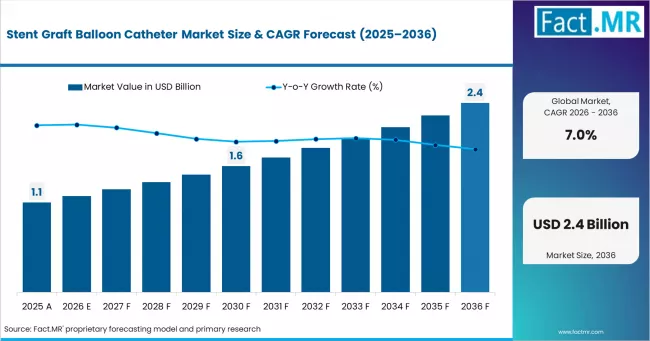
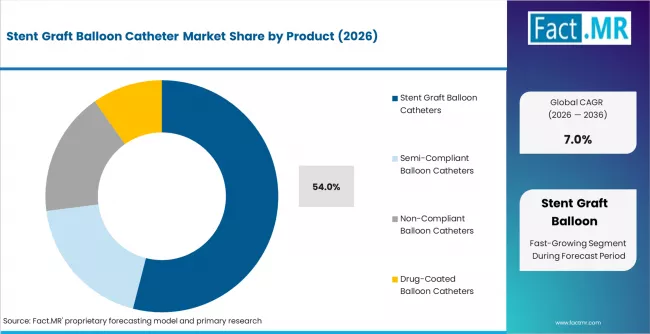
The global market for stent graft balloon catheter is estimated to be around USD 1.2 billion in 2026 and has been forecast to expand at a CAGR of 7.0% to end up at USD 2.4 billion by 2036. The Stent Graft Balloon Catheter segment is led by Stent Graft Balloon Catheters, which is anticipated to account for 54.0% of the product segment in 2026, while Stent Graft Balloon Catheters is expected to remain the leading application with around 54.0% share. The market was valued at USD 1.1 billion in 2025 and is poised for steady growth driven by evolving industry dynamics and regional demand patterns.
In 2025, the global Stent Graft Balloon Catheter Market was valued at approximately USD 1.1 billion.
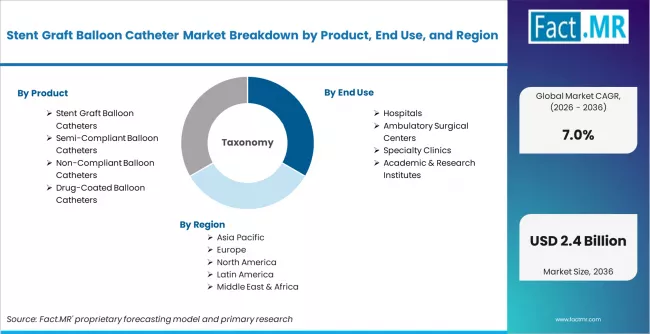
The market is estimated to reach USD 1.2 billion in 2026 and is projected to attain USD 2.4 billion by 2036
The stent graft balloon catheter market is likely to expand at a CAGR of 7.0% during the forecast period.
The market is anticipated to create an absolute dollar opportunity of USD 1.2 billion between 2026 and 2036.
Stent Graft Balloon Catheters account for 54.0% of market share in 2026.
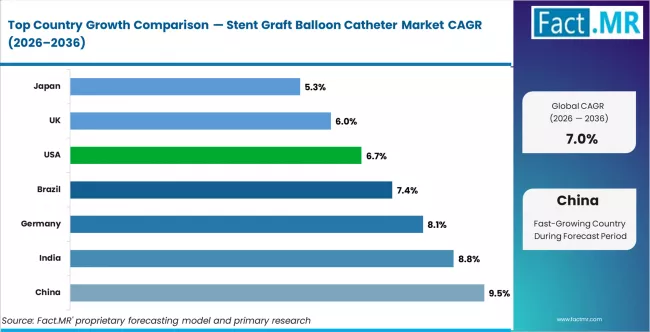
China (9.5%) and India (8.8%) are the key growth markets during the forecast period
Demand and Growth Drivers
Growing adoption of endovascular aortic repair (EVAR) and thoracic endovascular repair (TEVAR) is increasing demand for stent graft balloon catheters used in graft deployment and post-dilation.
Rising prevalence of aortic aneurysms and peripheral vascular disease is expanding the patient population requiring endovascular intervention.
Catheterization and hybrid operating room infrastructure expansion in Asia Pacific is broadening access to complex endovascular procedures.
Product and Segment View
Stent graft balloon catheters account for 54% of the product segment in 2026, serving as essential devices for endovascular graft deployment and vessel preparation.
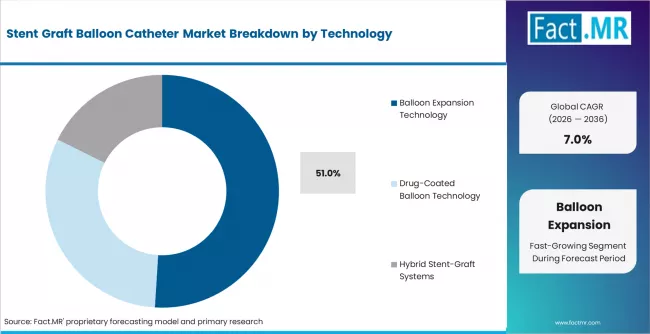
Balloon expansion technology holds 51% in 2026, reflecting the standard approach for stent-graft deployment and post-dilation in endovascular procedures.
Hospitals hold 63% of end-use demand in 2026, with vascular surgery and interventional radiology departments as the primary procedure settings.
Geography and Competitive Outlook
China leads at 9.5% CAGR, driven by expanding endovascular procedure volumes and vascular surgery infrastructure development.
North America and Europe remain the largest markets with established EVAR/TEVAR procedure bases.
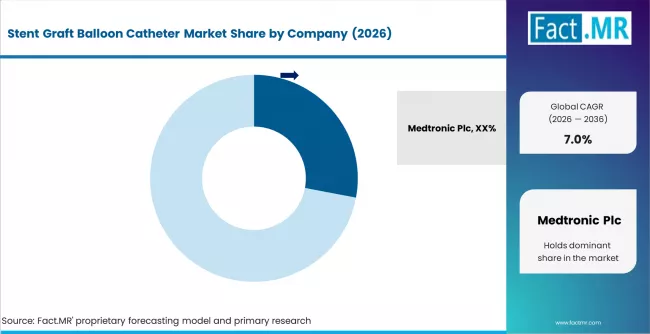
Medtronic holds 28% market share through its integrated endovascular stent-graft and catheter delivery systems.
Analyst Opinion
The stent graft balloon catheter market is closely tied to endovascular aortic repair procedure volumes, which are growing as the technique displaces open surgical repair across a broader patient population. Device demand is procedure-linked, with each EVAR/TEVAR case requiring balloon catheters for graft deployment and molding. Growth is concentrated in Asia Pacific where vascular surgery infrastructure is scaling rapidly. The competitive advantage accrues to companies offering integrated stent-graft delivery systems where the balloon catheter is a component of a proprietary platform, creating switching costs and procedure-level lock-in. Drug-coated balloon variants represent an emerging opportunity for combining vessel preparation with anti-restenotic therapy.
Why is the Stent Graft Balloon Catheter Market Growing?
Endovascular aortic repair adoption is expanding as the technique displaces open surgery across a broader range of aortic pathologies and patient demographics.
Hybrid operating room construction in emerging markets is enabling complex endovascular procedures previously limited to specialized centers.
The stent graft balloon catheter market is a direct derivative of endovascular procedure volume growth. Each EVAR, TEVAR, or peripheral stent-graft procedure requires balloon catheters for device deployment, vessel preparation, and post-dilation, creating a procedurally linked demand model.
The shift from open surgical to endovascular repair continues to expand the addressable patient population. Advances in stent-graft design, including fenestrated and branched configurations, are extending endovascular treatment to more complex anatomies, with each case requiring specialized balloon catheter support.
Segment-wise Analysis of the Stent Graft Balloon Catheter Market
Stent graft balloon catheters lead at 54% share in 2026, serving endovascular graft deployment and post-dilation.
Balloon expansion technology holds 51% in 2026, with inflation-based graft deployment as the standard technique.
Sterile single-use kits account for 67% of packaging in 2026, meeting regulatory sterilization and traceability requirements.
The market is segmented by product type (stent graft balloon, semi-compliant balloon, non-compliant balloon, drug-coated balloon catheters), end use (hospitals, ambulatory surgical centers, specialty clinics, academic and research institutes), technology (balloon expansion, drug-coated balloon, hybrid stent-graft systems), and packaging (sterile single-use kits, medical pouch, bulk hospital packaging).
Stent graft balloon catheters hold 54% of the product segment in 2026. Their leadership reflects the essential role of balloon inflation in endovascular graft deployment and vessel molding. Non-compliant and semi-compliant variants serve post-dilation and vessel preparation roles, while drug-coated balloon catheters are gaining share as pharmacological therapy integration advances.
Balloon expansion technology accounts for 51% in 2026. Inflation-based stent-graft deployment remains the standard approach in EVAR and TEVAR procedures. Drug-coated balloon technology is the fastest-growing sub-segment, combining vessel preparation with localized drug delivery to reduce restenosis in peripheral applications.
Key Growth Drivers, Constraints, and Market Scope
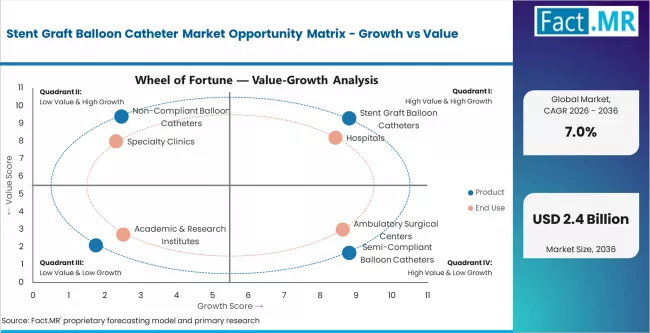
Stent Graft Balloon Catheter Market Opportunity Matrix Growth Vs Value | Source: Fact.MR
High device costs and reimbursement limitations constrain adoption in price-sensitive markets.
The stent graft balloon catheter market is shaped by vascular disease epidemiology, endovascular procedure adoption, device technology development, and reimbursement frameworks.
Growth Drivers
Demand is shaped by EVAR/TEVAR procedure volume growth, expanding endovascular treatment indications, and hybrid OR infrastructure development in emerging markets. Aging population demographics increase vascular disease prevalence and procedure candidacy.
Constraints
High device costs limit adoption in emerging markets without adequate reimbursement. Procedural complexity restricts use to specialized centers with trained vascular surgeons. Regulatory approval timelines for new device designs delay market entry.
Opportunities
Drug-coated balloon catheters for peripheral applications combine mechanical and pharmacological therapy. Complex aortic repair requiring fenestrated/branched grafts increases per-case balloon utilization. Asian market infrastructure expansion creates the largest procedural volume growth opportunity.
Regional Outlook Across Key Markets
Top Country Growth Comparison Stent Graft Balloon Catheter Market Cagr (2026 2036) | Source: Fact.MR
China leads at 9.5% CAGR, driven by vascular surgery infrastructure expansion and growing aortic disease prevalence.
India follows at 8.8% CAGR, reflecting expanding endovascular procedure capacity.
Germany records 8.1% CAGR, supported by established vascular surgery volumes and complex case capabilities.
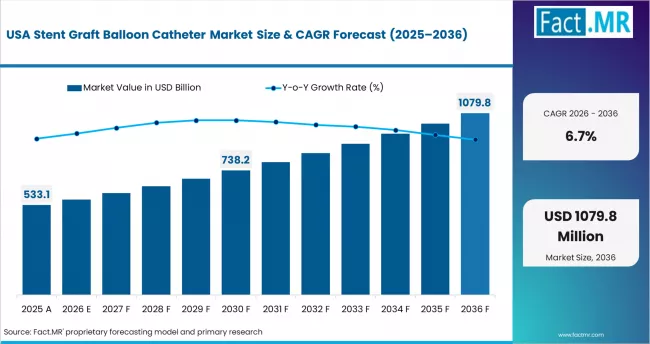
USA grows at 6.7% CAGR, with mature procedure volumes and device technology advancement.
Country CAGR Table
Country
CAGR (%)
China
9.5%
India
8.8%
Germany
8.1%
Brazil
7.4%
USA
6.7%
UK
6.0%
Japan
5.3%
Stent Graft Balloon Catheter Market Cagr Analysis By Country | Source: Fact.MR
Regional demand reflects vascular disease prevalence, endovascular procedure adoption, hospital infrastructure maturity, and reimbursement support for advanced vascular devices.
Market Outlook in China
The China stent graft balloon catheter market is projected to grow at a CAGR of 9.5% through 2036. Demand is driven by rapid vascular surgery infrastructure expansion, increasing aortic disease prevalence, and growing adoption of EVAR/TEVAR techniques.
Vascular surgery infrastructure expansion broadens procedure access.
Local device manufacturers are entering the market with cost-competitive offerings.
Demand Trends in India
The India stent graft balloon catheter market is projected to grow at a CAGR of 8.8% through 2036. Growth reflects expanding endovascular procedure capacity, growing tertiary hospital infrastructure, and increasing vascular disease burden.
Growing disease burden increases patient candidacy for intervention.
Germany Market Growth
The Germany stent graft balloon catheter market is projected to grow at a CAGR of 8.1% through 2036. Demand is supported by established vascular surgery centers, complex case expertise, and reimbursement support for advanced endovascular procedures.
Established vascular centers support high procedure volumes.
Complex case capabilities drive advanced device utilization.
Reimbursement frameworks support specialty device procurement.
USA Market Outlook
Stent Graft Balloon Catheter Market Country Value Analysis | Source: Fact.MR
The USA stent graft balloon catheter market is projected to grow at a CAGR of 6.7% through 2036. Demand is shaped by mature EVAR/TEVAR procedure volumes, advancing device technology, and expanding treatment indications for complex anatomies.
Stent Graft Balloon Catheter Market Analysis By Company | Source: Fact.MR
Medtronic holds 28% market share through its integrated endovascular stent-graft delivery systems spanning aortic and peripheral applications.
Cook Medical and B. Braun compete through established vascular device portfolios and hospital distribution networks.
Competition is shaped by stent-graft platform integration, delivery system design, physician training programs, and clinical evidence.
The competitive landscape is shaped by integration between stent-graft platforms and balloon catheter delivery systems. Medtronic leads through its Endurant and Valiant stent-graft systems, where balloon catheters are integral to the deployment mechanism. Cook Medical, B. Braun, and Terumo compete through established vascular device portfolios.
Strategic priorities include developing drug-coated balloon variants, improving catheter crossing profiles and deliverability, expanding hybrid stent-graft system capabilities, and building distribution in emerging market vascular surgery centers.
Competitive Benchmarking
Company
Platform Integration
Vascular Portfolio
Clinical Evidence
Geographic Reach
Medtronic
Full system
Comprehensive
Extensive
Global
Cook Medical
Moderate
Broad
Strong
Global
B. Braun
Moderate
Focused
Moderate
Europe/Asia
Terumo
Moderate
Catheter focused
Moderate
Global
Boston Scientific
Growing
Broad
Strong
Global
Recent Industry Developments
Medtronic launched an updated balloon delivery system for its aortic stent-graft platform in 2025, featuring improved catheter profile for percutaneous access.
Cook Medical expanded its peripheral stent-graft balloon catheter line in early 2026, targeting growing femoropopliteal intervention volumes.
MicroPort received regulatory approval for its stent graft balloon catheter system in China in 2025, targeting domestic vascular surgery market growth.
Leading Companies Shaping the Stent Graft Balloon Catheter Market
Major Players
Medtronic Plc
B. Braun Melsungen AG
Cook Medical INC
Terumo Corporation
Boston Scientific Corporation
Emerging Players
Cordis Corporation
MicroPort Scientific Corporation
Jotech GmbH
Cardionovum GmbH
Hexacath
Abbott Laboratories
Meril Life Sciences Pvt. Ltd.
Sources and Research References
Society for Vascular Surgery (SVS). Procedure volume and clinical practice data.
European Society for Vascular Surgery (ESVS). Clinical guidelines for endovascular repair.
Medtronic Plc. Annual reports and endovascular portfolio disclosures.
World Health Organization (WHO). Cardiovascular and vascular disease epidemiology.
United States Food and Drug Administration (FDA). Medical device regulatory databases.
Primary interviews with vascular surgeons, interventional radiologists, hospital procurement managers, and device distributors.
This bibliography is provided for reader reference. The full report contains the complete reference list.
Key Questions This Report Addresses
What is the current and projected size of the stent graft balloon catheter market?
What CAGR is expected between 2026 and 2036?
Which product type holds the largest share?
Which technology drives the highest demand?
What factors shape demand?
Which countries show fastest growth?
How is the competitive landscape structured?
How does Fact.MR validate the forecast?
Stent Graft Balloon Catheter Market Definition
The stent graft balloon catheter market covers balloon-based catheter devices used in endovascular stent-graft deployment, post-dilation, and vessel preparation during aortic, peripheral, and other vascular repair procedures. The market spans device manufacturing and distribution to hospital vascular surgery and interventional radiology departments.
Stent Graft Balloon Catheter Market Inclusions
The scope covers global and regional market size and forecasts for 2026 to 2036 across product type, end use, technology, packaging, and region. It includes demand analysis based on vascular disease prevalence, EVAR/TEVAR procedure volumes, and endovascular infrastructure development.
Stent Graft Balloon Catheter Market Exclusions
The scope excludes standalone bare-metal and drug-eluting stents without balloon delivery, diagnostic catheters, non-vascular balloon devices, and open surgical graft materials not deployed endovascularly.
Stent Graft Balloon Catheter Market Research Methodology
Primary research includes interviews with vascular surgeons, interventional radiologists, hospital procurement managers, and device distributors.
Desk research draws on vascular disease epidemiology, procedure volume statistics, device regulatory databases, and company financial disclosures.
Market sizing uses a demand-side model validated through procedure volume cross-checks, device utilization rates, and pricing benchmarks.
Data validation involves reconciliation with medical device registry data and expert panel review.
Scope of Analysis
Stent Graft Balloon Catheter Market Breakdown By Product, End Use, And Region | Source: Fact.MR
Parameter
Details
Quantitative Units
USD 1.2 billion to USD 2.4 billion, at a CAGR of 7.0%
Market Definition
Covers balloon catheter devices for endovascular stent-graft deployment, post-dilation, and vessel preparation in aortic, peripheral, and other vascular procedures.
Regions Covered
North America, Latin America, Europe, East Asia, South Asia and Pacific, Middle East and Africa
Countries Covered
USA, China, India, Germany, Brazil, UK, Japan, and 30+ countries
Key Companies
Medtronic, B. Braun, Cook Medical, Terumo, Boston Scientific, Cordis, MicroPort, Jotech, Cardionovum, Hexacath, Abbott, Meril
Forecast Period
2026 to 2036
Approach
Hybrid demand-side methodology built on procedure volume data, vascular disease epidemiology, device utilization rates, and primary interviews across vascular surgeons, hospitals, and device distributors.
Analysis by Product Type, End Use, Technology, Source, Packaging, and Region
Stent Graft Balloon Catheter Market Market Segmented by Product:
Stent Graft Balloon Catheters
Compliant Balloon Catheters
Aortic Stent Deployment Balloons
Semi-Compliant Balloon Catheters
Multi-Purpose Expansion Balloons
Peripheral Vascular Balloons
Non-Compliant Balloon Catheters
High Pressure Deployment Balloons
Calcified Lesion Expansion Systems
Drug-Coated Balloon Catheters
Drug-Eluting Stent Support Balloons
Anti-Restenosis Balloon Systems
Stent Graft Balloon Catheter Market Market Segmented by Product:
Stent Graft Balloon Catheters
Compliant Balloon Catheters
Aortic Stent Deployment Balloons
Semi-Compliant Balloon Catheters
Multi-Purpose Expansion Balloons
Peripheral Vascular Balloons
Non-Compliant Balloon Catheters
High Pressure Deployment Balloons
Calcified Lesion Expansion Systems
Drug-Coated Balloon Catheters
Drug-Eluting Stent Support Balloons
Anti-Restenosis Balloon Systems
Stent Graft Balloon Catheter Market Market Segmented by End Use:
Hospitals
Cardiology Departments
Catheterization Laboratories
Ambulatory Surgical Centers
Day Care Vascular Centers
Minimally Invasive Surgery Units
Specialty Clinics
Cardiovascular Clinics
Outpatient Interventional Centers
Academic & Research Institutes
Clinical Training Hospitals
Medical Research Facilities
Stent Graft Balloon Catheter Market Market Segmented by Technology:
Balloon Expansion Technology
Controlled Dilation Systems
High-Pressure Inflation Mechanisms
Drug-Coated Balloon Technology
Targeted Drug Delivery Systems
Anti-Restenosis Coating Technology
Hybrid Stent-Graft Systems
Integrated Deployment Platforms
AI-Assisted Navigation Systems
Stent Graft Balloon Catheter Market Market Segmented by Source:
Medical-Grade Polymers
Nylon-Based Materials
Polyurethane & Composite Materials
Biocompatible Polymer Blends
Stent Graft Balloon Catheter Market Market Segmented by Packaging:
Sterile Single-Use Kits
Blister-Sealed Catheter Packs
Procedure Ready Surgical Kits
Medical Pouch Packaging
Sterile Barrier Packaging
Hospital Supply Packs
Bulk Hospital Packaging
Catheterization Lab Kits
Institutional Supply Boxes
Stent Graft Balloon Catheter Market Market by Region:
North America
USA
Canada
Mexico
Latin America
Brazil
Chile
Rest of Latin America
Western Europe
Germany
UK
Italy
Spain
France
Nordic
BENELUX
Rest of Western Europe
Eastern Europe
Russia
Poland
Hungary
Balkan & Baltic
Rest of Eastern Europe
East Asia
China
Japan
South Korea
South Asia and Pacific
India
ASEAN
Australia & New Zealand
Rest of South Asia and Pacific
Middle East & Africa
Kingdom of Saudi Arabia
Other GCC Countries
Turkiye
South Africa
Other African Union
Rest of Middle East & Africa
Frequently Asked Questions
What is the market size in 2026?
The global stent graft balloon catheter market is estimated at USD 1.2 billion in 2026.
What will be the market size in 2036?
The market is projected to reach USD 2.4 billion by 2036.
What is the expected CAGR?
The market is expected to grow at a 7.0% CAGR between 2026 and 2036.
Which product type leads?
Stent graft balloon catheters hold 54% of the product segment in 2026.
Which technology accounts for highest demand?
Balloon expansion technology holds 51% in 2026.
Which country is fastest growing?
China is the fastest growing market at 9.45% CAGR through 2036.
What does the market cover?
Balloon catheter devices for endovascular stent-graft deployment, post-dilation, and vessel preparation in aortic, peripheral, and vascular procedures.
How does Fact.MR validate the forecast?
Fact.MR uses a hybrid demand-side methodology validated through procedure data, vascular epidemiology, and primary interviews across 30+ countries.
.webp "Top Country Growth Comparison Stent Graft Balloon Catheter Market Cagr (2026 2036)")