Tracheal Stents Market Size, Share, Growth and Forecast (2026 - 2036)

Tracheal Stents Market is segmented by Product (Metal Tracheal Stents, Silicone Tracheal Stents, Hybrid Tracheal Stents, Biodegradable Tracheal Stents, Custom Tracheal Stents), Material (Nitinol Materials, Medical Grade Silicone, Stainless Steel Materials, Polymer Materials), Application (Tracheal Stenosis Treatment, Airway Obstruction Management, Post-Surgical Airway Support, Pediatric Airway Management), and Region. Forecasts from 2026 to 2036.

Tracheal Stents Market Analysis and Forecast by Fact.MR

  • The Tracheal Stents Market is expected to grow from USD 136.6 million in 2026 to USD 306.0 million by 2036, at an 8.4% CAGR.
  • Driven by rising incidence of tracheal stenosis from post-intubation complications and malignant airway obstruction, expanding interventional pulmonology capabilities in tertiary hospitals, and growing adoption of self-expanding nitinol stent technologies, with Metal Tracheal Stents accounting for 48.3% of product demand in 2026 and hospitals contributing 61.4% share as companies invest in biodegradable stent development, improved radial force designs, and extended deployment system compatibility.
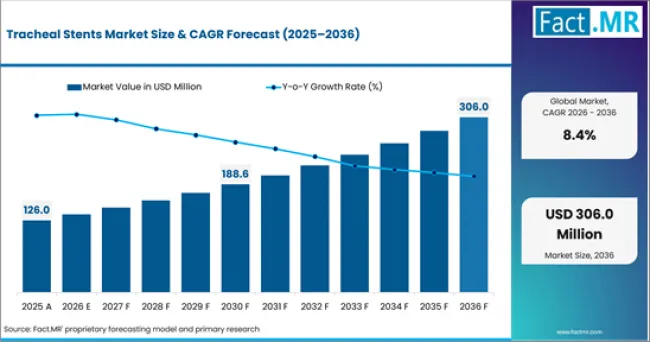
Tracheal Stents Market Value Analysis

Summary of Tracheal Stents Market

  • Market Snapshot
    • In 2025, the global Tracheal Stents Market was valued at approximately USD 126.0 million.
    • The market is estimated to reach USD 136.6 million in 2026 and is projected to attain USD 306.0 million by 2036.
    • The tracheal stents market is likely to expand at a CAGR of 8.4% during the forecast period.
    • The market is anticipated to create an absolute dollar opportunity of USD 169.4 million between 2026 and 2036.
    • Metal tracheal stents account for 48.3% of product segment share in 2026.
    • China (8.1%) and U.S. (7.6%) are the key growth markets during the forecast period.
  • Demand and Growth Drivers
    • The number of patients requiring airway stenting is increasing due to the increasing number of cases of post-intubation tracheal stenosis with increased numbers of patients requiring prolonged mechanical ventilation and intensive care.
    • The increasing incidence of malignant airway obstruction from cancers of the lung, esophagus and thyroid, creates continued demand for palliative and therapeutic stenting.
    • The rising number of interventional pulmonology training programs and bronchoscopy suite additions in tertiary hospitals increase procedural capacity.
    • Improvements in self-expanding nitinol stent technology allow for increased radial force, flexibility, and accuracy of deployment, broadening the spectrum of treatable airway anatomies.
    • Development of prototypes of biodegradable and drug-eluting tracheal stents opens the possibility of lower re-intervention rates and better long-term outcomes.
  • Product and Segment View
    • In 2026, metal tracheal stents will hold the highest share of 48.3% of the product segment, supported by nitinol self-expanding technology with strong radial force and established clinical evidence.
    • Nitinol materials represent 44.1% of the material share, indicating a preference for shape-memory alloys that allow for self-expanding stent designs.
    • Key segmentation includes:
      • Product: Metal Tracheal Stents Silicone Tracheal Stents Hybrid Tracheal Stents Biodegradable Tracheal Stents
      • Application: Treatment of tracheal stenosis, malignant airway obstruction, treatment of tracheomalacia, post-operative airway support
      • End User: Hospitals, Ambulatory Surgical Centers, Specialty Pulmonology Clinics
    • These devices address:
      • Restoration of airway patency in malignant and benign tracheal stenosis
      • Minimally invasive options for surgical tracheal resection and reconstruction
      • Palliative care of inoperable malignant airway compression: management of the airway
  • Geography and Competitive Outlook
    • Growth in Asia Pacific is led by China with an 8.1% CAGR, supported by hospital expansion and growing interventional pulmonology capacity.
    • North America at 7.6% (U.S.) is a reflection of established interventional pulmonology infrastructure, FDA regulatory pathways and hospital system investment in bronchoscopy suites.
    • Europe remains a strong market with steady growth, Germany at 6.8% driven by EU MDR compliance and advanced tertiary hospital infrastructure.
    • The key players include Cook Group, Merit Medical Systems Inc., Novatech SA, Taewoong Medical Co., Boston Scientific Corporation. Ltd., Bess AG, E. Benson Hood Laboratories Inc., Efer Endoscopy, Endo-Flex GmbH, Micro-Tech (Nanjing) Co. Standard Sci. Co. Tech Inc and Stening SRL.
  • Analyst Opinion
    • Shambhu Nath Jha, Principal Consultant at Fact.MR, says "The tracheal stents market is growing faster than the broader respiratory device category because it sits at the intersection of two expanding clinical needs: post-ICU tracheal stenosis management and palliative airway stenting for advanced thoracic malignancies. Metal self-expanding stents dominate because nitinol technology delivers the combination of radial force, flexibility, and ease of bronchoscopic deployment that clinicians require. The competitive opportunity is shifting toward companies that can offer improved migration resistance, tissue integration, and eventually biodegradable platforms that reduce the re-intervention burden on both patients and hospital systems."

Key Growth Drivers, Constraints, and Opportunities

Tracheal Stents Market Opportunity Matrix Growth Vs Value

Key Factors Driving Growth

  • As the number of post-intubation tracheal stenosis cases rises faster than the volume of ICU admissions, large hospital systems are experiencing an increasing patient pipeline for airway stenting.
  • The expansion of interventional pulmonology programs in tertiary hospitals is improving the procedural capability and physician training for bronchoscopic stent placement.
  • Self-expanding nitinol stent technology is expanding the treatable patient population to be deployed in complex airway anatomies that were previously difficult.

Key Market Constraints

  • As the number of post-intubation tracheal stenosis cases rises faster than the volume of ICU admissions, large hospital systems are experiencing an increasing patient pipeline for airway stenting.
  • The expansion of interventional pulmonology programs in tertiary hospitals is improving the procedural capability and physician training for bronchoscopic stent placement.
  • Self-expanding nitinol stent technology is expanding the treatable patient population to be deployed in complex airway anatomies that were previously difficult.

Key Opportunity Areas

  • Biodegradable tracheal stents are a high-value product opportunity that can potentially reduce re-intervention rates and the long-term burden of airway management.
  • Local immunosuppression and anti-granulation therapy utilizing drug-eluting stent technology is undergoing clinical evaluation for tracheal applications.
  • Investment in hospital infrastructure in emerging markets is increasing the addressable patient population for tracheal stenting beyond established Western healthcare systems.

Segment-wise Analysis of the Tracheal Stents Market

  • The nitinol self-expanding technology provides strong clinical evidence and physician familiarity, which is why metal tracheal stents are projected to account for 48.3% of product share in 2026.
  • Tracheal Stenosis Treatment Leads Application Dominates With 39.6% Share Owing To Rising Incidence Of Post Intubation Stenosis And Adoption Of Interventional Pulmonology
  • Hospitals command an end user share of 61.4%, owing to the specialized procedural infrastructure and clinical expertise needed to deploy tracheal stents.

The market is segmented on the basis of product, material, application, deployment method, end user and region. Metal stents have the advantage of radial force performance. Silicone stents are still relevant in removable applications. Bronchoscopic deployment is responsible for 57.2% of all deployment methods.

Which Product Segment Dominates the Tracheal Stents Market?
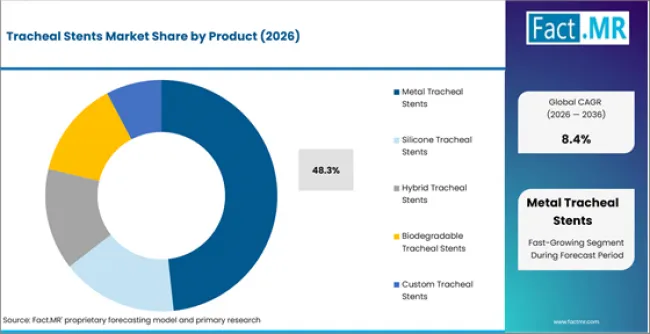
Tracheal Stents Market Analysis By Product

In 2026, the product segment value share of metal tracheal stents is 48.3%. In this category, nitinol self-expanding stents are the most popular, due to their shape memory properties that allow for compressed delivery and controlled expansion, allowing for a radial force that is sufficient to maintain airway patency against external compression from tumors or scar tissue.

Silicone tracheal stents have the second largest share due to removability and less tissue reaction profiles. They are still preferred in benign stenosis when the clinical intention is temporary stenting. Hybrid stents, consisting of silicone coverings and metal frames, provide a compromise between control of tissue interaction and structural support.

Which Deployment Method Dominates the Tracheal Stents Market?
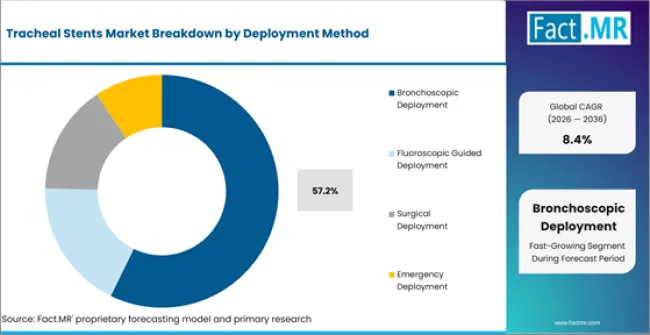
Tracheal Stents Market Analysis By Deployment Method

Bronchoscopic deployment accounts for 57.2% of the deployment-method segment in 2026. The standard is flexible and rigid bronchoscopy with stent placement. This allows direct visualization during the procedure and reduces the amount of anesthesia and recovery time compared to open surgical placement.

Surgical deployment still has a role in complex tracheal reconstructions where stenting alone is not sufficient. Fluoroscopic-guided placement is an adjunct technique in centers lacking advanced bronchoscopy capability.

Which Product Trend is Shaping the Next Phase of Growth in the Tracheal Stents Market?

The dominant product trend which is transforming clinical practice is the self-expanding nitinol stent with improved anti-migration properties and tissue integration coatings. Re-intervention remains a persistent challenge for current generation stents due to migration and granulation tissue formation. Manufacturers are responding with improved stent geometries, partially covered designs and surface modifications that improve the stability of the anchor without increasing tissue trauma.

More advanced development of biodegradable tracheal stents is currently underway, with polydioxanone and polylactic acid based prototypes demonstrating feasibility in clinical studies. These platforms, if approved by regulators, will overcome the long-standing limitation of permanent stent implantation by offering temporary airway support that gradually dissolves, eliminating the need for stent removal procedures.

Regional Outlook Across Key Markets

  • China is the leader at 8.1% driven by hospital expansion, growth in interventional pulmonology training and the development of domestic stent manufacturing capability.
  • The U.S., with 7.6%, has the established interventional pulmonology infrastructure, clinical guideline support and FDA regulatory paths for airway devices.
  • European markets are growing steadily, Germany at 6.8% due to advanced tertiary hospital networks and the UK at 6.3% from the expansion of NHS pulmonology services.

Top Country Growth Comparison Tracheal Stents Market Cagr (2026 2036)

CAGR Table

Country CAGR (%)
U.S. 7.6%
Germany 6.8%
South Korea 6.5%
UK 6.3%
France 6.0%
Japan 5.9%
Italy 5.7%

Source: Fact.MR analysis, based on proprietary forecasting model and primary research.
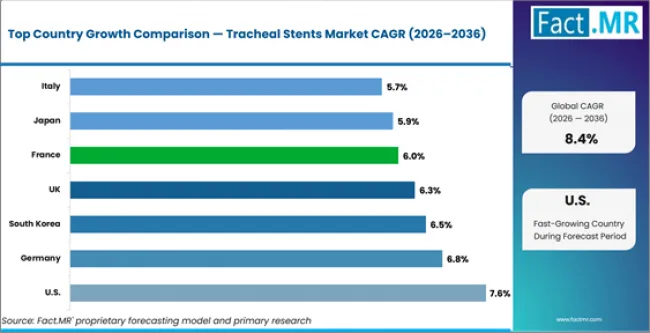
Tracheal Stents Market Cagr Analysis By Country

Market Outlook for Tracheal Stents in China

The China Tracheal Stents Market is projected to grow at a CAGR of 8.1% through 2036. Hospital expansion and growing domestic interventional pulmonology capabilities are creating sustained procurement demand. Technology self-sufficiency policies are supporting domestic stent manufacturing development by companies such as Micro-Tech (Nanjing).

  • Tier-2 and tier-3 hospital bronchoscopy suite installations are expanding procedural access beyond major academic centers.
  • Domestic manufacturers are investing in nitinol stent production to reduce import dependency for self-expanding airway devices.
  • Volume-based procurement programs are compressing unit pricing while expanding institutional access to tracheal stent products.

U.S. Tracheal Stents Demand Trends

Tracheal Stents Market Country Value Analysis

The U.S. Tracheal Stents Market is projected to grow at a CAGR of 7.6% through 2036. FDA 510(k) and PMA regulatory pathways support timely market access for airway stent products. Specialty pharmacy networks and hospital system consolidation shape device procurement economics.

  • Insurance and Medicare reimbursement frameworks support interventional pulmonology procedure volumes in academic and community hospital settings.
  • Hospital system consolidation is standardizing device procurement and concentrating purchasing authority for specialty airway devices.
  • Clinical guideline development by the American Association for Bronchology supports evidence-based tracheal stent selection and deployment protocols.

Germany Tracheal Stents Market Growth Assessment

The Germany Tracheal Stents Market is projected to grow at a CAGR of 6.8% through 2036. EU MDR/IVDR compliance requirements are reshaping medical device qualification timelines for tracheal stent manufacturers entering the European market. Advanced tertiary hospital infrastructure supports high procedural volumes.

  • GKV reimbursement pathways for interventional pulmonology procedures support clinical adoption of tracheal stenting in routine practice.
  • Hospital consolidation in the German healthcare system is concentrating specialized airway management services in regional centers of excellence.
  • DIN/EU quality standards create a high-specification market that rewards manufacturers with validated clinical performance data.

UK Tracheal Stents Market Growth Outlook

The UK Tracheal Stents Market is projected to grow at a CAGR of 6.3% through 2036. NICE health technology assessments influence device selection and procurement decisions across NHS trusts. Post-Brexit regulatory divergence from EU MDR creates separate device approval requirements.

  • NHS procurement frameworks centralize specialty medical device purchasing through national supply chain arrangements.
  • Interventional pulmonology service expansion within NHS is increasing procedural capacity for tracheal stent deployment.
  • Post-Brexit MHRA regulatory pathways are creating separate device clearance timelines from EU CE marking processes.

Japan Tracheal Stents Market Demand Analysis

Tracheal Stents Market Japan Market Share Analysis By Product

The Japan Tracheal Stents Market is projected to grow at a CAGR of 5.9% through 2036. PMDA device approval pathways and NHI reimbursement pricing revisions influence manufacturer launch strategies. The aging population generates sustained demand for airway management in thoracic malignancy patients.

  • Aging demographics increase lung and esophageal cancer incidence, expanding the patient population requiring palliative airway stenting.
  • Domestic supplier preference and long device qualification cycles shape market access for imported tracheal stent products.
  • NHI pricing revisions apply periodic downward adjustments that influence device manufacturer pricing strategy over product lifecycles.

Competitive Benchmarking and Company Positioning
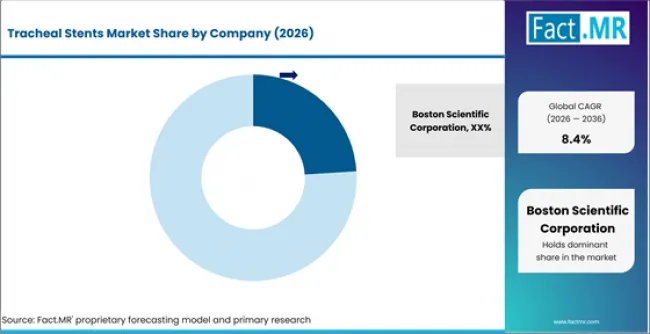
Tracheal Stents Market Analysis By Company

Tracheal Stents Market Analysis By Company

  • The Boston Scientific Corporation is the leader in the market with a share of approximately 24.0%, leveraging its Ultraflex and Polyflex airway stent platforms, global distribution, and relationships with interventional pulmonology centers.
  • Cook Group, Merit Medical and Novatech compete in Europe and Asia with specialized airway stent portfolios, clinical evidence programs and regional distribution strength.
  • For instance, Taewoong Medical, Micro-Tech (Nanjing) and Endo-Flex are responding to the growing demand in Asia Pacific and Europe with competitively priced self-expanding stent products and distributor networks.

The competitive landscape is moderately fragmented with Boston Scientific holding the largest market share based on its legacy airway stent portfolio and global interventional pulmonology relationships. Some European manufacturers such as Novatech, Efer Endoscopy and Stening SRL are well established in some clinical niches, notably silicone stent applications.

Asian manufacturers Taewoong Medical and Micro-Tech are expanding distribution to Western markets with cost-competitive nitinol stent products. Increasingly, competition is based on generation of clinical evidence, usability of deployment systems, and breadth of regulatory clearance across major healthcare markets.

Key Companies in the Tracheal Stents Market

  • Boston Scientific Corporation, Cook Group, Merit Medical Systems Inc., Novatech SA, Taewoong Medical Co. Ltd., Bess AG, E. Benson Hood Laboratories Inc., Efer Endoscopy, Endo-Flex GmbH, Micro-Tech (Nanjing) Co. Ltd., Standard Sci. Tech Inc., and Stening SRL are the leading companies.

Recent Industry Developments

FDA issues Class I recall for Boston Scientific AXIOS Stent and electrocautery-enhanced delivery systems (2026)

  • The FDA issued a Class I recall for Boston Scientific’s AXIOS stents and electrocautery-enhanced delivery systems, citing risks linked to deployment and expansion failures during use. Class I is the most serious recall level, indicating potential for serious injury or death.

Boston Scientific Receives FDA Approval for AGENT™ Drug-Coated Balloon (2024)

  • The U.S. FDA approved Boston Scientific’s Agent™ drug-coated balloon catheter, designed to treat in-stent restenosis (ISR)—a complication where previously implanted stents become re-narrowed. This is directly relevant to stent lifecycle management and airway/vascular stent complications.


Leading Companies Shaping the Tracheal Stents Market

  • Boston Scientific Corporation
  • Cook Group
  • Merit Medical Systems, Inc.
  • Novatech SA
  • Taewoong Medical Co., Ltd.
  • Micro-Tech (Nanjing) Co., Ltd.
  • Stening SRL
  • Merit Medical Systems, Inc.
  • W. L. Gore & Associates
  • M.I. Tech Co., Ltd.

Sources and Research References

  • Boston Scientific Corporation. (2026). Stent recall: Boston Scientific removes certain AXIOS stents and electrocautery-enhanced delivery systems. U.S. Food and Drug Administration. 
  • Boston Scientific Corporation. (2024). Boston Scientific receives FDA approval for the AGENT drug-coated balloon. PR Newswire. 

This bibliography is provided for reader reference and is not exhaustive. The full report contains the complete reference list and detailed citations.

Key Questions This Report Addresses

  • What is the estimated size of the global Tracheal Stents Market in 2026, and how is it projected to grow through the 2026 to 2036 forecast period?
  • What incremental revenue opportunity is the Tracheal Stents Market expected to create between 2026 and 2036, and what CAGR underpins this projection?
  • Which product segment holds the largest share in 2026, and what clinical performance factors support metal tracheal stent leadership?
  • How is the balance between metal and silicone tracheal stents expected to shift over the forecast period, and what drives clinical preference changes?
  • Which application segment is projected to generate the most incremental revenue through 2036, and what clinical demand patterns drive growth?
  • Which countries are projected to register the highest CAGR through 2036, and what healthcare infrastructure factors accelerate their growth?
  • How do demand patterns in China compare with those in the U.S. and Europe in terms of procedural volumes and device procurement models?
  • What clinical limitations, including stent migration and granulation tissue formation, could constrain growth in specific product segments?
  • What are the primary demand-side drivers sustaining growth, and how do they vary between malignant and benign tracheal stenosis indications?
  • Who are the leading companies, and how are they differentiating through stent design, deployment systems, and clinical evidence generation?
  • What recent regulatory and product developments in 2025 and 2026 are reshaping competitive positioning in the tracheal stent market?
  • Which product technology trend is driving the next phase of growth, and how are biodegradable and drug-eluting stent prototypes advancing?
  • How is interventional pulmonology training capacity expansion influencing procedural volume growth and device adoption across healthcare systems?
  • What role are reimbursement frameworks, clinical guidelines, and hospital procurement standardization playing in reshaping market access dynamics?

Tracheal Stents Market Definition

The tracheal stents market covers implantable tubular devices designed to maintain airway patency in patients with tracheal stenosis, malignant airway obstruction, tracheomalacia, and post-surgical airway compromise. It includes metal, silicone, hybrid, and biodegradable stent types deployed through bronchoscopic and surgical methods.

Tracheal Stents Market Inclusions

  • Global and regional market size and forecasts for 2026 to 2036 across product, material, application, deployment method, end user, and region.
  • Demand analysis based on tracheal stenosis incidence, malignant airway obstruction prevalence, interventional pulmonology capacity, and hospital capital investment.
  • Competitive landscape including stent design portfolios, clinical evidence, regulatory clearances, and distribution strategies of leading companies.

Tracheal Stents Market Exclusions

  • Bronchial stents, esophageal stents, and vascular stents not designed for tracheal airway applications.
  • Tracheostomy tubes, T-tubes, and external airway management devices that do not function as intraluminal stents.
  • Experimental stent prototypes in preclinical development without regulatory clearance or commercial availability.

Tracheal Stents Market Research Methodology

  • Methodology combines secondary research from clinical registries, medical device regulatory databases, and interventional pulmonology literature with primary validation.
  • Market sizing covers 30+ countries with inputs including ICU admission rates, tracheal stenosis incidence, thoracic cancer prevalence, and bronchoscopy procedure volumes.
  • Primary validation includes 20+ interviews across interventional pulmonologists, thoracic surgeons, hospital procurement teams, and medical device distributors.

Scope of Analysis

Tracheal Stents Market Breakdown By Product, Material, And Region

Parameter Details
Quantitative Units USD 136.6 million to USD 306.0 million, at a CAGR of 8.4%
Market Definition The Tracheal Stents Market covers implantable tubular devices for maintaining airway patency in tracheal stenosis, malignant airway obstruction, tracheomalacia, and post-surgical airway compromise.
Regions Covered North America, Latin America, Europe, East Asia, South Asia and Pacific, Middle East and Africa
Countries Covered China, U.S., Germany, South Korea, UK, France, Japan, ANZ, Italy, 30 plus countries
Key Companies

Boston Scientific Corporation, Cook Group, Merit Medical Systems, Inc., Novatech SA, Taewoong Medical Co., Ltd., Micro-Tech (Nanjing) Co., Ltd., Stening SRL, W. L. Gore & Associates, M.I. Tech Co., Ltd.

Forecast Period 2026 to 2036
Approach Hybrid demand-side and top-down methodology built on tracheal stenosis incidence, thoracic cancer prevalence, bronchoscopy procedure volumes, hospital capital investment, and primary interviews

Tracheal Stents Market Segmentation

  • Tracheal Stents Market Segmented by Product:

    • Metal Tracheal Stents
      • Self Expanding Metal Stents
        • Malignant Airway Applications
        • Interventional Pulmonology Products
      • Balloon Expandable Metal Stents
        • Tracheal Narrowing Applications
        • Respiratory Support Systems
    • Silicone Tracheal Stents
      • Straight Silicone Stent Systems
        • Airway Obstruction Applications
        • Pulmonary Care Products
      • Y Shaped Silicone Stent Systems
        • Complex Airway Applications
        • Thoracic Intervention Systems
    • Hybrid Tracheal Stents
      • Silicone Coated Metal Stents
        • Migration Prevention Applications
        • Long Term Airway Products
      • Drug Eluting Hybrid Stents
        • Infection Control Applications
        • Advanced Respiratory Systems
    • Biodegradable Tracheal Stents
      • Polymer Based Biodegradable Stents
        • Temporary Airway Applications
        • Pediatric Respiratory Products
      • Bioresorbable Tracheal Systems
        • Post Surgical Applications
        • Minimally Invasive Airway Systems
    • Custom Tracheal Stents
      • Three Dimensional Printed Stents
        • Personalized Airway Applications
        • Advanced Pulmonary Products
      • Patient Specific Stent Systems
        • Complex Anatomy Applications
        • Customized Respiratory Systems
  • Tracheal Stents Market Segmented by Material:

    • Nitinol Materials
      • Shape Memory Alloy Systems
        • Self Expansion Applications
        • Interventional Pulmonology Products
      • High Flexibility Nitinol Systems
        • Dynamic Airway Applications
        • Advanced Stent Products
    • Medical Grade Silicone
      • Soft Silicone Materials
        • Flexible Airway Applications
        • Patient Comfort Systems
      • Reinforced Silicone Materials
        • Long Term Support Applications
        • Durable Respiratory Products
    • Stainless Steel Materials
      • Braided Steel Structures
        • Rigid Airway Applications
        • Thoracic Support Products
      • Laser Cut Steel Systems
        • Precision Expansion Applications
        • Clinical Respiratory Systems
    • Polymer Materials
      • Bioresorbable Polymer Systems
        • Temporary Support Applications
        • Pediatric Care Products
      • Drug Coated Polymer Materials
        • Localized Therapy Applications
        • Advanced Airway Systems
  • Tracheal Stents Market Segmented by Application:

    • Tracheal Stenosis Treatment
      • Benign Stenosis Applications
        • Post Intubation Care Systems
        • Airway Reconstruction Products
      • Malignant Stenosis Applications
        • Cancer Care Systems
        • Palliative Respiratory Products
    • Airway Obstruction Management
      • Tumor Related Obstruction Applications
        • Oncology Care Systems
        • Respiratory Support Products
      • Foreign Body Airway Applications
        • Emergency Care Systems
        • Pulmonary Intervention Products
    • Post Surgical Airway Support
      • Thoracic Surgery Applications
        • Recovery Care Systems
        • Airway Stabilization Products
      • Tracheostomy Support Applications
        • Critical Care Systems
        • Respiratory Recovery Products
    • Pediatric Airway Management
      • Congenital Airway Disorder Applications
        • Pediatric Pulmonology Systems
        • Child Respiratory Products
      • Growth Adaptive Airway Applications
        • Long Term Pediatric Care Systems
        • Advanced Stent Products
  • Tracheal Stents Market Segmented by Deployment Method:

    • Bronchoscopic Deployment
      • Rigid Bronchoscopy Systems
        • Hospital Applications
        • Interventional Pulmonology Products
      • Flexible Bronchoscopy Systems
        • Minimally Invasive Applications
        • Respiratory Care Products
    • Fluoroscopic Guided Deployment
      • Image Guided Placement Systems
        • Precision Airway Applications
        • Thoracic Intervention Products
      • Real Time Visualization Systems
        • Complex Procedure Applications
        • Advanced Respiratory Systems
    • Surgical Deployment
      • Open Surgical Placement
        • Complex Reconstruction Applications
        • Thoracic Surgery Products
      • Hybrid Surgical Systems
        • Combined Procedure Applications
        • Advanced Airway Care Systems
    • Emergency Deployment
      • Rapid Placement Systems
        • Critical Airway Applications
        • Emergency Care Products
      • Bedside Deployment Systems
        • Intensive Care Applications
        • Immediate Respiratory Support Products
  • Tracheal Stents Market Segmented by End User:

    • Hospitals
      • Tertiary Care Hospitals
        • Advanced Airway Applications
        • Critical Care Products
      • General Hospitals
        • Routine Respiratory Applications
        • Pulmonary Care Systems
    • Specialty Clinics
      • Pulmonology Clinics
        • Airway Management Applications
        • Respiratory Treatment Products
      • Thoracic Surgery Clinics
        • Post Surgical Applications
        • Advanced Airway Systems
    • Ambulatory Surgical Centers
      • Day Care Surgical Applications
        • Minimally Invasive Procedures
        • Outpatient Respiratory Products
      • Bronchoscopy Center Applications
        • Diagnostic Procedures
        • Airway Intervention Systems
    • Research And Academic Institutes
      • Clinical Research Applications
        • Stent Development Systems
        • Experimental Respiratory Products
      • Medical Training Applications
        • Simulation Procedures
        • Educational Airway Systems
  • Tracheal Stents Market by Region:

    • North America
      • USA
      • Canada
      • Mexico
    • Latin America
      • Brazil
      • Chile
      • Rest of Latin America
    • Western Europe
      • Germany
      • UK
      • Italy
      • Spain
      • France
      • Nordic
      • BENELUX
      • Rest of Western Europe
    • Eastern Europe
      • Russia
      • Poland
      • Hungary
      • Balkan & Baltic
      • Rest of Eastern Europe
    • East Asia
      • China
      • Japan
      • South Korea
    • South Asia and Pacific
      • India
      • ASEAN
      • Australia & New Zealand
      • Rest of South Asia and Pacific
    • Middle East & Africa
      • Kingdom of Saudi Arabia
      • Other GCC Countries
      • Turkiye
      • South Africa
      • Other African Union
      • Rest of Middle East & Africa

- Frequently Asked Questions -

How big is the tracheal stents market in 2026?

The global tracheal stents market is estimated to be valued at USD 136.6 million in 2026.

What will be the size of the tracheal stents market in 2036?

The market size for the tracheal stents market is projected to reach USD 306.0 million by 2036.

How much will the tracheal stents market grow between 2026 and 2036?

The tracheal stents market is expected to grow at an 8.4% CAGR between 2026 and 2036.

What are the key products in the tracheal stents market?

The key products in the tracheal stents market are Metal Tracheal Stents, Silicone Tracheal Stents, Hybrid Tracheal Stents, Biodegradable Tracheal Stents and Custom Tracheal Stents.

Which material segment is expected to contribute a significant share in the tracheal stents market in 2026?

In terms of material, nitinol materials segment is expected to command 44.1% share in the tracheal stents market in 2026.

Table of Content

  1. Key Takeaways
    • Market Size and CAGR
    • Top Growth Driver
    • Fastest Growing Segment
    • Leading Region
    • Key Companies
    • Emerging Opportunities
  2. Executive Summary
    • Global Market Outlook
    • Demand-side Trends
    • Supply-side Trends
    • Technology Roadmap Analysis
    • Analysis and Recommendations
    • Analyst Perspective (What is happening? Why now? What should investors know?)
    • Key Questions Answered
      • How large is the market?
      • What is the CAGR?
      • What are key trends?
      • Which region dominates?
      • Who are the leaders?
  3. Market Overview
    • Market Coverage / Taxonomy
    • Market Definition / Scope / Limitations
  4. Research Methodology
    • Chapter Orientation
    • Analytical Lens and Working Hypotheses
      • Market Structure, Signals, and Trend Drivers
      • Benchmarking and Cross-market Comparability
      • Market Sizing, Forecasting, and Opportunity Mapping
    • Research Design and Evidence Framework
      • Desk Research Programme (Secondary Evidence)
      • Expert Input and Fieldwork (Primary Evidence)
      • Tooling, Models, and Reference Databases
    • Data Engineering and Model Build
    • Quality Assurance and Audit Trail
  5. Market Background
    • Market Dynamics (Drivers, Restraints, Opportunity, Trends)
    • Scenario Forecast (Optimistic, Likely, Conservative)
    • Impact Analysis
      • AI Impact
      • Sustainability Impact
      • Regulatory Impact
      • Technology Impact
    • Consumer / Buyer Analysis
      • Purchase Drivers
      • Adoption Barriers
      • Buyer Journey
    • Opportunity Map Analysis
    • Product Life Cycle Analysis
    • Supply Chain Analysis
    • Investment Feasibility Matrix
    • Value Chain Analysis
    • PESTLE and Porter's Analysis
    • Regulatory Landscape
    • Regional Parent Market Outlook
    • Production and Consumption Statistics
    • Import and Export Statistics
  6. Global Market Analysis and Forecast, 2021 to 2036
    • Historical Market Size Value (USD Million) Analysis, 2021 to 2025
    • Current and Future Market Size Value (USD Million) Projections, 2026 to 2036
      • Y-o-Y Growth Trend Analysis
      • Absolute $ Opportunity Analysis
  7. Global Market Pricing Analysis, 2021 to 2036
  8. Global Market Analysis and Forecast, By Product, 2021 to 2036
    • Introduction / Key Findings
    • Historical Market Size Value (USD Million) Analysis By Product, 2021 to 2025
    • Current and Future Market Size Value (USD Million) Analysis and Forecast By Product, 2026 to 2036
      • Metal Tracheal Stents
        • Self Expanding Metal Stents
        • Balloon Expandable Metal Stents
      • Silicone Tracheal Stents
        • Straight Silicone Stent Systems
        • Y Shaped Silicone Stent Systems
      • Hybrid Tracheal Stents
        • Silicone Coated Metal Stents
        • Drug Eluting Hybrid Stents
      • Biodegradable Tracheal Stents
        • Polymer Based Biodegradable Stents
        • Bioresorbable Tracheal Systems
      • Custom Tracheal Stents
        • Three Dimensional Printed Stents
        • Patient Specific Stent Systems
    • Y-o-Y Growth Trend Analysis By Product, 2021 to 2025
    • Absolute $ Opportunity Analysis By Product, 2026 to 2036
  9. Global Market Analysis and Forecast, By Material, 2021 to 2036
    • Introduction / Key Findings
    • Historical Market Size Value (USD Million) Analysis By Material, 2021 to 2025
    • Current and Future Market Size Value (USD Million) Analysis and Forecast By Material, 2026 to 2036
      • Nitinol Materials
        • Shape Memory Alloy Systems
        • High Flexibility Nitinol Systems
      • Medical Grade Silicone
        • Soft Silicone Materials
        • Reinforced Silicone Materials
      • Stainless Steel Materials
        • Braided Steel Structures
        • Laser Cut Steel Systems
      • Polymer Materials
        • Bioresorbable Polymer Systems
        • Drug Coated Polymer Materials
    • Y-o-Y Growth Trend Analysis By Material, 2021 to 2025
    • Absolute $ Opportunity Analysis By Material, 2026 to 2036
  10. Global Market Analysis and Forecast, By Application, 2021 to 2036
    • Introduction / Key Findings
    • Historical Market Size Value (USD Million) Analysis By Application, 2021 to 2025
    • Current and Future Market Size Value (USD Million) Analysis and Forecast By Application, 2026 to 2036
      • Tracheal Stenosis Treatment
        • Benign Stenosis Applications
        • Malignant Stenosis Applications
      • Airway Obstruction Management
        • Tumor Related Obstruction Applications
        • Foreign Body Airway Applications
      • Post Surgical Airway Support
        • Thoracic Surgery Applications
        • Tracheostomy Support Applications
      • Pediatric Airway Management
        • Congenital Airway Disorder Applications
        • Growth Adaptive Airway Applications
    • Y-o-Y Growth Trend Analysis By Application, 2021 to 2025
    • Absolute $ Opportunity Analysis By Application, 2026 to 2036
  11. Global Market Analysis and Forecast, By Deployment Method, 2021 to 2036
    • Introduction / Key Findings
    • Historical Market Size Value (USD Million) Analysis By Deployment Method, 2021 to 2025
    • Current and Future Market Size Value (USD Million) Analysis and Forecast By Deployment Method, 2026 to 2036
      • Bronchoscopic Deployment
        • Rigid Bronchoscopy Systems
        • Flexible Bronchoscopy Systems
      • Fluoroscopic Guided Deployment
        • Image Guided Placement Systems
        • Real Time Visualization Systems
      • Surgical Deployment
        • Open Surgical Placement
        • Hybrid Surgical Systems
      • Emergency Deployment
        • Rapid Placement Systems
        • Bedside Deployment Systems
    • Y-o-Y Growth Trend Analysis By Deployment Method, 2021 to 2025
    • Absolute $ Opportunity Analysis By Deployment Method, 2026 to 2036
  12. Global Market Analysis and Forecast, By End User, 2021 to 2036
    • Introduction / Key Findings
    • Historical Market Size Value (USD Million) Analysis By End User, 2021 to 2025
    • Current and Future Market Size Value (USD Million) Analysis and Forecast By End User, 2026 to 2036
      • Hospitals
        • Tertiary Care Hospitals
        • General Hospitals
      • Specialty Clinics
        • Pulmonology Clinics
        • Thoracic Surgery Clinics
      • Ambulatory Surgical Centers
        • Day Care Surgical Applications
        • Bronchoscopy Center Applications
      • Research And Academic Institutes
        • Clinical Research Applications
        • Medical Training Applications
    • Y-o-Y Growth Trend Analysis By End User, 2021 to 2025
    • Absolute $ Opportunity Analysis By End User, 2026 to 2036
  13. Global Market Analysis and Forecast, By Region, 2021 to 2036
    • Introduction
    • Historical Market Size Value (USD Million) Analysis By Region, 2021 to 2025
    • Current Market Size Value (USD Million) Analysis and Forecast By Region, 2026 to 2036
      • North America
      • Latin America
      • Western Europe
      • Eastern Europe
      • East Asia
      • South Asia and Pacific
      • Middle East & Africa
    • Market Attractiveness Analysis By Region
  14. North America Market Analysis and Forecast, By Country, 2021 to 2036
    • Historical Market Size Value (USD Million) Trend Analysis By Market Taxonomy, 2021 to 2025
    • Market Size Value (USD Million) Forecast By Market Taxonomy, 2026 to 2036
      • By Country
        • USA
        • Canada
        • Mexico
      • By Product
      • By Material
      • By Application
      • By Deployment Method
      • By End User
    • Market Attractiveness Analysis
      • By Country
      • By Product
      • By Material
      • By Application
      • By Deployment Method
      • By End User
    • Key Takeaways
  15. Latin America Market Analysis and Forecast, By Country
    • Historical Market Size Value (USD Million) Trend Analysis By Market Taxonomy, 2021 to 2025
    • Market Size Value (USD Million) Forecast By Market Taxonomy, 2026 to 2036
      • By Country
        • Brazil
        • Chile
        • Rest of Latin America
      • By Product
      • By Material
      • By Application
      • By Deployment Method
      • By End User
    • Market Attractiveness Analysis
      • By Country
      • By Product
      • By Material
      • By Application
      • By Deployment Method
      • By End User
    • Key Takeaways
  16. Western Europe Market Analysis and Forecast, By Country
    • Historical Market Size Value (USD Million) Trend Analysis By Market Taxonomy, 2021 to 2025
    • Market Size Value (USD Million) Forecast By Market Taxonomy, 2026 to 2036
      • By Country
        • Germany
        • UK
        • Italy
        • Spain
        • France
        • Nordic
        • BENELUX
        • Rest of Western Europe
      • By Product
      • By Material
      • By Application
      • By Deployment Method
      • By End User
    • Market Attractiveness Analysis
      • By Country
      • By Product
      • By Material
      • By Application
      • By Deployment Method
      • By End User
    • Key Takeaways
  17. Eastern Europe Market Analysis and Forecast, By Country
    • Historical Market Size Value (USD Million) Trend Analysis By Market Taxonomy, 2021 to 2025
    • Market Size Value (USD Million) Forecast By Market Taxonomy, 2026 to 2036
      • By Country
        • Russia
        • Poland
        • Hungary
        • Balkan & Baltic
        • Rest of Eastern Europe
      • By Product
      • By Material
      • By Application
      • By Deployment Method
      • By End User
    • Market Attractiveness Analysis
      • By Country
      • By Product
      • By Material
      • By Application
      • By Deployment Method
      • By End User
    • Key Takeaways
  18. East Asia Market Analysis and Forecast, By Country
    • Historical Market Size Value (USD Million) Trend Analysis By Market Taxonomy, 2021 to 2025
    • Market Size Value (USD Million) Forecast By Market Taxonomy, 2026 to 2036
      • By Country
        • China
        • Japan
        • South Korea
      • By Product
      • By Material
      • By Application
      • By Deployment Method
      • By End User
    • Market Attractiveness Analysis
      • By Country
      • By Product
      • By Material
      • By Application
      • By Deployment Method
      • By End User
    • Key Takeaways
  19. South Asia and Pacific Market Analysis and Forecast, By Country
    • Historical Market Size Value (USD Million) Trend Analysis By Market Taxonomy, 2021 to 2025
    • Market Size Value (USD Million) Forecast By Market Taxonomy, 2026 to 2036
      • By Country
        • India
        • ASEAN
        • Australia & New Zealand
        • Rest of South Asia and Pacific
      • By Product
      • By Material
      • By Application
      • By Deployment Method
      • By End User
    • Market Attractiveness Analysis
      • By Country
      • By Product
      • By Material
      • By Application
      • By Deployment Method
      • By End User
    • Key Takeaways
  20. Middle East & Africa Market Analysis and Forecast, By Country
    • Historical Market Size Value (USD Million) Trend Analysis By Market Taxonomy, 2021 to 2025
    • Market Size Value (USD Million) Forecast By Market Taxonomy, 2026 to 2036
      • By Country
        • Kingdom of Saudi Arabia
        • Other GCC Countries
        • Turkiye
        • South Africa
        • Other African Union
        • Rest of Middle East & Africa
      • By Product
      • By Material
      • By Application
      • By Deployment Method
      • By End User
    • Market Attractiveness Analysis
      • By Country
      • By Product
      • By Material
      • By Application
      • By Deployment Method
      • By End User
    • Key Takeaways
  21. Key Countries Market Analysis
    • USA
      • Pricing Analysis
      • Market Share Analysis, 2025
        • By Product
        • By Material
        • By Application
        • By Deployment Method
        • By End User
    • Canada
      • Pricing Analysis
      • Market Share Analysis, 2025
        • By Product
        • By Material
        • By Application
        • By Deployment Method
        • By End User
    • Mexico
      • Pricing Analysis
      • Market Share Analysis, 2025
        • By Product
        • By Material
        • By Application
        • By Deployment Method
        • By End User
    • Brazil
      • Pricing Analysis
      • Market Share Analysis, 2025
        • By Product
        • By Material
        • By Application
        • By Deployment Method
        • By End User
    • Chile
      • Pricing Analysis
      • Market Share Analysis, 2025
        • By Product
        • By Material
        • By Application
        • By Deployment Method
        • By End User
    • Germany
      • Pricing Analysis
      • Market Share Analysis, 2025
        • By Product
        • By Material
        • By Application
        • By Deployment Method
        • By End User
    • UK
      • Pricing Analysis
      • Market Share Analysis, 2025
        • By Product
        • By Material
        • By Application
        • By Deployment Method
        • By End User
    • Italy
      • Pricing Analysis
      • Market Share Analysis, 2025
        • By Product
        • By Material
        • By Application
        • By Deployment Method
        • By End User
    • Spain
      • Pricing Analysis
      • Market Share Analysis, 2025
        • By Product
        • By Material
        • By Application
        • By Deployment Method
        • By End User
    • France
      • Pricing Analysis
      • Market Share Analysis, 2025
        • By Product
        • By Material
        • By Application
        • By Deployment Method
        • By End User
    • India
      • Pricing Analysis
      • Market Share Analysis, 2025
        • By Product
        • By Material
        • By Application
        • By Deployment Method
        • By End User
    • ASEAN
      • Pricing Analysis
      • Market Share Analysis, 2025
        • By Product
        • By Material
        • By Application
        • By Deployment Method
        • By End User
    • Australia & New Zealand
      • Pricing Analysis
      • Market Share Analysis, 2025
        • By Product
        • By Material
        • By Application
        • By Deployment Method
        • By End User
    • China
      • Pricing Analysis
      • Market Share Analysis, 2025
        • By Product
        • By Material
        • By Application
        • By Deployment Method
        • By End User
    • Japan
      • Pricing Analysis
      • Market Share Analysis, 2025
        • By Product
        • By Material
        • By Application
        • By Deployment Method
        • By End User
    • South Korea
      • Pricing Analysis
      • Market Share Analysis, 2025
        • By Product
        • By Material
        • By Application
        • By Deployment Method
        • By End User
    • Russia
      • Pricing Analysis
      • Market Share Analysis, 2025
        • By Product
        • By Material
        • By Application
        • By Deployment Method
        • By End User
    • Poland
      • Pricing Analysis
      • Market Share Analysis, 2025
        • By Product
        • By Material
        • By Application
        • By Deployment Method
        • By End User
    • Hungary
      • Pricing Analysis
      • Market Share Analysis, 2025
        • By Product
        • By Material
        • By Application
        • By Deployment Method
        • By End User
    • Kingdom of Saudi Arabia
      • Pricing Analysis
      • Market Share Analysis, 2025
        • By Product
        • By Material
        • By Application
        • By Deployment Method
        • By End User
    • Turkiye
      • Pricing Analysis
      • Market Share Analysis, 2025
        • By Product
        • By Material
        • By Application
        • By Deployment Method
        • By End User
    • South Africa
      • Pricing Analysis
      • Market Share Analysis, 2025
        • By Product
        • By Material
        • By Application
        • By Deployment Method
        • By End User
  22. Market Structure Analysis
    • Competition Dashboard
    • Competition Benchmarking
    • Market Share Analysis of Top Players
      • By Regional
      • By Product
      • By Material
      • By Application
      • By Deployment Method
      • By End User
      • Emerging Startups
      • Innovation Benchmarking
    • Competition Analysis
      • Competition Deep Dive
        • Boston Scientific Corporation
          • Overview
          • Product Portfolio
          • Profitability by Market Segments (Product/Age /Sales Channel/Region)
          • Sales Footprint
          • Strategy Overview
            • Marketing Strategy
            • Product Strategy
            • Channel Strategy
        • Cook Group
        • Merit Medical Systems, Inc.
        • Novatech SA
        • Taewoong Medical Co., Ltd.
        • Bess Aktiengesellschaft (Bess AG)
        • E. Benson Hood Laboratories, Inc.
        • Efer Endoscopy
        • Endo-Flex GmbH
        • Micro-Tech (Nanjing) Co., Ltd.
        • Standard Sci. Tech, Inc.
        • Stening SRL
    • Case Studies
    • Success Stories
    • Recent Developments
  23. Assumptions & Acronyms Used

List Of Table

  • Table 1: Global Market Value (USD Million) Forecast by Region, 2021 to 2036
  • Table 2: Global Market Value (USD Million) Forecast by Product, 2021 to 2036
  • Table 3: Global Market Value (USD Million) Forecast by Material, 2021 to 2036
  • Table 4: Global Market Value (USD Million) Forecast by Application, 2021 to 2036
  • Table 5: Global Market Value (USD Million) Forecast by Deployment Method, 2021 to 2036
  • Table 6: Global Market Value (USD Million) Forecast by End User, 2021 to 2036
  • Table 7: Global Market rma_anu Forecast by rma_anu, 2021 to 2036
  • Table 8: North America Market Value (USD Million) Forecast by Country, 2021 to 2036
  • Table 9: North America Market Value (USD Million) Forecast by Product, 2021 to 2036
  • Table 10: North America Market Value (USD Million) Forecast by Material, 2021 to 2036
  • Table 11: North America Market Value (USD Million) Forecast by Application, 2021 to 2036
  • Table 12: North America Market Value (USD Million) Forecast by Deployment Method, 2021 to 2036
  • Table 13: North America Market Value (USD Million) Forecast by End User, 2021 to 2036
  • Table 14: Latin America Market Value (USD Million) Forecast by Country, 2021 to 2036
  • Table 15: Latin America Market Value (USD Million) Forecast by Product, 2021 to 2036
  • Table 16: Latin America Market Value (USD Million) Forecast by Material, 2021 to 2036
  • Table 17: Latin America Market Value (USD Million) Forecast by Application, 2021 to 2036
  • Table 18: Latin America Market Value (USD Million) Forecast by Deployment Method, 2021 to 2036
  • Table 19: Latin America Market Value (USD Million) Forecast by End User, 2021 to 2036
  • Table 20: Western Europe Market Value (USD Million) Forecast by Country, 2021 to 2036
  • Table 21: Western Europe Market Value (USD Million) Forecast by Product, 2021 to 2036
  • Table 22: Western Europe Market Value (USD Million) Forecast by Material, 2021 to 2036
  • Table 23: Western Europe Market Value (USD Million) Forecast by Application, 2021 to 2036
  • Table 24: Western Europe Market Value (USD Million) Forecast by Deployment Method, 2021 to 2036
  • Table 25: Western Europe Market Value (USD Million) Forecast by End User, 2021 to 2036
  • Table 26: Eastern Europe Market Value (USD Million) Forecast by Country, 2021 to 2036
  • Table 27: Eastern Europe Market Value (USD Million) Forecast by Product, 2021 to 2036
  • Table 28: Eastern Europe Market Value (USD Million) Forecast by Material, 2021 to 2036
  • Table 29: Eastern Europe Market Value (USD Million) Forecast by Application, 2021 to 2036
  • Table 30: Eastern Europe Market Value (USD Million) Forecast by Deployment Method, 2021 to 2036
  • Table 31: Eastern Europe Market Value (USD Million) Forecast by End User, 2021 to 2036
  • Table 32: East Asia Market Value (USD Million) Forecast by Country, 2021 to 2036
  • Table 33: East Asia Market Value (USD Million) Forecast by Product, 2021 to 2036
  • Table 34: East Asia Market Value (USD Million) Forecast by Material, 2021 to 2036
  • Table 35: East Asia Market Value (USD Million) Forecast by Application, 2021 to 2036
  • Table 36: East Asia Market Value (USD Million) Forecast by Deployment Method, 2021 to 2036
  • Table 37: East Asia Market Value (USD Million) Forecast by End User, 2021 to 2036
  • Table 38: South Asia and Pacific Market Value (USD Million) Forecast by Country, 2021 to 2036
  • Table 39: South Asia and Pacific Market Value (USD Million) Forecast by Product, 2021 to 2036
  • Table 40: South Asia and Pacific Market Value (USD Million) Forecast by Material, 2021 to 2036
  • Table 41: South Asia and Pacific Market Value (USD Million) Forecast by Application, 2021 to 2036
  • Table 42: South Asia and Pacific Market Value (USD Million) Forecast by Deployment Method, 2021 to 2036
  • Table 43: South Asia and Pacific Market Value (USD Million) Forecast by End User, 2021 to 2036
  • Table 44: Middle East & Africa Market Value (USD Million) Forecast by Country, 2021 to 2036
  • Table 45: Middle East & Africa Market Value (USD Million) Forecast by Product, 2021 to 2036
  • Table 46: Middle East & Africa Market Value (USD Million) Forecast by Material, 2021 to 2036
  • Table 47: Middle East & Africa Market Value (USD Million) Forecast by Application, 2021 to 2036
  • Table 48: Middle East & Africa Market Value (USD Million) Forecast by Deployment Method, 2021 to 2036
  • Table 49: Middle East & Africa Market Value (USD Million) Forecast by End User, 2021 to 2036

List Of Figures

  • Figure 1: Global Market Pricing Analysis
  • Figure 2: Global Market Value (USD Million) Forecast 2021 to 2036
  • Figure 3: Global Market Value Share and BPS Analysis by Product, 2026 and 2036
  • Figure 4: Global Market Y-o-Y Growth Comparison by Product, 2026 to 2036
  • Figure 5: Global Market Attractiveness Analysis by Product
  • Figure 6: Global Market Value Share and BPS Analysis by Material, 2026 and 2036
  • Figure 7: Global Market Y-o-Y Growth Comparison by Material, 2026 to 2036
  • Figure 8: Global Market Attractiveness Analysis by Material
  • Figure 9: Global Market Value Share and BPS Analysis by Application, 2026 and 2036
  • Figure 10: Global Market Y-o-Y Growth Comparison by Application, 2026 to 2036
  • Figure 11: Global Market Attractiveness Analysis by Application
  • Figure 12: Global Market Value Share and BPS Analysis by Deployment Method, 2026 and 2036
  • Figure 13: Global Market Y-o-Y Growth Comparison by Deployment Method, 2026 to 2036
  • Figure 14: Global Market Attractiveness Analysis by Deployment Method
  • Figure 15: Global Market Value Share and BPS Analysis by End User, 2026 and 2036
  • Figure 16: Global Market Y-o-Y Growth Comparison by End User, 2026 to 2036
  • Figure 17: Global Market Attractiveness Analysis by End User
  • Figure 18: Global Market Value (USD Million) Share and BPS Analysis by Region, 2026 and 2036
  • Figure 19: Global Market Y-o-Y Growth Comparison by Region, 2026 to 2036
  • Figure 20: Global Market Attractiveness Analysis by Region
  • Figure 21: North America Market Incremental Dollar Opportunity, 2026 to 2036
  • Figure 22: Latin America Market Incremental Dollar Opportunity, 2026 to 2036
  • Figure 23: Western Europe Market Incremental Dollar Opportunity, 2026 to 2036
  • Figure 24: Eastern Europe Market Incremental Dollar Opportunity, 2026 to 2036
  • Figure 25: East Asia Market Incremental Dollar Opportunity, 2026 to 2036
  • Figure 26: South Asia and Pacific Market Incremental Dollar Opportunity, 2026 to 2036
  • Figure 27: Middle East & Africa Market Incremental Dollar Opportunity, 2026 to 2036
  • Figure 28: North America Market Value Share and BPS Analysis by Country, 2026 and 2036
  • Figure 29: North America Market Value Share and BPS Analysis by Product, 2026 and 2036
  • Figure 30: North America Market Y-o-Y Growth Comparison by Product, 2026 to 2036
  • Figure 31: North America Market Attractiveness Analysis by Product
  • Figure 32: North America Market Value Share and BPS Analysis by Material, 2026 and 2036
  • Figure 33: North America Market Y-o-Y Growth Comparison by Material, 2026 to 2036
  • Figure 34: North America Market Attractiveness Analysis by Material
  • Figure 35: North America Market Value Share and BPS Analysis by Application, 2026 and 2036
  • Figure 36: North America Market Y-o-Y Growth Comparison by Application, 2026 to 2036
  • Figure 37: North America Market Attractiveness Analysis by Application
  • Figure 38: North America Market Value Share and BPS Analysis by Deployment Method, 2026 and 2036
  • Figure 39: North America Market Y-o-Y Growth Comparison by Deployment Method, 2026 to 2036
  • Figure 40: North America Market Attractiveness Analysis by Deployment Method
  • Figure 41: North America Market Value Share and BPS Analysis by End User, 2026 and 2036
  • Figure 42: North America Market Y-o-Y Growth Comparison by End User, 2026 to 2036
  • Figure 43: North America Market Attractiveness Analysis by End User
  • Figure 44: Latin America Market Value Share and BPS Analysis by Country, 2026 and 2036
  • Figure 45: Latin America Market Value Share and BPS Analysis by Product, 2026 and 2036
  • Figure 46: Latin America Market Y-o-Y Growth Comparison by Product, 2026 to 2036
  • Figure 47: Latin America Market Attractiveness Analysis by Product
  • Figure 48: Latin America Market Value Share and BPS Analysis by Material, 2026 and 2036
  • Figure 49: Latin America Market Y-o-Y Growth Comparison by Material, 2026 to 2036
  • Figure 50: Latin America Market Attractiveness Analysis by Material
  • Figure 51: Latin America Market Value Share and BPS Analysis by Application, 2026 and 2036
  • Figure 52: Latin America Market Y-o-Y Growth Comparison by Application, 2026 to 2036
  • Figure 53: Latin America Market Attractiveness Analysis by Application
  • Figure 54: Latin America Market Value Share and BPS Analysis by Deployment Method, 2026 and 2036
  • Figure 55: Latin America Market Y-o-Y Growth Comparison by Deployment Method, 2026 to 2036
  • Figure 56: Latin America Market Attractiveness Analysis by Deployment Method
  • Figure 57: Latin America Market Value Share and BPS Analysis by End User, 2026 and 2036
  • Figure 58: Latin America Market Y-o-Y Growth Comparison by End User, 2026 to 2036
  • Figure 59: Latin America Market Attractiveness Analysis by End User
  • Figure 60: Western Europe Market Value Share and BPS Analysis by Country, 2026 and 2036
  • Figure 61: Western Europe Market Value Share and BPS Analysis by Product, 2026 and 2036
  • Figure 62: Western Europe Market Y-o-Y Growth Comparison by Product, 2026 to 2036
  • Figure 63: Western Europe Market Attractiveness Analysis by Product
  • Figure 64: Western Europe Market Value Share and BPS Analysis by Material, 2026 and 2036
  • Figure 65: Western Europe Market Y-o-Y Growth Comparison by Material, 2026 to 2036
  • Figure 66: Western Europe Market Attractiveness Analysis by Material
  • Figure 67: Western Europe Market Value Share and BPS Analysis by Application, 2026 and 2036
  • Figure 68: Western Europe Market Y-o-Y Growth Comparison by Application, 2026 to 2036
  • Figure 69: Western Europe Market Attractiveness Analysis by Application
  • Figure 70: Western Europe Market Value Share and BPS Analysis by Deployment Method, 2026 and 2036
  • Figure 71: Western Europe Market Y-o-Y Growth Comparison by Deployment Method, 2026 to 2036
  • Figure 72: Western Europe Market Attractiveness Analysis by Deployment Method
  • Figure 73: Western Europe Market Value Share and BPS Analysis by End User, 2026 and 2036
  • Figure 74: Western Europe Market Y-o-Y Growth Comparison by End User, 2026 to 2036
  • Figure 75: Western Europe Market Attractiveness Analysis by End User
  • Figure 76: Eastern Europe Market Value Share and BPS Analysis by Country, 2026 and 2036
  • Figure 77: Eastern Europe Market Value Share and BPS Analysis by Product, 2026 and 2036
  • Figure 78: Eastern Europe Market Y-o-Y Growth Comparison by Product, 2026 to 2036
  • Figure 79: Eastern Europe Market Attractiveness Analysis by Product
  • Figure 80: Eastern Europe Market Value Share and BPS Analysis by Material, 2026 and 2036
  • Figure 81: Eastern Europe Market Y-o-Y Growth Comparison by Material, 2026 to 2036
  • Figure 82: Eastern Europe Market Attractiveness Analysis by Material
  • Figure 83: Eastern Europe Market Value Share and BPS Analysis by Application, 2026 and 2036
  • Figure 84: Eastern Europe Market Y-o-Y Growth Comparison by Application, 2026 to 2036
  • Figure 85: Eastern Europe Market Attractiveness Analysis by Application
  • Figure 86: Eastern Europe Market Value Share and BPS Analysis by Deployment Method, 2026 and 2036
  • Figure 87: Eastern Europe Market Y-o-Y Growth Comparison by Deployment Method, 2026 to 2036
  • Figure 88: Eastern Europe Market Attractiveness Analysis by Deployment Method
  • Figure 89: Eastern Europe Market Value Share and BPS Analysis by End User, 2026 and 2036
  • Figure 90: Eastern Europe Market Y-o-Y Growth Comparison by End User, 2026 to 2036
  • Figure 91: Eastern Europe Market Attractiveness Analysis by End User
  • Figure 92: East Asia Market Value Share and BPS Analysis by Country, 2026 and 2036
  • Figure 93: East Asia Market Value Share and BPS Analysis by Product, 2026 and 2036
  • Figure 94: East Asia Market Y-o-Y Growth Comparison by Product, 2026 to 2036
  • Figure 95: East Asia Market Attractiveness Analysis by Product
  • Figure 96: East Asia Market Value Share and BPS Analysis by Material, 2026 and 2036
  • Figure 97: East Asia Market Y-o-Y Growth Comparison by Material, 2026 to 2036
  • Figure 98: East Asia Market Attractiveness Analysis by Material
  • Figure 99: East Asia Market Value Share and BPS Analysis by Application, 2026 and 2036
  • Figure 100: East Asia Market Y-o-Y Growth Comparison by Application, 2026 to 2036
  • Figure 101: East Asia Market Attractiveness Analysis by Application
  • Figure 102: East Asia Market Value Share and BPS Analysis by Deployment Method, 2026 and 2036
  • Figure 103: East Asia Market Y-o-Y Growth Comparison by Deployment Method, 2026 to 2036
  • Figure 104: East Asia Market Attractiveness Analysis by Deployment Method
  • Figure 105: East Asia Market Value Share and BPS Analysis by End User, 2026 and 2036
  • Figure 106: East Asia Market Y-o-Y Growth Comparison by End User, 2026 to 2036
  • Figure 107: East Asia Market Attractiveness Analysis by End User
  • Figure 108: South Asia and Pacific Market Value Share and BPS Analysis by Country, 2026 and 2036
  • Figure 109: South Asia and Pacific Market Value Share and BPS Analysis by Product, 2026 and 2036
  • Figure 110: South Asia and Pacific Market Y-o-Y Growth Comparison by Product, 2026 to 2036
  • Figure 111: South Asia and Pacific Market Attractiveness Analysis by Product
  • Figure 112: South Asia and Pacific Market Value Share and BPS Analysis by Material, 2026 and 2036
  • Figure 113: South Asia and Pacific Market Y-o-Y Growth Comparison by Material, 2026 to 2036
  • Figure 114: South Asia and Pacific Market Attractiveness Analysis by Material
  • Figure 115: South Asia and Pacific Market Value Share and BPS Analysis by Application, 2026 and 2036
  • Figure 116: South Asia and Pacific Market Y-o-Y Growth Comparison by Application, 2026 to 2036
  • Figure 117: South Asia and Pacific Market Attractiveness Analysis by Application
  • Figure 118: South Asia and Pacific Market Value Share and BPS Analysis by Deployment Method, 2026 and 2036
  • Figure 119: South Asia and Pacific Market Y-o-Y Growth Comparison by Deployment Method, 2026 to 2036
  • Figure 120: South Asia and Pacific Market Attractiveness Analysis by Deployment Method
  • Figure 121: South Asia and Pacific Market Value Share and BPS Analysis by End User, 2026 and 2036
  • Figure 122: South Asia and Pacific Market Y-o-Y Growth Comparison by End User, 2026 to 2036
  • Figure 123: South Asia and Pacific Market Attractiveness Analysis by End User
  • Figure 124: Middle East & Africa Market Value Share and BPS Analysis by Country, 2026 and 2036
  • Figure 125: Middle East & Africa Market Value Share and BPS Analysis by Product, 2026 and 2036
  • Figure 126: Middle East & Africa Market Y-o-Y Growth Comparison by Product, 2026 to 2036
  • Figure 127: Middle East & Africa Market Attractiveness Analysis by Product
  • Figure 128: Middle East & Africa Market Value Share and BPS Analysis by Material, 2026 and 2036
  • Figure 129: Middle East & Africa Market Y-o-Y Growth Comparison by Material, 2026 to 2036
  • Figure 130: Middle East & Africa Market Attractiveness Analysis by Material
  • Figure 131: Middle East & Africa Market Value Share and BPS Analysis by Application, 2026 and 2036
  • Figure 132: Middle East & Africa Market Y-o-Y Growth Comparison by Application, 2026 to 2036
  • Figure 133: Middle East & Africa Market Attractiveness Analysis by Application
  • Figure 134: Middle East & Africa Market Value Share and BPS Analysis by Deployment Method, 2026 and 2036
  • Figure 135: Middle East & Africa Market Y-o-Y Growth Comparison by Deployment Method, 2026 to 2036
  • Figure 136: Middle East & Africa Market Attractiveness Analysis by Deployment Method
  • Figure 137: Middle East & Africa Market Value Share and BPS Analysis by End User, 2026 and 2036
  • Figure 138: Middle East & Africa Market Y-o-Y Growth Comparison by End User, 2026 to 2036
  • Figure 139: Middle East & Africa Market Attractiveness Analysis by End User
  • Figure 140: Global Market - Tier Structure Analysis
  • Figure 141: Global Market - Company Share Analysis

Tracheal Stents Market

Buy Report Now