- Base Value(2025): 160.00 Bn
- Estimated Value(2026): 164.80 Bn
- Forecast Value (2036): 221.48 Bn
- CAGR (2026 - 2036): 3.0%
Raw Cane Sugar Market Size, Market Forecast and Outlook ByFact.MR
The raw cane sugar market was valued at USD 160.00 billion in 2025, projected to reach USD 164.80 billion in 2026, and is forecast to expand to USD 221.48 billion by 2036 at a 3.0% CAGR. Rising global consumption in processed food manufacturing and sustained ethanol production mandates across tropical producer nations keep raw cane sugar volumes on a steady upward trajectory. Based onFact.MR's analysis, the absolute dollar opportunity of approximately USD 56.68 billion added over the decade reflects a market that expands incrementally rather than through disruptive demand surges.
Procurement decisions across the raw cane sugar supply chain are dictated by cyclical harvest yields, government trade policies, and the allocation of sugarcane feedstock between crystal sugar production and bioethanol distillation. Countries with mandated ethanol blending programs divert a portion of cane supply away from sugar milling, tightening refined output and supporting price floors. Tariff structures imposed by major importing nations also shape the competitive positioning of exporting mills.Fact.MR analysts observe that the interplay between food security policies and renewable fuel mandates establishes the structural foundation for this market's measured expansion.
India and Brazil anchor global raw cane sugar output, with India's domestic consumption patterns and Brazil's flex-mill allocation between sugar and ethanol acting as the two largest supply variables. China continues to import raw cane sugar to supplement domestic beet and cane production shortfalls in its southern provinces. United States refiners process imported raw cane sugar under a tariff-rate quota system that caps duty-free volumes annually. Thailand and Australia compete for export market share across East and South Asian buyer nations.Fact.MR is of the opinion that Africa's cane sugar sector, particularly in Mozambique and Tanzania, is positioned for capacity additions through ongoing infrastructure investment.
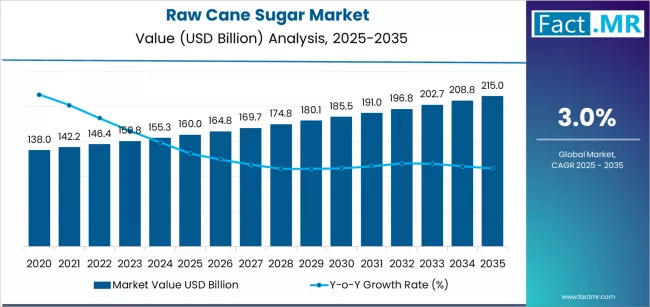
Raw Cane Sugar Market Market Value Analysis | Source: Fact.MR
Raw Cane Sugar Market Key Takeaways
| Metric | Details |
|---|---|
| Industry Size (2026) | USD 164.80 billion |
| Industry Value (2036) | USD 221.48 billion |
| CAGR (2026 to 2036) | 3.0% |
Source: Fact.MR analysis. Updated Mar 20, 2026
Raw Cane Sugar Market Definition
Raw cane sugar is the unrefined or partially refined crystalline sucrose extracted from sugarcane stalks through milling, clarification, and evaporation processes. It is traded as a bulk commodity for further refining into white sugar or direct use in food processing and ethanol production. The product serves as a primary caloric sweetener and a feedstock for industrial fermentation.
Raw Cane Sugar Market Inclusions
Market scope covers global and regional trade volumes and values for raw cane sugar, forecast period from 2026 to 2036, segment breakdowns by region, trade flow, and end use application. Pricing trend analysis across major trading hubs and seasonal production cycle assessments are included.
Raw Cane Sugar Market Exclusions
The scope excludes refined white sugar, liquid sucrose syrups, and specialty sugars such as demerara and muscovado unless traded as raw commodity grades. Downstream confectionery and beverage finished products are not within analytical boundaries. Beet-derived raw sugar is analyzed separately.
Raw Cane Sugar Market Research Methodology
- Primary Research: Analysts conducted interviews with sugar trading desk leads, mill procurement directors, and commodity logistics managers across 40 countries to validate production and trade volume data.
- Desk Research: Data collection aggregated national agricultural ministry production reports, customs trade databases, and international commodity exchange filings.
- Market-Sizing and Forecasting: Baseline values derive from a bottom-up aggregation of mill-level output data, applying country-specific yield curves and ethanol diversion rates to project trade volumes.
- Data Validation and Update Cycle: Projections are cross-validated against publicly reported quarterly trade data from major commodity exchanges and national statistical agencies.
Summary of Raw Cane Sugar Market
- Raw Cane Sugar Market Definition
- Raw cane sugar encompasses unrefined crystalline sucrose extracted from sugarcane, traded globally as a bulk commodity for refining, food processing, and bioethanol production.
- Demand Drivers in the Market
- Expanding processed food and beverage manufacturing sectors across South and Southeast Asia require consistent raw sugar feedstock volumes to maintain production schedules.
- Government-mandated bioethanol blending programs in Brazil and India create a competitive allocation dynamic between sugar milling and fuel distillation that supports floor pricing.
- Population growth and rising per-capita caloric intake in Sub-Saharan Africa generate incremental demand for affordable sweetener imports.
- Key Segments Analyzed in theFact.MR Report
- Asia accounts for 45.0% of regional demand in 2026, reflecting India's massive domestic consumption base and China's persistent import requirements.
- Domestic Use commands 71.0% of trade classification, as producing nations retain the majority of output for internal refining and consumption.
- Food & Beverage end use holds 64.0% of demand, anchored by confectionery, bakery, and beverage manufacturing sectors worldwide.
- Analyst Opinion atFact.MR
- FACT.MR analysts observe that the raw cane sugar market operates within a tightly regulated global trade framework where government quotas, tariff-rate structures, and ethanol mandates define the boundaries of supply availability. Mills that fail to secure long-term offtake agreements face margin compression during surplus harvest cycles. Capital allocation toward refinery modernization and logistics infrastructure will determine which producing nations capture incremental export share through 2036.
- Strategic Implications / Executive Takeaways
- Sugar trading firms must secure diversified sourcing agreements across multiple producing nations to mitigate single-origin harvest risk during volatile weather cycles.
- Refinery operators should prioritize capacity expansion aligned with projected import quota increases in destination markets such as China and Indonesia.
- Bioethanol producers must integrate flexible milling technology to optimize feedstock allocation between sugar crystal output and fuel-grade ethanol depending on prevailing commodity price signals.
- Methodology
- Primary Research:Fact.MR conducted technical interviews with commodity trading managers, mill operations directors, and logistics planners across 40 countries.
- Desk Research: Analysts aggregated production reports from national agricultural ministries, customs trade data, and commodity exchange filings.
- Market-Sizing and Forecasting: Forecasting models apply a bottom-up methodology starting with mill-level production metrics and projecting trade flows based on yield and policy variables.
Raw Cane Sugar Market Key Takeaways
| Metric | Value |
|---|---|
| Estimated Value in (2026E) | USD 160.0 billion |
| Forecast Value in (2036F) | USD 215.0 billion |
| Forecast CAGR (2026 to 2036) | 3.0% |
Source: Fact.MR analysis. Updated Mar 20, 2026
From 2030 to 2036, the market is forecast to grow from USD 185.0 billion to USD 215.0 billion, adding another USD 30.0 billion, which constitutes 54.5% of the overall ten-year expansion. This period is expected to be characterized by the expansion of specialized agricultural manufacturing facilities, the integration of advanced food technologies, and the development of customized raw cane sugar systems for specific food applications. The growing adoption of agricultural standards and food optimization requirements will drive demand for ultra-high quality raw cane sugar systems with enhanced sweetening specifications and consistent production characteristics.
Between 2020 and 2026, the market experienced steady expansion, driven by increasing recognition of agricultural technologies' importance in food operations and growing acceptance of specialized agricultural solutions in complex food optimization processes. The market developed as food providers recognized the need for high-quality agricultural systems to address stringent performance requirements and improve overall food outcomes. Research and development activities have begun to emphasize the importance of advanced agricultural technologies in achieving better production and sustainability in food processes.
Why is the Raw Cane Sugar Market Growing?
Market expansion is being supported by the increasing demand for food solutions and the corresponding need for high-quality agricultural systems in raw cane sugar applications across global agriculture and food operations. Modern food providers are increasingly focused on specialized agricultural technologies that can improve food performance, reduce operational costs, and enhance sweetening quality while meeting stringent production requirements. The proven efficacy of raw cane sugar in various food applications makes them an essential component of comprehensive food strategies and agricultural production.
The growing focus on food transformation and advanced agricultural optimization is driving demand for ultra-efficient raw cane sugar systems that meet stringent performance specifications and quality requirements for food applications. Food manufacturers' preference for reliable, high-performance agricultural systems that can ensure consistent food outcomes is creating opportunities for innovative agricultural technologies and customized food solutions. The rising influence of food regulations and agricultural protocols is also contributing to increased adoption of premium-grade raw cane sugar systems across different food applications and agricultural systems requiring specialized agricultural technology.
Opportunity Pathways - Raw Cane Sugar Market
The raw cane sugar market represents a specialized growth opportunity, expanding from USD 160.0 billion in 2025 to USD 215.0 billion by 2035 at a 3.0% CAGR. As food providers prioritize agricultural performance, quality compliance, and food efficiency in complex agricultural processes, agricultural systems have evolved from a niche food technology to an essential component enabling food optimization, performance monitoring, and multi-stage agricultural production across food operations and specialized agricultural applications.
The convergence of food expansion, increasing agricultural optimization adoption, specialized food organization growth, and performance monitoring requirements creates steady momentum in demand. High-efficiency formulations offering superior agricultural performance, cost-effective Asia systems balancing performance with economics, and specialized food & beverage variants for critical applications will capture market premiums, while geographic expansion into high-growth Asian food markets and emerging market penetration will drive volume leadership. Regulatory focus on food adoption and agricultural performance provides structural support.
- Pathway A - Asia Regional Dominance: Leading with 45.0% market share, Asia applications drive primary demand through complex food workflows requiring specialized agricultural systems for raw cane sugar optimization. Advanced formulations enabling improved food performance, reduced agricultural costs, and enhanced production quality command premium pricing from food providers requiring stringent performance specifications and quality compliance. Expected revenue pool: USD 72.0-96.8 billion.
- Pathway B - Domestic Use Market Leadership: Dominating with 71.0% market share through an optimal balance of accessibility and efficiency, domestic use serves most food applications while meeting raw cane sugar requirements. This specification addresses both performance standards and economic considerations, making it the preferred choice for food manufacturing and agricultural operations seeking reliable performance. Opportunity: USD 113.6-152.7 billion.
- Pathway C - American Market Acceleration: USA (3.3% CAGR) and Mexico (2.9% CAGR) lead regional growth through food infrastructure expansion, agricultural capability development, and domestic raw cane sugar demand. Strategic partnerships with local food manufacturers, quality compliance expertise, and supply chain localization enable the expansion of agricultural technology in major food hubs. Geographic expansion upside: USD 48.0-64.5 billion.
- Pathway D - Food & Beverage Premium Segment: Food & beverage applications serve specialized applications requiring exceptional performance specifications for critical agricultural processes. Food & beverage formulations supporting quality requirements, food applications, and performance-sensitive processes command significant premiums from advanced food companies and specialized agricultural organizations. Revenue potential: USD 126.4-169.9 billion.
- Pathway E - Advanced Processing & Technology Systems: Companies investing in sophisticated agricultural processing technologies, food analytics systems, and automated agricultural processes gain competitive advantages through consistent system performance and food reliability. Advanced processing capabilities enabling customized specifications and rapid scale-up capture premium food partnerships. Technology premium: USD 32.0-43.0 billion.
- Pathway F - Supply Chain Optimization & Reliability: Specialized distribution networks, strategic inventory management, and reliable supply chain systems create competitive differentiation in food markets requiring consistent raw cane sugar system availability. Companies offering guaranteed supply security, technical support, and quality documentation gain preferred supplier status with compliance-focused food providers. Supply chain value: USD 26.7-35.9 billion.
- Pathway G - Emerging Applications & Market Development: Beyond traditional food & beverage, raw cane sugar in industrial, bioethanol applications, and specialty food systems represent growth opportunities. Companies developing new applications, supporting R&D initiatives, and expanding into adjacent food markets capture incremental demand while diversifying revenue streams. Emerging opportunity: USD 21.3-28.7 billion.
Segmental Analysis
The market is segmented by region (production), trade, and end use. By region (production), the market is divided into Asia, Latin America, and Africa/others. Based on trade, the market is categorized into Domestic use and Exports. By end use, the market is divided into Food & beverage, Industrial, and Bioethanol.
By Region (Production), Asia Segment Accounts for 45.0% Market Share
The Asia segment is projected to account for 45.0% of the raw cane sugar market in 2025, reaffirming its position as the category's dominant production region. Food manufacturers increasingly recognize the optimal balance of production capacity and efficiency offered by Asia systems for most of the raw cane sugar applications, particularly in agricultural production and food optimization processes. This region addresses both production requirements and economic considerations while providing reliable agricultural performance across diverse food applications.
This region forms the foundation of most food protocols for raw cane sugar applications, as it represents the most established and commercially viable level of agricultural technology in the industry. Performance control standards and extensive food testing continue to strengthen confidence in Asia production among food and agricultural providers. With increasing recognition of the cost-performance optimization requirements in food agriculture, Asia systems align with both operational efficiency and food reliability goals, making them the central growth driver of comprehensive food agriculture strategies.
By Trade, Domestic Use Segment Accounts for 71.0% Market Share
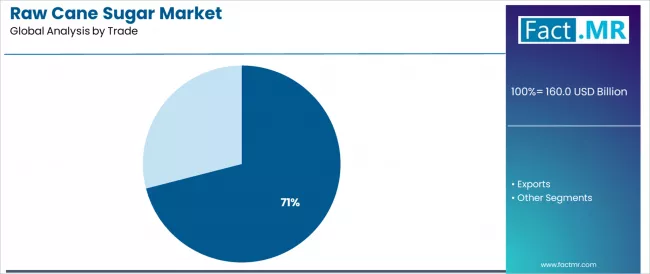
Raw Cane Sugar Market Analysis By Trade | Source: Fact.MR
Domestic use is projected to represent 71.0% of raw cane sugar demand in 2025, underscoring its role as the primary trade segment driving market adoption and growth. Food manufacturers recognize that domestic requirements, including complex food processes, specialized agricultural needs, and multi-stage food systems, often require specialized agricultural services that standard food technologies cannot adequately provide. Raw cane sugar offers enhanced operational efficiency and quality compliance in domestic use applications.
The segment is supported by the growing nature of food adoption, requiring sophisticated agricultural systems, and the increasing recognition that specialized agricultural technologies can improve food performance and agricultural outcomes. Food providers are increasingly adopting evidence-based agricultural guidelines that recommend specific agricultural systems for optimal food outcomes. As understanding of food complexity advances and quality requirements become more stringent, raw cane sugar will continue to play a crucial role in comprehensive food strategies within the domestic use market.
What are the Drivers, Restraints, and Key Trends of the Raw Cane Sugar Market?
The raw cane sugar market is advancing steadily due to increasing recognition of agricultural technologies' importance and growing demand for high-quality agricultural systems across the agriculture and food sectors. The market faces challenges, including complex integration processes, potential for performance variations during implementation and manufacturing, and concerns about supply chain consistency for specialized food equipment. Innovation in agricultural technologies and customized food protocols continues to influence product development and market expansion patterns.
Expansion of Specialized Food Agricultural Manufacturing and Agricultural Technologies
The growing adoption of advanced food agricultural manufacturing facilities is enabling the development of more sophisticated raw cane sugar production and quality control systems that can meet stringent food requirements. Specialized manufacturing plants offer comprehensive agricultural services, including advanced processing and optimization processes that are particularly important for achieving high-quality requirements in food applications. Advanced agricultural channels provide access to premium systems that can optimize food performance and reduce operational costs while maintaining cost-effectiveness for large-scale food operations.
Integration of Digital Food Systems and Agricultural Management Systems
Modern food companies are incorporating digital technologies such as real-time performance monitoring, automated agricultural management systems, and supply chain integration to enhance raw cane sugar manufacturing and distribution processes. These technologies improve system performance, enable continuous food monitoring, and provide better coordination between manufacturers and customers throughout the supply chain. Advanced digital platforms also enable customized performance specifications and early identification of potential system deviations or supply disruptions, supporting reliable food agricultural production.
Analysis of the Raw Cane Sugar Market by Key Country
.webp "Top Country Growth Comparison Raw Cane Sugar Market Cagr (2026 2036)")
Top Country Growth Comparison Raw Cane Sugar Market Cagr (2026 2036) | Source: Fact.MR
| Country | CAGR (2025-2035) |
|---|---|
| USA | 3.3% |
| Mexico | 2.9% |
| Germany | 2.6% |
| France | 2.5% |
| South Korea | 2.5% |
| UK | 2.4% |
| Japan | 2.3% |
Source: Fact.MR analysis. Updated Mar 20, 2026
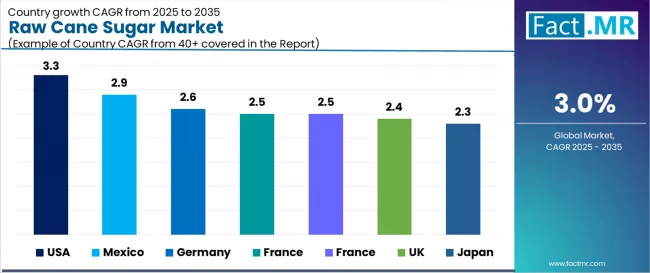
Raw Cane Sugar Market Cagr Analysis By Country | Source: Fact.MR
The market is experiencing varied growth globally, with USA leading at a 3.3% CAGR through 2035, driven by the expansion of food infrastructure development, increasing agricultural capabilities, and growing domestic demand for high-quality agricultural systems. Mexico follows at 2.9%, supported by food expansion, growing recognition of specialized agricultural technology importance, and expanding manufacturing capacity. Germany shows growth at 2.6%, emphasizing advanced food technologies and precision agricultural applications. France records 2.5% growth, with a focus on developing the food technology and agricultural industries. South Korea shows 2.5% growth, representing an established market with expanding food infrastructure and quality frameworks. UK exhibits 2.4% growth, supported by advanced manufacturing frameworks and comprehensive food guidelines. Japan demonstrates 2.3% growth, emphasizing food infrastructure expansion and systematic agricultural optimization approaches.
United States Demonstrates Growing Market Potential with Food Development
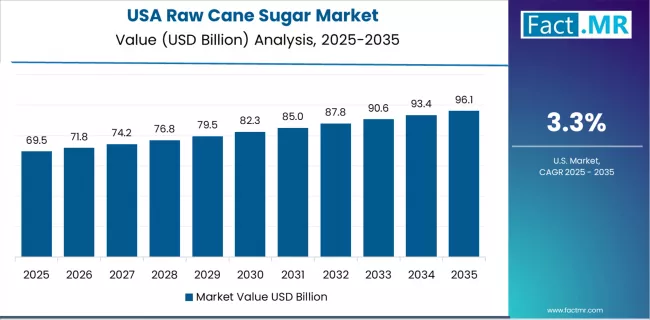
Raw Cane Sugar Market Country Value Analysis | Source: Fact.MR
The USA is projected to exhibit robust growth with a CAGR of 3.3% through 2035, driven by ongoing food expansion and increasing recognition of high-quality agricultural systems as essential food components for complex agricultural processes. The country's expanding food infrastructure and growing availability of specialized agricultural capabilities are creating significant opportunities for raw cane sugar adoption across both domestic and export-oriented food facilities. Major international and domestic food companies are establishing comprehensive production and distribution networks to serve the growing population of agricultural providers and food manufacturers requiring high-performance agricultural systems across agricultural and food applications throughout USA's major food development hubs.
The American government's strategic focus on food modernization and agricultural advancement is driving substantial investments in specialized agricultural capabilities. This policy support, combined with the country's large domestic food market and expanding agricultural infrastructure requirements, creates a favorable environment for the raw cane sugar market development. American manufacturers are increasingly focusing on high-value food technologies to improve agricultural capabilities, with raw cane sugar representing a key component in this food transformation.
- Government initiatives supporting food development and agricultural modernization are driving demand for high-quality agricultural systems throughout major food and agricultural centers, including Florida, Louisiana, and Hawaii regions.
- Manufacturing capacity expansion and agricultural system development are supporting appropriate utilization of raw cane sugar among food providers and agricultural manufacturers nationwide, with particular growth in food & beverage operations and food agricultural services.
Mexico Demonstrates Exceptional Market Potential with Food Growth
Mexico is expanding at a CAGR of 2.9%, supported by increasing food accessibility, growing agricultural awareness, and developing agricultural market presence across the country's major food manufacturing clusters. The country's large agricultural sector and increasing recognition of specialized agricultural systems are driving demand for effective high-quality agricultural solutions in both food and agricultural applications. International food companies and domestic manufacturers are establishing comprehensive distribution channels to serve the growing demand for quality agricultural systems while supporting the country's position as an emerging food technology market.
Mexico's agricultural sector continues to benefit from favorable food policies, expanding manufacturing capabilities, and cost-competitive agricultural infrastructure development. The country's focus on becoming a global food hub is driving investments in specialized agricultural technology and agricultural infrastructure. This development is particularly important for raw cane sugar applications, as food providers seek reliable domestic sources for critical agricultural technologies to reduce import dependency and improve supply chain security.
- Rising awareness about advanced agricultural options and improving manufacturing capabilities are creating opportunities for specialized agricultural systems across food and agricultural settings in major hubs like Veracruz, Jalisco, and San Luis Potosí.
- Growing manufacturing infrastructure development and technology adoption are supporting increased access to high-quality raw cane sugar among companies requiring comprehensive agricultural capabilities, particularly in food manufacturing and agricultural organizations.
Germany Maintains Market Leadership with Advanced Food Manufacturing
Germany is projected to grow at a CAGR of 2.6%, supported by well-established food manufacturing systems and precision agricultural protocols that emphasize performance, consistency, and quality compliance. German food manufacturers consistently utilize high-quality agricultural systems for complex agricultural applications and advanced food manufacturing, with particular strength in specialty agricultural technologies and high-value agricultural systems. The market is characterized by mature manufacturing protocols, comprehensive performance standards, and established relationships between food companies and agricultural providers that support long-term supply agreements and technical collaboration.
Germany's food industry benefits from advanced research and development capabilities, sophisticated manufacturing infrastructure, and strong regulatory frameworks that support high-quality agricultural system production. The country's focus on innovation and sustainability is driving the development of more efficient agricultural processes and cleaner production methods for specialized food systems like raw cane sugar. This focus on technological advancement and environmental responsibility aligns with global trends toward eco-friendly agricultural practices.
- Evidence-based agricultural guidelines and food research are supporting continued utilization of proven high-quality agricultural systems throughout food systems, with particular focus on food & beverage applications requiring stringent performance specifications.
- Specialty agricultural networks and manufacturing organizations are facilitating access to raw cane sugar while ensuring appropriate quality control and supply chain management, supported by Germany's strong logistics infrastructure and regulatory expertise.
France Shows Promising Growth with Food Infrastructure Expansion
France is projected to grow at a CAGR of 2.5% through 2035, driven by food infrastructure development, increasing access to agricultural capabilities, and growing recognition of specialized agricultural systems' importance in complex food optimization applications. French food providers are increasingly adopting high-quality agricultural approaches for complex agricultural applications, supported by expanding food market presence and improved technology accessibility across the country's major food regions. The market benefits from France's large domestic agricultural sector and growing participation in European food supply chains.
France's agricultural sector is experiencing modernization and expansion, particularly in food technologies and specialty agricultural systems. The country's strategic location and trade agreements provide access to both domestic and export markets, creating opportunities for raw cane sugar suppliers. Government support for food and agricultural technology development, combined with increasing private sector investment, is driving infrastructure improvements and capacity expansion in specialized agricultural manufacturing.
- Food development programs and agricultural access initiatives are supporting increased availability of raw cane sugar across diverse food applications, with particular growth in specialty food and agricultural services.
- Growing collaboration between international food companies and local manufacturers is enhancing agricultural options and technical expertise in high-quality agricultural, supported by technology transfer initiatives and joint venture partnerships.
South Korea Demonstrates Stable Growth with Established Manufacturing Infrastructure
South Korea is projected to grow at a CAGR of 2.5% through 2035, supported by established food manufacturing systems, evidence-based agricultural protocols, and comprehensive food frameworks that emphasize performance, quality, and regulatory compliance. South Korean food manufacturers consistently utilize high-quality agricultural systems as part of integrated food approaches, emphasizing agricultural outcomes and performance optimization in both agricultural and agricultural production. The market benefits from strong research and development capabilities, advanced manufacturing infrastructure, and well-established regulatory frameworks.
South Korea's food sector's focus on innovation and agricultural transformation drives demand for specialized agricultural systems that can support complex food optimization processes and meet stringent regulatory requirements. The country's mature market characteristics include established supplier relationships, comprehensive performance standards, and sophisticated logistics networks that support reliable supply chain management for critical food technologies.
- Regulatory frameworks supporting appropriate agricultural system utilization and comprehensive food coverage are maintaining stable market growth across agricultural sectors, with particular focus on quality compliance and food practice requirements.
- Food research collaboration and evidence-based agricultural guideline development are supporting continued innovation and appropriate utilization of raw cane sugar in food and specialty agricultural applications throughout major food centers.
United Kingdom Demonstrates Steady Growth with Advanced Manufacturing Support
The UK is projected to grow at a CAGR of 2.4% through 2035, supported by advanced manufacturing frameworks and comprehensive evidence-based food guidelines that facilitate the appropriate use of high-quality agricultural systems for complex agricultural applications. British food manufacturers consistently utilize established protocols for agricultural, emphasizing food outcomes and performance optimization within integrated manufacturing systems that support both domestic agricultural production and export markets. The country benefits from strong research capabilities, established food clusters, and comprehensive regulatory support.
The UK's agricultural food industries are characterized by high levels of innovation, strong academic-industry collaboration, and focus on high-value specialty systems. The country's expanding food sector and focus on agricultural technology create steady demand for agricultural systems, while the focus on high-quality manufacturing supports premium pricing for specialized food systems like raw cane sugar.
- Manufacturing pathways and food guidelines are supporting systematic adoption of proven high-quality agricultural systems across agricultural food and agricultural manufacturing services, with particular focus on specialty agricultural and food optimization operations.
- Food education programs and agricultural research initiatives are maintaining high standards for agricultural system utilization and performance monitoring, supported by collaborations between industry, academia, and regulatory agencies.
Japan Anchors Growth with Precision Food Manufacturing Infrastructure
Japan is projected to grow at a CAGR of 2.3% through 2035, supported by the country's well-established precision food manufacturing infrastructure, comprehensive performance coverage, and systematic approach to agricultural optimization that emphasizes consistency, reliability, and technical excellence. Japanese food manufacturers emphasize evidence-based agricultural system utilization within structured manufacturing frameworks that prioritize food optimization effectiveness and system performance in both agricultural and specialty food applications. The market is characterized by high technical standards, established performance systems, and long-term supplier relationships.
Japan's food industry benefits from advanced technology, sophisticated performance control systems, and a strong focus on continuous improvement. The country's expanding agricultural food sector and focus on food efficiency create steady demand for agricultural systems, while the focus on high-quality manufacturing supports premium pricing for specialized food systems like raw cane sugar.
- Comprehensive manufacturing system coordination and regulatory oversight are supporting stable utilization of high-quality agricultural systems across diverse food manufacturing settings and applications, with particular strength in agricultural food and precision food production.
- Academic research centers and manufacturing institutions are maintaining leadership in agricultural research and agricultural optimization protocol development for optimal food outcomes, supported by strong government funding for food technology research and development programs.
Europe Market Split by Country
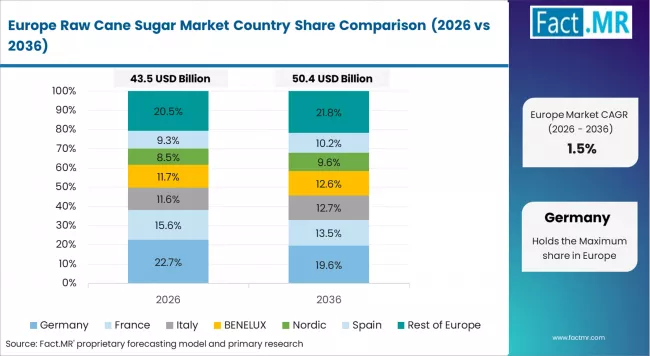
Raw Cane Sugar Market Europe Country Market Share Analysis, 2026 & 2036 | Source: Fact.MR
The raw cane sugar market in Europe is projected to grow from USD 38.4 billion in 2025 to USD 51.6 billion by 2035, registering a CAGR of 3.0% over the forecast period. Germany is expected to maintain its leadership position with a 31.8% market share in 2025, rising to 32.6% by 2035, supported by its advanced food infrastructure, precision agricultural capabilities, and strong agricultural presence throughout major food regions.
The United Kingdom follows with a 19.7% share in 2025, projected to reach 20.4% by 2035, driven by advanced food protocols, agricultural technology innovation integration, and expanding specialty agricultural networks serving both domestic and international markets. France holds a 16.9% share in 2025, expected to increase to 17.3% by 2035, supported by food infrastructure expansion and growing adoption of high-quality agricultural systems. Italy commands a 13.2% share in 2025, projected to reach 13.7% by 2035, while Spain accounts for 10.8% in 2025, expected to reach 11.3% by 2035. The BENELUX region is expected to maintain a 5.1% share in 2025, growing to 5.4% by 2035, supported by innovation-friendly regulatory frameworks and strong academic-industry collaboration. The Rest of Europe region, including Nordic countries, Eastern Europe, and smaller Western European markets, is anticipated to hold 2.5% in 2025, declining slightly to 2.3% by 2035, attributed to market consolidation toward larger core markets with established food and agricultural capabilities.
Competitive Landscape of the Raw Cane Sugar Market
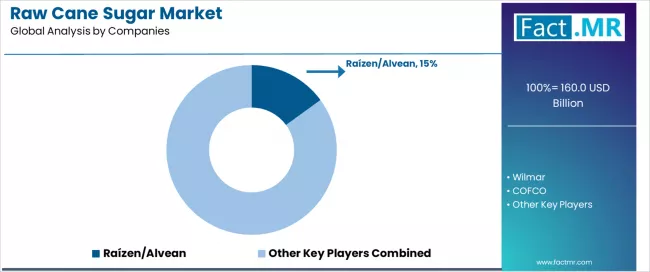
Raw Cane Sugar Market Analysis By Company | Source: Fact.MR
The market is characterized by competition among established food manufacturers, specialty agricultural companies, and agricultural service suppliers focused on delivering high-quality, consistent, and reliable agricultural systems. Companies are investing in agricultural technology advancement, performance control enhancement, strategic partnerships, and customer technical support to deliver effective, efficient, and reliable raw cane sugar solutions that meet stringent food and agricultural requirements. Agricultural optimization, performance validation protocols, and supply chain strategies are central to strengthening product portfolios and market presence.
Raízen/Alvean leads the market with comprehensive high-quality agricultural system offerings with a focus on agricultural consistency and manufacturing reliability for food applications. Wilmar provides specialized raw cane sugar systems with focus on food applications and comprehensive technical support services. COFCO focuses on advanced agricultural technologies and customized food solutions for agricultural systems serving global markets. Louis Dreyfus delivers established food systems with strong performance control systems and customer service capabilities.
Bunge operates with a focus on bringing innovative agricultural technologies to specialized food applications and emerging markets. Mitr Phol provides comprehensive agricultural system portfolios, including raw cane sugar, across multiple food applications and agricultural processes. Tereos specializes in customized agricultural solutions and performance management systems for food systems with focus on quality compliance. AB Sugar (Illovo) provides reliable supply chain solutions and technical expertise to enhance market accessibility and customer access to essential agricultural systems.
Key Players in the Raw Cane Sugar Market
- Raízen/Alvean
- Wilmar
- COFCO
- Louis Dreyfus
- Bunge
- Mitr Phol
- Tereos
- AB Sugar (Illovo)
- ED&F Man
- Cosan
Bibliography
- International Sugar Organization. (2024). Sugar Year Book 2024. ISO.
- Food and Agriculture Organization of the United Nations. (2024). Sugar: Market summary. FAO.
- United States Department of Agriculture, Foreign Agricultural Service. (2025). Sugar: World markets and trade. USDA FAS.
- Government of India, Department of Food and Public Distribution. (2024). Sugar production and consumption data 2023 to 2024. DFPD.
- Government of Brazil, Ministry of Agriculture. (2024). Sugarcane and ethanol production bulletin. MAPA.
- European Commission, Directorate-General for Agriculture and Rural Development. (2024). Sugar market situation report. EC.
This bibliography is provided for reader reference. The fullFact.MR report contains the complete reference list with primary research documentation.
This Report Addresses
- Market sizing and quantitative forecast metrics detailing global raw cane sugar trade volumes and values through 2036.
- Segmentation analysis mapping consumption patterns across geographic regions, trade classifications, and end-use applications.
- Regional deployment intelligence comparing production capacity expansion in tropical producer nations against refining demand in import-dependent economies.
- Regulatory compliance assessment analyzing how government ethanol mandates and tariff-rate quota structures affect supply allocation.
- Competitive landscape evaluation tracking the market positioning of major trading houses and integrated milling conglomerates.
- Strategic procurement guidance defining sourcing diversification requirements for downstream food processors.
- Supply chain vulnerability analysis identifying logistics constraints and weather-related harvest risks across key producing nations.
- Custom data delivery formats encompassing interactive dashboards, raw Excel datasets, and comprehensive PDF narrative reports.
Segmentation
Scope of the Report
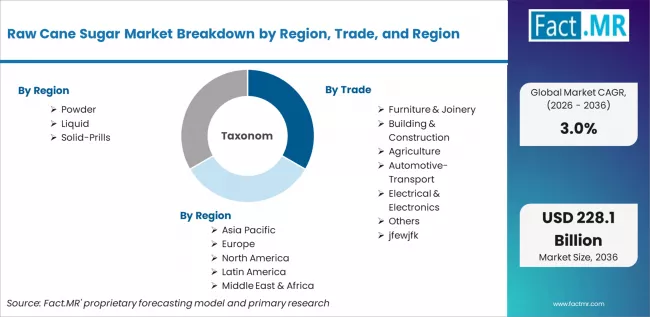
Raw Cane Sugar Market Breakdown By Region, Trade, And Region | Source: Fact.MR
| Metric | Value |
|---|---|
| Quantitative Units | USD 164.80 billion to USD 221.48 billion, at a CAGR of 3.0% |
| Market Definition | Raw cane sugar encompasses unrefined crystalline sucrose extracted from sugarcane, traded globally as a bulk commodity for refining, food processing, and bioethanol production. |
| Region Segmentation | Asia, Latin America, Africa/Others |
| Trade Segmentation | Domestic Use, Exports |
| End Use Segmentation | Food & Beverage, Industrial, Bioethanol |
| Regions Covered | North America, Latin America, Europe, East Asia, South Asia, Oceania, Middle East & Africa |
| Countries Covered | India, China, USA, Canada, UK, Germany, Japan, and 40 plus countries |
| Key Companies Profiled | Raizen/Alvean, Wilmar International Ltd., COFCO International, Louis Dreyfus Company, Bunge Ltd., Mitr Phol Sugar Corp. Ltd., Tereos SCA, AB Sugar (Illovo Sugar Africa), ED&F Man Holdings Ltd., Cosan S.A. |
| Forecast Period | 2026 to 2036 |
| Approach | Forecasting models apply a bottom-up methodology starting with mill-level output data, integrating country-specific yield projections, ethanol diversion assumptions, and trade policy variables. |
Source: Fact.MR analysis. Updated Mar 20, 2026
Raw Cane Sugar Market by Segments
-
Region (Production) :
- Asia
- Latin America
- Africa/others
-
Trade :
- Domestic use
- Exports
-
End Use :
- Food & beverage
- Industrial
- Bioethanol
-
Region :
-
Asia Pacific
- China
- India
- Japan
- South Korea
- ASEAN
- Australia & New Zealand
- Rest of Asia Pacific
-
North America
- United States
- Canada
- Mexico
-
Europe
- Germany
- United Kingdom
- France
- Italy
- Spain
- Nordic
- BENELUX
- Rest of Europe
-
Latin America
- Brazil
- Argentina
- Chile
- Rest
-
Frequently Asked Questions
How large is the demand for raw cane sugar in the global market in 2026?
What will be the market size of raw cane sugar by 2036?
What is the expected demand growth for raw cane sugar between 2026 and 2036?
Which region is poised to lead global demand by 2026?
How significant is the role of food and beverage end use in driving raw cane sugar demand?
What share does domestic use hold in global trade classification?
What is driving demand in India?
What compliance standards are referenced for Brazil?
What is the primary trade flow structure?
What is raw cane sugar and what is it mainly used for?
What is included in the scope of this report?
What is excluded from the scope of this report?
How doesFact.MR build and validate the raw cane sugar forecast?
Does the report cover USA in its regional analysis?
Who worked on this report


Preview the report firsthand - request a free sample
Free SampleGet the brochure for pricing and purchase details
Download PDF