- Base Value(2025): 6.37 Bn
- Estimated Value(2026): 6.77 Bn
- Forecast Value (2036): 12.35 Bn
- CAGR (2026 - 2036): 6.2%
Raw Beetroot Sugar Market Size, Market Forecast and Outlook By FACT.MR
The raw beetroot sugar market was valued at USD 6.37 billion in 2025, projected to reach USD 6.77 billion in 2026, and is forecast to expand to USD 12.35 billion by 2036 at a 6.2% CAGR. The absolute dollar opportunity of approximately USD 5.58 billion added over the forecast decade reflects accelerating demand for beet-derived sugar products in European and North American food processing sectors. As per FACT.MR, tightening agricultural land availability and rising input costs for beet cultivation shape the pricing dynamics that sustain this expansion trajectory.
Sugar beet processing operates within a vertically integrated supply chain where contracted acreage, factory throughput capacity, and by-product valorization (pulp, molasses, betaine) determine profitability per hectare. European Union Common Agricultural Policy (CAP) reforms and the abolition of production quotas in 2017 shifted competitive dynamics toward efficiency-focused consolidation among remaining processors. FACT.MR analysts note that organic certification premiums and non-GMO labeling requirements create segmented pricing tiers that benefit producers capable of maintaining traceability from field to crystal.
Germany and France dominate European beet sugar output, collectively accounting for the majority of EU production capacity. United States beet sugar production concentrates in the Red River Valley of Minnesota and North Dakota, where cooperative-owned factories process contracted acreage under federal sugar program price supports. Russia expanded its beet sugar processing capacity to reduce import dependency, while Turkey and Egypt maintain moderate beet cultivation for domestic supply supplementation. FACT.MR is of the opinion that climate adaptation and water management technologies will increasingly dictate the geographic viability of sugar beet farming through 2036.
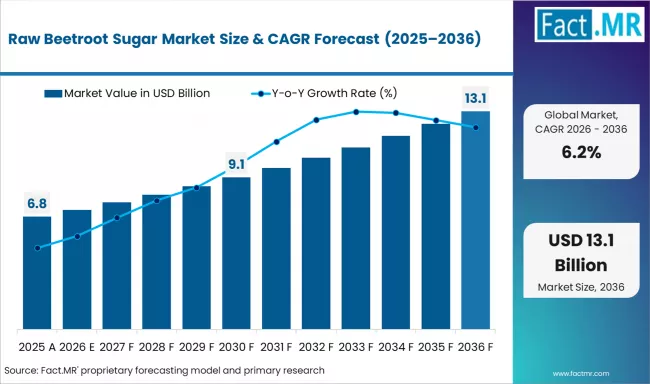
Raw Beetroot Sugar Market Market Value Analysis | Source: Fact.MR
Raw Beetroot Sugar Market Key Takeaways
| Metric | Details |
|---|---|
| Industry Size (2026) | USD 6.77 billion |
| Industry Value (2036) | USD 12.35 billion |
| CAGR (2026 to 2036) | 6.2% |
Source: Fact.MR analysis. Updated Mar 20, 2026
Raw Beetroot Sugar Market Definition
Raw beetroot sugar is the crystalline sucrose product extracted from sugar beet roots through diffusion, purification, and crystallization processes. It is used as a primary sweetener in food manufacturing, livestock feed production (via by-products), and industrial applications. The product is chemically identical to cane-derived sucrose but differs in production geography and agricultural cycle.
Raw Beetroot Sugar Market Inclusions
Market scope covers global and regional production volumes and values for raw beetroot sugar, forecast period from 2026 to 2036, segment breakdowns by product type and end user. Analysis of by-product valorization streams and organic certification trends is included.
Raw Beetroot Sugar Market Exclusions
The scope excludes refined white beet sugar beyond the raw processing stage, cane-derived raw sugar, and downstream finished food products. Specialty beet extracts used in cosmetic or pharmaceutical applications fall outside the analytical boundaries.
Raw Beetroot Sugar Market Research Methodology
- Primary Research: Analysts engaged with beet sugar factory operations managers, agricultural cooperative procurement leads, and food ingredient buyers across 30 countries.
- Desk Research: Data collection aggregated EU agricultural subsidy reports, USDA crop production data, and national food safety authority processing standards.
- Market-Sizing and Forecasting: Baseline values derive from a bottom-up aggregation of factory-level output, applying regional yield-per-hectare trends and contracted acreage projections.
- Data Validation and Update Cycle: Projections are cross-validated against publicly reported annual production statistics from national agricultural ministries and commodity trading data.
Summary of Raw Beetroot Sugar Market
- Raw Beetroot Sugar Market Definition
- Raw beetroot sugar encompasses crystalline sucrose extracted from sugar beet roots through industrial diffusion and crystallization, traded for food processing, livestock feed by-products, and industrial sweetener applications.
- Demand Drivers in the Market
- European food processors require domestically sourced beet sugar to comply with regional supply chain traceability mandates and reduce import dependency.
- Organic and non-GMO certification requirements from retail buyers create premium pricing tiers that incentivize dedicated organic beet cultivation programs.
- Livestock feed manufacturers rely on beet pulp and molasses by-products as cost-effective energy sources, linking sugar beet processing economics to animal nutrition demand.
- Key Segments Analyzed in the FACT.MR Report
- Brown product type holds 68.0% share in 2026, reflecting strong demand from artisanal bakery and specialty food manufacturers seeking less refined sweetener inputs.
- Food Processors account for 52.0% of end-user demand, driven by confectionery, bakery, and beverage production requiring consistent sucrose feedstock.
- Germany and France together anchor European production, with the EU representing the single largest beet sugar processing region globally.
- Analyst Opinion at FACT.MR
- As per FACT.MR, the raw beetroot sugar market is shaped by the dual pressures of agricultural policy reform and buyer-driven sustainability certification. Processors that cannot demonstrate auditable field-to-factory traceability risk losing shelf placement in premium retail channels. Capital investment in factory energy efficiency and by-product conversion capacity determines which operators maintain viable margins as input costs for seed, fertilizer, and water management rise across temperate cultivation zones.
- Strategic Implications / Executive Takeaways
- Beet sugar processors must invest in organic and non-GMO certification infrastructure to capture premium pricing tiers increasingly mandated by large retail procurement programs.
- Agricultural cooperatives should expand contracted acreage planning horizons to secure stable feedstock supply against competing crop rotation pressures.
- By-product valorization through dried beet pulp pellet exports and betaine extraction represents an underexploited margin enhancement pathway for integrated processors.
- Methodology
- Primary Research: FACT.MR conducted technical interviews with factory operations managers, cooperative procurement leads, and food ingredient buyers across 30 countries.
- Desk Research: Analysts aggregated EU agricultural policy reports, USDA crop data, and national food safety processing standards.
- Market-Sizing and Forecasting: Models apply a bottom-up methodology starting with factory-level output and contracted acreage projections.
What are the Key Drivers of the Raw Beetroot Sugar Market?
Rapid Increase in Adoption of Sugar Beetroot Pectin in Food Industry
Market growth of raw beetroot sugar is driven by the expanding uses of sugar beetroot pectin in the food industry. Since sugar beetroot pectin improves the characteristics of food products, the use of this substance is on the rise in the food industry. The characteristics include rheological, physicochemical, and nutritional elements.
Sugar beetroot pectin is gaining traction, despite being a more recent kind of pectin. This is connected to the fact that sugar beetroot pectin is produced with comparatively fewer steps than other types of pectin. Due to increasing research and development activities in the food industry, the worldwide market is expected to rise over the coming years.
Growing demand for components produced from plant sources is also being driven by the growing popularity of veganism and plant-based diets. Pectin from sugar beets is a vegan ingredient that may be used in a variety of foods, including jams, jellies, and desserts. The market for sugar beetroot pectin is anticipated to expand as a result of this trend, which is encouraging businesses to choose natural, vegan substitutes for conventional components.
Growing Usage of Raw Beetroot Sugar in Cosmetic Products
Increasing applications of raw beetroot sugar in cosmetics are driving market growth. Attributed to its high vitamin C content, raw beetroot sugar is also significantly used in cosmetic products such as sugar scrubs. Moreover, market growth is also driven by the application of the extract in facial masks and soaps, as it helps in reducing acne and blemishes on the skin.
The market is expected to witness considerable growth, driven by the adoption by cosmetic manufacturers for the production of lip gloss, blush, and hair color products. Due to such factors, market expansion will be significantly driven by the cosmetic industry.
Huge Demand for Natural Sweeteners
Demand for natural sweeteners is predicted to increase as consumer awareness of maintaining healthy eating and lifestyle habits rises. A healthier alternative to artificial sweeteners is raw beetroot sugar.
Betaine, a naturally occurring and prospective vitamin source found in raw beetroot sugar, is also present. It is employed in energy drinks for athletes and fitness enthusiasts. The worldwide market is anticipated to be driven by the rising use of raw beetroot sugar in the beverage industry over the coming years.
What is Restraining Global Demand Growth for Raw Beetroot Sugar?
Adverse Effects of Contamination on Growth of Sugar Beetroot Crops
Development of the global market for raw beetroot sugar may be hampered by a few restrictions. The adverse effects of contamination on the growth of sugar beetroot crops are one of the key inhibitors. By lowering the quality of the finished product, the extraction of sugar from these unhealthy crops might impede market expansion.
Pricing trends indicate that fluctuating costs of industrial equipment and raw materials are restraining market value. The availability of substitutes such as palm sugar is hampering market growth.
Which Region is Forecasted to Generate Substantial Revenue for Raw Beetroot Sugar Producers?
Favorable Climate for Sugar Beetroot Cultivation in Asia Pacific
- Asia Pacific accounts for 50% share of the global market due to the growing usage of raw beetroot sugar in livestock feed.
Increasing standards of living, a favorable climate for sugar beetroot cultivation, and rising disposable income are the key elements boosting market demand. Growing consumer preference for raw beetroot sugar over refined beet sugar is predicted to favor market expansion.
Country-wise Insights
.webp "Top Country Growth Comparison Raw Beetroot Sugar Market Cagr (2026 2036)")
Top Country Growth Comparison Raw Beetroot Sugar Market Cagr (2026 2036) | Source: Fact.MR
Why are Sales of Raw Beetroot Sugar Bolstering in the United States?
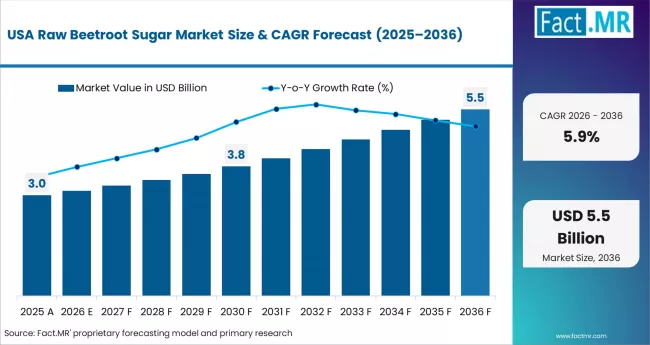
Raw Beetroot Sugar Market Country Value Analysis | Source: Fact.MR
Rapidly Expanding Food and Beverage Industry
The market in the United States is anticipated to experience considerable growth as a result of the expanding food and beverage industry. The development of the market may be influenced by the growing usage of sugar beetroot pectin as an emulsifier. Rapid innovation in harvesting technologies is boosting market value in the country.
Why is Demand for Raw Beetroot Sugar Strong in Germany?
Increase in Sugar Beetroot Production
Market growth in Germany is attributed to the massive production of sugar beets with premium and high-yield seeds. High alcoholic beverage consumption is boosting demand for natural flavorings and sweeteners and fostering market expansion. Increasing research and development efforts by major corporations and rising convenience food consumption are driving market revenue.
What Makes Japan an Opportune Market for Raw Beetroot Sugar Manufacturers?
Shifting Consumer Preferences toward Organic Ingredients
The market in Japan is expected to rise over the coming years due to rapid urbanization and the increasing usage of sugar beetroot pectin in bakery products. The growing population and shifting consumer preferences toward organic ingredients are supporting market expansion. The market value is anticipated to increase as a result of expanding distribution channels and rising demand for biofuel and ethanol-blend fossil fuel.
Category-wise Insights
Which Type of Raw Beetroot Sugar is Highly Sought-after?
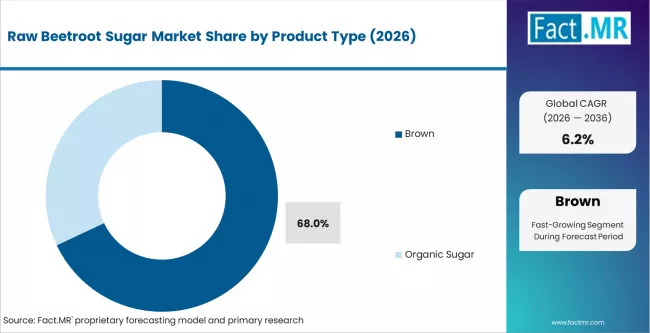
Raw Beetroot Sugar Market Analysis By Product Type | Source: Fact.MR
Brown Sugar Popular for Enhancing Blood Circulation and Aiding Platelet Development
Based on product type, the market is divided into brown (dark) sugar and organic sugar.
- Brown (dark) sugar accounts for 70% share of the global market in 2023.
Raw cane sugar or beetroot sugar is used to make brown sugar. Growing consumer awareness of the advantages of brown sugar intake is expected to boost market growth over the forecast period. Blood circulation is improved by brown sugar, which also promotes platelet growth.
Brown sugar has more additives than traditional white sugar, such as iron, calcium, magnesium, and potassium. Brown sugar is used to sweeten many prepared dishes and drinks, sauces, and marinades.
Which End User Will Account for High Revenue Generation in This Market?
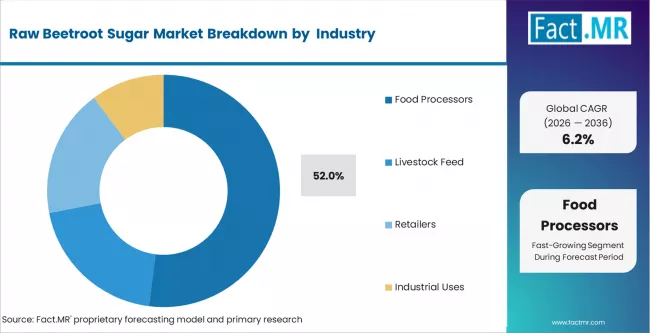
Raw Beetroot Sugar Market Analysis By End User | Source: Fact.MR
Raw Beetroot Sugar Widely Used in Food Processing Industry Owing to its Rich Properties of Vitamins, Iron, and Calcium
The market is segmented into food processors, livestock feed, retailers, and industrial uses based on end user. Known as a powerful antioxidant, the consumption of raw beetroot sugar is high in the food processing industry.
Raw beetroot sugar market growth is attributed to the rich properties of vitamins, iron, and calcium, which in turn have led to increased consumption of raw beetroot sugar in confectionery, beverages, and baked food products. The sugar pulp from beetroots also witnesses considerable demand among animal feed manufacturers globally.
While beetroot is a major source of sugar production, it also witnesses a significant demand among diabetic food manufacturers. Beetroot has a high sucrose content; however, the rate of converting it into glucose on consumption is low. Due to such factors, manufacturers producing diabetic food products prefer using raw beetroot sugar.
Competitive Landscape
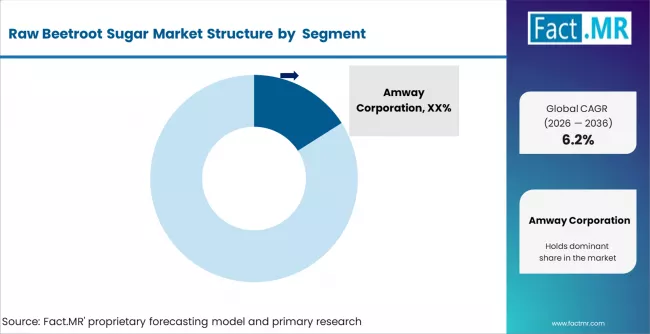
Raw Beetroot Sugar Market Analysis By Company | Source: Fact.MR
Leading companies are engaged in R&D activities to introduce new products to meet evolving customer demand trends. They are focusing on quality control, collaborations, supply chain management, new developments, and product standards to make a mark in the industry.
Top raw beetroot sugar manufacturers prefer using biotechnologically enhanced procedures for producing premium-quality beets while following safety regulations to reduce the environmental impact. This is expected to drive the raw beetroot sugar market over the coming years.
For instance,
- NutriScience Innovation LLC provides a range of uses for beetroot sugar extract in medicines, chemicals, and energy beverages.
Bibliography
- European Commission, Directorate-General for Agriculture and Rural Development. (2024). EU sugar market situation report. EC.
- United States Department of Agriculture, Economic Research Service. (2025). Sugar and sweeteners outlook. USDA ERS.
- Confederation Internationale des Betteraviers Europeens (CIBE). (2024). Beet growers annual report. CIBE.
- Food and Agriculture Organization of the United Nations. (2024). Sugar beet: Global production data. FAO.
- Nordzucker AG. (2024). Annual report 2023/2024. Nordzucker.
- Government of Germany, Federal Ministry of Food and Agriculture. (2024). Agricultural policy report 2024. BMEL.
This bibliography is provided for reader reference. The full FACT.MR report contains the complete reference list with primary research documentation.
This Report Addresses
- Market sizing and quantitative forecast metrics detailing global raw beetroot sugar production volumes and values through 2036.
- Segmentation analysis mapping demand patterns across product types and end-user categories in key beet-growing regions.
- Regional production intelligence comparing European consolidation dynamics against North American cooperative-model processing.
- Regulatory compliance assessment analyzing CAP reform impacts and organic certification requirements affecting processor economics.
- Competitive landscape evaluation tracking market positioning of major European and North American beet sugar processors.
- Strategic investment guidance identifying factory modernization and by-product valorization opportunities.
- Supply chain vulnerability analysis identifying climate-related yield risks and contracted acreage constraints across temperate zones.
- Custom data delivery formats encompassing interactive dashboards, raw Excel datasets, and comprehensive PDF narrative reports.
Segmentation
Scope of the Report
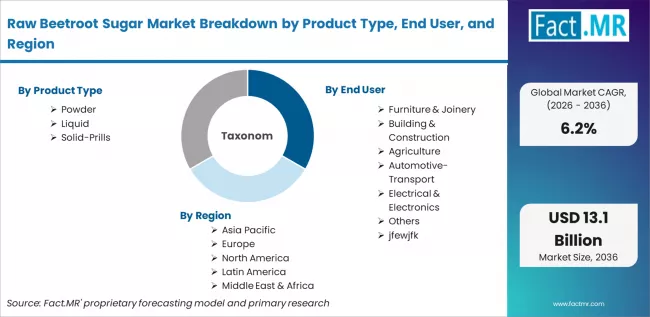
Raw Beetroot Sugar Market Breakdown By Product Type, End User, And Region | Source: Fact.MR
| Metric | Value |
|---|---|
| Quantitative Units | USD 6.77 billion to USD 12.35 billion, at a CAGR of 6.2% |
| Market Definition | Raw beetroot sugar encompasses crystalline sucrose extracted from sugar beet roots through industrial diffusion and crystallization, traded for food processing, livestock feed by-products, and industrial sweetener applications. |
| Product Type Segmentation | Brown, Organic Sugar |
| End User Segmentation | Food Processors, Livestock Feed, Retailers, Industrial Uses |
| Regions Covered | North America, Latin America, Europe, East Asia, South Asia, Oceania, Middle East & Africa |
| Countries Covered | India, China, USA, Canada, UK, Germany, Japan, and 40 plus countries |
| Key Companies Profiled | Suedzucker AG, Nordzucker AG, Tereos SCA, British Sugar plc, Cosun Beet Company, Pfeifer & Langen GmbH & Co. KG, Cristal Union, Michigan Sugar Company, American Crystal Sugar Company |
| Forecast Period | 2026 to 2036 |
| Approach | Forecasting models apply a bottom-up methodology starting with factory-level beet sugar output, integrating regional yield-per-hectare trends, contracted acreage data, and agricultural policy variables. |
Source: Fact.MR analysis. Updated Mar 20, 2026
Key Segments of Raw Beetroot Sugar Industry Research
-
By Product Type:
- Brown (Dark) Sugar
- Organic Sugar
-
By End User:
- Food Processors
- Livestock Feed
- Retailers
- Industrial Uses
-
By Region:
- North America
- Europe
- Asia Pacific
- Latin America
- Middle East & Africa
Frequently Asked Questions
How large is the demand for raw beetroot sugar in the global market in 2026?
What will be the market size of raw beetroot sugar by 2036?
What is the expected demand growth between 2026 and 2036?
Which product type is poised to lead by 2026?
How significant is the role of food processors in driving demand?
What is driving demand growth?
What is raw beetroot sugar and what is it mainly used for?
What is included in the scope of this report?
What is excluded from the scope of this report?
How does FACT.MR build and validate this forecast?
Does the report cover Germany in its regional analysis?
Does the report cover USA in its regional analysis?
Who worked on this report


Preview the report firsthand - request a free sample
Free SampleGet the brochure for pricing and purchase details
Download PDF