- Base Value(2025): 820.00 Mn
- Estimated Value(2026): 847.06 Mn
- Forecast Value (2036): 1171.97 Mn
- CAGR (2026 - 2036): 3.3%
Duplex Nickel Plating Market Size, Market Forecast and Outlook By Fact.MR
The duplex nickel plating market was valued at USD 820.00 million in 2025, projected to reach USD 847.06 million in 2026, and is forecast to expand to USD 1171.97 million by 2036 at a 3.3% CAGR. is being sustained by the automotive industry's continued specification of multi-layer nickel-chrome decorative plating on exterior trim components, where the duplex (semi-bright plus bright) nickel system provides the corrosion protection required to pass ASTM B456 and OEM-specific CASS (Copper Accelerated Salt Spray) test requirements that no single-layer nickel system can match.
The absolute dollar expansion between 2026 and 2036 amounts to approximately USD 324.91 million. Growth reflects automotive OEM production volumes (the primary demand driver), industrial machinery corrosion protection requirements, and plumbing fixture finishing. Nickel metal pricing (LME nickel traded between USD 16,000 and USD 22,000 per tonne through 2023 to 2025), environmental compliance costs for hexavalent chromium alternatives, and the capital intensity of automated plating line equipment act as cost variables.
Automotive plating engineers are qualifying trivalent chromium (Cr3+) topcoat processes over duplex nickel undercoats to replace hexavalent chromium (Cr6+) in compliance with EU ELV Directive and REACH restrictions. Plating chemical suppliers unable to demonstrate colour-matched trivalent chromium finishes that pass OEM visual standards over duplex nickel face progressive loss of automotive business.
All major regional markets reflect differentiated growth parameters. USA sets the pace at 3.8% CAGR. Mexico registers at 3.5% CAGR. Germany registers at 3.1% CAGR. France registers at 3.0% CAGR. UK registers at 2.9% CAGR. South Korea registers at 2.8% CAGR. Japan registers at 2.7% CAGR.
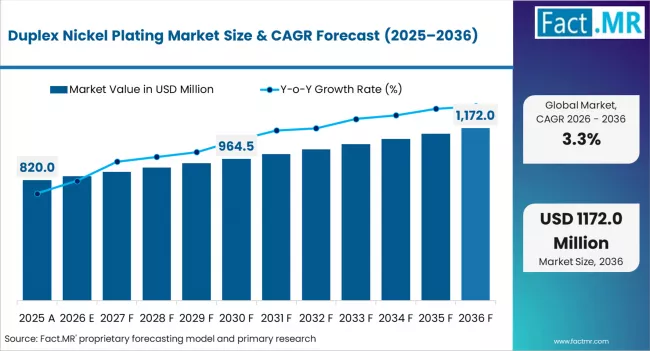
Duplex Nickel Plating Market Market Value Analysis | Source: Fact.MR
Duplex Nickel Plating Market Key Takeaways
| Metric | Details |
|---|---|
| Industry Size (2026) | USD 847.06 million |
| Industry Value (2036) | USD 1171.97 million |
| CAGR (2026 to 2036) | 3.3% |
Source: Fact.MR analysis. Updated Mar 24, 2026
Duplex Nickel Plating Market Definition
Duplex nickel plating is a multi-layer electroplating process that deposits two distinct nickel layers (semi-bright followed by bright) onto a substrate before final chromium topcoat application. The semi-bright nickel layer (containing less than 0.005% sulfur) provides the primary corrosion barrier, while the bright nickel layer (containing 0.04% to 0.1% sulfur) provides the levelling and reflectivity needed for decorative appearance. The electrochemical potential difference between the two layers creates a sacrificial corrosion mechanism that protects the substrate by preferentially corroding the bright layer before the semi-bright layer is attacked.
Duplex Nickel Plating Market Inclusions
Market scope covers global and regional revenue for duplex nickel plating services and chemicals across automotive, industrial machinery, and other application segments. Layer configuration segments include semi-bright plus bright, bright plus microcracked, and others. End-use segments span OEM and aftermarket. The forecast period is 2026 to 2036.
Duplex Nickel Plating Market Exclusions
The scope excludes electroless (autocatalytic) nickel plating. Single-layer bright nickel plating without the semi-bright underlayer is excluded. Nickel plating for functional (non-decorative) purposes such as hard chrome replacement and engineering build-up falls outside the boundary.
Duplex Nickel Plating Market Research Methodology
- Primary Research: Analysts engaged with procurement specialists, process engineers, and supply chain directors across producing and consuming regions to map the specific decision criteria triggering purchasing and specification changes.
- Desk Research: Data collection aggregated regulatory filings, trade body publications, standards body documentation, and company disclosures relevant to the product category.
- Market-Sizing and Forecasting: Baseline values derive from a bottom-up aggregation of production volumes and trade flows, applying region-specific demand curves to project adoption velocity through 2036.
- Data Validation and Update Cycle: Projections are tested against publicly reported industry expenditure guidance and cross-referenced with primary interview data to ensure internal consistency.
Summary of Duplex Nickel Plating Market
- Duplex Nickel Plating Market Definition
- Duplex nickel plating is a multi-layer electroplating process that deposits two distinct nickel layers (semi-bright followed by bright) onto a substrate before final chromium topcoat application. The semi-bright nickel layer (containing less than 0.005% sulfur) provides the primary corrosion barrier, while the bright nickel layer (containing 0.04% to 0.1% sulfur) provides the levelling and reflectivity needed for decorative appearance.
- Demand Drivers in the Market
- Automotive exterior trim specification: Global light vehicle production exceeding 85 million units annually sustains baseline demand for chrome-plated exterior trim components.
- Trivalent chromium transition: EU REACH Annex XIV restricts hexavalent chromium compounds, compelling automotive platers to transition to trivalent chromium (Cr3+) topcoat processes.
- Plumbing fixture decorative plating: Residential and commercial plumbing fixtures (faucets, shower systems, towel bars) require decorative nickel-chrome plating that resists constant water exposure and cleaning chemical contact.
- Key Segments Analyzed in the Fact.MR Report
- Automotive application: 46.0% share in 2026.
- Semi-bright + Bright layer: 64.0% share in 2026.
- USA: 3.8% compound growth through 2036.
- Analyst Opinion at Fact.MR
- The market is characterized by the dominance of automotive OEM specification. Automotive accounts for 46% share because exterior door handles, grille surrounds, mirror caps, and badging require decorative nickel-chrome plating that meets OEM corrosion standards (typically 48 to 96 hours CASS testing per ASTM B368). Semi-bright plus bright is the standard duplex configuration at 64% share. OEM production holds 71% share reflecting the concentration of plating demand in new vehicle manufacturing rather than aftermarket refinishing.
- Strategic Implications / Executive Takeaways
- Procurement teams must establish multi-year supply agreements with qualified producers to secure allocation ahead of anticipated demand increases.
- Product development resources should prioritize formulations that meet tightening regulatory specifications in key markets.
- Regional expansion strategies must account for divergent growth rates and regulatory environments across major consuming nations.
Duplex Nickel Plating Market Definition
Duplex nickel plating is a multi-layer electroplating process that deposits two distinct nickel layers (semi-bright followed by bright) onto a substrate before final chromium topcoat application. The semi-bright nickel layer (containing less than 0.005% sulfur) provides the primary corrosion barrier, while the bright nickel layer (containing 0.04% to 0.1% sulfur) provides the levelling and reflectivity needed for decorative appearance. The electrochemical potential difference between the two layers creates a sacrificial corrosion mechanism that protects the substrate by preferentially corroding the bright layer before the semi-bright layer is attacked.
Duplex Nickel Plating Market Inclusions
Market scope covers global and regional revenue for duplex nickel plating services and chemicals across automotive, industrial machinery, and other application segments. Layer configuration segments include semi-bright plus bright, bright plus microcracked, and others. End-use segments span OEM and aftermarket. The forecast period is 2026 to 2036.
Duplex Nickel Plating Market Exclusions
The scope excludes electroless (autocatalytic) nickel plating. Single-layer bright nickel plating without the semi-bright underlayer is excluded. Nickel plating for functional (non-decorative) purposes such as hard chrome replacement and engineering build-up falls outside the boundary.
Duplex Nickel Plating Market Research Methodology
- Primary Research: Structured interviews with category procurement managers, production engineers, and regulatory affairs specialists provided first-hand insight into purchasing decision frameworks and specification evolution.
- Desk Research: Systematic review of government regulatory databases, standards body publications, trade association reports, and company investor presentations formed the secondary data foundation.
- Market-Sizing and Forecasting: A hybrid top-down and bottom-up approach reconciles production capacity data with trade flow analysis and end-use consumption modelling across all covered regions.
- Data Validation and Update Cycle: All forecast outputs undergo cross-validation against primary interview findings and quarterly industry data releases to maintain projection accuracy.
Duplex Nickel Plating Market Analysis by Application
Based on Fact.MR's duplex nickel plating market report, consumption in Automotive applications is estimated to hold 46.0% share in 2026. Automotive dominance reflects the auto industry's non-negotiable corrosion performance requirements for exterior decorative trim, where duplex nickel is the only plating system that reliably passes the 48 to 96 hour CASS test mandated by every major OEM.
- OEM CASS test requirement: Toyota (TSH5504G), Volkswagen (TL 244), and GM (GMW14672) all specify duplex nickel-chrome plating systems that pass copper-accelerated acetic acid salt spray (CASS) testing for minimum 48 hours without substrate corrosion. Single-layer bright nickel fails these tests at 16 to 24 hours, making duplex nickel the mandatory specification [1].
- EV design continuation: Electric vehicle manufacturers (Tesla, Rivian, Lucid) continue to specify chrome-plated exterior trim elements on their vehicles despite the industry's technology shift. The decorative appearance preference for chrome trim persists across ICE and EV platforms, sustaining duplex nickel plating demand through the powertrain transition [2].
- Plastic substrate plating growth: Chrome-plated ABS and PC/ABS plastic trim components are replacing die-cast zinc trim on new vehicle platforms for weight reduction. Plastic plating requires specialized activation chemistry (etching, palladium activation) before duplex nickel deposition. C. Uyemura and Chemetall supply plastic plating process chemicals to automotive job shop platers [3].
Duplex Nickel Plating Market Analysis by Layer
As per Fact.MR's analysis, Semi-bright plus Bright duplex configuration accounts for 64.0% of duplex nickel plating market share in 2026. This standard duplex configuration dominates because the electrochemical potential difference between the low-sulfur semi-bright and high-sulfur bright nickel layers creates the sacrificial corrosion mechanism that is the fundamental principle of duplex nickel corrosion protection.
- Electrochemical protection mechanism: The 100 to 150 mV potential difference between semi-bright nickel (noble) and bright nickel (active) ensures that corrosive attack is directed laterally through the bright layer rather than penetrating to the substrate. This galvanic protection mechanism extends the time-to-substrate-corrosion by 3x to 5x compared to equivalent-thickness single-layer bright nickel [4].
- Process chemistry maturity: Semi-bright and bright nickel Watts bath chemistries have been refined over 60 years of industrial use. Atotech's Watts nickel processes and MacDermid Enthone's Udique bright nickel chemistry are installed at thousands of plating facilities worldwide with well-documented operating parameters and troubleshooting protocols [5].
- Thickness specification standards: ASTM B456 specifies minimum duplex nickel thickness of 30 to 40 micrometres (15 to 25 um semi-bright, 10 to 15 um bright) for automotive exterior service condition 4 (SC4). These thickness standards are universally referenced in OEM plating specifications, creating a uniform quality framework across the global automotive plating supply chain [6].
Duplex Nickel Plating Market Drivers, Restraints, and Opportunities
Fact.MR analysis indicates the duplex nickel plating market is structurally linked to automotive production volumes and the persistent consumer preference for chrome-finished decorative trim on vehicles. Despite periodic predictions of chrome trim elimination, global automotive chrome-plated component production exceeds 500 million parts annually.
The market is characterized by the dominance of automotive OEM specification. Automotive accounts for 46% share because exterior door handles, grille surrounds, mirror caps, and badging require decorative nickel-chrome plating that meets OEM corrosion standards (typically 48 to 96 hours CASS testing per ASTM B368). Semi-bright plus bright is the standard duplex configuration at 64% share. OEM production holds 71% share reflecting the concentration of plating demand in new vehicle manufacturing rather than aftermarket refinishing. Atotech (acquired by MKS Instruments) and MacDermid Enthone (Element Solutions) dominate the plating chemical supply segment with complete duplex nickel process packages.
Opportunities in the Duplex Nickel Plating Market
- Automotive exterior trim specification: Global light vehicle production exceeding 85 million units annually sustains baseline demand for chrome-plated exterior trim components. Each vehicle with chrome trim packages contains 5 to 15 duplex-nickel-plated components, and premium trim packages on SUVs and trucks may contain 20 or more plated parts, creating a direct correlation between vehicle production mix and plating demand.
- Trivalent chromium transition: EU REACH Annex XIV restricts hexavalent chromium compounds, compelling automotive platers to transition to trivalent chromium (Cr3+) topcoat processes. Atotech's TriChrome and Coventya's Trimetal trivalent chrome processes are being qualified over duplex nickel undercoats at automotive plating facilities in Germany, the United States, and China.
- Plumbing fixture decorative plating: Residential and commercial plumbing fixtures (faucets, shower systems, towel bars) require decorative nickel-chrome plating that resists constant water exposure and cleaning chemical contact. Moen, Kohler, and Grohe specify duplex nickel systems meeting ASME A112.18.1 plumbing fixture standards for 10-year corrosion warranty compliance.
Why is the Duplex Nickel Plating Market Growing?
Market expansion is being supported by the increasing global automotive production and surface finishing requirements driven by consumer quality expectations and regulatory compliance needs, alongside the corresponding demand for advanced electroplating technologies that can enhance corrosion protection, enable superior surface aesthetics, and maintain manufacturing efficiency across various automotive components, industrial machinery, consumer electronics, and metal fabrication applications. Modern automotive manufacturers and metal finishing companies are increasingly focused on implementing duplex nickel plating solutions that can improve product durability, enhance surface appearance, and provide consistent coating performance in demanding operating conditions.
The growing emphasis on environmental compliance and sustainable manufacturing is driving demand for duplex nickel plating that can support eco-friendly processes, enable waste reduction technologies, and ensure comprehensive environmental performance. Metal finishing industry manufacturers' preference for advanced coating technologies that combine corrosion excellence with aesthetic appeal and environmental responsibility is creating opportunities for innovative duplex nickel plating implementations. The rising influence of electric vehicle adoption and advanced automotive technologies is also contributing to increased adoption of duplex nickel plating that can provide superior surface characteristics without compromising manufacturing efficiency or environmental standards.
Segmental Analysis
The market is segmented by application, layer, and end use. By application, the market is divided into automotive, industrial machinery, and others. Based on layer, the market is categorized into semi-bright + bright, bright + microcracked, and others. By end use, the market is split between OEM and aftermarket.
By Application, the Automotive Segment Leads the Market
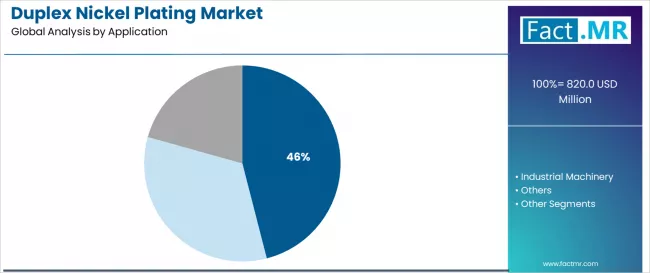
Duplex Nickel Plating Market Analysis By Application | Source: Fact.MR
The automotive application segment is projected to maintain its leading position in the duplex nickel plating market in 2025 with a 46.0% market share, reaffirming its role as the preferred application for vehicle component finishing and automotive surface treatment systems. Automotive manufacturers and component suppliers increasingly utilize duplex nickel plating for automotive applications due to its superior corrosion resistance, excellent aesthetic properties, and proven effectiveness in protecting automotive components while maintaining quality standards and durability requirements. Automotive plating technology's proven effectiveness and performance reliability directly address the industry requirements for vehicle component protection and quality enhancement across diverse automotive applications and component categories.
This application segment forms the foundation of modern automotive surface finishing, as it represents the process with the greatest contribution to component durability and established performance record across multiple automotive applications and vehicle systems. Automotive industry investments in surface treatment technologies continue to strengthen adoption among manufacturers and suppliers. With increasing demand for corrosion protection and aesthetic enhancement, automotive applications align with both quality objectives and performance requirements, making them the central component of comprehensive automotive surface treatment strategies.
By Layer, the Semi-bright + Bright Segment Dominates Market Demand
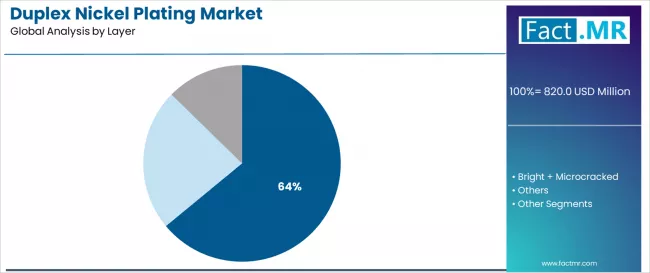
Duplex Nickel Plating Market Analysis By Layer | Source: Fact.MR
The semi-bright + bright layer segment is projected to represent the largest share of duplex nickel plating demand in 2025 with a 64.0% market share, underscoring its critical role as the primary layer configuration for decorative and functional plating applications across automotive, industrial, and consumer product finishing. Plating specialists prefer semi-bright + bright configurations for coating applications due to their exceptional aesthetic properties, superior leveling characteristics, and ability to provide optimal surface finish while supporting corrosion protection and manufacturing efficiency objectives. Positioned as essential configurations for modern electroplating applications, semi-bright + bright layers offer both appearance advantages and functional benefits.
The segment is supported by continuous innovation in electroplating technology and the growing availability of specialized layer formulations that enable superior surface performance with enhanced brightness and improved corrosion resistance. Additionally, manufacturers are investing in comprehensive plating programs to support increasingly demanding surface quality requirements and market demand for premium surface finishing solutions. As surface treatment standards advance and aesthetic requirements increase, the semi-bright + bright layer will continue to dominate the market while supporting advanced duplex nickel plating utilization and surface finishing optimization strategies.
By End Use, the OEM Segment Commands Market Leadership
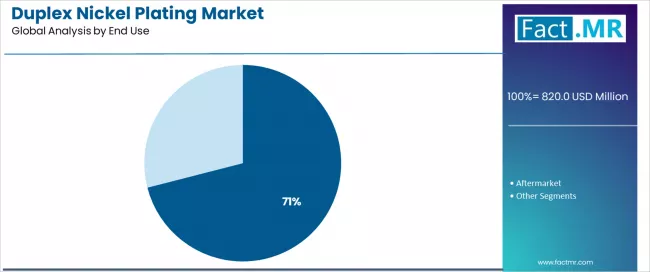
Duplex Nickel Plating Market Analysis By End Use | Source: Fact.MR
The OEM end use segment is projected to maintain the largest share of duplex nickel plating consumption in 2025 with a 71.0% market share, highlighting its fundamental role in original equipment manufacturing, automotive production, and industrial component fabrication applications. OEM manufacturers prefer duplex nickel plating for its comprehensive performance capabilities, quality consistency characteristics, and proven effectiveness in demanding applications requiring superior corrosion protection and consistent surface quality. This segment represents the backbone of duplex nickel plating consumption across multiple manufacturing sectors and production applications.
The OEM segment benefits from ongoing technological advancement in manufacturing processes and the expanding adoption of surface treatment technologies in critical production applications. OEM demand continues to grow due to increasing production volumes, rising quality standards, and the need for reliable surface treatments that can support complex manufacturing processes while maintaining cost-effectiveness. As manufacturing applications become more sophisticated and quality requirements increase, the OEM end use segment will continue to drive market growth while supporting advanced duplex nickel plating utilization and manufacturing optimization strategies.
What are the Drivers, Restraints, and Key Trends of the Duplex Nickel Plating Market?
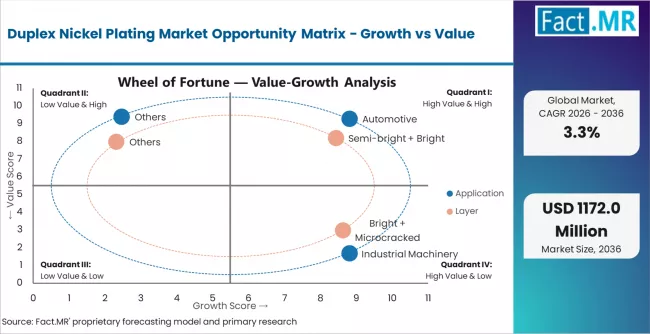
Duplex Nickel Plating Market Opportunity Matrix Growth Vs Value | Source: Fact.MR
The duplex nickel plating market is advancing steadily due to increasing automotive production and surface finishing requirements driven by quality standards and aesthetic expectations, growing adoption of advanced electroplating technologies that require high-performance coating solutions providing enhanced corrosion protection and surface aesthetics across diverse automotive manufacturing, industrial machinery, consumer electronics, and metal fabrication applications.
However, the market faces challenges, including environmental regulations affecting electroplating processes and waste management, competition from alternative coating technologies and surface treatment methods, and supply chain constraints related to nickel availability and processing chemical costs. Innovation in sustainable plating technologies and environmental compliance continues to influence product development and market expansion patterns.
Expansion of Electric Vehicle Manufacturing and Advanced Automotive Technologies
The growing adoption of electric vehicle production is driving demand for specialized surface finishing solutions that address EV component requirements including battery housing protection, charging system components, and electrical contact enhancement in automotive applications. Electric vehicle manufacturing requires advanced duplex nickel plating formulations that deliver superior corrosion performance across multiple automotive parameters while maintaining manufacturing efficiency and quality standards.
Automotive manufacturers are increasingly recognizing the competitive advantages of duplex nickel plating integration for electric vehicle production and component protection, creating opportunities for innovative plating technologies specifically designed for next-generation automotive applications.
Integration of Environmental Sustainability and Waste Reduction Methods
Modern electroplating companies are incorporating environmental sustainability approaches and waste reduction technologies to enhance environmental performance, reduce chemical consumption, and support comprehensive compliance objectives through optimized plating processes and waste management systems.
Leading companies are developing closed-loop systems, implementing chemical recovery technologies, and advancing plating processes that minimize environmental impact while maintaining coating quality. These approaches improve regulatory compliance while enabling new market opportunities, including sustainable manufacturing applications, eco-friendly surface treatments, and environmentally conscious industrial processes.
Development of Advanced Layer Technologies and Specialized Applications
The expansion of precision manufacturing, aerospace applications, and high-performance industrial equipment is driving demand for duplex nickel plating with enhanced layer characteristics and specialized coating properties. These advanced applications require specialized plating processes with precise layer control and exceptional performance that exceed traditional coating requirements, creating premium market segments with differentiated surface treatment propositions. Manufacturers are investing in advanced plating capabilities and quality control systems to serve emerging specialized applications while supporting innovation in aerospace, precision manufacturing, and high-performance industrial sectors.
Analysis of the Duplex Nickel Plating Market by Key Countries
.webp "Top Country Growth Comparison Duplex Nickel Plating Market Cagr (2026 2036)")
Top Country Growth Comparison Duplex Nickel Plating Market Cagr (2026 2036) | Source: Fact.MR
| Country | CAGR (2026-2036) |
|---|---|
| USA | 3.8% |
| Mexico | 3.5% |
| Germany | 3.1% |
| France | 3.0% |
| UK | 2.9% |
| South Korea | 2.8% |
| Japan | 2.7% |
Source: Fact.MR analysis. Updated Mar 24, 2026
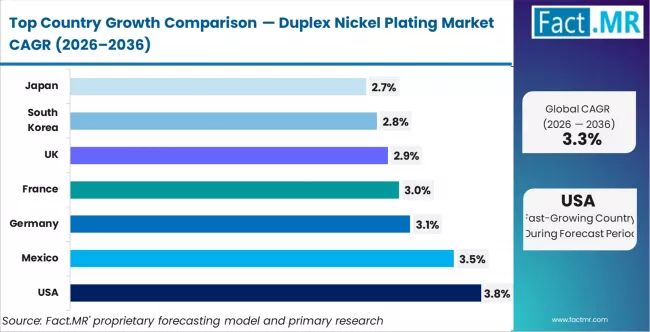
Duplex Nickel Plating Market Cagr Analysis By Country | Source: Fact.MR
The duplex nickel plating market is experiencing moderate growth globally, with the USA leading at a 3.8% CAGR through 2036, driven by expanding automotive manufacturing and growing industrial surface finishing, alongside increasing investment in advanced electroplating technologies and quality enhancement solutions.
Mexico follows at 3.5%, supported by automotive production growth, expanding manufacturing sector, and increasing demand for surface finishing services in domestic and export markets.
Germany shows growth at 3.1%, emphasizing automotive engineering excellence, precision manufacturing, and advanced surface treatment technologies. France demonstrates 3.0% growth, supported by automotive industry development and industrial manufacturing applications.
The UK records 2.9%, focusing on automotive component manufacturing and industrial surface finishing. South Korea exhibits 2.8% growth, emphasizing automotive technology and industrial applications. Japan shows 2.7% growth, emphasizing quality standards and precision electroplating applications.
The report covers an in-depth analysis of 40+ countries; seven top-performing countries are highlighted below.
USA Leads Global Market Growth with Automotive and Industrial Manufacturing Expansion
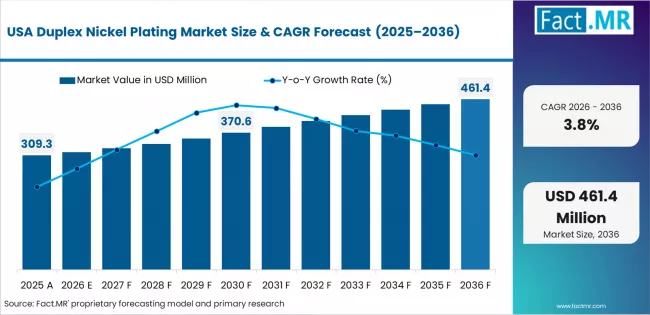
Duplex Nickel Plating Market Country Value Analysis | Source: Fact.MR
Revenue from duplex nickel plating in the USA is projected to exhibit strong growth with a CAGR of 3.8% through 2036, driven by expanding automotive manufacturing and rapidly growing industrial surface finishing sector supported by automotive production recovery and advanced manufacturing initiatives. The country's substantial automotive industry and increasing investment in electroplating technologies are creating substantial demand for duplex nickel plating solutions. Major automotive manufacturers and metal finishing companies are establishing comprehensive duplex nickel plating capabilities to serve both domestic markets and export opportunities.
- Strong automotive production growth and expanding metal finishing sector are driving demand for duplex nickel plating throughout major automotive regions including Michigan, Ohio, and the Southeast automotive corridors, supporting both OEM production and aftermarket component manufacturing facilities.
- Growing industrial manufacturing and surface treatment requirements are supporting the rapid adoption of duplex nickel plating technologies among manufacturers seeking enhanced corrosion protection and aesthetic enhancement in competitive manufacturing markets.
Mexico Demonstrates Automotive Integration with Manufacturing Growth
Revenue from duplex nickel plating in Mexico is expanding at a CAGR of 3.5%, supported by automotive manufacturing expansion, growing industrial production, and strategic position as an automotive component manufacturing hub for North American markets. Mexico's automotive infrastructure and cost-competitive manufacturing are driving sophisticated duplex nickel plating capabilities throughout manufacturing sectors. Leading automotive companies and metal finishing providers are establishing extensive plating facilities to address growing automotive production and export market demand.
- Automotive manufacturing growth and expanding industrial production infrastructure are creating opportunities for duplex nickel plating adoption across automotive component finishing, industrial surface treatment, and export-oriented manufacturing in major automotive regions including Central Mexico and automotive development zones.
- Growing automotive sector and manufacturing expansion are supporting the adoption of advanced electroplating technologies among manufacturers seeking to serve both domestic and international markets while maintaining quality standards and cost competitiveness.
Germany Demonstrates Automotive Engineering Excellence with Precision Manufacturing
Revenue from duplex nickel plating in Germany is expanding at a CAGR of 3.1%, driven by the country's automotive engineering leadership, precision manufacturing capabilities, and advanced surface treatment excellence supporting high-performance duplex nickel plating applications. Germany's automotive expertise and manufacturing innovation are driving demand for specialized duplex nickel plating solutions throughout automotive and industrial sectors. Leading automotive manufacturers and electroplating companies are establishing comprehensive innovation programs for next-generation surface treatment technologies.
- Advanced automotive engineering and precision manufacturing requirements are creating demand for specialized duplex nickel plating grades among automotive manufacturers and component suppliers seeking enhanced surface performance and quality optimization in competitive European automotive markets.
- Strong automotive industry expertise and manufacturing excellence are supporting the adoption of advanced electroplating technologies and surface treatment optimization across manufacturing facilities throughout major automotive regions including Bavaria and Baden-Württemberg.
France Shows Automotive Innovation and Industrial Manufacturing Leadership
Revenue from duplex nickel plating in France is expanding at a CAGR of 3.0%, supported by the country's automotive industry development, industrial manufacturing excellence, and pioneering surface treatment initiatives including advanced electroplating processes and quality enhancement systems. France's automotive heritage and manufacturing expertise are supporting investment in advanced duplex nickel plating technologies. Major automotive manufacturers and surface treatment companies are establishing comprehensive manufacturing programs incorporating plating advancement and quality optimization.
- Advanced automotive innovation and industrial manufacturing capabilities are creating demand for high-quality duplex nickel plating products supporting automotive component finishing, industrial surface treatment, and manufacturing excellence optimization throughout major automotive and industrial regions.
- Strong automotive focus and manufacturing leadership are driving the adoption of advanced electroplating technologies and surface enhancement throughout manufacturing facilities across automotive clusters and industrial zones.
UK Focuses on Automotive Component Manufacturing and Surface Finishing Innovation
Revenue from duplex nickel plating in the UK is growing at a CAGR of 2.9%, driven by the country's automotive component manufacturing, surface finishing innovation initiatives, and emphasis on advanced electroplating solutions for automotive and industrial applications. The UK's manufacturing research excellence and automotive commitments are supporting investment in advanced duplex nickel plating technologies. Major automotive component manufacturers and electroplating companies are establishing comprehensive surface treatment programs incorporating advanced plating formulations.
- Automotive component research and surface finishing innovation requirements are creating demand for high-performance duplex nickel plating grades supporting automotive manufacturing, component finishing, and surface treatment optimization throughout major automotive and manufacturing regions.
- Strong research capabilities and automotive component manufacturing mandates are driving the adoption of advanced electroplating processes and surface enhancement supporting superior coating performance and manufacturing leadership in competitive global markets.
South Korea Demonstrates Automotive Technology Leadership with Industrial Applications
Revenue from duplex nickel plating in South Korea is expanding at a CAGR of 2.8%, supported by the country's automotive technology advancement, industrial manufacturing expertise, and strong emphasis on surface finishing solutions for automotive and precision manufacturing applications. South Korea's automotive sophistication and manufacturing focus are driving sophisticated duplex nickel plating capabilities throughout automotive and industrial sectors. Leading automotive manufacturers and electroplating companies are investing extensively in advanced surface treatment technologies.
- Advanced automotive technology development and industrial manufacturing innovation are creating demand for specialized duplex nickel plating products throughout automotive applications, industrial machinery finishing, and manufacturing facilities in major automotive regions including Seoul Capital Area and automotive manufacturing zones.
- Strong automotive industry and manufacturing expertise are supporting the adoption of innovative electroplating technologies and surface optimization for next-generation applications requiring superior coating performance and manufacturing excellence.
Japan Shows Quality Excellence Focus with Precision Electroplating Applications
Revenue from duplex nickel plating in Japan is expanding at a CAGR of 2.7%, supported by the country's quality excellence standards, precision manufacturing capabilities, and strong emphasis on high-specification surface treatments for advanced automotive and industrial sectors. Japan's quality sophistication and electroplating excellence are driving demand for premium duplex nickel plating products. Leading automotive manufacturers and electroplating companies are investing in specialized capabilities for advanced surface treatment applications.
- Advanced precision manufacturing and quality processing requirements are creating opportunities for high-quality duplex nickel plating products throughout specialized automotive production, precision component finishing, and industrial applications meeting stringent quality and performance standards.
- Strong automotive industry and manufacturing sector are driving adoption of specialized duplex nickel plating grades and advanced electroplating technologies supporting innovation in automotive finishing, precision manufacturing, and quality surface treatment sectors requiring superior coating performance and consistency.
Europe Market Split by Country
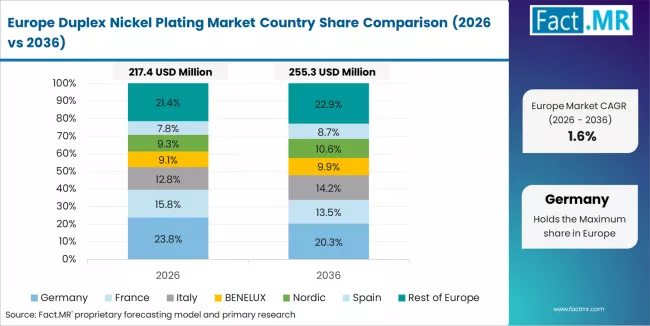
Duplex Nickel Plating Market Europe Country Market Share Analysis, 2026 & 2036 | Source: Fact.MR
The duplex nickel plating market in Europe is projected to grow from USD 246.0 million in 2026 to USD 342.0 million by 2036, registering a CAGR of 3.3% over the forecast period. Germany is expected to maintain its leadership position with a 26.8% market share in 2026, declining slightly to 26.4% by 2036, supported by its advanced automotive industry and precision manufacturing capabilities.
France follows with a 21.5% share in 2026, projected to reach 21.8% by 2036, driven by comprehensive automotive development and industrial manufacturing industry applications. The United Kingdom holds a 19.1% share in 2026, expected to decrease to 18.8% by 2036 due to market diversification. Italy commands a 13.7% share, while Spain accounts for 10.2% in 2026. The Rest of Europe region is anticipated to gain momentum, expanding its collective share from 8.7% to 9.1% by 2036, attributed to increasing surface finishing adoption in Nordic countries and emerging Eastern European automotive manufacturing implementing advanced electroplating technologies.
Semi-bright + Bright Layer Applications Dominate Automotive Surface Finishing in Japan
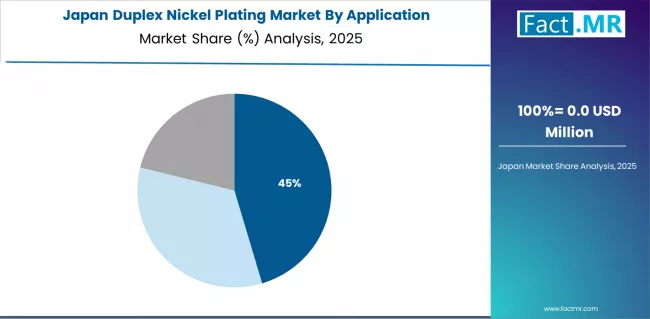
Duplex Nickel Plating Market Japan Market Share Analysis By Application | Source: Fact.MR
The Japanese duplex nickel plating market demonstrates a mature and precision-focused landscape, characterized by advanced integration of semi-bright + bright layer technologies with existing automotive manufacturing infrastructure across production facilities, component networks, and surface finishing operations. Japan's emphasis on quality excellence and manufacturing precision drives demand for high-reliability duplex nickel plating solutions that support comprehensive automotive quality initiatives and regulatory requirements in manufacturing operations. The market benefits from strong partnerships between international electroplating providers like Atotech, MacDermid Enthone, and domestic automotive leaders, including established automotive manufacturers and component companies, creating comprehensive service ecosystems that prioritize surface quality and technical precision programs. Manufacturing centers in major automotive regions showcase advanced duplex nickel plating implementations where coating systems achieve quality improvements through integrated automotive programs.
OEM Applications Lead Surface Treatment Services in South Korea
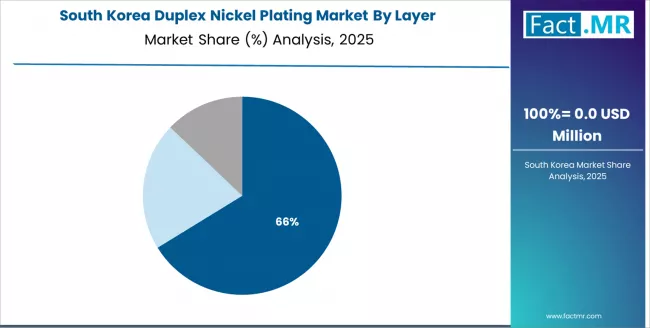
Duplex Nickel Plating Market South Korea Market Share Analysis By Layer | Source: Fact.MR
The South Korean duplex nickel plating market is characterized by strong international OEM application presence, with companies like Coventya, C. Uyemura, and Transene maintaining dominant positions through comprehensive system integration and technical services capabilities for automotive modernization and manufacturing applications. The market is demonstrating a growing emphasis on localized technical support and rapid deployment capabilities, as Korean companies increasingly demand customized solutions that integrate with domestic automotive infrastructure and advanced manufacturing systems deployed across major automotive centers and production facilities. Local automotive companies and regional manufacturing integrators are gaining market share through strategic partnerships with global providers, offering specialized services including technical training programs and certification services for electroplating specialists. The competitive landscape shows increasing collaboration between multinational electroplating companies and Korean automotive specialists, creating hybrid service models that combine international surface treatment expertise with local market knowledge and automotive relationship management.
Competitive Landscape of the Duplex Nickel Plating Market
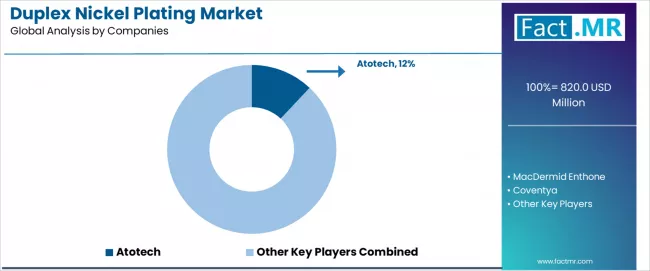
Duplex Nickel Plating Market Analysis By Company | Source: Fact.MR
The duplex nickel plating market is characterized by competition among established electroplating chemical manufacturers, specialized surface treatment companies, and diversified industrial chemical producers.
Companies are investing in sustainable process technology development, environmental compliance innovation, product portfolio expansion, and application-specific solution development to deliver high-performance, environmentally responsible, and cost-effective duplex nickel plating solutions.
Innovation in eco-friendly chemistry, process optimization technologies, and specialized application development is central to strengthening market position and competitive advantage.
Atotech leads the market with a 12.0% share, offering comprehensive duplex nickel plating solutions with a focus on automotive applications, environmental compliance programs, and advanced electroplating technologies across diverse automotive and industrial distribution channels.
The company has announced major sustainability initiatives and investments in eco-friendly plating technologies to support growing global demand for environmentally responsible surface treatment solutions and regulatory compliance.
MacDermid Enthone provides innovative electroplating solutions with emphasis on process optimization and environmental excellence, while Coventya delivers specialized surface treatment materials with focus on automotive and industrial applications.
C. Uyemura offers advanced plating solutions with comprehensive duplex nickel plating offerings for multiple manufacturing categories, and Transene provides electroplating technologies with emphasis on performance optimization and application versatility.
Chemetall specializes in surface treatment solutions with advanced duplex nickel plating technologies, while Growel focuses on regional manufacturing applications. Other key players including SurTec, Bales Metal Surface, and PPG Industries contribute to market competition through specialized chemistry capabilities and application expertise.
Duplex Nickel Plating Market - Stakeholder Contribution Framework
Duplex nickel plating represents a surface treatment segment within automotive and industrial manufacturing applications, projected to grow from USD 820.0 million in 2025 to USD 1,140.0 million by 2035 at a 3.3% CAGR.
These electroplating processes primarily automotive, industrial machinery, and specialty configurations for multiple applications—serve as critical surface treatment technologies in automotive manufacturing, industrial component production, consumer electronics, and metal fabrication applications where corrosion protection, aesthetic enhancement, and surface durability are essential.
Market expansion is driven by increasing automotive production, growing industrial manufacturing, expanding surface finishing requirements, and rising demand for advanced electroplating solutions across diverse automotive, industrial, electronics, and metal finishing sectors.
How Environmental Regulators Could Strengthen Electroplating Standards and Compliance Assurance?
- Environmental Compliance Standards: Establish comprehensive technical specifications for duplex nickel plating processes, including waste management requirements, emission control standards, chemical handling protocols, and environmental performance criteria that ensure consistent compliance across automotive manufacturing, industrial facilities, electroplating services, and metal finishing applications.
- Sustainable Process Integration: Develop regulatory frameworks that incentivize environmentally responsible electroplating practices, requiring manufacturers to implement waste reduction systems, utilize chemical recovery technologies, incorporate closed-loop processes, and achieve measurable environmental improvements in duplex nickel plating operations.
- Waste Management Requirements: Implement mandatory environmental control standards for duplex nickel plating facilities, including wastewater treatment protocols, chemical disposal procedures, and emission monitoring systems that ensure environmental protection and regulatory compliance across diverse electroplating applications.
- Chemical Safety Certification: Create specialized guidelines for electroplating chemicals used in duplex nickel plating, addressing stringent safety specifications, handling requirements, and environmental validation procedures specific to industrial applications requiring enhanced worker safety and environmental protection.
- Green Technology Support Programs: Provide regulatory facilitation and research incentives for development of next-generation sustainable electroplating technologies that improve environmental performance, reduce chemical consumption, and enable emerging applications in eco-friendly manufacturing and green surface treatment.
How Industry Associations Could Advance Electroplating Standards and Market Development?
- Process Best Practices: Develop comprehensive technical guidelines for duplex nickel plating processes, quality optimization, and environmental compliance techniques that maximize coating effectiveness, ensure regulatory compliance, and maintain cost-effectiveness across automotive manufacturing, industrial applications, and electroplating services.
- Environmental Performance Benchmarking: Establish industry-wide metrics for environmental performance, including waste reduction assessment, chemical efficiency measurement, energy consumption evaluation, and compliance documentation that enable comparative analysis and drive continuous improvement toward environmental optimization objectives.
- Technical Training Programs: Create specialized education initiatives for electroplating technicians, environmental specialists, and manufacturing professionals covering duplex nickel plating characteristics, environmental requirements, safety protocols, and process techniques across diverse electroplating applications.
- Quality Standardization: Develop standardized testing methodologies for duplex nickel plating evaluation, including coating assessment, environmental compliance analysis, process validation, and application-specific performance metrics that facilitate objective process comparison and quality validation.
- Industry Collaboration: Facilitate partnerships between duplex nickel plating suppliers, automotive manufacturers, research institutions, and environmental organizations to advance electroplating technology development, address emerging environmental challenges, and accelerate innovation in sustainable surface treatment applications.
How Duplex Nickel Plating Manufacturers Could Drive Innovation and Market Leadership?
- Sustainable Technology Development: Invest in eco-friendly process enhancement, waste reduction optimization, environmental compliance improvement, and chemical efficiency initiatives that enhance coating effectiveness while maintaining regulatory compliance and cost competitiveness in global markets.
- Advanced Chemistry Development: Develop next-generation duplex nickel plating formulations with enhanced coating characteristics, including optimized corrosion resistance, improved aesthetic properties, increased process efficiency, and application-specific performance attributes for emerging surface treatment segments.
- Environmental Management Integration: Implement intelligent process control systems with real-time environmental monitoring, predictive waste assessment, automated compliance verification, and data analytics that optimize process efficiency, ensure environmental compliance, and reduce operational impact.
- Technical Application Support: Establish comprehensive customer service capabilities providing process consultation, environmental guidance, quality troubleshooting, and technical expertise that strengthen customer relationships and enable successful electroplating implementation.
- Global Service Excellence: Develop regional service networks, environmental compliance management, reliable technical support systems, and responsive customer service that ensure consistent process availability, maintain coating quality, and support customer manufacturing requirements worldwide.
How End-User Industries Could Optimize Surface Treatment Performance and Manufacturing Success?
- Strategic Process Selection: Conduct comprehensive assessments of surface treatment requirements, environmental constraints, quality objectives, and cost considerations to optimize duplex nickel plating selection and achieve desired coating characteristics while managing total manufacturing costs and compliance requirements.
- Manufacturing Process Optimization: Implement advanced development methodologies utilizing process validation, quality evaluation, and systematic performance assessment to maximize duplex nickel plating coating benefits, minimize environmental impact, and optimize overall manufacturing effectiveness and surface quality.
- Quality Assurance Management: Develop optimized process protocols, environmental control procedures, and quality validation that ensure effective duplex nickel plating utilization, maximize coating benefits, and maintain consistent surface performance throughout manufacturing operations.
- Environmental Compliance Integration: Incorporate environmental best practices, regulatory compliance principles, and sustainability considerations into surface treatment planning and manufacturing processes that support comprehensive environmental objectives and regulatory excellence.
- Strategic Partnerships: Establish strategic partnerships with duplex nickel plating suppliers for joint process programs, environmental optimization initiatives, and co-innovation projects that address specific manufacturing challenges and accelerate surface treatment commercialization.
How Research Institutions Could Enable Surface Treatment Technology Advancement?
- Electroplating Science Research: Conduct fundamental investigations into duplex nickel plating mechanisms, coating enhancement, process optimization, and environmental applications that advance surface treatment understanding and enable breakthrough innovations in electroplating technology and coating science.
- Process Technology Development: Develop novel plating methods, including advanced chemistry techniques, sustainable process approaches, and environmental enhancement technologies that improve coating performance while maintaining process validity and cost effectiveness.
- Manufacturing Application Innovation: Investigate emerging applications for duplex nickel plating in electric vehicle components, advanced manufacturing systems, precision electronics, and specialized industrial applications that create new market opportunities and expand surface treatment potential.
- Technical Analysis Services: Provide advanced coating research services utilizing surface analysis, corrosion testing, environmental assessment, and manufacturing evaluation methodologies that enable detailed understanding of duplex nickel plating properties and industrial applications.
- Technology Transfer Programs: Facilitate technology commercialization through licensing agreements, startup incubation programs, technical publications, and collaborative research projects that accelerate surface treatment innovation adoption and strengthen industry-academia partnerships.
How Investors and Financial Enablers Could Support Surface Treatment Market Growth?
- Manufacturing Infrastructure Investment: Provide capital for duplex nickel plating facility construction, process capacity expansion, and environmental technology upgrade projects that address growing surface treatment demand while improving operational efficiency and environmental performance.
- Technology Innovation Financing: Fund research and development of breakthrough duplex nickel plating technologies, including sustainable process methods, environmental compliance systems, and novel coating applications that address current market limitations and create competitive advantages.
- Environmental Compliance Support: Finance environmental improvement initiatives, waste reduction programs, regulatory compliance development, and sustainability advancement that enhance environmental performance and position manufacturers for long-term market acceptance and growth.
- Market Expansion Investment: Support strategic acquisitions, market entry initiatives, distribution network development, and customer technical service capabilities that accelerate geographic expansion and strengthen competitive positions in high-growth surface treatment markets.
- Global Manufacturing Development: Provide financing and technical assistance for duplex nickel plating facilities in developing economies, creating new surface treatment supply capabilities, supporting local manufacturing development, and expanding global market access for electroplating solutions.
Key Players in the Duplex Nickel Plating Market
- Atotech
- MacDermid Enthone
- Coventya
- C. Uyemura
- Transene
- Chemetall
- Growel
- SurTec
- Bales Metal Surface
- PPG Industries
Bibliography
- Atotech (MKS Instruments). (2024). Decorative nickel-chrome plating: Process portfolio. Atotech.
- ASTM International. (2024). ASTM B456: Standard specification for electrodeposited coatings of copper plus nickel plus chromium. ASTM.
- MacDermid Enthone (Element Solutions). (2024). Udique bright nickel: Process specifications. MacDermid.
- Coventya. (2024). Trimetal trivalent chromium: Automotive qualification data. Coventya.
- C. Uyemura & Co., Ltd. (2024). Plastic plating: Activation and nickel deposition chemistry. Uyemura.
- ASME. (2024). A112.18.1: Plumbing supply fittings, plating requirements. ASME.
This bibliography is provided for reader reference. The full Fact.MR report contains the complete reference list with primary research documentation.
This Report Addresses
- Market sizing and quantitative forecast metrics detailing the precise expenditure dedicated to duplex nickel plating across major industrial sectors through 2036.
- Segmentation analysis mapping the adoption patterns of specific application categories and evaluating the technical and economic factors driving segment share distribution.
- Regional deployment intelligence comparing growth trajectories across Asia Pacific, North America, Europe, Latin America, and Middle East and Africa.
- Regulatory compliance assessment analyzing how evolving standards and policies affect product specifications and market access in key consuming regions.
- Competitive posture evaluation tracking the positioning of leading producers and the structural factors determining competitive advantage.
- Capital investment strategic guidance defining the procurement and capacity planning considerations for industry participants.
- Supply chain risk analysis identifying the specific feedstock, logistics, and regulatory variables that constrain market expansion.
- Custom data delivery formats encompassing interactive dashboards, raw Excel datasets, and PDF narrative reports.
Segmentation
Scope of the Report
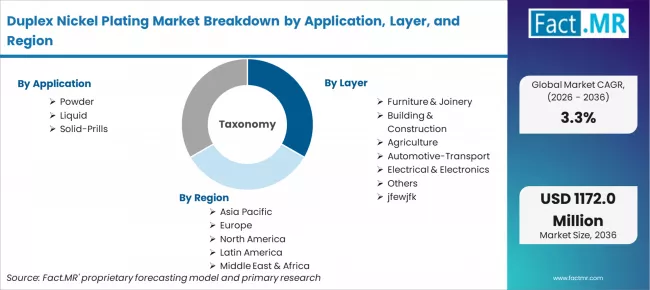
Duplex Nickel Plating Market Breakdown By Application, Layer, And Region | Source: Fact.MR
| Metric | Value |
|---|---|
| Quantitative Units | USD 847.06 million to USD 1171.97 million, at a CAGR of 3.3% |
| Market Definition | Duplex nickel plating is a multi-layer electroplating process that deposits two distinct nickel layers (semi-bright followed by bright) onto a substrate before final chromium topcoat application. The semi-bright nickel layer (containing less than 0.005% sulfur) provides the primary corrosion barrier, while the bright nickel layer (containing 0.04% to 0.1% sulfur) provides the levelling and reflectivity needed for decorative appearance. |
| Application Segmentation | Automotive, Industrial Machinery, Others |
| Layer Segmentation | Semi-bright + Bright, Bright + Microcracked, Others |
| End Use Segmentation | OEM, Aftermarket |
| Regions Covered | North America, Latin America, Europe, East Asia, South Asia, Oceania, Middle East & Africa |
| Countries Covered | USA, Mexico, Germany, France, UK, South Korea, Japan, and 40 plus countries |
| Key Companies Profiled | Atotech, MacDermid Enthone, Coventya, C. Uyemura, Transene, Chemetall, Growel, SurTec, Bales Metal Surface, PPG Industries |
| Forecast Period | 2026 to 2036 |
| Approach | Hybrid top-down and bottom-up methodology reconciling production, trade, and consumption data with primary research validation. |
Source: Fact.MR analysis. Updated Mar 24, 2026
Duplex Nickel Plating Market by Segments
-
Application :
- Automotive
- Industrial Machinery
- Others
-
Layer :
- Semi-bright + Bright
- Bright + Microcracked
- Others
-
End Use :
- OEM
- Aftermarket
-
Region :
-
East Asia
- China
- Japan
- South Korea
- Taiwan
- Rest of East Asia
-
Europe
- Germany
- United Kingdom
- France
- Italy
- Spain
- Netherlands
- Nordic
- BENELUX
- Rest of Europe
-
North America
- United States
- Canada
- Mexico
-
South Asia
- India
- Pakistan
- Bangladesh
- Rest of South Asia
-
Latin America
- Brazil
- Argentina
- Chile
- Rest of Latin America
-
Middle East & Africa
- Kingdom of Saudi Arabia
- Other GCC Countries
- Turkey
- South Africa
- Other African Union
- Rest of Middle East & Africa
-
Eastern Europe
- Russia
- Poland
- Czech Republic
- Rest of Eastern Europe
-
Frequently Asked Questions
How large is the demand for Duplex Nickel Plating in the global market in 2026?
What will be the market size of Duplex Nickel Plating in the global market by 2036?
What is the expected demand growth for Duplex Nickel Plating in the global market between 2026 and 2036?
Which Application is poised to lead global sales by 2026?
How is the Layer segment structured in this report?
What is the growth outlook for USA in this report?
What is Duplex Nickel Plating and what is it mainly used for?
How does Fact.MR build and validate the Duplex Nickel Plating forecast?
Who worked on this report


Preview the report firsthand - request a free sample
Free SampleGet the brochure for pricing and purchase details
Download PDF