Hormone Replacement Therapy Market
Hormone Replacement Therapy Market Size and Share Forecast Outlook 2026 to 2036
Hormone replacement therapy market is projected to grow from USD 25.2 billion in 2026 to USD 44.0 billion by 2036, at a CAGR of 5.7%. Estrogen & Progesterone Replacement Therapy will dominate with a 56.0% market share, while oral will lead the route of administration segment with a 41.0% share.
Hormone Replacement Therapy Market Forecast and Outlook 2026 to 2036
The global hormone replacement therapy market is projected to grow from USD 25.17 billion in 2026 to USD 44.01 billion by 2036. This translates into a total growth of 74.9%, with the market forecast to expand at a CAGR of 5.7% between 2026 and 2036. The overall market size is expected to grow by over 1.7X during this period, supported by exponential demand for hormonal disorder management solutions, rising adoption of advanced hormone therapy protocols, and growing emphasis on patient quality of life improvement and therapeutic outcome optimization across global healthcare operations.
Quick Stats on Hormone Replacement Therapy Market
- Hormone Replacement Therapy Market Value (2026): USD 25.17 billion
- Hormone Replacement Therapy Market Forecast Value (2036): USD 44.01 billion
- Hormone Replacement Therapy Market Forecast CAGR (2026 to 2036): 5.7%
- Leading Product in Hormone Replacement Therapy Market: Estrogen & Progesterone Replacement Therapy (56.0%)
- Leading Route of Administration in Hormone Replacement Therapy Market: Oral (41.0%)
- Leading Disease Type in Hormone Replacement Therapy Market: Menopause (45.0%)
- Key Growth Regions in Hormone Replacement Therapy Market: Asia Pacific, North America, and Europe
- Key Players in Hormone Replacement Therapy Market: Eli Lilly and Company, Bayer AG, Noven Pharmaceuticals Inc., Pfizer Inc., Merck & Co. Inc., Viatris Inc., Novo Nordisk A/S, F. Hoffmann-La Roche Ltd., ASCEND Therapeutics US LLC, AbbVie Inc.
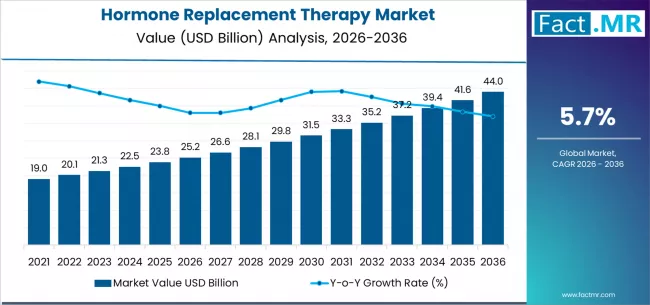
The hormone replacement therapy market is positioned for substantial expansion, driven by increasing recognition of hormonal imbalance impact on health outcomes, growing aging population demographics with enhanced healthcare access standards, and rising adoption of advanced therapeutic formulations across endocrinology and women's health practices globally.
The market demonstrates robust fundamentals supported by expanding specialty pharmaceutical networks, healthcare professionals' focus on personalized hormone therapy protocols, and rising recognition of hormone replacement treatments as critical healthcare components in achieving enhanced patient wellbeing, symptom management capabilities, and chronic disease prevention effectiveness within modern healthcare architectures across diverse patient populations.
Hormone Replacement Therapy Market Key Takeaways
| Metric | Value |
|---|---|
| Estimated Value (2026E) | USD 25.17 billion |
| Forecast Value (2036F) | USD 44.01 billion |
| Forecast CAGR (2026 to 2036) | 5.7% |
Category
| Category | Segments |
|---|---|
| Product | Estrogen and Progesterone Replacement Therapy; HGH Replacement Therapy; Thyroid Hormone Replacement Therapy; Testosterone Replacement Therapy; Parathyroid Hormone Replacement |
| Route of Administration | Oral; Parenteral; Transdermal; Others |
| Disease Type | Menopause; Hypothyroidism; Male Hypogonadism; Growth Hormone Deficiency; Hypoparathyroidism |
| Region | Asia Pacific; North America; Europe; Latin America; Middle East & Africa |
Segmental Analysis
How does Estrogen & Progesterone Replacement Therapy drive Leadership in Hormone Treatments?
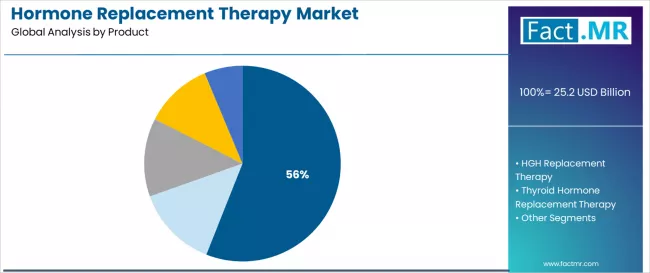
Estrogen and progesterone replacement therapy is projected to account for 56.0% of the hormone replacement therapy market in 2026, reaffirming its position as the category's dominant therapeutic product specification.
Healthcare providers increasingly recognize the optimal balance of symptom management efficacy and established clinical evidence offered by estrogen and progesterone therapies for menopausal women, particularly in vasomotor symptom control and bone health preservation applications.
This category addresses both acute symptom relief requirements and long-term health maintenance demands while providing reliable therapeutic outcomes across diverse patient populations.
Why does Oral Administration Route Command Majority Market Share?
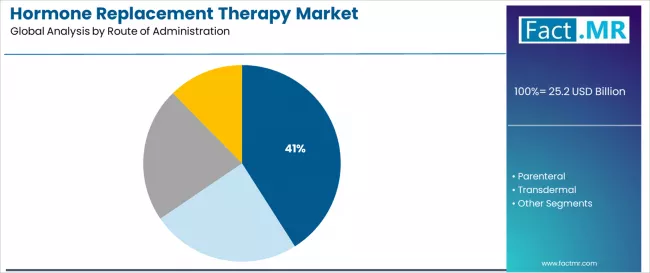
Oral administration route is projected to represent 41.0% of hormone replacement therapy demand in 2026, underscoring its role as the primary delivery method driving market adoption and patient acceptance.
Healthcare providers recognize that oral administration, including diverse tablet formulations, varied dosing schedules, and comprehensive therapeutic options, provides the largest addressable market that parenteral or transdermal applications cannot match in patient convenience and prescribing familiarity.
Oral hormone therapies utilized in endocrine management offer enhanced patient compliance and established treatment protocol compatibility essential for serving chronic disease management and routine therapeutic requirements.
What drives Hormone Replacement Therapy for Menopause?
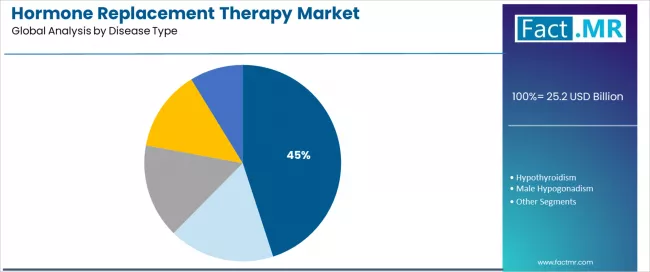
The menopause disease type is projected to account for 45.0% of the hormone replacement therapy market in 2026, establishing its position as the leading indication segment. Healthcare providers increasingly recognize that menopause management, encompassing vasomotor symptom control, urogenital health maintenance, and bone density preservation, represents the most clinically significant and patient-impacting condition requiring specialized hormone replacement due to symptom prevalence and quality of life effects. This disease type addresses both immediate symptom relief requirements and long-term health protection demands while delivering critical therapeutic outcomes across diverse patient demographics.
What are the Drivers, Restraints, and Key Trends of the Hormone Replacement Therapy Market?
The hormone replacement therapy market is expanding due to increasing awareness of hormonal disorders and their impact on long-term health outcomes, alongside growing demand for effective management of menopause, andropause, and endocrine deficiencies. Aging populations and improved diagnostic capabilities are further supporting demand across global healthcare systems.
Market growth is constrained by safety concerns related to long-term hormone use, including cardiovascular and cancer-related risks, which influence prescribing behavior and patient acceptance. Regulatory complexity in therapy approvals and formulation changes adds development hurdles, while adherence challenges in chronic treatment regimens affect real-world effectiveness and continuity of care.
Key trends include the rising adoption of bioidentical hormone formulations and advanced drug delivery technologies, such as sustained-release systems that improve dosing consistency and patient compliance. Integration of digital health platforms is also gaining traction, with telemedicine, mobile apps, and remote patient monitoring supporting personalized dose adjustments, symptom tracking, and early detection of adverse effects. These developments are improving treatment optimization, patient engagement, and overall therapeutic outcomes in long-term hormone management.
Analysis of the Hormone Replacement Therapy Market by Key Countries
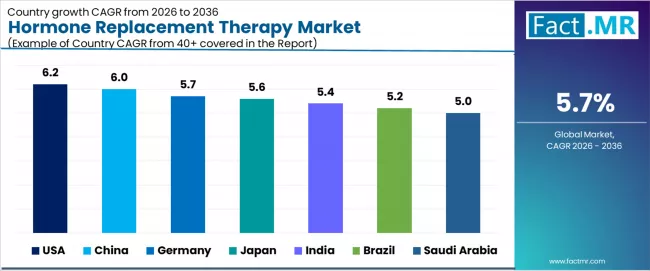
| Country | CAGR (2026-2036) |
|---|---|
| USA | 6.2% |
| China | 6.0% |
| Germany | 5.7% |
| Japan | 5.6% |
| India | 5.4% |
| Brazil | 5.2% |
| Saudi Arabia | 5.0% |
What Factors are Accelerating Hormone Replacement Therapy Uptake in the USA?
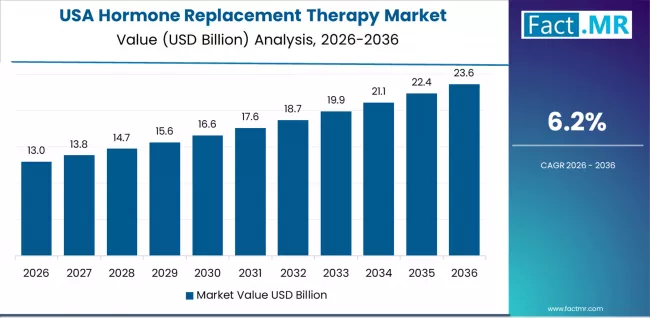
The USA hormone replacement therapy market is projected to grow at a CAGR of 6.2% through 2036, supported by a large menopausal population and increasing recognition of hormone therapy in quality-of-life management. Advanced healthcare infrastructure and widespread access to women’s health and endocrinology services support adoption across primary and specialty care.
Established insurance coverage and strong clinical research capabilities further reinforce demand. Healthcare providers increasingly emphasize individualized treatment approaches, positioning personalized hormone therapy as a core component of patient-centered care.
How is Rising Menopause Awareness Reshaping China’s HRT Market Outlook?
China’s hormone replacement therapy market is expanding at a CAGR of 6.0%, driven by a rapidly aging female population and rising awareness of menopause and endocrine health. Improving healthcare access in urban regions and expanding pharmaceutical distribution networks support wider therapy adoption.
Government-led health initiatives and growing patient willingness to seek hormonal treatment continue to strengthen demand. Hormone therapy use is increasing across menopause management and related endocrine applications as clinical awareness improves.
Why Does Germany Continue to Set the Benchmark for Evidence-Based HRT Adoption?
Germany is projected to record a CAGR of 5.7% through 2036, supported by an aging population and a strong pharmaceutical innovation ecosystem. Comprehensive insurance coverage ensures broad access to hormone therapies, while strict clinical guidelines reinforce evidence-based adoption.
Physicians prioritize validated treatment protocols and safety compliance, supporting demand across women’s health and personalized medicine applications. Germany’s emphasis on quality standards and clinical rigor sustains steady market expansion.
How is Japan’s Aging Demographic Sustaining Demand for Hormone Replacement Therapies?
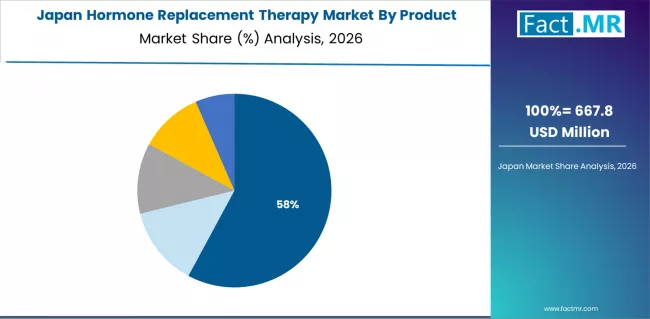
Japan’s hormone replacement therapy market is expected to grow at a CAGR of 5.6%. Growth is driven by rapid population aging and advanced healthcare infrastructure. Hormone therapies are integrated into women’s health and geriatric care programs, with strong emphasis on long-term safety and monitoring.
Healthcare providers favor well-established formulations supported by extensive clinical data. Universal healthcare coverage and conservative prescribing practices ensure consistent, guideline-driven adoption.
What is Driving Gradual Expansion of Hormone Therapy Access in India?
India’s hormone replacement therapy market is expanding at a CAGR of 5.4%, supported by rising health awareness and growth in private healthcare infrastructure. Urban centers account for most demand as recognition of hormonal disorder management improves. Cost sensitivity shapes prescribing behavior, encouraging use of affordable and generic hormone therapies. Expanding domestic pharmaceutical manufacturing and distribution networks continue to improve treatment accessibility.
How is Private Healthcare Growth Supporting HRT Adoption in Brazil?
Brazil is projected to grow at a CAGR of 5.2%, driven by expansion of private healthcare services and increasing awareness of hormone therapy benefits. Urban healthcare facilities and endocrinology practices are key adoption points. Physicians emphasize evidence-based treatments while balancing accessibility considerations. Improving pharmaceutical distribution and healthcare investment continue to support steady market development.
How do Healthcare Modernization Efforts Shape HRT Demand in Saudi Arabia?
Saudi Arabia’s hormone replacement therapy market is expected to expand at a CAGR of 5.0% through 2036, supported by healthcare modernization initiatives under Vision 2030. Rising health awareness and improved access to advanced therapies are increasing adoption across specialty care settings. Patients and providers prioritize treatment quality and established safety profiles. Continued healthcare investment and pharmaceutical access support gradual market growth.
Competitive Landscape of the Hormone Replacement Therapy Market
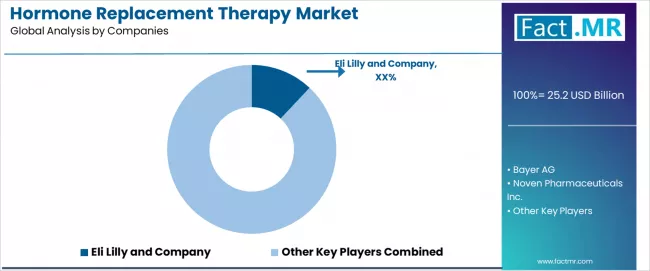
The hormone replacement therapy market is highly competitive, with participation from large pharmaceutical companies, specialty hormone therapy developers, and women’s health-focused organizations. Competition is driven by clinical evidence strength, safety profiles, delivery system innovation, and engagement with healthcare providers rather than price-led positioning. Ongoing investment in clinical research, pharmacovigilance, and patient-centric formulations shapes market differentiation.
Eli Lilly and Company holds a leading position, supported by strong research capabilities and a broad hormone therapy portfolio addressing multiple endocrine indications. Bayer AG competes through integrated women’s health platforms and a diversified global hormone therapy offering. Noven Pharmaceuticals Inc. specializes in transdermal delivery systems, while Pfizer Inc. leverages scale and therapeutic breadth to maintain a strong presence in hormone-based treatments.
Other key participants include Merck & Co., Inc., which emphasizes research-driven innovation, and Viatris Inc., which strengthens access through generic hormone therapies. Novo Nordisk A/S focuses on peptide and growth hormone applications, while Roche, AbbVie Inc., and ASCEND Therapeutics contribute through specialized formulations and targeted therapeutic development. Overall competitiveness favors companies combining clinical validation, delivery innovation, and strong regulatory execution.
Key Players in the Hormone Replacement Therapy Market
- Eli Lilly and Company
- Bayer AG
- Noven Pharmaceuticals Inc.
- Pfizer Inc.
- Merck & Co. Inc.
- Viatris Inc.
- Novo Nordisk A/S
- F. Hoffmann-La Roche Ltd.
- ASCEND Therapeutics US LLC
- AbbVie Inc.
Scope of the Report
| Items | Values |
|---|---|
| Quantitative Units (2026) | USD 25.17 Billion |
| Product | Estrogen & Progesterone Replacement Therapy, HGH Replacement Therapy, Thyroid Hormone Replacement Therapy, Testosterone Replacement Therapy, Parathyroid Hormone Replacement |
| Route of Administration | Oral, Parenteral, Transdermal, Others |
| Disease Type | Menopause, Hypothyroidism, Male Hypogonadism, Growth Hormone Deficiency, Hypoparathyroidism |
| Regions Covered | Asia Pacific, North America, Europe, Latin America, MEA |
| Countries Covered | USA, Germany, Japan, China, India, Brazil, Saudi Arabia and 40+ countries |
| Key Companies Profiled | Eli Lilly and Company, Bayer AG, Noven Pharmaceuticals Inc., Pfizer Inc., Merck & Co. Inc., Viatris Inc., Novo Nordisk A/S, F. Hoffmann-La Roche Ltd., ASCEND Therapeutics US LLC, AbbVie Inc. |
| Additional Attributes | Dollar sales by product, route of administration, disease type, regional demand trends, competitive landscape, physician preferences for specific hormone therapies, integration with comprehensive patient care systems, innovations in delivery technology development, bioidentical formulation advancement, and therapeutic safety optimization capabilities |
Hormone Replacement Therapy Market by Segments
-
Product :
- Estrogen & Progesterone Replacement Therapy
- HGH Replacement Therapy
- Thyroid Hormone Replacement Therapy
- Testosterone Replacement Therapy
- Parathyroid Hormone Replacement
-
Route of Administration :
- Oral
- Parenteral
- Transdermal
- Others
-
Disease Type :
- Menopause
- Hypothyroidism
- Male Hypogonadism
- Growth Hormone Deficiency
- Hypoparathyroidism
-
Region :
-
Asia Pacific
- China
- India
- Japan
- South Korea
- ASEAN
- Australia & New Zealand
- Rest of Asia Pacific
-
North America
- United States
- Canada
- Mexico
-
Europe
- Germany
- France
- United Kingdom
- Italy
- Spain
- Nordic
- BENELUX
- Rest of Europe
-
Latin America
- Brazil
- Argentina
- Chile
- Rest of Latin America
-
MEA
- Kingdom of Saudi Arabia
- Other GCC Countries
- Turkey
- South Africa
- Other African Countries
- Rest of MEA
-

Table of Content
- Executive Summary
- Global Market Outlook
- Demand to side Trends
- Supply to side Trends
- Technology Roadmap Analysis
- Analysis and Recommendations
- Market Overview
- Market Coverage / Taxonomy
- Market Definition / Scope / Limitations
- Market Background
- Market Dynamics
- Drivers
- Restraints
- Opportunity
- Trends
- Scenario Forecast
- Demand in Optimistic Scenario
- Demand in Likely Scenario
- Demand in Conservative Scenario
- Opportunity Map Analysis
- Product Life Cycle Analysis
- Supply Chain Analysis
- Investment Feasibility Matrix
- Value Chain Analysis
- PESTLE and Porter’s Analysis
- Regulatory Landscape
- Regional Parent Market Outlook
- Production and Consumption Statistics
- Import and Export Statistics
- Market Dynamics
- Global Market Analysis 2021 to 2025 and Forecast, 2026 to 2036
- Historical Market Size Value (USD Million) Analysis, 2021 to 2025
- Current and Future Market Size Value (USD Million) Projections, 2026 to 2036
- Y to o to Y Growth Trend Analysis
- Absolute $ Opportunity Analysis
- Global Market Pricing Analysis 2021 to 2025 and Forecast 2026 to 2036
- Global Market Analysis 2021 to 2025 and Forecast 2026 to 2036, By Product
- Introduction / Key Findings
- Historical Market Size Value (USD Million) Analysis By Product, 2021 to 2025
- Current and Future Market Size Value (USD Million) Analysis and Forecast By Product, 2026 to 2036
- Estrogen & Progesterone Replacement Therapy
- HGH Replacement Therapy
- Thyroid Hormone Replacement Therapy
- Testosterone Replacement Therapy
- Parathyroid Hormone Replacement
- Estrogen & Progesterone Replacement Therapy
- Y to o to Y Growth Trend Analysis By Product, 2021 to 2025
- Absolute $ Opportunity Analysis By Product, 2026 to 2036
- Global Market Analysis 2021 to 2025 and Forecast 2026 to 2036, By Route of Administration
- Introduction / Key Findings
- Historical Market Size Value (USD Million) Analysis By Route of Administration, 2021 to 2025
- Current and Future Market Size Value (USD Million) Analysis and Forecast By Route of Administration, 2026 to 2036
- Oral
- Parenteral
- Transdermal
- Others
- Oral
- Y to o to Y Growth Trend Analysis By Route of Administration, 2021 to 2025
- Absolute $ Opportunity Analysis By Route of Administration, 2026 to 2036
- Global Market Analysis 2021 to 2025 and Forecast 2026 to 2036, By Disease Type
- Introduction / Key Findings
- Historical Market Size Value (USD Million) Analysis By Disease Type, 2021 to 2025
- Current and Future Market Size Value (USD Million) Analysis and Forecast By Disease Type, 2026 to 2036
- Menopause
- Hypothyroidism
- Male Hypogonadism
- Growth Hormone Deficiency
- Hypoparathyroidism
- Menopause
- Y to o to Y Growth Trend Analysis By Disease Type, 2021 to 2025
- Absolute $ Opportunity Analysis By Disease Type, 2026 to 2036
- Global Market Analysis 2021 to 2025 and Forecast 2026 to 2036, By Region
- Introduction
- Historical Market Size Value (USD Million) Analysis By Region, 2021 to 2025
- Current Market Size Value (USD Million) Analysis and Forecast By Region, 2026 to 2036
- North America
- Latin America
- Western Europe
- Eastern Europe
- East Asia
- South Asia and Pacific
- Middle East & Africa
- Market Attractiveness Analysis By Region
- North America Market Analysis 2021 to 2025 and Forecast 2026 to 2036, By Country
- Historical Market Size Value (USD Million) Trend Analysis By Market Taxonomy, 2021 to 2025
- Market Size Value (USD Million) Forecast By Market Taxonomy, 2026 to 2036
- By Country
- USA
- Canada
- Mexico
- By Product
- By Route of Administration
- By Disease Type
- By Country
- Market Attractiveness Analysis
- By Country
- By Product
- By Route of Administration
- By Disease Type
- Key Takeaways
- Latin America Market Analysis 2021 to 2025 and Forecast 2026 to 2036, By Country
- Historical Market Size Value (USD Million) Trend Analysis By Market Taxonomy, 2021 to 2025
- Market Size Value (USD Million) Forecast By Market Taxonomy, 2026 to 2036
- By Country
- Brazil
- Chile
- Rest of Latin America
- By Product
- By Route of Administration
- By Disease Type
- By Country
- Market Attractiveness Analysis
- By Country
- By Product
- By Route of Administration
- By Disease Type
- Key Takeaways
- Western Europe Market Analysis 2021 to 2025 and Forecast 2026 to 2036, By Country
- Historical Market Size Value (USD Million) Trend Analysis By Market Taxonomy, 2021 to 2025
- Market Size Value (USD Million) Forecast By Market Taxonomy, 2026 to 2036
- By Country
- Germany
- UK
- Italy
- Spain
- France
- Nordic
- BENELUX
- Rest of Western Europe
- By Product
- By Route of Administration
- By Disease Type
- By Country
- Market Attractiveness Analysis
- By Country
- By Product
- By Route of Administration
- By Disease Type
- Key Takeaways
- Eastern Europe Market Analysis 2021 to 2025 and Forecast 2026 to 2036, By Country
- Historical Market Size Value (USD Million) Trend Analysis By Market Taxonomy, 2021 to 2025
- Market Size Value (USD Million) Forecast By Market Taxonomy, 2026 to 2036
- By Country
- Russia
- Poland
- Hungary
- Balkan & Baltic
- Rest of Eastern Europe
- By Product
- By Route of Administration
- By Disease Type
- By Country
- Market Attractiveness Analysis
- By Country
- By Product
- By Route of Administration
- By Disease Type
- Key Takeaways
- East Asia Market Analysis 2021 to 2025 and Forecast 2026 to 2036, By Country
- Historical Market Size Value (USD Million) Trend Analysis By Market Taxonomy, 2021 to 2025
- Market Size Value (USD Million) Forecast By Market Taxonomy, 2026 to 2036
- By Country
- China
- Japan
- South Korea
- By Product
- By Route of Administration
- By Disease Type
- By Country
- Market Attractiveness Analysis
- By Country
- By Product
- By Route of Administration
- By Disease Type
- Key Takeaways
- South Asia and Pacific Market Analysis 2021 to 2025 and Forecast 2026 to 2036, By Country
- Historical Market Size Value (USD Million) Trend Analysis By Market Taxonomy, 2021 to 2025
- Market Size Value (USD Million) Forecast By Market Taxonomy, 2026 to 2036
- By Country
- India
- ASEAN
- Australia & New Zealand
- Rest of South Asia and Pacific
- By Product
- By Route of Administration
- By Disease Type
- By Country
- Market Attractiveness Analysis
- By Country
- By Product
- By Route of Administration
- By Disease Type
- Key Takeaways
- Middle East & Africa Market Analysis 2021 to 2025 and Forecast 2026 to 2036, By Country
- Historical Market Size Value (USD Million) Trend Analysis By Market Taxonomy, 2021 to 2025
- Market Size Value (USD Million) Forecast By Market Taxonomy, 2026 to 2036
- By Country
- Kingdom of Saudi Arabia
- Other GCC Countries
- Turkiye
- South Africa
- Other African Union
- Rest of Middle East & Africa
- By Product
- By Route of Administration
- By Disease Type
- By Country
- Market Attractiveness Analysis
- By Country
- By Product
- By Route of Administration
- By Disease Type
- Key Takeaways
- Key Countries Market Analysis
- USA
- Pricing Analysis
- Market Share Analysis, 2025
- By Product
- By Route of Administration
- By Disease Type
- Canada
- Pricing Analysis
- Market Share Analysis, 2025
- By Product
- By Route of Administration
- By Disease Type
- Mexico
- Pricing Analysis
- Market Share Analysis, 2025
- By Product
- By Route of Administration
- By Disease Type
- Brazil
- Pricing Analysis
- Market Share Analysis, 2025
- By Product
- By Route of Administration
- By Disease Type
- Chile
- Pricing Analysis
- Market Share Analysis, 2025
- By Product
- By Route of Administration
- By Disease Type
- Germany
- Pricing Analysis
- Market Share Analysis, 2025
- By Product
- By Route of Administration
- By Disease Type
- UK
- Pricing Analysis
- Market Share Analysis, 2025
- By Product
- By Route of Administration
- By Disease Type
- Italy
- Pricing Analysis
- Market Share Analysis, 2025
- By Product
- By Route of Administration
- By Disease Type
- Spain
- Pricing Analysis
- Market Share Analysis, 2025
- By Product
- By Route of Administration
- By Disease Type
- France
- Pricing Analysis
- Market Share Analysis, 2025
- By Product
- By Route of Administration
- By Disease Type
- India
- Pricing Analysis
- Market Share Analysis, 2025
- By Product
- By Route of Administration
- By Disease Type
- ASEAN
- Pricing Analysis
- Market Share Analysis, 2025
- By Product
- By Route of Administration
- By Disease Type
- Australia & New Zealand
- Pricing Analysis
- Market Share Analysis, 2025
- By Product
- By Route of Administration
- By Disease Type
- China
- Pricing Analysis
- Market Share Analysis, 2025
- By Product
- By Route of Administration
- By Disease Type
- Japan
- Pricing Analysis
- Market Share Analysis, 2025
- By Product
- By Route of Administration
- By Disease Type
- South Korea
- Pricing Analysis
- Market Share Analysis, 2025
- By Product
- By Route of Administration
- By Disease Type
- Russia
- Pricing Analysis
- Market Share Analysis, 2025
- By Product
- By Route of Administration
- By Disease Type
- Poland
- Pricing Analysis
- Market Share Analysis, 2025
- By Product
- By Route of Administration
- By Disease Type
- Hungary
- Pricing Analysis
- Market Share Analysis, 2025
- By Product
- By Route of Administration
- By Disease Type
- Kingdom of Saudi Arabia
- Pricing Analysis
- Market Share Analysis, 2025
- By Product
- By Route of Administration
- By Disease Type
- Turkiye
- Pricing Analysis
- Market Share Analysis, 2025
- By Product
- By Route of Administration
- By Disease Type
- South Africa
- Pricing Analysis
- Market Share Analysis, 2025
- By Product
- By Route of Administration
- By Disease Type
- USA
- Market Structure Analysis
- Competition Dashboard
- Competition Benchmarking
- Market Share Analysis of Top Players
- By Regional
- By Product
- By Route of Administration
- By Disease Type
- Competition Analysis
- Competition Deep Dive
- Eli Lilly and Company
- Overview
- Product Portfolio
- Profitability by Market Segments (Product/Age /Sales Channel/Region)
- Sales Footprint
- Strategy Overview
- Marketing Strategy
- Product Strategy
- Channel Strategy
- Bayer AG
- Noven Pharmaceuticals Inc.
- Pfizer Inc.
- Merck & Co. Inc.
- Viatris Inc.
- Novo Nordisk A/S
- F. Hoffmann-La Roche Ltd.
- ASCEND Therapeutics US LLC
- AbbVie Inc.
- Eli Lilly and Company
- Competition Deep Dive
- Assumptions & Acronyms Used
- Research Methodology
List Of Table
- Table 1: Global Market Value (USD Million) Forecast by Region, 2021 to 2036
- Table 2: Global Market Value (USD Million) Forecast by Product, 2021 to 2036
- Table 3: Global Market Value (USD Million) Forecast by Route of Administration, 2021 to 2036
- Table 4: Global Market Value (USD Million) Forecast by Disease Type, 2021 to 2036
- Table 5: North America Market Value (USD Million) Forecast by Country, 2021 to 2036
- Table 6: North America Market Value (USD Million) Forecast by Product, 2021 to 2036
- Table 7: North America Market Value (USD Million) Forecast by Route of Administration, 2021 to 2036
- Table 8: North America Market Value (USD Million) Forecast by Disease Type, 2021 to 2036
- Table 9: Latin America Market Value (USD Million) Forecast by Country, 2021 to 2036
- Table 10: Latin America Market Value (USD Million) Forecast by Product, 2021 to 2036
- Table 11: Latin America Market Value (USD Million) Forecast by Route of Administration, 2021 to 2036
- Table 12: Latin America Market Value (USD Million) Forecast by Disease Type, 2021 to 2036
- Table 13: Western Europe Market Value (USD Million) Forecast by Country, 2021 to 2036
- Table 14: Western Europe Market Value (USD Million) Forecast by Product, 2021 to 2036
- Table 15: Western Europe Market Value (USD Million) Forecast by Route of Administration, 2021 to 2036
- Table 16: Western Europe Market Value (USD Million) Forecast by Disease Type, 2021 to 2036
- Table 17: Eastern Europe Market Value (USD Million) Forecast by Country, 2021 to 2036
- Table 18: Eastern Europe Market Value (USD Million) Forecast by Product, 2021 to 2036
- Table 19: Eastern Europe Market Value (USD Million) Forecast by Route of Administration, 2021 to 2036
- Table 20: Eastern Europe Market Value (USD Million) Forecast by Disease Type, 2021 to 2036
- Table 21: East Asia Market Value (USD Million) Forecast by Country, 2021 to 2036
- Table 22: East Asia Market Value (USD Million) Forecast by Product, 2021 to 2036
- Table 23: East Asia Market Value (USD Million) Forecast by Route of Administration, 2021 to 2036
- Table 24: East Asia Market Value (USD Million) Forecast by Disease Type, 2021 to 2036
- Table 25: South Asia and Pacific Market Value (USD Million) Forecast by Country, 2021 to 2036
- Table 26: South Asia and Pacific Market Value (USD Million) Forecast by Product, 2021 to 2036
- Table 27: South Asia and Pacific Market Value (USD Million) Forecast by Route of Administration, 2021 to 2036
- Table 28: South Asia and Pacific Market Value (USD Million) Forecast by Disease Type, 2021 to 2036
- Table 29: Middle East & Africa Market Value (USD Million) Forecast by Country, 2021 to 2036
- Table 30: Middle East & Africa Market Value (USD Million) Forecast by Product, 2021 to 2036
- Table 31: Middle East & Africa Market Value (USD Million) Forecast by Route of Administration, 2021 to 2036
- Table 32: Middle East & Africa Market Value (USD Million) Forecast by Disease Type, 2021 to 2036
List Of Figures
- Figure 1: Global Market Pricing Analysis
- Figure 2: Global Market Value (USD Million) Forecast 2021 to 2036
- Figure 3: Global Market Value Share and BPS Analysis by Product, 2026 and 2036
- Figure 4: Global Market Y to o to Y Growth Comparison by Product, 2026 to 2036
- Figure 5: Global Market Attractiveness Analysis by Product
- Figure 6: Global Market Value Share and BPS Analysis by Route of Administration, 2026 and 2036
- Figure 7: Global Market Y to o to Y Growth Comparison by Route of Administration, 2026 to 2036
- Figure 8: Global Market Attractiveness Analysis by Route of Administration
- Figure 9: Global Market Value Share and BPS Analysis by Disease Type, 2026 and 2036
- Figure 10: Global Market Y to o to Y Growth Comparison by Disease Type, 2026 to 2036
- Figure 11: Global Market Attractiveness Analysis by Disease Type
- Figure 12: Global Market Value (USD Million) Share and BPS Analysis by Region, 2026 and 2036
- Figure 13: Global Market Y to o to Y Growth Comparison by Region, 2026 to 2036
- Figure 14: Global Market Attractiveness Analysis by Region
- Figure 15: North America Market Incremental Dollar Opportunity, 2026 to 2036
- Figure 16: Latin America Market Incremental Dollar Opportunity, 2026 to 2036
- Figure 17: Western Europe Market Incremental Dollar Opportunity, 2026 to 2036
- Figure 18: Eastern Europe Market Incremental Dollar Opportunity, 2026 to 2036
- Figure 19: East Asia Market Incremental Dollar Opportunity, 2026 to 2036
- Figure 20: South Asia and Pacific Market Incremental Dollar Opportunity, 2026 to 2036
- Figure 21: Middle East & Africa Market Incremental Dollar Opportunity, 2026 to 2036
- Figure 22: North America Market Value Share and BPS Analysis by Country, 2026 and 2036
- Figure 23: North America Market Value Share and BPS Analysis by Product, 2026 and 2036
- Figure 24: North America Market Y to o to Y Growth Comparison by Product, 2026 to 2036
- Figure 25: North America Market Attractiveness Analysis by Product
- Figure 26: North America Market Value Share and BPS Analysis by Route of Administration, 2026 and 2036
- Figure 27: North America Market Y to o to Y Growth Comparison by Route of Administration, 2026 to 2036
- Figure 28: North America Market Attractiveness Analysis by Route of Administration
- Figure 29: North America Market Value Share and BPS Analysis by Disease Type, 2026 and 2036
- Figure 30: North America Market Y to o to Y Growth Comparison by Disease Type, 2026 to 2036
- Figure 31: North America Market Attractiveness Analysis by Disease Type
- Figure 32: Latin America Market Value Share and BPS Analysis by Country, 2026 and 2036
- Figure 33: Latin America Market Value Share and BPS Analysis by Product, 2026 and 2036
- Figure 34: Latin America Market Y to o to Y Growth Comparison by Product, 2026 to 2036
- Figure 35: Latin America Market Attractiveness Analysis by Product
- Figure 36: Latin America Market Value Share and BPS Analysis by Route of Administration, 2026 and 2036
- Figure 37: Latin America Market Y to o to Y Growth Comparison by Route of Administration, 2026 to 2036
- Figure 38: Latin America Market Attractiveness Analysis by Route of Administration
- Figure 39: Latin America Market Value Share and BPS Analysis by Disease Type, 2026 and 2036
- Figure 40: Latin America Market Y to o to Y Growth Comparison by Disease Type, 2026 to 2036
- Figure 41: Latin America Market Attractiveness Analysis by Disease Type
- Figure 42: Western Europe Market Value Share and BPS Analysis by Country, 2026 and 2036
- Figure 43: Western Europe Market Value Share and BPS Analysis by Product, 2026 and 2036
- Figure 44: Western Europe Market Y to o to Y Growth Comparison by Product, 2026 to 2036
- Figure 45: Western Europe Market Attractiveness Analysis by Product
- Figure 46: Western Europe Market Value Share and BPS Analysis by Route of Administration, 2026 and 2036
- Figure 47: Western Europe Market Y to o to Y Growth Comparison by Route of Administration, 2026 to 2036
- Figure 48: Western Europe Market Attractiveness Analysis by Route of Administration
- Figure 49: Western Europe Market Value Share and BPS Analysis by Disease Type, 2026 and 2036
- Figure 50: Western Europe Market Y to o to Y Growth Comparison by Disease Type, 2026 to 2036
- Figure 51: Western Europe Market Attractiveness Analysis by Disease Type
- Figure 52: Eastern Europe Market Value Share and BPS Analysis by Country, 2026 and 2036
- Figure 53: Eastern Europe Market Value Share and BPS Analysis by Product, 2026 and 2036
- Figure 54: Eastern Europe Market Y to o to Y Growth Comparison by Product, 2026 to 2036
- Figure 55: Eastern Europe Market Attractiveness Analysis by Product
- Figure 56: Eastern Europe Market Value Share and BPS Analysis by Route of Administration, 2026 and 2036
- Figure 57: Eastern Europe Market Y to o to Y Growth Comparison by Route of Administration, 2026 to 2036
- Figure 58: Eastern Europe Market Attractiveness Analysis by Route of Administration
- Figure 59: Eastern Europe Market Value Share and BPS Analysis by Disease Type, 2026 and 2036
- Figure 60: Eastern Europe Market Y to o to Y Growth Comparison by Disease Type, 2026 to 2036
- Figure 61: Eastern Europe Market Attractiveness Analysis by Disease Type
- Figure 62: East Asia Market Value Share and BPS Analysis by Country, 2026 and 2036
- Figure 63: East Asia Market Value Share and BPS Analysis by Product, 2026 and 2036
- Figure 64: East Asia Market Y to o to Y Growth Comparison by Product, 2026 to 2036
- Figure 65: East Asia Market Attractiveness Analysis by Product
- Figure 66: East Asia Market Value Share and BPS Analysis by Route of Administration, 2026 and 2036
- Figure 67: East Asia Market Y to o to Y Growth Comparison by Route of Administration, 2026 to 2036
- Figure 68: East Asia Market Attractiveness Analysis by Route of Administration
- Figure 69: East Asia Market Value Share and BPS Analysis by Disease Type, 2026 and 2036
- Figure 70: East Asia Market Y to o to Y Growth Comparison by Disease Type, 2026 to 2036
- Figure 71: East Asia Market Attractiveness Analysis by Disease Type
- Figure 72: South Asia and Pacific Market Value Share and BPS Analysis by Country, 2026 and 2036
- Figure 73: South Asia and Pacific Market Value Share and BPS Analysis by Product, 2026 and 2036
- Figure 74: South Asia and Pacific Market Y to o to Y Growth Comparison by Product, 2026 to 2036
- Figure 75: South Asia and Pacific Market Attractiveness Analysis by Product
- Figure 76: South Asia and Pacific Market Value Share and BPS Analysis by Route of Administration, 2026 and 2036
- Figure 77: South Asia and Pacific Market Y to o to Y Growth Comparison by Route of Administration, 2026 to 2036
- Figure 78: South Asia and Pacific Market Attractiveness Analysis by Route of Administration
- Figure 79: South Asia and Pacific Market Value Share and BPS Analysis by Disease Type, 2026 and 2036
- Figure 80: South Asia and Pacific Market Y to o to Y Growth Comparison by Disease Type, 2026 to 2036
- Figure 81: South Asia and Pacific Market Attractiveness Analysis by Disease Type
- Figure 82: Middle East & Africa Market Value Share and BPS Analysis by Country, 2026 and 2036
- Figure 83: Middle East & Africa Market Value Share and BPS Analysis by Product, 2026 and 2036
- Figure 84: Middle East & Africa Market Y to o to Y Growth Comparison by Product, 2026 to 2036
- Figure 85: Middle East & Africa Market Attractiveness Analysis by Product
- Figure 86: Middle East & Africa Market Value Share and BPS Analysis by Route of Administration, 2026 and 2036
- Figure 87: Middle East & Africa Market Y to o to Y Growth Comparison by Route of Administration, 2026 to 2036
- Figure 88: Middle East & Africa Market Attractiveness Analysis by Route of Administration
- Figure 89: Middle East & Africa Market Value Share and BPS Analysis by Disease Type, 2026 and 2036
- Figure 90: Middle East & Africa Market Y to o to Y Growth Comparison by Disease Type, 2026 to 2036
- Figure 91: Middle East & Africa Market Attractiveness Analysis by Disease Type
- Figure 92: Global Market - Tier Structure Analysis
- Figure 93: Global Market - Company Share Analysis
- FAQs -
How big is the hormone replacement therapy market in 2026?
The global hormone replacement therapy market is estimated to be valued at USD 25.2 billion in 2026.
What will be the size of hormone replacement therapy market in 2036?
The market size for the hormone replacement therapy market is projected to reach USD 44.0 billion by 2036.
How much will be the hormone replacement therapy market growth between 2026 and 2036?
The hormone replacement therapy market is expected to grow at a 5.7?GR between 2026 and 2036.
What are the key product types in the hormone replacement therapy market?
The key product types in hormone replacement therapy market are estrogen & progesterone replacement therapy, hgh replacement therapy, thyroid hormone replacement therapy, testosterone replacement therapy and parathyroid hormone replacement.
Which route of administration segment to contribute significant share in the hormone replacement therapy market in 2026?
In terms of route of administration, oral segment to command 41.0% share in the hormone replacement therapy market in 2026.