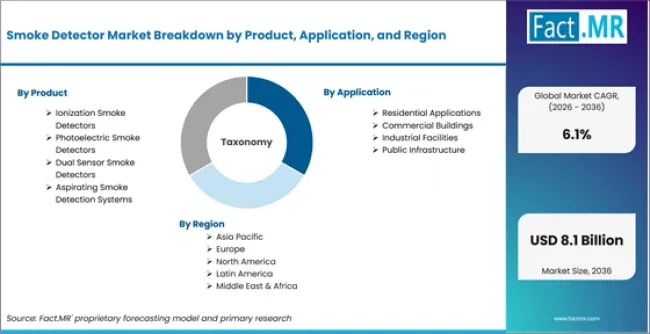
Smoke Detector Market Size, Share, Growth and Forecast (2026 - 2036)

Smoke Detector Market is segmented by Product (Ionization Smoke Detectors, Photoelectric Smoke Detectors, Dual Sensor Smoke Detectors, Aspirating Smoke Detection Systems), Application (Residential Applications, Commercial Buildings, Industrial Facilities, Public Infrastructure), End Use (Residential Sector, Commercial Sector, Industrial Sector, Public Sector), and Region. Forecasts from 2026 to 2036.

Smoke Detector Analysis and Forecast by Fact.MR

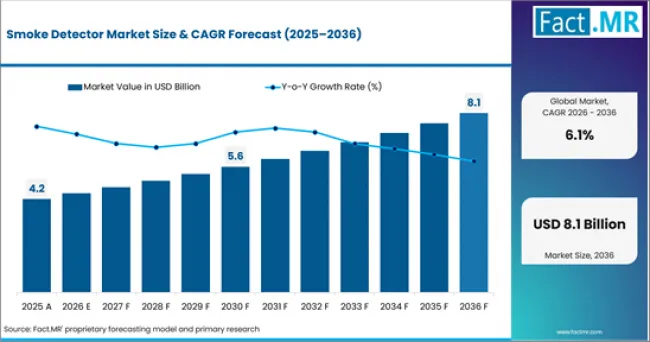
  • The Smoke Detector Market is expected to grow from USD 4.5 billion in 2026 to USD 8.1 billion by 2036, at a 6.1% CAGR.
  • Driven by stricter fire safety codes and building-regulation mandates, smart home technology driving connected-alarm adoption, and ongoing residential and commercial construction activity.
  • Ionization Smoke Detectors accounting for 32.4% share and Residential Applications contributing 72.9% share as property owners prioritize early fire detection, occupant safety, regulatory compliance, and risk mitigation across residential and commercial buildings.
Smoke Detector Market Value Analysis

Summary of the Smoke Detector Market

  • Market Snapshot
    • In 2025, the global Smoke Detector Market was valued at approximately USD 4.2 billion.
    • The market is estimated to reach USD 4.5 billion in 2026 and is projected to attain USD 8.1 billion by 2036.
    • The market is likely to expand at a CAGR of 6.1% during the forecast period.
    • The market is anticipated to create an absolute dollar opportunity of USD 3.6 billion between 2026 and 2036.
    • Ionization Smoke Detectors account for 32.4% of product share in 2026.
    • China (8.2%) and India (7.6%) are the key growth markets during the forecast period.
  • Demand and Growth Drivers
    • Stricter fire safety codes and building regulations across markets, including retrofit mandates, are expanding the installed base of interconnected smoke alarms in both residential and commercial settings.
    • Smart home technology adoption is driving demand for connected smoke detectors with app-based alerts, remote monitoring, and integration with broader home security ecosystems.
    • Ongoing construction activity in residential, commercial, and public infrastructure sustains new-installation and code-upgrade demand.
    • Smart connected systems with subscription monitoring services create recurring revenue beyond one-time hardware sales.
    • Dual-sensor and multi-sensor fusion technologies reduce false alarms and support premium positioning.
  • Product and Segment View
    • Ionization Smoke Detectors accounts for 32.4% of the product segment in 2026, emerging as the leading category.
    • Residential Applications account for 72.9% of the application segment in 2026, making it the dominant use setting.
  • Key segmentation includes:
    • Product: Ionization Smoke Detectors, Photoelectric Smoke Detectors, Dual Sensor Smoke Detectors, Aspirating Smoke Detection Systems
    • Application: Residential Applications, Commercial Buildings, Industrial Facilities, Public Infrastructure
    • End Use: Residential Sector, Commercial Sector, Industrial Sector, Public Sector
    • Technology: Ionization Sensing Technology, Photoelectric Sensing Technology, Multi Sensor Fusion Technology, Aspirating Technology
    • Formulation: Standalone Detector Units, Smart Connected Systems, Integrated Fire Safety Systems, Industrial Grade Systems
    • Distribution Channel: Direct Sales, Retail Channels, Online Sales, Distributors & Installers
    • These systems enable:
      • Early smoke and fire particle detection
      • App-based real-time alert and monitoring
      • Interconnected multi-room alarm coverage
  • Geography and Competitive Outlook
    • North America leads on fire safety code stringency, established detector installed base, and smart home adoption driving connected-alarm demand.
    • Europe demand reflects the EN 54 framework, updated building energy and safety regulations, and strong commercial and institutional retrofit activity.
    • Urbanization, construction activity, and tightening fire safety codes across China and India drive the steepest regional growth, widening the detector installed base across Asia Pacific.
    • China (8.2%) and India (7.6%) lead country growth, with other major markets showing steady demand.
    • Key companies include Honeywell International Inc., Johnson Controls International plc, Siemens AG, Robert Bosch GmbH, Carrier Global Corporation (Kidde), Hochiki Corporation.
  • Analyst Opinion
    • Shambhu Nath Jha, Principal Consultant at Fact.MR, says "Smoke detector demand is driven by building codes, construction activity, and the smart-home shift that is pulling detectors into connected ecosystems. Ionization still leads by installed base, but photoelectric and dual-sensor models gain share as false-alarm reduction becomes a buying criterion. Smart connected systems with app-based monitoring and subscription services are the most important growth lever, creating recurring revenue beyond one-time hardware. China and India are the fastest-growing markets as urbanization and code mandates widen the installed base. The firms best positioned pair reliable detection with smart-home integration and channel reach, since residential buyers increasingly choose ecosystem compatibility over standalone alarms."

Key Growth Drivers, Constraints, and Opportunities
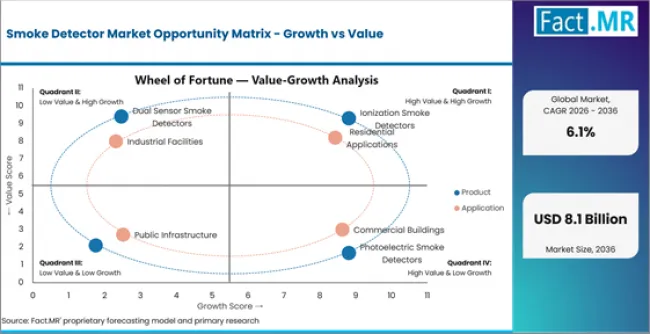
Smoke Detector Market Opportunity Matrix Growth Vs Value

Key Factors Driving Growth

  • Stricter fire safety codes and building regulations across markets, including retrofit mandates, are expanding the installed base of interconnected smoke alarms in both residential and commercial settings.
  • Smart home technology adoption is driving demand for connected smoke detectors with app-based alerts, remote monitoring, and integration with broader home security ecosystems.
  • Ongoing construction activity in residential, commercial, and public infrastructure sustains new-installation and code-upgrade demand.

Key Market Constraints

  • Price sensitivity in residential segments limits penetration of premium smart and dual-sensor models in some markets.
  • False-alarm rates with ionization detectors in certain environments drive replacement rather than category expansion.
  • Fragmented installation and maintenance practices in older building stock slow retrofit compliance.

Key Opportunity Areas

  • Smart connected systems with subscription monitoring services create recurring revenue beyond one-time hardware sales.
  • Dual-sensor and multi-sensor fusion technologies reduce false alarms and support premium positioning.
  • Emerging-market urbanization and construction growth widen the addressable installed base.

Segment-wise Analysis of the Smoke Detector

  • Ionization Smoke Detectors holds 32.4% of the product segment in 2026, supported by established installed base and procurement scale.
  • Residential Applications represents 72.9% of the application segment in 2026, anchored by its dominant residential application base.

The Smoke Detector Market is segmented by product, application, end use, technology, formulation, distribution channel. Demand is shaped by building codes, fire-safety regulations, replacement cycles, and procurement practices.

Which Product Segment Dominates the Smoke Detector?
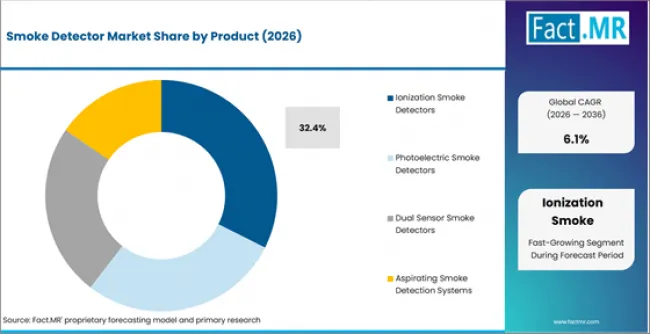
Smoke Detector Market Analysis By Product

Ionization Smoke Detectors lead the product segment with 32.4% share in 2026, reflecting a large installed base and widespread residential use. Their sensitivity to flaming-fire particles sustains demand despite the shift toward photoelectric and dual-sensor models.

The segment is expected to face gradual share pressure as photoelectric and dual-sensor systems gain ground on false-alarm performance and evolving building codes. Ionization detectors retain a large installed base, but the growth trajectory favors optical and multi-sensor technologies.

Which Application Segment Dominates the Smoke Detector?
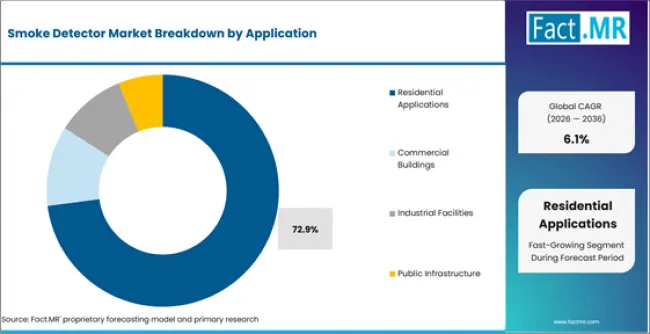
Smoke Detector Market Analysis By Application

Residential Applications lead the application segment with 72.9% share in 2026, driven by building code mandates, homeowner safety awareness, and smart-home integration that increasingly embed smoke detection into connected ecosystems. The residential installed base is the largest demand pool.

The application is likely to hold its dominant share as code mandates expand and smart-home penetration rises. Commercial, industrial, and public infrastructure grow alongside, but residential demand anchors the largest application channel through sheer building-stock scale.

Which Product Trend is Shaping the Next Phase of Growth in the Smoke Detector?

Ionization Smoke Detectors lead the product segment at 32.4%, but the defining shift is toward photoelectric and dual-sensor systems that reduce false-alarm rates and meet evolving code requirements. Ionization-sensing technology anchors a large share, while photoelectric sensing gains ground as regulations and buyer preference increasingly favor optical detection in residential settings.

Smart connected systems represent the most disruptive direction. App-based monitoring, Wi-Fi connectivity, and integration with home security ecosystems are transforming smoke detectors from passive alarms into active safety platforms. Standalone detector units anchor the largest formulation share, but smart connected systems grow as builders and homeowners invest in data-enabled fire safety.

Regional Outlook Across Key Markets

  • North America leads on fire safety code stringency, established detector installed base, and smart home adoption driving connected-alarm demand.
  • Europe demand reflects the EN 54 framework, updated building energy and safety regulations, and strong commercial and institutional retrofit activity.
  • Urbanization, construction activity, and tightening fire safety codes across China and India drive the steepest regional growth, widening the detector installed base across Asia Pacific.
  • Japan shows steady demand anchored in advanced building infrastructure and updated fire safety standards.

Top Country Growth Comparison Smoke Detector Market Cagr (2026 2036)

CAGR Table

Country CAGR (%)
China 8.2%
India 7.6%
Germany 7.0%
Brazil 6.4%
U.S. 5.8%
UK 5.2%
Japan 4.6%

Source: Fact.MR analysis, based on proprietary forecasting model and primary research.
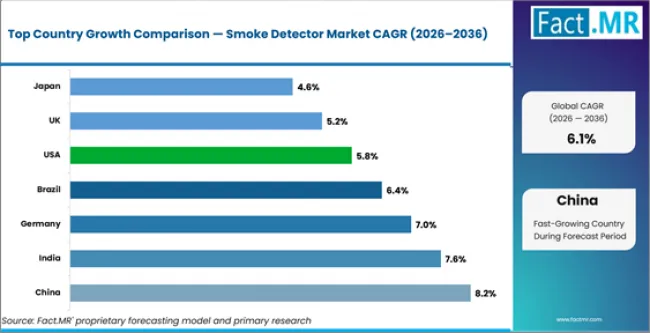
Smoke Detector Market Cagr Analysis By Country

Market Outlook for Smoke Detector in China

The China Smoke Detector market is projected to grow at a CAGR of 8.2% through 2036. National building fire safety codes including GB 55037-2022 retrofit requirements are widening the smoke detector installed base across residential and commercial buildings. Domestic manufacturers hold cost advantages in standalone detector production, while smart connected systems gain traction in new urban developments.

  • National fire safety code mandates are widening the installed base of interconnected smoke alarms.
  • Domestic manufacturers hold cost advantages in standalone and smart detector production.

India Smoke Detector Demand Trends

The India Smoke Detector market is projected to grow at a CAGR of 7.6% through 2036. Demand is shaped by rapid urbanization, commercial construction growth, and tightening fire safety regulation that expand detector requirements beyond high-rise and commercial buildings. Cost-effectiveness favors standalone ionization and photoelectric units, while smart city projects introduce connected detector demand.

  • Urbanization and commercial construction are expanding fire safety code coverage and detector demand.
  • Smart city projects introduce connected smoke detector requirements in new developments.

Smoke Detector Growth Assessment in Germany

The Germany Smoke Detector market is projected to grow at a CAGR of 7.0% through 2036. Updated building energy and fire safety regulations, aligned with the EN 54 framework, govern detector specification across German residential and commercial buildings. Commercial and institutional retrofit activity sustains demand for photoelectric and aspirating systems, while energy-performance targets shape building-safety investment.

  • EN 54 framework compliance shapes detector specification in commercial and institutional buildings.
  • Building retrofit activity sustains demand for photoelectric and aspirating detection systems.

United States Smoke Detector Market Opportunity Outlook
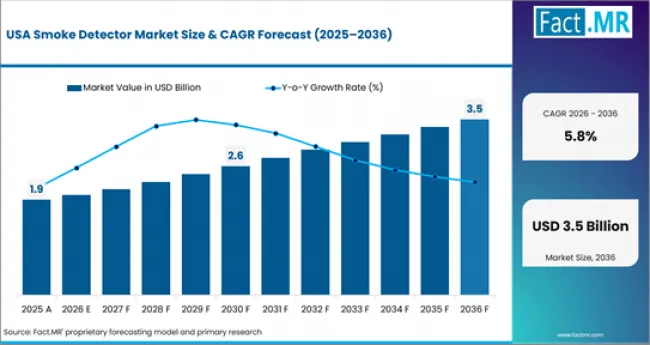
Smoke Detector Market Country Value Analysis

The United States Smoke Detector market is projected to grow at a CAGR of 5.8% through 2036. NFPA standards mandating smoke alarm installations in homes anchor the largest installed base, with replacement cycles and smart-home integration driving connected-alarm growth. Residential construction and code-upgrade activity sustain new-installation demand, while insurance-incentivized smart detectors reduce false alarms and lower premiums.

  • NFPA code mandates sustain the largest residential detector installed base.
  • Insurance-incentivized smart detectors support connected-alarm adoption and replacement.

Smoke Detector Demand Analysis in Japan
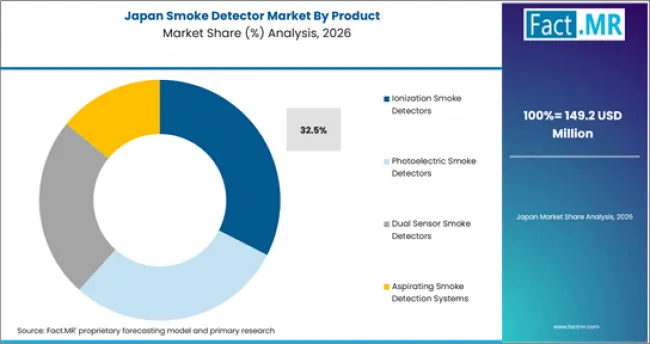
Smoke Detector Market Japan Market Share Analysis By Product

The Japan Smoke Detector market is projected to grow at a CAGR of 4.6% through 2036. Updated fire safety standards and advanced building infrastructure mean growth is led by replacement and upgrade cycles rather than first-time installation. Preference for quality and domestic suppliers shapes procurement, while advanced multi-sensor and aspirating systems serve commercial and industrial applications.

  • Updated fire safety standards drive detector replacement and upgrade cycles.
  • Advanced multi-sensor and aspirating systems serve commercial and industrial applications.

Competitive Benchmarking and Company Positioning
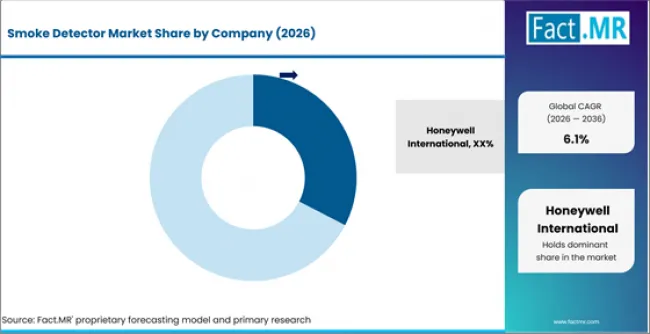
Smoke Detector Market Analysis By Company

Smoke Detector Analysis By Company

  • Honeywell, Johnson Controls, Siemens, and Bosch hold leading positions through broad fire-safety portfolios spanning ionization, photoelectric, aspirating, and smart connected systems, supported by global distribution and code-compliance expertise.
  • Carrier Global through Kidde, Hochiki, and Halma compete strongly across residential, commercial, and industrial formats, where detection performance, false-alarm reduction, and channel reach shape competitive standing.
  • Smart-home integration and connected-alarm ecosystems increasingly differentiate leaders as buyers move from standalone detectors to data-enabled safety platforms.

The competitive landscape is moderately concentrated, with differentiation driven by detection-technology breadth, smart-home integration, and code-compliance positioning. Honeywell, Johnson Controls, Siemens, and Bosch lead through broad fire-safety portfolios, global distribution, and the ability to serve residential, commercial, and industrial segments from a single platform.

Below the leaders, Kidde, Hochiki, Halma, Gentex, Apollo, and Ei Electronics maintain strong positions across specific market segments and geographies. Competition turns on detection accuracy, false-alarm performance, and retail or installer channel access rather than brand alone.

Smart and connected systems are the competitive frontier. Partnerships linking smoke detection with home-security ecosystems and subscription monitoring services create recurring revenue and deeper consumer relationships. Suppliers that combine reliable detection with app-based connectivity and dependable service are positioned to capture code-upgrade and smart-home adoption demand.

Key Companies in the Smoke Detector

  • Leading companies in the smoke detector market include Honeywell International Inc., Johnson Controls International plc, Siemens AG, Robert Bosch GmbH, which hold strong positions through portfolio breadth, fire-safety expertise, product reliability, and broad distribution.
  • Carrier Global Corporation (Kidde), Hochiki Corporation, Halma plc, Gentex Corporation maintain established positions across specific segments and channels, competing on detection performance, reliability, service, and regional reach.
  • Apollo Fire Detectors Ltd., Ei Electronics (Aico) and other specialists compete through focused offerings and niche strength, reinforcing relevance in a competitive but evolving market.

Recent Industry Developments

  • Honeywell International Inc. - NOTIFIER INSPIRE Self-Testing Fire Alarm System (February 2025)
    • In February 2025, Honeywell introduced the NOTIFIER INSPIRE series, a fire alarm system with EN-approved self-testing smoke detectors that automate testing to improve installation, maintenance, and life-safety system efficiency. The system targets commercial and institutional buildings.
  • Carrier Global Corporation (Kidde) - EXCELLENCE Series Optical Smoke Detectors (March 2025)
    • In March 2025, Kidde Commercial launched its EXCELLENCE Series smoke detectors featuring patented multi-wave, multi-angle optical detection. The technology distinguishes nuisance particles from real fire threats, addressing false-alarm concerns in complex commercial environments.
  • Honeywell International Inc. - Acquisition of Li-ion Tamer Business (July 2025)
    • In July 2025, Honeywell acquired the Li-ion Tamer business from Nexceris, enhancing its fire-safety portfolio with early detection of lithium-ion battery off-gassing and smoke. The acquisition addresses emerging fire risks from battery energy-storage systems.

Leading Companies Shaping the Smoke Detector

  • Honeywell International Inc.
  • Johnson Controls International plc
  • Siemens AG
  • Robert Bosch GmbH
  • Carrier Global Corporation (Kidde)
  • Hochiki Corporation
  • Halma plc
  • Gentex Corporation
  • Apollo Fire Detectors Ltd.
  • Ei Electronics (Aico)

Sources and Research References

  • Honeywell International Inc. (2025). Honeywell launches NOTIFIER INSPIRE, the next generation of fire alarm systems with self-testing smoke detectors. 
  • Carrier Global Corporation. (2025). Kidde Commercial launches EXCELLENCE Series optical smoke detectors. 
  • Honeywell International Inc. (2025). Honeywell acquires Li-ion Tamer business from Nexceris to strengthen fire detection capabilities for battery energy storage systems. 

This bibliography is provided for reader reference and is not exhaustive. The full report contains the complete reference list and detailed citations.

Key Questions This Report Addresses

  • What is the current and future size of the Smoke Detector Market?
  • How fast is the Smoke Detector Market expected to grow between 2026 and 2036?
  • Which product segment is likely to lead the market by 2026?
  • Which application segment is expected to account for the highest demand by 2026?
  • What factors are driving demand in the smoke detector market globally?
  • Which countries are projected to show the fastest growth through 2036?
  • What is driving market expansion in China and India?
  • Who are the key companies active in the smoke detector market?
  • How are smart connected systems reshaping the smoke detector competitive landscape?
  • What role do building code mandates play in driving detector installed-base growth?
  • How does Fact.MR estimate and validate the smoke detector market forecast?

Smoke Detector Market Definition

The smoke detector market covers ionization, photoelectric, dual-sensor, and aspirating smoke detection systems used in residential, commercial, industrial, and public infrastructure applications. It spans ionization-sensing, photoelectric-sensing, multi-sensor fusion, and aspirating technologies delivered through standalone, smart connected, integrated fire safety, and industrial-grade system formats across residential, commercial, industrial, and public sectors.

Smoke Detector Market Inclusions

  • The scope covers global and regional market size and forecasts for 2026 to 2036 across product type, application, end use, technology, formulation, and distribution channel.
  • It includes demand tied to building code mandates, fire safety regulation, smart home integration, and commercial construction activity.
  • Pricing analysis spans entry-level standalone detectors to premium connected and aspirating systems across retail, distributor, and installer channels.
  • Coverage includes smart connected systems with app-based monitoring and IoT integration.

Smoke Detector Market Exclusions

  • The scope excludes fire suppression systems, extinguishers, and alarm panels without a smoke-detection component.
  • It excludes general building-management systems sold without dedicated smoke-detection hardware.
  • Non-smoke gas detection systems outside the fire-safety definition are excluded.
  • Professional firefighting equipment is excluded.

Smoke Detector Market Research Methodology

  • The methodology combines secondary research, primary interviews, and demand-side modeling.
  • It draws on 110 plus secondary sources and benchmarks 50 plus product and system portfolios.
  • Market sizing covers 30 plus countries through a building-stock and code-compliance model with top-down validation.
  • Key inputs include residential and commercial construction activity, fire safety code requirements, smart-home penetration, and replacement cycles.
  • The model cross-checks unit demand with retail and distributor shipments, pricing trends, and building-permit data.
  • Primary validation includes 20 plus interviews across fire-safety engineers, building managers, distributors, and installers.
  • Final estimates pass through building-stock review and sensitivity testing.

Scope of Analysis

Smoke Detector Market Breakdown By Product, Application, And Region

Parameter Details
Quantitative Units USD 4.5 billion to USD 8.1 billion, at a CAGR of 6.1%
Market Definition The smoke detector market covers ionization, photoelectric, dual-sensor, and aspirating detection systems used in residential, commercial, industrial, and public safety applications.
Regions Covered North America, Latin America, Europe, East Asia, South Asia and Pacific, Middle East and Africa
Countries Covered China, India, Germany, Brazil, U.S., UK, Japan, 30 plus countries
Key Companies Honeywell International Inc., Johnson Controls International plc, Siemens AG, Robert Bosch GmbH, Carrier Global Corporation (Kidde), Hochiki Corporation, Halma plc, Gentex Corporation, Apollo Fire Detectors Ltd., Ei Electronics (Aico)
Forecast Period 2026 to 2036
Approach Hybrid demand-side and top-down methodology built on country-level demand, product and performance benchmarking, pricing analysis, shipment validation, and primary interviews across manufacturers, installers, distributors, and end users

Smoke Detector Segmentation

  • Smoke Detector Market Segmented by Product:

    • Ionization Smoke Detectors
      • Dual Chamber Ionization Sensors
        • Radioactive Source Ionization Units
        • Enhanced Sensitivity Ionization Systems
      • Standard Ionization Detectors
        • Residential Grade Ionization Units
        • Commercial Ionization Devices
    • Photoelectric Smoke Detectors
      • Optical Beam Detection Systems
        • Scattered Light Sensors
        • Reflected Light Detection Units
      • Advanced Optical Sensors
        • Dust Resistant Optical Detectors
        • High Sensitivity Optical Units
    • Dual Sensor Smoke Detectors
      • Hybrid Detection Systems
        • Ionization + Photoelectric Units
        • Multi Criteria Detection Systems
      • Smart Algorithm Based Detectors
        • AI Smoke Pattern Recognition Units
        • Adaptive Sensitivity Detectors
    • Aspirating Smoke Detection Systems
      • Air Sampling Systems
        • High Sensitivity Sampling Units
        • Early Warning Detection Systems
      • Laser Based Detection Systems
        • Precision Laser Particle Detectors
        • Data Center Grade ASP Systems
  • Smoke Detector Market Segmented by Application:

    • Residential Applications
      • Apartments & Flats
        • High Rise Residential Buildings
        • Low Rise Housing Units
      • Individual Homes
        • Single Family Homes
        • Villas & Bungalows
    • Commercial Buildings
      • Office Complexes
        • Corporate Office Towers
        • Co Working Spaces
      • Retail Spaces
        • Shopping Malls
        • Supermarkets & Stores
    • Industrial Facilities
      • Manufacturing Plants
        • Heavy Industrial Units
        • Light Manufacturing Facilities
      • Warehousing Facilities
        • Logistics Warehouses
        • Cold Storage Warehouses
    • Public Infrastructure
      • Transportation Hubs
        • Airports & Terminals
        • Railway Stations
      • Government Buildings
        • Municipal Facilities
        • Educational Institutions
  • Smoke Detector Market Segmented by End Use:

    • Residential Sector
      • Urban Housing
        • Smart Apartment Complexes
        • Affordable Housing Units
      • Rural Housing
        • Independent Rural Homes
        • Small Town Residences
    • Commercial Sector
      • Corporate Sector
        • IT & Tech Offices
        • Financial Institutions
      • Retail Sector
        • Retail Chains
        • Shopping Centers
    • Industrial Sector
      • Manufacturing Sector
        • Automotive Plants
        • Electronics Factories
      • Energy & Utilities
        • Power Plants
        • Oil & Gas Facilities
    • Public Sector
      • Government Infrastructure
        • Public Safety Buildings
        • Defense Installations
      • Institutional Sector
        • Schools & Universities
        • Hospitals & Clinics
  • Smoke Detector Market Segmented by Technology:

    • Ionization Sensing Technology
      • Radioactive Particle Sensing
        • Alpha Particle Detection Systems
        • Ion Chamber Detection Units
      • Enhanced Ion Flow Systems
        • High Sensitivity Ion Sensors
        • Low Noise Ionization Chambers
    • Photoelectric Sensing Technology
      • Optical Scattering Systems
        • Infrared Light Sensors
        • Laser Based Optical Detection
      • Reflective Light Systems
        • Dust Particle Reflection Sensors
        • Smoke Density Optical Systems
    • Multi Sensor Fusion Technology
      • Hybrid Detection Algorithms
        • Dual Signal Processing Systems
        • Cross Validation Sensor Engines
      • AI Based Detection Systems
        • Machine Learning Smoke Patterns
        • Predictive Fire Detection Models
    • Aspirating Technology
      • Air Sampling Networks
        • Continuous Air Monitoring Systems
        • Early Warning Sampling Units
      • Laser Particle Detection
        • High Precision Particle Counters
        • Data Center Grade Detection Systems
  • Smoke Detector Market Segmented by Formulation:

    • Standalone Detector Units
      • Battery Powered Units
        • Replaceable Battery Systems
        • Long Life Battery Detectors
      • Hardwired Systems
        • AC Powered Detection Units
        • Building Integrated Systems
    • Smart Connected Systems
      • IoT Enabled Detectors
        • WiFi Connected Smoke Sensors
        • Cloud Alert Integrated Devices
      • Wireless Mesh Systems
        • Interlinked Alarm Networks
        • Central Monitoring Systems
    • Integrated Fire Safety Systems
      • Fire Alarm Integration Units
        • Sprinkler System Connected Devices
        • Emergency Response Systems
      • Building Management Integration
        • Smart Building Fire Systems
        • Central Control Panel Integration
    • Industrial Grade Systems
      • Rugged Detection Units
        • High Temperature Resistant Sensors
        • Dust Proof Industrial Detectors
      • Hazardous Environment Systems
        • Explosion Proof Smoke Detectors
        • Chemical Plant Safety Systems
  • Smoke Detector Market Segmented by Distribution Channel:

    • Direct Sales
      • B2B Direct Contracts
        • Construction Company Supply Deals
        • Industrial Facility Contracts
      • Government Procurement
        • Public Safety Equipment Tenders
        • Infrastructure Safety Programs
    • Retail Channels
      • Hardware Stores
        • Home Improvement Chains
        • Local Electrical Stores
      • Specialty Safety Stores
        • Fire Safety Equipment Retailers
        • Security System Retailers
    • Online Sales
      • E Commerce Platforms
        • Home Safety Online Stores
        • Smart Device Marketplaces
      • Brand Websites
        • Manufacturer Direct Portals
        • Subscription Safety Services
    • Distributors & Installers
      • Regional Distributors
        • Fire Safety Equipment Distributors
        • Security System Installers
      • System Integrators
        • Smart Building Integrators
        • Industrial Safety Integrators
  • Smoke Detector Market by Region:

    • North America
      • USA
      • Canada
      • Mexico
    • Latin America
      • Brazil
      • Chile
      • Rest of Latin America
    • Western Europe
      • Germany
      • UK
      • Italy
      • Spain
      • France
      • Nordic
      • BENELUX
      • Rest of Western Europe
    • Eastern Europe
      • Russia
      • Poland
      • Hungary
      • Balkan & Baltic
      • Rest of Eastern Europe
    • East Asia
      • China
      • Japan
      • South Korea
    • South Asia and Pacific
      • India
      • ASEAN
      • Australia & New Zealand
      • Rest of South Asia and Pacific
    • Middle East & Africa
      • Kingdom of Saudi Arabia
      • Other GCC Countries
      • Turkiye
      • South Africa
      • Other African Union
      • Rest of Middle East & Africa

- Frequently Asked Questions -

How big is the smoke detector market in 2026?

The global smoke detector market is estimated to be valued at USD 4.5 billion in 2026.

What will be the size of the smoke detector market in 2036?

The market size for the smoke detector market is projected to reach USD 8.1 billion by 2036.

How much will be the smoke detector market growth between 2026 and 2036?

The smoke detector market is expected to grow at a 6.1% CAGR between 2026 and 2036.

What are the key products in the smoke detector market?

The key products in smoke detector market are Ionization Smoke Detectors, Photoelectric Smoke Detectors, Dual Sensor Smoke Detectors and Aspirating Smoke Detection Systems.

Which application segment is expected to contribute significant share in the smoke detector market in 2026?

In terms of application, residential applications segment is expected to command 72.9% share in the smoke detector market in 2026.

Table of Content

  1. Key Takeaways
    • Market Size and CAGR
    • Top Growth Driver
    • Fastest Growing Segment
    • Leading Region
    • Key Companies
    • Emerging Opportunities
  2. Executive Summary
    • Global Market Outlook
    • Demand-side Trends
    • Supply-side Trends
    • Technology Roadmap Analysis
    • Analysis and Recommendations
    • Analyst Perspective (What is happening? Why now? What should investors know?)
    • Key Questions Answered
      • How large is the market?
      • What is the CAGR?
      • What are key trends?
      • Which region dominates?
      • Who are the leaders?
  3. Market Overview
    • Market Coverage / Taxonomy
    • Market Definition / Scope / Limitations
  4. Research Methodology
    • Chapter Orientation
    • Analytical Lens and Working Hypotheses
      • Market Structure, Signals, and Trend Drivers
      • Benchmarking and Cross-market Comparability
      • Market Sizing, Forecasting, and Opportunity Mapping
    • Research Design and Evidence Framework
      • Desk Research Programme (Secondary Evidence)
      • Expert Input and Fieldwork (Primary Evidence)
      • Tooling, Models, and Reference Databases
    • Data Engineering and Model Build
    • Quality Assurance and Audit Trail
  5. Market Background
    • Market Dynamics (Drivers, Restraints, Opportunity, Trends)
    • Scenario Forecast (Optimistic, Likely, Conservative)
    • Impact Analysis
      • AI Impact
      • Sustainability Impact
      • Regulatory Impact
      • Technology Impact
    • Consumer / Buyer Analysis
      • Purchase Drivers
      • Adoption Barriers
      • Buyer Journey
    • Opportunity Map Analysis
    • Product Life Cycle Analysis
    • Supply Chain Analysis
    • Investment Feasibility Matrix
    • Value Chain Analysis
    • PESTLE and Porter's Analysis
    • Regulatory Landscape
    • Regional Parent Market Outlook
    • Production and Consumption Statistics
    • Import and Export Statistics
  6. Global Market Analysis and Forecast, 2021 to 2036
    • Historical Market Size Value (USD Million) Analysis, 2021 to 2025
    • Current and Future Market Size Value (USD Million) Projections, 2026 to 2036
      • Y-o-Y Growth Trend Analysis
      • Absolute $ Opportunity Analysis
  7. Global Market Pricing Analysis, 2021 to 2036
  8. Global Market Analysis and Forecast, By Product, 2021 to 2036
    • Introduction / Key Findings
    • Historical Market Size Value (USD Million) Analysis By Product, 2021 to 2025
    • Current and Future Market Size Value (USD Million) Analysis and Forecast By Product, 2026 to 2036
      • Ionization Smoke Detectors
        • Dual Chamber Ionization Sensors
        • Standard Ionization Detectors
      • Photoelectric Smoke Detectors
        • Optical Beam Detection Systems
        • Advanced Optical Sensors
      • Dual Sensor Smoke Detectors
        • Hybrid Detection Systems
        • Smart Algorithm Based Detectors
      • Aspirating Smoke Detection Systems
        • Air Sampling Systems
        • Laser Based Detection Systems
    • Y-o-Y Growth Trend Analysis By Product, 2021 to 2025
    • Absolute $ Opportunity Analysis By Product, 2026 to 2036
  9. Global Market Analysis and Forecast, By Application, 2021 to 2036
    • Introduction / Key Findings
    • Historical Market Size Value (USD Million) Analysis By Application, 2021 to 2025
    • Current and Future Market Size Value (USD Million) Analysis and Forecast By Application, 2026 to 2036
      • Residential Applications
        • Apartments & Flats
        • Individual Homes
      • Commercial Buildings
        • Office Complexes
        • Retail Spaces
      • Industrial Facilities
        • Manufacturing Plants
        • Warehousing Facilities
      • Public Infrastructure
        • Transportation Hubs
        • Government Buildings
    • Y-o-Y Growth Trend Analysis By Application, 2021 to 2025
    • Absolute $ Opportunity Analysis By Application, 2026 to 2036
  10. Global Market Analysis and Forecast, By End Use, 2021 to 2036
    • Introduction / Key Findings
    • Historical Market Size Value (USD Million) Analysis By End Use, 2021 to 2025
    • Current and Future Market Size Value (USD Million) Analysis and Forecast By End Use, 2026 to 2036
      • Residential Sector
        • Urban Housing
        • Rural Housing
      • Commercial Sector
        • Corporate Sector
        • Retail Sector
      • Industrial Sector
        • Manufacturing Sector
        • Energy & Utilities
      • Public Sector
        • Government Infrastructure
        • Institutional Sector
    • Y-o-Y Growth Trend Analysis By End Use, 2021 to 2025
    • Absolute $ Opportunity Analysis By End Use, 2026 to 2036
  11. Global Market Analysis and Forecast, By Technology, 2021 to 2036
    • Introduction / Key Findings
    • Historical Market Size Value (USD Million) Analysis By Technology, 2021 to 2025
    • Current and Future Market Size Value (USD Million) Analysis and Forecast By Technology, 2026 to 2036
      • Ionization Sensing Technology
        • Radioactive Particle Sensing
        • Enhanced Ion Flow Systems
      • Photoelectric Sensing Technology
        • Optical Scattering Systems
        • Reflective Light Systems
      • Multi Sensor Fusion Technology
        • Hybrid Detection Algorithms
        • AI Based Detection Systems
      • Aspirating Technology
        • Air Sampling Networks
        • Laser Particle Detection
    • Y-o-Y Growth Trend Analysis By Technology, 2021 to 2025
    • Absolute $ Opportunity Analysis By Technology, 2026 to 2036
  12. Global Market Analysis and Forecast, By Formulation, 2021 to 2036
    • Introduction / Key Findings
    • Historical Market Size Value (USD Million) Analysis By Formulation, 2021 to 2025
    • Current and Future Market Size Value (USD Million) Analysis and Forecast By Formulation, 2026 to 2036
      • Standalone Detector Value (USD Million)s
        • Battery Powered Value (USD Million)s
        • Hardwired Systems
      • Smart Connected Systems
        • IoT Enabled Detectors
        • Wireless Mesh Systems
      • Integrated Fire Safety Systems
        • Fire Alarm Integration Value (USD Million)s
        • Building Management Integration
      • Industrial Grade Systems
        • Rugged Detection Value (USD Million)s
        • Hazardous Environment Systems
    • Y-o-Y Growth Trend Analysis By Formulation, 2021 to 2025
    • Absolute $ Opportunity Analysis By Formulation, 2026 to 2036
  13. Global Market Analysis and Forecast, By Distribution Channel
    • Introduction / Key Findings
    • Historical Market Size Value (USD Million) Analysis By Distribution Channel, 2021 to 2025
    • Current and Future Market Size Value (USD Million) Analysis and Forecast By Distribution Channel, 2026 to 2036
      • Direct Sales
        • B2B Direct Contracts
        • Government Procurement
      • Retail Channels
        • Hardware Stores
        • Specialty Safety Stores
      • Online Sales
        • E Commerce Platforms
        • Brand Websites
      • Distributors & Installers
        • Regional Distributors
        • System Integrators
    • Y-o-Y Growth Trend Analysis By Distribution Channel, 2021 to 2025
    • Absolute $ Opportunity Analysis By Distribution Channel, 2026 to 2036
  14. Global Market Analysis and Forecast, By Region, 2021 to 2036
    • Introduction
    • Historical Market Size Value (USD Million) Analysis By Region, 2021 to 2025
    • Current Market Size Value (USD Million) Analysis and Forecast By Region, 2026 to 2036
      • North America
      • Latin America
      • Western Europe
      • Eastern Europe
      • East Asia
      • South Asia and Pacific
      • Middle East & Africa
    • Market Attractiveness Analysis By Region
  15. North America Market Analysis and Forecast, By Country, 2021 to 2036
    • Historical Market Size Value (USD Million) Trend Analysis By Market Taxonomy, 2021 to 2025
    • Market Size Value (USD Million) Forecast By Market Taxonomy, 2026 to 2036
      • By Country
        • USA
        • Canada
        • Mexico
      • By Product
      • By Application
      • By End Use
      • By Technology
      • By Formulation
      • By Distribution Channel
    • Market Attractiveness Analysis
      • By Country
      • By Product
      • By Application
      • By End Use
      • By Technology
      • By Formulation
      • By Distribution Channel
    • Key Takeaways
  16. Latin America Market Analysis and Forecast, By Country
    • Historical Market Size Value (USD Million) Trend Analysis By Market Taxonomy, 2021 to 2025
    • Market Size Value (USD Million) Forecast By Market Taxonomy, 2026 to 2036
      • By Country
        • Brazil
        • Chile
        • Rest of Latin America
      • By Product
      • By Application
      • By End Use
      • By Technology
      • By Formulation
      • By Distribution Channel
    • Market Attractiveness Analysis
      • By Country
      • By Product
      • By Application
      • By End Use
      • By Technology
      • By Formulation
      • By Distribution Channel
    • Key Takeaways
  17. Western Europe Market Analysis and Forecast, By Country
    • Historical Market Size Value (USD Million) Trend Analysis By Market Taxonomy, 2021 to 2025
    • Market Size Value (USD Million) Forecast By Market Taxonomy, 2026 to 2036
      • By Country
        • Germany
        • UK
        • Italy
        • Spain
        • France
        • Nordic
        • BENELUX
        • Rest of Western Europe
      • By Product
      • By Application
      • By End Use
      • By Technology
      • By Formulation
      • By Distribution Channel
    • Market Attractiveness Analysis
      • By Country
      • By Product
      • By Application
      • By End Use
      • By Technology
      • By Formulation
      • By Distribution Channel
    • Key Takeaways
  18. Eastern Europe Market Analysis and Forecast, By Country
    • Historical Market Size Value (USD Million) Trend Analysis By Market Taxonomy, 2021 to 2025
    • Market Size Value (USD Million) Forecast By Market Taxonomy, 2026 to 2036
      • By Country
        • Russia
        • Poland
        • Hungary
        • Balkan & Baltic
        • Rest of Eastern Europe
      • By Product
      • By Application
      • By End Use
      • By Technology
      • By Formulation
      • By Distribution Channel
    • Market Attractiveness Analysis
      • By Country
      • By Product
      • By Application
      • By End Use
      • By Technology
      • By Formulation
      • By Distribution Channel
    • Key Takeaways
  19. East Asia Market Analysis and Forecast, By Country
    • Historical Market Size Value (USD Million) Trend Analysis By Market Taxonomy, 2021 to 2025
    • Market Size Value (USD Million) Forecast By Market Taxonomy, 2026 to 2036
      • By Country
        • China
        • Japan
        • South Korea
      • By Product
      • By Application
      • By End Use
      • By Technology
      • By Formulation
      • By Distribution Channel
    • Market Attractiveness Analysis
      • By Country
      • By Product
      • By Application
      • By End Use
      • By Technology
      • By Formulation
      • By Distribution Channel
    • Key Takeaways
  20. South Asia and Pacific Market Analysis and Forecast, By Country
    • Historical Market Size Value (USD Million) Trend Analysis By Market Taxonomy, 2021 to 2025
    • Market Size Value (USD Million) Forecast By Market Taxonomy, 2026 to 2036
      • By Country
        • India
        • ASEAN
        • Australia & New Zealand
        • Rest of South Asia and Pacific
      • By Product
      • By Application
      • By End Use
      • By Technology
      • By Formulation
      • By Distribution Channel
    • Market Attractiveness Analysis
      • By Country
      • By Product
      • By Application
      • By End Use
      • By Technology
      • By Formulation
      • By Distribution Channel
    • Key Takeaways
  21. Middle East & Africa Market Analysis and Forecast, By Country
    • Historical Market Size Value (USD Million) Trend Analysis By Market Taxonomy, 2021 to 2025
    • Market Size Value (USD Million) Forecast By Market Taxonomy, 2026 to 2036
      • By Country
        • Kingdom of Saudi Arabia
        • Other GCC Countries
        • Turkiye
        • South Africa
        • Other African Union
        • Rest of Middle East & Africa
      • By Product
      • By Application
      • By End Use
      • By Technology
      • By Formulation
      • By Distribution Channel
    • Market Attractiveness Analysis
      • By Country
      • By Product
      • By Application
      • By End Use
      • By Technology
      • By Formulation
      • By Distribution Channel
    • Key Takeaways
  22. Key Countries Market Analysis
    • USA
      • Pricing Analysis
      • Market Share Analysis, 2025
        • By Product
        • By Application
        • By End Use
        • By Technology
        • By Formulation
        • By Distribution Channel
    • Canada
      • Pricing Analysis
      • Market Share Analysis, 2025
        • By Product
        • By Application
        • By End Use
        • By Technology
        • By Formulation
        • By Distribution Channel
    • Mexico
      • Pricing Analysis
      • Market Share Analysis, 2025
        • By Product
        • By Application
        • By End Use
        • By Technology
        • By Formulation
        • By Distribution Channel
    • Brazil
      • Pricing Analysis
      • Market Share Analysis, 2025
        • By Product
        • By Application
        • By End Use
        • By Technology
        • By Formulation
        • By Distribution Channel
    • Chile
      • Pricing Analysis
      • Market Share Analysis, 2025
        • By Product
        • By Application
        • By End Use
        • By Technology
        • By Formulation
        • By Distribution Channel
    • Germany
      • Pricing Analysis
      • Market Share Analysis, 2025
        • By Product
        • By Application
        • By End Use
        • By Technology
        • By Formulation
        • By Distribution Channel
    • UK
      • Pricing Analysis
      • Market Share Analysis, 2025
        • By Product
        • By Application
        • By End Use
        • By Technology
        • By Formulation
        • By Distribution Channel
    • Italy
      • Pricing Analysis
      • Market Share Analysis, 2025
        • By Product
        • By Application
        • By End Use
        • By Technology
        • By Formulation
        • By Distribution Channel
    • Spain
      • Pricing Analysis
      • Market Share Analysis, 2025
        • By Product
        • By Application
        • By End Use
        • By Technology
        • By Formulation
        • By Distribution Channel
    • France
      • Pricing Analysis
      • Market Share Analysis, 2025
        • By Product
        • By Application
        • By End Use
        • By Technology
        • By Formulation
        • By Distribution Channel
    • India
      • Pricing Analysis
      • Market Share Analysis, 2025
        • By Product
        • By Application
        • By End Use
        • By Technology
        • By Formulation
        • By Distribution Channel
    • ASEAN
      • Pricing Analysis
      • Market Share Analysis, 2025
        • By Product
        • By Application
        • By End Use
        • By Technology
        • By Formulation
        • By Distribution Channel
    • Australia & New Zealand
      • Pricing Analysis
      • Market Share Analysis, 2025
        • By Product
        • By Application
        • By End Use
        • By Technology
        • By Formulation
        • By Distribution Channel
    • China
      • Pricing Analysis
      • Market Share Analysis, 2025
        • By Product
        • By Application
        • By End Use
        • By Technology
        • By Formulation
        • By Distribution Channel
    • Japan
      • Pricing Analysis
      • Market Share Analysis, 2025
        • By Product
        • By Application
        • By End Use
        • By Technology
        • By Formulation
        • By Distribution Channel
    • South Korea
      • Pricing Analysis
      • Market Share Analysis, 2025
        • By Product
        • By Application
        • By End Use
        • By Technology
        • By Formulation
        • By Distribution Channel
    • Russia
      • Pricing Analysis
      • Market Share Analysis, 2025
        • By Product
        • By Application
        • By End Use
        • By Technology
        • By Formulation
        • By Distribution Channel
    • Poland
      • Pricing Analysis
      • Market Share Analysis, 2025
        • By Product
        • By Application
        • By End Use
        • By Technology
        • By Formulation
        • By Distribution Channel
    • Hungary
      • Pricing Analysis
      • Market Share Analysis, 2025
        • By Product
        • By Application
        • By End Use
        • By Technology
        • By Formulation
        • By Distribution Channel
    • Kingdom of Saudi Arabia
      • Pricing Analysis
      • Market Share Analysis, 2025
        • By Product
        • By Application
        • By End Use
        • By Technology
        • By Formulation
        • By Distribution Channel
    • Turkiye
      • Pricing Analysis
      • Market Share Analysis, 2025
        • By Product
        • By Application
        • By End Use
        • By Technology
        • By Formulation
        • By Distribution Channel
    • South Africa
      • Pricing Analysis
      • Market Share Analysis, 2025
        • By Product
        • By Application
        • By End Use
        • By Technology
        • By Formulation
        • By Distribution Channel
  23. Market Structure Analysis
    • Competition Dashboard
    • Competition Benchmarking
    • Market Share Analysis of Top Players
      • By Regional
      • By Product
      • By Application
      • By End Use
      • By Technology
      • By Formulation
      • By Distribution Channel
      • Emerging Startups
      • Innovation Benchmarking
    • Competition Analysis
      • Competition Deep Dive
        • Honeywell International
          • Overview
          • Product Portfolio
          • Profitability by Market Segments (Product/Age /Sales Channel/Region)
          • Sales Footprint
          • Strategy Overview
            • Marketing Strategy
            • Product Strategy
            • Channel Strategy
        • Siemens AG
        • Value (USD Million)ed Technologies Corporation
        • Tyco
        • Hochiki Corporation
        • Robert Bosch
        • Nest Labs
        • NEC Corporation
        • Johnson Control
        • Schneider Electric
        • Others
    • Case Studies
    • Success Stories
    • Recent Developments
  24. Assumptions & Acronyms Used

List Of Table

  • Table 1: Global Market Value (USD Million) Forecast by Region, 2021 to 2036
  • Table 2: Global Market Value (USD Million) Forecast by Product, 2021 to 2036
  • Table 3: Global Market Value (USD Million) Forecast by Application, 2021 to 2036
  • Table 4: Global Market Value (USD Million) Forecast by End Use, 2021 to 2036
  • Table 5: Global Market Value (USD Million) Forecast by Technology, 2021 to 2036
  • Table 6: Global Market Value (USD Million) Forecast by Formulation, 2021 to 2036
  • Table 7: Global Market Value (USD Million) Forecast by Distribution Channel, 2021 to 2036
  • Table 8: Global Market rma_anu Forecast by rma_anu, 2021 to 2036
  • Table 9: North America Market Value (USD Million) Forecast by Country, 2021 to 2036
  • Table 10: North America Market Value (USD Million) Forecast by Product, 2021 to 2036
  • Table 11: North America Market Value (USD Million) Forecast by Application, 2021 to 2036
  • Table 12: North America Market Value (USD Million) Forecast by End Use, 2021 to 2036
  • Table 13: North America Market Value (USD Million) Forecast by Technology, 2021 to 2036
  • Table 14: North America Market Value (USD Million) Forecast by Formulation, 2021 to 2036
  • Table 15: North America Market Value (USD Million) Forecast by Distribution Channel, 2021 to 2036
  • Table 16: Latin America Market Value (USD Million) Forecast by Country, 2021 to 2036
  • Table 17: Latin America Market Value (USD Million) Forecast by Product, 2021 to 2036
  • Table 18: Latin America Market Value (USD Million) Forecast by Application, 2021 to 2036
  • Table 19: Latin America Market Value (USD Million) Forecast by End Use, 2021 to 2036
  • Table 20: Latin America Market Value (USD Million) Forecast by Technology, 2021 to 2036
  • Table 21: Latin America Market Value (USD Million) Forecast by Formulation, 2021 to 2036
  • Table 22: Latin America Market Value (USD Million) Forecast by Distribution Channel, 2021 to 2036
  • Table 23: Western Europe Market Value (USD Million) Forecast by Country, 2021 to 2036
  • Table 24: Western Europe Market Value (USD Million) Forecast by Product, 2021 to 2036
  • Table 25: Western Europe Market Value (USD Million) Forecast by Application, 2021 to 2036
  • Table 26: Western Europe Market Value (USD Million) Forecast by End Use, 2021 to 2036
  • Table 27: Western Europe Market Value (USD Million) Forecast by Technology, 2021 to 2036
  • Table 28: Western Europe Market Value (USD Million) Forecast by Formulation, 2021 to 2036
  • Table 29: Western Europe Market Value (USD Million) Forecast by Distribution Channel, 2021 to 2036
  • Table 30: Eastern Europe Market Value (USD Million) Forecast by Country, 2021 to 2036
  • Table 31: Eastern Europe Market Value (USD Million) Forecast by Product, 2021 to 2036
  • Table 32: Eastern Europe Market Value (USD Million) Forecast by Application, 2021 to 2036
  • Table 33: Eastern Europe Market Value (USD Million) Forecast by End Use, 2021 to 2036
  • Table 34: Eastern Europe Market Value (USD Million) Forecast by Technology, 2021 to 2036
  • Table 35: Eastern Europe Market Value (USD Million) Forecast by Formulation, 2021 to 2036
  • Table 36: Eastern Europe Market Value (USD Million) Forecast by Distribution Channel, 2021 to 2036
  • Table 37: East Asia Market Value (USD Million) Forecast by Country, 2021 to 2036
  • Table 38: East Asia Market Value (USD Million) Forecast by Product, 2021 to 2036
  • Table 39: East Asia Market Value (USD Million) Forecast by Application, 2021 to 2036
  • Table 40: East Asia Market Value (USD Million) Forecast by End Use, 2021 to 2036
  • Table 41: East Asia Market Value (USD Million) Forecast by Technology, 2021 to 2036
  • Table 42: East Asia Market Value (USD Million) Forecast by Formulation, 2021 to 2036
  • Table 43: East Asia Market Value (USD Million) Forecast by Distribution Channel, 2021 to 2036
  • Table 44: South Asia and Pacific Market Value (USD Million) Forecast by Country, 2021 to 2036
  • Table 45: South Asia and Pacific Market Value (USD Million) Forecast by Product, 2021 to 2036
  • Table 46: South Asia and Pacific Market Value (USD Million) Forecast by Application, 2021 to 2036
  • Table 47: South Asia and Pacific Market Value (USD Million) Forecast by End Use, 2021 to 2036
  • Table 48: South Asia and Pacific Market Value (USD Million) Forecast by Technology, 2021 to 2036
  • Table 49: South Asia and Pacific Market Value (USD Million) Forecast by Formulation, 2021 to 2036
  • Table 50: South Asia and Pacific Market Value (USD Million) Forecast by Distribution Channel, 2021 to 2036
  • Table 51: Middle East & Africa Market Value (USD Million) Forecast by Country, 2021 to 2036
  • Table 52: Middle East & Africa Market Value (USD Million) Forecast by Product, 2021 to 2036
  • Table 53: Middle East & Africa Market Value (USD Million) Forecast by Application, 2021 to 2036
  • Table 54: Middle East & Africa Market Value (USD Million) Forecast by End Use, 2021 to 2036
  • Table 55: Middle East & Africa Market Value (USD Million) Forecast by Technology, 2021 to 2036
  • Table 56: Middle East & Africa Market Value (USD Million) Forecast by Formulation, 2021 to 2036
  • Table 57: Middle East & Africa Market Value (USD Million) Forecast by Distribution Channel, 2021 to 2036

List Of Figures

  • Figure 1: Global Market Pricing Analysis
  • Figure 2: Global Market Value (USD Million) Forecast 2021 to 2036
  • Figure 3: Global Market Value Share and BPS Analysis by Product, 2026 and 2036
  • Figure 4: Global Market Y-o-Y Growth Comparison by Product, 2026 to 2036
  • Figure 5: Global Market Attractiveness Analysis by Product
  • Figure 6: Global Market Value Share and BPS Analysis by Application, 2026 and 2036
  • Figure 7: Global Market Y-o-Y Growth Comparison by Application, 2026 to 2036
  • Figure 8: Global Market Attractiveness Analysis by Application
  • Figure 9: Global Market Value Share and BPS Analysis by End Use, 2026 and 2036
  • Figure 10: Global Market Y-o-Y Growth Comparison by End Use, 2026 to 2036
  • Figure 11: Global Market Attractiveness Analysis by End Use
  • Figure 12: Global Market Value Share and BPS Analysis by Technology, 2026 and 2036
  • Figure 13: Global Market Y-o-Y Growth Comparison by Technology, 2026 to 2036
  • Figure 14: Global Market Attractiveness Analysis by Technology
  • Figure 15: Global Market Value Share and BPS Analysis by Formulation, 2026 and 2036
  • Figure 16: Global Market Y-o-Y Growth Comparison by Formulation, 2026 to 2036
  • Figure 17: Global Market Attractiveness Analysis by Formulation
  • Figure 18: Global Market Value Share and BPS Analysis by Distribution Channel, 2026 and 2036
  • Figure 19: Global Market Y-o-Y Growth Comparison by Distribution Channel, 2026 to 2036
  • Figure 20: Global Market Attractiveness Analysis by Distribution Channel
  • Figure 21: Global Market Value (USD Million) Share and BPS Analysis by Region, 2026 and 2036
  • Figure 22: Global Market Y-o-Y Growth Comparison by Region, 2026 to 2036
  • Figure 23: Global Market Attractiveness Analysis by Region
  • Figure 24: North America Market Incremental Dollar Opportunity, 2026 to 2036
  • Figure 25: Latin America Market Incremental Dollar Opportunity, 2026 to 2036
  • Figure 26: Western Europe Market Incremental Dollar Opportunity, 2026 to 2036
  • Figure 27: Eastern Europe Market Incremental Dollar Opportunity, 2026 to 2036
  • Figure 28: East Asia Market Incremental Dollar Opportunity, 2026 to 2036
  • Figure 29: South Asia and Pacific Market Incremental Dollar Opportunity, 2026 to 2036
  • Figure 30: Middle East & Africa Market Incremental Dollar Opportunity, 2026 to 2036
  • Figure 31: North America Market Value Share and BPS Analysis by Country, 2026 and 2036
  • Figure 32: North America Market Value Share and BPS Analysis by Product, 2026 and 2036
  • Figure 33: North America Market Y-o-Y Growth Comparison by Product, 2026 to 2036
  • Figure 34: North America Market Attractiveness Analysis by Product
  • Figure 35: North America Market Value Share and BPS Analysis by Application, 2026 and 2036
  • Figure 36: North America Market Y-o-Y Growth Comparison by Application, 2026 to 2036
  • Figure 37: North America Market Attractiveness Analysis by Application
  • Figure 38: North America Market Value Share and BPS Analysis by End Use, 2026 and 2036
  • Figure 39: North America Market Y-o-Y Growth Comparison by End Use, 2026 to 2036
  • Figure 40: North America Market Attractiveness Analysis by End Use
  • Figure 41: North America Market Value Share and BPS Analysis by Technology, 2026 and 2036
  • Figure 42: North America Market Y-o-Y Growth Comparison by Technology, 2026 to 2036
  • Figure 43: North America Market Attractiveness Analysis by Technology
  • Figure 44: North America Market Value Share and BPS Analysis by Formulation, 2026 and 2036
  • Figure 45: North America Market Y-o-Y Growth Comparison by Formulation, 2026 to 2036
  • Figure 46: North America Market Attractiveness Analysis by Formulation
  • Figure 47: North America Market Value Share and BPS Analysis by Distribution Channel, 2026 and 2036
  • Figure 48: North America Market Y-o-Y Growth Comparison by Distribution Channel, 2026 to 2036
  • Figure 49: North America Market Attractiveness Analysis by Distribution Channel
  • Figure 50: Latin America Market Value Share and BPS Analysis by Country, 2026 and 2036
  • Figure 51: Latin America Market Value Share and BPS Analysis by Product, 2026 and 2036
  • Figure 52: Latin America Market Y-o-Y Growth Comparison by Product, 2026 to 2036
  • Figure 53: Latin America Market Attractiveness Analysis by Product
  • Figure 54: Latin America Market Value Share and BPS Analysis by Application, 2026 and 2036
  • Figure 55: Latin America Market Y-o-Y Growth Comparison by Application, 2026 to 2036
  • Figure 56: Latin America Market Attractiveness Analysis by Application
  • Figure 57: Latin America Market Value Share and BPS Analysis by End Use, 2026 and 2036
  • Figure 58: Latin America Market Y-o-Y Growth Comparison by End Use, 2026 to 2036
  • Figure 59: Latin America Market Attractiveness Analysis by End Use
  • Figure 60: Latin America Market Value Share and BPS Analysis by Technology, 2026 and 2036
  • Figure 61: Latin America Market Y-o-Y Growth Comparison by Technology, 2026 to 2036
  • Figure 62: Latin America Market Attractiveness Analysis by Technology
  • Figure 63: Latin America Market Value Share and BPS Analysis by Formulation, 2026 and 2036
  • Figure 64: Latin America Market Y-o-Y Growth Comparison by Formulation, 2026 to 2036
  • Figure 65: Latin America Market Attractiveness Analysis by Formulation
  • Figure 66: Latin America Market Value Share and BPS Analysis by Distribution Channel, 2026 and 2036
  • Figure 67: Latin America Market Y-o-Y Growth Comparison by Distribution Channel, 2026 to 2036
  • Figure 68: Latin America Market Attractiveness Analysis by Distribution Channel
  • Figure 69: Western Europe Market Value Share and BPS Analysis by Country, 2026 and 2036
  • Figure 70: Western Europe Market Value Share and BPS Analysis by Product, 2026 and 2036
  • Figure 71: Western Europe Market Y-o-Y Growth Comparison by Product, 2026 to 2036
  • Figure 72: Western Europe Market Attractiveness Analysis by Product
  • Figure 73: Western Europe Market Value Share and BPS Analysis by Application, 2026 and 2036
  • Figure 74: Western Europe Market Y-o-Y Growth Comparison by Application, 2026 to 2036
  • Figure 75: Western Europe Market Attractiveness Analysis by Application
  • Figure 76: Western Europe Market Value Share and BPS Analysis by End Use, 2026 and 2036
  • Figure 77: Western Europe Market Y-o-Y Growth Comparison by End Use, 2026 to 2036
  • Figure 78: Western Europe Market Attractiveness Analysis by End Use
  • Figure 79: Western Europe Market Value Share and BPS Analysis by Technology, 2026 and 2036
  • Figure 80: Western Europe Market Y-o-Y Growth Comparison by Technology, 2026 to 2036
  • Figure 81: Western Europe Market Attractiveness Analysis by Technology
  • Figure 82: Western Europe Market Value Share and BPS Analysis by Formulation, 2026 and 2036
  • Figure 83: Western Europe Market Y-o-Y Growth Comparison by Formulation, 2026 to 2036
  • Figure 84: Western Europe Market Attractiveness Analysis by Formulation
  • Figure 85: Western Europe Market Value Share and BPS Analysis by Distribution Channel, 2026 and 2036
  • Figure 86: Western Europe Market Y-o-Y Growth Comparison by Distribution Channel, 2026 to 2036
  • Figure 87: Western Europe Market Attractiveness Analysis by Distribution Channel
  • Figure 88: Eastern Europe Market Value Share and BPS Analysis by Country, 2026 and 2036
  • Figure 89: Eastern Europe Market Value Share and BPS Analysis by Product, 2026 and 2036
  • Figure 90: Eastern Europe Market Y-o-Y Growth Comparison by Product, 2026 to 2036
  • Figure 91: Eastern Europe Market Attractiveness Analysis by Product
  • Figure 92: Eastern Europe Market Value Share and BPS Analysis by Application, 2026 and 2036
  • Figure 93: Eastern Europe Market Y-o-Y Growth Comparison by Application, 2026 to 2036
  • Figure 94: Eastern Europe Market Attractiveness Analysis by Application
  • Figure 95: Eastern Europe Market Value Share and BPS Analysis by End Use, 2026 and 2036
  • Figure 96: Eastern Europe Market Y-o-Y Growth Comparison by End Use, 2026 to 2036
  • Figure 97: Eastern Europe Market Attractiveness Analysis by End Use
  • Figure 98: Eastern Europe Market Value Share and BPS Analysis by Technology, 2026 and 2036
  • Figure 99: Eastern Europe Market Y-o-Y Growth Comparison by Technology, 2026 to 2036
  • Figure 100: Eastern Europe Market Attractiveness Analysis by Technology
  • Figure 101: Eastern Europe Market Value Share and BPS Analysis by Formulation, 2026 and 2036
  • Figure 102: Eastern Europe Market Y-o-Y Growth Comparison by Formulation, 2026 to 2036
  • Figure 103: Eastern Europe Market Attractiveness Analysis by Formulation
  • Figure 104: Eastern Europe Market Value Share and BPS Analysis by Distribution Channel, 2026 and 2036
  • Figure 105: Eastern Europe Market Y-o-Y Growth Comparison by Distribution Channel, 2026 to 2036
  • Figure 106: Eastern Europe Market Attractiveness Analysis by Distribution Channel
  • Figure 107: East Asia Market Value Share and BPS Analysis by Country, 2026 and 2036
  • Figure 108: East Asia Market Value Share and BPS Analysis by Product, 2026 and 2036
  • Figure 109: East Asia Market Y-o-Y Growth Comparison by Product, 2026 to 2036
  • Figure 110: East Asia Market Attractiveness Analysis by Product
  • Figure 111: East Asia Market Value Share and BPS Analysis by Application, 2026 and 2036
  • Figure 112: East Asia Market Y-o-Y Growth Comparison by Application, 2026 to 2036
  • Figure 113: East Asia Market Attractiveness Analysis by Application
  • Figure 114: East Asia Market Value Share and BPS Analysis by End Use, 2026 and 2036
  • Figure 115: East Asia Market Y-o-Y Growth Comparison by End Use, 2026 to 2036
  • Figure 116: East Asia Market Attractiveness Analysis by End Use
  • Figure 117: East Asia Market Value Share and BPS Analysis by Technology, 2026 and 2036
  • Figure 118: East Asia Market Y-o-Y Growth Comparison by Technology, 2026 to 2036
  • Figure 119: East Asia Market Attractiveness Analysis by Technology
  • Figure 120: East Asia Market Value Share and BPS Analysis by Formulation, 2026 and 2036
  • Figure 121: East Asia Market Y-o-Y Growth Comparison by Formulation, 2026 to 2036
  • Figure 122: East Asia Market Attractiveness Analysis by Formulation
  • Figure 123: East Asia Market Value Share and BPS Analysis by Distribution Channel, 2026 and 2036
  • Figure 124: East Asia Market Y-o-Y Growth Comparison by Distribution Channel, 2026 to 2036
  • Figure 125: East Asia Market Attractiveness Analysis by Distribution Channel
  • Figure 126: South Asia and Pacific Market Value Share and BPS Analysis by Country, 2026 and 2036
  • Figure 127: South Asia and Pacific Market Value Share and BPS Analysis by Product, 2026 and 2036
  • Figure 128: South Asia and Pacific Market Y-o-Y Growth Comparison by Product, 2026 to 2036
  • Figure 129: South Asia and Pacific Market Attractiveness Analysis by Product
  • Figure 130: South Asia and Pacific Market Value Share and BPS Analysis by Application, 2026 and 2036
  • Figure 131: South Asia and Pacific Market Y-o-Y Growth Comparison by Application, 2026 to 2036
  • Figure 132: South Asia and Pacific Market Attractiveness Analysis by Application
  • Figure 133: South Asia and Pacific Market Value Share and BPS Analysis by End Use, 2026 and 2036
  • Figure 134: South Asia and Pacific Market Y-o-Y Growth Comparison by End Use, 2026 to 2036
  • Figure 135: South Asia and Pacific Market Attractiveness Analysis by End Use
  • Figure 136: South Asia and Pacific Market Value Share and BPS Analysis by Technology, 2026 and 2036
  • Figure 137: South Asia and Pacific Market Y-o-Y Growth Comparison by Technology, 2026 to 2036
  • Figure 138: South Asia and Pacific Market Attractiveness Analysis by Technology
  • Figure 139: South Asia and Pacific Market Value Share and BPS Analysis by Formulation, 2026 and 2036
  • Figure 140: South Asia and Pacific Market Y-o-Y Growth Comparison by Formulation, 2026 to 2036
  • Figure 141: South Asia and Pacific Market Attractiveness Analysis by Formulation
  • Figure 142: South Asia and Pacific Market Value Share and BPS Analysis by Distribution Channel, 2026 and 2036
  • Figure 143: South Asia and Pacific Market Y-o-Y Growth Comparison by Distribution Channel, 2026 to 2036
  • Figure 144: South Asia and Pacific Market Attractiveness Analysis by Distribution Channel
  • Figure 145: Middle East & Africa Market Value Share and BPS Analysis by Country, 2026 and 2036
  • Figure 146: Middle East & Africa Market Value Share and BPS Analysis by Product, 2026 and 2036
  • Figure 147: Middle East & Africa Market Y-o-Y Growth Comparison by Product, 2026 to 2036
  • Figure 148: Middle East & Africa Market Attractiveness Analysis by Product
  • Figure 149: Middle East & Africa Market Value Share and BPS Analysis by Application, 2026 and 2036
  • Figure 150: Middle East & Africa Market Y-o-Y Growth Comparison by Application, 2026 to 2036
  • Figure 151: Middle East & Africa Market Attractiveness Analysis by Application
  • Figure 152: Middle East & Africa Market Value Share and BPS Analysis by End Use, 2026 and 2036
  • Figure 153: Middle East & Africa Market Y-o-Y Growth Comparison by End Use, 2026 to 2036
  • Figure 154: Middle East & Africa Market Attractiveness Analysis by End Use
  • Figure 155: Middle East & Africa Market Value Share and BPS Analysis by Technology, 2026 and 2036
  • Figure 156: Middle East & Africa Market Y-o-Y Growth Comparison by Technology, 2026 to 2036
  • Figure 157: Middle East & Africa Market Attractiveness Analysis by Technology
  • Figure 158: Middle East & Africa Market Value Share and BPS Analysis by Formulation, 2026 and 2036
  • Figure 159: Middle East & Africa Market Y-o-Y Growth Comparison by Formulation, 2026 to 2036
  • Figure 160: Middle East & Africa Market Attractiveness Analysis by Formulation
  • Figure 161: Middle East & Africa Market Value Share and BPS Analysis by Distribution Channel, 2026 and 2036
  • Figure 162: Middle East & Africa Market Y-o-Y Growth Comparison by Distribution Channel, 2026 to 2036
  • Figure 163: Middle East & Africa Market Attractiveness Analysis by Distribution Channel
  • Figure 164: Global Market - Tier Structure Analysis
  • Figure 165: Global Market - Company Share Analysis

Smoke Detector Market

Buy Report Now