- Market Value (2025): USD 11.3 Mn
- Estimated Value(2026): 11.8 Bn
- Forecast Value (2036):18.0 Bn
- CAGR (2026 - 2036): 4.3%
What is the Railcar Leasing Market forecast to be worth by 2036?
USD 11.8 billion in 2026 to USD 18.0 billion by 2036 at 4.3% CAGR.
- The railcar leasing market was valued at USD 11.3 billion in 2025 as shippers used contracted fleets to manage commodity cycles.
- Demand is projected to increase from USD 11.8 billion in 2026 to USD 18.0 billion by 2036.
- The market is forecast to record 4.3% CAGR from 2026 to 2036 as industrial shippers prioritize car availability and capital-light fleet access.
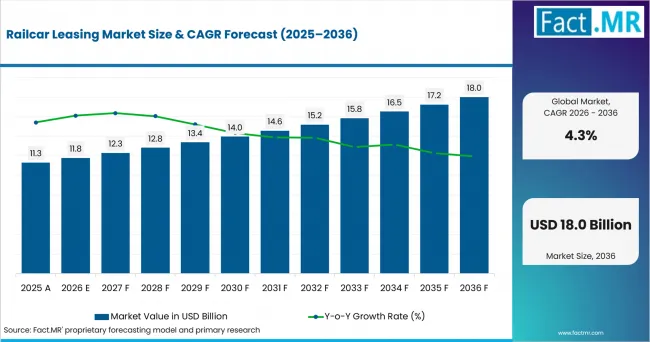
Railcar Leasing Market Value Analysis | Source: Fact.MR
What are the defining numbers behind Railcar Leasing Market growth?
USD 6.2 billion absolute opportunity by 2036, led by Hopper Cars, Agri Produce, Forestry and F&B Products, Bulk Commodity Transportation and Direct Leasing Providers.
- Demand Drivers in the Market
- Agricultural shippers need covered and gravity discharge hopper capacity because seasonal loading windows leave little room for car shortages.
- Chemical logistics teams need tank car compliance support owing to inspection rules and product-specific service needs.
- Industrial manufacturers need boxcars and flat cars so equipment moves without heavy balance-sheet exposure.
- Rail operators need lessor-backed maintenance programs supported by clear service records and fleet-location visibility.
- Key Segments Analyzed
- By Product: Hopper Cars are expected to hold 23.80% share in 2026 due to grain, fertilizer and dry-bulk leasing demand.
- By End Use: Agri Produce, Forestry and F&B Products are projected to account for 36.90% share in 2026 supported by recurring bulk flows.
- By Application: Bulk Commodity Transportation is anticipated to capture 63.50% share in 2026 owing to heavy tonnage movement.
- By Distribution Channel: Direct Leasing Providers are estimated to represent 55.30% share in 2026 because large fleets need service accountability.
- Analyst Opinion at Fact.MR
- Shambhu Nath Jha of Fact.MR states, "Railcar leasing is valued when shippers need the right car type before the commodity season or contract window opens. Lessors are expected to win more renewals when maintenance proof and car availability are built into the lease. Suppliers should combine specialty fleet depth, repair access and clear utilization data."
- Strategic Implications
- Fleet managers should align lease duration with commodity exposure before choosing between hopper, tank and intermodal equipment.
- Lessors should document maintenance standards for every specialized car family used in regulated freight.
- Rail operators should use lease contracts to reduce idle-car risk during uneven industrial demand.
- Investors should separate direct leasing income from railcar manufacturing cycles and finance-only exposure.
Germany is forecast to record 4.7% CAGR through 2036 led by industrial freight density and wagon availability. Brazil is projected to post 4.3% CAGR supported by grain, ore and corridor expansion. The USA is anticipated to advance at 3.9% CAGR because cross-border rail freight keeps specialized fleets in use. The U.K. is estimated to hold 3.5% CAGR as rail freight remains tied to network paths. Japan is expected to register 3.1% CAGR owing to compact rail logistics and containerized freight services.
How does the Railcar Leasing Market break down by segment?
Hopper Cars lead at 23.80%; Agri Produce, Forestry and F&B Products lead at 36.90%.
Which product dominates?
Hopper Cars are projected to account for 23.8% share in 2026.
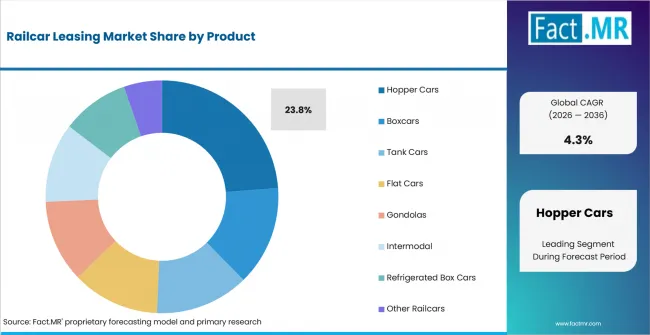
Railcar Leasing Market Analysis By Product | Source: Fact.MR
Hopper cars are expected to lead Product because dry-bulk shippers lease capacity around grain, fertilizer and mineral flows. Gravity discharge cars serve fast unloading sites. Pressure discharge cars fit materials that need controlled unloading. Destatis reported that 327.952 million tonnes of goods were transported by rail in Germany in 2025, down 2.8% from the previous year.
What leads the End Use segment?
Agri Produce, Forestry and F&B Products are forecast to hold 36.9% share in 2026.
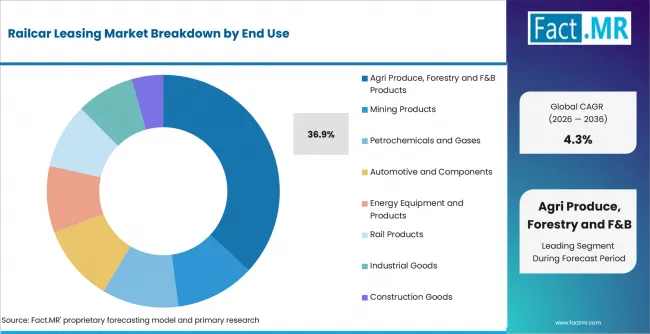
Railcar Leasing Market Analysis By End Use | Source: Fact.MR
Agri Produce, Forestry and F&B Products are forecast to lead End Use since freight owners lease equipment for crop flows and food-grade movement. Agricultural commodities need clean hopper capacity during tight shipping windows. Forestry and food products use boxcars or refrigerated cars when protection is needed. Brazil's ANTT set a railway freight production target of 378.224 x 10^6 TKU for 2026 in its 2026 to 2029 strategic plan.
How does Application shape demand?
Bulk Commodity Transportation is anticipated to lead with 63.5% share in 2026.
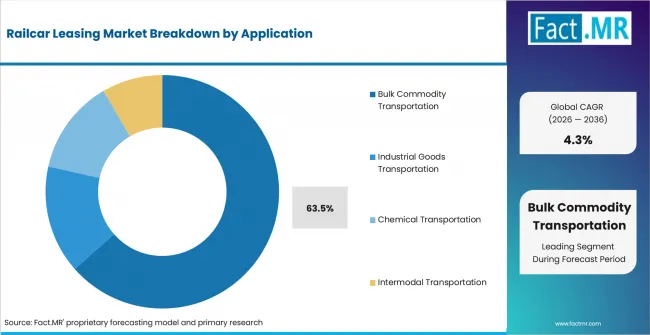
Railcar Leasing Market Analysis By Application | Source: Fact.MR
Bulk Commodity Transportation is anticipated to hold the main application share due to recurring volume in minerals, fuels and agricultural freight. Energy commodity transport uses tank cars and gondolas. Agricultural commodity transport depends on hopper fleets.
What supports Direct Leasing Providers within Distribution Channel?
Direct Leasing Providers are estimated to represent 55.3% share in 2026.
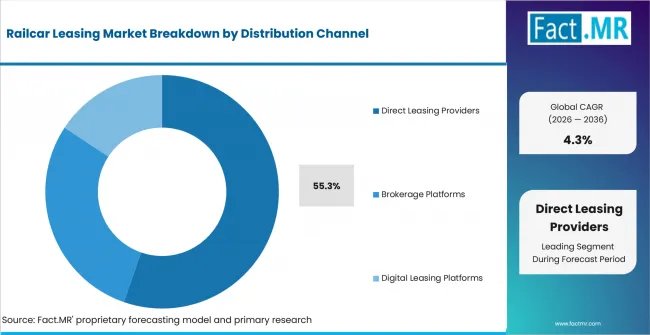
Railcar Leasing Market Analysis By Distribution Channel | Source: Fact.MR
Direct Leasing Providers are estimated to lead Distribution Channel because shippers want one accountable party for contracts, fleet condition and service changes. Manufacturer leasing remains useful when new cars are tied to build programs. Independent leasing firms serve shippers that need flexible terms. Digital platforms are developing around search and asset matching, but large users still prefer direct lease support.
What is accelerating Railcar Leasing Market adoption, and what is holding it back?
Specialized fleet access drives it; utilization and maintenance cost restrain it.
| DRIVER | (~) % IMPACT ON CAGR | GEOGRAPHIC RELEVANCE | IMPACT TIMELINE |
|---|---|---|---|
| Specialized hopper and tank fleet access | +1.2% | USA, Germany, Brazil | Short term (<= 2 years) |
| Capital-light equipment planning | +1.0% | Mature leasing markets | Short term (<= 2 years) |
| Commodity-specific maintenance support | +0.8% | Chemical and food corridors | Medium term (2-4 years) |
| Intermodal and industrial rail corridors | +0.7% | USA, U.K., Japan | Medium term (2-4 years) |
| Direct provider service accountability | +0.5% | Large shipper accounts | Long term (>= 4 years) |
- Specialized hopper and tank fleet access: Shippers lease cars when cargo requires a specific unloading method or tank specification. Fleet depth shapes renewal talks because substitute equipment is rarely perfect. Lessors with maintenance shops close to loading regions are projected to receive stronger contract attention.
- Capital-light equipment planning: Leasing reduces the cash burden of buying cars outright. Industries with uneven commodity cycles can preserve cash while securing car access. Finance teams are expected to favor contracts that preserve fleet access without locking in all capital.
- Commodity-specific maintenance support: Tank, refrigerated and food-grade cars need cleaning, inspection and documentation. Lessors that manage these steps lower operating friction for shippers. Service quality is anticipated to carry more weight as cargo standards tighten.
- Intermodal and industrial rail corridors: Intermodal railcars and flat cars help connect container terminals, factories and inland distribution points. Network path reliability remains a buyer concern. Leasing demand is projected to follow corridors where scheduled freight paths are more dependable.
- Direct provider service accountability: Direct leasing keeps fleet condition, billing and replacement planning inside one contract. Large shippers often prefer that accountability. Smaller accounts are expected to keep using brokers where car needs are irregular.
| OPPORTUNITY | (~) % IMPACT ON CAGR | GEOGRAPHIC RELEVANCE | IMPACT TIMELINE |
|---|---|---|---|
| Replacement-ready specialized cars | +0.7% | North America and Europe | Medium term (2-4 years) |
| Digital fleet visibility | +0.6% | Large shipper accounts | Medium term (2-4 years) |
| Agricultural export corridors | +0.5% | Brazil, USA, Germany | Short term (<= 2 years) |
| Chemical and energy car renewal | +0.4% | USA, Japan, U.K. | Long term (>= 4 years) |
- Replacement-ready specialized cars: Older equipment can remain useful when maintenance records are clear. Newer specialized cars still attract interest where cargo rules or loading sites change. Leasing firms are expected to balance refurbishments with selective fleet additions.
- Digital fleet visibility: Asset tracking can improve car release, return and repair planning. Digital tools are useful when shippers need proof of availability before committing volume. Adoption is projected to be strongest among multi-site shippers.
- Agricultural export corridors: Crop exports require reliable hopper capacity at peak periods. Brazil and the USA create recurring demand for dry-bulk cars. Lessors are anticipated to benefit when rail corridors gain predictable loading slots.
- Chemical and energy car renewal: Tank cars require documented compliance and product-specific configuration. Energy and chemical shippers place weight on lease fleets with inspection depth. Renewal demand is forecast to remain selective because each product family has a different car need.
| RESTRAINT | (~) % IMPACT ON CAGR | GEOGRAPHIC RELEVANCE | IMPACT TIMELINE |
|---|---|---|---|
| Utilization volatility | -0.6% | Commodity-exposed markets | Short term (<= 2 years) |
| Maintenance and compliance cost | -0.5% | Tank and refrigerated fleets | Medium term (2-4 years) |
| Track access and service reliability | -0.4% | Congested corridors | Medium term (2-4 years) |
| Interest-rate and asset-price exposure | -0.3% | Asset-heavy lessors | Long term (>= 4 years) |
- Utilization volatility: Lease economics weaken when car demand falls between commodity seasons. Idle assets still carry storage and maintenance cost. Lessors are expected to manage this risk by mixing car types and customer terms.
- Maintenance and compliance cost: Specialized railcars need inspections, cleaning and component work before certain cargos move. These costs pressure contract margins. Smaller lessors are projected to avoid niches where service duties exceed their shop access.
- Track access and service reliability: A leased car has less value when network paths are irregular. Service issues can lengthen car cycle time and reduce revenue days. Customers are anticipated to favor fleets tied to reliable corridors.
Interest-rate and asset-price exposure: Railcar leasing is capital intensive. Higher funding cost can make new fleet additions slower. Contracts with long duration are expected to remain useful when lessors need predictable cash flow.
Which countries are scaling Railcar Leasing Market fastest?
- The country comparison spans 1.6 percentage points and forms two practical growth bands across the forecast period.
- Germany remains 0.4 percentage point above Brazil because industrial wagon requirements support repeat leasing decisions.
- Brazil remains 0.4 percentage point above the USA as rail-corridor investment supports hopper and gondola demand.
- The USA remains 0.4 percentage point above the U.K. because cross-border freight keeps specialized fleets in use.
- The U.K. remains 0.4 percentage point above Japan as freight path planning supports scheduled car use.
- Japan closes the displayed range with compact industrial corridors and containerized freight services.
Comparable CAGRs can create different entry conditions due to network density, fleet age, maintenance access and corridor reliability. Full report coverage includes North America, Latin America, Europe, East Asia, South Asia and Pacific, Middle East and Africa.
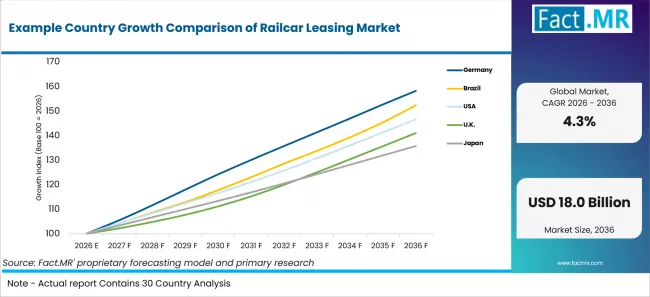
Example Country Growth Comparison Of Railcar Leasing Market | Source: Fact.MR
| COUNTRY | CAGR (2026-2036) |
|---|---|
| Germany | 4.7% |
| Brazil | 4.3% |
| USA | 3.9% |
| U.K. | 3.5% |
| Japan | 3.1% |
What supports Germany adoption?
4.7% CAGR, supported by rail freight density and industrial wagon requirements.
Germany's leasing demand reflects dense domestic freight flows and cross-border wagon use. Lessors are expected to win contracts when they combine car availability with maintenance coverage across European routes.
How is Brazil scaling demand?
4.3% CAGR, driven by corridor expansion and bulk export movement.
Brazil's leasing outlook is tied to long-distance movement of grain, ore and construction inputs. Seasonal agriculture and mining flows are expected to support durable hopper and gondola leasing on long corridors.
What supports USA demand?
3.9% CAGR, backed by cross-border freight and specialized car pools.
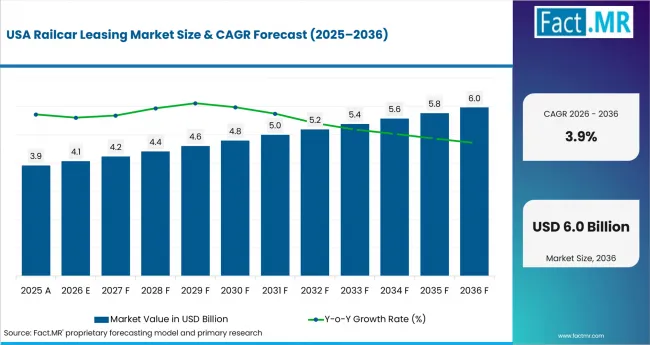
Railcar Leasing Market Country Value Analysis | Source: Fact.MR
The USA remains a large railcar leasing market because shippers move energy, chemicals and agricultural goods across long rail distances. The Bureau of Transportation Statistics reported that rail moved USD 184.5 billion in U.S. transborder freight in 2025. Leasing is expected to remain useful where tank cars and covered hoppers need regulatory upkeep.
How does the U.K. perform?
3.5% CAGR, supported by rail freight activity and path-sensitive network planning.
The U.K. market is smaller but commercially active across container paths, construction materials and energy-related rail movements. GOV.UK’s Rail Trends 2025 reported that 16.5 billion net tonne-kilometres of rail freight were transported in Great Britain in 2024–25. Fleet access is expected to remain linked to scheduled paths and terminal access.
What supports Japan's growth?
3.1% CAGR, led by container rail freight and compact industrial corridors.
Japan's railcar leasing outlook is selective because freight movement is concentrated on compact corridors and container services. MLIT reported 3,650,493 tonnes of rail freight in December 2025 and 1,561,874 thousand tonne-kilometres of freight movement that month. Leasing value is expected to stay concentrated where shippers need flexible domestic car access.
Which companies have direct Railcar Leasing Market relevance?
GATX, VTG, Trinity Industries, UTLX and TOUAX have direct railcar-leasing or freight-wagon-leasing relevance.
GATX supports North American scale through railcar leasing; GATX and Brookfield Infrastructure announced the Wells Fargo rail-assets transaction on May 29, 2025, and completed the acquisition on January 1, 2026. In September 2025, VTG established dedicated Logistics and Production divisions alongside its core Leasing business, with Michael Eckelsberger responsible for the Leasing division. Trinity Industries combines railcar production with railcar leasing services. Union Tank Car Company serves tank car leasing, design, manufacturing and maintenance. TOUAX SCA (TOUAX Rail) participates in freight railcar leasing across Europe and selected international markets.
Which companies are the key providers?
Key companies include GATX Corporation, VTG GmbH, Trinity Industries, Inc., Union Tank Car Company, TOUAX SCA (TOUAX Rail) and CIT Rail.
- GATX Corporation
- VTG GmbH
- Trinity Industries, Inc.
- Union Tank Car Company
- TOUAX SCA (TOUAX Rail)
- CIT Rail
Bibliography
- Agência Nacional de Transportes Terrestres. (2025). Plano estratégico 2026–2029.
- Bureau of Transportation Statistics. (2026, May 15). Transborder freight data annual report: 2025. U.S. Department of Transportation.
- Department for Transport, & Office of Rail and Road. (2025, December 9). Rail Trends 2025. GOV.UK.
- GATX Rail Europe. (2025, November 12). GATX Rail Europe and DB Cargo AG have received regulatory approval for the sale-and-leaseback transaction for approximately 6,000 freight cars.
- Federal Statistical Office (Destatis). (2026, April 9). Railway goods transport by railway and main traffic relations.
- Trinity Industries, Inc. (2025, October 30). Trinity Industries, Inc. announces third quarter 2025 results.
- Union Tank Car Company. (2025). Union Tank Car Company’s commitment to Responsible Care® [PDF].
- VTG GmbH. (2025, September 16). VTG establishes dedicated logistics and production divisions alongside its core leasing business.
- GATX Corporation. (2025, May 30). GATX and Brookfield Infrastructure acquire Wells Fargo’s rail assets [Webcast].
- GATX Corporation. (2026, January 5). GATX Corporation and Brookfield Infrastructure complete acquisition of Wells Fargo’s rail assets.
This Report Answers
- The report provides strategic intelligence on the Railcar Leasing Market across Product and End Use choices that shape freight fleet planning.
- Segment analysis covers Hopper Cars and Bulk Commodity Transportation as the share leaders within the 2026 market.
- Country outlook evaluates Germany and Brazil alongside the USA. The U.K. and Japan complete the growth comparison.
- Competitive analysis profiles GATX and VTG alongside Trinity Industries, Union Tank Car Company, TOUAX SCA (TOUAX Rail) and CIT Rail.
- Distribution assessment covers Direct Leasing Providers while brokerage and digital leasing channels complete the channel view.
What does the Railcar Leasing Market cover?
Railcar leasing covers owned freight railcars leased to shippers and rail users under rental or lease terms.
It includes cars used for dry bulk, liquids, containers, vehicles and industrial cargo. Coverage relates to freight wagons and rail freight infrastructure where equipment access affects service performance.
What is included in the scope?
The scope includes hopper cars, boxcars, tank cars, flat cars, gondolas, intermodal cars and refrigerated box cars.
It also includes direct leasing, brokered leasing and digital leasing platforms. Related coverage touches rail freight and intermodal freight transportation when the car lease is tied to freight movement.
What is excluded from the scope?
The scope excludes passenger rolling stock, locomotives and general rail infrastructure spending unless the spending is directly linked to freight railcar leasing.
It also excludes railcar manufacturing revenue where no lease or fleet-management activity is attached. Broader rolling stock categories are included only when freight car leasing is the direct use case.
How Was the Analysis Built?
The analysis draws on 120+ sources, 35+ company portfolios, 25+ countries and more than 20 industry interviews.
- Primary Research: Primary research includes discussions with lessors, fleet managers, repair providers, shippers, rail operators and procurement teams. These conversations examine car selection, contract terms, maintenance requirements, channel preferences and barriers to wider lease use.
- Desk Research: Desk research covers government freight statistics, regulator publications, company releases, trade data, safety rules and rail industry associations. Selected public sources used in the analysis are documented in the bibliography.
- Market Sizing and Forecasting: Market estimates combine historical values, segment shares, country-level growth, fleet needs, leasing channels, commodity flows, maintenance cost and barriers to market expansion.
- Data Validation and Update Cycle: Findings are validated by comparing public data, company activity, regulatory changes, operating statistics and primary interviews. Updates review fleet acquisitions, refinancing, maintenance rules, commodity movement and leasing-channel changes.
What is the report’s scope and coverage?
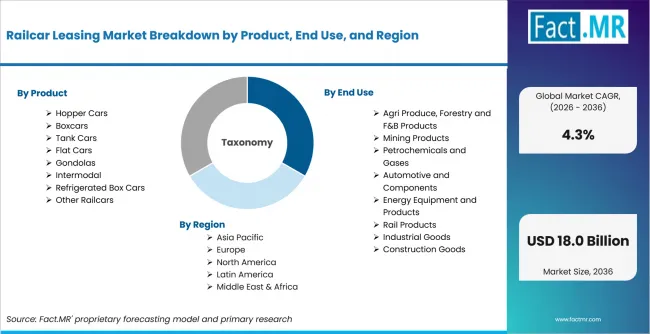
Railcar Leasing Market Breakdown By Product End Use And Region | Source: Fact.MR
| ATTRIBUTE | DETAILS |
|---|---|
| Quantitative Units | USD Billion |
| Market Definition | Freight railcars leased under contracts to shippers, rail operators and industrial logistics teams where fleet access, maintenance support and car-type availability determine lease selection |
| Product | Hopper Cars; Boxcars; Tank Cars; Flat Cars; Gondolas; Intermodal; Refrigerated Box Cars; Other Railcars |
| End Use | Agri Produce, Forestry and F&B Products; Mining Products; Petrochemicals and Gases; Automotive and Components; Energy Equipment and Products; Rail Products; Industrial Goods; Construction Goods |
| Application | Bulk Commodity Transportation; Industrial Goods Transportation; Chemical Transportation; Intermodal Transportation |
| Distribution Channel | Direct Leasing Providers; Brokerage Platforms; Digital Leasing Platforms |
| Regions Covered | North America; Latin America; Europe; East Asia; South Asia and Pacific; Middle East and Africa |
| Countries Covered | Germany; Brazil; USA; U.K.; Japan |
| Key Companies Profiled | GATX Corporation; VTG GmbH; Trinity Industries, Inc.; Union Tank Car Company; TOUAX SCA (TOUAX Rail); CIT Rail |
| Forecast Period | 2026 to 2036 |
| Approach | Hybrid top-down and bottom-up approach using rail freight activity; fleet replacement needs; commodity corridors; car-type demand; country adoption patterns; leasing channel review; active company participation and source-verified market evidence |
How is the market segmented?
-
By Product
-
Hopper Cars
- Gravity Discharge Hopper Cars
- Pressure Discharge Hopper Cars
- High Capacity Hopper Cars
- Boxcars
- Standard Boxcars
- Insulated Boxcars
- High Cube Boxcars
- Tank Cars
- Pressurized Tank Cars
- Non Pressurized Tank Cars
- Specialized Tank Cars
- Flat Cars
- Standard Flat Cars
- Heavy Duty Flat Cars
- Specialized Flat Cars
- Gondolas
- Open Gondolas
- Covered Gondolas
- High Capacity Gondolas
- Intermodal
- Container Railcars
- Trailer Railcars
- High Speed Intermodal
- Refrigerated Box Cars
- Mechanical Refrigerated Cars
- Cryogenic Refrigerated Cars
- Insulated Refrigerated Cars
- Other Railcars
- Maintenance Railcars
- Special Purpose Railcars
- Service Railcars
-
-
By End Use
- Agri Produce, Forestry and F&B Products
- Agricultural Commodities
- Forestry Products
- Food and Beverage Products
- Mining Products
- Coal Transport
- Metal Ore Transport
- Mineral Transport
- Petrochemicals and Gases
- Chemical Transport
- Gas Transport
- Petrochemical Products
- Automotive and Components
- Vehicle Transport
- Automotive Parts
- Aftermarket Products
- Energy Equipment and Products
- Power Equipment
- Renewable Energy Equipment
- Energy Materials
- Rail Products
- Track Components
- Rolling Stock Components
- Signaling Equipment
- Industrial Goods
- Heavy Machinery
- Manufactured Goods
- Chemical Products
- Construction Goods
- Building Materials
- Infrastructure Materials
- Construction Equipment
- Agri Produce, Forestry and F&B Products
-
By Application
- Bulk Commodity Transportation
- Energy Commodities Transport
- Agricultural Commodities Transport
- Industrial Goods Transportation
- Manufactured Goods Transport
- Construction Material Transport
- Chemical Transportation
- Hazardous Chemical Logistics
- Non Hazardous Chemicals
- Intermodal Transportation
- Container Rail Transport
- Logistics Hub Distribution
- Bulk Commodity Transportation
-
By Distribution Channel
- Direct Leasing Providers
- Railcar Manufacturer Leasing
- Independent Leasing Firms
- Brokerage Platforms
- Rail Freight Brokers
- Logistics Intermediaries
- Digital Leasing Platforms
- Online Asset Marketplaces
- AI Matching Platforms
- Direct Leasing Providers
-
By Region
- North America
- Latin America
- Western Europe
- Eastern Europe
- East Asia
- South Asia and Pacific
- Middle East & Africa