- Market Value (2025): USD 167.9 Mn
- Estimated Value (2026): USD 225.0 Mn
- Forecast Value (2036): USD 4200.0 Mn
- CAGR (2026-2036): 34.0%
What is the ADAS Quantum Sensors Market forecast to be worth by 2036?
USD 225.0 million in 2026 to USD 4,200.0 million by 2036 at a 34.0% CAGR.
- The ADAS quantum sensors market reached USD 167.9 million in 2025.
- Demand is projected to increase from USD 225.0 million in 2026 to USD 4,200.0 million by 2036.
- The market is forecast to record a 34.0% CAGR from 2026 to 2036 as automakers, sensor integrators and semiconductor teams validate higher-sensitivity sensing paths.
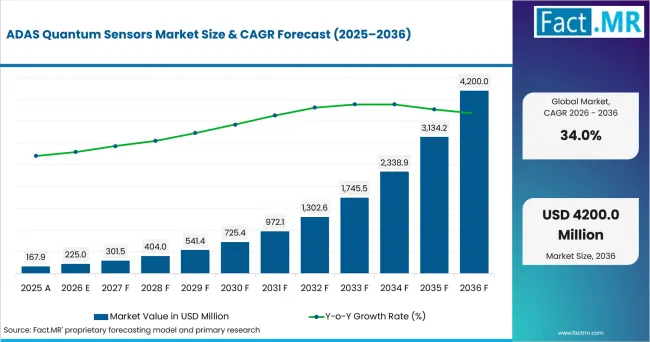
Adas Quantum Sensors Market Value Analysis | Source: Fact.MR
What are the defining numbers behind ADAS Quantum Sensors Market growth?
An absolute opportunity of USD 3,975.0 million is expected between 2026 and 2036.
- Demand Drivers in the Market
- Automakers need sensing layers that improve detection confidence when visibility and lane markings vary across city routes.
- Sensor module teams need quantum-dot and diamond materials that raise signal quality without a full ADAS electronics redesign.
- Navigation engineers need atomic and magnetic references where GNSS loss raises position drift across tunnels, dense cities and protected routes.
- Semiconductor inspection teams need quantum imaging to locate buried defects in high-reliability vehicle electronics and advanced packages.
- NHTSA finalized the addition of four ADAS technologies to NCAP in November 2024, including lane keeping assistance and blind spot intervention; in May 2026, the agency announced the first vehicle to pass the newly integrated tests.
- Key Segments Analyzed
- By Material System: Quantum dots are projected to hold 36.0% share in 2026 because their optical response fits coating and thin-film routes for sensor components.
- By Process: Coating is expected to account for 41.0% share in 2026 due to compatibility with sensor surface treatment and module-level integration.
- By Function: Sensing is anticipated to capture 44.0% share in 2026 as ADAS teams prioritize direct measurement accuracy over secondary imaging use.
- By Application: Automotive is estimated to represent 38.0% share in 2026 owing to camera, radar and navigation upgrade cycles in driver-assistance systems.
- By Form: Liquid resist is forecast to hold 49.0% share in 2026 as coating processes require materials that can be deposited with repeatable thickness.
- Analyst Opinion at Fact.MR
- Shambhu Nath Jha, Principal Consultant at Fact.MR, states, “ADAS quantum sensors are drawing attention because real-road noise makes measurement trust a commercial issue. The market is expected to reward suppliers that can document stability across temperature, vibration and electronics packaging conditions. Stronger suppliers should combine sensor physics, automotive validation data and manufacturable coating or module processes.”
- Strategic Implications
- Automotive suppliers should document sensor repeatability under vibration, thermal cycling and electromagnetic interference before pursuing platform awards.
- Material developers should tie quantum-dot and diamond NV performance claims to coating yield, packaging compatibility and lifetime data.
- Module integrators should design reference architectures that connect quantum sensing outputs with ADAS controllers and diagnostic software.
- Test labs should build measurement protocols that compare quantum sensor outputs with classical radar, camera and inertial references.
The UK is projected to post 43.8% CAGR through 2036; supporting context includes automated-vehicle permitting and electric-platform activity. South Korea is forecast to advance at 40.3% CAGR; supporting context includes vehicle exports and automated-driving pilots. Germany is anticipated to record 33.4% CAGR; supporting context includes automotive patent activity and quantum technology research. The USA is estimated to reach 33.0% CAGR; supporting context includes ADAS safety evaluation and federal quantum-sensor research. Japan is projected to reach 26.4% CAGR; supporting context includes automated-mobility policy and ISO-linked remote-support standards.
How does the ADAS Quantum Sensors Market break down by segment?
Quantum dots lead Material System at 36.0%; Liquid resist leads Form at 49.0%.
Which Material System dominates?
Quantum dots hold 36.0% share in 2026.
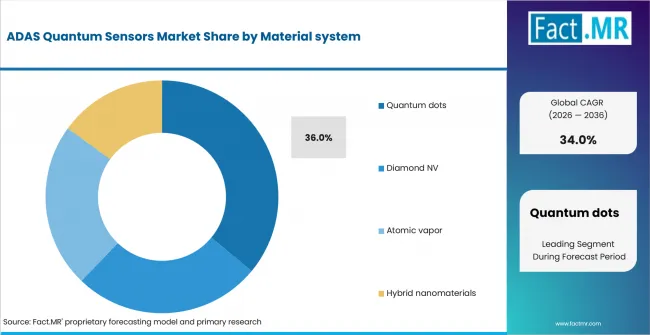
Adas Quantum Sensors Market Analysis By Material System | Source: Fact.MR
Quantum dots lead because their optical behavior can be tuned for compact sensor coatings. The segment is projected to benefit from material learning in photonics, display films and chip-scale optical systems. In ADAS quantum sensors, commercial value is tied to repeatable deposition and stable signal behavior.
What leads the Process segment?
Coating accounts for 41.0% share in 2026.
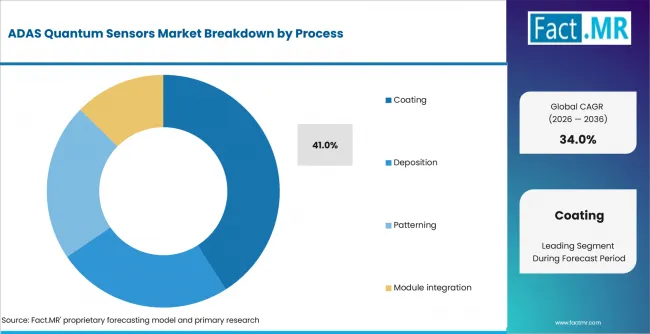
Adas Quantum Sensors Market Analysis By Process | Source: Fact.MR
Coating leads because sensor makers can apply quantum materials without changing the full sensor architecture. It gives engineering teams a practical route to tune surface response and film thickness. Automotive qualification is expected to favor process control more than laboratory sensitivity alone.
How does Function shape demand?
Sensing captures 44.0% share in 2026.
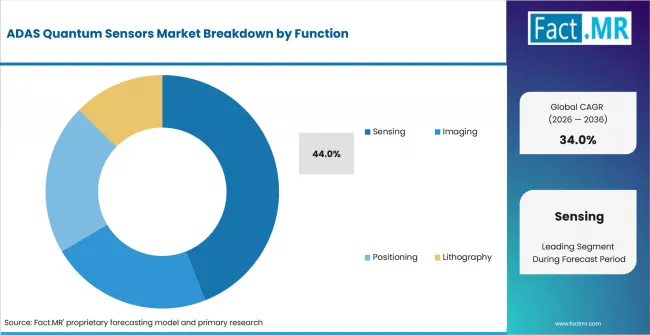
Adas Quantum Sensors Market Analysis By Function | Source: Fact.MR
Sensing captures the main share because ADAS systems first need reliable environmental and position signals. NASA JPL reported in April 2025 that a science-grade quantum gravity gradiometer could be as much as 10 times more sensitive than classical sensors. JPL states that gravity maps support navigation, resource management and national security, providing direct evidence for high-sensitivity positioning and mapping applications.
What supports Automotive within Application?
Automotive represents 38.0% share in 2026.
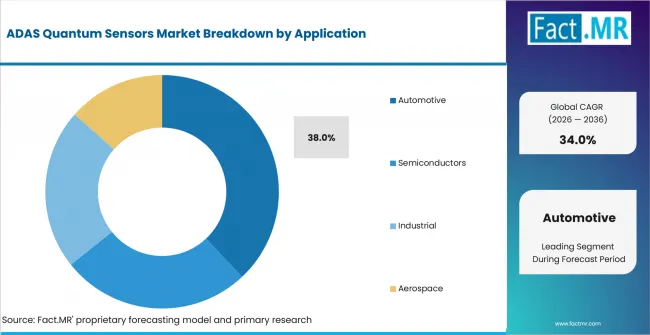
Adas Quantum Sensors Market Analysis By Application | Source: Fact.MR
Automotive leads application demand because driver-assistance platforms require sensing redundancy and calibration stability. NHTSA finalized the addition of four ADAS technologies to NCAP in November 2024, including blind spot warning and lane keeping assistance; in May 2026, the agency reported that the new evaluations had been integrated into NCAP testing. The updated NCAP provides defined performance evaluations for ADAS functions including lane keeping assistance, blind spot warning and blind spot intervention.
What leads the Form segment?
Liquid resist holds 49.0% share in 2026.
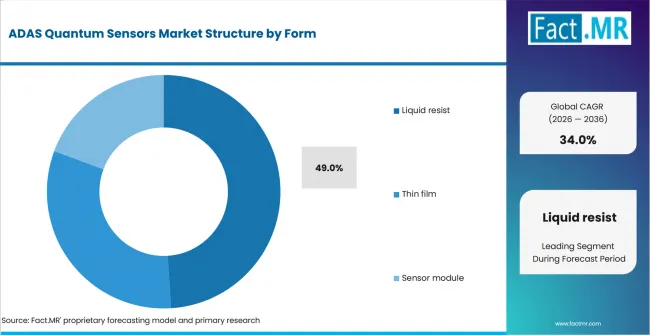
Adas Quantum Sensors Market Analysis By Form | Source: Fact.MR
Liquid resist leads because it fits coating workflows that place quantum materials onto sensor surfaces. Repeatable film formation supports prototyping and scale-up before packaged sensor modules take over larger programs. Suppliers with documented viscosity, curing and layer-control data are expected to face fewer integration delays.
What is accelerating ADAS Quantum Sensors Market adoption, and what is holding it back?
Demand is expected to rise through safety validation, quantum-material processing and GPS-resilient positioning.
Drivers Impact Analysis
| DRIVER | (~) % IMPACT ON CAGR | GEOGRAPHIC RELEVANCE | IMPACT TIMELINE |
|---|---|---|---|
| ADAS safety and sensing redundancy | +3.1% | Global | Short term (<= 2 years) |
| Quantum-dot coating integration | +2.4% | North America, Europe, East Asia | Medium term (2-4 years) |
| GPS-resilient positioning needs | +1.8% | USA, UK, Japan, South Korea | Long term (>= 4 years) |
| Automotive semiconductor inspection demand | +1.2% | Germany, Japan, South Korea | Medium term (2-4 years) |
Source: Fact.MR analysis. Updated Aug 25, 2026
- ADAS safety and sensing redundancy: Vehicle platforms need additional measurement channels when camera, radar or inertial readings weaken under road noise.
- Quantum-dot coating integration: Coating processes can move quantum materials into sensor surfaces while preserving module design flexibility.
- GPS-resilient positioning needs: Atomic and magnetic sensing is expected to help navigation engineers reduce drift when satellite signals weaken.
Opportunity Impact Analysis
| OPPORTUNITY | (~) % IMPACT ON CAGR | GEOGRAPHIC RELEVANCE | IMPACT TIMELINE |
|---|---|---|---|
| Liquid-resist routes for quantum-dot components | +1.6% | Global | Medium term (2-4 years) |
| Diamond NV magnetometry for navigation and inspection | +1.3% | Europe, North America | Long term (>= 4 years) |
| Sensor modules linked to ADAS controllers | +1.0% | Global | Short term (<= 2 years) |
Source: Fact.MR analysis. Updated Aug 25, 2026
- Liquid-resist routes: Suppliers can gain earlier design feedback when functional coatings are tested on familiar substrates and process tools.
- Diamond NV magnetometry: Automotive and semiconductor users can apply high-sensitivity magnetic measurement to navigation and package inspection problems.
- ADAS controller integration: Module vendors can improve adoption by proving that quantum sensor outputs fit diagnostic and safety software.
Restraints Impact Analysis
| RESTRAINT | (~) % IMPACT ON CAGR | GEOGRAPHIC RELEVANCE | IMPACT TIMELINE |
|---|---|---|---|
| Automotive-grade reliability validation | -0.9% | Global | Short term (<= 2 years) |
| Packaging and temperature-control workload | -0.6% | North America, Europe, East Asia | Medium term (2-4 years) |
| Design-win timing in high-volume ADAS | -0.5% | Global | Long term (>= 4 years) |
Source: Fact.MR analysis. Updated Aug 25, 2026
- Automotive-grade reliability validation: New quantum sensing designs must pass long qualification cycles before vehicle platforms approve them.
- Packaging and temperature-control workload: Some quantum sensor architectures need tight environmental control, raising integration work for compact modules.
- Design-win timing in high-volume ADAS: Automakers prefer proven sensor supply chains, so suppliers need pilot data before scaling revenue.
Which countries are scaling the ADAS Quantum Sensors Market through 2036?
- The country comparison spans 17.4 percentage points between the UK and Japan across the forecast period.
- The UK remains 3.5 percentage points above South Korea; supporting context includes automated-passenger-service permitting and 2025 zero-emission-car registrations.
- South Korea remains 6.9 percentage points above Germany; supporting context includes record 2025 automobile exports and government-funded automated-driving service expansion.
- Germany remains 0.4 percentage point above the USA; supporting context includes 2025 electric-passenger-car production and automotive patent activity.
- The USA remains 6.6 percentage points above Japan; supporting context includes NHTSA ADAS performance evaluations and federal quantum-sensor research funding.
Comparable CAGRs create different entry conditions due to platform depth, automated-driving policy and quantum research maturity. Full report coverage includes North America, Latin America, Western Europe, Eastern Europe, East Asia, South Asia & Pacific, Middle East & Africa.
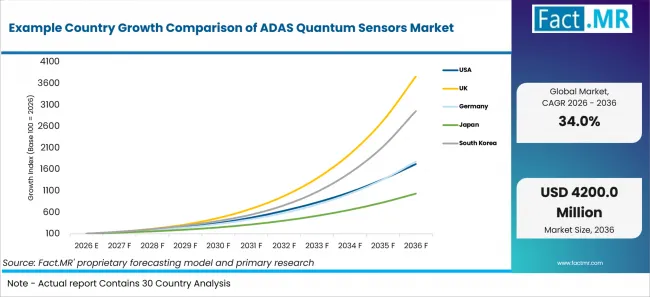
Example Country Growth Comparison Of Adas Quantum Sensors Market | Source: Fact.MR
| Country | CAGR (2026-2036) |
|---|---|
| UK | 43.8% |
| South Korea | 40.3% |
| Germany | 33.4% |
| USA | 33.0% |
| Japan | 26.4% |
Source: Fact.MR analysis. Updated Aug 25, 2026
What supports the United Kingdom’s growth?
43.8% CAGR, supported by automated-vehicle permitting and electric-platform expansion.
The UK combines an expanding zero-emission vehicle base with a permitting framework for automated passenger services. The Department for Transport reported on April 29, 2026, that 473,226 road-using zero-emission cars were registered for the first time in the UK in 2025. The government response on automated passenger services, published on April 23, 2026, said the permitting scheme would be enabled from spring 2026, ahead of full Automated Vehicles Act implementation in the second half of 2027. The permitting scheme provides a legal route for initial automated-passenger-service pilots before full implementation of the Act.
How is South Korea scaling demand?
40.3% CAGR, driven by vehicle exports and automated-driving service pilots.
South Korea combines a large automobile-export base with government-backed automated-driving pilots. The Ministry of Trade, Industry and Resources reported in January 2026 that automobile exports reached USD 72.0 billion in 2025. The Ministry of Land, Infrastructure and Transport announced in February 2026 that KRW 3 billion would support automated-driving services across eight local governments. Together, the figures document a USD 72.0 billion automobile-export base in 2025 and government-funded expansion of automated-driving services across eight local governments.
What is supporting Germany’s adoption?
33.4% CAGR, backed by automotive patent depth and quantum technology research.
Germany combines large-scale electric-vehicle production with high automotive patent activity. VDA reported in February 2026 that German plants produced 1.67 million electric passenger cars in 2025, equal to 40% of domestic passenger-car production. The German Patent and Trade Mark Office reported in March 2026 that Robert Bosch GmbH filed 4,109 patent applications in 2025.
What supports USA adoption?
33.0% CAGR, supported by federal ADAS evaluation and quantum sensor development.
U.S. federal activity spans both ADAS safety evaluation and quantum information science research. NHTSA reported in May 2026 that NCAP had integrated four new ADAS performance evaluations, including blind spot warning and lane keeping assistance. The U.S. Department of Energy announced in January 2025 that USD 71 million would support 25 quantum information science projects, including work on quantum sensors.
How does Japan perform?
26.4% CAGR, led by Level 4 mobility standards and sensor qualification discipline.
Japan combines automated-mobility policy with an international standard for remote support of low-speed automated driving systems. METI reported in June 2025 that ISO 7856 for remote support of low-speed automated driving systems had been issued following Japan-led development under ISO/TC 204/WG 14. METI and MLIT also updated the Mobility DX Strategy in June 2025 following public-private discussions that included the implementation of AI-powered automated-driving technologies. ISO 7856 specifies requirements including in-vehicle camera detection range for safe remote support, data and communication quality between vehicles and control centers, and performance-test procedures for remote-support systems used with low-speed automated vehicles operating on predefined routes.
Who leads the ADAS Quantum Sensors Market?
Bosch, Infleqtion, SBQuantum, IonQ (Vector Atomic) and Q-CTRL are the profiled providers.
Bosch has the clearest automotive bridge because it combines ADAS sensor portfolios with dedicated quantum sensing work. Bosch announced on April 7, 2025, that it was establishing Bosch Quantum Sensing as a joint venture with Element Six, subject to official approval, to advance the commercialization of diamond-based quantum sensors. Bosch said Element Six would supply highly engineered synthetic diamonds while Bosch would integrate them into robust, scalable sensor systems, with future mobility navigation complementary to conventional GPS identified as one potential application.
Infleqtion and IonQ’s Vector Atomic business provide atomic timing, inertial sensing, and positioning, navigation, and timing capabilities relevant to GPS-resilient operation. Infleqtion reported in October 2025 that it had demonstrated a quantum optical atomic clock aboard a Royal Navy autonomous submarine testbed. IonQ completed its acquisition of Vector Atomic on October 7, 2025, adding precision atomic clocks, inertial sensors, and synchronization hardware to its quantum technology platform.
Which companies are the key providers?
Bosch, Infleqtion, SBQuantum, IonQ (Vector Atomic) and Q-CTRL.
- Bosch
- Infleqtion
- SBQuantum
- IonQ (Vector Atomic)
- Q-CTRL
Bibliography
- Robert Bosch GmbH. (2025, April 23). Auto Shanghai: Bosch presents new software and hardware for assisted and automated driving.
- Robert Bosch GmbH. (2025, April 7). Bosch establishes company with the synthetic diamond solutions provider Element Six.
- Department for Transport. (2026, April 29). Vehicle licensing statistics, United Kingdom: 2025. GOV.UK.
- Department for Transport, & Centre for Connected and Autonomous Vehicles. (2026, April 23). Automated passenger services: Permitting scheme – government response. GOV.UK.
- German Patent and Trade Mark Office. (2026, March 10). DPMA annual figures for 2025: Considerable increase in inventions.
- Infleqtion. (2025, October 28). Infleqtion and Royal Navy demonstrate world’s first quantum optical clock on underwater autonomous submarine to advance GPS-Free Navigation.
- Ministry of Economy, Trade and Industry. (2025, June 5). New international standard for remote support for low-speed automated driving systems issued based on contributions from Japan.
- Ministry of Economy, Trade and Industry. (2025, June 9). Mobility Digital Transformation (DX) Strategy updated.
- Ministry of Land, Infrastructure and Transport. (2026, February 26). Autonomous Driving Vehicles to Serve Transportation-Vulnerable Areas.
- Ministry of Trade, Industry and Resources. (2026, January 15). Automobile exports hit record high of $72 billion in 2025.
- NASA Jet Propulsion Laboratory. (2025, April 15). NASA aims to fly first quantum sensor for gravity measurements.
- National Highway Traffic Safety Administration. (2026, May 7). Trump’s Transportation Department announces Tesla Model Y is the first vehicle to pass NHTSA’s new ‘Advanced Driver Assistance System’ tests.
- SBQuantum. (2025, November 14). European Space Agency awards new contract to SBQuantum preparing quantum sensors for space deployment.
- U.S. Department of Energy, Office of Science. (2025, January 16). Department of Energy announces $71 million for research on quantum information science enabled discoveries in high energy physics.
- Verband der Automobilindustrie. (2026, February 3). New record: 40% electric share of passenger car production in 2025.
- IonQ. (2025, October 7). IonQ completes acquisition of Vector Atomic, the global leader in advanced quantum sensing.
- Q-CTRL. (2025, April 14). Q-CTRL overcomes GPS-denial with quantum sensing, achieves quantum advantage.
This Report Answers
- The report explains where ADAS quantum sensors are used across material system, process, function, application and form.
- Segment analysis identifies the leading subsegments and the operational reasons automakers prioritize them.
- Country analysis examines the listed markets and the policy or production mechanisms supporting ADAS sensor deployment.
- Competitive analysis reviews current providers across quantum sensing components, navigation systems and measurement platforms.
- Application analysis assesses how safety validation and electronic-package reliability influence purchase decisions.
What does the ADAS Quantum Sensors Market cover?
The ADAS Quantum Sensors Market covers sensor materials, components and modules that apply quantum effects to perception, positioning, imaging or electronics inspection linked to driver-assistance systems. It includes quantum-dot materials, diamond NV sensing and atomic-vapor approaches where the output supports vehicle safety or reliability decisions.
The assessment covers automotive ADAS use along with semiconductor inspection and industrial sensing routes that support vehicle electronics. It considers how graphene ADAS sensors and automotive radar sensors compete for module space inside the same vehicle safety stack.
What is included in the scope?
The scope includes quantum-dot sensor coatings, liquid-resist materials, diamond NV magnetometry components, atomic sensing modules and semiconductor inspection tools used for ADAS electronics reliability. It includes module-level integration where ADAS central controller platforms receive or process sensor outputs.
The scope covers quantum sensing linked to camera, radar, positioning and sensor-fusion validation. It includes testing routes associated with autonomous driving calibration rigs, as well as downstream sensor-adjacent categories such as lidar sensor modules where qualification methods overlap.
What is excluded from the scope?
The scope excludes general cameras, radar chips, lidar units and inertial measurement units when no quantum sensing function is present. It excludes base semiconductor equipment unless quantum measurement is used for inspection or validation. Related categories such as automotive semiconductors and automotive electronics are treated as adjacent demand pools.
How Was the Analysis Built?
The analysis draws on 120+ sources, 35+ company portfolios, 25+ countries, and more than 20 industry interviews.
- Primary Research: Primary research includes discussions with manufacturers, service providers, technology developers, distributors, end users, procurement teams, and subject-matter experts. These conversations examine purchasing priorities, product adoption, operational challenges, approval requirements, competitive positioning, and the factors that influence wider market acceptance.
- Desk Research: Desk research covers government statistics, regulatory publications, company filings, trade data, technical studies, industry associations, standards, public policy, and other authoritative sources. Every source used in the analysis is documented in the bibliography.
- Market Sizing and Forecasting: Market estimates combine historical performance, demand indicators, pricing and volume trends, segment shares, company participation, country-level growth, adoption patterns, investment activity, and barriers to market expansion.
- Data Validation and Update Cycle: Findings are validated by comparing primary interviews with public data, company activity, regulatory changes, trade patterns, and industry developments. Regular updates review new product launches, capacity changes, partnerships, approvals, procurement trends, and shifts in commercial adoption.
Segmentation
What is the report’s scope and coverage?
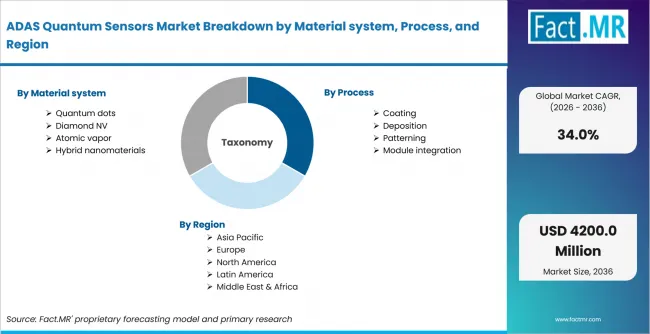
Adas Quantum Sensors Market Breakdown By Material System, Process, And Region | Source: Fact.MR
| Attribute | Details |
|---|---|
| Quantitative Units | USD million |
| Market Definition | Quantum-enabled sensor materials, components and modules used to improve sensing, positioning, imaging or semiconductor inspection linked to ADAS and automated-vehicle electronics. |
| Material System | Quantum dots; Diamond NV; Atomic vapor; Hybrid nanomaterials |
| Process | Coating; Deposition; Patterning; Module integration; Lithography |
| Function | Sensing; Imaging; Positioning |
| Application | Automotive; Semiconductors; Industrial; Aerospace |
| Form | Liquid resist; Thin film; Sensor module |
| Regions Covered | North America; Latin America; Western Europe; Eastern Europe; East Asia; South Asia & Pacific; Middle East & Africa |
| Countries Covered | USA; UK; Germany; Japan; South Korea |
| Key Companies Profiled | Bosch; Infleqtion; SBQuantum; IonQ (Vector Atomic); Q-CTRL |
| Forecast Period | 2026 to 2036 |
| Approach | Hybrid top-down and bottom-up approach using ADAS platform adoption, quantum sensing activity, material-system readiness, country CAGRs and provider portfolio review. |
Source: Fact.MR analysis. Updated Aug 25, 2026
How is the market segmented?
-
By Material System:
- Quantum dots
- Diamond NV
- Atomic vapor
- Hybrid nanomaterials
-
By Process:
- Coating
- Deposition
- Patterning
- Module integration
- Lithography
-
By Function:
- Sensing
- Imaging
- Positioning
-
By Application:
- Automotive
- Semiconductors
- Industrial
- Aerospace
-
By Form:
- Liquid resist
- Thin film
- Sensor module
-
By Region:
- North America
- Latin America
- Western Europe
- Eastern Europe
- East Asia
- South Asia & Pacific
- Middle East & Africa
Frequently Asked Questions
How big is the ADAS quantum sensors market in 2026?
What is the CAGR of the ADAS quantum sensors market from 2026 to 2036?
Which material system leads the ADAS quantum sensors market?
Which process leads the ADAS quantum sensors market?
Who are the leading companies in the ADAS quantum sensors market?
Who worked on this report


Preview the report firsthand - request a free sample
Free SampleGet the brochure for pricing and purchase details
Download PDF