Rail Freight Market (2026 - 2036)

Rail Freight Market is segmented by Cargo Type (Containerized, Non-containerized, Liquid Bulk), Service Type (Full Carload (FCL), Less than Carload (LCL), Intermodal Transportation), Distance (Long-haul (Over 500 miles / 800 km), Medium-haul (150-500 miles / 240-800 km), Short-haul (Under 150 miles / 240 km)), End-User Industry (Mining (Coal, Iron Ore, Other Minerals), Agriculture (Grain, Fertilizer, Animal Feed), Energy (Petroleum, Natural Gas, Biofuels), Manufacturing (Industrial Equipment, Machinery), Construction (Cement, Aggregates, Lumber), Retail (Consumer Goods, E-commerce), Automotive (Parts, Finished Vehicles), Chemical (Industrial Chemicals, Petrochemicals), Food & Beverages, Others (Waste, Military, Government)), and Region. Forecast for 2026 to 2036.

Core Findings

    Rail Freight Market Forecast 2026 to 2036

    In 2025, the rail freight market was valued at USD 370 billion. Based on Fact MR’s analysis, demand for rail freight services is estimated to grow to USD 388.5 billion in 2026 and USD 602.7 billion by 2036. FMR projects a CAGR of 4.5% during the forecast period.

    The absolute dollar growth from 2026 to 2036 is USD 214.2 billion. This growth is driven by increasing global demand for more efficient, cost-effective, and sustainable transportation methods for goods. Rail freight is becoming increasingly vital for long-distance transportation of bulk goods, driven by infrastructure improvements, the rise of green logistics, and government initiatives to shift more goods from road to rail to reduce carbon footprints. However, challenges such as infrastructure limitations, regulatory constraints, and competition from other transport modes may influence the market's growth.

    As Jim Vena, Chief Executive Officer of Union Pacific, noted regarding the benefits of rail freight consolidation and service for the broader economy, ‘Our shareholders see the value and understand this merger will unlock new opportunities to enhance service, growth and innovation.’

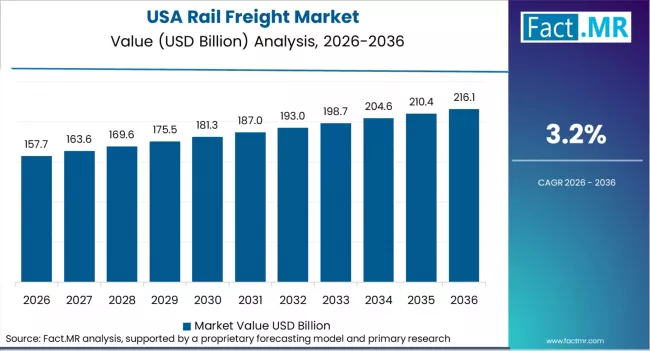
    India leads with a CAGR of 5.3%, driven by rapid industrial growth and ongoing infrastructure development to improve rail freight services. China follows with 4.1%, supported by its strong emphasis on improving rail transport for goods. The USA grows at 3.2%, reflecting steady demand for rail freight services in the North American market. Germany grows at 2.8%, benefiting from ongoing investments in European rail networks. France shows growth at 2.6%, supported by a strong rail infrastructure. The UK grows at 2.5%, with stable demand for rail freight as part of the country's logistics system. Canada grows at 2.9%, driven by improvements in rail connectivity and growing trade with the USA. Japan grows at 2.2%, with a mature market but steady demand for efficient freight solutions. Brazil grows at 3.0%, supported by investments in rail infrastructure and increasing demand for sustainable freight solutions.
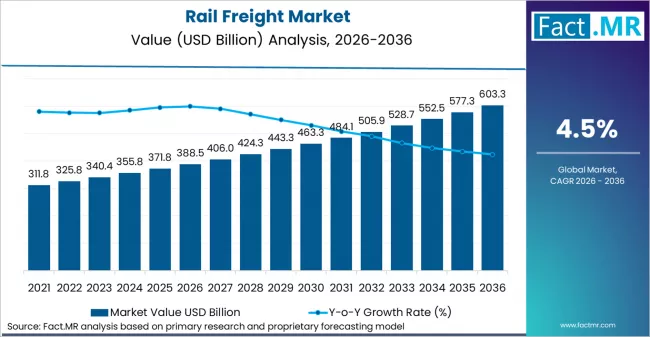
    Rail Freight Market Market Value Analysis

    Metric Value
    Estimated Value in (2026E) USD 388.5 billion
    Forecast Value in (2036F) USD 602.7 billion
    Forecast CAGR (2026 to 2036) 4.5%

    Rail Freight Market Definition

    The Rail Freight Market involves the transportation of goods and cargo via railway networks, including associated services and logistics solutions used by shippers to move bulk, intermodal, and containerized freight across regional and international rail corridors.

    Market Inclusions

    This report covers global and regional market sizes for rail freight over a defined forecast period, including freight types (bulk, intermodal, automotive, container), service modes (door‑to‑door, terminal‑to‑terminal), and end‑use sectors (manufacturing, mining, agriculture, retail).

    Market Exclusions

    The scope excludes passenger rail services, air and road freight transport not integrated with rail logistics, and freight forwarding services unrelated to rail carriage.

    Research Methodology

    • Primary Research: Interviews were conducted with railway operators, logistics managers, and industry analysts.
    • Desk Research: Data was sourced from railway associations, transportation statistics, and industry reports.
    • Market‑Sizing and Forecasting: A hybrid model combining top‑down freight demand forecasts with bottom‑up traffic and revenue data was used.
    • Data Validation and Update Cycle: Findings were validated through expert review and aligned with recent traffic, revenue, and trade figures.

    Summary of the Rail Freight Market

    • Market Definition
      • The Rail Freight Market involves the transportation of goods and cargo via railway networks, including services and logistics solutions used by shippers to move bulk, intermodal, and containerized freight across regional and international corridors. The market is essential for the efficient movement of commodities and manufactured goods, with growing emphasis on sustainability and cost-effectiveness.
    • Demand Drivers
      • Efficiency and Sustainability: Rail freight offers a cost-effective, efficient, and environmentally friendly mode of transportation for bulk and heavy goods. As governments push for greener logistics, rail is becoming increasingly vital in reducing carbon emissions and road congestion.
      • Infrastructure Developments: Ongoing infrastructure improvements, particularly in Asia and North America, are enhancing the capacity and efficiency of rail freight networks, driving further growth in the market.
      • Shift from Road to Rail: Increasing government initiatives to shift cargo from road to rail to reduce road traffic and carbon footprints are boosting rail freight demand.
    • Key Segments Analyzed
      • Cargo Type: Containerized cargo is projected to dominate, accounting for 51.8% of the market by 2026. This type of freight benefits from its flexibility and compatibility with different transportation modes.
      • Service Type: Full Carload (FCL) services are expected to hold the largest share, with 57.4% of the market in 2026. FCL services are ideal for bulk shipments of a single cargo type, offering cost efficiency.
      • Geography: India, China, and the USA are leading the market, with India showing the highest growth at a 5.3% CAGR, supported by industrial growth and infrastructure development.
    • Analyst Opinion at Fact MR
      • Shambhu Nath Jha, Principal Consultant at Fact MR, emphasized the importance of infrastructure development in the rail freight sector, stating, "As global trade increases and governments focus on sustainable transport, rail freight will continue to grow as a vital solution for bulk and intermodal cargo."
    • Strategic Implications/Executive Takeaways
      • Sustainability Focus: Companies should focus on sustainable rail freight solutions, particularly in response to increasing regulatory pressure to reduce carbon emissions from road transport.
      • Infrastructure Investments: Investment in infrastructure upgrades, particularly in emerging markets like India and China, will be essential for future growth.
      • Intermodal Solutions: Expanding intermodal solutions that combine rail with road and sea freight can increase efficiency, improve transit times, and cater to the rising demand for flexible logistics options.
    • Methodology
      • Primary research conducted with railway operators, logistics managers, and industry analysts.
      • Desk research from railway associations, transportation statistics, and industry reports.
      • Market sizing and forecasting used top-down freight demand forecasts with bottom-up traffic and revenue data.

    Segmental Analysis

    Rail Freight Market Analysis by Service Type
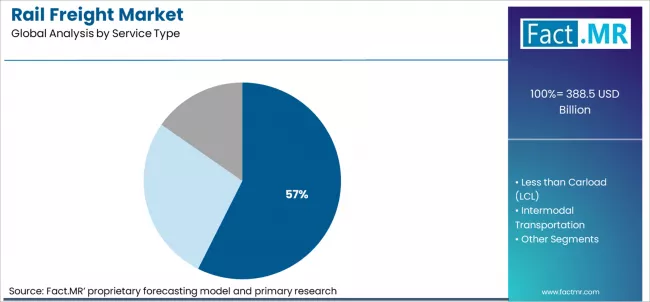
    Rail Freight Market Analysis By Service Type

    • Market Overview: Full Carload (FCL) is expected to capture 57.4% of the market share by 2026. Full Carload services involve transporting large quantities of a single type of cargo, typically offering a cost-effective solution for industries that require the shipment of bulk goods over long distances.
    • Demand Drivers:
      • Cost-Effectiveness for Bulk Shipments: FCL services are ideal for industries that need to ship large quantities of goods, such as coal, agricultural products, and raw materials. The ability to fill an entire railcar with a single cargo type helps reduce shipping costs and optimize logistics operations.
      • Efficiency in Large-Scale Transport: Full Carload services provide a streamlined and efficient transportation method for large quantities of goods, making them essential for supply chains that require high-volume, long-distance freight transport.
      • Increased Industrial Production: As manufacturing and industrial production expand globally, the demand for Full Carload services grows, particularly for commodities and goods that are commonly shipped in large volumes.

    Rail Freight Market Analysis by Cargo Type
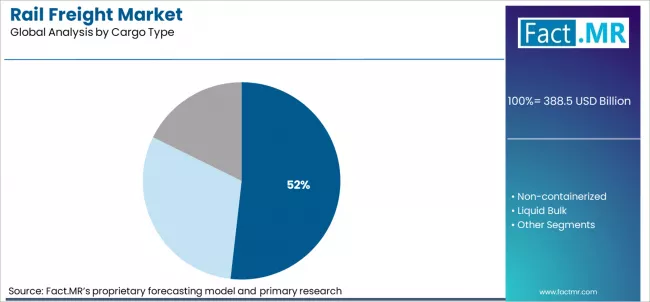
    Rail Freight Market Analysis By Cargo Type

    • Market Overview: Containerized cargo is projected to hold 51.8% of the market share by 2026. Containerized transport, involving goods shipped in standardized containers, is popular for its efficiency, flexibility, and compatibility with various transportation modes, including rail, sea, and road.
    • Demand Drivers:
      • Efficiency in Handling and Transshipment: Containerized cargo is easier to load, unload, and transfer between different modes of transportation, making it the preferred choice for international and intermodal freight. The containerization of goods simplifies logistics and reduces handling times.
      • Growth in Global Trade: The increasing volume of global trade, particularly in consumer goods and electronics, is driving the demand for containerized transport. The flexibility of containerized cargo to be moved via multiple transport methods, including rail, sea, and road, contributes to its dominance in the rail freight market.
      • Standardization and Versatility: The use of standardized containers in rail freight allows for greater scalability and ease of operation. Containerized cargo can be used across a wide range of industries, enhancing its appeal for a variety of goods and commodities.

    Rail Freight Market Drivers, Restraints, and Opportunities

    FMR analysts observe that the rail freight market is a mature, infrastructure‑anchored segment essential to bulk cargo movement across major economies. Historically, rail has offered cost‑efficient transport for heavy commodities like coal, minerals, grain, and industrial goods; this structural demand persists because rail provides lower unit costs and higher stability than road transport over long distances. The 2026 valuation reflects this baseline foundation, with volumes tied closely to industrial output, trade flows, and national infrastructure investment.

    While demand for basic bulk freight remains large, growth is shifting toward intermodal and value‑added rail services that integrate with logistics networks to serve manufactured goods, e‑commerce, and time‑sensitive cargo. These advanced services often command higher yields, contributing to net market value growth even as unit volumes align with broader trade and economic cycles. The market exists because rail remains a core backbone of inland freight movement, particularly for large‑scale and heavy‑tonnage shipments where road and water alternatives are less competitive.

    • Intermodal Logistics Demand: Adoption of rail as part of integrated supply chains for containers and manufactured goods is increasing, replacing exclusively road‑based transport where cost and sustainability matter.
    • Regulatory & Infrastructure Standards: Government rail modernization initiatives and freight corridors push adoption of certified rail solutions that meet capacity, safety, and interoperability criteria.
    • Regional Trade Dynamics: In Asia‑Pacific and North America, extensive rail networks and strong freight volumes drive higher uptake of rail freight services compared with regions with limited rail infrastructure.

    Regional Analysis

    The market analysis covers key global regions, including East Asia, South Asia, North America, Western Europe, and Latin America. It is segmented geographically, with specific market dynamics for each region. The full report provides a detailed market attractiveness analysis.
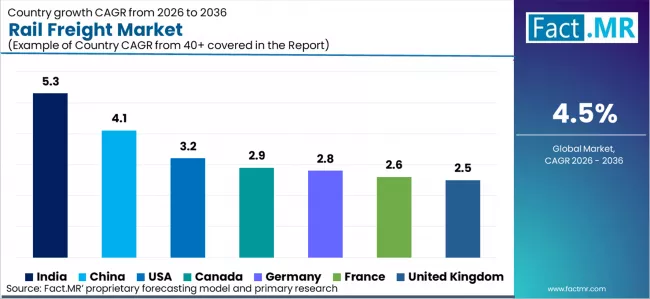
    Rail Freight Market Cagr Analysis By Country

    Country CAGR (%)
    China 4.1%
    India 5.3%
    USA 3.2%
    Germany 2.8%
    France 2.6%
    United Kingdom 2.5%
    Canada 2.9%
    Japan 2.2%
    Brazil 3.0%

    Source: Fact MR (FMR) analysis, based on proprietary forecasting model and primary research.

    East Asia

    In East Asia, China and India are the dominant markets for rail freight, driven by large-scale manufacturing, growing international trade, and expanding rail infrastructure for freight transportation.

    • China: Demand for rail freight in China is projected to rise at 4.1% CAGR through 2036. China’s rapid industrial growth, expanding rail network, and strong focus on improving logistics infrastructure continue to support steady market growth.
    • India: Demand for rail freight in India is projected to rise at 5.3% CAGR through 2036. India’s increasing focus on freight transport via rail, government infrastructure initiatives, and rising demand for cost-effective logistics solutions continue to drive the market forward.

    North America
    Rail Freight Market Country Value Analysis

    In North America, the USA and Canada are significant markets for rail freight, supported by the growing demand for efficient freight transportation and increasing investments in rail infrastructure.

    • USA: Demand for rail freight in the U.S. is projected to rise at 3.2% CAGR through 2036. The USA’s extensive rail network and growing demand for freight transport continue to support market growth, particularly with the rising demand for cost-effective logistics solutions.
    • Canada: Demand for rail freight in Canada is projected to rise at 2.9% CAGR through 2036. Canada’s strong rail infrastructure, increased demand for intermodal freight transport, and growing trade with the USA contribute to steady market growth.

    Western Europe

    In Western Europe, Germany, France, and the United Kingdom are important markets for rail freight, driven by strong industrial sectors, increasing demand for efficient freight transport, and government initiatives to enhance rail infrastructure.

    • Germany: Demand for rail freight in Germany is projected to rise at 2.8% CAGR through 2036. Germany’s well-established rail infrastructure and focus on environmental sustainability continue to fuel market demand for rail freight transport.
    • France: Demand for rail freight in France is projected to rise at 2.6% CAGR through 2036. France’s rail network development and increasing adoption of rail for freight transport continue to contribute to steady market growth.
    • United Kingdom: Demand for rail freight in the UK is projected to rise at 2.5% CAGR through 2036. The UK’s strong logistics infrastructure and growing demand for intermodal transport continue to drive demand for rail freight services.

    Latin America

    In Latin America, Brazil is the leading market for rail freight, driven by growing industrialization, increasing demand for transportation infrastructure, and the expanding role of rail in long-distance freight transport.

    • Brazil: Demand for rail freight in Brazil is projected to rise at 3.0% CAGR through 2036. Brazil’s growing rail infrastructure investments and expanding demand for freight transport across the country continue to support market growth.

    Fact MR's analysis of the Rail Freight Market in East Asia, South Asia, North America, Western Europe, and Latin America consists of country-wise assessments that include China, India, the USA, Germany, France, the United Kingdom, Canada, Japan, and Brazil. Readers can find detailed trends, regulatory updates, and company-specific investments shaping the market’s growth in these countries.

    Rail Freight Market Overview
    Rail Freight Market Analysis By Company

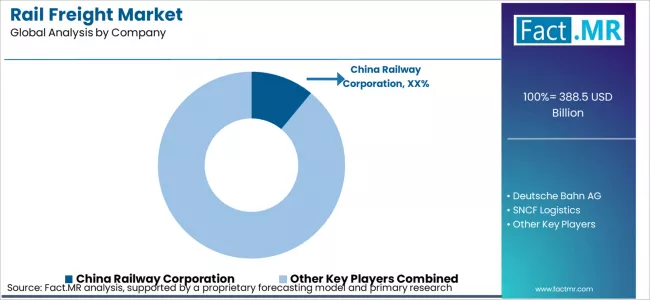
    The Rail Freight Market is dominated by key players like China Railway Corporation, Deutsche Bahn AG, and SNCF Logistics, which drive freight operations in their respective regions. Leading U.S. companies such as BNSF Railway Company, Union Pacific Railroad Company, and CSX Corporation maintain a significant market share in North America, offering robust freight solutions across long distances. European giants like Russian Railways (RZD), PKP Cargo S.A., and SBB Cargo AG lead in freight services across the continent, while Indian Railways stands as a major player in the Asia-Pacific region. Additionally, Canadian National Railway Company and Canadian Pacific Railway Limited (CP Rail) ensure efficient intermodal services within North America. Newer entrants, including Aurizon Holdings Limited and Pacific National Pty Ltd, also make strides in the growing global rail freight market. Companies such as The Greenbrier Companies, Inc., and Watco Companies, LLC provide essential railcar manufacturing and logistics services. With increasing demand for sustainable transport solutions, the market is expected to grow as key players expand their global operations and infrastructure.

    Recent Industry Developments

    • The First Transcontinental Railroad (US-Canada-Mexico)
      • In early 2026, the proposed Union Pacific-Norfolk Southern combination has become a central focus of the North American market. The potential merger aims to create the first true transcontinental railroad, designed specifically to capture the surge in "nearshoring" manufacturing traffic from Mexico to the Eastern U.S.
    • European "Barking Eurohub" & Cross-Channel Freight
      • In February 2026, the UK government and Network Rail announced a landmark deal to restore regular cross-Channel intermodal freight. The Barking Eurohub in London will receive a £15 million investment to become a primary international logistics node, allowing direct rail export of consumer goods to France, Germany, and Italy.
    • Digital Automatic Coupler (DAC) Commercial Scaling
      • Europe has entered a "decisive phase" for the Digital Automatic Coupler (DAC). The PioDAC project, kicked off in late 2025, is conducting extensive real-life commercial testing throughout 2026. This technology is the "holy grail" for rail freight automation, enabling automatic coupling/uncoupling and real-time digital train integrity monitoring.

    Key Players of the Rail Freight Market

    • China Railway Corporation
    • Deutsche Bahn AG
    • SNCF Logistics
    • BNSF Railway Company
    • Union Pacific Railroad Company
    • CSX Corporation
    • Norfolk Southern Railway Company
    • Canadian National Railway Company
    • Canadian Pacific Railway Limited (CP Rail)
    • Indian Railways
    • Russian Railways (RZD)
    • PKP Cargo S.A.
    • Rail Cargo Group (ÖBB)
    • SBB Cargo AG
    • The Greenbrier Companies, Inc.
    • Genesee & Wyoming Inc.
    • Watco Companies, LLC
    • Aurizon Holdings Limited
    • Pacific National Pty Ltd
    • Freightliner Group Limited

    Report Scope

    Metric Value
    Quantitative Units USD 388.5 billion (2026) to USD 602.7 billion (2036), at a CAGR of 4.5%
    Market Definition The Rail Freight Market includes transportation services for various types of cargo such as containerized, non-containerized, and liquid bulk, using rail as the mode of transport.
    By Cargo Type Containerized, Non-containerized, Liquid Bulk
    By Service Type Full Carload (FCL), Less than Carload (LCL), Intermodal Transportation
    By Distance Long-haul (Over 500 miles / 800 km), Medium-haul (150-500 miles / 240-800 km), Short-haul (Under 150 miles / 240 km)
    By End-User Industry Mining (Coal, Iron Ore, Other Minerals), Agriculture (Grain, Fertilizer, Animal Feed), Energy (Petroleum, Natural Gas, Biofuels), Manufacturing (Industrial Equipment, Machinery), Construction (Cement, Aggregates, Lumber), Retail (Consumer Goods, E-commerce), Automotive (Parts, Finished Vehicles), Chemical (Industrial Chemicals, Petrochemicals), Food & Beverages, Others (Waste, Military, Government)
    Regions Covered North America, Latin America, Europe, East Asia, South Asia, Oceania, Middle East and Africa
    Countries Covered United States, Canada, Mexico, Brazil, Argentina, Germany, France, United Kingdom, Italy, Spain, China, India, Japan, South Korea, Indonesia, Australia, and 40+ countries
    Key Companies Profiled China Railway Corporation, Deutsche Bahn AG, SNCF Logistics, BNSF Railway Company, Union Pacific Railroad Company, CSX Corporation, Norfolk Southern Railway Company, Canadian National Railway Company, Canadian Pacific Railway Limited (CP Rail), Indian Railways, Russian Railways (RZD), PKP Cargo S.A., Rail Cargo Group (ÖBB), SBB Cargo AG, The Greenbrier Companies, Inc., Genesee & Wyoming Inc., Watco Companies, LLC, Aurizon Holdings Limited, Pacific National Pty Ltd, Freightliner Group Limited
    Forecast Period 2026 to 2036
    Approach Hybrid top-down and bottom-up market modeling validated through primary interviews with manufacturers and supported by trade data benchmarking and market research.

    Rail Freight Market Key Segments

    • Cargo Type:

      • Containerized
        • Dry Containers
        • Refrigerated Containers
        • Tank Containers
      • Non-containerized
        • Bulk Commodities (Coal, Minerals, Grain)
        • Breakbulk Cargo
        • Automotive (Finished Vehicles)
        • Heavy Machinery
      • Liquid Bulk
        • Petroleum Products
        • Chemicals
        • Food-Grade Liquids
    • Service Type:

      • Full Carload (FCL)
        • Unit Trains (Single Commodity)
        • Manifest Trains (Mixed Commodities)
      • Less than Carload (LCL)
      • Intermodal Transportation
        • Domestic Intermodal
        • International Intermodal
    • Distance:

      • Long-haul (Over 500 miles / 800 km)
      • Medium-haul (150-500 miles / 240-800 km)
      • Short-haul (Under 150 miles / 240 km)
    • End-User Industry:

      • Mining (Coal, Iron Ore, Other Minerals)
      • Agriculture (Grain, Fertilizer, Animal Feed)
      • Energy (Petroleum, Natural Gas, Biofuels)
      • Manufacturing (Industrial Equipment, Machinery)
      • Construction (Cement, Aggregates, Lumber)
      • Retail (Consumer Goods, E-commerce)
      • Automotive (Parts, Finished Vehicles)
      • Chemical (Industrial Chemicals, Petrochemicals)
      • Food & Beverages
      • Others (Waste, Military, Government)
    • Region:

      • North America
        • United States
        • Canada
        • Mexico
      • Latin America
        • Brazil
        • Argentina
        • Chile
        • Colombia
        • Rest of Latin America
      • Europe
        • Germany
        • France
        • United Kingdom
        • Italy
        • Spain
        • Russia
        • Nordic
        • Benelux
        • Rest of Europe
      • East Asia
        • China
        • Japan
        • South Korea
      • South Asia & Pacific
        • India
        • Bangladesh
        • Pakistan
        • Australia
        • New Zealand
        • Rest of South Asia & Pacific
      • Middle East & Africa
        • Saudi Arabia
        • UAE
        • Turkey
        • South Africa
        • Rest of Middle East & Africa

    Bibliographies

    • BNSF Railway Company. (2023). Enhancing freight services through innovation and sustainability. BNSF Railway Company.
    • Canadian National Railway Company. (2023). Driving efficiency in rail freight: Key developments and future outlook. Canadian National Railway Company.
    • China Railway Corporation. (2023). Rail freight solutions: Growth and development in China’s logistics sector. China Railway Corporation.
    • Deutsche Bahn AG. (2023). Rail freight market growth and innovation in Europe. Deutsche Bahn AG.
    • GOV.UK. (2026, February 25). Landmark deal paves way for return of regular cross-Channel rail freight [Press release]. Department for Transport, UK Government.
    • International Union of Railways (UIC). (2026, March). Moving towards real DAC operations: Where do we stand and what’s next? International Union of Railways.
    • Union Pacific Railroad Company. (2023). Innovations in rail freight: A sustainable future. Union Pacific Railroad Company.
    • Union Pacific Railroad Company. (2026, January). UP shares vision at rail shippers meeting regarding proposed merger [Corporate update]. Union Pacific Railroad Company.

    This report offers

    • Market Forecasts from 2026 to 2036, including projections on total market size, demand growth, and key growth drivers.
    • Revenue Insights including forecasts of USD 388.5 billion in 2026 and USD 602.7 billion by 2036, with a CAGR of 4.5%.
    • Segmentation Breakdown based on cargo types (containerized, non-containerized, liquid bulk), service types (full carload, less than carload, intermodal transportation), and industry end-users (mining, agriculture, automotive, manufacturing, and more).
    • Regional Dynamics highlighting key countries, including China, India, the USA, Germany, and Brazil, with growth rates and country-specific insights.
    • Industry Drivers such as rising demand for sustainable logistics, cost-efficient freight transport, and government initiatives for infrastructure enhancement.
    • Competitive Landscape analyzing the key players in the market, including China Railway Corporation, Deutsche Bahn AG, and Union Pacific Railroad Company, alongside market strategies.
    • Technological Trends such as rail infrastructure advancements, automation, and the adoption of green logistics solutions that will influence the rail freight market’s future.

    Table of Content

    1. Executive Summary
      • Global Market Outlook
      • Demand to side Trends
      • Supply to side Trends
      • Technology Roadmap Analysis
      • Analysis and Recommendations
    2. Market Overview
      • Market Coverage / Taxonomy
      • Market Definition / Scope / Limitations
    3. Research Methodology
      • Chapter Orientation
      • Analytical Lens and Working Hypotheses
        • Market Structure, Signals, and Trend Drivers
        • Benchmarking and Cross-market Comparability
        • Market Sizing, Forecasting, and Opportunity Mapping
      • Research Design and Evidence Framework
        • Desk Research Programme (Secondary Evidence)
          • Company Annual and Sustainability Reports
          • Peer-reviewed Journals and Academic Literature
          • Corporate Websites, Product Literature, and Technical Notes
          • Earnings Decks and Investor Briefings
          • Statutory Filings and Regulatory Disclosures
          • Technical White Papers and Standards Notes
          • Trade Journals, Industry Magazines, and Analyst Briefs
          • Conference Proceedings, Webinars, and Seminar Materials
          • Government Statistics Portals and Public Data Releases
          • Press Releases and Reputable Media Coverage
          • Specialist Newsletters and Curated Briefings
          • Sector Databases and Reference Repositories
          • FMR Internal Proprietary Databases and Historical Market Datasets
          • Subscription Datasets and Paid Sources
          • Social Channels, Communities, and Digital Listening Inputs
          • Additional Desk Sources
        • Expert Input and Fieldwork (Primary Evidence)
          • Primary Modes
            • Qualitative Interviews and Expert Elicitation
            • Quantitative Surveys and Structured Data Capture
            • Blended Approach
          • Why Primary Evidence is Used
          • Field Techniques
            • Interviews
            • Surveys
            • Focus Groups
            • Observational and In-context Research
            • Social and Community Interactions
          • Stakeholder Universe Engaged
            • C-suite Leaders
            • Board Members
            • Presidents and Vice Presidents
            • R&D and Innovation Heads
            • Technical Specialists
            • Domain Subject-matter Experts
            • Scientists
            • Physicians and Other Healthcare Professionals
          • Governance, Ethics, and Data Stewardship
            • Research Ethics
            • Data Integrity and Handling
        • Tooling, Models, and Reference Databases
      • Data Engineering and Model Build
        • Data Acquisition and Ingestion
        • Cleaning, Normalisation, and Verification
        • Synthesis, Triangulation, and Analysis
      • Quality Assurance and Audit Trail
    4. Market Background
      • Market Dynamics
        • Drivers
        • Restraints
        • Opportunity
        • Trends
      • Scenario Forecast
        • Demand in Optimistic Scenario
        • Demand in Likely Scenario
        • Demand in Conservative Scenario
      • Opportunity Map Analysis
      • Product Life Cycle Analysis
      • Supply Chain Analysis
      • Investment Feasibility Matrix
      • Value Chain Analysis
      • PESTLE and Porter’s Analysis
      • Regulatory Landscape
      • Regional Parent Market Outlook
      • Production and Consumption Statistics
      • Import and Export Statistics
    5. Global Market Analysis 2021 to 2025 and Forecast, 2026 to 2036
      • Historical Market Size Value (USD Million) Analysis, 2021 to 2025
      • Current and Future Market Size Value (USD Million) Projections, 2026 to 2036
        • Y to o to Y Growth Trend Analysis
        • Absolute $ Opportunity Analysis
    6. Global Market Pricing Analysis 2021 to 2025 and Forecast 2026 to 2036
    7. Global Market Analysis 2021 to 2025 and Forecast 2026 to 2036, By Service Type
      • Introduction / Key Findings
      • Historical Market Size Value (USD Million) Analysis By Service Type , 2021 to 2025
      • Current and Future Market Size Value (USD Million) Analysis and Forecast By Service Type , 2026 to 2036
        • Full Carload (FCL)
        • Less than Carload (LCL)
        • Intermodal Transportation
      • Y to o to Y Growth Trend Analysis By Service Type , 2021 to 2025
      • Absolute $ Opportunity Analysis By Service Type , 2026 to 2036
    8. Global Market Analysis 2021 to 2025 and Forecast 2026 to 2036, By Cargo Type
      • Introduction / Key Findings
      • Historical Market Size Value (USD Million) Analysis By Cargo Type, 2021 to 2025
      • Current and Future Market Size Value (USD Million) Analysis and Forecast By Cargo Type, 2026 to 2036
        • Containerized
        • Non-containerized
        • Liquid Bulk
      • Y to o to Y Growth Trend Analysis By Cargo Type, 2021 to 2025
      • Absolute $ Opportunity Analysis By Cargo Type, 2026 to 2036
    9. Global Market Analysis 2021 to 2025 and Forecast 2026 to 2036, By Region
      • Introduction
      • Historical Market Size Value (USD Million) Analysis By Region, 2021 to 2025
      • Current Market Size Value (USD Million) Analysis and Forecast By Region, 2026 to 2036
        • North America
        • Latin America
        • Western Europe
        • Eastern Europe
        • East Asia
        • South Asia and Pacific
        • Middle East & Africa
      • Market Attractiveness Analysis By Region
    10. North America Market Analysis 2021 to 2025 and Forecast 2026 to 2036, By Country
      • Historical Market Size Value (USD Million) Trend Analysis By Market Taxonomy, 2021 to 2025
      • Market Size Value (USD Million) Forecast By Market Taxonomy, 2026 to 2036
        • By Country
          • USA
          • Canada
          • Mexico
        • By Service Type
        • By Cargo Type
      • Market Attractiveness Analysis
        • By Country
        • By Service Type
        • By Cargo Type
      • Key Takeaways
    11. Latin America Market Analysis 2021 to 2025 and Forecast 2026 to 2036, By Country
      • Historical Market Size Value (USD Million) Trend Analysis By Market Taxonomy, 2021 to 2025
      • Market Size Value (USD Million) Forecast By Market Taxonomy, 2026 to 2036
        • By Country
          • Brazil
          • Chile
          • Rest of Latin America
        • By Service Type
        • By Cargo Type
      • Market Attractiveness Analysis
        • By Country
        • By Service Type
        • By Cargo Type
      • Key Takeaways
    12. Western Europe Market Analysis 2021 to 2025 and Forecast 2026 to 2036, By Country
      • Historical Market Size Value (USD Million) Trend Analysis By Market Taxonomy, 2021 to 2025
      • Market Size Value (USD Million) Forecast By Market Taxonomy, 2026 to 2036
        • By Country
          • Germany
          • UK
          • Italy
          • Spain
          • France
          • Nordic
          • BENELUX
          • Rest of Western Europe
        • By Service Type
        • By Cargo Type
      • Market Attractiveness Analysis
        • By Country
        • By Service Type
        • By Cargo Type
      • Key Takeaways
    13. Eastern Europe Market Analysis 2021 to 2025 and Forecast 2026 to 2036, By Country
      • Historical Market Size Value (USD Million) Trend Analysis By Market Taxonomy, 2021 to 2025
      • Market Size Value (USD Million) Forecast By Market Taxonomy, 2026 to 2036
        • By Country
          • Russia
          • Poland
          • Hungary
          • Balkan & Baltic
          • Rest of Eastern Europe
        • By Service Type
        • By Cargo Type
      • Market Attractiveness Analysis
        • By Country
        • By Service Type
        • By Cargo Type
      • Key Takeaways
    14. East Asia Market Analysis 2021 to 2025 and Forecast 2026 to 2036, By Country
      • Historical Market Size Value (USD Million) Trend Analysis By Market Taxonomy, 2021 to 2025
      • Market Size Value (USD Million) Forecast By Market Taxonomy, 2026 to 2036
        • By Country
          • China
          • Japan
          • South Korea
        • By Service Type
        • By Cargo Type
      • Market Attractiveness Analysis
        • By Country
        • By Service Type
        • By Cargo Type
      • Key Takeaways
    15. South Asia and Pacific Market Analysis 2021 to 2025 and Forecast 2026 to 2036, By Country
      • Historical Market Size Value (USD Million) Trend Analysis By Market Taxonomy, 2021 to 2025
      • Market Size Value (USD Million) Forecast By Market Taxonomy, 2026 to 2036
        • By Country
          • India
          • ASEAN
          • Australia & New Zealand
          • Rest of South Asia and Pacific
        • By Service Type
        • By Cargo Type
      • Market Attractiveness Analysis
        • By Country
        • By Service Type
        • By Cargo Type
      • Key Takeaways
    16. Middle East & Africa Market Analysis 2021 to 2025 and Forecast 2026 to 2036, By Country
      • Historical Market Size Value (USD Million) Trend Analysis By Market Taxonomy, 2021 to 2025
      • Market Size Value (USD Million) Forecast By Market Taxonomy, 2026 to 2036
        • By Country
          • Kingdom of Saudi Arabia
          • Other GCC Countries
          • Turkiye
          • South Africa
          • Other African Union
          • Rest of Middle East & Africa
        • By Service Type
        • By Cargo Type
      • Market Attractiveness Analysis
        • By Country
        • By Service Type
        • By Cargo Type
      • Key Takeaways
    17. Key Countries Market Analysis
      • USA
        • Pricing Analysis
        • Market Share Analysis, 2025
          • By Service Type
          • By Cargo Type
      • Canada
        • Pricing Analysis
        • Market Share Analysis, 2025
          • By Service Type
          • By Cargo Type
      • Mexico
        • Pricing Analysis
        • Market Share Analysis, 2025
          • By Service Type
          • By Cargo Type
      • Brazil
        • Pricing Analysis
        • Market Share Analysis, 2025
          • By Service Type
          • By Cargo Type
      • Chile
        • Pricing Analysis
        • Market Share Analysis, 2025
          • By Service Type
          • By Cargo Type
      • Germany
        • Pricing Analysis
        • Market Share Analysis, 2025
          • By Service Type
          • By Cargo Type
      • UK
        • Pricing Analysis
        • Market Share Analysis, 2025
          • By Service Type
          • By Cargo Type
      • Italy
        • Pricing Analysis
        • Market Share Analysis, 2025
          • By Service Type
          • By Cargo Type
      • Spain
        • Pricing Analysis
        • Market Share Analysis, 2025
          • By Service Type
          • By Cargo Type
      • France
        • Pricing Analysis
        • Market Share Analysis, 2025
          • By Service Type
          • By Cargo Type
      • India
        • Pricing Analysis
        • Market Share Analysis, 2025
          • By Service Type
          • By Cargo Type
      • ASEAN
        • Pricing Analysis
        • Market Share Analysis, 2025
          • By Service Type
          • By Cargo Type
      • Australia & New Zealand
        • Pricing Analysis
        • Market Share Analysis, 2025
          • By Service Type
          • By Cargo Type
      • China
        • Pricing Analysis
        • Market Share Analysis, 2025
          • By Service Type
          • By Cargo Type
      • Japan
        • Pricing Analysis
        • Market Share Analysis, 2025
          • By Service Type
          • By Cargo Type
      • South Korea
        • Pricing Analysis
        • Market Share Analysis, 2025
          • By Service Type
          • By Cargo Type
      • Russia
        • Pricing Analysis
        • Market Share Analysis, 2025
          • By Service Type
          • By Cargo Type
      • Poland
        • Pricing Analysis
        • Market Share Analysis, 2025
          • By Service Type
          • By Cargo Type
      • Hungary
        • Pricing Analysis
        • Market Share Analysis, 2025
          • By Service Type
          • By Cargo Type
      • Kingdom of Saudi Arabia
        • Pricing Analysis
        • Market Share Analysis, 2025
          • By Service Type
          • By Cargo Type
      • Turkiye
        • Pricing Analysis
        • Market Share Analysis, 2025
          • By Service Type
          • By Cargo Type
      • South Africa
        • Pricing Analysis
        • Market Share Analysis, 2025
          • By Service Type
          • By Cargo Type
    18. Market Structure Analysis
      • Competition Dashboard
      • Competition Benchmarking
      • Market Share Analysis of Top Players
        • By Regional
        • By Service Type
        • By Cargo Type
    19. Competition Analysis
      • Competition Deep Dive
        • China Railway Corporation
          • Overview
          • Product Portfolio
          • Profitability by Market Segments (Product/Age /Sales Channel/Region)
          • Sales Footprint
          • Strategy Overview
            • Marketing Strategy
            • Product Strategy
            • Channel Strategy
        • Deutsche Bahn AG
        • SNCF Logistics
        • BNSF Railway Company
        • Union Pacific Railroad Company
        • CSX Corporation
        • Norfolk Southern Railway Company
    20. Assumptions & Acronyms Used

    List Of Table

    • Table 1: Global Market Value (USD Million) Forecast by Region, 2021 to 2036
    • Table 2: Global Market Value (USD Million) Forecast by Service Type , 2021 to 2036
    • Table 3: Global Market Value (USD Million) Forecast by Cargo Type, 2021 to 2036
    • Table 4: North America Market Value (USD Million) Forecast by Country, 2021 to 2036
    • Table 5: North America Market Value (USD Million) Forecast by Service Type , 2021 to 2036
    • Table 6: North America Market Value (USD Million) Forecast by Cargo Type, 2021 to 2036
    • Table 7: Latin America Market Value (USD Million) Forecast by Country, 2021 to 2036
    • Table 8: Latin America Market Value (USD Million) Forecast by Service Type , 2021 to 2036
    • Table 9: Latin America Market Value (USD Million) Forecast by Cargo Type, 2021 to 2036
    • Table 10: Western Europe Market Value (USD Million) Forecast by Country, 2021 to 2036
    • Table 11: Western Europe Market Value (USD Million) Forecast by Service Type , 2021 to 2036
    • Table 12: Western Europe Market Value (USD Million) Forecast by Cargo Type, 2021 to 2036
    • Table 13: Eastern Europe Market Value (USD Million) Forecast by Country, 2021 to 2036
    • Table 14: Eastern Europe Market Value (USD Million) Forecast by Service Type , 2021 to 2036
    • Table 15: Eastern Europe Market Value (USD Million) Forecast by Cargo Type, 2021 to 2036
    • Table 16: East Asia Market Value (USD Million) Forecast by Country, 2021 to 2036
    • Table 17: East Asia Market Value (USD Million) Forecast by Service Type , 2021 to 2036
    • Table 18: East Asia Market Value (USD Million) Forecast by Cargo Type, 2021 to 2036
    • Table 19: South Asia and Pacific Market Value (USD Million) Forecast by Country, 2021 to 2036
    • Table 20: South Asia and Pacific Market Value (USD Million) Forecast by Service Type , 2021 to 2036
    • Table 21: South Asia and Pacific Market Value (USD Million) Forecast by Cargo Type, 2021 to 2036
    • Table 22: Middle East & Africa Market Value (USD Million) Forecast by Country, 2021 to 2036
    • Table 23: Middle East & Africa Market Value (USD Million) Forecast by Service Type , 2021 to 2036
    • Table 24: Middle East & Africa Market Value (USD Million) Forecast by Cargo Type, 2021 to 2036

    List Of Figures

    • Figure 1: Global Market Pricing Analysis
    • Figure 2: Global Market Value (USD Million) Forecast 2021 to 2036
    • Figure 3: Global Market Value Share and BPS Analysis by Service Type , 2026 and 2036
    • Figure 4: Global Market Y to o to Y Growth Comparison by Service Type , 2026 to 2036
    • Figure 5: Global Market Attractiveness Analysis by Service Type
    • Figure 6: Global Market Value Share and BPS Analysis by Cargo Type, 2026 and 2036
    • Figure 7: Global Market Y to o to Y Growth Comparison by Cargo Type, 2026 to 2036
    • Figure 8: Global Market Attractiveness Analysis by Cargo Type
    • Figure 9: Global Market Value (USD Million) Share and BPS Analysis by Region, 2026 and 2036
    • Figure 10: Global Market Y to o to Y Growth Comparison by Region, 2026 to 2036
    • Figure 11: Global Market Attractiveness Analysis by Region
    • Figure 12: North America Market Incremental Dollar Opportunity, 2026 to 2036
    • Figure 13: Latin America Market Incremental Dollar Opportunity, 2026 to 2036
    • Figure 14: Western Europe Market Incremental Dollar Opportunity, 2026 to 2036
    • Figure 15: Eastern Europe Market Incremental Dollar Opportunity, 2026 to 2036
    • Figure 16: East Asia Market Incremental Dollar Opportunity, 2026 to 2036
    • Figure 17: South Asia and Pacific Market Incremental Dollar Opportunity, 2026 to 2036
    • Figure 18: Middle East & Africa Market Incremental Dollar Opportunity, 2026 to 2036
    • Figure 19: North America Market Value Share and BPS Analysis by Country, 2026 and 2036
    • Figure 20: North America Market Value Share and BPS Analysis by Service Type , 2026 and 2036
    • Figure 21: North America Market Y to o to Y Growth Comparison by Service Type , 2026 to 2036
    • Figure 22: North America Market Attractiveness Analysis by Service Type
    • Figure 23: North America Market Value Share and BPS Analysis by Cargo Type, 2026 and 2036
    • Figure 24: North America Market Y to o to Y Growth Comparison by Cargo Type, 2026 to 2036
    • Figure 25: North America Market Attractiveness Analysis by Cargo Type
    • Figure 26: Latin America Market Value Share and BPS Analysis by Country, 2026 and 2036
    • Figure 27: Latin America Market Value Share and BPS Analysis by Service Type , 2026 and 2036
    • Figure 28: Latin America Market Y to o to Y Growth Comparison by Service Type , 2026 to 2036
    • Figure 29: Latin America Market Attractiveness Analysis by Service Type
    • Figure 30: Latin America Market Value Share and BPS Analysis by Cargo Type, 2026 and 2036
    • Figure 31: Latin America Market Y to o to Y Growth Comparison by Cargo Type, 2026 to 2036
    • Figure 32: Latin America Market Attractiveness Analysis by Cargo Type
    • Figure 33: Western Europe Market Value Share and BPS Analysis by Country, 2026 and 2036
    • Figure 34: Western Europe Market Value Share and BPS Analysis by Service Type , 2026 and 2036
    • Figure 35: Western Europe Market Y to o to Y Growth Comparison by Service Type , 2026 to 2036
    • Figure 36: Western Europe Market Attractiveness Analysis by Service Type
    • Figure 37: Western Europe Market Value Share and BPS Analysis by Cargo Type, 2026 and 2036
    • Figure 38: Western Europe Market Y to o to Y Growth Comparison by Cargo Type, 2026 to 2036
    • Figure 39: Western Europe Market Attractiveness Analysis by Cargo Type
    • Figure 40: Eastern Europe Market Value Share and BPS Analysis by Country, 2026 and 2036
    • Figure 41: Eastern Europe Market Value Share and BPS Analysis by Service Type , 2026 and 2036
    • Figure 42: Eastern Europe Market Y to o to Y Growth Comparison by Service Type , 2026 to 2036
    • Figure 43: Eastern Europe Market Attractiveness Analysis by Service Type
    • Figure 44: Eastern Europe Market Value Share and BPS Analysis by Cargo Type, 2026 and 2036
    • Figure 45: Eastern Europe Market Y to o to Y Growth Comparison by Cargo Type, 2026 to 2036
    • Figure 46: Eastern Europe Market Attractiveness Analysis by Cargo Type
    • Figure 47: East Asia Market Value Share and BPS Analysis by Country, 2026 and 2036
    • Figure 48: East Asia Market Value Share and BPS Analysis by Service Type , 2026 and 2036
    • Figure 49: East Asia Market Y to o to Y Growth Comparison by Service Type , 2026 to 2036
    • Figure 50: East Asia Market Attractiveness Analysis by Service Type
    • Figure 51: East Asia Market Value Share and BPS Analysis by Cargo Type, 2026 and 2036
    • Figure 52: East Asia Market Y to o to Y Growth Comparison by Cargo Type, 2026 to 2036
    • Figure 53: East Asia Market Attractiveness Analysis by Cargo Type
    • Figure 54: South Asia and Pacific Market Value Share and BPS Analysis by Country, 2026 and 2036
    • Figure 55: South Asia and Pacific Market Value Share and BPS Analysis by Service Type , 2026 and 2036
    • Figure 56: South Asia and Pacific Market Y to o to Y Growth Comparison by Service Type , 2026 to 2036
    • Figure 57: South Asia and Pacific Market Attractiveness Analysis by Service Type
    • Figure 58: South Asia and Pacific Market Value Share and BPS Analysis by Cargo Type, 2026 and 2036
    • Figure 59: South Asia and Pacific Market Y to o to Y Growth Comparison by Cargo Type, 2026 to 2036
    • Figure 60: South Asia and Pacific Market Attractiveness Analysis by Cargo Type
    • Figure 61: Middle East & Africa Market Value Share and BPS Analysis by Country, 2026 and 2036
    • Figure 62: Middle East & Africa Market Value Share and BPS Analysis by Service Type , 2026 and 2036
    • Figure 63: Middle East & Africa Market Y to o to Y Growth Comparison by Service Type , 2026 to 2036
    • Figure 64: Middle East & Africa Market Attractiveness Analysis by Service Type
    • Figure 65: Middle East & Africa Market Value Share and BPS Analysis by Cargo Type, 2026 and 2036
    • Figure 66: Middle East & Africa Market Y to o to Y Growth Comparison by Cargo Type, 2026 to 2036
    • Figure 67: Middle East & Africa Market Attractiveness Analysis by Cargo Type
    • Figure 68: Global Market - Tier Structure Analysis
    • Figure 69: Global Market - Company Share Analysis

    - FAQs -

    How large is the demand for Rail Freight in the global market in 2026?

    Demand for Rail Freight in the global market is estimated to be valued at USD 388.5 billion in 2026.

    What will be the market size of Rail Freight in the global market by 2036?

    The market size for Rail Freight is projected to reach USD 602.7 billion by 2036.

    What is the expected demand growth for Rail Freight in the global market between 2026 and 2036?

    Demand for Rail Freight in the global market is expected to grow at a CAGR of 4.5% between 2026 and 2036.

    Which service type is expected to dominate the market?

    Full Carload (FCL) is expected to dominate the market, accounting for 57.4% of the market share in 2026, due to its efficiency in transporting bulk commodities and heavy goods over long distances via rail.

    Which region is expected to show the highest growth rate for Rail Freight?

    India is projected to show the highest regional CAGR at 5.3% during the forecast period, driven by expanding infrastructure, increased demand for domestic transportation of goods, and government efforts to modernize rail freight systems.

    How significant is the growth outlook for China in this market?

    China is expected to grow at a CAGR of 4.1%, reflecting its dominant position in global rail freight, extensive rail network, and increasing demand for efficient transportation of goods within its growing economy.

    What is the growth outlook for the United States in the Rail Freight market?

    The United States is projected to grow at a CAGR of 3.2% from 2026 to 2036, supported by continued demand for domestic freight movement, an extensive rail network, and the growing shift toward more sustainable modes of transportation.

    What is the growth forecast for Germany in the Rail Freight market?

    Germany is expected to grow at a CAGR of 2.8%, driven by a strong rail network, increasing demand for efficient logistics solutions, and efforts to promote rail freight as an eco-friendly alternative to road and air transport.

    What is the growth forecast for France in the Rail Freight market?

    France is expected to grow at a CAGR of 2.6%, supported by continued modernization of its rail infrastructure and a growing emphasis on rail freight to reduce carbon emissions in the logistics sector.

    What is the growth forecast for the United Kingdom in the Rail Freight market?

    The United Kingdom is expected to grow at a CAGR of 2.5%, reflecting growing demand for sustainable transport options and efforts to integrate rail freight with the broader European logistics network.

    What is the growth forecast for Canada in the Rail Freight market?

    Canada is expected to grow at a CAGR of 2.9%, supported by the increasing need for reliable and efficient transportation of natural resources and goods, particularly across its vast geographical expanse.

    What is the growth forecast for Japan in the Rail Freight market?

    Japan is expected to grow at a CAGR of 2.2%, with demand driven by the efficient movement of goods within its well-developed rail system, and government support for rail transport in the logistics industry.

    What is the growth forecast for Brazil in the Rail Freight market?

    Brazil is expected to grow at a CAGR of 3.0%, reflecting the country’s increasing need for effective transportation solutions to move raw materials and goods, particularly within its large agricultural and mining sectors.

    Which company is identified as a leading player in the Rail Freight market?

    China Railway Corporation is recognized as a leading player in this market, given its extensive rail network, significant role in global rail freight, and its ongoing modernization efforts to enhance rail transportation capabilities.

    What are Full Carload (FCL) services used for in Rail Freight?

    Full Carload (FCL) services are used for transporting large quantities of goods, such as bulk commodities and industrial products, in dedicated railcars. These services are typically employed for transporting items that require significant volume and specialized handling over long distances.

    What does the Rail Freight market include in this report?

    The market scope includes various rail freight services, with a particular focus on Full Carload (FCL) services, which dominate the market due to their ability to transport a wide range of goods efficiently and economically.

    How is the market forecast developed in this report?

    The forecast is developed using historical data on rail freight demand, trends in transportation logistics, governmental policies promoting rail as a sustainable transportation mode, and insights from key industry players involved in rail operations.

    What is meant by the Rail Freight market in this report?

    The market refers to the global production, trade, and consumption of rail freight services, with a focus on Full Carload (FCL) services, which are used for transporting bulk goods and commodities across regions and countries.

    Rail Freight Market