- Market Value (2025): USD 688.5 Mn
- Estimated Value (2026): USD 840.0 Mn
- Forecast Value (2036): USD 6136.0 Mn
- CAGR (2026-2036): 22.0%
What is the Self-Healing Auto Coatings Market forecast to be worth by 2036?
USD 840.0 million in 2026 to USD 6136.0 million by 2036 at a 22.0% CAGR.
- The Self-Healing Auto Coatings Market reached USD 688.5 million in 2025.
- Demand is projected to increase from USD 840.0 million in 2026 to USD 6136.0 million by 2036.
- The market is forecast to record 22.0% CAGR from 2026 to 2036 as automakers, collision repair networks and fleet operators specify coatings that reduce visible micro-scratches and preserve exterior finish quality.
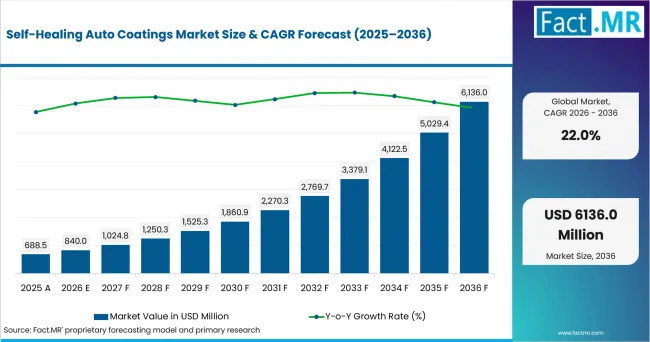
Self Healing Auto Coatings Market Value Analysis | Source: Fact.MR
What are the defining numbers behind Self-Healing Auto Coatings Market growth?
USD 5296.0 million absolute opportunity is expected between 2026 and 2036.
- Demand Drivers in the Market
- Automotive paint engineers need recoverable clear layers as darker finishes and complex exterior panels make micro-scratches easier to see during inspection.
- Collision repair shops need coating systems that reduce booth time while protecting finish quality. PPG launched U.S. clearcoats in May 2025 for value-focused and premium collision repair segments, including products built around faster bake and room-temperature cure options.
- Fleet operators need finishes that reduce repeated polishing and repainting. OICA reported on April 23, 2026 that global vehicle production increased from 92.7 million units in 2024 to 96.4 million units in 2025, an increase of 3.9%.
- Paint formulators need lower-emission coating routes as current automotive refinish and vehicle surface-coating rules keep VOC and hazardous-air-pollutant control central to material selection.
- Key Segments Analyzed
- By Chemistry: Polyurethane is expected to hold 41.0% share in 2026 due to its balance of flexibility, gloss retention and compatibility with automotive clearcoat systems.
- By Form: Liquid coating is projected to account for 44.0% share in 2026 as sprayable OEM and refinish systems remain practical for body panels.
- By Performance: Self-repair is anticipated to capture 38.0% share in 2026 since visible scratch recovery is the main value claim in self-healing auto coatings.
- By Application: Automotive is estimated to represent 34.0% share in 2026 owing to exposure from gravel impact, washing brushes, weathering and road chemicals.
- Analyst Opinion at Fact.MR
- Shambhu Nath Jha, Principal Consultant at Fact.MR, states, “Self-healing auto coatings are drawing attention because finish repair cost, surface quality and cure energy are now discussed together. Adoption is expected to favor coatings that prove scratch recovery without changing the paint-shop or bodyshop workflow. Suppliers should combine resin depth, refinish training and documented recovery performance across weathering cycles.”
- Strategic Implications
- Coating manufacturers should show scratch recovery after wash cycles, sunlight exposure and common automotive chemicals so paint engineers can judge durability in real use.
- Automotive OEM teams should test self-healing layers against current primers, basecoats and clearcoats before changing line speed or bake profiles.
- Refinish brands should link repair-speed claims with booth energy use.
- Fleet maintenance teams should compare coating cost with polishing, repainting and vehicle downtime before approving premium exterior-protection systems.
The USA is projected to record 24.5% CAGR through 2036, supported by vehicle assembly scale and refinish compliance pressure. Japan is expected to post 23.5% CAGR as domestic paint suppliers test exterior-material processes for thermoplastic body parts. South Korea is forecast to advance at 22.8% CAGR as export programs require consistent finish quality. The UK is anticipated to reach 20.5% CAGR on the back of road-use exposure and EV registrations. Germany is estimated to record 17.1% CAGR through premium production and OEM approval discipline.
How does the Self-Healing Auto Coatings Market break down by segment?
Polyurethane leads Chemistry at 41.0%; Liquid coating leads Form at 44.0%.
Which Chemistry dominates?
Polyurethane is expected to hold 41.0% share in 2026.
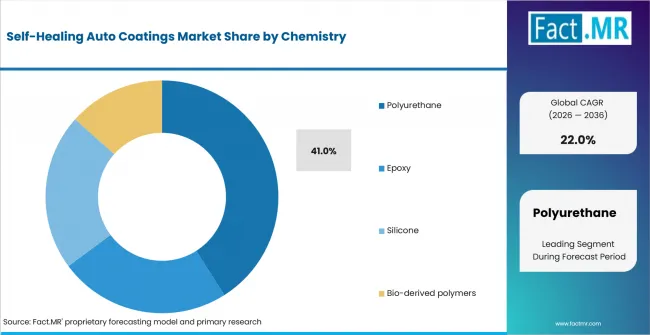
Self Healing Auto Coatings Market Analysis By Chemistry | Source: Fact.MR
Polyurethane leads because it gives coating formulators a practical balance of flexibility, gloss and abrasion performance. These traits fit clearcoat layers that must bend with panels and still hold surface appearance after washing or light scratching.
What leads the Form segment?
Liquid coating is projected to account for 44.0% share in 2026.
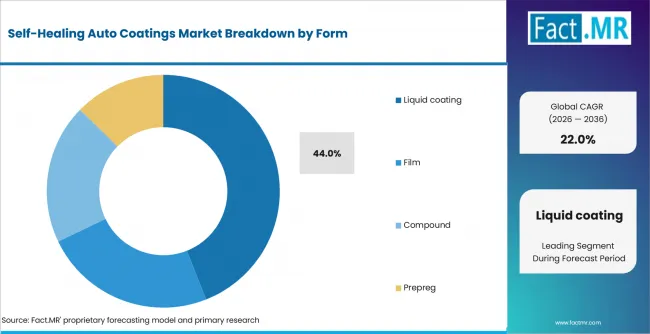
Self Healing Auto Coatings Market Analysis By Form | Source: Fact.MR
Liquid coating leads because spray application already fits OEM paint shops and collision repair booths. A coating that uses familiar guns, booth settings and repair preparation faces a shorter approval path than a format that requires new equipment.
How does Performance shape demand?
Self-repair is anticipated to capture 38.0% share in 2026.
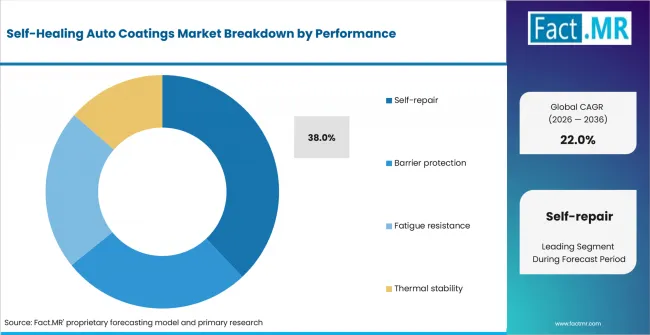
Self Healing Auto Coatings Market Analysis By Performance | Source: Fact.MR
Self-repair leads because the visible promise of the category is scratch recovery after routine surface damage. The performance claim must hold after sun exposure, detergents and road chemicals, otherwise the premium over standard clearcoat is harder to justify.
Nippon Paint Automotive Coatings announced in March 2025 that it jointly developed an in-mold coating technology for large thermoplastic automotive exterior parts.
What supports Automotive within Application?
Automotive is estimated to represent 34.0% share in 2026.
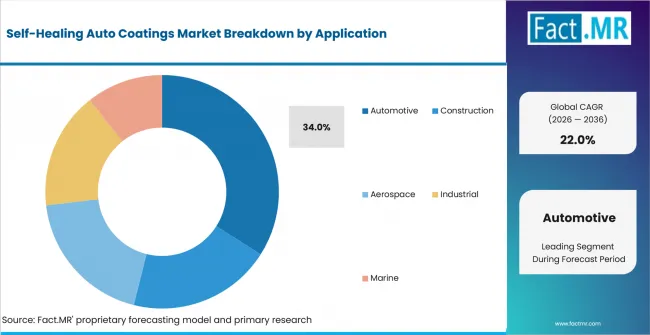
Self Healing Auto Coatings Market Analysis By Application | Source: Fact.MR
Automotive leads because vehicle surfaces face repeated contact from road grit, car-wash brushes and daily weathering. Passenger vehicles also place high value on visible gloss, so small scratches can affect perceived quality quickly.
OICA reported in April 2026 that global vehicle production reached 96.4 million units in 2025. That production base keeps OEM coatings and refinish systems central to any recoverable surface technology aimed at exterior panels.
What is accelerating Self-Healing Auto Coatings Market adoption, and what is holding it back?
Demand is expected to rise through scratch recovery, refinish productivity and lower-emission coating needs. Growth is constrained by validation time, material cost and repair approval routines.
Drivers Impact Analysis
| DRIVER | (~) % IMPACT ON CAGR | GEOGRAPHIC RELEVANCE | IMPACT TIMELINE |
|---|---|---|---|
| Scratch recovery in premium exterior finishes | +2.4% | USA, Japan, South Korea | Short term (<= 2 years) |
| Refinish booth productivity and cure-speed pressure | +1.7% | USA, UK, Germany | Medium term (2-4 years) |
| Lower-emission coating compliance in repair channels | +1.3% | North America, Western Europe | Medium term (2-4 years) |
| Thermoplastic exterior parts and EV platform design | +0.9% | Japan, South Korea, Germany | Long term (>= 4 years) |
Source: Fact.MR analysis. Updated Aug 26, 2026
- Scratch recovery in premium exterior finishes: Automakers and bodyshops are expected to value coatings that recover fine scratches while maintaining gloss on darker and high-visibility paint colors.
- Refinish booth productivity and cure-speed pressure: Collision-repair suppliers are focusing on clearcoat systems that improve repair-cycle efficiency across both value-focused and premium refinishing applications.
- Lower-emission coating compliance in repair channels: Material selection in automotive refinishing remains closely tied to emissions control, encouraging coatings that balance repair performance with lower-emission requirements.
Opportunity Impact Analysis
| OPPORTUNITY | (~) % IMPACT ON CAGR | GEOGRAPHIC RELEVANCE | IMPACT TIMELINE |
|---|---|---|---|
| Low-bake and room-temperature repair systems | +1.5% | USA, UK, Germany | Short term (<= 2 years) |
| Recoverable layers for thermoplastic exterior panels | +1.1% | Japan, South Korea | Medium term (2-4 years) |
| Fleet finish protection and lower rework frequency | +0.8% | North America, Europe | Long term (>= 4 years) |
Source: Fact.MR analysis. Updated Aug 26, 2026
- Low-bake and room-temperature repair systems: Bodyshops are increasingly favoring coating systems that support lower-temperature curing and more efficient repair workflows.
- Recoverable layers for thermoplastic exterior panels: Exterior-parts manufacturers are exploring coating processes designed for large thermoplastic automotive components and integrated surface protection.
- Fleet finish protection: Fleet operators are expected to compare self-healing coatings with polishing frequency, repainting intervals and vehicle downtime across high-mileage assets.
Restraints Impact Analysis
| RESTRAINT | (~) % IMPACT ON CAGR | GEOGRAPHIC RELEVANCE | IMPACT TIMELINE |
|---|---|---|---|
| OEM and insurer validation cycles | -0.8% | Global | Short term (<= 2 years) |
| Premium material cost versus standard clearcoat | -0.6% | USA, Europe | Medium term (2-4 years) |
| Compatibility with existing basecoat and cure systems | -0.5% | Japan, South Korea, Germany | Long term (>= 4 years) |
Source: Fact.MR analysis. Updated Aug 26, 2026
- OEM and insurer validation cycles: New coatings must pass appearance, durability and repairability checks before they move from trial panels into vehicle programs or insured collision repairs.
- Premium material cost versus standard clearcoat: Buyers are expected to weigh scratch-recovery value against product price when standard clearcoats already meet many repair estimates.
- Compatibility with existing basecoat and cure systems: Adoption is constrained when a self-healing layer needs different booth settings, substrate preparation or post-repair handling.
Which countries are scaling the Self-Healing Auto Coatings Market through 2036?
- The country comparison spans 7.4 percentage points across the forecast period.
- The USA remains 1.0 percentage point above Japan as assembly scale and refinish compliance pressure support demand.
- Japan remains 0.7 percentage point above South Korea through exterior-material development and domestic supplier depth.
- South Korea remains 2.3 percentage points above the UK as export programs keep finish consistency central.
- The UK remains 3.4 percentage points above Germany as EV registrations and road-use exposure support repair demand.
- Germany closes the displayed range through premium OEM qualification and strict finish requirements.
Comparable CAGRs create different entry conditions because each country tests self-healing coatings against different repair networks, vehicle mix and paint-shop approval routines. Full report coverage includes North America, Latin America, Western Europe, Eastern Europe, East Asia, South Asia & Pacific, Middle East & Africa.
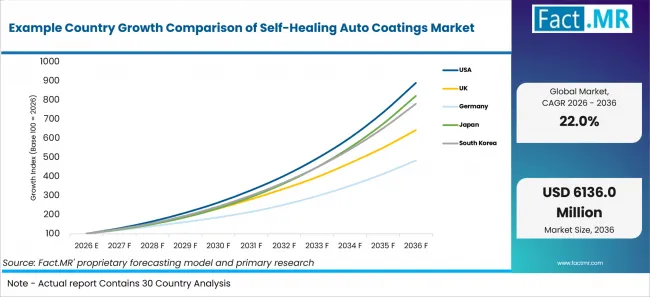
Example Country Growth Comparison Of Self Healing Auto Coatings Market | Source: Fact.MR
| Country | CAGR (2026-2036) |
|---|---|
| USA | 24.5% |
| Japan | 23.5% |
| South Korea | 22.8% |
| UK | 20.5% |
| Germany | 17.1% |
Source: Fact.MR analysis. Updated Aug 26, 2026
What supports USA adoption?
24.5% CAGR, supported by vehicle assembly scale and refinish compliance pressure.
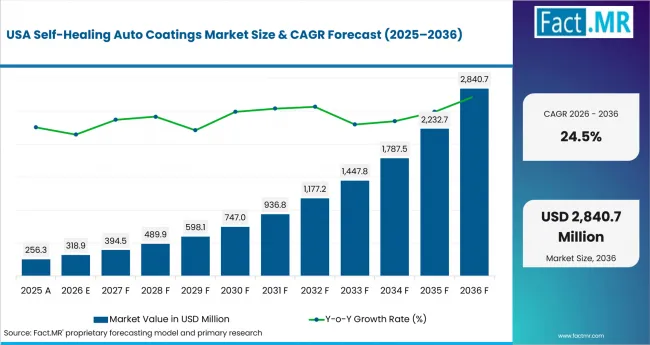
Self Healing Auto Coatings Market Country Value Analysis | Source: Fact.MR
U.S. coating adoption is shaped by large assembly volumes and a repair channel that must manage VOC limits. The Federal Reserve’s August 2026 G.17 release showed total motor vehicle assemblies at a seasonally adjusted annual rate of 10.6770 million units in July 2026. EPA states that the 1998 final rule for automobile refinish coatings was estimated to reduce VOC emissions by 31,900 tons per year, equivalent to a 33% reduction from the 1995 baseline estimate, providing long-standing regulatory context for lower-VOC automotive refinish formulations.
How does Japan scale demand?
23.5% CAGR, led by exterior-material innovation and domestic production depth.
Japan’s demand is linked to domestic paint expertise and exterior parts innovation. OICA reported on April 23, 2026, that Japan produced 8.41 million vehicles in 2025. Toyota released its 2025 sales, production and export results on January 29, 2026. Nippon Paint’s March 2025 in-mold coating development provides a coating route for large thermoplastic automotive exterior parts and expands design possibilities for future mass-produced vehicles.
What supports South Korea adoption?
22.8% CAGR, supported by export quality and eco-friendly vehicle growth.
South Korea’s role as an export hub makes exterior finish consistency a commercial priority. The Ministry of Trade, Industry and Resources reported record automobile exports of USD 72.0 billion in 2025. The same January 2026 release said eco-friendly vehicle sales reached 813,000 units in 2025, up 25% from 2024. Coatings used on exported EV and hybrid models must hold gloss, color match and scratch performance across long distribution routes.
What supports the United Kingdom’s growth?
20.5% CAGR, backed by zero-emission registrations and road-use exposure.
The UK market is influenced by EV registrations and a dense repair base. The Department for Transport reported that 473,000 zero-emission cars were registered for the first time in the UK in 2025, up 24% from 2024. DfT road-traffic estimates showed 342.6 billion motor-vehicle miles travelled on Great Britain’s roads in 2025, up 1.9% year over year.
What is supporting Germany’s adoption?
17.1% CAGR, supported by premium OEM qualification and refinish partnerships.
Germany’s demand is tied to premium vehicle production and strict coating approval routines. VDA reported German passenger car production at 4.1518 million units in 2025. VDA also reported that Germany produced 1.67 million electric passenger cars in 2025, 23% more than in 2024.
Who leads the Self-Healing Auto Coatings Market?
PPG Industries competes through automotive-refinish clearcoats and bodyshop-focused systems, including its May 2025 U.S. launch of clearcoats for value-focused and premium collision-repair segments.
Kansai Paint and Nippon Paint maintain established automotive-refinish product lines. Competition is shaped by repair-cycle efficiency, curing performance, color accuracy, coating-system compatibility, OEM requirements and technical support.
Which companies are the key providers?
Key companies include PPG Industries, Kansai Paint, and Nippon Paint.
- PPG Industries
- Kansai Paint
- Nippon Paint
Bibliography
- Board of Governors of the Federal Reserve System. (2026, August 18). Industrial production and capacity utilization—G.17: Table 3. Motor vehicle assemblies.
- Department for Transport. (2026, April 29). Vehicle licensing statistics, United Kingdom: 2025.
- Department for Transport. (2026, May 20). Road traffic estimates in Great Britain: 2025.
- International Organization of Motor Vehicle Manufacturers. (2026, April 23). Auto industry growth shifted east in 2025 amid global repositioning.
- Ministry of Trade, Industry and Resources. (2026, January 15). Automobile exports hit record high of $72 billion in 2025.
- PPG Industries, Inc. (2025, May 7). PPG launches clearcoats for value-focused and premium collision repair segments.
- Toyota Motor Corporation. (2026, January 29). Sales, production, and export results for 2025 (January–December).
- U.S. Environmental Protection Agency. (2026, January 21). Automobile refinish coatings: National volatile organic compound emission standards.
- U.S. Environmental Protection Agency. (2026, March 30). Surface coating of automobiles and light-duty trucks: National emission standards for hazardous air pollutants (NESHAP).
This Report Answers
- The report explains where self-healing auto coatings are used across chemistry and form. It also covers performance type and application linkages.
- Segment analysis identifies the leading subsegments and the operational reasons automakers and bodyshops prioritize them.
- Country analysis examines the listed markets and the vehicle production, repair and regulatory mechanisms supporting coating adoption.
- Competitive analysis reviews current providers across automotive coatings, refinish products and exterior coating technologies.
- Application analysis assesses how scratch recovery, booth time and substrate compatibility influence material approval.
What does the Self-Healing Auto Coatings Market cover?
The Self-Healing Auto Coatings Market covers recoverable coating layers used on vehicle surfaces to reduce visible micro-scratches and preserve exterior finish quality. It is linked to automotive coating systems, refinish paints and clearcoat processes where surface appearance affects repair cost and customer acceptance.
The assessment covers chemistry, coating form and performance behavior across OEM and repair settings. It also reviews adjacent coating technologies such as automotive OEM coatings and urethane surface coatings where durability and finish retention guide supplier selection.
What is included in the scope?
The scope includes liquid self-healing coatings, recoverable clearcoat systems, scratch-recovery surface layers and self-repairing exterior materials used for passenger vehicles, fleets and collision repair. It also tracks self-healing industrial epoxy coatings and broader self-healing coatings when their mechanisms are transferable to automotive surfaces.
The scope also includes paint films, functional layers and formulation inputs that support scratch recovery or barrier performance. Adjacent references include paint protection films, functional coating materials, coating additives and coating pretreatment where they affect adhesion, gloss or surface durability.
What is outside the scope?
The scope places decorative household paints, building-only protective coatings and marine-only coatings outside the revenue boundary when they lack a direct automotive exterior use. Electronics-only conformal coatings and semiconductor coating processes are treated as separate markets unless they support vehicle exterior coating decisions.
Raw resins, pigments and curing agents are treated as inputs. They enter the market assessment only when sold as part of a self-healing automotive coating system or a qualified repair coating package.
How Was the Analysis Built?
The analysis draws on 120+ inputs, 35+ company portfolios, 25+ countries and more than 20 industry interviews.
- Primary Research: Interviews include coating manufacturers, refinish technicians, OEM paint engineers, distributors, fleet maintenance teams and procurement teams. These discussions examine approvals, finish testing and repair economics.
- Desk Research: Desk research covers government statistics, regulatory publications, company announcements, vehicle production data, technical studies and trade associations. External information points are documented in the bibliography.
- Market Sizing and Forecasting: Market estimates combine historical performance, demand indicators, pricing trends, segment shares, country-level growth, adoption patterns and company activity.
- Data Validation and Update Cycle: Findings are checked against public data, company activity, regulatory changes and trade patterns. Updates review product launches, process changes and commercial adoption.
Segmentation
What is the report’s scope and coverage?
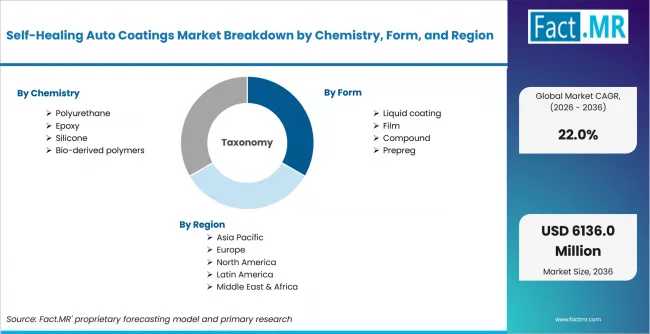
Self Healing Auto Coatings Market Breakdown By Chemistry, Form, And Region | Source: Fact.MR
| Attribute | Details |
|---|---|
| Quantitative Units | USD million |
| Market Definition | Coatings used on automotive surfaces that recover from fine scratches or micro-damage through polymer mobility, embedded healing agents or surface-response mechanisms. The scope covers coatings used for exterior finish protection, repair quality and visible surface durability. |
| Chemistry | Polyurethane; Epoxy; Silicone; Bio-derived polymers |
| Form | Liquid coating; Film; Compound |
| Performance | Self-repair; Barrier protection; Fatigue resistance; Thermal stability |
| Application | Automotive; Construction; Aerospace; Industrial; Marine as adjacent validation areas |
| Regions Covered | North America; Latin America; Western Europe; Eastern Europe; East Asia; South Asia & Pacific; Middle East & Africa |
| Countries Covered | USA; UK; Germany; Japan; South Korea |
| Companies Profiled | PPG Industries; Kansai Paint; Nippon Paint |
| Forecast Period | 2026 to 2036 |
| Approach | Hybrid top-down and bottom-up approach using coating chemistry demand, vehicle production indicators, refinish workflow needs, country-level adoption and company portfolio review. |
Source: Fact.MR analysis. Updated Aug 26, 2026
How is the market segmented?
-
By Chemistry:
- Polyurethane
- Epoxy
- Silicone
- Bio-derived polymers
-
By Form:
- Liquid coating
- Film
- Compound
-
By Performance:
- Self-repair
- Barrier protection
- Fatigue resistance
- Thermal stability
-
By Application:
- Automotive
- Construction
- Aerospace
- Industrial
- Marine
-
By Region:
- North America
- Latin America
- Western Europe
- Eastern Europe
- East Asia
- South Asia & Pacific
- Middle East & Africa
Frequently Asked Questions
How big is the self-healing auto coatings market in 2026?
What is the CAGR of the self-healing auto coatings market from 2026 to 2036?
Which chemistry leads the self-healing auto coatings market?
Which form leads the self-healing auto coatings market?
Who are the leading companies in the self-healing auto coatings market?
Who worked on this report


Preview the report firsthand - request a free sample
Free SampleGet the brochure for pricing and purchase details
Download PDF