- Market Value (2025): USD 42.3 Bn
- Estimated Value (2026): USD 45.9 Bn
- Forecast Value (2036): USD 103.8 Bn
- CAGR (2026-2036): 8.5%
What is the Interactive Display Market forecast to be worth by 2036?
USD 103.8 billion by 2036 at an 8.5% CAGR.
- The interactive display market reached USD 42.3 billion in 2025.
- Demand is projected to increase from USD 45.9 billion in 2026 to USD 103.8 billion by 2036.
- The market is projected to expand at an 8.5% CAGR from 2026 to 2036.
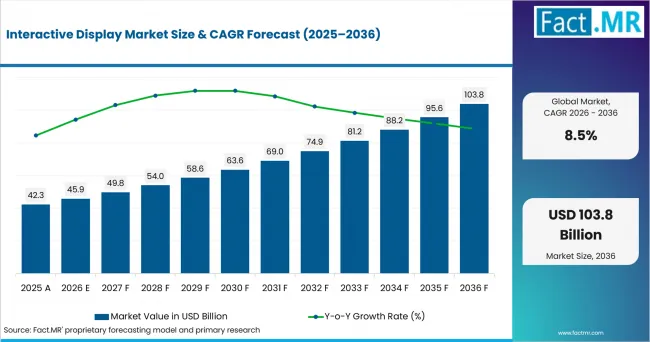
Interactive Display Market Value Analysis | Source: Fact.MR
What are the defining numbers behind Interactive Display Market growth?
An absolute opportunity of USD 57.9 billion is expected between 2026 and 2036.
- Demand Drivers in the Market
- Digital classroom infrastructure is shifting from device access alone toward shared visual collaboration. The U.S. Department of Education's August 2026 guidance notes that technology increasingly plays a key role in education and urges schools to select tools around instructional value. Interactive displays give teachers a common surface for annotation, student-device sharing and whole-class instruction.
- Flat panels are reducing the operating friction associated with projector-based rooms. ViewSonic's 2026 education portfolio includes 4K interactive displays with up to 40 touch points, integrated operating systems and USB-C connectivity. These capabilities allow schools to combine front-of-room display and annotation in one endpoint, supporting wider smart education deployments.
- Hybrid work keeps meeting-room collaboration relevant. Eurostat reported that 52.9% of EU enterprises with at least 10 workers held remote meetings in 2024. Interactive displays support in-room annotation and content sharing for teams that combine physical and remote participants, linking room hardware with web conferencing workflows.
- National school modernization programmes sustain refresh demand. The UK Department for Education expects schools and colleges to work toward six core digital standards by 2030, while Japan continues to build on the GIGA School one-device-per-student environment. Shared displays provide the classroom layer that turns individual-device content into group instruction.
- Touch-enabled commercial screens extend demand beyond education. Retail and healthcare buyers use interactive screens for wayfinding, self-service and guided information, while interactive kiosks and digital signage deployments create adjacent demand for durable touch displays that can operate for long daily duty cycles.
- Key Segments Analyzed
- Interactive Flat Panel Displays account for 48.3% of Product in 2026 because direct-view 4K panels combine display, touch and connectivity without the alignment and lamp maintenance associated with projector-based systems.
- Education Applications represent 73.6% of Application in 2026 as classrooms use shared touch surfaces for annotation, lesson presentation and collaborative work alongside student devices.
- Educational Institutions hold 57.4% of End Use in 2026 because schools and universities deploy interactive displays across multiple classrooms, lecture spaces and training rooms rather than as isolated purchases.
- Capacitive Touch Technology accounts for 36.8% of Technology in 2026 because projected-capacitive systems support accurate finger and pen input through a clean glass surface suited to frequent collaborative use.
- Integrated Display Systems represent 65.1% of Formulation in 2026 because buyers can combine the panel, computing layer, speakers, connectivity and collaboration software in one managed room endpoint.
- Direct Sales Channels account for 42.7% of Distribution Channel in 2026 because institutional and enterprise projects often require demonstrations, standardized configurations, warranties and rollout support negotiated directly with manufacturers or enterprise sales teams.
- Analyst Opinion at Fact.MR
- Shambhu Nath Jha, Principal Consultant, Fact.MR, states, “Interactive display purchases are moving from simple screen replacement toward integrated room systems. Schools and enterprises increasingly evaluate touch accuracy, device sharing, software compatibility and remote management together. Suppliers that reduce setup work while keeping the display easy for teachers and meeting-room users to operate can build stronger replacement and expansion demand through 2036.”
- Strategic Implications
- Display suppliers should organize portfolios around room type and user workflow. A primary classroom, lecture hall and executive meeting room may require different screen sizes, touch performance and compute configurations even when they use the same display platform.
- Education vendors can capture more value by pairing hardware with device management, lesson-sharing tools and teacher onboarding. The display becomes more useful when it fits the school's wider enterprise video and content environment rather than operating as a standalone screen.
- Manufacturers should design replacement programmes around installed room infrastructure. Standard mounting patterns, USB-C connectivity and remote firmware management can reduce the labor required to refresh large display fleets.
- Channel strategy should separate standardized fleet deployments from complex multi-vendor rooms. Direct sales can support large repeatable rollouts, while integrators remain important where displays must connect with cameras, control systems and existing AV equipment.
How does the Interactive Display Market break down by segment?
The market is segmented by Product, Application, End Use, Technology, Formulation and Distribution Channel.
Why do Interactive Flat Panel Displays lead Product?
Interactive Flat Panel Displays are projected to account for a 48.3% share in 2026.
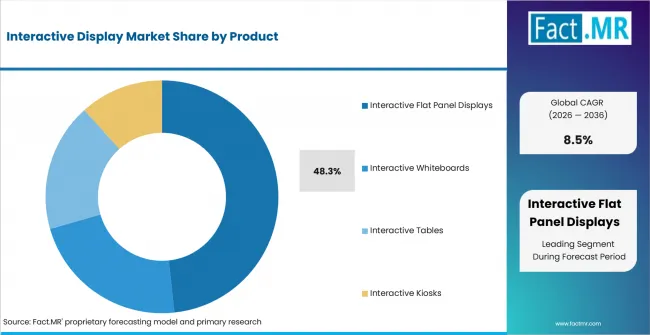
Interactive Display Market Analysis By Product | Source: Fact.MR
Flat panels lead because they place the image and touch surface in one direct-view unit. Schools and meeting rooms avoid projector alignment, lamp replacement and shadowing, while users can write directly on the screen and switch between local or connected content without changing the room setup.
ViewSonic's 2026 education range includes 4K panels with up to 40 touch points, built-in operating systems, speakers and USB-C connectivity. That combination shows why flat panels can replace several separate room components while remaining familiar to users.
Why do Education Applications lead Application?
Education Applications are projected to account for a 73.6% share in 2026.
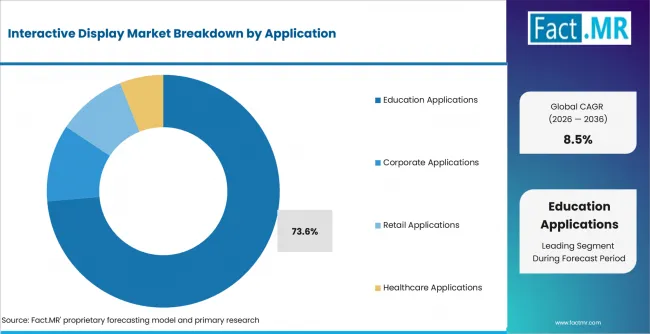
Interactive Display Market Analysis By Application | Source: Fact.MR
Education leads because a shared front-of-room surface remains useful even when every learner has an individual device. Teachers can display student work, annotate material and move between whole-class explanation and group collaboration without asking learners to crowd around smaller screens.
The U.S. Department of Education continues to treat classroom technology as an instructional decision, while the UK Department for Education maintains digital standards for school infrastructure and devices. These policies support continued investment in classroom hardware that can be integrated into a broader digital-learning environment.
Why do Educational Institutions lead End Use?
Educational Institutions are projected to account for a 57.4% share in 2026.
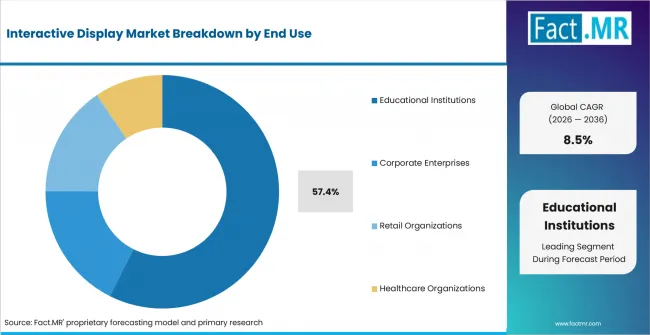
Interactive Display Market Analysis By End Use | Source: Fact.MR
Educational institutions lead because one purchasing decision can translate into deployments across many rooms. Schools and universities often standardize screen size, mounting, connectivity and management across classrooms so that teachers encounter the same interface from room to room.
The U.S. National Center for Education Statistics reported 99,073 operating public elementary and secondary schools with about 49.3 million students in the 2024-25 school year. This installed base creates recurring demand for new classroom deployments, damaged-unit replacement and scheduled technology refreshes.
Why does Capacitive Touch Technology lead Technology?
Capacitive Touch Technology is projected to account for a 36.8% share in 2026.
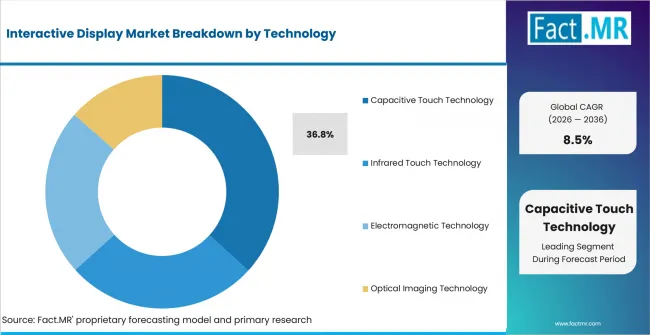
Interactive Display Market Analysis By Technology | Source: Fact.MR
Capacitive touch supports precise direct interaction through a flat glass surface, making it well suited to rooms where users switch frequently between finger input and digital pen work. The technology can also support multi-user collaboration without adding a raised frame around the active area.
ViewSonic's 2026 education portfolio includes projected-capacitive touch on its IFP63 series, showing how PCAP is moving into large-format classroom products. Infrared touch remains important where cost and very large screen sizes carry more weight, but capacitive systems fit buyers seeking a more direct writing and touch experience.
Why do Integrated Display Systems lead Formulation?
Integrated Display Systems are projected to account for a 65.1% share in 2026.
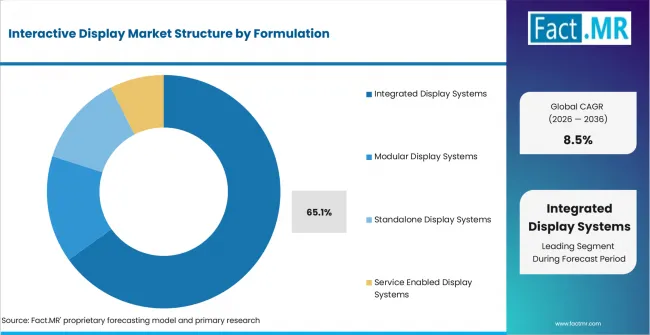
Interactive Display Market Analysis By Formulation | Source: Fact.MR
Integrated systems lead because buyers can treat the display as a complete room endpoint rather than assemble the screen, compute device, audio, connectivity and collaboration layer separately. Fewer components reduce cabling and simplify support when the same configuration is repeated across many rooms.
SMART's T Pro series combines 4K display capability with flexible computing, an integrated microphone array and room audio. ViewSonic also offers EDLA-certified displays with Android and Google application access. These product architectures show why institutions increasingly evaluate the complete operating environment rather than the panel alone.
Why do Direct Sales Channels lead Distribution Channel?
Direct Sales Channels are projected to account for a 42.7% share in 2026.
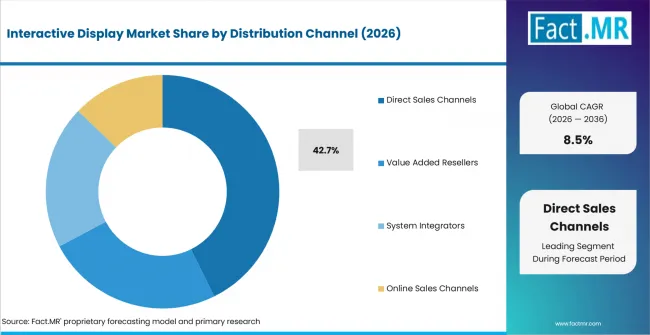
Interactive Display Market Analysis By Distribution Channel | Source: Fact.MR
Direct sales lead because large display purchases are often project-based. A school district or enterprise may need a demonstration, a standard room specification and negotiated warranties before committing to dozens or hundreds of units.
Working directly with the manufacturer or its enterprise team also makes it easier to coordinate model availability, firmware policy, mounting accessories and replacement support across a rollout. Value-added resellers and system integrators remain important where a display must be combined with several third-party AV or IT systems.
What is accelerating Interactive Display Market adoption, and what is holding it back?
Adoption is being accelerated by classroom digitization, meeting-room collaboration and replacement of projector-based systems with integrated touch panels. Growth is restrained by hardware cost, long institutional procurement cycles and integration work across older AV and IT environments.
Drivers Impact Analysis
| Factor | (~) % Impact on CAGR | Geographic Relevance | Impact Timeline |
|---|---|---|---|
| Digital classroom modernization | +1.5% | Global | Short term (≤ 2 years) |
| Enterprise collaboration room upgrades | +1.2% | USA, UK and Germany | Short term (≤ 2 years) |
| Replacement of projector-whiteboard systems | +1.0% | Global | Medium term (2-4 years) |
| Multi-touch and integrated computing | +0.8% | Global | Medium term (2-4 years) |
| Interactive self-service deployment | +0.5% | USA, Japan and South Korea | Long term (≥ 4 years) |
Source: Fact.MR analysis. Updated Aug 26, 2026
Opportunity Impact Analysis
| Factor | (~) % Impact on CAGR | Geographic Relevance | Impact Timeline |
|---|---|---|---|
| Large-format 4K and 8K classroom upgrades | +0.9% | Global | Medium term (2-4 years) |
| AI-enabled collaboration and lesson software | +0.8% | USA, South Korea and Japan | Medium term (2-4 years) |
| Remote display management and fleet services | +0.6% | Global | Long term (≥ 4 years) |
| Healthcare and retail interaction workflows | +0.4% | UK, Germany and Japan | Long term (≥ 4 years) |
Source: Fact.MR analysis. Updated Aug 26, 2026
Restraints Impact Analysis
| Factor | (~) % Impact on CAGR | Geographic Relevance | Impact Timeline |
|---|---|---|---|
| High display and installation cost | -1.0% | Global | Short term (≤ 2 years) |
| Education and public procurement cycles | -0.8% | USA, UK and Germany | Short term (≤ 2 years) |
| Legacy AV and IT integration complexity | -0.6% | Global | Medium term (2-4 years) |
| Substitution by lower-cost non-interactive displays | -0.5% | Price-sensitive markets | Medium term (2-4 years) |
Source: Fact.MR analysis. Updated Aug 26, 2026
Which countries are scaling the Interactive Display Market through 2036?
- USA: A large school installed base and continuing attention to responsible classroom technology create replacement and expansion demand for interactive panels. NCES counted 99,073 operating public schools in the 2024-25 school year.
- UK: Department for Education standards require schools and colleges to plan digital infrastructure and governance toward 2030, supporting structured technology-refresh programmes that can include shared classroom displays.
- South Korea: The Ministry of Education approved 76 AI digital textbooks for use in 2025 and stated that classroom digital infrastructure would be reinforced, increasing the amount of interactive digital content used during lessons.
- Japan: The GIGA School environment has normalized one-device-per-student learning, while MEXT continues projects around advanced technology and education data. Interactive displays provide a shared surface for presenting and discussing device-based work.
- Germany: DigitalPakt 2.0 extends school digital modernization through 2030, keeping infrastructure renewal and digital teaching tools on procurement agendas across the federal states.
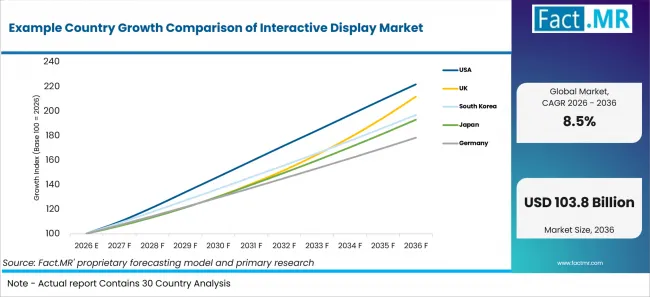
Example Country Growth Comparison Of Interactive Display Market | Source: Fact.MR
| Country | CAGR, 2026-2036 |
|---|---|
| USA | 8.3% |
| UK | 7.8% |
| South Korea | 7.0% |
| Japan | 6.8% |
| Germany | 6.0% |
Source: Fact.MR analysis. Updated Aug 26, 2026
What is driving USA's growth through 2036?
The USA is forecast to expand at an 8.3% CAGR from 2026 to 2036.
The country combines a large education installed base with recurring technology replacement. NCES reported 99,073 operating public elementary and secondary schools and about 49.3 million students in the 2024-25 school year, giving display suppliers a broad base of classrooms that can be upgraded over time.
The U.S. Department of Education's August 2026 guidance also emphasizes instructional value when selecting classroom technology. This encourages buyers to evaluate interactive displays on usability and learning fit rather than screen specifications alone, increasing the importance of software compatibility and teacher-ready workflows.
What is driving the UK's growth through 2036?
The UK is forecast to expand at a 7.8% CAGR from 2026 to 2036.
School technology procurement is being shaped by a more formal digital infrastructure framework. The Department for Education expects schools and colleges to work toward six core digital standards by 2030, covering areas such as broadband, wireless networks, governance and cyber security.
As institutions modernize the underlying network and device environment, interactive displays can be refreshed as part of a wider classroom technology plan. Buyers are more likely to favor systems that fit existing authentication, connectivity and support arrangements rather than isolated display purchases.
What is driving South Korea's growth through 2036?
South Korea is forecast to expand at a 7.0% CAGR from 2026 to 2036.
Digital curriculum initiatives are increasing the amount of screen-based material used in classrooms. The Ministry of Education approved 76 AI digital textbooks for use in 2025 across selected grades and subjects and said teacher preparation and digital infrastructure would be strengthened for classroom use.
This creates a practical role for shared interactive displays even where students have individual devices. Teachers need a common surface for demonstrating digital content, comparing student work and moving between whole-class explanation and individual activity.
What is driving Japan's growth through 2036?
Japan is forecast to expand at a 6.8% CAGR from 2026 to 2036.
Japan's GIGA School programme has established one-device-per-student ICT environments across compulsory education, making digital content a routine part of classroom activity. MEXT continues to support advanced technology and education-data use in schools through demonstration programmes.
Interactive displays complement individual devices by giving teachers a shared visual surface for discussion and annotation. Replacement demand can therefore track classroom-device renewal and network upgrades rather than depend on new school construction alone.
What is driving Germany's growth through 2036?
Germany is forecast to expand at a 6.0% CAGR from 2026 to 2036.
DigitalPakt 2.0 extends coordinated school digitization through 2030 and follows the first DigitalPakt Schule programme. The new framework keeps digital infrastructure, administration and teaching modernization within long-term school investment planning.
Interactive displays fit this environment where schools are replacing older projection systems or standardizing digital classrooms. Procurement is likely to favor products that can be supported across municipal school estates and remain compatible with local device-management and network policies.
Who Leads the Interactive Display Market?
Key players in the Interactive Display Market include Samsung Display Co. Ltd., BenQ Corporation, IntuiLab SA, Google Inc., Egan Teamboard Inc., SMART Technologies, Crystal Display Systems Ltd., Cisco Systems Inc., Hitachi Ltd., Planar Systems Inc., LG Display Co. Ltd., ViewSonic Corporation, Microsoft Corp, Epson America Inc., NEC Display Solutions Ltd. and Panasonic Corporation.
Competition spans panel technology, complete interactive-display systems and collaboration ecosystems. Hardware-focused suppliers compete on image quality, touch latency, screen size, integrated computing and fleet management. Collaboration-platform companies influence purchasing through compatibility with meeting, identity and content-sharing environments already used by schools and enterprises.
Education deployments place additional weight on teacher usability, warranty coverage and the ability to manage many devices centrally. Enterprise buyers focus more heavily on room interoperability, camera and audio integration, security controls and support for established conferencing platforms.
NEC Display Solutions Ltd. is a legacy company name. NEC and Sharp combined their display-solution businesses in 2020, after which NEC Display Solutions was renamed Sharp NEC Display Solutions Ltd. The historical name remains relevant to the installed visual-display base associated with NEC-branded products.
Which companies are the key providers?
Samsung Display Co. Ltd.; BenQ Corporation; IntuiLab SA; Google Inc.; Egan Teamboard Inc.; SMART Technologies; Crystal Display Systems Ltd.; Cisco Systems Inc.; Hitachi Ltd.; Planar Systems Inc.; LG Display Co. Ltd.; ViewSonic Corporation; Microsoft Corp; Epson America Inc.; NEC Display Solutions Ltd.; Panasonic Corporation.
- BASF SE
- Evonik Industries AG
- Croda International Plc
- Lubrizol Corporation
- Ashland Inc.
- Solvay SA
- Lonza Group Ltd.
- Vantage Specialty Chemicals
- Phoenix Chemical Inc.
- Innospec Inc.
- RITA Corporation
- Yasho Industries Pvt. Ltd.
- ABITEC Corporation
- Stepan Company
- Lipo Chemicals, Inc.
Bibliography
- Department for Education. (2026). Meeting Digital and Technology Standards in Schools and Colleges. UK Government.
- Eurostat. (2025). 53% of EU Enterprises Held Remote Meetings in 2024. European Commission.
- Kultusministerkonferenz. (2025). DigitalPakt 2.0: Five Billion Euros for Education Modernization through 2030.
- Ministry of Education, Republic of Korea. (2024). AI Digital Textbooks for 2025 to Realize Personalized Education for All.
- Ministry of Education, Culture, Sports, Science and Technology, Japan. (2025). Next-Generation School and Education Technology and Education Data Utilization Programme.
- National Center for Education Statistics. (2026). Number of Operating Public Elementary and Secondary Schools and Districts, School Year 2024-25. U.S. Department of Education.
- NEC Corporation. (2020). NEC and Sharp Announce Joint Venture to Combine Display Solution Businesses.
- SMART Technologies. (2026). SMART Board T Pro Series Interactive Display for Classrooms.
- U.S. Department of Education. (2026). Guidance on Responsible Use of Education Technology in the Classroom.
- ViewSonic Corporation. (2026). ViewSonic Education Hardware and ViewBoard Interactive Display Portfolio.
This Report Answers
- How classroom digitization is changing demand for shared interactive display systems.
- Why interactive flat panels have become the main product format across education and collaboration rooms.
- How touch technology and integrated computing influence institutional purchasing decisions.
- Which country-specific education technology programmes are supporting display refresh and deployment.
- How suppliers compete across hardware performance, software compatibility, service and room integration.
What does the Interactive Display Market cover?
The Interactive Display Market covers touch-enabled visual systems designed for direct user interaction in education, corporate, retail and healthcare environments. Revenue includes interactive flat panels, interactive whiteboards, interactive tables and interactive kiosks sold as complete display systems.
The assessment also includes integrated hardware and software display platforms where computing, collaboration or management functionality is sold as part of the interactive display system. The market is measured at the system level rather than at the value of touch components or display panels sold separately.
What is included in the scope?
The scope includes 4K and 8K interactive flat panels, projection-based and embedded interactive whiteboards, educational and commercial interactive tables, and indoor or outdoor interactive kiosks.
Applications include education, corporate collaboration, retail interaction and healthcare use. Buyers include educational institutions, corporate enterprises, retail organizations and healthcare organizations. Technology coverage spans capacitive, infrared, electromagnetic and optical-imaging touch systems, together with integrated, modular, standalone and service-enabled display configurations.
What is excluded from the scope?
The scope excludes non-interactive televisions and commercial displays that do not support direct touch or pen input. Standalone projectors are outside the market unless they form part of an interactive whiteboard system.
Standalone conferencing software, learning-management platforms, digital signage software and touch sensors sold as components are excluded unless they are bundled within a complete interactive display offering. Consumer tablets, smartphones and notebook touchscreens are also outside the market.
How Was the Analysis Built?
The analysis combines primary research with desk research across interactive-display manufacturers, system integrators, education technology buyers and enterprise AV teams.
- Primary Research: Interviews focus on display manufacturers, education procurement teams, AV system integrators, enterprise collaboration managers, technology resellers and institutional IT support teams. Discussions examine screen-size selection, touch performance, room integration, refresh cycles and purchasing channels.
- Desk Research: The review uses education-technology policy, school infrastructure data, enterprise collaboration statistics, company product documentation, display specifications and public information on school digitization programmes.
- Market Sizing and Forecasting: Estimates combine interactive-display shipments, average system value, installed classroom and meeting-room bases, replacement cycles, application mix, touch-technology mix and country-level deployment trends.
- Data Validation and Update Cycle: Findings are checked against product launches, school and enterprise technology programmes, company portfolio changes and changes in display specifications or channel structure.
Segmentation
What is the report's scope and coverage?
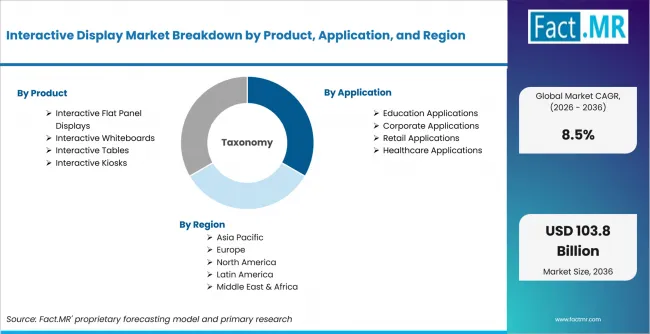
Interactive Display Market Breakdown By Product, Application, And Region | Source: Fact.MR
| Attribute | Details |
|---|---|
| Quantitative Units | USD billion |
| Market Definition | Touch-enabled display systems sold for shared interaction across education, corporate, retail and healthcare applications |
| Segments Covered | Product; Application; End Use; Technology; Formulation; Distribution Channel |
| Regions Covered | North America; Latin America; Europe; East Asia; South Asia and Pacific; Middle East and Africa |
| Countries Covered | USA; UK; South Korea; Japan; Germany |
| Key Companies Profiled | Samsung Display Co. Ltd.; BenQ Corporation; IntuiLab SA; Google Inc.; Egan Teamboard Inc.; SMART Technologies; Crystal Display Systems Ltd.; Cisco Systems Inc.; Hitachi Ltd.; Planar Systems Inc.; LG Display Co. Ltd.; ViewSonic Corporation; Microsoft Corp; Epson America Inc.; NEC Display Solutions Ltd.; Panasonic Corporation |
| Forecast Period | 2026 to 2036 |
| Base Year | 2025 |
| Market Value, 2026 | USD 45.9 billion |
| Market Value, 2036 | USD 103.8 billion |
| CAGR, 2026-2036 | 8.5% |
| Absolute Opportunity | USD 57.9 billion |
| Approach | Hybrid top-down and bottom-up approach using display shipments, average system value, installed room base, replacement cycles, application mix, touch technology and country-level deployment |
Source: Fact.MR analysis. Updated Aug 26, 2026
How is the market segmented?
-
By Product
- Interactive Flat Panel Displays
- 4K Interactive Flat Panels
- 8K Interactive Flat Panels
- Interactive Whiteboards
- Projection Based Whiteboards
- Embedded Display Whiteboards
- Interactive Tables
- Educational Interactive Tables
- Commercial Interactive Tables
- Interactive Kiosks
- Indoor Interactive Kiosks
- Outdoor Interactive Kiosks
- Interactive Flat Panel Displays
-
By Application
- Education Applications
- Classroom Learning Applications
- Remote Learning Applications
- Corporate Applications
- Meeting Room Collaboration
- Training Applications
- Retail Applications
- Customer Engagement Applications
- In Store Navigation Applications
- Healthcare Applications
- Patient Engagement Applications
- Clinical Collaboration Applications
- Education Applications
-
By End Use
- Educational Institutions
- Schools
- Universities
- Corporate Enterprises
- Large Enterprises
- Small & Medium Enterprises
- Retail Organizations
- Retail Chains
- Brand Experience Centers
- Healthcare Organizations
- Hospitals
- Healthcare Networks
- Educational Institutions
-
By Technology
- Capacitive Touch Technology
- Projected Capacitive Systems
- Advanced Capacitive Systems
- Infrared Touch Technology
- Multi User Infrared Systems
- High Accuracy Infrared Systems
- Electromagnetic Technology
- Active Pen Systems
- Hybrid Pen Touch Systems
- Optical Imaging Technology
- Camera Based Recognition Systems
- AI Enhanced Imaging Systems
- Capacitive Touch Technology
-
By Formulation
- Integrated Display Systems
- Hardware Integrated Platforms
- Software Integrated Platforms
- Modular Display Systems
- Scalable Display Architectures
- Customizable Display Platforms
- Standalone Display Systems
- Single Purpose Display Systems
- Portable Display Systems
- Service Enabled Display Systems
- Managed Display Services
- Support Service Platforms
- Integrated Display Systems
-
By Distribution Channel
- Direct Sales Channels
- Enterprise Direct Sales
- Project Based Sales
- Value Added Resellers
- Technology Resellers
- Education Resellers
- System Integrators
- AV System Integrators
- IT Integration Firms
- Online Sales Channels
- Manufacturer Online Platforms
- E Commerce Platforms
- Direct Sales Channels
Frequently Asked Questions
What is the Interactive Display Market value in 2026?
At what CAGR is the market projected to grow?
What is the projected market value by 2036?
Which Product leads the market?
Which Application leads the market?
Which End Use leads the market?
Which Technology leads the market?
Which Formulation leads the market?
Which Distribution Channel leads the market?
What CAGR is projected for the USA?
What is the primary driver in this market?
What is the main restraint?
Which companies are included in the market assessment?
Who worked on this report


Preview the report firsthand - request a free sample
Free SampleGet the brochure for pricing and purchase details
Download PDF