- Base Value(2025): 1820 Mn
- Forecast Value (2035): 3079 Mn
- CAGR (2035): 4.4%
Tinplate Packaging Market Outlook 2025 to 2035
The global tinplate packaging market is expected to reach USD 3,079 million by 2035, up from USD 1,820 million in 2025. During the forecast period 2025 to 2035, the industry is projected to register at a CAGR of 5.4%.
Tinplate packaging is gaining traction due to its full recyclability, effective barrier properties, and suitability for food, beverage, and industrial applications. Advancements in coatings, printing, and high-speed processing are further boosting its appeal in premium and cross-sectoral packaging markets.
Quick Stats for Tinplate Packaging Market
- Industry Value(2025):USD 1,820 Million
- Projected Value (2035):USD 3,079 Million
- Forecast CAGR(2025 to 2035):5.4%
- Leading Segment(2025):Cans (45% Market Share)
- Fastest Growing Country (2025-35):China (7.2% CAGR)
- Top Key Players:AJ Packaging Limited, Tinplate Company, Zenith Tins, HUBER Packaging Group GmbH, Golden Grain Group Ltd, Ball Corporation, CPMC, Crown Holdings, Greif Incorporated, Ardagh Group, Thyssenkrupp.
2025-to-2035.webp "Us Tinplate Packaging Market Market Value(usd Million)2025 To 2035")
Us Tinplate Packaging Market Market Value(usd Million)2025 To 2035 | Source: Fact.MR
What are the drivers of tinplate packaging market?
The tinplate packaging industry is driven by an increase in demand of environment friendly and recyclable substances. Tinplate retains full structural integrity when recycled and, therefore, is suitable in times of stringent environmental regulations and consumer demands on the use of environment friendly packaging.
It offers effective barrier to moisture, gas and light and thus it can be used to preserve canned foods, beverages and aerosol products. Such qualities are known to improve shelf life that increases its usage in the FMCG industries.
Tinplate is used in industrial applications because of its strength, ability to be formed and resist corrosion, supporting its use in packing chemicals, lubricants, and paints.
New coating and printing technologies make branding more effective, catering to the needs in the high-quality food and gift markets. Together with the compatibility with high-speed filling machines, the tinplate packaging is witnessing the solid, cross-sectoral expansion all around the globe.
What are the regional trends of tinplate packaging market?
The consumption of tinplate packaging in Asia Pacific, by proportion, remains high due to the expansion of packaged food, rapid industrialization, and urbanization in China, India, and Southeast Asia. There is also an increased environmental awareness thus supporting adoption of metal packaging.
Demand has returned to Europe because of sustainability regulations and activities related to circular economies. Germany, France, and Italy are emphasizing on metal packaging in bid to avert plastic reliance particularly in premium items and food.
North America is experiencing consistent growth as the demand increases in ready-to-eat dishes and environment friendly-packaging. The upgrading of recycling infrastructure in the U.S is proving beneficial to tinplate formats.
Latin America and Middle East & Africa are experiencing steady growth, with a boost of growing FMCG industries and external investment in packaging. Tinplate is durable hence safe storage and transportation of food in areas that have fewer cold chain distribution.
What are the challenges and restraining factors of tinplate packaging market?
Raw material prices, particularly tin and steel which are volatile, is one of the major risks of the tinplate packaging market which affect costs and profitability.
There is also the increased competition in the market with PET bottles as well as flexible plastic pouches that are lighter, cheaper and can take any shape and are especially used in beverages and personal care.
Most developing countries have poor recycling infrastructure so sustainability advantage of tinplate is not optimized and this is a reason why tinplate is less desirable than plastic.
Other quick uses that can make it inconvenient to use are denting challenges associated with transport and limited flexibility in shaping applications that are niche based. There is also a problem of access to modern tin-free technologies in addition to steel among some manufacturers.
Industry needs to resolve the supply chain, innovate in its design procedures, and endorse the recyclability feature of tinplate to ecologically cognizant consumers together with regulators to remain competitive.
Country-Wise Outlook
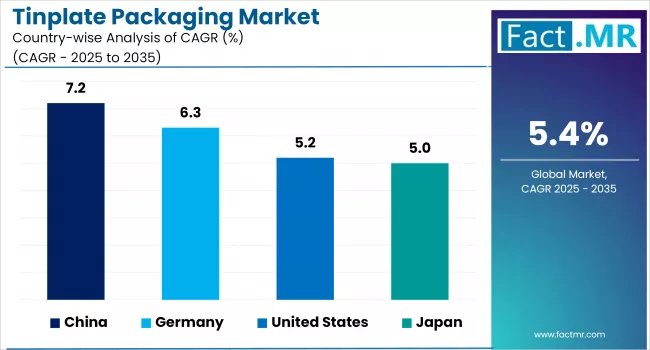
Tinplate Packaging Market By Country | Source: Fact.MR
Sustainability and Steel Ingenuity Put Germany on the Tinplate Map
Germany produces one of the most developed tinplate packaging industries insist mainly on strong environment regulations, industry-based recycling frameworks, and packaging regulations set by the EU. The nation is marketing the infinite recyclability and its application across canned food and chemical drums as well as aerosol products.
Can-making is undergoing a technology revolution and robotics, laser welding and BPA-NI coatings are now the norm. Eco-designed formats and rigorous recyclability labeling are encouraged by the Packaging Act in Germany and the world of digital customization (in promotional tins, in particular) is increasing the application of tinplate in marketing-driven packaging initiatives.
China Powers Tinplate Packaging Growth with Scale and Innovation
China is a global leader in tinplate packaging because it boasts of an overwhelming presence in steel manufacturing, huge base consumption, and the growing demand of domestic shelf-stable packaged products. It is driven by high rates of urbanization, changing retail trends and the consistent use of food, beverages and industrial packages.
In response to concerns related to packaging waste, government policies in China are promoting more sustainable solutions. Higher standards for food-grade materials are accelerating the shift toward non-toxic coatings and recyclable tinplate formats.
Design Meets Tradition as Japan Elevates Tinplate Appeal
Japan’s tinplate packaging market reflects a combination of precise engineering and longstanding consumer preferences for durable, refined designs. It is prevalent in fine confectionary, health supplements, tea tins, and collector quality preserved foods that are typically made with complex finishing and recyclable utility.
The model focusing on the Society 5.0 evolvement in Japan encourages smart packaging implementations like the NFC tags, and their anti-fraud implementation in the tin platform. Radiating aesthetic design of the product is mixed up in sustainability because tinplate fits the 3R policy in Japan. Automation in the production, nostalgia and the culture of gifting guarantee further development of the market.
Category-Wise Analysis
Cans Dominate Tinplate Usage in Consumer-Ready Packaging Formats
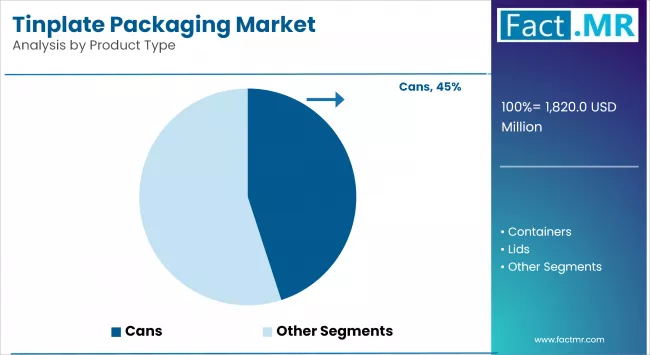
Tinplate Packaging Market By Product Type | Source: Fact.MR
Cans are the most used type of product in the tinplate packaging market because of its barrier properties, durability and economical mass production. They are perfect with the perishable goods because they are less susceptible to light, oxygen and contaminants.
As demand grows in shelf-stable foods and beverages, especially in the urban and disaster-preparedness markets, canѕ still maintain unequaled reliability and recyclability. Their position in food, pet food, and specialty beverages has also been improved by lightweight designs as well as advancements and improvement in the can shaping.
0.13 to 0.20 mm Tinplate Thickness Balances Formability and Strength
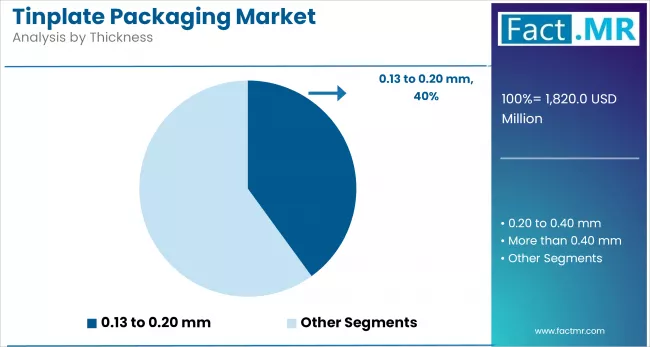
Tinplate Packaging Market By Thickness | Source: Fact.MR
0.13 to 0.20 mm is the ideal gage of tin plate which is used in fast packaging line. This specification gives sufficient strength to sustain pressurizing and stacking, but sufficient thinness to allow easy forming in can making and can forming operations.
It is suitable with both the two-piece and three-piece can manufacture. Besides, tinplate optimization in the range will help in cost savings and material saving, which aligns with sustainability and light-weighting trends in the packaging sector.
Food Packaging Applications Propel Demand for High-Barrier Tinplate Solutions
Tinplate is an important component of food packaging that results in great shelf life even on the shelves. Its inbuilt power and its ability to withstand retort processing make it easy to enclose vegetables, meat products, seafood, as well as soups by manufacturers safely.
Direct food contact regulatory approval and the fact that tinplate can incorporate elements of internal lacquer coating give tinplate confidence in the global food supply market. Tinplate packaging especially in cans, is able to fulfill the safety and sustainability expectations amongst the consumers who have an interest in eco-friendly formats that are convenient and long lasting as well as reducing the amount of waste.
Competitive Analysis
The tinplate packaging sector follows an integrated structure, with vertically coordinated producers and processors throughout the value chain. Despite being metal-based, tinplate remains applicable in food preservation and consumer goods due to its barrier properties, recyclability, and durability.
New entrants face limitations due to high capital requirements and fluctuations in raw material prices, which favor companies with backward integration. Market dynamics are also shaped by evolving trade practices, with a gradual shift toward hybrid canning formats and ongoing demand for peel-off ends and microwave-compatible solutions. These trends require continuous product development among small and mid-sized packaging enterprises operating with limited technical capacity.
Companies that manage legacy operations while adapting to customization, convenience features, and retail visibility are establishing a stronger presence in specific regional markets.
Key players in the market are AJ Packaging Limited, Tinplate Company, Zenith Tins, HUBER Packaging Group GmbH, Golden Grain Group Ltd, Ball Corporation, CPMC, Crown Holdings, Greif Incorporated, Ardagh Group, Thyssenkrupp, and other players.
Recent Development
- In May 2025, HUBER Packaging Group introduced its enhanced NewV tin LED series, offering energy-efficient UV-LED inks and varnishes tailored for tinplate and pre coated aluminum applications, featuring excellent adhesion and high color intensity.
- In April 2025, Ardagh Group (Glass Packaging‑North America) announced five of its customers won “Clear Choice Awards,” highlighting its tinplate and glass packaging excellence.
Methodology and Industry Tracking Approach
Fact.MR research on tinplate packaging market in 2025 involved more than 3800 market players spread over 18 countries. In order to reflect the changing industry trends, 85+ regional industry insiders, such as food safety officers, packaging technologists, and metal coating specialists were interviewed in October, 2025 to reflect the increasing desire to find a solution of tinplate that is light weighted, BPA-free, and corrosion resistance.
In June 2024 to May 2025, the market was in a strong period of expansion based on the introduction of innovations in digital printing and smart labeling to allow real-time tracing and brand customization of canned products and aerosols.
Fact.MR analysts also noted that the demand of recyclable and low-carbon tinplate has been growing significantly since 2018 and manufacturers have shifted towards closed-loop steel recovery, eco-coatings, lead-free soldering, and other measures in line with the emerging sustainable requirements in various parts of the globe.
Fact.MR has provided detailed information about the price points of key manufacturers of Tinplate Packaging Market positioned across regions, sales growth, production capacity, and speculative technological expansion, in the recently published report.
Segmentation
Segmentation of Tinplate packaging market
-
By Product Type :
- Cans
- Containers
- Lids
- Others
- Application
-
By Food Packaging :
- Beverages Packaging
- Alcoholic Drinks
- Non-Alcoholic Drinks
- Aerosol Products Packaging
- Cosmetics
- Healthcare
- Automotive
- Others
-
By Thickness :
- 0.13 to 0.20 mm
- 0.20 to 0.40 mm
- More than 0.40 mm
-
By Region :
- North America
- Latin America
- Western Europe
- Eastern Europe
- East Asia
- South Asia & Pacific
- Middle East & Africa
Frequently Asked Questions
What was the global Tinplate packaging market size reported by Fact.MR for 2025?
Who are the major players operating in the tinplate packaging market?
What is the Estimated Valuation of the tinplate packaging market in 2035?
What value CAGR did the Tinplate packaging market exhibit over the last five years?
Who worked on this report


Preview the report firsthand - request a free sample
Free SampleGet the brochure for pricing and purchase details
Download PDF