3nm Semiconductor EDA AI Tools Market
3nm Semiconductor EDA AI Tools Market Size and Share Forecast Outlook 2026 to 2036
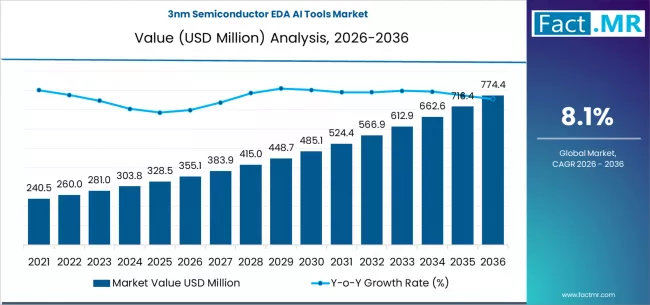
3nm semiconductor eda ai tools market is projected to grow from USD 355.1 million in 2026 to USD 774.4 million by 2036, at a CAGR of 8.1%. P&R/Synthesis will dominate with a 31.0% market share, while foundries will lead the customer segment with a 44.0% share.
3nm Semiconductor EDA AI Tools Market Forecast and Outlook 2026 to 2036
The global market for 3nm semiconductor electronic design automation AI tools is projected to grow from USD 355.10 million in 2026 to USD 774.44 million by 2036, achieving a CAGR of 8.1%. Growth is driven by the extreme complexity and exorbitant cost associated with designing integrated circuits at the 3nm process node and beyond.
Key Takeaways from the 3nm Semiconductor EDA AI Tools Market
- Market Value for 2026: USD 355.10 Million
- Market Value for 2036: USD 774.44 Million
- Forecast CAGR (2026-2036): 8.1%
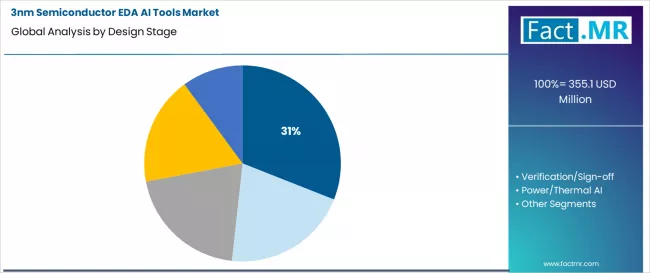
- Leading Design Stage Segment (2026): P&R/Synthesis (31%)
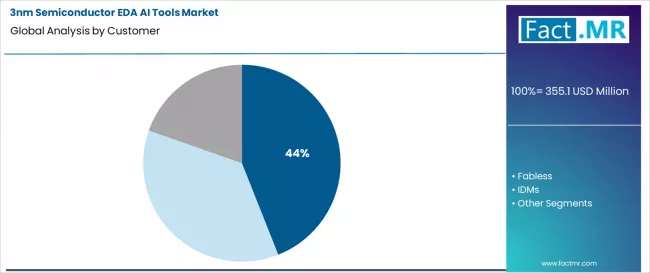
- Leading Customer Segment (2026): Foundries (44%)
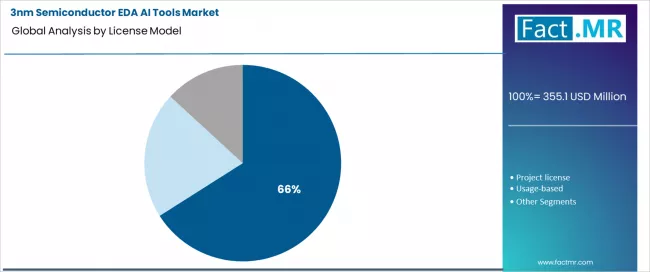
- Leading License Model Segment (2026): Subscription (66%)
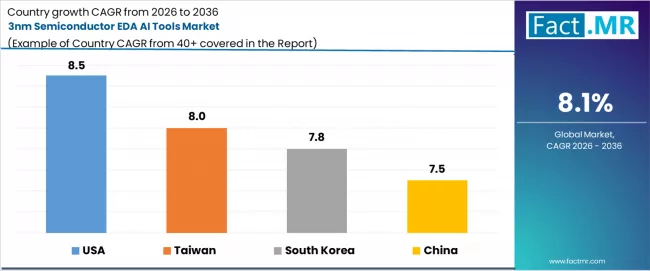
- Key Growth Countries: USA (8.50% CAGR), Taiwan (8.00% CAGR), South Korea (7.80% CAGR), China (7.50% CAGR)
- Key Players in the Market: Synopsys Inc., Cadence, Siemens EDA, Ansys, Silvaco, Keysight
![]()
At these atomic scales, traditional design methodologies are insufficient to manage the intricate interdependencies of power, performance, area, and yield. AI and machine learning have become indispensable, integrated into the EDA workflow to predict outcomes, automate optimization, and navigate a vastly expanded design space. These tools are critical for reducing time-to-market, managing soaring non-recurring engineering costs, and achieving first-pass silicon success.
The market's expansion is linked to leading-edge foundries and the competitive race among fabless companies and IDMs to deliver next-generation chips for AI. The landscape also involves high-performance computing, and advanced mobile platforms, making AI-enhanced EDA a strategic enabler of technological progress.
Metric
| Metric | Value |
|---|---|
| Market Value (2026) | USD 355.10 Million |
| Market Forecast Value (2036) | USD 774.44 Million |
| Forecast CAGR (2026-2036) | 8.1% |
Category
| Category | Segments |
|---|---|
| Design Stage | P&R/Synthesis, Verification/Sign-off, Power/Thermal AI, Yield Optimisation, DFM AI |
| Customer | Foundries, Fabless, IDMs |
| License Model | Subscription, Project License, Usage-based |
| Region | North America, Latin America, Western Europe, Eastern Europe, East Asia, South Asia & Pacific, MEA |
Segmental Analysis
By Design Stage, Where is AI Having the Most Immediate Impact on Productivity?
![]()
Placement & routing (P&R) and synthesis lead the design stage segment with a 31% share. This stage is arguably the most complex and time-consuming in physical design, involving the placement of billions of transistors and the routing of interconnects while adhering to thousands of multi-physics constraints.
AI tools are transformative here, using predictive models to explore the design space more efficiently, automatically generating floorplans, optimizing for timing and congestion, and reducing iterations. This direct acceleration of the core implementation flow delivers the most palpable reduction in design cycle time, justifying significant investment.
By Customer, Who is the Primary Driver and Integrator of AI EDA Flows?
![]()
Foundries constitute the dominant customer segment, holding 44% of the market. As the developers of the 3nm process design kits (PDKs), foundries are responsible for creating and qualifying the complex design rules and simulation models. They work in lockstep with EDA vendors to integrate AI tools directly into their certified reference flows.
This deep collaboration is essential because AI models for yield prediction and design-for-manufacturability must be trained on the foundry’s proprietary process data. Foundries drive adoption by requiring or strongly recommending AI-enabled tools to ensure designs are manufacturable and meet performance targets.
By License Model, What is the Preferred Commercial Structure?
![]()
The subscription license model is overwhelmingly dominant at 66%. This reflects the need for continuous, rapid updates in a fast-evolving technological landscape. Subscription provides customers with access to the latest AI models, bug fixes, and support for new process node updates from foundries.
It aligns the cost structure with project timelines and provides EDA vendors with recurring revenue, facilitating ongoing R&D into more advanced AI capabilities. The model offers flexibility and ensures designers always have access to state-of-the-art tools necessary to tackle 3nm challenges.
What are the Principal Drivers, Constraints, and Evolving Dynamics of this Market?
The paramount driver is the impossibility of designing 3nm chips with human-scale analysis alone, necessitating AI to manage exponential complexity in power integrity, thermal effects, and parasitic extraction. A key restraint is the black box nature of some AI models, which can create certification and risk-mitigation challenges for safety-critical or high-reliability chip designs, where deterministic outcomes are required.
A significant opportunity lies in the development of holistic, chip-level AI co-optimization engines that simultaneously balance digital, analog, and packaging constraints, moving from point-tool AI to a system-level AI orchestrator. The dominant trend is the tight, three-way partnership between EDA vendors, foundries, and leading-edge chip designers to create purpose-built AI models trained on proprietary manufacturing data, effectively making the AI tool a conduit for foundry-specific process intelligence and a critical component of design technology co-optimization (DTCO).
Analysis of the 3nm Semiconductor EDA AI Tools Market by Key Countries
![]()
| Country | CAGR (2026-2036) |
|---|---|
| USA | 8.50% |
| Taiwan | 8.00% |
| South Korea | 7.80% |
| China | 7.50% |
How does the USA’s Ecosystem of EDA Innovation and Leading-Edge Design Drive Growth?
![]()
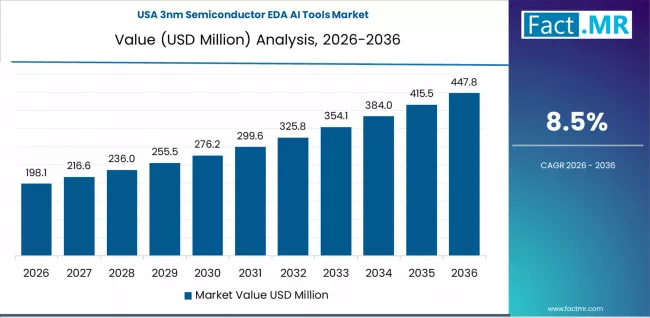
The USA's leading 8.50% CAGR is anchored in its dual dominance as the home of the world's premier EDA software companies and a dense ecosystem of pioneering fabless design firms and IDMs. The relentless demand from U.S.-based companies designing the most advanced AI accelerators, CPUs, and GPUs for 3nm nodes creates a direct and immediate market for cutting-edge AI tools.
Growth is fueled by massive R&D investments from EDA leaders and the competitive necessity for U.S. chip designers to leverage every possible AI advantage to shorten development cycles and optimize PPA.
What is Taiwan’s Pivotal Role as the Foundry Epicenter?
Taiwan's 8.00% growth is uniquely driven by its position as the home of TSMC, the world's leading foundry for 3nm production. Taiwan’s market is defined by the deep, symbiotic R&D collaboration between TSMC and major EDA vendors. AI tools for yield learning, DFM, and sign-off are co-developed and validated within TSMC's Open Innovation Platform (OIP).
This makes Taiwan the critical testing and integration ground for 3nm EDA AI solutions, with demand flowing from TSMC’s need to equip its vast global customer base with certified, high-productivity design capabilities.
How does South Korea’s Memory and Foundry Leadership Shape Demand?
South Korea's 7.80% CAGR is powered by its giants in both memory (Samsung, SK Hynix) and advanced foundry services. For memory, AI EDA tools are crucial for designing ultra-dense, high-performance 3nm DRAM and NAND chips.
For Samsung's foundry business, mirroring the dynamic in Taiwan, AI tools are essential for customer support and process optimization. South Korean growth is characterized by significant investment in proprietary AI enhancements for memory design and strong participation in the co-development of foundry-certified AI flows for advanced nodes.
What drives China’s Strategic Pursuit of EDA Self-Sufficiency?
China's 7.50% growth is propelled by a national strategic imperative to develop a domestic, controllable EDA software stack amid geopolitical tensions. While Chinese foundries (SMIC) and fabless companies currently utilize international EDA tools, there is massive parallel investment in indigenous AI-driven EDA solutions.
The market is shaped by government funding, research initiatives, and the growth of domestic chip designers aiming to eventually leverage homegrown AI EDA tools for advanced nodes, creating a dual-track market of adoption and development.
Competitive Landscape of the 3nm Semiconductor EDA AI Tools Market
![]()
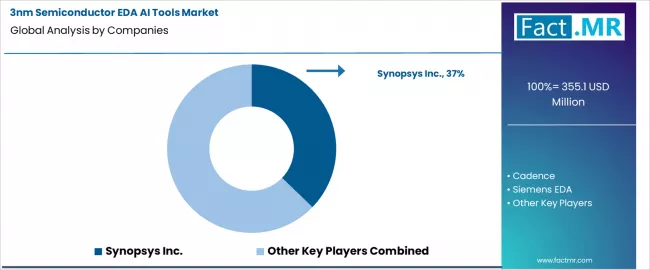
The competitive landscape is an oligopoly dominated by Synopsys and Cadence, with Siemens EDA (formerly Mentor) forming a strong third player, followed by specialized simulation providers like Ansys. Competition is intense and revolves around which company can embed the most effective, foundry-certified AI across the broadest span of the design flow, from system architecture and verification to physical implementation and sign-off.
Success is determined by the depth of partnerships with leading foundries, the performance and accuracy of proprietary AI engines, and the ability to offer a unified, AI-infused platform that reduces the need for point tools and disruptive flow changes. The high barriers to entry, including immense R&D costs and the necessity of foundry validation, solidify the position of incumbents.
Key Players in the 3nm Semiconductor EDA AI Tools Market
- Synopsys Inc.
- Cadence
- Siemens EDA
- Ansys
- Silvaco
- Keysight
Scope of Report
| Items | Values |
|---|---|
| Quantitative Units | USD Million |
| Design Stage | P&R/Synthesis, Verification/Sign-off, Power/Thermal AI, Yield Optimisation, DFM AI |
| Customer | Foundries, Fabless, IDMs |
| License Model | Subscription, Project License, Usage-based |
| Key Countries | USA, Taiwan, South Korea, China |
| Key Companies | Synopsys Inc., Cadence, Siemens EDA, Ansys, Silvaco, Keysight |
| Additional Analysis | Comparative analysis of AI algorithm performance (accuracy vs. runtime) for different design tasks; study of data security and IP protection in cloud-based AI EDA platforms; total cost of design ownership analysis with AI tools versus traditional flows; impact of AI on required engineering skill sets and team structures; assessment of the role of AI in design technology co-optimization (DTCO) and system technology co-optimization (STCO). |
Market by Segments
-
Design Stage :
- P&R/Synthesis
- Verification/Sign-off
- Power/Thermal AI
- Yield Optimisation
- DFM AI
-
Customer :
- Foundries
- Fabless
- IDMs
-
License Model :
- Subscription
- Project License
- Usage-based
-
Region :
-
North America
- USA
- Canada
-
Latin America
- Brazil
- Mexico
- Argentina
- Rest of Latin America
-
Western Europe
- Germany
- France
- Italy
- Spain
- UK
- BENELUX
- Rest of Western Europe
-
Eastern Europe
- Russia
- Poland
- Czech Republic
- Rest of Eastern Europe
-
East Asia
- China
- Japan
- South Korea
- Taiwan
- Rest of East Asia
-
South Asia & Pacific
- India
- ASEAN
- Australia
- Rest of South Asia & Pacific
-
MEA
- GCC Countries
- South Africa
- Turkiye
- Rest of MEA
-
References
- IEEE Council on Electronic Design Automation (CEDA). (2025). Roadmap on AI/ML for Electronic Design. IEEE.
- International Roadmap for Devices and Systems (IRDS). (2025). More Moore Chapter: Design Enablement. IEEE.
- Kahng, A. B. (2025). Machine Learning in EDA: A Foundational Perspective. Springer.
- Smith, M. J. S. (2025). Application-Specific Integrated Circuits: Design in the 3nm Era. Addison-Wesley.
- Synopsys Inc. (2025). White Paper: AI-Driven Design for 3nm and Beyond. Company Publication.
- TSMC. (2025). Open Innovation Platform (OIP) Ecosystem Forum Report. Taiwan Semiconductor Manufacturing Company.
Table of Content
- Executive Summary
- Global Market Outlook
- Demand to side Trends
- Supply to side Trends
- Technology Roadmap Analysis
- Analysis and Recommendations
- Market Overview
- Market Coverage / Taxonomy
- Market Definition / Scope / Limitations
- Market Background
- Market Dynamics
- Drivers
- Restraints
- Opportunity
- Trends
- Scenario Forecast
- Demand in Optimistic Scenario
- Demand in Likely Scenario
- Demand in Conservative Scenario
- Opportunity Map Analysis
- Product Life Cycle Analysis
- Supply Chain Analysis
- Investment Feasibility Matrix
- Value Chain Analysis
- PESTLE and Porter’s Analysis
- Regulatory Landscape
- Regional Parent Market Outlook
- Production and Consumption Statistics
- Import and Export Statistics
- Market Dynamics
- Global Market Analysis 2021 to 2025 and Forecast, 2026 to 2036
- Historical Market Size Value (USD Million) Analysis, 2021 to 2025
- Current and Future Market Size Value (USD Million) Projections, 2026 to 2036
- Y to o to Y Growth Trend Analysis
- Absolute $ Opportunity Analysis
- Global Market Pricing Analysis 2021 to 2025 and Forecast 2026 to 2036
- Global Market Analysis 2021 to 2025 and Forecast 2026 to 2036, By Design Stage
- Introduction / Key Findings
- Historical Market Size Value (USD Million) Analysis By Design Stage, 2021 to 2025
- Current and Future Market Size Value (USD Million) Analysis and Forecast By Design Stage, 2026 to 2036
- P&R/Synthesis
- Verification/Sign-off
- Power/Thermal AI
- Yield Optimisation
- DFM AI
- P&R/Synthesis
- Y to o to Y Growth Trend Analysis By Design Stage, 2021 to 2025
- Absolute $ Opportunity Analysis By Design Stage, 2026 to 2036
- Global Market Analysis 2021 to 2025 and Forecast 2026 to 2036, By Customer
- Introduction / Key Findings
- Historical Market Size Value (USD Million) Analysis By Customer, 2021 to 2025
- Current and Future Market Size Value (USD Million) Analysis and Forecast By Customer, 2026 to 2036
- Foundries
- Fabless
- IDMs
- Foundries
- Y to o to Y Growth Trend Analysis By Customer, 2021 to 2025
- Absolute $ Opportunity Analysis By Customer, 2026 to 2036
- Global Market Analysis 2021 to 2025 and Forecast 2026 to 2036, By License Model
- Introduction / Key Findings
- Historical Market Size Value (USD Million) Analysis By License Model, 2021 to 2025
- Current and Future Market Size Value (USD Million) Analysis and Forecast By License Model, 2026 to 2036
- Subscription
- Project license
- Usage-based
- Subscription
- Y to o to Y Growth Trend Analysis By License Model, 2021 to 2025
- Absolute $ Opportunity Analysis By License Model, 2026 to 2036
- Global Market Analysis 2021 to 2025 and Forecast 2026 to 2036, By Region
- Introduction
- Historical Market Size Value (USD Million) Analysis By Region, 2021 to 2025
- Current Market Size Value (USD Million) Analysis and Forecast By Region, 2026 to 2036
- North America
- Latin America
- Western Europe
- Eastern Europe
- East Asia
- South Asia and Pacific
- Middle East & Africa
- Market Attractiveness Analysis By Region
- North America Market Analysis 2021 to 2025 and Forecast 2026 to 2036, By Country
- Historical Market Size Value (USD Million) Trend Analysis By Market Taxonomy, 2021 to 2025
- Market Size Value (USD Million) Forecast By Market Taxonomy, 2026 to 2036
- By Country
- USA
- Canada
- Mexico
- By Design Stage
- By Customer
- By License Model
- By Country
- Market Attractiveness Analysis
- By Country
- By Design Stage
- By Customer
- By License Model
- Key Takeaways
- Latin America Market Analysis 2021 to 2025 and Forecast 2026 to 2036, By Country
- Historical Market Size Value (USD Million) Trend Analysis By Market Taxonomy, 2021 to 2025
- Market Size Value (USD Million) Forecast By Market Taxonomy, 2026 to 2036
- By Country
- Brazil
- Chile
- Rest of Latin America
- By Design Stage
- By Customer
- By License Model
- By Country
- Market Attractiveness Analysis
- By Country
- By Design Stage
- By Customer
- By License Model
- Key Takeaways
- Western Europe Market Analysis 2021 to 2025 and Forecast 2026 to 2036, By Country
- Historical Market Size Value (USD Million) Trend Analysis By Market Taxonomy, 2021 to 2025
- Market Size Value (USD Million) Forecast By Market Taxonomy, 2026 to 2036
- By Country
- Germany
- UK
- Italy
- Spain
- France
- Nordic
- BENELUX
- Rest of Western Europe
- By Design Stage
- By Customer
- By License Model
- By Country
- Market Attractiveness Analysis
- By Country
- By Design Stage
- By Customer
- By License Model
- Key Takeaways
- Eastern Europe Market Analysis 2021 to 2025 and Forecast 2026 to 2036, By Country
- Historical Market Size Value (USD Million) Trend Analysis By Market Taxonomy, 2021 to 2025
- Market Size Value (USD Million) Forecast By Market Taxonomy, 2026 to 2036
- By Country
- Russia
- Poland
- Hungary
- Balkan & Baltic
- Rest of Eastern Europe
- By Design Stage
- By Customer
- By License Model
- By Country
- Market Attractiveness Analysis
- By Country
- By Design Stage
- By Customer
- By License Model
- Key Takeaways
- East Asia Market Analysis 2021 to 2025 and Forecast 2026 to 2036, By Country
- Historical Market Size Value (USD Million) Trend Analysis By Market Taxonomy, 2021 to 2025
- Market Size Value (USD Million) Forecast By Market Taxonomy, 2026 to 2036
- By Country
- China
- Japan
- South Korea
- By Design Stage
- By Customer
- By License Model
- By Country
- Market Attractiveness Analysis
- By Country
- By Design Stage
- By Customer
- By License Model
- Key Takeaways
- South Asia and Pacific Market Analysis 2021 to 2025 and Forecast 2026 to 2036, By Country
- Historical Market Size Value (USD Million) Trend Analysis By Market Taxonomy, 2021 to 2025
- Market Size Value (USD Million) Forecast By Market Taxonomy, 2026 to 2036
- By Country
- India
- ASEAN
- Australia & New Zealand
- Rest of South Asia and Pacific
- By Design Stage
- By Customer
- By License Model
- By Country
- Market Attractiveness Analysis
- By Country
- By Design Stage
- By Customer
- By License Model
- Key Takeaways
- Middle East & Africa Market Analysis 2021 to 2025 and Forecast 2026 to 2036, By Country
- Historical Market Size Value (USD Million) Trend Analysis By Market Taxonomy, 2021 to 2025
- Market Size Value (USD Million) Forecast By Market Taxonomy, 2026 to 2036
- By Country
- Kingdom of Saudi Arabia
- Other GCC Countries
- Turkiye
- South Africa
- Other African Union
- Rest of Middle East & Africa
- By Design Stage
- By Customer
- By License Model
- By Country
- Market Attractiveness Analysis
- By Country
- By Design Stage
- By Customer
- By License Model
- Key Takeaways
- Key Countries Market Analysis
- USA
- Pricing Analysis
- Market Share Analysis, 2025
- By Design Stage
- By Customer
- By License Model
- Canada
- Pricing Analysis
- Market Share Analysis, 2025
- By Design Stage
- By Customer
- By License Model
- Mexico
- Pricing Analysis
- Market Share Analysis, 2025
- By Design Stage
- By Customer
- By License Model
- Brazil
- Pricing Analysis
- Market Share Analysis, 2025
- By Design Stage
- By Customer
- By License Model
- Chile
- Pricing Analysis
- Market Share Analysis, 2025
- By Design Stage
- By Customer
- By License Model
- Germany
- Pricing Analysis
- Market Share Analysis, 2025
- By Design Stage
- By Customer
- By License Model
- UK
- Pricing Analysis
- Market Share Analysis, 2025
- By Design Stage
- By Customer
- By License Model
- Italy
- Pricing Analysis
- Market Share Analysis, 2025
- By Design Stage
- By Customer
- By License Model
- Spain
- Pricing Analysis
- Market Share Analysis, 2025
- By Design Stage
- By Customer
- By License Model
- France
- Pricing Analysis
- Market Share Analysis, 2025
- By Design Stage
- By Customer
- By License Model
- India
- Pricing Analysis
- Market Share Analysis, 2025
- By Design Stage
- By Customer
- By License Model
- ASEAN
- Pricing Analysis
- Market Share Analysis, 2025
- By Design Stage
- By Customer
- By License Model
- Australia & New Zealand
- Pricing Analysis
- Market Share Analysis, 2025
- By Design Stage
- By Customer
- By License Model
- China
- Pricing Analysis
- Market Share Analysis, 2025
- By Design Stage
- By Customer
- By License Model
- Japan
- Pricing Analysis
- Market Share Analysis, 2025
- By Design Stage
- By Customer
- By License Model
- South Korea
- Pricing Analysis
- Market Share Analysis, 2025
- By Design Stage
- By Customer
- By License Model
- Russia
- Pricing Analysis
- Market Share Analysis, 2025
- By Design Stage
- By Customer
- By License Model
- Poland
- Pricing Analysis
- Market Share Analysis, 2025
- By Design Stage
- By Customer
- By License Model
- Hungary
- Pricing Analysis
- Market Share Analysis, 2025
- By Design Stage
- By Customer
- By License Model
- Kingdom of Saudi Arabia
- Pricing Analysis
- Market Share Analysis, 2025
- By Design Stage
- By Customer
- By License Model
- Turkiye
- Pricing Analysis
- Market Share Analysis, 2025
- By Design Stage
- By Customer
- By License Model
- South Africa
- Pricing Analysis
- Market Share Analysis, 2025
- By Design Stage
- By Customer
- By License Model
- USA
- Market Structure Analysis
- Competition Dashboard
- Competition Benchmarking
- Market Share Analysis of Top Players
- By Regional
- By Design Stage
- By Customer
- By License Model
- Competition Analysis
- Competition Deep Dive
- Synopsys Inc.
- Overview
- Product Portfolio
- Profitability by Market Segments (Product/Age /Sales Channel/Region)
- Sales Footprint
- Strategy Overview
- Marketing Strategy
- Product Strategy
- Channel Strategy
- Cadence
- Siemens EDA
- Ansys
- Silvaco
- Keysight
- Synopsys Inc.
- Competition Deep Dive
- Assumptions & Acronyms Used
- Research Methodology
List Of Table
- Table 1: Global Market Value (USD Million) Forecast by Region, 2021 to 2036
- Table 2: Global Market Value (USD Million) Forecast by Design Stage, 2021 to 2036
- Table 3: Global Market Value (USD Million) Forecast by Customer, 2021 to 2036
- Table 4: Global Market Value (USD Million) Forecast by License Model, 2021 to 2036
- Table 5: North America Market Value (USD Million) Forecast by Country, 2021 to 2036
- Table 6: North America Market Value (USD Million) Forecast by Design Stage, 2021 to 2036
- Table 7: North America Market Value (USD Million) Forecast by Customer, 2021 to 2036
- Table 8: North America Market Value (USD Million) Forecast by License Model, 2021 to 2036
- Table 9: Latin America Market Value (USD Million) Forecast by Country, 2021 to 2036
- Table 10: Latin America Market Value (USD Million) Forecast by Design Stage, 2021 to 2036
- Table 11: Latin America Market Value (USD Million) Forecast by Customer, 2021 to 2036
- Table 12: Latin America Market Value (USD Million) Forecast by License Model, 2021 to 2036
- Table 13: Western Europe Market Value (USD Million) Forecast by Country, 2021 to 2036
- Table 14: Western Europe Market Value (USD Million) Forecast by Design Stage, 2021 to 2036
- Table 15: Western Europe Market Value (USD Million) Forecast by Customer, 2021 to 2036
- Table 16: Western Europe Market Value (USD Million) Forecast by License Model, 2021 to 2036
- Table 17: Eastern Europe Market Value (USD Million) Forecast by Country, 2021 to 2036
- Table 18: Eastern Europe Market Value (USD Million) Forecast by Design Stage, 2021 to 2036
- Table 19: Eastern Europe Market Value (USD Million) Forecast by Customer, 2021 to 2036
- Table 20: Eastern Europe Market Value (USD Million) Forecast by License Model, 2021 to 2036
- Table 21: East Asia Market Value (USD Million) Forecast by Country, 2021 to 2036
- Table 22: East Asia Market Value (USD Million) Forecast by Design Stage, 2021 to 2036
- Table 23: East Asia Market Value (USD Million) Forecast by Customer, 2021 to 2036
- Table 24: East Asia Market Value (USD Million) Forecast by License Model, 2021 to 2036
- Table 25: South Asia and Pacific Market Value (USD Million) Forecast by Country, 2021 to 2036
- Table 26: South Asia and Pacific Market Value (USD Million) Forecast by Design Stage, 2021 to 2036
- Table 27: South Asia and Pacific Market Value (USD Million) Forecast by Customer, 2021 to 2036
- Table 28: South Asia and Pacific Market Value (USD Million) Forecast by License Model, 2021 to 2036
- Table 29: Middle East & Africa Market Value (USD Million) Forecast by Country, 2021 to 2036
- Table 30: Middle East & Africa Market Value (USD Million) Forecast by Design Stage, 2021 to 2036
- Table 31: Middle East & Africa Market Value (USD Million) Forecast by Customer, 2021 to 2036
- Table 32: Middle East & Africa Market Value (USD Million) Forecast by License Model, 2021 to 2036
List Of Figures
- Figure 1: Global Market Pricing Analysis
- Figure 2: Global Market Value (USD Million) Forecast 2021 to 2036
- Figure 3: Global Market Value Share and BPS Analysis by Design Stage, 2026 and 2036
- Figure 4: Global Market Y to o to Y Growth Comparison by Design Stage, 2026 to 2036
- Figure 5: Global Market Attractiveness Analysis by Design Stage
- Figure 6: Global Market Value Share and BPS Analysis by Customer, 2026 and 2036
- Figure 7: Global Market Y to o to Y Growth Comparison by Customer, 2026 to 2036
- Figure 8: Global Market Attractiveness Analysis by Customer
- Figure 9: Global Market Value Share and BPS Analysis by License Model, 2026 and 2036
- Figure 10: Global Market Y to o to Y Growth Comparison by License Model, 2026 to 2036
- Figure 11: Global Market Attractiveness Analysis by License Model
- Figure 12: Global Market Value (USD Million) Share and BPS Analysis by Region, 2026 and 2036
- Figure 13: Global Market Y to o to Y Growth Comparison by Region, 2026 to 2036
- Figure 14: Global Market Attractiveness Analysis by Region
- Figure 15: North America Market Incremental Dollar Opportunity, 2026 to 2036
- Figure 16: Latin America Market Incremental Dollar Opportunity, 2026 to 2036
- Figure 17: Western Europe Market Incremental Dollar Opportunity, 2026 to 2036
- Figure 18: Eastern Europe Market Incremental Dollar Opportunity, 2026 to 2036
- Figure 19: East Asia Market Incremental Dollar Opportunity, 2026 to 2036
- Figure 20: South Asia and Pacific Market Incremental Dollar Opportunity, 2026 to 2036
- Figure 21: Middle East & Africa Market Incremental Dollar Opportunity, 2026 to 2036
- Figure 22: North America Market Value Share and BPS Analysis by Country, 2026 and 2036
- Figure 23: North America Market Value Share and BPS Analysis by Design Stage, 2026 and 2036
- Figure 24: North America Market Y to o to Y Growth Comparison by Design Stage, 2026 to 2036
- Figure 25: North America Market Attractiveness Analysis by Design Stage
- Figure 26: North America Market Value Share and BPS Analysis by Customer, 2026 and 2036
- Figure 27: North America Market Y to o to Y Growth Comparison by Customer, 2026 to 2036
- Figure 28: North America Market Attractiveness Analysis by Customer
- Figure 29: North America Market Value Share and BPS Analysis by License Model, 2026 and 2036
- Figure 30: North America Market Y to o to Y Growth Comparison by License Model, 2026 to 2036
- Figure 31: North America Market Attractiveness Analysis by License Model
- Figure 32: Latin America Market Value Share and BPS Analysis by Country, 2026 and 2036
- Figure 33: Latin America Market Value Share and BPS Analysis by Design Stage, 2026 and 2036
- Figure 34: Latin America Market Y to o to Y Growth Comparison by Design Stage, 2026 to 2036
- Figure 35: Latin America Market Attractiveness Analysis by Design Stage
- Figure 36: Latin America Market Value Share and BPS Analysis by Customer, 2026 and 2036
- Figure 37: Latin America Market Y to o to Y Growth Comparison by Customer, 2026 to 2036
- Figure 38: Latin America Market Attractiveness Analysis by Customer
- Figure 39: Latin America Market Value Share and BPS Analysis by License Model, 2026 and 2036
- Figure 40: Latin America Market Y to o to Y Growth Comparison by License Model, 2026 to 2036
- Figure 41: Latin America Market Attractiveness Analysis by License Model
- Figure 42: Western Europe Market Value Share and BPS Analysis by Country, 2026 and 2036
- Figure 43: Western Europe Market Value Share and BPS Analysis by Design Stage, 2026 and 2036
- Figure 44: Western Europe Market Y to o to Y Growth Comparison by Design Stage, 2026 to 2036
- Figure 45: Western Europe Market Attractiveness Analysis by Design Stage
- Figure 46: Western Europe Market Value Share and BPS Analysis by Customer, 2026 and 2036
- Figure 47: Western Europe Market Y to o to Y Growth Comparison by Customer, 2026 to 2036
- Figure 48: Western Europe Market Attractiveness Analysis by Customer
- Figure 49: Western Europe Market Value Share and BPS Analysis by License Model, 2026 and 2036
- Figure 50: Western Europe Market Y to o to Y Growth Comparison by License Model, 2026 to 2036
- Figure 51: Western Europe Market Attractiveness Analysis by License Model
- Figure 52: Eastern Europe Market Value Share and BPS Analysis by Country, 2026 and 2036
- Figure 53: Eastern Europe Market Value Share and BPS Analysis by Design Stage, 2026 and 2036
- Figure 54: Eastern Europe Market Y to o to Y Growth Comparison by Design Stage, 2026 to 2036
- Figure 55: Eastern Europe Market Attractiveness Analysis by Design Stage
- Figure 56: Eastern Europe Market Value Share and BPS Analysis by Customer, 2026 and 2036
- Figure 57: Eastern Europe Market Y to o to Y Growth Comparison by Customer, 2026 to 2036
- Figure 58: Eastern Europe Market Attractiveness Analysis by Customer
- Figure 59: Eastern Europe Market Value Share and BPS Analysis by License Model, 2026 and 2036
- Figure 60: Eastern Europe Market Y to o to Y Growth Comparison by License Model, 2026 to 2036
- Figure 61: Eastern Europe Market Attractiveness Analysis by License Model
- Figure 62: East Asia Market Value Share and BPS Analysis by Country, 2026 and 2036
- Figure 63: East Asia Market Value Share and BPS Analysis by Design Stage, 2026 and 2036
- Figure 64: East Asia Market Y to o to Y Growth Comparison by Design Stage, 2026 to 2036
- Figure 65: East Asia Market Attractiveness Analysis by Design Stage
- Figure 66: East Asia Market Value Share and BPS Analysis by Customer, 2026 and 2036
- Figure 67: East Asia Market Y to o to Y Growth Comparison by Customer, 2026 to 2036
- Figure 68: East Asia Market Attractiveness Analysis by Customer
- Figure 69: East Asia Market Value Share and BPS Analysis by License Model, 2026 and 2036
- Figure 70: East Asia Market Y to o to Y Growth Comparison by License Model, 2026 to 2036
- Figure 71: East Asia Market Attractiveness Analysis by License Model
- Figure 72: South Asia and Pacific Market Value Share and BPS Analysis by Country, 2026 and 2036
- Figure 73: South Asia and Pacific Market Value Share and BPS Analysis by Design Stage, 2026 and 2036
- Figure 74: South Asia and Pacific Market Y to o to Y Growth Comparison by Design Stage, 2026 to 2036
- Figure 75: South Asia and Pacific Market Attractiveness Analysis by Design Stage
- Figure 76: South Asia and Pacific Market Value Share and BPS Analysis by Customer, 2026 and 2036
- Figure 77: South Asia and Pacific Market Y to o to Y Growth Comparison by Customer, 2026 to 2036
- Figure 78: South Asia and Pacific Market Attractiveness Analysis by Customer
- Figure 79: South Asia and Pacific Market Value Share and BPS Analysis by License Model, 2026 and 2036
- Figure 80: South Asia and Pacific Market Y to o to Y Growth Comparison by License Model, 2026 to 2036
- Figure 81: South Asia and Pacific Market Attractiveness Analysis by License Model
- Figure 82: Middle East & Africa Market Value Share and BPS Analysis by Country, 2026 and 2036
- Figure 83: Middle East & Africa Market Value Share and BPS Analysis by Design Stage, 2026 and 2036
- Figure 84: Middle East & Africa Market Y to o to Y Growth Comparison by Design Stage, 2026 to 2036
- Figure 85: Middle East & Africa Market Attractiveness Analysis by Design Stage
- Figure 86: Middle East & Africa Market Value Share and BPS Analysis by Customer, 2026 and 2036
- Figure 87: Middle East & Africa Market Y to o to Y Growth Comparison by Customer, 2026 to 2036
- Figure 88: Middle East & Africa Market Attractiveness Analysis by Customer
- Figure 89: Middle East & Africa Market Value Share and BPS Analysis by License Model, 2026 and 2036
- Figure 90: Middle East & Africa Market Y to o to Y Growth Comparison by License Model, 2026 to 2036
- Figure 91: Middle East & Africa Market Attractiveness Analysis by License Model
- Figure 92: Global Market - Tier Structure Analysis
- Figure 93: Global Market - Company Share Analysis
- FAQs -
How big is the 3nm semiconductor eda ai tools market in 2026?
The global 3nm semiconductor eda ai tools market is estimated to be valued at USD 355.1 million in 2026.
What will be the size of 3nm semiconductor eda ai tools market in 2036?
The market size for the 3nm semiconductor eda ai tools market is projected to reach USD 774.4 million by 2036.
How much will be the 3nm semiconductor eda ai tools market growth between 2026 and 2036?
The 3nm semiconductor eda ai tools market is expected to grow at a 8.1% CAGR between 2026 and 2036.
What are the key product types in the 3nm semiconductor eda ai tools market?
The key product types in 3nm semiconductor eda ai tools market are p&r/synthesis, verification/sign-off, power/thermal ai, yield optimisation and dfm ai.
Which customer segment to contribute significant share in the 3nm semiconductor eda ai tools market in 2026?
In terms of customer, foundries segment to command 44.0% share in the 3nm semiconductor eda ai tools market in 2026.