- Base Value(2025): 5200 Mn
- Forecast Value (2035): 28391 Mn
- CAGR (2035): 17.3%
AI Fleet Operations Platform Market Outlook (2025 to 2035)
The global AI fleet operations platform market is expected to reach USD 28,391 million by 2035, up from USD 5,200 million in 2025. During the forecast period (2025 to 2035), the industry is projected to expand at a CAGR of 18.5%.
The AI fleet operations platforms are quintessential, which allows real-time optimization of routing, telematics, predictive maintenance, safety and electrification. The increasing pace of e-commerce, high fuel prices, regulatory compliance pressure, and the adoption of EVs are forcing fleets to implement AI-based orchestration to minimize cost, maximize up time, increase safety, and achieve sustainability goals in multi-sided logistics networks to drive rapid digitalization.
2025-to-2035.webp "Us Ai Fleet Operations Platform Market Industry Value(usd Million)2025 To 2035")
Us Ai Fleet Operations Platform Market Industry Value(usd Million)2025 To 2035 | Source: Fact.MR
Quick Stats for AI Fleet Operations Platform Market
- Industry Value (2025): USD 5,200 Million
- Projected Value (2035): USD 28,391 Million
- Forecast CAGR (2025 to 2035): 18.5%
- Leading Segment (2025): Platform / Core Software (28.6% Market Share)
- Fastest Growing Country (2025-2035): China (20.3% CAGR)
- Top Key Players: Geotab, Samsara, Verizon Connect, and Motive
What are the drivers of the AI fleet operations platform market?
Constant, high-fidelity data about the vehicle, the driver, and the cargo has become available and is generated by ubiquitous telematics and edge sensors and represents the raw stuff of machine learning. With this telemetry, vendors are able to provide predictive maintenance, routing efficiencies, and safety information. Data scale helps lower the cost per model to train and allows to compile fleets-based benchmarking, speeding up commercialization of AI modules and platform monetization plans as it is presented to enterprise clients.
Electrification and fleet electrification plans also have an urgency in the use of AI that will coordinate charging portfolios, predict battery degradation, and plan paths based on range constraints. Fleet-scale energy optimization needs to be coupled to utility signals, incentive programs and charging operators. Telematics platforms that integrate telematics with energy management allow minimisation of the downtimes and significantly cut the overall cost of ownership by the EV operators, as well as OEM integrations.
Pressure from e-commerce, same-day delivery expectations, and urban logistics complexity compels fleets to maximize asset utilization and optimize last-mile routing. Simultaneous employee shortages and strengthened safety imperatives grow the use of video telematics and coaching. Emission and data privacy regulations also prompt new deployments of platforms that can report compliance, support auditing and substantiate operational betterment and sustainability metrics.
What are the regional trends of the AI fleet operations platform market?
North America is the advanced region in commercial use and product development with venture capital and OEM collaborations and a high concentration of big fleet operators. Integration into enterprise telematics, advanced driver-assistance analytics, and EV orchestration of the fleet. Procurement also prefers SaaS whose APIs and security controls are robust and roll-based contracting to manage total cost and data governance procedures.
In Western Europe, there is policy-driven demand of emissions monitoring, compliance with safety and optimization of urban freight. Nordics, Germany and the UK are investing in pilot projects of connecting fleet software to the local authority logistics and low-emission zones.
East Asia, anchored by China, scales rapidly through domestic telematics OEMs, integrated hardware-software bundles, and government-backed smart-city initiatives. The Chinese prioritise cost-efficient, mass scale deployments and roadmaps to electrification; Japan and South Korea are more concerned with high reliability systems and automotive supplier ecosystems. Investors in regions prefer proposals that will have quick ROI and regional AI models.
What are the challenges and restraining factors of the AI fleet operations platform market?
The complexities of regulatory fragmentation and data privacy regulations bring complexity around compliance and increase the cost of integration and thus deployment. Either the platform should support different types of audit trail, anonymization, residency of data or otherwise there is risk of facing fines and losing clients.
Issues in integrating with legacy telematics, nonstandard data and proprietary OEM interfaces add to the time taken during onboarding and the implementation cost. Most fleets do not have a uniform quality of telemetry or keep maintenance records that prevent high predictive model accuracy. Data engineering and fleet analytics skills gaps also limit quick roll dedicating and model governance over time, increasing the support expense of suppliers.
Electrification introduces dependencies on charging infrastructure, grid constraints not directly within the control of the platforms, making optimization and financial projections tricky. Scale could be jeopardized by capital constrained operators who are always reluctant in their upgrades. Moreover, connected vehicles and edge devices pose a cyber threat that requires ongoing investments in security; a possible hack may lead to operations shutdown and an extended reputation loss. There are also material and liability increases of insurance premiums.
Country-Wise Insights
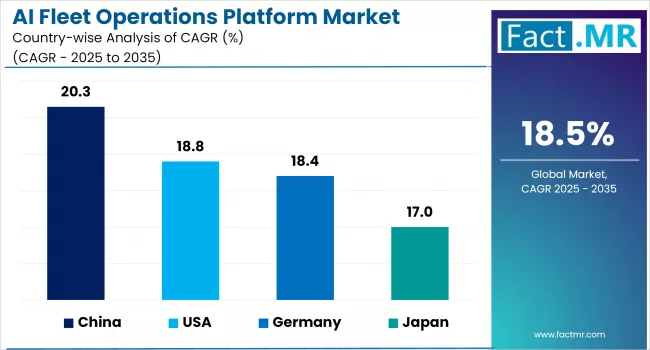
Ai Fleet Operations Platform Market Cagr By Country | Source: Fact.MR
United States is The Technology and Enterprise Leader in Fleet AI
The concentration of telematics vendors, AI startups, and cloud providers spreads across the U.S. and accelerates the innovation of products. The rapid prototyping is financed by venture capital and OEM alliances that facilitate prototyping to allow advanced analytics, computers vision, and edge inferencing capabilities. Differentiation is driven by concentrating talent in the field of software and data science.
Scalability and multi-tenancy as well as high-security and compliance capabilities are the key characteristics of SaaS platforms that are in demand by large enterprise fleets and logistics integrators in the U.S. Procurement teams will focus on the quantifiable ROI, API-level interoperability and support of complex enterprise workflow through SLA. Outcome-based contracts and modular pricing are preferred on the market as a way of controlling the total cost.
2025-to2035.webp "Us Ai Fleet Operations Platform Market Country Value(usd Million)2025 To2035")
Us Ai Fleet Operations Platform Market Country Value(usd Million)2025 To2035 | Source: Fact.MR
U.S. vendors are spreading worldwide via expansion alliances, local roll-outs and M&A to gain scale and expertise IP. Instead, export orientation is first on English-speaking markets, then regulatory adjusted offerings on Europe and Asia. There is a focus on channel partnership, OEM integrations and managed services as growth strategies in the quest to secure high-revenue enterprise accounts.
Germany is The European Center for Automotive Integration and Compliance
To make highly integrated fleet solutions, Germany is making use of its automotive engineering excellence and OEM ecosystems. Tier-1 partners and suppliers can cooperate on embedded telematics and vehicle-native data standards that permit high-fidelity diagnostics and predictive maintenance. A high-quality engineering workforce and comprehensive supply chains quickly roll out compliant, safety-conscious platforms.
The focus on emissions, safety, and data protection areas raises regulatory pressure on vendors to design their platforms that will feature other strong compliance modules and local certification. German fleets tend to procure through interoperability testing, long-term support contracts, demonstrable lifecycle cost advantages especially useful to vendors whose infrastructure has the potential to deliver enterprise-grade delivery.
China is The High-Volume EV and Integrated Hardware-Software Market Driver
China focuses on scale and bundled packages so, combining domestic telematics hardware with cloud and edge software offerings to achieve reduced time-to-deploy. Electrification incentives and smart-city pilots by government speed up the electrification efforts on logistic and municipal fleets. Telematics is embedded in local OEMs and tier suppliers, generating an effective domestic chain of offering fleet AI.
Cost- consciousness buying advantages are given to vertically integrated vendors who provide hardware, connectivity and software as a package. The strategy reduces startup costs and accelerates roll-outs and allows model training to work with large datasets. Chinese sellers highly regard on-device inferencing customized AI and cost-efficient edge inferencing to meet large ticket buyers.
The export strategies will focus on Southeast Asia, Africa and Latin America with competitive products that are localized. Chinese operators go to the extent of investing in collaborations with local telecom and logistical integrators to expand abroad. Future plans on aggressive expansions will be supported by continued investment in EV infrastructure and urban logistics platforms. Scaling is aided by talent development.
Category-Wise Analysis
Platform and Core Software are The Central Nervous System for Fleet Operations
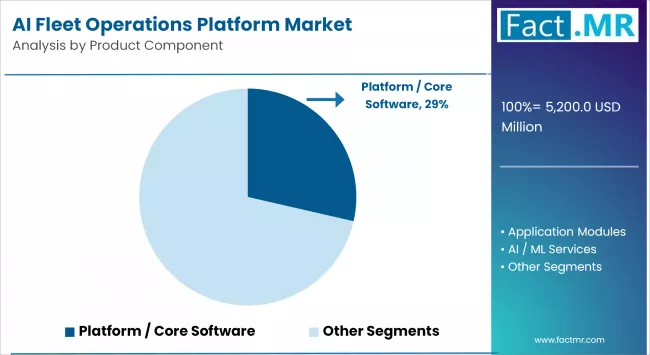
Ai Fleet Operations Platform Market By Product Component | Source: Fact.MR
The value layer will be built on platform and core software, which is a combination of streams of telematics, API management, and standardizing fleet workflows. Such platforms support modular extensions and third party integrations, as well as being the business facade of analytics, compliance and dispatch. Platform stability, uptime, and extensibility are important issues to buyers who make them part of the procurement decision drivers; this is because the platforms have material impacts on continuity of operations.
In the future, differentiation between platforms will come in the form of enterprise level security, low latency edge orchestration, and the broader ecosystem that is supported. Vendors offering strong developer tooling, certified OEM integrations and outcome-based SLAs are going to win enterprise budgets. Monetizing shifts to a mix of transaction and outcome based pricing, which aligns a vendors interests with the fleet efficiency improvements. Data residency and edge inference needs will be met using Hybrid cloud models that will develop new premium levels of AI inferencing and regulatory accreditation services.
Application Modules Drive Immediate Operational Savings and Safety Outcomes
The four application modules, namely, route optimization, predictive maintenance, driver safety, and compliance are the commercial workhorses that deliver quantifiable ROI. Business enterprises tend to buy modules in phases as value-addition in fuel savings, downtime and incidents-prevention becomes established. Modular procurement reduces the barrier to adoption and can realize custom implementations of the system to specific vehicle types and vertical needs.
The next areas of expansion of modules will be more rigorous specialization of AI models, fleets with federated learning, and real-time prescriptive responses. Those that speed time-to-value through pre-trained models, and quick integration toolkits will be the dominant vendors. Commercial models will move to performance-based pricing on fuel savings and uptime assurances that bring about shared-savings potentials. Integrating with OEMs and telcos through strategic cooperation will enhance the manufacturing speed with modular vendors instilling verticalized capabilities in the cold-chain, hazardous transport, and asset intensive segments to attract higher rates.
Competitive Analysis
Key players in the AI Fleet Operations Platform market including Geotab, Samsara, Verizon Connect, Motive, Lytx, Nauto, Autofleet, SmartDrive Systems, Teletrac Navman, Omnitracs, Trimble Transportation (Trimble), Fleet Complete (Powerfleet), MiX Telematics, Webfleet Solutions, and Azuga
The competition is based on the platforming scale and module depth. Enterprise deals go to large incumbents on the strength of integrated stacks and OEM deals, combined with extensive professional services, whereas niche vendors can differentiate on the strength of better AI models or narrower feature sets. Purchasers also prefer provable KPI, vendor SLA, provable pilots, as a de-risking behavior.
The areas of innovation competition include edge inferencing, accuracy in computer vision, EV orchestration abilities. The pricing is shifting towards outcome-based pricing and consumption-based models and squeezing the margins of vendors in non-differentiated offerings. Technological advantages will be played out in certified integrations, developer ecosystems and benchmarks of total-cost-of-ownership. The preference of buyers by the third-party authorities and regulatory bodies creates few buyers that turn to vendors that meet the standards of adoption by those platforms capable of scaling to a global market.
Recent Development
- In May 2025, Geotab announced that it had strengthened partnerships with over 80% of leading OEMs, aiming to drive data harmonization and establish industry standards across the automotive supply chain. This initiative enhanced Geotab’s telematics platform by enabling broader vehicle integration and improving data capabilities, marking a significant advancement in their offerings within the industry.
- In April 2025, Lytx launched "Lytx+ with Geotab," a unified fleet management solution that combined Lytx’s video safety insights with Geotab’s telematics. This integration aimed to enhance safety, improve operational efficiency, and achieve fleet cost savings through the use of AI and video telematics technology.
Fact.MR has provided detailed information about the price points of key manufacturers of AI Fleet Operations Platform Market positioned across regions, sales growth, production capacity, and speculative technological expansion, in the recently published report.
Methodology and Industry Tracking Approach
The 2025 AI fleet operations platform market report by Fact.MR synthesizes primary and secondary intelligence gathered between June 2024 and May 2025. Primary research incorporated structured interviews and surveys with 1,400 stakeholders across 14 countries, with a minimum of 80 respondents per country; approximately 60% of participants were end users (fleet operators, 3PLs, OEM fleet divisions, and municipal agencies) and 40% comprised procurement leads, system integrators, regulatory advisors, and technology partners.
Quantitative inputs emphasized telematics fidelity, AI model performance, EV integration readiness, interoperability, and compliance requirements. A regionally weighted calibration model ensured representation across North America, Europe, and Asia Pacific.
Secondary research drew on over 110 validated sources—industry filings, product specifications, technical papers, and investment reports—and all inputs were triangulated to produce conservative estimates and actionable, vendor-focused insights for strategy, procurement, and product development.
Fact.MR applied rigorous analytical tools such as multi-variable regression and scenario modeling to ensure data robustness. With continuous monitoring of the glass adhesives space since 2018, this report offers a comprehensive roadmap for firms seeking competitive advantage, innovation, and sustainable growth within the sector.
Segmentation
Segmentation of AI Fleet Operations Platform Market
-
By Product Component :
- Platform / Core Software
- Application Modules (Route Optimization, Predictive Maintenance, etc.)
- AI / ML Services
- Telematics & Edge Software
- Professional & Managed Services
-
By Solution Function :
- Cost & Efficiency Optimization
- Downtime & Reliability Improvement
- Safety & Risk Management
- Compliance Automation
- Sustainability & Emissions Reduction
-
By Deployment Model :
- SaaS / Cloud Hosted
- Hybrid (Edge + Cloud)
- On-Premises
-
By Vehicle Type :
- Light Commercial Vehicles (LCV)
- Heavy Commercial Vehicles (HCV)
- Passenger Car Fleets
- Specialty & Off-road Vehicles
-
By Region :
- North America
- Latin America
- Western Europe
- Eastern Europe
- East Asia
- South Asia & Pacific
- Middle East & Africa
Frequently Asked Questions
What was the Global AI Fleet Operations Platform Market Size Reported by Fact.MR for 2025?
Who are the Major Players Operating in the AI Fleet Operations Platform Market?
What is the Estimated Valuation of the AI Fleet Operations Platform Market in 2035?
What Value CAGR did the AI Fleet Operations Platform Market Exhibit Over the Last Five Years?
Who worked on this report


Preview the report firsthand - request a free sample
Free SampleGet the brochure for pricing and purchase details
Download PDF