- Base Value(2025): 6.00 Bn
- Estimated Value(2026): 6.11 Bn
- Forecast Value (2036): 7.30 Bn
- CAGR (2026 - 2036): 1.80%
Expanded Polystyrene Market Size, Market Forecast and Outlook By Fact.MR
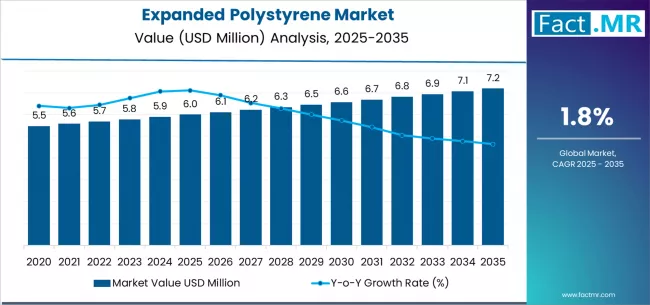
The expanded polystyrene market was valued at USD 6.00 billion in 2025, projected to reach USD 6.11 billion in 2026, and is forecast to expand to USD 7.30 billion by 2036 at a 1.80% CAGR. Building energy efficiency code compliance and the cost-effective thermal insulation requirements of residential and commercial construction continue to sustain expanded polystyrene consumption in the global building materials sector. EPS maintains a competitive position against alternative insulation materials due to its low thermal conductivity, moisture resistance, lightweight handling properties, and installed cost advantage on a per-R-value basis in wall, roof, and below-grade foundation applications.
Expanded Polystyrene Market Market Value Analysis | Source: Fact.MR
Summary of Expanded Polystyrene Market
- Market Overview
- The market is valued at USD 6.00 billion in 2025 and is projected to reach USD 7.30 billion by 2036.
- The industry is expected to grow at a 1.80% CAGR from 2026 to 2036, creating an incremental opportunity of USD 1.19 billion.
- The market operates as a mature, cost-driven building insulation and protective packaging category where thermal performance per unit cost, moisture resistance, and installed weight advantage define competitive positioning against polyisocyanurate, mineral wool, and alternative polymer foam insulation systems.
- Demand and Growth Drivers
- Building energy efficiency codes requiring continuous insulation in wall, roof, and below-grade foundation assemblies sustain baseline EPS consumption in residential and commercial construction.
- Protective packaging applications for electronics, appliances, and cold chain food distribution maintain a diversified consumption base alongside construction insulation demand.
- Cost-per-R-value advantage over polyisocyanurate and mineral wool insulation on installed basis supports EPS specification in cost-sensitive residential construction projects.
- Among key countries, the USA leads at 2.2% CAGR, followed by Mexico at 1.9%, Germany at 1.6%, France at 1.5%, the UK at 1.3%, South Korea at 1.2%, and Japan at 1.1%.
- Product and Segment View
- Expanded polystyrene is a rigid, closed-cell foam produced by expanding polystyrene beads with a blowing agent, creating a lightweight material with low thermal conductivity used in building insulation and protective packaging.
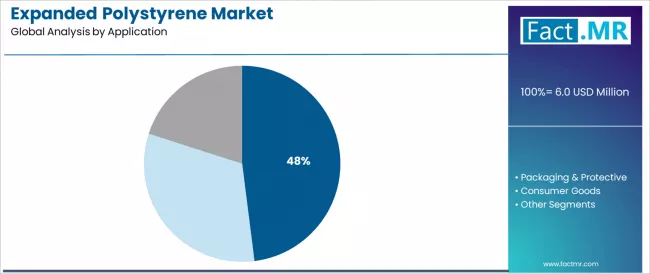
- Building & Insulation holds 48.0% of the Application segment in 2026, reflecting EPS use in wall sheathing, roof insulation, below-grade foundation boards, and insulated concrete form systems.
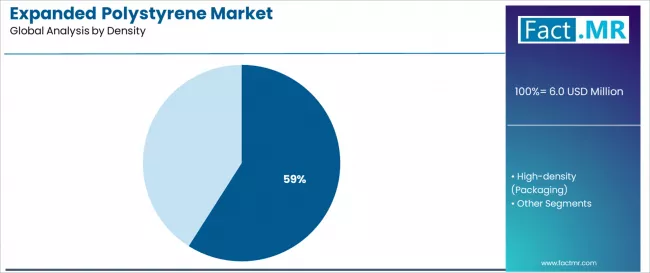
- Low-density EPS accounts for 59.0% of the Density segment in 2026, preferred for general building insulation applications where thermal resistance per unit thickness at minimum weight is the primary specification.
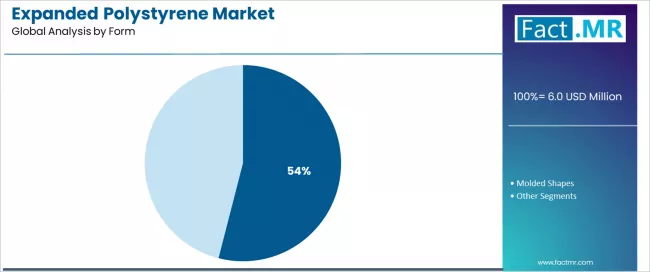
- Blocks & Sheets command 54.0% of the Form segment in 2026, representing the primary product format for cut-to-size insulation boards and structural insulated panel cores.
- Scope includes low and high-density EPS in block, sheet, and molded forms for building insulation, packaging, and consumer goods applications. Extruded polystyrene (XPS), polyurethane spray foam, mineral wool, and single-use EPS foodservice containers are excluded.
- Geography and Competitive Outlook
- The USA and Mexico are the primary demand centres, driven by residential construction activity, energy code compliance requirements, and cold chain packaging consumption.
- Germany and France anchor European demand through building renovation insulation mandates and packaging sector consumption.
- Competition is shaped by EPS bead production scale, converter network density, and recycling infrastructure investment, with BASF SE, Dow Inc., TotalEnergies SE, Knauf Insulation GmbH, and JSP Corporation among the principal suppliers.
- Analyst Opinion at Fact.MR
- Shambhu Nath Jha , Principal Consultant for Chemicals and Materials, opines: 'In my analysis, I have observed that the expanded polystyrene market faces a structural bifurcation between building insulation growth and packaging contraction. Municipal single-use EPS packaging bans in major U.S. and European cities are progressively shrinking the protective packaging addressable market, while building energy code tightening sustains insulation demand. EPS producers that invest in chemical recycling infrastructure to convert post-consumer EPS waste back into styrene monomer feedstock will address the environmental regulatory headwind while securing a cost-advantaged raw material supply loop.'
- Strategic Implications / Executive Takeaways
- EPS producers must invest in chemical recycling infrastructure that converts post-consumer EPS waste into styrene monomer to address regulatory environmental concerns and secure cost-advantaged feedstock.
- Building insulation converters should develop high-performance graphite-enhanced EPS grades that deliver higher R-value per inch to maintain competitive positioning against polyisocyanurate alternatives.
- Packaging division directors need to accelerate transition from single-use EPS protective packaging toward reusable EPS systems with deposit-return logistics to preempt municipal ban expansion.
Expanded Polystyrene Market Key Takeaways
| Metric | Details |
|---|---|
| Industry Size (2026) | USD 6.11 billion |
| Industry Value (2036) | USD 7.30 billion |
| CAGR (2026 to 2036) | 1.80% |
Source: Fact.MR analysis. Updated Mar 31, 2026
Between 2026 and 2036, the market is set to register an absolute dollar opportunity of USD 1.19 billion. This modest trajectory reflects the mature, slow-growth character of the EPS market, constrained by increasing regulatory scrutiny of polystyrene waste, municipal single-use EPS packaging bans, and competition from polyisocyanurate and mineral wool insulation alternatives. Styrene monomer feedstock pricing, linked to benzene and ethylene petrochemical markets, introduces margin variability for EPS bead producers and converters.
The USA leads with a 2.2% CAGR, supported by residential construction activity and commercial building energy code compliance requiring continuous insulation. Mexico follows at 1.9%, driven by housing construction and cold chain packaging demand. Germany registers 1.6%, anchored by building renovation insulation requirements. France tracks at 1.5%, the UK at 1.3%, South Korea at 1.2%, and Japan at 1.1%.
Why is the Expanded Polystyrene Market Growing?
Energy efficiency demand creates compelling operational advantages through EPS that provides immediate thermal insulation and weight reduction benefits without conventional material limitations, enabling manufacturers to meet building requirements while maintaining structural efficacy and reducing energy complexity.
Lightweight packaging development accelerates as construction processing facilities worldwide seek advanced foam systems that complement traditional building processes, enabling precise thermal delivery and weight control that align with industry standards and energy regulations.
Consumer goods supplementation drives adoption from manufacturers and packaging producers requiring effective lightweight compounds that maximize insulation benefits while maintaining operational productivity during manufacturing and foam integration operations.
Growth is likely to face headwinds from environmental complexity that varies across foam suppliers regarding the recyclability of EPS and sustainability processing requirements, which may limit adoption in environmentally sensitive markets.
Technical limitations also persist regarding foam degradation and performance conditions that may reduce effectiveness in extreme temperature, UV exposure, or extended outdoor conditions, affecting material quality and insulation consistency.
Opportunity Pathways - Expanded Polystyrene Market
The expanded polystyrene market represents a thermal insulation opportunity driven by expanding energy efficiency trends, construction modernization, and the need for superior insulation effectiveness in diverse building applications. As manufacturers worldwide seek to achieve 95-98% thermal effectiveness, reduce material weight, and integrate advanced foam systems with automated platforms, EPS is evolving from basic foam to sophisticated insulation solutions ensuring energy quality and thermal benefits.
The market's growth trajectory from USD 6.0 million in 2025 to USD 7.2 million by 2035 at a 1.8% CAGR reflects fundamental shifts in construction preferences and thermal foam optimization. Geographic expansion opportunities are particularly pronounced in North American markets, while the dominance of building and insulation applications (48.0% market share) and low-density EPS (59.0% share) provides clear strategic focus areas.
- Pathway A - Building & Insulation Leadership & Advanced Foam OptimizationStrengthening the dominant building and insulation segment (48.0% market share) through enhanced foam formulations, superior thermal content, and automated processing systems. This pathway focuses on optimizing insulation performance, improving energy efficiency, extending operational effectiveness to 95-98% success rates, and developing specialized formulations for diverse construction applications. Market leadership consolidation through advanced foam engineering and automated production integration enables premium positioning while defending competitive advantages against alternative insulation materials. Expected revenue pool: USD 0.346-0.467 million
- Pathway B - North America Distribution Expansion & Market LocalizationRapid construction and packaging growth across North America creates substantial expansion opportunities through local distribution capabilities and construction partnerships. Growing energy efficiency consciousness and thermal insulation trends drive sustained demand for advanced foam systems. Distribution strategies reduce supply chain costs, enable faster product availability, and position companies advantageously for construction programs while accessing growing domestic markets. Expected revenue pool: USD 0.277-0.374 million
- Pathway C - Low-density EPS Market Dominance & Manufacturing IntegrationExpansion within the dominant low-density EPS segment (59.0% market share) through specialized insulation commerce addressing manufacturer preferences and processor requirements. This pathway encompasses foam marketing systems, manufacturer engagement integration, and compatibility with diverse insulation platforms. Premium positioning reflects superior product accessibility and comprehensive construction compliance supporting modern building commerce. Expected revenue pool: USD 0.226-0.305 million
- Pathway D - Packaging & Protective Application DiversificationStrategic expansion into packaging and protective applications (32.0% market share) requires enhanced protective capabilities and specialized processing addressing packaging requirements. This pathway addresses shock absorption, protective packaging, and shipping integration with advanced processing for demanding packaging conditions. Premium pricing reflects specialized performance requirements and extended durability standards. Expected revenue pool: USD 0.185-0.250 million
- Pathway E - Blocks & Sheets InnovationDevelopment of specialized blocks and sheets for construction applications (54.0% share), addressing specific performance requirements and building demands. This pathway encompasses high-performance foam products, construction applications, and cost-effective alternatives for building markets. Technology differentiation through proprietary foam processing enables diversified revenue streams while reducing dependency on single form types. Expected revenue pool: USD 0.154-0.208 million
- Pathway F - Consumer Goods Development & Product IntegrationExpansion of consumer goods segment (20.0% market share) through enhanced product properties, consumer applications, and specialized consumer requirements. This pathway encompasses advanced consumer development, product applications, and specialty consumer products requiring lightweight characteristics. Market development through advanced foam engineering enables differentiated positioning while accessing consumer markets requiring foam solutions. Expected revenue pool: USD 0.130-0.176 million
- Pathway G - Environmental Compliance & Sustainable Production DevelopmentDevelopment of environmentally superior EPS production addressing regulatory compliance and sustainability requirements across building and packaging applications. This pathway encompasses sustainable foam manufacturing practices, recyclable processing methods, and comprehensive environmental documentation. Premium positioning reflects environmental leadership and regulatory expertise while enabling access to environmentally-focused procurement programs and sustainability-driven partnerships. Expected revenue pool: USD 0.110-0.149 million
Segmental Analysis
The market segments by application into building & insulation, packaging & protective, and consumer goods categories, representing the evolution from traditional foam materials to specialized insulation solutions for comprehensive thermal optimization.
By density, the market’s segmentation includes low-density EPS and high-density EPS, reflecting distinct requirements for insulation performance, structural strength, and application standards.
Form segmentation covers blocks & sheets and molded shapes categories, with blocks and sheets leading adoption while molded shapes show steady growth patterns driven by manufacturing convenience expansion programs.
The segmentation structure reveals technology progression from standard foam processing toward specialized insulation systems with enhanced thermal and structural capabilities, while application diversity spans from construction to specialized packaging and consumer applications requiring precise foam solutions.
By Application, the Building & Insulation Segment Accounts for Dominant Market Share
Expanded Polystyrene Market Analysis By Application | Source: Fact.MR
Building and insulation systems command the leading position in the expanded polystyrene market with approximately 48.0% market share through advanced thermal features, including superior insulation content, flexible application capability, and energy optimization that enable manufacturers to achieve optimal thermal benefits across diverse construction and building environments.
The segment benefits from manufacturer preference for reliable insulation systems that provide consistent thermal performance, reduced energy costs, and insulation efficiency optimization without requiring significant installation modifications. Advanced foam features enable automated construction systems, thermal consistency, and integration with existing building equipment, where thermal performance and energy reliability represent critical operational requirements.
Building and insulation systems differentiate through proven thermal stability, consistent insulation characteristics, and integration with automated construction systems that enhance operational effectiveness while maintaining optimal quality suitable for diverse building and construction applications.
Key market characteristics:
- Advanced foam formulations with optimized thermal content and insulation capabilities
- Extended operational effectiveness, enabling 95-98% thermal performance success with consistent energy quality
- Manufacturing compatibility, including automated foam systems, thermal monitoring, and process integration for construction and building operations
Packaging & Protective Applications Show Strong Market Growth
Packaging and protective application systems maintain a significant 32.0% market share in the Expanded Polystyrene market due to their specialized protective properties and versatile application advantages.
Packaging & protective application appeal to manufacturers requiring high-performance foam materials with consistent characteristics for packaging formulation, protective applications, and specialty shipping. Market growth is driven by packaging industry expansion, emphasizing reliable foam solutions and operational efficiency through optimized foam systems.
By Density, the Low-density EPS Segment Accounts for the Largest Market Share
Expanded Polystyrene Market Analysis By Density | Source: Fact.MR
Low-density EPS dominates the expanded polystyrene market with approximately 59.0% market share due to widespread adoption of insulation platforms and increasing focus on thermal precision, weight accessibility, and insulation applications that minimize weight limitations while maintaining thermal quality standards.
Construction manufacturers prioritize foam performance, thermal convenience, and integration with existing construction infrastructure that enables coordinated building across multiple construction categories. The segment benefits from substantial energy investment and modernization programs that emphasize the acquisition of low-density EPS systems for construction formulation and thermal efficiency applications.
Construction expansion programs incorporate EPS as premium insulation for specialized energy operations, while insulation-focused trends increase demand for advanced foam capabilities that comply with building standards and minimize thermal losses.
Density dynamics include:
- Strong growth in construction and building platforms requiring premium foam capabilities
- Increasing adoption in construction services for thermal management access
- Rising integration with automated construction fulfillment systems for distribution optimization and contractor satisfaction
High-density EPS Demonstrates Steady Growth
High-density EPS captures approximately 41.0% market share through specialized structural requirements in construction platforms, packaging manufacturers, and protective applications. These facilities demand robust foam systems capable of operating in diverse structural conditions while providing effective load bearing and protective capabilities.
By Form, Blocks & Sheets Shows Traditional Demand
Expanded Polystyrene Market Analysis By Form | Source: Fact.MR
Blocks and sheets distribution accounts for approximately 54.0% market share, including foam suppliers, construction companies, and specialty foam manufacturers requiring product distribution capabilities for contractor accessibility and market penetration.
What are the Drivers, Restraints, and Key Trends of the Expanded Polystyrene Market?
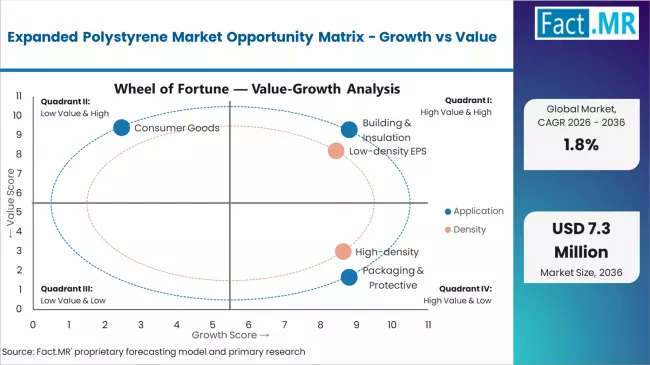
Expanded Polystyrene Market Opportunity Matrix Growth Vs Value | Source: Fact.MR
Energy efficiency trends drive primary adoption as EPS provides thermal insulation capabilities that enable manufacturers to meet construction demands without weight limitations, supporting sustainable building operations and energy missions that require thermal foam applications.
Energy consciousness accelerates market expansion as manufacturers seek effective foam systems that minimize thermal losses while maintaining structural effectiveness during construction and building scenarios.
Lightweight construction spending increases worldwide, creating sustained demand for foam systems that complement traditional construction processes and provide operational flexibility in complex thermal management environments.
Environmental complexity varies across foam suppliers regarding the recyclability of EPS and sustainability processing requirements, which may limit operational flexibility and market penetration in regions with limited environmental capacity or sustainability-sensitive construction operations.
Foam degradation limitations persist regarding performance and environmental conditions that may reduce effectiveness in extreme temperature, UV exposure, or extended outdoor conditions, affecting material quality and insulation consistency.
Market fragmentation across multiple construction specifications and building standards creates compatibility concerns between different suppliers and existing construction infrastructure.
Adoption accelerates in construction and packaging sectors where thermal requirements justify foam system costs, with geographic concentration in developed markets transitioning toward mainstream adoption in emerging economies driven by energy consciousness expansion and construction development.
Technology development focuses on enhanced foam capabilities, improved thermal performance, and integration with automated construction systems that optimize insulation effectiveness and operational reliability.
The market could face disruption if alternative insulation materials or environmental regulations significantly limit the deployment of polystyrene-based systems in construction or packaging applications, though foam's unique combination of thermal benefits, lightweight properties, and construction positioning continues to make them valuable in specialty construction applications.
Analysis of the Expanded Polystyrene Market by Key Country
The expanded polystyrene market demonstrates varied regional dynamics with growth leaders including the USA (2.2% CAGR) and Mexico (1.9% CAGR) driving expansion through construction capacity additions and foam development programs.
Steady performers encompass Germany (1.6% CAGR), France (1.5% CAGR), and UK (1.3% CAGR), benefiting from established construction industries and advanced insulation adoption. Mature markets feature South Korea (1.2% CAGR) and Japan (1.1% CAGR), where specialized construction applications and foam technology integration support consistent growth patterns.
.webp "Top Country Growth Comparison Expanded Polystyrene Market Cagr (2026 2036)")
Top Country Growth Comparison Expanded Polystyrene Market Cagr (2026 2036) | Source: Fact.MR
| Country | CAGR (2026-2036) |
|---|---|
| USA | 2.2% |
| Mexico | 1.9% |
| Germany | 1.6% |
| France | 1.5% |
| UK | 1.3% |
| South Korea | 1.2% |
| Japan | 1.1% |
Source: Fact.MR analysis. Updated Mar 31, 2026
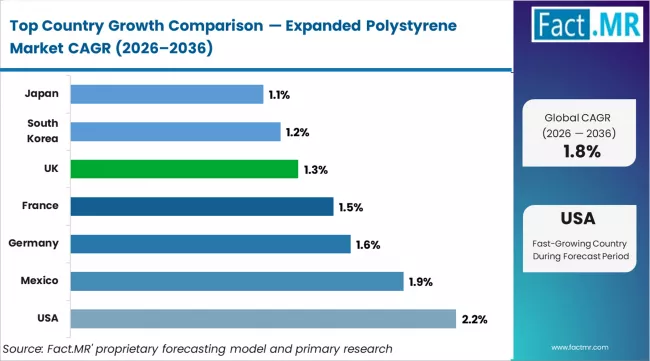
Expanded Polystyrene Market Cagr Analysis By Country | Source: Fact.MR
Regional synthesis reveals developed markets leading adoption through construction expansion and insulation infrastructure development, while emerging countries maintain strong expansion supported by foam technology advancement and construction standardization requirements. North American markets show robust growth driven by construction industry applications and insulation integration trends.
USA Demonstrates Technology Innovation
The US market emphasizes advanced foam features, including precision thermal control and integration with comprehensive construction platforms that manage product quality, efficiency optimization, and cost control applications through unified monitoring systems. The country demonstrates strong growth at 2.2% CAGR, driven by construction modernization, energy initiative projects, and emerging insulation applications that support foam system integration. American construction manufacturers prioritize operational effectiveness with EPS delivering consistent foam performance through advanced processing algorithms and thermal adaptation capabilities.
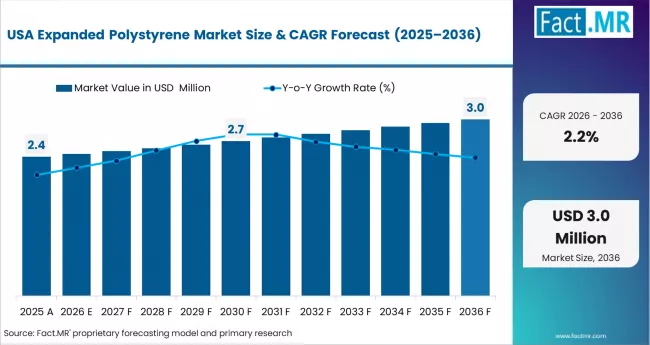
Expanded Polystyrene Market Country Value Analysis | Source: Fact.MR
Technology deployment channels include major construction manufacturers, specialized foam suppliers, and energy procurement programs that support professional applications for complex construction production and foam applications. Foam platform integration capabilities with established construction systems expand market appeal across diverse operational requirements seeking thermal and reliability benefits. The resilient construction sector and expanding energy capacity additions create sustained demand, while innovative applications in advanced insulation open new growth avenues.
Performance Metrics:
- Construction manufacturing facilities in Texas, California, and Florida leading adoption for thermal insulation operations
- Foam contractor channels maintaining 78% market share for complex construction integration applications
- Commercial energy programs supporting 27% of system acquisitions across construction and building facilities
- Foam platform compatibility with major construction systems driving procurement selection criteria
Germany Maintains Technology Leadership
Germany's advanced construction market demonstrates sophisticated EPS deployment with documented operational effectiveness in construction applications and foam processing facilities through integration with existing processing systems and production infrastructure. The country leverages engineering expertise in construction technology and foam systems integration to maintain strong growth at 1.6% CAGR. Industrial centers, including North Rhine-Westphalia, Bavaria, and Baden-Württemberg, showcase premium installations where foam systems integrate with comprehensive construction platforms and building management systems to optimize production and foam effectiveness.
German construction companies prioritize system reliability and EU compliance in foam development, creating demand for premium foam systems with advanced features, including production monitoring integration and automated processing systems. The market benefits from established construction infrastructure and a willingness to invest in advanced thermal technologies that provide long-term operational benefits and compliance with international construction safety and foam standards. Premium construction applications, specialty foam systems, and energy programs drive diversified demand across multiple end-use segments.
Market Intelligence Brief:
- Engineering focuses on EU standardization and construction safety compliance, driving premium segment growth
- Construction partnerships providing 45% faster development cycles
- Technology collaboration between German construction companies and international foam companies
- Energy training programs expanding foam system integration in construction and building scenarios
France Shows Balanced Construction Growth
France maintains steady expansion at 1.5% CAGR through diversified demand from construction programs, building modernization activities, and foam development projects. Major construction regions in Île-de-France, Provence-Alpes-Côte d'Azur, and Rhône-Alpes drive EPS adoption for commercial and residential construction production. Construction research and development programs create sustained foam demand, while premium energy applications provide additional growth opportunities. Government support for energy innovation and construction quality initiatives supports consistent market development.
Market Characteristics:
- Advanced construction research capabilities and building regulations are creating demand for innovative foam technologies supporting thermal development and construction optimization
- Strong construction tradition and energy excellence leadership are driving the adoption of premium foam technologies and advanced materials throughout construction facilities
UK Drives Construction Processing and Foam Integration
The UK market holds steady growth at 1.3% CAGR, driven by construction modernization activities, energy programs, and foam adoption trends. British construction facilities and foam companies are implementing advanced EPS systems to enhance production capabilities and support construction operations that align with energy regulations and quality standards. Market expansion benefits from government construction quality programs that mandate thermal capabilities in foam processing and construction specifications, creating sustained demand where operational flexibility and foam compliance represent critical requirements.
Strategic Market Indicators:
- Construction and foam facilities leading adoption with modernization programs requiring advanced foam systems
- Government construction quality programs providing regulatory support for advanced foam system acquisition
- Energy compliance requirements driving demand for standardized systems with international operational compatibility
- Specialized premium energy and construction segments adopting comprehensive foam solutions for construction optimization
Japan Emphasizes Precision and Construction Excellence
Japan demonstrates steady market development with a 1.1% CAGR, distinguished by construction and energy producers' preference for high-quality EPS systems that integrate seamlessly with existing production systems and provide reliable long-term operation in specialized foam applications. The market prioritizes advanced features, including precision thermal control, stability durability, and integration with comprehensive foam platforms that reflect Japanese industry expectations for technological sophistication and operational excellence.
High-specification construction and specialty premium energy applications drive demand, supported by advanced foam research and development initiatives. Japanese manufacturers emphasize foam purity, consistent performance characteristics, and comprehensive quality documentation that aligns with stringent construction industry standards. The focus on premium applications and technical excellence supports stable growth despite mature market conditions.
Market Characteristics:
- Premium focus on building systems with advanced foam algorithms and precision thermal capabilities
- Integration requirements with existing construction and energy platforms
- Emphasis on operational reliability and long-term durability in construction and energy applications
South Korea Emphasizes Advanced Construction Integration
South Korea demonstrates robust market development with a 1.2% CAGR, distinguished by construction and energy producers' preference for high-quality EPS systems that integrate seamlessly with existing production systems and provide reliable long-term operation in specialized foam applications. The market prioritizes advanced features, including precision thermal control, stability durability, and integration with comprehensive foam platforms that reflect Korean industry expectations for technological sophistication and operational excellence.
Growth drivers encompass building applications, expanding construction modernization requirements, and advanced foam system integration. Korean manufacturers emphasize quality control systems and comprehensive technical support that align with domestic construction industry standards. The convergence of high-tech construction processing, energy innovation, and growing foam production creates diversified demand across multiple application segments.
Market Characteristics:
- Premium focus on building systems with advanced foam algorithms and precision thermal capabilities
- Integration requirements with existing construction and energy platforms
- Emphasis on operational reliability and long-term durability in construction and building applications
Mexico Emerges as High-Growth Market
Mexico leads growth momentum with a 1.9% CAGR, driven by rapid construction industry modernization, expanding energy applications, and foam development adoption across major regions including Mexico City, Guadalajara, and industrial zones. Construction industry development and energy requirements drive primary demand, while growing construction manufacturing and building sectors create diversified application opportunities. Government construction industry initiatives and energy programs support sustained expansion. The convergence of construction industry modernization, energy growth, and foam capacity expansion positions Mexico as a key emerging market for EPS systems.
Strategic Market Indicators:
- Government support for construction industry development and energy expansion is driving demand for specialty foam processing throughout major regions and construction clusters across construction facilities, energy centers, and foam manufacturing centers
- Strong construction sector growth and an expanding network of building facilities are supporting the rapid adoption of EPS technologies among construction manufacturers seeking enhanced thermal efficiency and superior foam offerings
Europe Market Split by Country
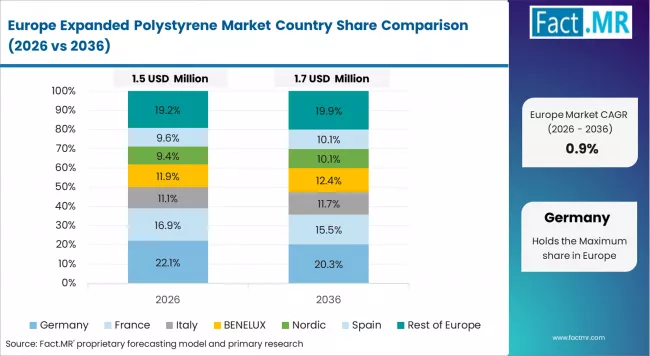
Expanded Polystyrene Market Europe Country Market Share Analysis, 2026 & 2036 | Source: Fact.MR
The European Expanded Polystyrene market is projected to grow from USD 1.80 million in 2026 to USD 2.16 million by 2036, registering a CAGR of 1.8% over the forecast period. Germany is expected to maintain its leadership position with a 28.1% market share in 2026, declining slightly to 27.7% by 2036, supported by its advanced construction infrastructure and major building centers in North Rhine-Westphalia and Bavaria.
France follows with a 20.3% share in 2026, projected to reach 20.5% by 2036, driven by comprehensive construction modernization programs and energy initiatives. The UK holds a 18.2% share in 2026, expected to moderate to 17.9% by 2036 through specialized construction activities and energy applications. Italy commands a 13.1% share in 2026, rising to 13.3% by 2036 through strong construction and energy projects. Spain accounts for 9.2% in 2026, reaching 9.4% by 2036 aided by construction modernization and energy applications. The Netherlands maintains a 4.3% share in 2026, increasing to 4.4% by 2036 driven by specialty construction and foam innovation demand. The Rest of Europe region is anticipated to hold 6.8% in 2026, increasing to 6.8% by 2036, reflecting steady adoption in Nordic countries and Central & Eastern European construction upgrades.
Building & Insulation Dominate Application Demand in Japan
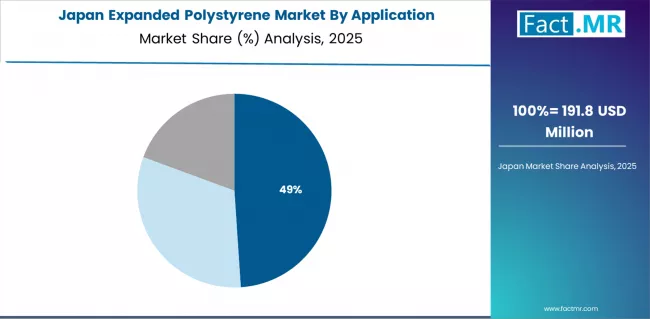
Expanded Polystyrene Market Japan Market Share Analysis By Application | Source: Fact.MR
In Japan, the Expanded Polystyrene market prioritizes building and insulation systems, which capture the dominant share of construction and energy installations due to their advanced features, including precision thermal optimization and seamless integration with existing construction infrastructure. Japanese construction manufacturers emphasize reliability, precision, and long-term operational excellence, creating demand for building systems that provide consistent foam performance and adaptive thermal capabilities based on construction requirements and energy conditions. Packaging and protective application systems maintain secondary positions primarily in specialized packaging applications and construction installations where comprehensive protective functionality meets operational requirements without compromising construction efficiency.
Strategic Market Indicators:
- Premium focus on building systems with advanced foam algorithms and precision thermal capabilities
- Integration requirements with existing construction platforms and energy systems
- Emphasis on operational reliability and long-term durability in construction and energy applications
Chemical Companies Lead Construction Services in South Korea
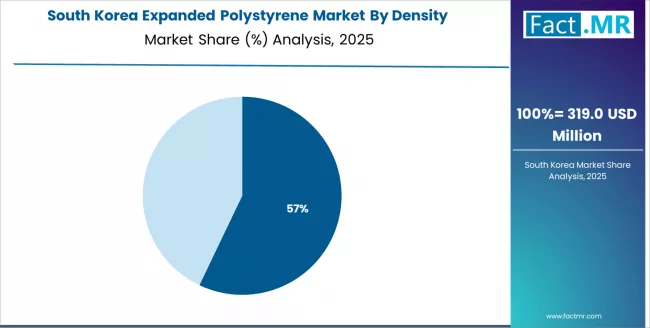
Expanded Polystyrene Market South Korea Market Share Analysis By Density | Source: Fact.MR
In South Korea, the market structure favors international chemical companies, including BASF, Dow, and TotalEnergies, which maintain dominant positions through comprehensive product portfolios and established construction industry networks supporting both manufacturing operations and construction installations. These providers offer integrated solutions combining advanced EPS systems with professional application services and ongoing technical support that appeal to Korean manufacturers seeking reliable thermal systems. Local construction contractors and system integrators capture a moderate market share by providing localized service capabilities and competitive pricing for standard construction installations, while domestic manufacturers focus on specialized applications and cost-effective solutions tailored to Korean construction industry characteristics.
Channel Insights:
- International chemical brands maintaining premium market positioning through advanced thermal offerings
- Local construction industry networks expanding to support growing demand for professional foam processing and maintenance
- System integration capabilities becoming a key differentiator for facility-wide and construction applications
Competitive Landscape of the Expanded Polystyrene Market
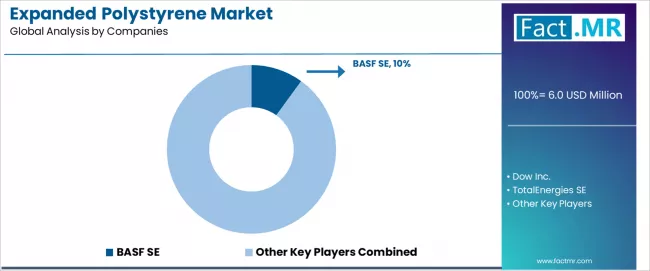
Expanded Polystyrene Market Analysis By Company | Source: Fact.MR
The expanded polystyrene market operates with moderate concentration, featuring approximately 8-10 meaningful participants, where leading companies control roughly 35-42% of the global market share through established construction relationships and comprehensive foam portfolios.
Competition emphasizes advanced foam capabilities, system reliability, and thermal integration rather than price-based rivalry. The leading company, BASF, commands approximately 10.0% market share through its specialized EPS expertise and extensive construction and building industry presence.
Market leaders encompass BASF, Dow, and TotalEnergies, which maintain competitive advantages through extensive foam development expertise, global construction contractor networks, and comprehensive system integration capabilities that create customer switching costs and support premium pricing. These companies leverage years of foam technology experience and ongoing research investments to develop advanced EPS systems with precision thermal control and insulation monitoring features.
Technology innovators include Braskem, Knauf Insulation, and Salux, which compete through specialized foam technology focus and innovative application interfaces that appeal to manufacturers seeking advanced construction capabilities and operational flexibility. These companies differentiate through rapid foam development cycles and specialized construction and packaging application focus.
Regional specialists feature companies like ACH Foam Technologies, JSP Corporation, Sealed Air, Armacell, and various regional suppliers, which focus on specific geographic markets and specialized applications, including EPS-based systems and integrated construction solutions.
Market dynamics favor participants that combine reliable foam capabilities with advanced application software, including precision thermal control and automatic insulation optimization capabilities. Competitive pressure intensifies as traditional construction contractors expand into foam systems, while specialized foam companies challenge established players through innovative thermal solutions and cost-effective platforms targeting specialized construction and packaging segments.
Key Players in the Expanded Polystyrene Market
- BASF SE
- Dow Inc.
- TotalEnergies SE
- Braskem S.A.
- Knauf Insulation GmbH
- Salux GmbH
- ACH Foam Technologies, LLC
- JSP Corporation
- Sealed Air Corporation
- Armacell International S.A.
Bibliography
- International Code Council. (2024). International Energy Conservation Code: Continuous insulation requirements. ICC.
- European Manufacturers of Expanded Polystyrene. (2025). EUMEPS annual industry statistics: Production and recycling data. EUMEPS.
- U.S. Census Bureau. (2025). Value of construction put in place: Insulation material expenditure. U.S. Department of Commerce.
- European Commission. (2024). Energy Performance of Buildings Directive: Insulation specification standards. EC.
- Plastics Industry Association. (2025). U.S. expanded polystyrene market data report. PLASTICS.
This bibliography is provided for reader reference. The full Fact.MR report contains the complete reference list with primary research documentation.
This Report Addresses
- Market sizing and quantitative forecast metrics detailing EPS expenditure across global building insulation, packaging, and consumer goods sectors through 2036.
- Segmentation analysis mapping consumption velocity across building insulation, packaging, and consumer goods applications and evaluating low versus high-density demand dynamics.
- Country-level deployment intelligence comparing building energy code stringency, construction activity, and packaging regulation impact across USA, Mexico, Germany, France, UK, South Korea, and Japan.
- Competitive material assessment analyzing EPS positioning against polyisocyanurate, mineral wool, and alternative polymer foam insulation on thermal performance, cost, and environmental compliance metrics.
- Recycling and sustainability assessment evaluating chemical recycling technology readiness, post-consumer collection infrastructure, and regulatory environmental impact on EPS market growth.
- Regulatory compliance assessment identifying building energy code insulation requirements and municipal packaging ban legislation across covered markets.
- Custom data delivery formats encompassing interactive dashboards, raw Excel datasets, and comprehensive PDF narrative reports.
Expanded Polystyrene Market Definition
Expanded polystyrene (EPS) is a rigid, closed-cell polymer foam produced by expanding polystyrene beads with a hydrocarbon blowing agent, creating a lightweight, thermally insulating material with low moisture absorption. Products include insulation boards, molded packaging shapes, and structural building components. The market covers production, conversion, and sale of EPS products globally.
Expanded Polystyrene Market Inclusions
Market scope includes low-density and high-density EPS in block, sheet, and molded form for building insulation, protective packaging, and consumer goods applications. Country coverage spans USA, Mexico, Germany, France, UK, South Korea, and Japan. Forecast covers 2026 to 2036 with base year 2025.
Expanded Polystyrene Market Exclusions
Extruded polystyrene (XPS) foam boards, polyurethane spray foam insulation, mineral wool insulation, single-use EPS foodservice containers and cups, and raw polystyrene resin supply are excluded.
Expanded Polystyrene Market Research Methodology
- Primary Research: Analysts engaged with building insulation specification consultants, EPS converter operations managers, and packaging procurement directors to map construction code compliance requirements, product specifications, and competitive material substitution dynamics.
- Desk Research: Data collection phases aggregated national building energy code adoption schedules, construction material expenditure data, and municipal EPS packaging ban legislation records from covered countries.
- Market-Sizing and Forecasting: Baseline values derive from a bottom-up aggregation of EPS production and conversion volumes by density and application, applying construction activity indices and packaging consumption rates to project demand velocity.
- Data Validation and Update Cycle: Projections are tested against publicly reported construction material expenditure data from national statistics agencies and EPS industry production statistics from the European Manufacturers of Expanded Polystyrene association.
Segmentation
Scope of the Report
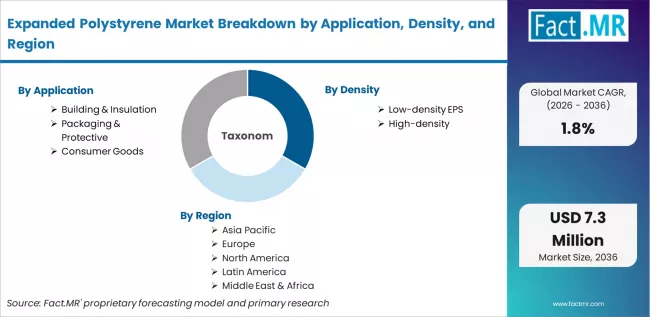
Expanded Polystyrene Market Breakdown By Application, Density, And Region | Source: Fact.MR
| Metric | Value |
|---|---|
| Quantitative Units | USD 6.11 billion to USD 7.30 billion, at a CAGR of 1.80% |
| Market Definition | Expanded polystyrene encompasses rigid closed-cell polymer foam in low and high-density grades produced as blocks, sheets, and molded shapes for building insulation, protective packaging, and consumer goods applications globally. |
| Application Segmentation | Building & Insulation, Packaging & Protective, Consumer Goods |
| Density Segmentation | Low-density EPS, High-density |
| Form Segmentation | Blocks & Sheets, Molded Shapes |
| Regions Covered | USA, Mexico, Germany, France, UK, South Korea, Japan |
| Key Companies Profiled | BASF SE, Dow Inc., TotalEnergies SE, Braskem S.A., Knauf Insulation GmbH, Salux GmbH, ACH Foam Technologies, LLC, JSP Corporation, Sealed Air Corporation, Armacell International S.A. |
| Forecast Period | 2026 to 2036 |
| Approach | Forecasting models apply a bottom-up methodology starting with residential and commercial construction permit data and packaging consumption indices, cross-validated against EPS converter production records and building code compliance schedules. |
Source: Fact.MR analysis. Updated Mar 31, 2026
Expanded Polystyrene Market by Segments
-
Application :
- Building & Insulation
- Packaging & Protective
- Consumer Goods
-
Density :
- Low-density EPS (Insulation)
- High-density (Packaging)
-
Form :
- Blocks & Sheets
- Molded Shapes
-
Region :
- North America
- USA
- Canada
- Mexico
- Europe
- Germany
- France
- UK
- Italy
- Spain
- Netherlands
- Nordic
- Rest of Europe
- Asia Pacific
- Japan
- South Korea
- China
- India
- ASEAN
- Australia & New Zealand
- Rest of Asia Pacific
- Latin America
- Brazil
- Argentina
- Rest of Latin America
- Middle East & Africa
- GCC Countries
- South Africa
- Rest of Middle East & Africa
- North America
Frequently Asked Questions
How large is the expanded polystyrene market in 2026?
What will be the market size by 2036?
What is the expected demand growth between 2026 and 2036?
Which Application leads?
Which Density commands the largest share?
Which country is the fastest-growing?
What is included in the scope?
What is excluded?
Who worked on this report


Preview the report firsthand - request a free sample
Free SampleGet the brochure for pricing and purchase details
Download PDF