- Base Value(2024): 40.1 Bn
- Estimated Value(2024): 40.1 Bn
- Forecast Value (2035): 451 Bn
- CAGR (2024 - 2035): 25.4%
Payment Gateway Market Outlook (2025 to 2035)
The global payment gateway market is projected to grow from USD 40.1 billion in 2024 to USD 451 billion by 2035. During the forecast period 2025 to 2035, the industry is projected to register at a CAGR of 24.6%.
Payment gateways play an essential role in securing and processing real-time digital transactions between customers and merchants across various industries. They authenticate, encrypt, and route payment messages, and assist with internet purchases, payment of services, and mobile shopping applications.
2025-to-2035.webp "Us Payment Gateway Market Market Value(usd Billion)2025 To 2035")
Us Payment Gateway Market Market Value(usd Billion)2025 To 2035 | Source: Fact.MR
With the rise of e-commerce, advancements in financial technology, and a shift toward cashless transactions, payment gateways have become a necessary component of routine business operations and digital financial systems worldwide.
Quick Facts about Payment Gateway Market
- Industry Value (2025): USD 50 Billion
- Projected Value (2035): USD 451 Billion
- Forecast CAGR (2025 to 2035): 24.6%
- Leading Segment (2025): Hosted Payment Gateways (30% Market Share)
- Country Growth Rate (2025 to 2035): India (26.5% CAGR)
- Top Key Players: Verifone Holdings, Inc., Authorize.Net, Bitpay, Inc., Amazon Payments Inc., Braintree, Wepay, Inc., and PayU Group
What drives the payment gateway market’s growth across industries in today’s digital-first economy?
Several factors are contributing to the expansion of the payment gateway market. The growing interest in e-commerce and online banking is one of the main factors, as it is prompting businesses to introduce improved online payment processes. Broader usage of mobile devices and improved internet connectivity allow consumers to shop and make payments while on the move.
In addition, the growth of small and medium-sized businesses adopting cloud-based financial tools is generating demand for cost-efficient, scalable payment solutions. The integration of fintech features such as digital wallets and buy now, pay later options is also influencing market growth, as consumers show a preference for secure, contactless, and efficient payment methods.
What key trends are driving growth in the global payment gateway market today?
The primary market shaping the payment gateway ecosystem includes the adoption of contactless and QR-based payments, the use of artificial intelligence for fraud detection, and the growth of embedded finance. An increasing number of businesses are selecting platform-based gateway solutions with customizable APIs that integrate with checkout systems and loyalty programs.
Payment gateways are also being designed to support mobile-first experiences, particularly for younger, digitally familiar users. At the same time, open banking and real-time payment infrastructure are promoting transparency and faster transactions. Support for cryptocurrency and cross-border transaction features is becoming more common, as gateways aim to serve a broader, globally connected user base.
Why do high transaction fees limit the adoption of payment gateways among small enterprises?
Despite making continuous developments, the payment gateway market experiences a number of challenges. The different regulatory frameworks in different countries also limit international operations, adding additional costs for compliance. The risk of cybersecurity, such as data breaches and fraud, remains a threat to security, particularly for smaller vendors with less infrastructure.
High levels of industry competition exert pricing pressure, which in turn affects revenue margins for service providers. In developing regions, the digital divide and limited internet connectivity hinder market penetration. In addition, consumer reluctance to share financial information online persists among certain populations, limiting the broader adoption of digital payment solutions in both mainstream and underserved markets.
What are the regional growth trends shaping the global payment gateway market landscape?
North America maintains a well-established market base, supported by the widespread use of digital wallets, advancements in security solutions, and the presence of international providers such as PayPal, Stripe, and Square. The United States and Canada are the most advanced in the early adoption of fintech and its regulations.
With a substantial amount of e-commerce activities and innovations introduced by regional platforms, including Alipay, WeChat Pay, and KakaoPay, East Asia is experiencing significant market expansion. The further expansion of the fintech ecosystem and government-initiated digitization promoted by the region's government is aiding in the expansion.
Western Europe benefits from regulatory frameworks, such as PSD2 and GDPR, along with a well-developed banking infrastructure and growing consumer interest in open banking and seamless digital transaction capabilities. Germany, the UK, and France are advancing in areas such as gateway interoperability and API-driven payment systems.
Country-wise Outlook
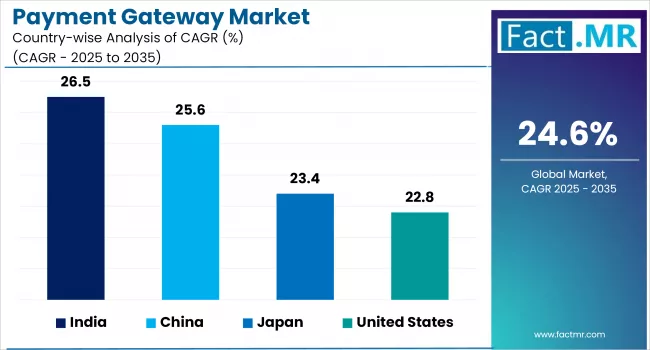
Payment Gateway Market By Country | Source: Fact.MR
U.S. Market Strengthens with Cloud Adoption, Fintech Presence, and Secure Payment Innovation
The convergence of digital commerce acceleration, increasing smartphone usage, and the adoption of contactless payment technologies has fueled the growth of the payment gateway market in the United States.
The U.S. is the headquarters of several large global fintech companies, and the payment systems based on cloud technology and combined with API, were adopted by both local and large businesses. Focus on safe transactions and compliance with the requirements of PCI-DSS is also a precondition for the emergence of fraud detection and payment encapsulation technologies.
2025-to-2035.webp "Us Payment Gateway Market Country Value(usd Billion)2025 To 2035")
Us Payment Gateway Market Country Value(usd Billion)2025 To 2035 | Source: Fact.MR
The progressive policy of online transformation supported by the government and the development of e-commerce keep placing providers like Stripe, PayPal, and Square in more advantageous conditions. Besides, the usage of AI and machine learning in payment gateway infrastructure facilitates potential risks assessment in real-time and transaction-level customization, contributing to the continuous market growth.
China Advances with Mobile-First Ecosystem and Strategic Support for Cashless Economy
China’s rapid payment gateway market expansion is led by the digital-first nature of its consumer base and the widespread presence of mobile payment ecosystems, particularly Alipay and WeChat Pay. As a government strategy to a “cashless society” and a general support for fintech innovation, digital transactions have extended into nearly all sectors, including retail, entertainment, healthcare, and public services.
The growth of the e-commerce market of the country is an ongoing factor that causes the demand for a secure and stable payment infrastructure. As the local providers saturate the market, the foreign companies are increasingly establishing collaboration opportunities with the local platforms to meet the regulatory demands and the cybersecurity in China. Continuously investing in blockchain-based gateways and central bank digital currency (CBDC) further describes the evolving and technologically driven structure of the payment ecosystem in the country.
India Market Expands with UPI Surge, Policy Support, and Localized Fintech Innovation
India’s Payment Gateway market is growing at a steady pace due to digitalization policies, like Digital India, wider access to affordable internet, and increasing UPI-based transactions. The market is witnessing consistent momentum toward financial inclusion, driven by a growing segment of digitally aware consumers from both urban and rural areas.
Government-led initiatives such as Aadhaar-enabled payments and regulatory frameworks such as RBI’s guidelines related to data localization or tokenization are changing the dynamics of the market landscape. Domestic providers such as Razorpay, Paytm, and PhonePe are focusing on innovation with localized offerings, and global players like Stripe and Amazon Pay continue to expand their operational reach.
In addition, the post-pandemic increase in digital retail, edtech, e-commerce, and online services has widened the addressable market, positioning India as an active region in the adoption of payment gateway technologies.
Category-Wise Market Outlook
API-Based Gateways Gain Momentum with Customization and Seamless Checkout Experience
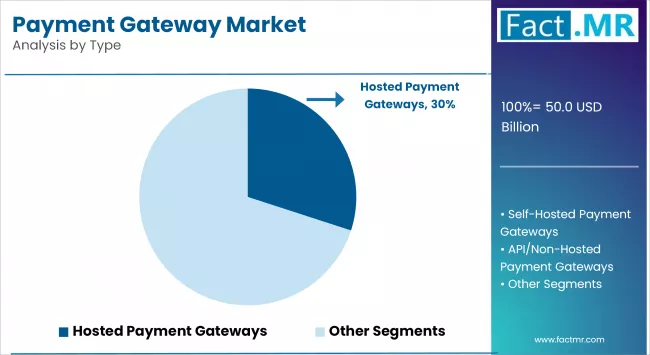
Payment Gateway Market By Type | Source: Fact.MR
API or Non-Hosted Payment Gateways represent a steadily expanding subsegment among the various types of gateways. This expansion is primarily facilitated by their high level of customizability, which enables businesses to have full control over the user experience when transacting.
Unlike hosted counterparts that redirect users to external pages, API-based systems keep users within the merchant’s environment, which supports trust, brand consistency, and conversion outcomes. They are particularly popular among tech-savvy merchants and firms who seek easy branded checkouts, especially in a competitive e-commerce setting.
SME Adoption Accelerates Through Affordable and Scalable Digital Payment Solutions
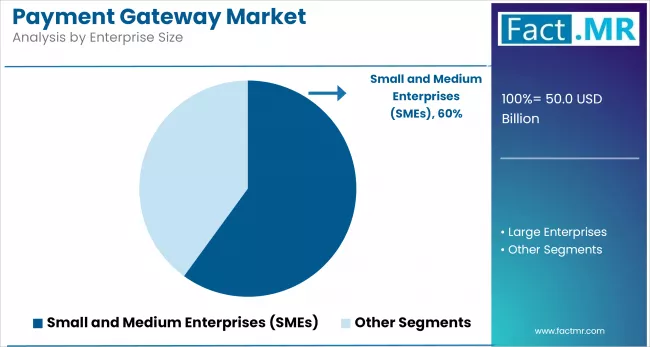
Payment Gateway Market By Enterprise Size | Source: Fact.MR
The adoption of payment gateways is increasing steadily among SMEs. This shift is supported by the advancement of digital transformation in small businesses, allowing them to reach broader customer bases and reduce operational burdens through digital payment methods.
With the availability of affordable, plug-and-play payment solutions and SaaS models, SMEs now have access to tools that were previously limited to larger enterprises. The preference for cost-effective and easily integrated gateways is becoming more evident, particularly in emerging markets where entrepreneurship and mobile-first commerce models are expanding.
Digital Wallet Adoption Expands with Contactless Convenience and Mobile Integration
Mobile payments are increasingly being adopted through digital wallets, which are being facilitated by the high mobile penetration rate, the simplicity of use, and the growth in contactless payment systems. The post-pandemic landscape, particularly, also accelerated the shift towards touch-free payments, as consumers preferred options like Apple Pay and Google Pay as well as regional equivalents such as Paytm or Alipay.
Their capacity to combine several payment sources, enabling immediate transactions and their compatibility with loyalty or reward systems, make them functional for both users and merchants. This trend is more evident in the Asia-Pacific and some parts of Europe.
Subscription and Digital Content Payments Drive Demand for Adaptive Gateway Solutions
Within the application landscape, the subscription and digital content payments segment is expanding at a notable rate. This trend is linked to the expansion of the digital economy, which includes streaming platforms, SaaS, and content-based subscription models.
Such models need recurring billing, adaptive payment cycles and smooth user interactions, all of which have led to demand for advanced adaptive payment gateways. The tendency towards media use, cloud-based tools and demand-based services is prominent among younger users and enterprises operating in digitized environments.
Competitive Analysis
Growth in digital commerce, mobile payments, and integrated fintechs is contributing to the expansion of the global payment gateway market. Companies are focusing on checkout processes with minimal friction, fraud prevention features, and omnichannel support.
Industry pioneers such as PayPal, Stripe, and Adyen are developing platforms that offer integration support, geographical coverage, and access to real-time analytics.
Amazon Payments and Braintree utilize their parent company ecosystems to extend reach and strengthen user confidence, while BitPay explores payment methods based on cryptocurrency. Companies like PayU, WePay, and Authorize.Net are developing services for niche and regional markets using API based offerings as well as merchant-specific solutions.
Hardware-associated providers such as Verifone connect physical with digital retail wants and are relevant using smart terminals and cloud services. Efforts in product development, strategic collaborations, and transitions toward embedded finance and user-oriented digital systems mark the competitive environment.
Key Market Players of the payment gateway industry are Verifone Holdings, Inc., Authorize.Net, Bitpay, Inc., Amazon Payments Inc., Braintree, Wepay, Inc., PayU Group, Stripe, Adyen, PayPal Holdings, Inc.
Recent Development
- In February 2025, Verifone expanded its partnership with PayPal to deliver a comprehensive omnichannel payment solution for enterprise merchants globally. This collaboration combines Verifone’s in-person payment assets with PayPal’s enterprise payment processing capabilities, aiming to offer flexible and scalable payment acceptance solutions. [Source: Verifone]
- In April 2024, BitPay announced a major update to its platform, expanding support to over 100 cryptocurrencies. This enhancement streamlines the invoice system, enabling merchants to accept a broader range of digital assets. The move enhances flexibility, widens crypto adoption, and simplifies the overall payment experience for global users. [Source: BitPay]
Fact.MR has provided detailed information about the price points of key manufacturers of the Payment Gateway Market positioned across regions, sales growth, production capacity, and speculative technological expansion, in the recently published report.
Segmentation
Segmentation of Payment Gateway Market Research
-
By Type :
- Hosted Payment Gateways
- Self-Hosted Payment Gateways
- API/Non-Hosted Payment Gateways
- Local Bank Integration Gateways
- Platform-Based / Integrated Gateways
-
By Enterprise Size :
- Small and Medium Enterprises (SMEs)
- Large Enterprises
-
By Mode of Payment :
- Credit/Debit Cards
- Digital Wallets
- Net Banking
- Cryptocurrency
- Buy Now, Pay Later (BNPL)
- Bank Transfers / Direct Debit
-
By Application :
- Online Checkout & Shopping Cart Processing
- Booking & Reservation Payments
- Medical Billing & Insurance Payments
- Tuition & Fee Collection Systems
- Subscription & Digital Content Payments
- Government Fee & Tax Payments
- Service-Based Billing & Invoicing
-
By End User :
- Retailers and E-commerce Platforms
- Travel & Hospitality Companies
- Healthcare Providers
- Educational Institutions
- Media & Entertainment Providers
- Government Bodies
- Professional & Service-Based Entities
-
By Region :
- North America
- Latin America
- Western Europe
- Eastern Europe
- East Asia
- South Asia & Pacific
- Middle East & Africa
Frequently Asked Questions
What was the Global Payment Gateway Market Size Reported by Fact.MR for 2024?
Who are the Major Players Operating in the Payment Gateway Market?
What is the Estimated Valuation of the Payment Gateway Market in 2035?
What Value CAGR did the Payment Gateway Market Exhibit Over the Last Five Years?
Who worked on this report


Preview the report firsthand - request a free sample
Free SampleGet the brochure for pricing and purchase details
Download PDF