- Base Value(2025): 1.7 Bn
- Forecast Value (2035): 10.1 Bn
- CAGR (2035): 21%
Predictive Warranty Automation Market Outlook (2025 to 2035)
The global predictive warranty automation market is expected to reach USD 10.1 billion by 2035, up from USD 1.7 billion in 2025. During the forecast period 2025 to 2035, the industry is projected to expand at a CAGR of 19.5%.
The predictive warranty automation market is altering the world of warranty management by allowing product issues to be anticipated, minimizing the cost of claims and increasing customer satisfaction. With the increased product complexity and customer demands that the industries deal with, the use of AI-based predictive analytics and integration of IoT is becoming a necessity.
Using these technologies, manufacturers and service providers can predict failures and simplify and enhance processes and quality, thus predictive automation is the foundation of efficient, economical and customer-centric warranty operations.
2025-to-2035.webp "Us Predictive Warranty Automation Market Market Value(usd Billion)2025 To 2035")
Us Predictive Warranty Automation Market Market Value(usd Billion)2025 To 2035 | Source: Fact.MR
Quick Stats for Predictive Warranty Automation Market
- Industry Value (2025): USD 1.7 Billion
- Projected Value (2035): USD 10.1 Billion
- Forecast CAGR (2025 to 2035): 19.5%
- Leading Segment (2025): Cloud-Based (63.7% Market Share)
- Fastest Growing Country (2025-2035): U.S. (20.5% CAGR)
- Top Key Players: Tavant Technologies, SAP,IBM,and Wipro
What are the drivers of the Predictive Warranty Automation market?
On the one hand, the predictive warranty automation market is witnessing rapid growth as industries heavily concentrate on lowering operational expenses and raising product reliability and customer experience levels. Predictive analytics and AI-enabled automation offer the promise of predicting failures and automating more and more of the claims process as manufacturing, automotive, electronics, and other industrial industries adopt more complex and more connected products.
Attachment of IoT-enabled monitoring, real-time data analytics, and machine learning models is facilitating proactive-based interventions in relationship services, reducing downtimes, and extending asset lifecycle value. Enhancing the quality of the products under regulatory pressure and increasing competition are driving the rate of adoption. Market expansion has further been realized through strategic partnerships of OEMs with software providers and service networks.
What are the regional trends of the Predictive Warranty Automation market?
The global marketplace of the predictive warranty automation industry depicts various adoption rates determined by technology preparedness, regulatory provisions, and market maturity.
Advanced AI integration, IoT-enabled monitoring and close OEM-software liaison, especially in U.S. car manufacturing and industrial equipment areas, are the strengths of North America in this regard. Strict adherence to the quality of products sold, coupled with sustainability policies, as well as early implementation of predictive maintenance in manufacturing industries such as Germany and France, are key growth drivers of Europe.
The Asia-Pacific region is briskly growing in terms of industrial modernization, increased consumerism, and investments in the ecosystems of connected products in China, Japan, and India. Market areas in Latin America, the Middle East and Africa are gradually implementing solutions to improve reliability, save downtime and achieve export-type quality.
What are the challenges and restraining factors of the Predictive Warranty Automation market?
The inconsistencies in data quality and accessibility across geographies and industries are one of the greatest opportunities facing the predictive warranty automation market. Predictive models have been shown to work best when they have consistent, high volume and clean product performance data. Still, they are frequently limited by scattered data sources, legacy systems, and patchy IoT integration capabilities, resulting in limited accuracy.
The skills gap in deploying and maintaining the AI-driven warranty platforms, especially those of the SMEs, is another limitation. Adherence to the changing data privacy policies complicates it, not to mention the terms in which the predictive systems should be aligned with various industry-related diversity of warranty standards. Also, the initial implementation costs, as well as the problem of integrating it with the existing ERP/CRM ecosystem, hinder its adoption, especially in the emerging economies.
Country-Wise Insights
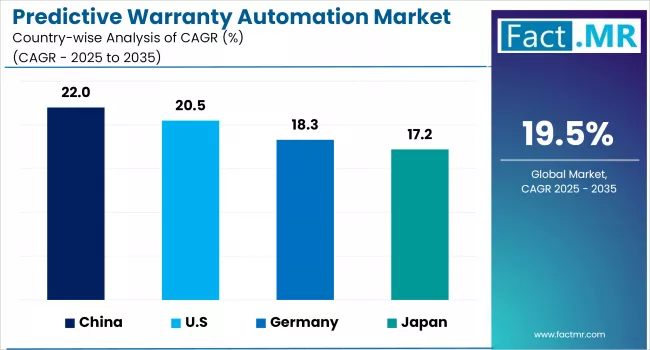
Predictive Warranty Automation Market By Country | Source: Fact.MR
U.S. leads in AI-driven, IoT-enabled predictive warranty adoption
The AI-enabled warranty platforms are well adopted in the automotive, industrial machinery, and consumer electronics industries to drive the predictive warranty automation market in the U.S. IoT sensors and predictive analytics are being implemented by OEMs and service networks to prevent failures and improve service cost as well as uptime. Big companies in industry centers are installing personalized forecasting systems that cater to industry-specific regulatory standards.
2025-to-2035.webp "Us Predictive Warranty Automation Market Country Value(usd Billion)2025 To 2035")
Us Predictive Warranty Automation Market Country Value(usd Billion)2025 To 2035 | Source: Fact.MR
ERP and CRM integration is gaining momentum with a mature ecosystem of vendors and with federal data security standards to support. There is also increased pressure to roll out predictive solutions across high-value asset categories due to growing demand for improvement of customer experience, as well as pressure from competition.
Germany excels in Industry 4.0 and quality-focused predictive automation
The advanced manufacturing industry, high regulatory standards on product quality, and dominance in the adoption of Industry 4.0 characterize the German market. The improvement of the recovery of the suppliers is in part. Lately, there is a trend toward integrating predictive warranty structures in manufacturers of automatic and industrial equipment who want to minimize downtime.
Real-time monitoring of the failure of the production plant is made possible by investments in IoT infrastructure and data analytics centers. Early adoption is being fuelled by compliance with EU product liability directives, and the regional clusters of specialization in Bavaria and Baden-Wurttemberg are at the forefront in deployment. Collaborations are speeding up the innovation between software vendors, research institutes, OEMs, and the applications are widening into renewable energy equipment and high-technology products of engineering.
Japan advances connected ecosystems for precision predictive warranty solutions
The Japanese market is representative of its high-precision manufacturing, and predictive warranty automation has found use in automotive, electronics, and robotics. Organizations are using connected product ecosystems and AI algorithms to find micro-failures before they escalate to critical levels and achieve high percentages of customer satisfaction.
The integration of its services with digital twins and monitoring platforms available in real-time is making it possible to schedule services proactively, predominantly in export industries. The adoption is being encouraged by conformance with local quality control standards and international warranty requirements. Predictive analytics pilot projects are leading in Tokyo and Nagoya manufacturing centers, and OEM collaborations with tech providers are reducing OEM deployment cycles with a concomitant increase in market penetration.
Category-Wise Analysis
AI-powered software platforms drive proactive warranty cost reduction
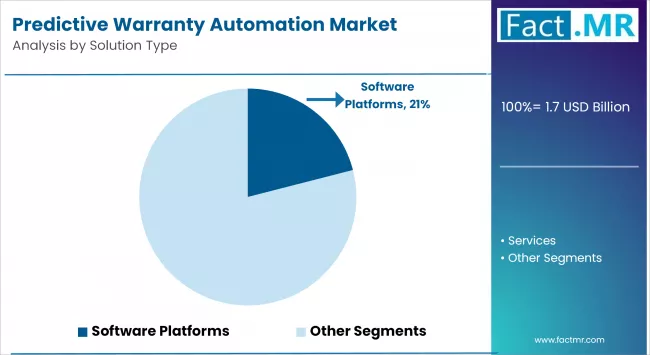
Predictive Warranty Automation Market By Solution Type | Source: Fact.MR
The predictive warranty automation market is controlled by software platforms that provide AI-based analytics, connectivity to IoT data, and the automation of claim processes within the same platform. The solutions help the manufacturers and service providers to forecast failures, schedule maintenance activities and minimize warranty costs by carrying out proactive actions.
Real-time information is offered by integrated dashboards and machine learning models, enabling specific identification of failure patterns and preventing fraud. They have a scalable platform that will enable the platform to be implemented in operations across the globe and is compatible with most ERP and CRM systems, which gives ease of work. Software platforms are the basis of data-driven warranty optimization with continuous updates and cloud connectivity, and custom predictive models.
Cloud deployment enables scalable, real-time predictive warranty management
The fastest growing is the system deployed through the cloud because it is scalable, affordable, and can be accessed in real-time. The cloud-enabled predictive warranty solutions enable enterprise integration of IoT data streams, AI, and analytics solutions without paying lots of money on infrastructure. Compared to the previous model, this one allows keeping all the global assets in a centralized manner, delivering the updates rather quickly, and scaling easily as the amount of data increases.
In-built cybersecurity models and certification of compliance extend more to regulated industries. The level of collaboration among OEMs, their services partners and suppliers are also improved using the cloud-based systems so that value chain collaboration leads to actionable predictive insights. They are an agile company that creates a unique position as an accelerator of instant innovation.
Automotive sector leads in IoT-driven predictive warranty solutions
The automotive industry is the end-user with the greatest inherent need to embrace predictive warranty automation because it has high asset complexity, high quality requirements, and faces intense competition. AI, IoT sensors, and telematics help OEMs and suppliers identify component wear or risks of failure in an early stage, thus lessening downtime and warranty claim costs.
Predictive models facilitate proactive recalls and targeted maintenance that will increase customer satisfaction. It is integrated with manufacturing analytics to constantly provide feedback on product quality, and the ecosystems in connected vehicles are an avenue to constantly provide performance information.
With recalls costing millions of dollars, predictive warranty systems are becoming increasingly essential in manufacturing companies to protect the brand reputation, reduce supplier recovery and improve operations efficiency.
Competitive Analysis
Key players in the predictive warranty automation industry include Tavant Technologies, SAP, IBM, Wipro, Oracle, Siemens, PTC, ServiceNow, Mulberry and TCS.
The predictive warranty automation market is becoming increasingly competitive as more and more organizations are looking into the use of AI-driven and data-focused warranty solutions as a cost reduction measure and a promising increase in product reliability. Most prominent organizations are investing in cutting-edge machine learning models, IoT accessibility, and live reporting in order to provide proactive failure reporting and automated claims services.
There is an obvious tendency towards a cloud-native platform, which would allow global scaling and expedited deployment. The expanding reach of their strategic partnerships with OEMs, software vendors and system integrators is opening up more areas in the market, as is industry-specific customization, which is becoming a significant market differentiator. The presence of regional innovation centers, especially in North America, Europe, and the Asia-Pacific, is increasing the pace of innovation and competitiveness in products.
Recent Development
- In March 2025, Tavant Technologies released elaborate AI-driven warranty adjudication functions into its Warranty.AI solution, which can automatically identify duplicate claims, detect anomalies, and provide real-time recommendations. This enhancement will increase the precision of the claims, shorten the processing time and improve the effectiveness of supplier recovery by OEMs and service providers.
- In February 2025, PTC expanded its IoT-enabled asset monitoring capabilities, with AI-driven analyses on ThingWorx-based predictive services supporting warranty management. The emergence enables new manufacturers to focus better on the probability of failure and preventative maintenance schedules, as well as warranty expenses, to facilitate greater uptime and customer satisfaction levels.
Fact.MR has provided detailed information about the price points of key manufacturers of the Predictive Warranty Automation Market positioned across regions, sales growth, production capacity, and speculative technological expansion, in the recently published report.
Methodology and Industry Tracking Approach
The 2025 Global Predictive Warranty Automation Market report by Fact.MR consulted with 12,500 stakeholders distributed in 35 countries, and at least 350 stakeholders were interviewed in each market. One-third, two-thirds were response users, or solution adopters (e.g., OEMs, manufacturers, service providers), the one-third were professionals in the industry (e.g., system integrator, consultants, technology vendor).
Data was obtained between July 2024 and June 2025 in terms of different trends, drivers of demand, opportunities, investments, and risks in the entire warranty automation value chain. There was weighting of the survey responses to match market shares and demographics in the regions. Based on more than 300 sources, among which were academic works, patent applications, regulatory documents, and financial statements, the work included sophisticated methods of statistical analysis, such as the regression analysis.
With Fact.MR monitoring consumer behavior, product efficacy, industry trends, and market opportunities since 2018, this report is becoming an authoritative source of information that stakeholders can rely on.
Segmentation
Segmentation of Predictive Warranty Automation market
-
By Solution Type :
- Software Platforms
- Services
-
By Deployment Model :
- Cloud-Based
- On-Premise
- Hybrid
-
By End-User Industry :
- Automotive
- Consumer Electronics
- Industrial Equipment & Machinery
- Aerospace & Defense
- Healthcare Devices
- Energy & Utilities
-
By Organization Size :
- Large Enterprises
- Small & Medium Enterprises (SMEs)
-
By Warranty Type :
- Standard Warranties
- Extended Warranties
- Service Contracts
-
By Region :
- North America
- Latin America
- Western Europe
- Eastern Europe
- East Asia
- South Asia & Pacific
- Middle East & Africa
Frequently Asked Questions
What was the Global Predictive Warranty Automation Market Size Reported by Fact.MR for 2025?
Who are the Major Players Operating in the Predictive Warranty Automation market?
What is the Estimated Valuation of the Predictive Warranty Automation Market in 2035?
What Value CAGR did the Predictive Warranty Automation Market Exhibit Over the Last Five Years?
Who worked on this report


Preview the report firsthand - request a free sample
Free SampleGet the brochure for pricing and purchase details
Download PDF