Addiction Treatment Market Size, Share, Growth and Forecast (2026 - 2036)

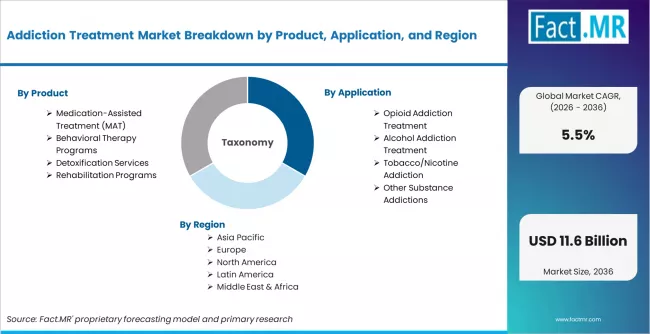
Addiction Treatment Market is segmented by Product (Medication-Assisted Treatment (MAT), Behavioral Therapy Programs, Detoxification Services, Rehabilitation Programs), Application (Opioid Addiction Treatment, Alcohol Addiction Treatment, Tobacco/Nicotine Addiction, Other Substance Addictions), End Use (Rehabilitation Centers, Hospitals, Outpatient Clinics, Community Health Centers), and Region, with forecasts covering the period from 2026 to 2036.

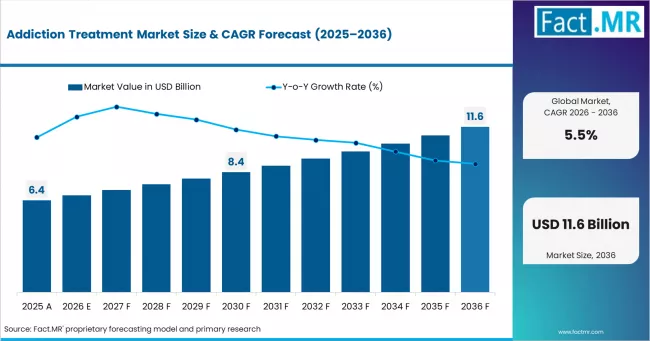
According to Fact.MR estimates, the global addiction treatment market market was valued at USD 6.4 billion in 2025. The market is projected to reach USD 6.8 billion in 2026 and is expected to grow to USD 11.6 billion by 2036, expanding at a CAGR of 5.5%. Medication-Assisted Treatment (MAT) is anticipated to account for 34.0% of the product segment in 2026, while Opioid Addiction Treatment is expected to remain the leading application with around 42.0% share.
Addiction Treatment Market Analysis and Forecast by Fact.MR

According to Fact.MR estimates, the global addiction treatment market market was valued at USD 6.4 billion in 2025. The market is projected to reach USD 6.8 billion in 2026 and is expected to grow to USD 11.6 billion by 2036, expanding at a CAGR of 5.5%. Medication-Assisted Treatment (MAT) is anticipated to account for 34.0% of the product segment in 2026, while Opioid Addiction Treatment is expected to remain the leading application with around 42.0% share.

Addiction Treatment Market Market Value Analysis

Summary of Addiction Treatment Market

  • Market Snapshot
    • The addiction treatment market was valued at USD 6.44 billion in 2025.
    • By 2036, the Addiction Treatment Market is expected to be worth USD 11.56 billion.
    • From 2026 to 2036, the market is projected to expand at a CAGR of 5.47%.
    • The market is projected to create an incremental opportunity of USD 4.77 billion between 2026 and 2036.
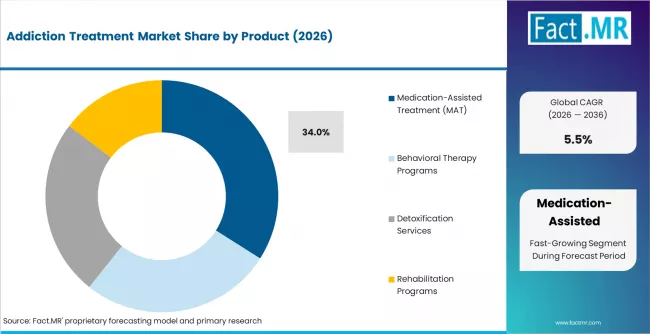
    • In 2026, medication-assisted treatment (MAT) is expected to account for 34% of the product segment, driven by sustained opioid and alcohol use disorder treatment demand.
    • China (7.38%) and India (6.84%) are two of the fastest growing markets in the world.
  • Demand and Growth Drivers

    • Demand is shaped by the sustained opioid addiction crisis across developed markets and rising substance use disorder prevalence globally.
    • Growth reflects expanding insurance coverage for substance use disorder treatment under mental health parity regulations and Medicaid expansion.
    • Adoption is increasing due to growing telehealth adoption, digital therapeutic platform expansion, and rising clinical acceptance of medication-assisted treatment protocols.
  • Product and Segment View
    • Medication-assisted treatment (MAT) leads the product segment with a 34% share in 2026, supported by sustained opioid and alcohol use disorder treatment demand.
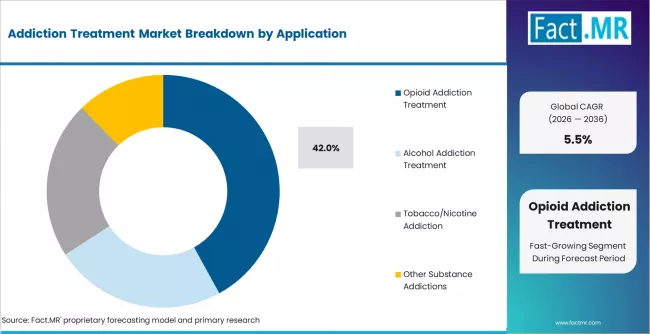
    • Opioid addiction treatment holds 42% of the application segment, anchored by methadone, buprenorphine, and naltrexone prescription volumes.
    • Rehabilitation centers account for 38% of end-use demand, while hospitals, outpatient clinics, and community health centers form secondary channels.
  • Geography and Competitive Outlook
    • North America remains the largest regional market, supported by the ongoing opioid crisis response, broad insurance coverage for addiction treatment, and established rehabilitation infrastructure.
    • Asia Pacific is the fastest-growing region, led by China where expanding substance use disorder recognition, growing rehabilitation capacity, and rising treatment access are all supporting demand.
    • The competitive field is led by Alkermes plc with an estimated 18% share, followed by Indivior Plc., Orexo AB, Titan Pharmaceuticals Inc., and Teva Pharmaceutical Industries Ltd.
  • Analyst Opinion
    • Addiction treatment has evolved from a narrow specialty category into a broader healthcare priority backed by regulatory, reimbursement, and clinical tailwinds, and the commercial economics reflect this shift. The category is structurally attractive because growth is anchored by the sustained opioid crisis response in developed markets and expanding substance use disorder treatment access in emerging markets, while premium uplift comes from long-acting injectable medications and digital therapeutic platforms. The commercial lever that matters most is integrated treatment model depth because payers and regulators increasingly prefer providers who combine medication, behavioral therapy, and care coordination into bundled offerings. Players that combine pharmaceutical portfolio depth with digital therapeutic capabilities and provider network relationships will capture premium positioning, while generic pharmaceutical competitors without integrated care models face pricing pressure from payer consolidation.

Why is Addiction Treatment Market Growing?

  • Growth reflects the sustained opioid addiction crisis across developed markets and rising substance use disorder prevalence globally.
  • Demand is shaped by expanding insurance coverage for substance use disorder treatment under mental health parity and Medicaid expansion.
  • Adoption is increasing due to telehealth addiction treatment expansion, digital therapeutic platform growth, and rising clinical acceptance of MAT protocols.

The demand base rests on the sustained opioid addiction crisis that continues affecting millions of patients across the United States, Canada, and other developed markets. Despite public health response efforts, opioid overdose deaths and opioid use disorder prevalence remain at historically elevated levels, which drives sustained demand for medication-assisted treatment and specialty rehabilitation services. Synthetic opioid availability including fentanyl has extended the crisis timeline and created new demand for treatment-resistant patient populations.

The second structural driver is insurance coverage expansion. Mental health parity regulations in the United States require insurance plans to provide comparable coverage for substance use disorder treatment relative to other medical care. Medicaid expansion under the Affordable Care Act extended coverage to many previously uninsured patients with substance use disorders. These coverage expansions have substantially increased the funded treatment population and created sustained revenue growth for addiction treatment providers and pharmaceutical manufacturers.

The third driver is channel expansion through telehealth and digital therapeutics. The DEA's X-waiver removal eliminated prescriber certification barriers for buprenorphine prescription in the United States, which expanded access to MAT across primary care settings. Telehealth platforms such as Bicycle Health, Boulder Care, and Ophelia have built dedicated addiction treatment services accessible to patients beyond traditional specialty clinic settings. Digital therapeutic platforms are also expanding as adjunct treatment options supported by clinical evidence.

Segment-wise Analysis of Addiction Treatment Market

  • Medication-assisted treatment leads the product segment with 34% share in 2026, anchored by sustained opioid and alcohol use disorder medication demand.
  • Behavioral therapy programs represent a fast-growing sub-segment, driven by telehealth expansion and CBT platform adoption.
  • Opioid addiction treatment holds 42% of the application segment, followed by alcohol addiction treatment and tobacco and nicotine addiction as secondary use cases.

The segmentation view shows a category with balanced contribution from medication-assisted treatment, behavioral therapy, detoxification services, and rehabilitation programs. Competitive advantage rests on integrated treatment model capability, pharmaceutical portfolio depth, and digital therapeutic and telehealth platform integration. Growth over the forecast period is expected to tilt toward long-acting injectable medications and digital therapeutic platforms as reimbursement models increasingly reward outcome-based treatment.

Why Does Medication-Assisted Treatment Lead the Product Segment?
Addiction Treatment Market Analysis By Product

Medication-assisted treatment leads the product segment because clinical evidence has firmly established MAT as the gold standard for opioid use disorder treatment. Methadone, buprenorphine, and naltrexone-based therapies all have strong clinical evidence supporting reduced overdose risk, improved treatment retention, and better long-term outcomes relative to behavioral therapy alone. This evidence base has driven clinical practice consensus, reimbursement coverage expansion, and sustained prescription volume growth across opioid and alcohol use disorder treatment.

The segment leadership is reinforced by long-acting injectable formulations. Alkermes plc's Vivitrol (extended-release naltrexone) and Indivior Plc.'s Sublocade (monthly buprenorphine injection) both support medication adherence challenges that have historically limited MAT effectiveness. Monthly injection protocols improve treatment retention and reduce diversion risk, which supports premium pricing relative to oral formulations. These long-acting platforms continue to capture market share from traditional oral MAT products.

Why are Behavioral Therapy Programs a Fast-Growing Sub-Segment?
Addiction Treatment Market Analysis By Application

Behavioral therapy programs are a fast-growing sub-segment because telehealth expansion has dramatically improved access to specialized addiction behavioral therapy. Cognitive behavioral therapy, motivational interviewing, and contingency management programs can be delivered through video telehealth platforms, which expands patient access beyond traditional in-person therapy settings. This access expansion combined with insurance coverage for telehealth behavioral health services creates sustained growth.

Growth within behavioral therapy is also being lifted by digital therapeutic platform development. Pear Therapeutics (before its bankruptcy), DynamiCare Health, and other digital therapeutic companies have developed FDA-cleared software platforms that deliver structured behavioral interventions for substance use disorders. While the digital therapeutic payer coverage environment remains challenging, clinical evidence continues accumulating and commercial pathways are evolving, which supports category growth over the forecast period.

Key Growth Drivers, Constraints, and Market Scope
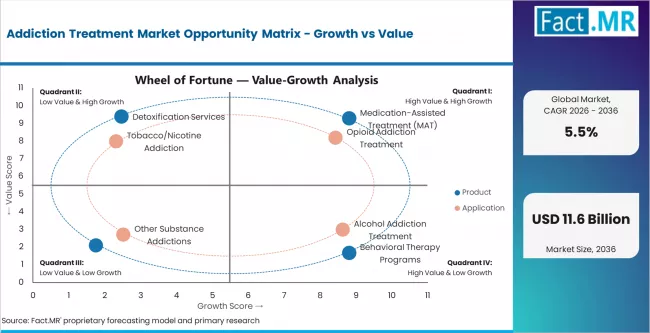
Addiction Treatment Market Opportunity Matrix Growth Vs Value

  • Sustained opioid crisis response and insurance coverage expansion are the structural demand foundations.
  • Long-acting injectable medication adoption and telehealth addiction treatment expansion are the key compositional shifts driving premium growth.
  • Stigma barriers, workforce shortages, and reimbursement complexity remain the leading constraints.

The market scope is shaped by the combination of sustained MAT medication demand, rehabilitation service volume growth, and premium uplift from long-acting injectables and digital therapeutic platforms. Competitive advantage sits in integrated treatment model capability, pharmaceutical portfolio depth, and telehealth and digital therapeutic integration.

Growth Drivers

The primary driver is the sustained opioid addiction crisis in developed markets, which continues driving demand for MAT medications and specialty rehabilitation services. A second driver is insurance coverage expansion under mental health parity regulations and Medicaid expansion, which has substantially increased the funded treatment population. A third driver is channel expansion through telehealth and digital therapeutics, which has widened access to addiction treatment beyond traditional specialty clinic settings. These three forces combine to deliver a steady mid-single-digit growth trajectory with premium uplift from long-acting injectables.

Constraints

The leading constraint is stigma barriers that continue limiting patient willingness to seek addiction treatment. Despite public awareness improvements, many patients with substance use disorders avoid treatment due to perceived stigma, employment concerns, or social consequences, which limits treatment penetration. A second constraint is workforce shortages. Addiction medicine physicians, certified addiction counselors, and specialty nursing staff are in short supply relative to demand, which creates service capacity constraints particularly in rural and underserved areas. A third constraint is reimbursement complexity across public and private payers, prior authorization requirements, and variable coverage for newer treatment modalities including digital therapeutics.

Opportunities

The strongest opportunity lies in long-acting injectable medication expansion, where improved treatment retention and reduced diversion risk support premium pricing and margin growth. A second opportunity is telehealth addiction treatment channel expansion, where specialty providers can capture market share from traditional in-person clinic models. A third opportunity is emerging market penetration, particularly in China and India, where expanding substance use disorder recognition, growing rehabilitation capacity, and rising treatment access all support category growth across pharmaceutical and service segments.

Regional Outlook Across Key Markets

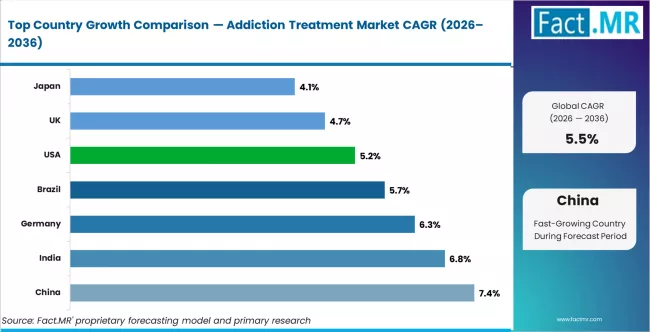
Top Country Growth Comparison Addiction Treatment Market Cagr (2026 2036)

  • China leads country-level growth at 7.38% CAGR, supported by expanding substance use disorder recognition, growing rehabilitation capacity, and rising treatment access.
  • India follows at 6.84%, driven by growing private rehabilitation network expansion, rising substance use disorder awareness, and expanding mental health service infrastructure.
  • North America remains the largest regional pool by absolute value, with the USA at 5.20% supported by opioid crisis response and broad insurance coverage for addiction treatment.
  • European demand is led by Germany at 6.29% and the UK at 4.65%, with both countries showing mature addiction treatment infrastructure.

Country CAGR Table

Country CAGR (%)
China 7.38%
India 6.84%
Germany 6.29%
Brazil 5.74%
USA 5.20%
UK 4.65%
Japan 4.10%

Source: Fact.MR analysis, based on proprietary forecasting model and primary research.
Addiction Treatment Market Cagr Analysis By Country

Regional dynamics split into three profiles. Asia Pacific leads on growth rate, pulled by substance use disorder recognition expansion and rehabilitation capacity growth. Europe grows at mid-single-digit rates driven by mature addiction treatment infrastructure and broad statutory insurance coverage. North America remains the largest dollar market, anchored by the sustained opioid crisis response, broad insurance coverage for addiction treatment, and established rehabilitation infrastructure.

United States
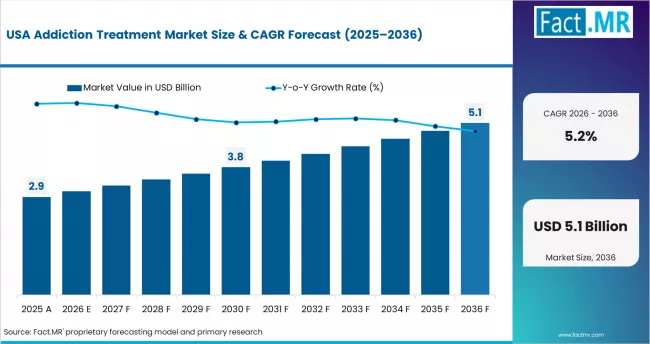
Addiction Treatment Market Country Value Analysis

The United States anchors global demand through its sustained opioid crisis response, broad insurance coverage for addiction treatment, and established rehabilitation infrastructure. Alkermes plc, Indivior Plc., and other pharmaceutical manufacturers lead the MAT medication segment, while corporate rehabilitation chains such as American Addiction Centers, Acadia Healthcare, and Universal Health Services drive concentrated service procurement. Telehealth providers including Bicycle Health, Boulder Care, and Ophelia are expanding access across primary care and specialty settings.

  • Sustained opioid crisis response drives MAT medication and rehabilitation service demand.
  • Broad insurance coverage under mental health parity supports funded treatment volumes.
  • Corporate rehabilitation chains and telehealth providers drive service delivery consolidation.

Canada

Canada represents a steady growth market shaped by provincial health system coverage for addiction treatment, hospital and community-based treatment networks, and ongoing opioid crisis response. Provincial health systems cover MAT medications and specialty rehabilitation services, which supports predictable treatment access. British Columbia, Ontario, and Alberta have all implemented substantial opioid crisis response programs that sustain treatment service demand.

  • Provincial health system coverage supports MAT medication and rehabilitation service demand.
  • Ongoing opioid crisis response sustains treatment service investment.
  • Specialty rehabilitation and community-based treatment networks drive service delivery.

United Kingdom

The United Kingdom market is shaped by NHS England's addiction treatment services, local authority substance misuse programs, and the mix of NHS and private rehabilitation provider channels. NHS trusts deploy MAT programs across community services, while private rehabilitation providers such as Priory Group and UKAT serve private-pay and insurance-funded patients. Alcohol use disorder treatment represents a particularly significant component of UK addiction treatment activity.

  • NHS addiction treatment services drive MAT medication and behavioral therapy demand.
  • Local authority substance misuse programs support community-based treatment access.
  • Private rehabilitation providers serve private-pay and insurance-funded patients.

Germany

Germany leads European growth on the strength of mature addiction treatment infrastructure, statutory insurance coverage for MAT and rehabilitation services, and established specialty treatment networks. German addiction medicine physicians, rehabilitation clinics, and psychiatric hospitals deliver comprehensive addiction treatment services supported by statutory insurance. Alkermes plc, Indivior Plc., and other pharmaceutical manufacturers compete across the German MAT channel.

  • Mature addiction treatment infrastructure supports broad service adoption.
  • Statutory insurance coverage provides predictable reimbursement for MAT and rehabilitation services.
  • Established specialty treatment networks drive service delivery across major metropolitan areas.

China

China is the fastest-growing country in the forecast, driven by expanding substance use disorder recognition, growing rehabilitation capacity, and rising treatment access. Chinese public health authorities have expanded opioid agonist therapy programs including methadone maintenance clinics across tier-1 and tier-2 cities. Rehabilitation capacity has also expanded through specialty psychiatric hospitals and community-based treatment programs, which supports sustained category growth.

  • Expanding substance use disorder recognition drives treatment service demand.
  • Growing rehabilitation capacity supports broader MAT program access.
  • Rising treatment access supports category growth across pharmaceutical and service segments.

India

India represents a strong growth market driven by growing private rehabilitation network expansion, rising substance use disorder awareness, and expanding mental health service infrastructure. Private rehabilitation providers such as Cadabam's, Hope Trust, and various specialty clinics are expanding across Indian metropolitan markets. Government-supported de-addiction centers also provide broader access to treatment services, while pharmaceutical manufacturers are expanding MAT medication availability.

  • Private rehabilitation network expansion drives specialty service demand.
  • Rising substance use disorder awareness supports treatment access growth.
  • Expanding mental health service infrastructure supports integrated addiction treatment.

Competitive Benchmarking and Company Positioning
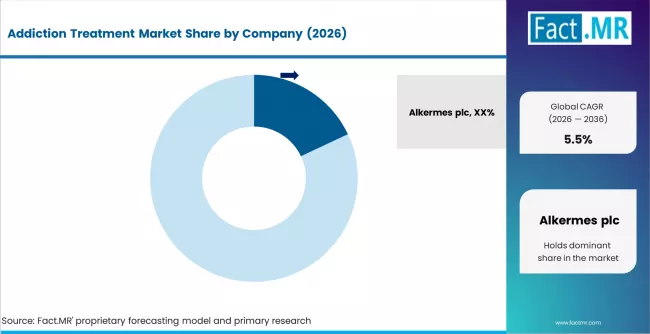
Addiction Treatment Market Analysis By Company

  • Alkermes plc leads with an estimated 18% share, supported by its Vivitrol extended-release naltrexone platform and established addiction treatment specialty presence.
  • Indivior Plc., Orexo AB, Titan Pharmaceuticals Inc., and Teva Pharmaceutical Industries Ltd. compete through differentiated MAT medication portfolios.
  • Specialty players such as Mallinckrodt, Cipla Ltd., Pfizer Inc., GlaxoSmithKline plc, and Hikma Pharmaceuticals PLC hold positions across specific medication and geographic segments.

The competitive field is fragmented with pharmaceutical manufacturers serving MAT medications and specialty treatment providers serving behavioral and rehabilitation segments. Alkermes plc commands a strong share position through its Vivitrol extended-release naltrexone platform, which supports monthly injection-based treatment for opioid and alcohol use disorders. Alkermes's specialty addiction treatment channel relationships and long-acting injectable format create meaningful competitive advantages.

Indivior Plc. holds strong positions across buprenorphine formulations including Suboxone film and Sublocade monthly injection. Orexo AB competes through Zubsolv and other buprenorphine formulations. Titan Pharmaceuticals Inc. has developed implantable buprenorphine products for long-duration MAT. Teva Pharmaceutical Industries Ltd., Mallinckrodt, Cipla Ltd., Pfizer Inc., and GlaxoSmithKline plc maintain positions across generic and branded addiction medication segments. Specialty behavioral therapy and rehabilitation providers compete in parallel service segments.

Strategic priorities across the field include expanding long-acting injectable portfolios, building digital therapeutic and telehealth capabilities, and strengthening specialty provider channel relationships. Pharmaceutical manufacturers with long-acting injectable platforms will capture outsized share of forecast period growth, while generic pharmaceutical competitors face pricing pressure from payer consolidation and therapeutic substitution dynamics.

Competitive Analysis

Competitive positioning rests on three dimensions: long-acting injectable portfolio depth, specialty channel relationships, and integrated treatment model capability. Alkermes plc leads on specialty injection platform positioning with Vivitrol. Indivior Plc. leads across the broader buprenorphine segment. Orexo AB and Titan Pharmaceuticals Inc. compete in specialty buprenorphine formulations. Generic manufacturers including Mallinckrodt, Cipla Ltd., and Teva Pharmaceutical Industries Ltd. serve commodity medication segments.

Second-tier competitors maintain relevance through specialty medication formulations, focused therapeutic strategies, or regional channel concentration. Digital therapeutic companies and telehealth addiction treatment providers represent emerging competitive threats from adjacent service categories. The gap between long-acting injectable platform manufacturers and commodity medication producers continues to widen as clinical guidelines increasingly favor injection-based protocols.

Benchmarking Table

Company Scale Reach MAT Portfolio Injectable Platform Specialty Channel
Alkermes plc Global Focused Strong Strong
Indivior Plc. Global Medium-Broad Strong Strong
Orexo AB Global Focused Medium Medium-Strong
Titan Pharmaceuticals Inc. Regional Focused Medium Medium
Teva Pharmaceutical Industries Ltd. Global Medium Low Medium
Mallinckrodt Regional Focused Low Medium
Cipla Ltd. Regional Medium Low Medium

Recent Developments

  • In 2025, Alkermes plc continued expanding its Vivitrol addiction treatment platform through increased specialty channel presence and outcome evidence generation.
  • In 2025, Indivior Plc. advanced its Sublocade monthly buprenorphine injection platform through expanded indication coverage and prescriber training programs.
  • In 2026, Orexo AB strengthened its buprenorphine product portfolio through formulation updates and digital therapeutic partnership expansion.

Leading Companies Shaping Addiction Treatment Market

  • Major Players

    • Alkermes plc
    • Indivior Plc.
    • Orexo AB
    • Titan Pharmaceuticals Inc.
    • Teva Pharmaceutical Industries Ltd.
    • Mallinckrodt
    • Cipla Ltd.
    • Pfizer Inc.
  • Emerging Players

    • GlaxoSmithKline plc
    • Hikma Pharmaceuticals PLC
    • Braeburn Pharmaceuticals
    • Camurus AB
    • Kaleo Inc.
    • Emergent BioSolutions
    • Bicycle Health
    • Boulder Care

Sources and Research References

  • Substance Abuse and Mental Health Services Administration (SAMHSA) - National Survey on Drug Use and Health
  • United States Food and Drug Administration (FDA) - Approvals Database for Addiction Medications
  • World Health Organization (WHO) - Global Burden of Substance Use Disorders Publications
  • American Society of Addiction Medicine (ASAM) - Clinical Practice Guidelines on MAT
  • National Institute on Drug Abuse (NIDA) - Research Publications on Addiction Treatment
  • Alkermes plc - Annual Report and Addiction Treatment Segment Disclosures
  • Primary interviews with addiction medicine physicians, rehabilitation program directors, MAT prescribers, and pharmaceutical manufacturers

This bibliography is provided for reader reference and is not exhaustive. The full report contains the complete reference list and detailed citations.

Key Questions This Report Addresses

  • What is the current and future size of the addiction treatment market?
  • How fast is the market expected to grow between 2026 and 2036?
  • Which product segment is likely to lead the market by 2026?
  • Which application segment will account for the highest demand by 2026?
  • How is long-acting injectable medication adoption reshaping demand patterns?
  • Why are China and India emerging as the fastest-growing markets?
  • Which countries are projected to show the fastest growth through 2036?
  • Who are the key companies active in the addiction treatment market?
  • How is telehealth addiction treatment changing the competitive dynamics?

Addiction Treatment Market Definition

The addiction treatment market covers pharmaceutical therapies, behavioral therapy programs, detoxification services, and rehabilitation programs used to treat substance use disorders including opioid, alcohol, nicotine, and other substance addictions. This includes medication-assisted treatment medications such as methadone, buprenorphine, and naltrexone-based therapies, behavioral therapy programs including cognitive behavioral therapy and motivational interviewing, detoxification services including medical detox programs and inpatient detox facilities, and rehabilitation programs including residential rehab programs and outpatient rehab services. The market spans rehabilitation centers, hospitals, outpatient clinics, community health centers, residential treatment facilities, detox and emergency care units, counseling centers, and public health programs.

Addiction Treatment Market Inclusions

The scope includes medication-assisted treatment across opioid dependence medications including methadone, buprenorphine, and naltrexone-based therapies, behavioral therapy programs including cognitive behavioral therapy (CBT) and motivational interviewing, detoxification services including medical detox programs and inpatient detox facilities, and rehabilitation programs including residential rehab programs and outpatient rehab services. It covers applications across opioid addiction treatment, prescription opioid dependence, heroin addiction treatment, alcohol addiction treatment, alcohol use disorder therapy, relapse prevention programs, tobacco and nicotine addiction, smoking cessation programs, nicotine replacement therapy, and other substance addictions including cannabis, synthetic drug, and polysubstance abuse treatment. Coverage spans rehabilitation centers, hospitals, outpatient clinics, community health centers, residential treatment facilities, long-term recovery centers, detox and emergency care units, counseling centers, day care treatment programs, and public health programs from 2026 to 2036.

Addiction Treatment Market Exclusions

The scope excludes general mental health services not specifically targeted at substance use disorders, psychiatric hospitals that do not operate dedicated addiction treatment programs, and general primary care services. It also excludes consumer wellness products marketed as addiction prevention or self-help tools without clinical validation, non-prescription smoking cessation products sold through retail channels without clinical oversight, and general counseling services not specifically focused on substance use disorder treatment. Harm reduction supplies such as naloxone overdose reversal products are discussed but not counted in the primary market sizing, which focuses on comprehensive treatment services and medications.

Addiction Treatment Market Research Methodology

  • Primary Research: Interviews with addiction medicine physicians, rehabilitation program directors, MAT prescribers, pharmaceutical manufacturers, and payer medical directors to validate treatment patterns, pricing dynamics, and coverage trends.
  • Desk Research: Review of SAMHSA treatment facility data, Medicare and Medicaid coverage policies, FDA approvals for addiction medications, DEA prescriber data, and published clinical guideline publications.
  • Market Sizing: Demand-side model built on substance use disorder prevalence, treatment admission volumes, medication prescription volumes, per-patient treatment pricing across care settings, and insurance coverage penetration.
  • Data Validation: Cross-validation across primary interviews, SAMHSA data, insurance claims publications, and addiction medicine society publications, with sensitivity analysis on MAT adoption rates and telehealth addiction treatment expansion.

Scope of Analysis

Addiction Treatment Market Breakdown By Product, Application, And Region

Parameter Details
Quantitative Units USD 6.79 billion to USD 11.56 billion, at a CAGR of 5.47%
Market Definition The addiction treatment market covers pharmaceutical therapies, behavioral therapy programs, detoxification services, and rehabilitation programs used to treat substance use disorders including opioid, alcohol, nicotine, and other substance addictions, spanning MAT medications, CBT programs, detox services, and residential and outpatient rehab programs.
Regions Covered North America, Latin America, Europe, East Asia, South Asia and Pacific, Middle East and Africa
Countries Covered USA, Canada, UK, Germany, China, India, Brazil, Japan, 30 plus countries
Key Companies Alkermes plc, Indivior Plc., Orexo AB, Titan Pharmaceuticals Inc., Teva Pharmaceutical Industries Ltd., Mallinckrodt, Cipla Ltd., Pfizer Inc.
Forecast Period 2026 to 2036
Approach Hybrid demand-side and top-down methodology built on substance use disorder prevalence, treatment admission volumes, medication prescription volumes, per-patient treatment pricing across care settings, insurance coverage penetration, and primary interviews across addiction medicine physicians, rehabilitation program directors, MAT prescribers, and pharmaceutical manufacturers

Market Segmentation Analysis

  • Addiction Treatment Market Market Segmented by Product:

    • Medication-Assisted Treatment (MAT)
      • Opioid Dependence Medications
        • Methadone & Buprenorphine
        • Naltrexone-Based Therapies
    • Behavioral Therapy Programs
      • Cognitive Behavioral Therapy (CBT)
        • Motivational Interviewing
    • Detoxification Services
      • Medical Detox Programs
        • Inpatient Detox Facilities
    • Rehabilitation Programs
      • Residential Rehab Programs
        • Outpatient Rehab Services
  • Addiction Treatment Market Market Segmented by Application:

    • Opioid Addiction Treatment
      • Prescription Opioid Dependence
        • Heroin Addiction Treatment
    • Alcohol Addiction Treatment
      • Alcohol Use Disorder Therapy
        • Relapse Prevention Programs
    • Tobacco/Nicotine Addiction
      • Smoking Cessation Programs
        • Nicotine Replacement Therapy
    • Other Substance Addictions
      • Cannabis & Synthetic Drug Treatment
        • Polysubstance Abuse Treatment
  • Addiction Treatment Market Market Segmented by End Use:

    • Rehabilitation Centers
      • Residential Treatment Facilities
        • Long-Term Recovery Centers
    • Hospitals
      • Inpatient Addiction Treatment
        • Detox & Emergency Care Units
    • Outpatient Clinics
      • Day Care Treatment Programs
        • Counseling Centers
    • Community Health Centers
      • Public Health Programs
        • Non-Profit Recovery Centers
  • Addiction Treatment Market Market Segmented by Technology:

    • Pharmacotherapy
      • Drug-Based Treatment Approaches
        • Opioid Agonist & Antagonist Therapy
    • Behavioral Therapy Technology
      • Digital CBT Platforms
        • Telehealth Counseling Systems
    • Telemedicine & Digital Therapeutics
      • Remote Addiction Treatment Apps
        • Virtual Support Programs
    • AI-Based Monitoring & Analytics
      • Relapse Prediction Systems
        • Personalized Treatment Algorithms
  • Addiction Treatment Market Market Segmented by Distribution Channel:

    • Hospital Pharmacies
      • Inpatient Drug Dispensing
        • Addiction Treatment Centers Supply
    • Retail Pharmacies
      • Prescription Fulfillment
        • Nicotine Replacement Products
    • Online Pharmacies
      • E-Pharmacy Platforms
        • Home Delivery Addiction Medications
  • Addiction Treatment Market Market Segmented by Packaging:

    • Blister Packs
      • Unit Dose Medication Packs
        • Controlled Drug Packaging
    • Bottles & Vials
      • Liquid Medication Containers
        • Tablet & Capsule Bottles
    • Therapy Kits
      • Rehabilitation Program Kits
        • Home-Based Treatment Kits
  • Addiction Treatment Market Market by Region:

    • North America
      • USA
      • Canada
      • Mexico
    • Latin America
      • Brazil
      • Chile
      • Rest of Latin America
    • Western Europe
      • Germany
      • UK
      • Italy
      • Spain
      • France
      • Nordic
      • BENELUX
      • Rest of Western Europe
    • Eastern Europe
      • Russia
      • Poland
      • Hungary
      • Balkan & Baltic
      • Rest of Eastern Europe
    • East Asia
      • China
      • Japan
      • South Korea
    • South Asia and Pacific
      • India
      • ASEAN
      • Australia & New Zealand
      • Rest of South Asia and Pacific
    • Middle East & Africa
      • Kingdom of Saudi Arabia
      • Other GCC Countries
      • Turkiye
      • South Africa
      • Other African Union
      • Rest of Middle East & Africa

- Frequently Asked Questions -

How big is the addiction treatment market in 2026?

The global addiction treatment market is estimated to be valued at USD 6.79 billion in 2026.

What will be the size of the addiction treatment market in 2036?

The market size is projected to reach USD 11.56 billion by 2036.

How much will the addiction treatment market grow between 2026 and 2036?

The market is expected to grow at a 5.47% CAGR between 2026 and 2036.

Which product segment is expected to lead the market in 2026?

Medication-assisted treatment (MAT) is expected to lead the product segment with a 34% share in 2026.

Which country is the fastest-growing market?

China is the fastest-growing country in the forecast, projected to grow at a 7.38% CAGR through 2036.

Why is India a key growth market?

India is projected to grow at a 6.84% CAGR, driven by growing private rehabilitation network expansion, rising substance use disorder awareness, and expanding mental health service infrastructure.

What does the addiction treatment market cover?

The market covers pharmaceutical therapies, behavioral therapy programs, detoxification services, and rehabilitation programs used to treat substance use disorders including opioid, alcohol, nicotine, and other substance addictions, spanning MAT medications, CBT programs, detox services, and residential and outpatient rehab programs.

How is the market forecast estimated and validated?

The forecast is built on a hybrid demand-side and top-down model using substance use disorder prevalence, treatment admission volumes, medication prescription volumes, per-patient treatment pricing across care settings, insurance coverage penetration, and primary interviews across addiction medicine physicians, rehabilitation program directors, MAT prescribers, and pharmaceutical manufacturers.

Table of Content

  1. Executive Summary
    • Global Market Outlook
    • Demand to side Trends
    • Supply to side Trends
    • Technology Roadmap Analysis
    • Analysis and Recommendations
  2. Market Overview
    • Market Coverage / Taxonomy
    • Market Definition / Scope / Limitations
  3. Research Methodology
    • Chapter Orientation
    • Analytical Lens and Working Hypotheses
      • Market Structure, Signals, and Trend Drivers
      • Benchmarking and Cross-market Comparability
      • Market Sizing, Forecasting, and Opportunity Mapping
    • Research Design and Evidence Framework
      • Desk Research Programme (Secondary Evidence)
        • Company Annual and Sustainability Reports
        • Peer-reviewed Journals and Academic Literature
        • Corporate Websites, Product Literature, and Technical Notes
        • Earnings Decks and Investor Briefings
        • Statutory Filings and Regulatory Disclosures
        • Technical White Papers and Standards Notes
        • Trade Journals, Industry Magazines, and Analyst Briefs
        • Conference Proceedings, Webinars, and Seminar Materials
        • Government Statistics Portals and Public Data Releases
        • Press Releases and Reputable Media Coverage
        • Specialist Newsletters and Curated Briefings
        • Sector Databases and Reference Repositories
        • Fact.MR Internal Proprietary Databases and Historical Market Datasets
        • Subscription Datasets and Paid Sources
        • Social Channels, Communities, and Digital Listening Inputs
        • Additional Desk Sources
      • Expert Input and Fieldwork (Primary Evidence)
        • Primary Modes
          • Qualitative Interviews and Expert Elicitation
          • Quantitative Surveys and Structured Data Capture
          • Blended Approach
        • Why Primary Evidence is Used
        • Field Techniques
          • Interviews
          • Surveys
          • Focus Groups
          • Observational and In-context Research
          • Social and Community Interactions
        • Stakeholder Universe Engaged
          • C-suite Leaders
          • Board Members
          • Presidents and Vice Presidents
          • R&D and Innovation Heads
          • Technical Specialists
          • Domain Subject-matter Experts
          • Scientists
          • Physicians and Other Healthcare Professionals
        • Governance, Ethics, and Data Stewardship
          • Research Ethics
          • Data Integrity and Handling
      • Tooling, Models, and Reference Databases
    • Data Engineering and Model Build
      • Data Acquisition and Ingestion
      • Cleaning, Normalisation, and Verification
      • Synthesis, Triangulation, and Analysis
    • Quality Assurance and Audit Trail
  4. Market Background
    • Market Dynamics
      • Drivers
      • Restraints
      • Opportunity
      • Trends
    • Scenario Forecast
      • Demand in Optimistic Scenario
      • Demand in Likely Scenario
      • Demand in Conservative Scenario
    • Opportunity Map Analysis
    • Product Life Cycle Analysis
    • Supply Chain Analysis
    • Investment Feasibility Matrix
    • Value Chain Analysis
    • PESTLE and Porter’s Analysis
    • Regulatory Landscape
    • Regional Parent Market Outlook
    • Production and Consumption Statistics
    • Import and Export Statistics
  5. Global Market Analysis 2021 to 2025 and Forecast, 2026 to 2036
    • Historical Market Size Value (USD Million) Analysis, 2021 to 2025
    • Current and Future Market Size Value (USD Million) Projections, 2026 to 2036
      • Y to o to Y Growth Trend Analysis
      • Absolute $ Opportunity Analysis
  6. Global Market Pricing Analysis 2021 to 2025 and Forecast 2026 to 2036
  7. Global Market Analysis 2021 to 2025 and Forecast 2026 to 2036, By Product
    • Introduction / Key Findings
    • Historical Market Size Value (USD Million) Analysis By Product , 2021 to 2025
    • Current and Future Market Size Value (USD Million) Analysis and Forecast By Product , 2026 to 2036
      • Medication-Assisted Treatment (MAT)
        • Opioid Dependence Medications
        • _Methadone & Buprenorphine
        • _Naltrexone-Based Therapies
      • Behavioral Therapy Programs
        • Cognitive Behavioral Therapy (CBT)
        • _Motivational Interviewing
      • Detoxification Services
        • Medical Detox Programs
        • _Inpatient Detox Facilities
      • Rehabilitation Programs
        • Residential Rehab Programs
        • _Outpatient Rehab Services
    • Y to o to Y Growth Trend Analysis By Product , 2021 to 2025
    • Absolute $ Opportunity Analysis By Product , 2026 to 2036
  8. Global Market Analysis 2021 to 2025 and Forecast 2026 to 2036, By Application
    • Introduction / Key Findings
    • Historical Market Size Value (USD Million) Analysis By Application, 2021 to 2025
    • Current and Future Market Size Value (USD Million) Analysis and Forecast By Application, 2026 to 2036
      • Opioid Addiction Treatment
        • Prescription Opioid Dependence
        • _Heroin Addiction Treatment
      • Alcohol Addiction Treatment
        • Alcohol Use Disorder Therapy
        • _Relapse Prevention Programs
      • Tobacco/Nicotine Addiction
        • Smoking Cessation Programs
        • _Nicotine Replacement Therapy
      • Other Substance Addictions
        • Cannabis & Synthetic Drug Treatment
        • _Polysubstance Abuse Treatment
    • Y to o to Y Growth Trend Analysis By Application, 2021 to 2025
    • Absolute $ Opportunity Analysis By Application, 2026 to 2036
  9. Global Market Analysis 2021 to 2025 and Forecast 2026 to 2036, By End Use
    • Introduction / Key Findings
    • Historical Market Size Value (USD Million) Analysis By End Use, 2021 to 2025
    • Current and Future Market Size Value (USD Million) Analysis and Forecast By End Use, 2026 to 2036
      • Rehabilitation Centers
        • Residential Treatment Facilities
        • _Long-Term Recovery Centers
      • Hospitals
        • Inpatient Addiction Treatment
        • _Detox & Emergency Care Value (USD Million)s
      • Outpatient Clinics
        • Day Care Treatment Programs
        • _Counseling Centers
      • Community Health Centers
        • Public Health Programs
        • _Non-Profit Recovery Centers
    • Y to o to Y Growth Trend Analysis By End Use, 2021 to 2025
    • Absolute $ Opportunity Analysis By End Use, 2026 to 2036
  10. Global Market Analysis 2021 to 2025 and Forecast 2026 to 2036, By Technology
    • Introduction / Key Findings
    • Historical Market Size Value (USD Million) Analysis By Technology, 2021 to 2025
    • Current and Future Market Size Value (USD Million) Analysis and Forecast By Technology, 2026 to 2036
      • Pharmacotherapy
        • Drug-Based Treatment Approaches
        • _Opioid Agonist & Antagonist Therapy
      • Behavioral Therapy Technology
        • Digital CBT Platforms
        • _Telehealth Counseling Systems
      • Telemedicine & Digital Therapeutics
        • Remote Addiction Treatment Apps
        • _Virtual Support Programs
      • AI-Based Monitoring & Analytics
        • Relapse Prediction Systems
        • _Personalized Treatment Algorithms
    • Y to o to Y Growth Trend Analysis By Technology, 2021 to 2025
    • Absolute $ Opportunity Analysis By Technology, 2026 to 2036
  11. Global Market Analysis 2021 to 2025 and Forecast 2026 to 2036, By Distribution Channel
    • Introduction / Key Findings
    • Historical Market Size Value (USD Million) Analysis By Distribution Channel, 2021 to 2025
    • Current and Future Market Size Value (USD Million) Analysis and Forecast By Distribution Channel, 2026 to 2036
      • Hospital Pharmacies
        • Inpatient Drug Dispensing
        • _Addiction Treatment Centers Supply
      • Retail Pharmacies
        • Prescription Fulfillment
        • _Nicotine Replacement Products
      • Online Pharmacies
        • E-Pharmacy Platforms
        • _Home Delivery Addiction Medications
    • Y to o to Y Growth Trend Analysis By Distribution Channel, 2021 to 2025
    • Absolute $ Opportunity Analysis By Distribution Channel, 2026 to 2036
  12. Global Market Analysis 2021 to 2025 and Forecast 2026 to 2036, By Packaging
    • Introduction / Key Findings
    • Historical Market Size Value (USD Million) Analysis By Packaging, 2021 to 2025
    • Current and Future Market Size Value (USD Million) Analysis and Forecast By Packaging, 2026 to 2036
      • Blister Packs
        • Value (USD Million) Dose Medication Packs
        • _Controlled Drug Packaging
      • Bottles & Vials
        • Liquid Medication Containers
        • _Tablet & Capsule Bottles
      • Therapy Kits
        • Rehabilitation Program Kits
        • _Home-Based Treatment Kits
    • Y to o to Y Growth Trend Analysis By Packaging, 2021 to 2025
    • Absolute $ Opportunity Analysis By Packaging, 2026 to 2036
  13. Global Market Analysis 2021 to 2025 and Forecast 2026 to 2036, By Region
    • Introduction
    • Historical Market Size Value (USD Million) Analysis By Region, 2021 to 2025
    • Current Market Size Value (USD Million) Analysis and Forecast By Region, 2026 to 2036
      • North America
      • Latin America
      • Western Europe
      • Eastern Europe
      • East Asia
      • South Asia and Pacific
      • Middle East & Africa
    • Market Attractiveness Analysis By Region
  14. North America Market Analysis 2021 to 2025 and Forecast 2026 to 2036, By Country
    • Historical Market Size Value (USD Million) Trend Analysis By Market Taxonomy, 2021 to 2025
    • Market Size Value (USD Million) Forecast By Market Taxonomy, 2026 to 2036
      • By Country
        • USA
        • Canada
        • Mexico
      • By Product
      • By Application
      • By End Use
      • By Technology
      • By Distribution Channel
      • By Packaging
    • Market Attractiveness Analysis
      • By Country
      • By Product
      • By Application
      • By End Use
      • By Technology
      • By Distribution Channel
      • By Packaging
    • Key Takeaways
  15. Latin America Market Analysis 2021 to 2025 and Forecast 2026 to 2036, By Country
    • Historical Market Size Value (USD Million) Trend Analysis By Market Taxonomy, 2021 to 2025
    • Market Size Value (USD Million) Forecast By Market Taxonomy, 2026 to 2036
      • By Country
        • Brazil
        • Chile
        • Rest of Latin America
      • By Product
      • By Application
      • By End Use
      • By Technology
      • By Distribution Channel
      • By Packaging
    • Market Attractiveness Analysis
      • By Country
      • By Product
      • By Application
      • By End Use
      • By Technology
      • By Distribution Channel
      • By Packaging
    • Key Takeaways
  16. Western Europe Market Analysis 2021 to 2025 and Forecast 2026 to 2036, By Country
    • Historical Market Size Value (USD Million) Trend Analysis By Market Taxonomy, 2021 to 2025
    • Market Size Value (USD Million) Forecast By Market Taxonomy, 2026 to 2036
      • By Country
        • Germany
        • UK
        • Italy
        • Spain
        • France
        • Nordic
        • BENELUX
        • Rest of Western Europe
      • By Product
      • By Application
      • By End Use
      • By Technology
      • By Distribution Channel
      • By Packaging
    • Market Attractiveness Analysis
      • By Country
      • By Product
      • By Application
      • By End Use
      • By Technology
      • By Distribution Channel
      • By Packaging
    • Key Takeaways
  17. Eastern Europe Market Analysis 2021 to 2025 and Forecast 2026 to 2036, By Country
    • Historical Market Size Value (USD Million) Trend Analysis By Market Taxonomy, 2021 to 2025
    • Market Size Value (USD Million) Forecast By Market Taxonomy, 2026 to 2036
      • By Country
        • Russia
        • Poland
        • Hungary
        • Balkan & Baltic
        • Rest of Eastern Europe
      • By Product
      • By Application
      • By End Use
      • By Technology
      • By Distribution Channel
      • By Packaging
    • Market Attractiveness Analysis
      • By Country
      • By Product
      • By Application
      • By End Use
      • By Technology
      • By Distribution Channel
      • By Packaging
    • Key Takeaways
  18. East Asia Market Analysis 2021 to 2025 and Forecast 2026 to 2036, By Country
    • Historical Market Size Value (USD Million) Trend Analysis By Market Taxonomy, 2021 to 2025
    • Market Size Value (USD Million) Forecast By Market Taxonomy, 2026 to 2036
      • By Country
        • China
        • Japan
        • South Korea
      • By Product
      • By Application
      • By End Use
      • By Technology
      • By Distribution Channel
      • By Packaging
    • Market Attractiveness Analysis
      • By Country
      • By Product
      • By Application
      • By End Use
      • By Technology
      • By Distribution Channel
      • By Packaging
    • Key Takeaways
  19. South Asia and Pacific Market Analysis 2021 to 2025 and Forecast 2026 to 2036, By Country
    • Historical Market Size Value (USD Million) Trend Analysis By Market Taxonomy, 2021 to 2025
    • Market Size Value (USD Million) Forecast By Market Taxonomy, 2026 to 2036
      • By Country
        • India
        • ASEAN
        • Australia & New Zealand
        • Rest of South Asia and Pacific
      • By Product
      • By Application
      • By End Use
      • By Technology
      • By Distribution Channel
      • By Packaging
    • Market Attractiveness Analysis
      • By Country
      • By Product
      • By Application
      • By End Use
      • By Technology
      • By Distribution Channel
      • By Packaging
    • Key Takeaways
  20. Middle East & Africa Market Analysis 2021 to 2025 and Forecast 2026 to 2036, By Country
    • Historical Market Size Value (USD Million) Trend Analysis By Market Taxonomy, 2021 to 2025
    • Market Size Value (USD Million) Forecast By Market Taxonomy, 2026 to 2036
      • By Country
        • Kingdom of Saudi Arabia
        • Other GCC Countries
        • Turkiye
        • South Africa
        • Other African Union
        • Rest of Middle East & Africa
      • By Product
      • By Application
      • By End Use
      • By Technology
      • By Distribution Channel
      • By Packaging
    • Market Attractiveness Analysis
      • By Country
      • By Product
      • By Application
      • By End Use
      • By Technology
      • By Distribution Channel
      • By Packaging
    • Key Takeaways
  21. Key Countries Market Analysis
    • USA
      • Pricing Analysis
      • Market Share Analysis, 2025
        • By Product
        • By Application
        • By End Use
        • By Technology
        • By Distribution Channel
        • By Packaging
    • Canada
      • Pricing Analysis
      • Market Share Analysis, 2025
        • By Product
        • By Application
        • By End Use
        • By Technology
        • By Distribution Channel
        • By Packaging
    • Mexico
      • Pricing Analysis
      • Market Share Analysis, 2025
        • By Product
        • By Application
        • By End Use
        • By Technology
        • By Distribution Channel
        • By Packaging
    • Brazil
      • Pricing Analysis
      • Market Share Analysis, 2025
        • By Product
        • By Application
        • By End Use
        • By Technology
        • By Distribution Channel
        • By Packaging
    • Chile
      • Pricing Analysis
      • Market Share Analysis, 2025
        • By Product
        • By Application
        • By End Use
        • By Technology
        • By Distribution Channel
        • By Packaging
    • Germany
      • Pricing Analysis
      • Market Share Analysis, 2025
        • By Product
        • By Application
        • By End Use
        • By Technology
        • By Distribution Channel
        • By Packaging
    • UK
      • Pricing Analysis
      • Market Share Analysis, 2025
        • By Product
        • By Application
        • By End Use
        • By Technology
        • By Distribution Channel
        • By Packaging
    • Italy
      • Pricing Analysis
      • Market Share Analysis, 2025
        • By Product
        • By Application
        • By End Use
        • By Technology
        • By Distribution Channel
        • By Packaging
    • Spain
      • Pricing Analysis
      • Market Share Analysis, 2025
        • By Product
        • By Application
        • By End Use
        • By Technology
        • By Distribution Channel
        • By Packaging
    • France
      • Pricing Analysis
      • Market Share Analysis, 2025
        • By Product
        • By Application
        • By End Use
        • By Technology
        • By Distribution Channel
        • By Packaging
    • India
      • Pricing Analysis
      • Market Share Analysis, 2025
        • By Product
        • By Application
        • By End Use
        • By Technology
        • By Distribution Channel
        • By Packaging
    • ASEAN
      • Pricing Analysis
      • Market Share Analysis, 2025
        • By Product
        • By Application
        • By End Use
        • By Technology
        • By Distribution Channel
        • By Packaging
    • Australia & New Zealand
      • Pricing Analysis
      • Market Share Analysis, 2025
        • By Product
        • By Application
        • By End Use
        • By Technology
        • By Distribution Channel
        • By Packaging
    • China
      • Pricing Analysis
      • Market Share Analysis, 2025
        • By Product
        • By Application
        • By End Use
        • By Technology
        • By Distribution Channel
        • By Packaging
    • Japan
      • Pricing Analysis
      • Market Share Analysis, 2025
        • By Product
        • By Application
        • By End Use
        • By Technology
        • By Distribution Channel
        • By Packaging
    • South Korea
      • Pricing Analysis
      • Market Share Analysis, 2025
        • By Product
        • By Application
        • By End Use
        • By Technology
        • By Distribution Channel
        • By Packaging
    • Russia
      • Pricing Analysis
      • Market Share Analysis, 2025
        • By Product
        • By Application
        • By End Use
        • By Technology
        • By Distribution Channel
        • By Packaging
    • Poland
      • Pricing Analysis
      • Market Share Analysis, 2025
        • By Product
        • By Application
        • By End Use
        • By Technology
        • By Distribution Channel
        • By Packaging
    • Hungary
      • Pricing Analysis
      • Market Share Analysis, 2025
        • By Product
        • By Application
        • By End Use
        • By Technology
        • By Distribution Channel
        • By Packaging
    • Kingdom of Saudi Arabia
      • Pricing Analysis
      • Market Share Analysis, 2025
        • By Product
        • By Application
        • By End Use
        • By Technology
        • By Distribution Channel
        • By Packaging
    • Turkiye
      • Pricing Analysis
      • Market Share Analysis, 2025
        • By Product
        • By Application
        • By End Use
        • By Technology
        • By Distribution Channel
        • By Packaging
    • South Africa
      • Pricing Analysis
      • Market Share Analysis, 2025
        • By Product
        • By Application
        • By End Use
        • By Technology
        • By Distribution Channel
        • By Packaging
  22. Market Structure Analysis
    • Competition Dashboard
    • Competition Benchmarking
    • Market Share Analysis of Top Players
      • By Regional
      • By Product
      • By Application
      • By End Use
      • By Technology
      • By Distribution Channel
      • By Packaging
  23. Competition Analysis
    • Competition Deep Dive
      • Alkermes plc
        • Overview
        • Product Portfolio
        • Profitability by Market Segments (Product/Age /Sales Channel/Region)
        • Sales Footprint
        • Strategy Overview
          • Marketing Strategy
          • Product Strategy
          • Channel Strategy
      • Cipla Ltd.
      • GlaxoSmithKline plc
      • Pfizer Inc.
      • Mallinckrodt
      • Hikma Pharmaceuticals PLC
      • Orexo AB
      • Titan Pharmaceuticals Inc.
      • Teva Pharmaceutical Industries Ltd
      • Indivor Plc.
  24. Assumptions & Acronyms Used

List Of Table

  • Table 1: Global Market Value (USD Million) Forecast by Region, 2021 to 2036
  • Table 2: Global Market Value (USD Million) Forecast by Product , 2021 to 2036
  • Table 3: Global Market Value (USD Million) Forecast by Application, 2021 to 2036
  • Table 4: Global Market Value (USD Million) Forecast by End Use, 2021 to 2036
  • Table 5: Global Market Value (USD Million) Forecast by Technology, 2021 to 2036
  • Table 6: Global Market Value (USD Million) Forecast by Distribution Channel, 2021 to 2036
  • Table 7: Global Market Value (USD Million) Forecast by Packaging, 2021 to 2036
  • Table 8: North America Market Value (USD Million) Forecast by Country, 2021 to 2036
  • Table 9: North America Market Value (USD Million) Forecast by Product , 2021 to 2036
  • Table 10: North America Market Value (USD Million) Forecast by Application, 2021 to 2036
  • Table 11: North America Market Value (USD Million) Forecast by End Use, 2021 to 2036
  • Table 12: North America Market Value (USD Million) Forecast by Technology, 2021 to 2036
  • Table 13: North America Market Value (USD Million) Forecast by Distribution Channel, 2021 to 2036
  • Table 14: North America Market Value (USD Million) Forecast by Packaging, 2021 to 2036
  • Table 15: Latin America Market Value (USD Million) Forecast by Country, 2021 to 2036
  • Table 16: Latin America Market Value (USD Million) Forecast by Product , 2021 to 2036
  • Table 17: Latin America Market Value (USD Million) Forecast by Application, 2021 to 2036
  • Table 18: Latin America Market Value (USD Million) Forecast by End Use, 2021 to 2036
  • Table 19: Latin America Market Value (USD Million) Forecast by Technology, 2021 to 2036
  • Table 20: Latin America Market Value (USD Million) Forecast by Distribution Channel, 2021 to 2036
  • Table 21: Latin America Market Value (USD Million) Forecast by Packaging, 2021 to 2036
  • Table 22: Western Europe Market Value (USD Million) Forecast by Country, 2021 to 2036
  • Table 23: Western Europe Market Value (USD Million) Forecast by Product , 2021 to 2036
  • Table 24: Western Europe Market Value (USD Million) Forecast by Application, 2021 to 2036
  • Table 25: Western Europe Market Value (USD Million) Forecast by End Use, 2021 to 2036
  • Table 26: Western Europe Market Value (USD Million) Forecast by Technology, 2021 to 2036
  • Table 27: Western Europe Market Value (USD Million) Forecast by Distribution Channel, 2021 to 2036
  • Table 28: Western Europe Market Value (USD Million) Forecast by Packaging, 2021 to 2036
  • Table 29: Eastern Europe Market Value (USD Million) Forecast by Country, 2021 to 2036
  • Table 30: Eastern Europe Market Value (USD Million) Forecast by Product , 2021 to 2036
  • Table 31: Eastern Europe Market Value (USD Million) Forecast by Application, 2021 to 2036
  • Table 32: Eastern Europe Market Value (USD Million) Forecast by End Use, 2021 to 2036
  • Table 33: Eastern Europe Market Value (USD Million) Forecast by Technology, 2021 to 2036
  • Table 34: Eastern Europe Market Value (USD Million) Forecast by Distribution Channel, 2021 to 2036
  • Table 35: Eastern Europe Market Value (USD Million) Forecast by Packaging, 2021 to 2036
  • Table 36: East Asia Market Value (USD Million) Forecast by Country, 2021 to 2036
  • Table 37: East Asia Market Value (USD Million) Forecast by Product , 2021 to 2036
  • Table 38: East Asia Market Value (USD Million) Forecast by Application, 2021 to 2036
  • Table 39: East Asia Market Value (USD Million) Forecast by End Use, 2021 to 2036
  • Table 40: East Asia Market Value (USD Million) Forecast by Technology, 2021 to 2036
  • Table 41: East Asia Market Value (USD Million) Forecast by Distribution Channel, 2021 to 2036
  • Table 42: East Asia Market Value (USD Million) Forecast by Packaging, 2021 to 2036
  • Table 43: South Asia and Pacific Market Value (USD Million) Forecast by Country, 2021 to 2036
  • Table 44: South Asia and Pacific Market Value (USD Million) Forecast by Product , 2021 to 2036
  • Table 45: South Asia and Pacific Market Value (USD Million) Forecast by Application, 2021 to 2036
  • Table 46: South Asia and Pacific Market Value (USD Million) Forecast by End Use, 2021 to 2036
  • Table 47: South Asia and Pacific Market Value (USD Million) Forecast by Technology, 2021 to 2036
  • Table 48: South Asia and Pacific Market Value (USD Million) Forecast by Distribution Channel, 2021 to 2036
  • Table 49: South Asia and Pacific Market Value (USD Million) Forecast by Packaging, 2021 to 2036
  • Table 50: Middle East & Africa Market Value (USD Million) Forecast by Country, 2021 to 2036
  • Table 51: Middle East & Africa Market Value (USD Million) Forecast by Product , 2021 to 2036
  • Table 52: Middle East & Africa Market Value (USD Million) Forecast by Application, 2021 to 2036
  • Table 53: Middle East & Africa Market Value (USD Million) Forecast by End Use, 2021 to 2036
  • Table 54: Middle East & Africa Market Value (USD Million) Forecast by Technology, 2021 to 2036
  • Table 55: Middle East & Africa Market Value (USD Million) Forecast by Distribution Channel, 2021 to 2036
  • Table 56: Middle East & Africa Market Value (USD Million) Forecast by Packaging, 2021 to 2036

List Of Figures

  • Figure 1: Global Market Pricing Analysis
  • Figure 2: Global Market Value (USD Million) Forecast 2021-2036
  • Figure 3: Global Market Value Share and BPS Analysis by Product, 2026 and 2036
  • Figure 4: Global Market Y-o-Y Growth Comparison by Product,2026 to 2036
  • Figure 5: Global Market Attractiveness Analysis by Product
  • Figure 6: Global Market Value Share and BPS Analysis by Application, 2026 and 2036
  • Figure 7: Global Market Y-o-Y Growth Comparison by Application,2026 to 2036
  • Figure 8: Global Market Attractiveness Analysis by Application
  • Figure 9: Global Market Value Share and BPS Analysis by End Use, 2026 and 2036
  • Figure 10: Global Market Y-o-Y Growth Comparison by End Use,2026 to 2036
  • Figure 11: Global Market Attractiveness Analysis by End Use
  • Figure 12: Global Market Value Share and BPS Analysis by Technology, 2026 and 2036
  • Figure 13: Global Market Y-o-Y Growth Comparison by Technology,2026 to 2036
  • Figure 14: Global Market Attractiveness Analysis by Technology
  • Figure 15: Global Market Value Share and BPS Analysis by Distribution Channel, 2026 and 2036
  • Figure 16: Global Market Y-o-Y Growth Comparison by Distribution Channel,2026 to 2036
  • Figure 17: Global Market Attractiveness Analysis by Distribution Channel
  • Figure 18: Global Market Value Share and BPS Analysis by Packaging, 2026 and 2036
  • Figure 19: Global Market Y-o-Y Growth Comparison by Packaging,2026 to 2036
  • Figure 20: Global Market Attractiveness Analysis by Packaging
  • Figure 21: Global Market Value (USD Million) Share and BPS Analysis by Region, 2026 and 2036
  • Figure 22: Global Market Y-o-Y Growth Comparison by Region,2026 to 2036
  • Figure 23: Global Market Attractiveness Analysis by Region
  • Figure 24: North America Market Incremental Dollar Opportunity,2026 to 2036
  • Figure 25: Latin America Market Incremental Dollar Opportunity,2026 to 2036
  • Figure 26: Western Europe Market Incremental Dollar Opportunity,2026 to 2036
  • Figure 27: Eastern Europe Market Incremental Dollar Opportunity,2026 to 2036
  • Figure 28: East Asia Market Incremental Dollar Opportunity,2026 to 2036
  • Figure 29: South Asia and Pacific Market Incremental Dollar Opportunity,2026 to 2036
  • Figure 30: Middle East & Africa Market Incremental Dollar Opportunity,2026 to 2036
  • Figure 31: North America Market Value Share and BPS Analysis by Country, 2026 and 2036
  • Figure 32: North America Market Value Share and BPS Analysis by Product, 2026 and 2036
  • Figure 33: North America Market Y-o-Y Growth Comparison by Product,2026 to 2036
  • Figure 34: North America Market Attractiveness Analysis by Product
  • Figure 35: North America Market Value Share and BPS Analysis by Application, 2026 and 2036
  • Figure 36: North America Market Y-o-Y Growth Comparison by Application,2026 to 2036
  • Figure 37: North America Market Attractiveness Analysis by Application
  • Figure 38: North America Market Value Share and BPS Analysis by End Use, 2026 and 2036
  • Figure 39: North America Market Y-o-Y Growth Comparison by End Use,2026 to 2036
  • Figure 40: North America Market Attractiveness Analysis by End Use
  • Figure 41: North America Market Value Share and BPS Analysis by Technology, 2026 and 2036
  • Figure 42: North America Market Y-o-Y Growth Comparison by Technology,2026 to 2036
  • Figure 43: North America Market Attractiveness Analysis by Technology
  • Figure 44: North America Market Value Share and BPS Analysis by Distribution Channel, 2026 and 2036
  • Figure 45: North America Market Y-o-Y Growth Comparison by Distribution Channel,2026 to 2036
  • Figure 46: North America Market Attractiveness Analysis by Distribution Channel
  • Figure 47: North America Market Value Share and BPS Analysis by Packaging, 2026 and 2036
  • Figure 48: North America Market Y-o-Y Growth Comparison by Packaging,2026 to 2036
  • Figure 49: North America Market Attractiveness Analysis by Packaging
  • Figure 50: Latin America Market Value Share and BPS Analysis by Country, 2026 and 2036
  • Figure 51: Latin America Market Value Share and BPS Analysis by Product, 2026 and 2036
  • Figure 52: Latin America Market Y-o-Y Growth Comparison by Product,2026 to 2036
  • Figure 53: Latin America Market Attractiveness Analysis by Product
  • Figure 54: Latin America Market Value Share and BPS Analysis by Application, 2026 and 2036
  • Figure 55: Latin America Market Y-o-Y Growth Comparison by Application,2026 to 2036
  • Figure 56: Latin America Market Attractiveness Analysis by Application
  • Figure 57: Latin America Market Value Share and BPS Analysis by End Use, 2026 and 2036
  • Figure 58: Latin America Market Y-o-Y Growth Comparison by End Use,2026 to 2036
  • Figure 59: Latin America Market Attractiveness Analysis by End Use
  • Figure 60: Latin America Market Value Share and BPS Analysis by Technology, 2026 and 2036
  • Figure 61: Latin America Market Y-o-Y Growth Comparison by Technology,2026 to 2036
  • Figure 62: Latin America Market Attractiveness Analysis by Technology
  • Figure 63: Latin America Market Value Share and BPS Analysis by Distribution Channel, 2026 and 2036
  • Figure 64: Latin America Market Y-o-Y Growth Comparison by Distribution Channel,2026 to 2036
  • Figure 65: Latin America Market Attractiveness Analysis by Distribution Channel
  • Figure 66: Latin America Market Value Share and BPS Analysis by Packaging, 2026 and 2036
  • Figure 67: Latin America Market Y-o-Y Growth Comparison by Packaging,2026 to 2036
  • Figure 68: Latin America Market Attractiveness Analysis by Packaging
  • Figure 69: Western Europe Market Value Share and BPS Analysis by Country, 2026 and 2036
  • Figure 70: Western Europe Market Value Share and BPS Analysis by Product, 2026 and 2036
  • Figure 71: Western Europe Market Y-o-Y Growth Comparison by Product,2026 to 2036
  • Figure 72: Western Europe Market Attractiveness Analysis by Product
  • Figure 73: Western Europe Market Value Share and BPS Analysis by Application, 2026 and 2036
  • Figure 74: Western Europe Market Y-o-Y Growth Comparison by Application,2026 to 2036
  • Figure 75: Western Europe Market Attractiveness Analysis by Application
  • Figure 76: Western Europe Market Value Share and BPS Analysis by End Use, 2026 and 2036
  • Figure 77: Western Europe Market Y-o-Y Growth Comparison by End Use,2026 to 2036
  • Figure 78: Western Europe Market Attractiveness Analysis by End Use
  • Figure 79: Western Europe Market Value Share and BPS Analysis by Technology, 2026 and 2036
  • Figure 80: Western Europe Market Y-o-Y Growth Comparison by Technology,2026 to 2036
  • Figure 81: Western Europe Market Attractiveness Analysis by Technology
  • Figure 82: Western Europe Market Value Share and BPS Analysis by Distribution Channel, 2026 and 2036
  • Figure 83: Western Europe Market Y-o-Y Growth Comparison by Distribution Channel,2026 to 2036
  • Figure 84: Western Europe Market Attractiveness Analysis by Distribution Channel
  • Figure 85: Western Europe Market Value Share and BPS Analysis by Packaging, 2026 and 2036
  • Figure 86: Western Europe Market Y-o-Y Growth Comparison by Packaging,2026 to 2036
  • Figure 87: Western Europe Market Attractiveness Analysis by Packaging
  • Figure 88: Eastern Europe Market Value Share and BPS Analysis by Country, 2026 and 2036
  • Figure 89: Eastern Europe Market Value Share and BPS Analysis by Product, 2026 and 2036
  • Figure 90: Eastern Europe Market Y-o-Y Growth Comparison by Product,2026 to 2036
  • Figure 91: Eastern Europe Market Attractiveness Analysis by Product
  • Figure 92: Eastern Europe Market Value Share and BPS Analysis by Application, 2026 and 2036
  • Figure 93: Eastern Europe Market Y-o-Y Growth Comparison by Application,2026 to 2036
  • Figure 94: Eastern Europe Market Attractiveness Analysis by Application
  • Figure 95: Eastern Europe Market Value Share and BPS Analysis by End Use, 2026 and 2036
  • Figure 96: Eastern Europe Market Y-o-Y Growth Comparison by End Use,2026 to 2036
  • Figure 97: Eastern Europe Market Attractiveness Analysis by End Use
  • Figure 98: Eastern Europe Market Value Share and BPS Analysis by Technology, 2026 and 2036
  • Figure 99: Eastern Europe Market Y-o-Y Growth Comparison by Technology,2026 to 2036
  • Figure 100: Eastern Europe Market Attractiveness Analysis by Technology
  • Figure 101: Eastern Europe Market Value Share and BPS Analysis by Distribution Channel, 2026 and 2036
  • Figure 102: Eastern Europe Market Y-o-Y Growth Comparison by Distribution Channel,2026 to 2036
  • Figure 103: Eastern Europe Market Attractiveness Analysis by Distribution Channel
  • Figure 104: Eastern Europe Market Value Share and BPS Analysis by Packaging, 2026 and 2036
  • Figure 105: Eastern Europe Market Y-o-Y Growth Comparison by Packaging,2026 to 2036
  • Figure 106: Eastern Europe Market Attractiveness Analysis by Packaging
  • Figure 107: East Asia Market Value Share and BPS Analysis by Country, 2026 and 2036
  • Figure 108: East Asia Market Value Share and BPS Analysis by Product, 2026 and 2036
  • Figure 109: East Asia Market Y-o-Y Growth Comparison by Product,2026 to 2036
  • Figure 110: East Asia Market Attractiveness Analysis by Product
  • Figure 111: East Asia Market Value Share and BPS Analysis by Application, 2026 and 2036
  • Figure 112: East Asia Market Y-o-Y Growth Comparison by Application,2026 to 2036
  • Figure 113: East Asia Market Attractiveness Analysis by Application
  • Figure 114: East Asia Market Value Share and BPS Analysis by End Use, 2026 and 2036
  • Figure 115: East Asia Market Y-o-Y Growth Comparison by End Use,2026 to 2036
  • Figure 116: East Asia Market Attractiveness Analysis by End Use
  • Figure 117: East Asia Market Value Share and BPS Analysis by Technology, 2026 and 2036
  • Figure 118: East Asia Market Y-o-Y Growth Comparison by Technology,2026 to 2036
  • Figure 119: East Asia Market Attractiveness Analysis by Technology
  • Figure 120: East Asia Market Value Share and BPS Analysis by Distribution Channel, 2026 and 2036
  • Figure 121: East Asia Market Y-o-Y Growth Comparison by Distribution Channel,2026 to 2036
  • Figure 122: East Asia Market Attractiveness Analysis by Distribution Channel
  • Figure 123: East Asia Market Value Share and BPS Analysis by Packaging, 2026 and 2036
  • Figure 124: East Asia Market Y-o-Y Growth Comparison by Packaging,2026 to 2036
  • Figure 125: East Asia Market Attractiveness Analysis by Packaging
  • Figure 126: South Asia and Pacific Market Value Share and BPS Analysis by Country, 2026 and 2036
  • Figure 127: South Asia and Pacific Market Value Share and BPS Analysis by Product, 2026 and 2036
  • Figure 128: South Asia and Pacific Market Y-o-Y Growth Comparison by Product,2026 to 2036
  • Figure 129: South Asia and Pacific Market Attractiveness Analysis by Product
  • Figure 130: South Asia and Pacific Market Value Share and BPS Analysis by Application, 2026 and 2036
  • Figure 131: South Asia and Pacific Market Y-o-Y Growth Comparison by Application,2026 to 2036
  • Figure 132: South Asia and Pacific Market Attractiveness Analysis by Application
  • Figure 133: South Asia and Pacific Market Value Share and BPS Analysis by End Use, 2026 and 2036
  • Figure 134: South Asia and Pacific Market Y-o-Y Growth Comparison by End Use,2026 to 2036
  • Figure 135: South Asia and Pacific Market Attractiveness Analysis by End Use
  • Figure 136: South Asia and Pacific Market Value Share and BPS Analysis by Technology, 2026 and 2036
  • Figure 137: South Asia and Pacific Market Y-o-Y Growth Comparison by Technology,2026 to 2036
  • Figure 138: South Asia and Pacific Market Attractiveness Analysis by Technology
  • Figure 139: South Asia and Pacific Market Value Share and BPS Analysis by Distribution Channel, 2026 and 2036
  • Figure 140: South Asia and Pacific Market Y-o-Y Growth Comparison by Distribution Channel,2026 to 2036
  • Figure 141: South Asia and Pacific Market Attractiveness Analysis by Distribution Channel
  • Figure 142: South Asia and Pacific Market Value Share and BPS Analysis by Packaging, 2026 and 2036
  • Figure 143: South Asia and Pacific Market Y-o-Y Growth Comparison by Packaging,2026 to 2036
  • Figure 144: South Asia and Pacific Market Attractiveness Analysis by Packaging
  • Figure 145: Middle East & Africa Market Value Share and BPS Analysis by Country, 2026 and 2036
  • Figure 146: Middle East & Africa Market Value Share and BPS Analysis by Product, 2026 and 2036
  • Figure 147: Middle East & Africa Market Y-o-Y Growth Comparison by Product,2026 to 2036
  • Figure 148: Middle East & Africa Market Attractiveness Analysis by Product
  • Figure 149: Middle East & Africa Market Value Share and BPS Analysis by Application, 2026 and 2036
  • Figure 150: Middle East & Africa Market Y-o-Y Growth Comparison by Application,2026 to 2036
  • Figure 151: Middle East & Africa Market Attractiveness Analysis by Application
  • Figure 152: Middle East & Africa Market Value Share and BPS Analysis by End Use, 2026 and 2036
  • Figure 153: Middle East & Africa Market Y-o-Y Growth Comparison by End Use,2026 to 2036
  • Figure 154: Middle East & Africa Market Attractiveness Analysis by End Use
  • Figure 155: Middle East & Africa Market Value Share and BPS Analysis by Technology, 2026 and 2036
  • Figure 156: Middle East & Africa Market Y-o-Y Growth Comparison by Technology,2026 to 2036
  • Figure 157: Middle East & Africa Market Attractiveness Analysis by Technology
  • Figure 158: Middle East & Africa Market Value Share and BPS Analysis by Distribution Channel, 2026 and 2036
  • Figure 159: Middle East & Africa Market Y-o-Y Growth Comparison by Distribution Channel,2026 to 2036
  • Figure 160: Middle East & Africa Market Attractiveness Analysis by Distribution Channel
  • Figure 161: Middle East & Africa Market Value Share and BPS Analysis by Packaging, 2026 and 2036
  • Figure 162: Middle East & Africa Market Y-o-Y Growth Comparison by Packaging,2026 to 2036
  • Figure 163: Middle East & Africa Market Attractiveness Analysis by Packaging
  • Figure 164: Global Market - Tier Structure Analysis
  • Figure 165: Global Market - Company Share Analysis

Addiction Treatment Market