Keratosis Treatment Market
Keratosis Treatment Market Size and Share Forecast Outlook 2026 to 2036
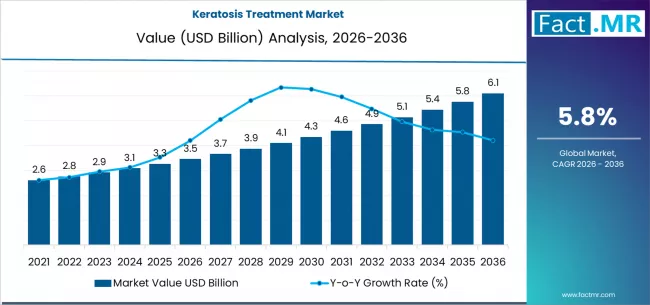
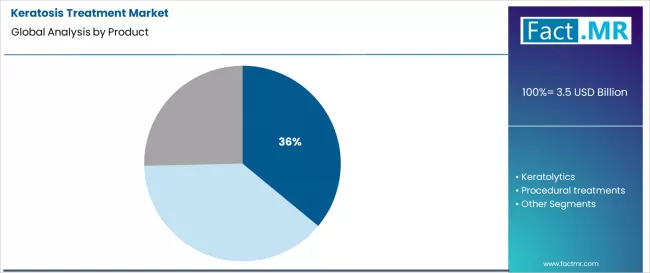
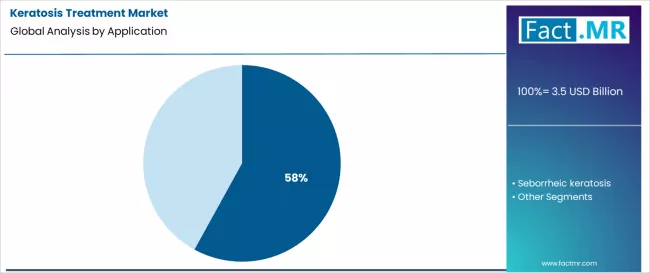
Keratosis treatment market is projected to grow from USD 3.5 billion in 2026 to USD 6.1 billion by 2036, at a CAGR of 5.8%. Topical retinoids will dominate with a 36.0% market share, while actinic keratosis will lead the application segment with a 58.0% share.
Keratosis Treatment Market Forecast and Outlook 2026 to 2036
The global keratosis treatment market is projected to grow to USD 3.46 billion in 2026, and eventually to USD 6.10 billion by 2036, at a CAGR of 5.8%. This market addresses the management of common precancerous and benign skin growths, driven by a high global prevalence linked to aging populations and cumulative sun exposure.
Key Takeaways from the Keratosis Treatment Market
- Market Value for 2026: USD 3.46 Billion
- Market Value for 2036: USD 6.10 Billion
- Forecast CAGR 2026 to 2036: 5.8%
- Leading Product Segment (2026): Topical Retinoids (36.0%)
- Leading Application Segment (2026): Actinic Keratosis (58.0%)
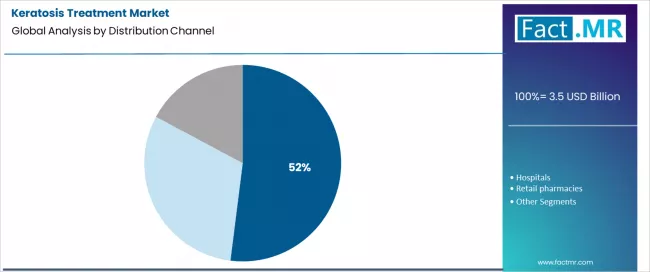
- Leading Distribution Channel Segment (2026): Dermatology Clinics (52.0%)
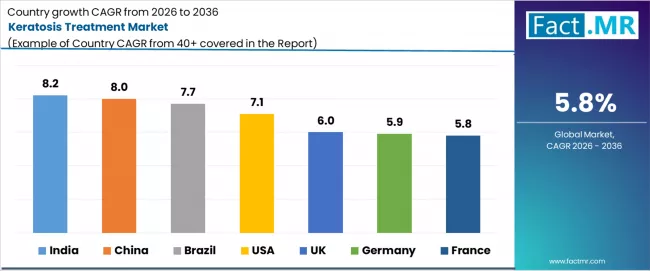
- Key Growth Countries: India (8.2% CAGR), China (8.0% CAGR), Brazil (7.7% CAGR), USA (7.1% CAGR), UK (6.0% CAGR), Germany (5.9% CAGR), France (5.8% CAGR)
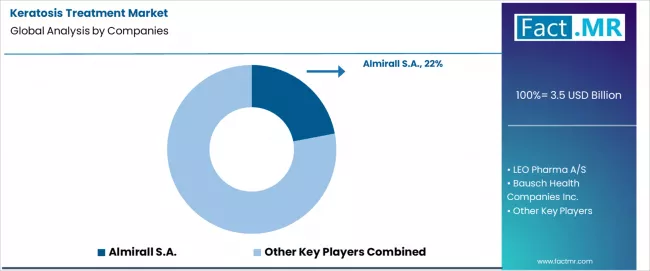
- Key Players in the Market: Almirall S.A., LEO Pharma A/S, Bausch Health Companies Inc., Galderma S.A., Pfizer Inc.

The dominance of actinic keratosis as an application underscores its clinical significance as the most common precancerous skin lesion, necessitating treatment to prevent progression to squamous cell carcinoma. Growth is also supported by increasing patient awareness and the availability of diverse treatment modalities ranging from topical prescriptions to in-office procedures.
Strategic focus within the market centers on balancing efficacy with tolerability and cosmetic outcomes. There is a clear trend towards combination therapies and novel drug delivery systems designed to improve patient compliance for topical regimens used in field-directed therapy.
The expansion of non-invasive procedural options, including advanced cryotherapy and laser-based treatments, caters to the demand for effective solutions with minimal downtime, particularly for seborrheic keratosis. The competitive landscape is shaped by the need to provide dermatologists with a versatile toolkit for managing these highly prevalent conditions across diverse patient populations.
Metric
| Metric | Value |
|---|---|
| Market Value (2026) | USD 3.46 Billion |
| Market Forecast Value (2036) | USD 6.10 Billion |
| Forecast CAGR 2026 to 2036 | 5.8% |
Category
| Category | Segments |
|---|---|
| Product | Topical Retinoids, Keratolytics, Procedural Treatments |
| Application | Actinic Keratosis, Seborrheic Keratosis |
| Distribution Channel | Dermatology Clinics, Hospitals, Retail Pharmacies |
| Region | North America, Latin America, Western Europe, Eastern Europe, East Asia, South Asia & Pacific, Middle East & Africa |
Segmental Analysis
By Product, Which Segment is a Mainstay for Long-Term Management and Field Therapy?

Topical retinoids command a leading 36.0% share, serving as a cornerstone for managing actinic keratosis, particularly for field cancerization. Their mechanism promotes cellular differentiation and normalization of dysplastic keratinocytes.
While often associated with local skin irritation, their role in long-term maintenance therapy and combination treatment protocols ensures sustained demand, supported by a strong foundation of clinical evidence and dermatologist familiarity.
By Application, Which Pre-cancerous Condition Drives the Majority of Treatment Demand?

Actinic keratosis constitutes the dominant application segment at 58.0%. Its high prevalence in fair-skinned, elderly populations and its well-established risk of progression to invasive squamous cell carcinoma make its treatment a medical necessity.
This drives consistent demand across both pharmacologic and procedural treatment segments, as dermatologists aim to clear lesions and prevent skin cancer, solidifying its position as the core clinical driver of the market.
By Distribution Channel, Which Setting is Central to Diagnosis and Procedure-Based Treatment?

Dermatology clinics form the primary distribution channel segment at 52.0%. These specialized settings are the essential hub for accurate diagnosis, prescription of topical therapies, and administration of in-office procedural treatments like cryosurgery, curettage, and laser therapy. Their role in providing comprehensive management for chronic keratotic conditions centralizes both product dispensing and service revenue.
What are the Principal Drivers, Constraints, and Evolving Dynamics of this Market?
The principal driver is the rising global prevalence of actinic keratosis, fueled by aging demographics and historical sun exposure in large population cohorts, creating a vast and growing patient pool requiring treatment. A major constraint is the frequent local skin reactions associated with effective topical therapies, which can hinder patient adherence and completion of treatment courses, potentially compromising outcomes.
A significant opportunity lies in the development of novel, well-tolerated topical formulations with shorter application durations and enhanced efficacy, which could improve compliance and treatment success rates.
The dominant trend is the growing integration of in-office procedural treatments with topical field therapy, employing a combination approach to address both visible lesions and subclinical field damage for more comprehensive and durable management.
Analysis of the Keratosis Treatment Market by Key Countries

| Country | CAGR 2026 to 2036 |
|---|---|
| India | 8.2% |
| China | 8.0% |
| Brazil | 7.7% |
| USA | 7.1% |
| UK | 6.0% |
| Germany | 5.9% |
| France | 5.8% |
Does the USA's Market Reflect High Treatment Rates and a Preference for Procedural Interventions?
The USA’s 7.1% CAGR is characterized by high diagnosis rates, significant patient awareness, and a healthcare infrastructure that supports both prescription topical therapy and in-office procedures.
Growth is driven by the adoption of newer topical combinations and advanced cryotherapy devices within dermatology clinics, with reimbursement policies significantly influencing the choice between pharmacologic and procedural management.
Can Brazil's Market Growth Overcome Disparities in Access to Specialist Dermatological Care?
Brazil’s 7.7% CAGR is fueled by a large population with significant sun exposure but faces challenges in equitable access to dermatologists, particularly outside major urban centers. The scope for keratosis treatment is concentrated in private dermatology clinics, with procedural treatments and topical prescriptions growing among the insured population, while over-the-counter keratolytics see broader use in the general market.
Does Aging Population and A Growing Aesthetic Dermatology Sector drive China’s Expansion?
China’s 8.0% CAGR is propelled by its rapidly aging demographic and increasing focus on skin health and appearance. The market for seborrheic keratosis treatment is growing in parallel with the aesthetic dermatology sector.
While actinic keratosis treatment is established, growth is accelerated by improving access to dermatologists in urban hospitals and the rising adoption of laser and cryotherapy procedures.
Will India's Growth be Catalyzed by Rising Awareness and an Expanding Private Clinic Network?
India’s leading 8.2% CAGR is driven by increasing health awareness, growing disposable income, and the rapid expansion of private dermatology clinic chains in metropolitan and tier-2 cities.
The market is experiencing growth across segments, from topical retinoids for actinic keratosis to procedural treatments for seborrheic keratosis, though cost sensitivity remains a key factor in treatment selection.
Is Germany's Mature Market Focused on Guideline-Adherent and Efficient Treatment Protocols?
Germany’s 5.9% CAGR reflects a stable, guideline-driven market. Treatment protocols for actinic keratosis are well-established within the statutory health insurance system, favoring cost-effective topical therapies and standardized procedural interventions. Growth is steady, supported by an aging population and efficient care delivery through a dense network of dermatology practices.
Does France's Healthcare System Support Widespread Access to Both Topical and Procedural Options?
France’s 5.8% CAGR operates within a system that generally provides good coverage for medically necessary treatments like actinic keratosis therapy. Access to both prescription topicals and in-clinic procedures is facilitated, leading to a balanced market. Growth is consistent, moderated by government efforts to control healthcare spending, which can influence the adoption rates of newer, premium-priced therapies.
Do NHS Referral Pathways and Commissioning Policies modulate the UK’s Market Growth?
National Health Service (NHS) pathways influence the UK’s 6.0% CAGR where referral to secondary care dermatology is often required for prescription of specialized topicals or procedures.
Growth is modulated by commissioning policies and wait times within the NHS, though a parallel private dermatology sector provides more immediate access to a full range of treatments, contributing to overall market expansion.
Competitive Landscape of the Keratosis Treatment Market

The competitive landscape features a mix of specialized dermatology companies and larger pharmaceutical firms. Competition centers on product differentiation within topical segments, such as improved tolerability profiles, shorter treatment durations, and novel mechanisms, and on the technological advancement of procedural devices.
Companies with a diversified portfolio spanning prescription topicals and medical devices for cryotherapy or laser treatment are positioned to cater to the full spectrum of dermatologist needs. Success relies heavily on direct engagement with dermatologists through medical science liaisons and clinical education, emphasizing comparative efficacy and real-world data.
Strategic partnerships with dermatology clinics for device placement and service agreements are common. Given the high prevalence of conditions, effective marketing strategies also include patient awareness campaigns about sun damage and the importance of treating precancerous lesions, which indirectly drives demand for professional treatments.
Key Players in the Keratosis Treatment Market
- Almirall S.A.
- LEO Pharma A/S
- Bausch Health Companies Inc.
- Galderma S.A.
- Pfizer Inc.
- Others
Scope of Report
| Items | Metrics |
|---|---|
| Quantitative Units | USD Billion |
| Product | Topical Retinoids, Keratolytics, Procedural Treatments |
| Application | Actinic Keratosis, Seborrheic Keratosis |
| Distribution Channel | Dermatology Clinics, Hospitals, Retail Pharmacies |
| Key Countries | India, China, Brazil, USA, Germany, France, UK |
| Key Companies | Almirall, LEO Pharma, Bausch Health, Galderma, Pfizer, Others |
| Additional Analysis | Comparative analysis of local skin reaction profiles for topical therapies; cost-effectiveness of procedural vs. pharmacological treatment; impact of tele-dermatology on follow-up care; analysis of over-the-counter keratolytic market dynamics. |
Market by Segments
-
Product :
- Topical Retinoids
- Keratolytics
- Procedural Treatments
-
Application :
- Actinic Keratosis
- Seborrheic Keratosis
-
Distribution Channel :
- Dermatology Clinics
- Hospitals
- Retail Pharmacies
-
Region :
-
North America
- USA
- Canada
-
Latin America
- Brazil
- Mexico
- Argentina
- Rest of Latin America
-
Western Europe
- Germany
- France
- UK
- Italy
- Spain
- BENELUX
- Rest of Western Europe
-
Eastern Europe
- Russia
- Poland
- Czech Republic
- Rest of Eastern Europe
-
East Asia
- China
- Japan
- South Korea
- Rest of East Asia
-
South Asia & Pacific
- India
- ASEAN
- Australia
- Rest of South Asia & Pacific
-
MEA
- GCC Countries
- South Africa
- Turkiye
- Rest of MEA
-
Bibliography
- American Academy of Dermatology (AAD). (2025). Guidelines of Care for the Management of Actinic Keratosis.
- European Dermatology Forum (EDF). (2024). S3 Guideline on the Diagnosis and Treatment of Actinic Keratosis and Cutaneous Squamous Cell Carcinoma.
- Journal of the American Academy of Dermatology. (2025). Special Issue: Advances in Field Cancerization Therapy.
- The British Association of Dermatologists (BAD). (2024). Clinical Guidelines for the Management of Seborrheic Keratosis.
Table of Content
- Executive Summary
- Global Market Outlook
- Demand to side Trends
- Supply to side Trends
- Technology Roadmap Analysis
- Analysis and Recommendations
- Market Overview
- Market Coverage / Taxonomy
- Market Definition / Scope / Limitations
- Market Background
- Market Dynamics
- Drivers
- Restraints
- Opportunity
- Trends
- Scenario Forecast
- Demand in Optimistic Scenario
- Demand in Likely Scenario
- Demand in Conservative Scenario
- Opportunity Map Analysis
- Product Life Cycle Analysis
- Supply Chain Analysis
- Investment Feasibility Matrix
- Value Chain Analysis
- PESTLE and Porter’s Analysis
- Regulatory Landscape
- Regional Parent Market Outlook
- Production and Consumption Statistics
- Import and Export Statistics
- Market Dynamics
- Global Market Analysis 2021 to 2025 and Forecast, 2026 to 2036
- Historical Market Size Value (USD Million) Analysis, 2021 to 2025
- Current and Future Market Size Value (USD Million) Projections, 2026 to 2036
- Y to o to Y Growth Trend Analysis
- Absolute $ Opportunity Analysis
- Global Market Pricing Analysis 2021 to 2025 and Forecast 2026 to 2036
- Global Market Analysis 2021 to 2025 and Forecast 2026 to 2036, By Product
- Introduction / Key Findings
- Historical Market Size Value (USD Million) Analysis By Product, 2021 to 2025
- Current and Future Market Size Value (USD Million) Analysis and Forecast By Product, 2026 to 2036
- Topical retinoids
- Keratolytics
- Procedural treatments
- Topical retinoids
- Y to o to Y Growth Trend Analysis By Product, 2021 to 2025
- Absolute $ Opportunity Analysis By Product, 2026 to 2036
- Global Market Analysis 2021 to 2025 and Forecast 2026 to 2036, By Application
- Introduction / Key Findings
- Historical Market Size Value (USD Million) Analysis By Application, 2021 to 2025
- Current and Future Market Size Value (USD Million) Analysis and Forecast By Application, 2026 to 2036
- Actinic keratosis
- Seborrheic keratosis
- Actinic keratosis
- Y to o to Y Growth Trend Analysis By Application, 2021 to 2025
- Absolute $ Opportunity Analysis By Application, 2026 to 2036
- Global Market Analysis 2021 to 2025 and Forecast 2026 to 2036, By Distribution Channel
- Introduction / Key Findings
- Historical Market Size Value (USD Million) Analysis By Distribution Channel, 2021 to 2025
- Current and Future Market Size Value (USD Million) Analysis and Forecast By Distribution Channel, 2026 to 2036
- Dermatology clinics
- Hospitals
- Retail pharmacies
- Dermatology clinics
- Y to o to Y Growth Trend Analysis By Distribution Channel, 2021 to 2025
- Absolute $ Opportunity Analysis By Distribution Channel, 2026 to 2036
- Global Market Analysis 2021 to 2025 and Forecast 2026 to 2036, By Region
- Introduction
- Historical Market Size Value (USD Million) Analysis By Region, 2021 to 2025
- Current Market Size Value (USD Million) Analysis and Forecast By Region, 2026 to 2036
- North America
- Latin America
- Western Europe
- Eastern Europe
- East Asia
- South Asia and Pacific
- Middle East & Africa
- Market Attractiveness Analysis By Region
- North America Market Analysis 2021 to 2025 and Forecast 2026 to 2036, By Country
- Historical Market Size Value (USD Million) Trend Analysis By Market Taxonomy, 2021 to 2025
- Market Size Value (USD Million) Forecast By Market Taxonomy, 2026 to 2036
- By Country
- USA
- Canada
- Mexico
- By Product
- By Application
- By Distribution Channel
- By Country
- Market Attractiveness Analysis
- By Country
- By Product
- By Application
- By Distribution Channel
- Key Takeaways
- Latin America Market Analysis 2021 to 2025 and Forecast 2026 to 2036, By Country
- Historical Market Size Value (USD Million) Trend Analysis By Market Taxonomy, 2021 to 2025
- Market Size Value (USD Million) Forecast By Market Taxonomy, 2026 to 2036
- By Country
- Brazil
- Chile
- Rest of Latin America
- By Product
- By Application
- By Distribution Channel
- By Country
- Market Attractiveness Analysis
- By Country
- By Product
- By Application
- By Distribution Channel
- Key Takeaways
- Western Europe Market Analysis 2021 to 2025 and Forecast 2026 to 2036, By Country
- Historical Market Size Value (USD Million) Trend Analysis By Market Taxonomy, 2021 to 2025
- Market Size Value (USD Million) Forecast By Market Taxonomy, 2026 to 2036
- By Country
- Germany
- UK
- Italy
- Spain
- France
- Nordic
- BENELUX
- Rest of Western Europe
- By Product
- By Application
- By Distribution Channel
- By Country
- Market Attractiveness Analysis
- By Country
- By Product
- By Application
- By Distribution Channel
- Key Takeaways
- Eastern Europe Market Analysis 2021 to 2025 and Forecast 2026 to 2036, By Country
- Historical Market Size Value (USD Million) Trend Analysis By Market Taxonomy, 2021 to 2025
- Market Size Value (USD Million) Forecast By Market Taxonomy, 2026 to 2036
- By Country
- Russia
- Poland
- Hungary
- Balkan & Baltic
- Rest of Eastern Europe
- By Product
- By Application
- By Distribution Channel
- By Country
- Market Attractiveness Analysis
- By Country
- By Product
- By Application
- By Distribution Channel
- Key Takeaways
- East Asia Market Analysis 2021 to 2025 and Forecast 2026 to 2036, By Country
- Historical Market Size Value (USD Million) Trend Analysis By Market Taxonomy, 2021 to 2025
- Market Size Value (USD Million) Forecast By Market Taxonomy, 2026 to 2036
- By Country
- China
- Japan
- South Korea
- By Product
- By Application
- By Distribution Channel
- By Country
- Market Attractiveness Analysis
- By Country
- By Product
- By Application
- By Distribution Channel
- Key Takeaways
- South Asia and Pacific Market Analysis 2021 to 2025 and Forecast 2026 to 2036, By Country
- Historical Market Size Value (USD Million) Trend Analysis By Market Taxonomy, 2021 to 2025
- Market Size Value (USD Million) Forecast By Market Taxonomy, 2026 to 2036
- By Country
- India
- ASEAN
- Australia & New Zealand
- Rest of South Asia and Pacific
- By Product
- By Application
- By Distribution Channel
- By Country
- Market Attractiveness Analysis
- By Country
- By Product
- By Application
- By Distribution Channel
- Key Takeaways
- Middle East & Africa Market Analysis 2021 to 2025 and Forecast 2026 to 2036, By Country
- Historical Market Size Value (USD Million) Trend Analysis By Market Taxonomy, 2021 to 2025
- Market Size Value (USD Million) Forecast By Market Taxonomy, 2026 to 2036
- By Country
- Kingdom of Saudi Arabia
- Other GCC Countries
- Turkiye
- South Africa
- Other African Union
- Rest of Middle East & Africa
- By Product
- By Application
- By Distribution Channel
- By Country
- Market Attractiveness Analysis
- By Country
- By Product
- By Application
- By Distribution Channel
- Key Takeaways
- Key Countries Market Analysis
- USA
- Pricing Analysis
- Market Share Analysis, 2025
- By Product
- By Application
- By Distribution Channel
- Canada
- Pricing Analysis
- Market Share Analysis, 2025
- By Product
- By Application
- By Distribution Channel
- Mexico
- Pricing Analysis
- Market Share Analysis, 2025
- By Product
- By Application
- By Distribution Channel
- Brazil
- Pricing Analysis
- Market Share Analysis, 2025
- By Product
- By Application
- By Distribution Channel
- Chile
- Pricing Analysis
- Market Share Analysis, 2025
- By Product
- By Application
- By Distribution Channel
- Germany
- Pricing Analysis
- Market Share Analysis, 2025
- By Product
- By Application
- By Distribution Channel
- UK
- Pricing Analysis
- Market Share Analysis, 2025
- By Product
- By Application
- By Distribution Channel
- Italy
- Pricing Analysis
- Market Share Analysis, 2025
- By Product
- By Application
- By Distribution Channel
- Spain
- Pricing Analysis
- Market Share Analysis, 2025
- By Product
- By Application
- By Distribution Channel
- France
- Pricing Analysis
- Market Share Analysis, 2025
- By Product
- By Application
- By Distribution Channel
- India
- Pricing Analysis
- Market Share Analysis, 2025
- By Product
- By Application
- By Distribution Channel
- ASEAN
- Pricing Analysis
- Market Share Analysis, 2025
- By Product
- By Application
- By Distribution Channel
- Australia & New Zealand
- Pricing Analysis
- Market Share Analysis, 2025
- By Product
- By Application
- By Distribution Channel
- China
- Pricing Analysis
- Market Share Analysis, 2025
- By Product
- By Application
- By Distribution Channel
- Japan
- Pricing Analysis
- Market Share Analysis, 2025
- By Product
- By Application
- By Distribution Channel
- South Korea
- Pricing Analysis
- Market Share Analysis, 2025
- By Product
- By Application
- By Distribution Channel
- Russia
- Pricing Analysis
- Market Share Analysis, 2025
- By Product
- By Application
- By Distribution Channel
- Poland
- Pricing Analysis
- Market Share Analysis, 2025
- By Product
- By Application
- By Distribution Channel
- Hungary
- Pricing Analysis
- Market Share Analysis, 2025
- By Product
- By Application
- By Distribution Channel
- Kingdom of Saudi Arabia
- Pricing Analysis
- Market Share Analysis, 2025
- By Product
- By Application
- By Distribution Channel
- Turkiye
- Pricing Analysis
- Market Share Analysis, 2025
- By Product
- By Application
- By Distribution Channel
- South Africa
- Pricing Analysis
- Market Share Analysis, 2025
- By Product
- By Application
- By Distribution Channel
- USA
- Market Structure Analysis
- Competition Dashboard
- Competition Benchmarking
- Market Share Analysis of Top Players
- By Regional
- By Product
- By Application
- By Distribution Channel
- Competition Analysis
- Competition Deep Dive
- Almirall S.A.
- Overview
- Product Portfolio
- Profitability by Market Segments (Product/Age /Sales Channel/Region)
- Sales Footprint
- Strategy Overview
- Marketing Strategy
- Product Strategy
- Channel Strategy
- LEO Pharma A/S
- Bausch Health Companies Inc.
- Galderma S.A.
- Pfizer Inc.
- Others
- Almirall S.A.
- Competition Deep Dive
- Assumptions & Acronyms Used
- Research Methodology
List Of Table
- Table 1: Global Market Value (USD Million) Forecast by Region, 2021 to 2036
- Table 2: Global Market Value (USD Million) Forecast by Product, 2021 to 2036
- Table 3: Global Market Value (USD Million) Forecast by Application, 2021 to 2036
- Table 4: Global Market Value (USD Million) Forecast by Distribution Channel, 2021 to 2036
- Table 5: North America Market Value (USD Million) Forecast by Country, 2021 to 2036
- Table 6: North America Market Value (USD Million) Forecast by Product, 2021 to 2036
- Table 7: North America Market Value (USD Million) Forecast by Application, 2021 to 2036
- Table 8: North America Market Value (USD Million) Forecast by Distribution Channel, 2021 to 2036
- Table 9: Latin America Market Value (USD Million) Forecast by Country, 2021 to 2036
- Table 10: Latin America Market Value (USD Million) Forecast by Product, 2021 to 2036
- Table 11: Latin America Market Value (USD Million) Forecast by Application, 2021 to 2036
- Table 12: Latin America Market Value (USD Million) Forecast by Distribution Channel, 2021 to 2036
- Table 13: Western Europe Market Value (USD Million) Forecast by Country, 2021 to 2036
- Table 14: Western Europe Market Value (USD Million) Forecast by Product, 2021 to 2036
- Table 15: Western Europe Market Value (USD Million) Forecast by Application, 2021 to 2036
- Table 16: Western Europe Market Value (USD Million) Forecast by Distribution Channel, 2021 to 2036
- Table 17: Eastern Europe Market Value (USD Million) Forecast by Country, 2021 to 2036
- Table 18: Eastern Europe Market Value (USD Million) Forecast by Product, 2021 to 2036
- Table 19: Eastern Europe Market Value (USD Million) Forecast by Application, 2021 to 2036
- Table 20: Eastern Europe Market Value (USD Million) Forecast by Distribution Channel, 2021 to 2036
- Table 21: East Asia Market Value (USD Million) Forecast by Country, 2021 to 2036
- Table 22: East Asia Market Value (USD Million) Forecast by Product, 2021 to 2036
- Table 23: East Asia Market Value (USD Million) Forecast by Application, 2021 to 2036
- Table 24: East Asia Market Value (USD Million) Forecast by Distribution Channel, 2021 to 2036
- Table 25: South Asia and Pacific Market Value (USD Million) Forecast by Country, 2021 to 2036
- Table 26: South Asia and Pacific Market Value (USD Million) Forecast by Product, 2021 to 2036
- Table 27: South Asia and Pacific Market Value (USD Million) Forecast by Application, 2021 to 2036
- Table 28: South Asia and Pacific Market Value (USD Million) Forecast by Distribution Channel, 2021 to 2036
- Table 29: Middle East & Africa Market Value (USD Million) Forecast by Country, 2021 to 2036
- Table 30: Middle East & Africa Market Value (USD Million) Forecast by Product, 2021 to 2036
- Table 31: Middle East & Africa Market Value (USD Million) Forecast by Application, 2021 to 2036
- Table 32: Middle East & Africa Market Value (USD Million) Forecast by Distribution Channel, 2021 to 2036
List Of Figures
- Figure 1: Global Market Pricing Analysis
- Figure 2: Global Market Value (USD Million) Forecast 2021 to 2036
- Figure 3: Global Market Value Share and BPS Analysis by Product, 2026 and 2036
- Figure 4: Global Market Y to o to Y Growth Comparison by Product, 2026 to 2036
- Figure 5: Global Market Attractiveness Analysis by Product
- Figure 6: Global Market Value Share and BPS Analysis by Application, 2026 and 2036
- Figure 7: Global Market Y to o to Y Growth Comparison by Application, 2026 to 2036
- Figure 8: Global Market Attractiveness Analysis by Application
- Figure 9: Global Market Value Share and BPS Analysis by Distribution Channel, 2026 and 2036
- Figure 10: Global Market Y to o to Y Growth Comparison by Distribution Channel, 2026 to 2036
- Figure 11: Global Market Attractiveness Analysis by Distribution Channel
- Figure 12: Global Market Value (USD Million) Share and BPS Analysis by Region, 2026 and 2036
- Figure 13: Global Market Y to o to Y Growth Comparison by Region, 2026 to 2036
- Figure 14: Global Market Attractiveness Analysis by Region
- Figure 15: North America Market Incremental Dollar Opportunity, 2026 to 2036
- Figure 16: Latin America Market Incremental Dollar Opportunity, 2026 to 2036
- Figure 17: Western Europe Market Incremental Dollar Opportunity, 2026 to 2036
- Figure 18: Eastern Europe Market Incremental Dollar Opportunity, 2026 to 2036
- Figure 19: East Asia Market Incremental Dollar Opportunity, 2026 to 2036
- Figure 20: South Asia and Pacific Market Incremental Dollar Opportunity, 2026 to 2036
- Figure 21: Middle East & Africa Market Incremental Dollar Opportunity, 2026 to 2036
- Figure 22: North America Market Value Share and BPS Analysis by Country, 2026 and 2036
- Figure 23: North America Market Value Share and BPS Analysis by Product, 2026 and 2036
- Figure 24: North America Market Y to o to Y Growth Comparison by Product, 2026 to 2036
- Figure 25: North America Market Attractiveness Analysis by Product
- Figure 26: North America Market Value Share and BPS Analysis by Application, 2026 and 2036
- Figure 27: North America Market Y to o to Y Growth Comparison by Application, 2026 to 2036
- Figure 28: North America Market Attractiveness Analysis by Application
- Figure 29: North America Market Value Share and BPS Analysis by Distribution Channel, 2026 and 2036
- Figure 30: North America Market Y to o to Y Growth Comparison by Distribution Channel, 2026 to 2036
- Figure 31: North America Market Attractiveness Analysis by Distribution Channel
- Figure 32: Latin America Market Value Share and BPS Analysis by Country, 2026 and 2036
- Figure 33: Latin America Market Value Share and BPS Analysis by Product, 2026 and 2036
- Figure 34: Latin America Market Y to o to Y Growth Comparison by Product, 2026 to 2036
- Figure 35: Latin America Market Attractiveness Analysis by Product
- Figure 36: Latin America Market Value Share and BPS Analysis by Application, 2026 and 2036
- Figure 37: Latin America Market Y to o to Y Growth Comparison by Application, 2026 to 2036
- Figure 38: Latin America Market Attractiveness Analysis by Application
- Figure 39: Latin America Market Value Share and BPS Analysis by Distribution Channel, 2026 and 2036
- Figure 40: Latin America Market Y to o to Y Growth Comparison by Distribution Channel, 2026 to 2036
- Figure 41: Latin America Market Attractiveness Analysis by Distribution Channel
- Figure 42: Western Europe Market Value Share and BPS Analysis by Country, 2026 and 2036
- Figure 43: Western Europe Market Value Share and BPS Analysis by Product, 2026 and 2036
- Figure 44: Western Europe Market Y to o to Y Growth Comparison by Product, 2026 to 2036
- Figure 45: Western Europe Market Attractiveness Analysis by Product
- Figure 46: Western Europe Market Value Share and BPS Analysis by Application, 2026 and 2036
- Figure 47: Western Europe Market Y to o to Y Growth Comparison by Application, 2026 to 2036
- Figure 48: Western Europe Market Attractiveness Analysis by Application
- Figure 49: Western Europe Market Value Share and BPS Analysis by Distribution Channel, 2026 and 2036
- Figure 50: Western Europe Market Y to o to Y Growth Comparison by Distribution Channel, 2026 to 2036
- Figure 51: Western Europe Market Attractiveness Analysis by Distribution Channel
- Figure 52: Eastern Europe Market Value Share and BPS Analysis by Country, 2026 and 2036
- Figure 53: Eastern Europe Market Value Share and BPS Analysis by Product, 2026 and 2036
- Figure 54: Eastern Europe Market Y to o to Y Growth Comparison by Product, 2026 to 2036
- Figure 55: Eastern Europe Market Attractiveness Analysis by Product
- Figure 56: Eastern Europe Market Value Share and BPS Analysis by Application, 2026 and 2036
- Figure 57: Eastern Europe Market Y to o to Y Growth Comparison by Application, 2026 to 2036
- Figure 58: Eastern Europe Market Attractiveness Analysis by Application
- Figure 59: Eastern Europe Market Value Share and BPS Analysis by Distribution Channel, 2026 and 2036
- Figure 60: Eastern Europe Market Y to o to Y Growth Comparison by Distribution Channel, 2026 to 2036
- Figure 61: Eastern Europe Market Attractiveness Analysis by Distribution Channel
- Figure 62: East Asia Market Value Share and BPS Analysis by Country, 2026 and 2036
- Figure 63: East Asia Market Value Share and BPS Analysis by Product, 2026 and 2036
- Figure 64: East Asia Market Y to o to Y Growth Comparison by Product, 2026 to 2036
- Figure 65: East Asia Market Attractiveness Analysis by Product
- Figure 66: East Asia Market Value Share and BPS Analysis by Application, 2026 and 2036
- Figure 67: East Asia Market Y to o to Y Growth Comparison by Application, 2026 to 2036
- Figure 68: East Asia Market Attractiveness Analysis by Application
- Figure 69: East Asia Market Value Share and BPS Analysis by Distribution Channel, 2026 and 2036
- Figure 70: East Asia Market Y to o to Y Growth Comparison by Distribution Channel, 2026 to 2036
- Figure 71: East Asia Market Attractiveness Analysis by Distribution Channel
- Figure 72: South Asia and Pacific Market Value Share and BPS Analysis by Country, 2026 and 2036
- Figure 73: South Asia and Pacific Market Value Share and BPS Analysis by Product, 2026 and 2036
- Figure 74: South Asia and Pacific Market Y to o to Y Growth Comparison by Product, 2026 to 2036
- Figure 75: South Asia and Pacific Market Attractiveness Analysis by Product
- Figure 76: South Asia and Pacific Market Value Share and BPS Analysis by Application, 2026 and 2036
- Figure 77: South Asia and Pacific Market Y to o to Y Growth Comparison by Application, 2026 to 2036
- Figure 78: South Asia and Pacific Market Attractiveness Analysis by Application
- Figure 79: South Asia and Pacific Market Value Share and BPS Analysis by Distribution Channel, 2026 and 2036
- Figure 80: South Asia and Pacific Market Y to o to Y Growth Comparison by Distribution Channel, 2026 to 2036
- Figure 81: South Asia and Pacific Market Attractiveness Analysis by Distribution Channel
- Figure 82: Middle East & Africa Market Value Share and BPS Analysis by Country, 2026 and 2036
- Figure 83: Middle East & Africa Market Value Share and BPS Analysis by Product, 2026 and 2036
- Figure 84: Middle East & Africa Market Y to o to Y Growth Comparison by Product, 2026 to 2036
- Figure 85: Middle East & Africa Market Attractiveness Analysis by Product
- Figure 86: Middle East & Africa Market Value Share and BPS Analysis by Application, 2026 and 2036
- Figure 87: Middle East & Africa Market Y to o to Y Growth Comparison by Application, 2026 to 2036
- Figure 88: Middle East & Africa Market Attractiveness Analysis by Application
- Figure 89: Middle East & Africa Market Value Share and BPS Analysis by Distribution Channel, 2026 and 2036
- Figure 90: Middle East & Africa Market Y to o to Y Growth Comparison by Distribution Channel, 2026 to 2036
- Figure 91: Middle East & Africa Market Attractiveness Analysis by Distribution Channel
- Figure 92: Global Market - Tier Structure Analysis
- Figure 93: Global Market - Company Share Analysis
- FAQs -
How big is the keratosis treatment market in 2026?
The global keratosis treatment market is estimated to be valued at USD 3.5 billion in 2026.
What will be the size of keratosis treatment market in 2036?
The market size for the keratosis treatment market is projected to reach USD 6.1 billion by 2036.
How much will be the keratosis treatment market growth between 2026 and 2036?
The keratosis treatment market is expected to grow at a 5.8% CAGR between 2026 and 2036.
What are the key product types in the keratosis treatment market?
The key product types in keratosis treatment market are topical retinoids, keratolytics and procedural treatments.
Which application segment to contribute significant share in the keratosis treatment market in 2026?
In terms of application, actinic keratosis segment to command 58.0% share in the keratosis treatment market in 2026.